Levantine/Gulf/Persian Warrior Women?
I’m still reading Sarum, by Edward Rutherford, although I am nearing the end. I am still thinking back to a fictional character – I think she is fictional because when I Google’d her name, I got the name of an English queen, but not this particular Aelfgifu.
In Sarum, Aelfgifu is a warrior woman. As a young girl, she hangs out with all the guys, rides with them, hunts with them, and is accepted by them. When the Vikings raid, she fights them. The Vikings are astounded, and more than a little angry, to be fought – successfully – by a woman. Later, her father reluctantly allows her to ride with the men to counter another Viking raid – they need all the “men” they can get, and she is one of the best.
I am intrigued. History shows that these exceptional women pop up now and then, and usually just at the right time. Joan of Arc for the French, the Amazons, Apache women warriors in Native American lore, Chinese Tang dynasty warrior women, Masai warrior women in Africa. We have women in the US Army, and I often hear their commanders say “some of my best men are women.”
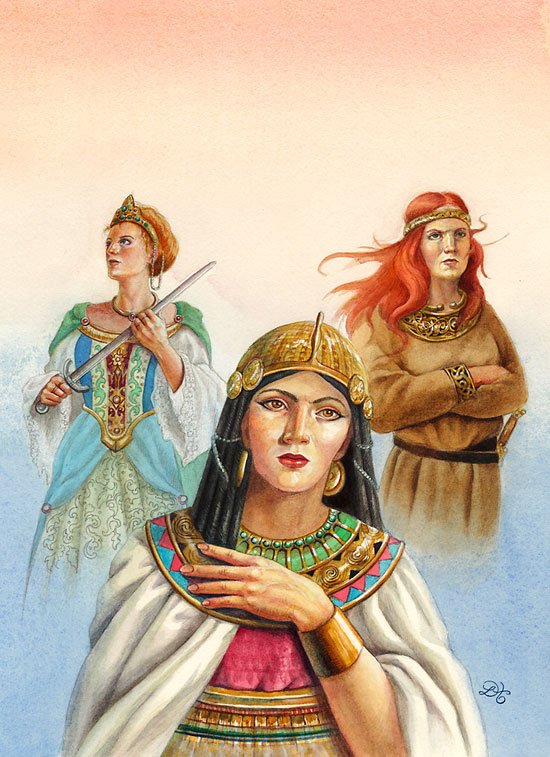
It was hard to find a good warrior women illustration which had women with their clothes on. Most of the illustrator, I guess, being men, they protray women warriors in scanty attire, and most of them have exaggerated breasts and hips, and tiny little wasp waists, and legs about twice as long as a normal woman. Sort of Barbie-doll in warrior women attire. *she snorts in disgust* Leaves a fighter a little vulnerable, don’t you think, fighting in a metal bra and tiny little loincloth? That metal would get uncomfortable in no time, and man, how can you ride a horse for very long without chafing your legs? But then reality wouldn’t sell the drawing, would it?
OK, OK, back to the real question – Warrior women pop up in all cultures. I think that is true, but when I think of the Arabian Gulf, or Persia, or the Levant, no one comes to mind, other than Sheherezad, but she triumphed by her wits, not her brawn, not her fighting skills. I remember hearing that nomadic women could be fierce; are there not legends of Bedouin women?
Is there a woman / are there women who were legendary fighters in Middle East culture? Are there women in Persian culture who fought, or held a castle, or were otherwise brave in the face of danger? Speak now!
Burke and Tin Roof Blowdown
“So what are you reading?”
Sparkle’s question didn’t surprise me. It’s one of the things we share, a love of reading, anything really but especially mystery books.
“I just started James Lee Burke’s new book, The Tin Roof Blowdown,” I responded.
Her eyes brightened and she threw back her head and laughed! “I knew it! I saw he had a new book out and I hoped you had already bought it!”
What she’s not saying is “bought it, read it and will pass it along to me!”
It’s what we do. I am in the middle of a series she recommended and loaned to my son, he is 3/4 way through (the Hyperion series) and has passed along the first two volumes to me, which, when finished, I will return to my sis.
James Lee Burke’s newest book, The Tin Roof Blowdown, is Burke at his best. His last book ended with the ominous storm rolling in that has changed the face of New Orleans and this book starts with Hurricane Katrina. The stories are heartbreaking, and all the more so because they are true. New Orleans is one of the most corrupt cities in the United States, about one third of the police force LEFT the city they were hired to protect in the evacuation, and the poorest of the poor were left behind, to suffer, to struggle to live, or to die. Many did all three.
Detective Dave Robicheaux is called into the “Big Sleazy” with the rest of the New Iberia police force to help with rescue operations, and to try to bring some order into the chaos. He gets involved with a missing priest, two looters being shot, a robbery that includes cocaine, counterfeit cash and blood diamonds, and the usual cast of psycopaths and organized crime goombahs.
The book builds inexorably to a nail-biting climax.
This author can WRITE. He is head and shoulders above the average churn-em-out detective writer. Here is one of his less poetic, but more insightful entries:
” . . . the honest to God truth is that law enforcement is not even law “enforcement.” We deal with problems after the fact. We catch criminals by chance and accident, either during the commission of the crimes or through snitches. Because of forensic and evidentiary problems, most of the crimes recidivists commit are not even prosecutable. Most inmates currently in the slams spend lifetimes figuring out ways to come to the attention of the system. Ultimately, jail is the only place they feel safe from their own failures.
Unfortunately, the last people on our minds are the victims of crime. They become an addendum to both the investigation and the prosecution of the case, adverbs instead of nouns. Ask rape victims, or people who have been beaten with gun butts or metal pipes or tied to chairs and tortured how they felt toward the system after they learned that their assailants were released on bond without the victims being notified.
I don’t believe in capital punishment, but I don’t argue with the prosecutors who support it. The mouths of the people they represent are stopped with dust. What kind of advocate would not try to give them voice?

The Good Husband of Zebra Drive
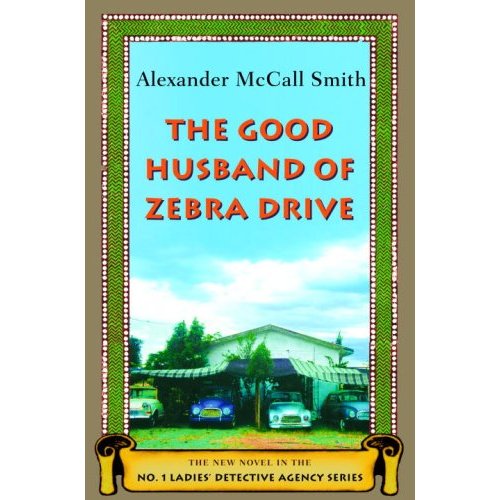
In Alexander McCall Smith’s newest book about Mma Ramotswe, it is a time of transition and unease. Unthinkable things happen. Mma Makutsi quits her job as Mma Ramotswe’s assistant detective, and Charlie, the apprentice, quits to start his own taxi service. Mr. J.L.B. Matekoni feels a restless urge to try out his detecting skills and everything is in turmoil.
And underneath, amazing things happen. When you think differently, there is room for change, and forgiveness.
With Mma Makutsi back in her usual place, the heavy atmosphere that had prevailed that morning lifted. The emotional reunion, as demonstrative and effusive as if Mma Makutsi had been away for months, or even years, had embarrassed the men, who had exchanged glances and then looked away, as if in guilt at an intrusion into essentially female mysteries. But when the ululating from Mma Ramotswe had died down and the tea had been made, everything returned to normal.
“Why did she bother to leave if she was going to be back in five minutes?” asked the younger apprentice.
“It’s because she doesn’t think like anybody else,” said Charlie. “She thinks backwards.”
Mr. J.L.B. Matekoni, who overheard this, shook his head. “It’s a sign of maturity to be able to change your mind when you realize that you’re wrong,” he explained. “It’s the same with fixing a car. If you find out that you’re going along the wrong lines then don’t hesitate to stop and correct yourself. If, for example, you’re changing the oil seal at the back of a gearbox, you might try to save time by doing this without taking the gearbox out. But it’s always quicker to take the gearbox out. If you don’t, you end up taking the floor out and anyway, you have to take the top of the gearbox off, and the prop shaft too. So it’s best to stop and admit your mistake before you go any further and damage things.”
Charlie listened to this – it was a long speech for Mr. J.L.B. Matekoni – and then looked away. He wondered if this was a random example siezed upon by Mr. J.L.B. Matekoni, or if he knew about the seal he had tried to install in the old rear-wheel-drive Ford. Could he have found out somehow?
In another place, Charlie has just told Mma Ramotswe of his plans to start the No. 1 Ladies Taxi Service:
For a minute or two, nobody spoke. Mma Ramotswe was aware of the sound of Charlie’s breathing, which was shallow, from excitement. We must remember, she thought, what it is like to be young and enthusiastic, to have a plan, a dream. There is always a danger that as we went on in life we forget about that; caution – even fear – replaced optimism and courage. When you were young, like Charlie, you believed that you could do anything, and, in some circumstances at least, you could. . . . .
“I will tell all my friends to use your taxi,” she said. “I am sure you will be very busy.”
And oh yes, in the midst of all this, three mysteries get solved – a case of inventory gone missing, a case of a string of inexplicable hospital deaths, and a case of a husband potentialy gone astray.
GREAT summer reading, deceptively simple. You find yourself mulling over the situations, the responses and the outcomes, and trying out new ways of thinking. Give it a try – you don’t have to read the whole series to enjoy each volume.
This eighth book in the series is available from Amazon.com for a mere $12.70. It makes great summer reading.
Anya Seaton and Avalon
Avalon, by Anya Seaton, is an amazing book, a book I almost didn’t read, but once I picked it up, I could hardly stop reading until I had reached the end. It took me to a whole new world.
It opens in England, around the turn of the first millenium, when people had names like Aethelred and Aelfrhryth which is enough to make me NOT want to read the book. But I read another book by Anya Seaton, Katherine, and I really liked it. It, too, took place in very early English history, and had such an authentic feel. It wasn’t like you pick up the book and all the lords and ladies are in gorgeous clothes, Seaton captures the primitive life many lived in “castles”, freezing cold most of the winter, no plumbing – many of the poorest laborers in Kuwait live better, in terms of food, a roof over their head, toilet facilities – that these early nobles. And the life of villagers was even more basic, a true scrabble for survival, and under filthy conditions, not a lot of time of opportunity for bathing, so people had quite an odor most of the time.
Avalon begins with a chance meeting of a young man and a young woman, a tragedy, and a journey. Their story, as first one love and the other doesn’t, then the other does and misses the opportunity – takes us from the southernmost part of England to Iceland, to Ireland, to Greenland and to the new world, all in the space of these two intertwined lives. They never marry, and yet the book, and their relationship, is a romance.
As you can see, once I got into the book, I couldn’t put it down until the last page. These people are so real, so genuine and so human – and Seaton makes you care about them. She manages to throw in enough detail that I could almost swear I visited these places – a thousand years ago. I have spun wool to buy necessities for our sod house in Iceland, I have embroidered tapestries in the Bower of my husband’s castle, I have sent my son off to settle with his Irish bride in the new world – yes, I think I have done.
The political situation in England at this time is chaotic, with Vikings raiding their coastal cities, and deep up the rivers into the interior, feuding over who will wear the crown, and problems with the capabilities of rulers to rule. There is a constant friction between the church and state, for land, for power, for wealth. The majority of the novel takes place during the reign of – I am not kidding – Ethelred the Unready.
At the very end, I found to my astonishment, that this book also concerned the ramifications of a big lie, just as my previous book reviewed. This is a total co-incidence, something that surprised me, and this book ends in a totally different way, as the main character comes to grips with her deception, owns up to it, willing to suffer the consequences.
Is this what I want? Merwyn thought, and at once came the answer. Yes, it is. There would be boring days ahead, but never again the depressions and miseries of before . . . She felt cleansed, peaceful, and there was much gratitude. . .
That totally cracked me up, but this is a romance of a different nature, a very real romance, with the real kinds of choices that real-life romances entail, and the real life consequences. The hand of God is a major player here, and the beliefs of the characters shape events in a way consistent with the times. Dreams are taken very seriously, and the power of curses, and sorceries, which I never give two thoughts in my daily life in the 21st century.
The main characters have their own nobility, based on their choices, their growth, and their coming to terms with their lives and situations. I learned a lot reading Avalon, and I also had a great time while learning.
All in all, a fascinating read.
Labyrinth by Kate Mosse
When I saw this book at the Barnes and Noble, I thought “isn’t Kate Moss a fashion model?” but that is a different Kate Moss, a Moss without the ‘e’ at the end.
This book was a New York Times bestseller, but then so was the Da Vinci Code, which I thought badly written and sometimes incoherent. The premise was interesting, but it was done years ago by French authors Michael Baigent, Richard Leigh and Henry Lincoln. Holy Blood, Holy Grail hypothesizes (and pulls together a load of hypothetical evidence to support) that the mystical grail is really a symbolic representation of the blood of Christ, that Jesus was not crucified but instead left Jerusalem with his wife Mary Magdeleine and went to France, and started a family there which eventually became the early French royal line.
I remember telling my son this story, as we travelled through the southern areas of France, and him saying in his smart-mouth-teenager way “only the French would be so arrogant as to believe the blood of God was flowing in their veins!”
We spent a lot of time travelling in France. We love France. So when I discovered that Labyrinth was about the beginning of the French crusade against the Cathars, I was delighted. We know this history. We know this area – it is one of the most beautiful areas of France. We know Carcassone, which in its renovation by Viollet-le-Duc is like Disney-does-fortified-city. It’s formidable, but it’s not entirely authentic.
Who are the Cathars? The Cathars were a break-away sect who were called by others ‘bons hommes’ or ‘bons Chretiens’ (good-Christians), but, pre-Luther, they saw many flaws in the way the Catholic church has become more political than spiritual.
They valued inner faith above outward display. They needed no consecrated buildings, no superstitious rituals, no humiliating obeisance designed to keep ordinary men apart from God. They did not worship images, nor prostrate themselves before idols or instruments of torture. For the ‘Bons Chretiens’ the power of God lay in the word. They needed only books and prayers, words spoken and read aloud. Salvations was nothing to do with alms or relics or Sabbath prayers spoken in a language only the priests understood. . . In their eyes, all were equal in the Grace of the Holy Father – Jew or Saracen, man and woman, the beasts of the fields and the birds of the air. There would be no hell, no final day of judgement, because through God’s grace all would be saved, although many would be destined to live life many times over before they regained God’s kingdom.
They believed the earth was created as a trap, by Satan, and that our lives here keep us apart from the glory of God. They believed we keep coming back, until we purify ourselves spiritually, and that in the end, if we get it right, we end up back where we came from, with God. And they believed we all have the right to read the bible, and to talk directly with God, without the necessity of a priest to interpret or to direct.
But this Crusade, the Fourth Crusade, is little known. This Crusade, declared by the Pope to wipe out the Cathar heresy (sometimes known as Bogomilism or Albigencian heresy) was really the tool of the nobility that was then France, less than half of the France of today, to grab the rich, lush southern lands of the Pays d’Oc. The Fourth Crusade was an opportunity for knights to increase their holdings. And it doubled the size of France.
The Labyrinth takes you inside the walls. The main character is not Cathar, but it didn’t matter – this war wasn’t really about wiping out the Cathars as much as subjugating an independant land and making it part of France. You may have heard one famous quote from this Crusade – as the Crusaders were attacking Besiers, the Abbot of Citeaux was asked how the soldiers could tell the good Catholics from the heritics. “Tuez-les tous. Dieu reconnaitra les sien,” he replied – Kill them all. God will know his own.
The book is lightweight, an easy read. The heroine, Alice, seems to have lived before, as Alais, and has memories she has never lived. You jump back and forth between today, and the time of the Crusade, in the early 1200s. Some of the plot mechanisms don’t make a lot of sense, but you do get a real sense of life in a fortified town during the 1200’s, and of the injustice done to this beautiful area in France. For a book I am lukewarm about in retrospect, I read it avidly, and enjoyed the read.
What I like about this book is that it brings to life a time in history that few pay any attention to. Somewhere in the book, it says that “history is written by the victors.” We see France today, and we know little about the struggle that united these diverse areas into one nation. This book illuminates a slice of time, a grave injustice, and a sense that religion is too often a tool for political ends.
Like the heroine, the big church in Carcassone, where the trials and tortures of the ‘heretics’ took place sends a cold chill up my spine, I can hear the screams of the tortured. I love churches, and I can’t go into this one. It feels unholy. Did you know that the origination of the Inquisition was not in Spain, as most people believe, but in this area of France? And it was aimed, first, at the Cathars.
All in all, not a bad book. Though light in plot, it is heavy in content, a book you will remember and think about in terms of issues, if not the main characters.
Dark, Disturbing Road
Do you remember the happy books you read? Those that are light and breezy? Those with happy-ever-after endings? Most of the time, my bet would be you don’t. You read them, and they’re gone.
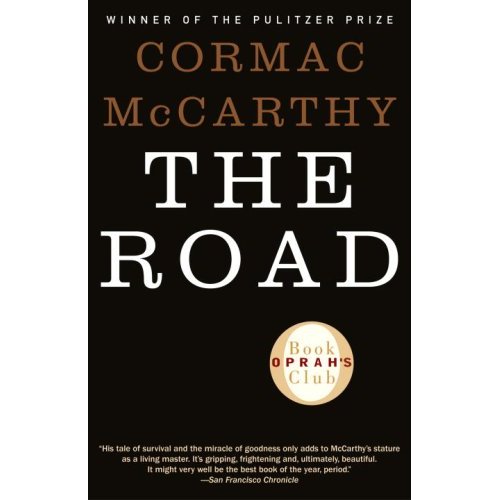
Not this book, The Road, by Cormac McCarthy. I found myself hesitating to even review this book, it is so disturbing to me. The prose is simple, even stark. The atmosphere is relentlessly bleak. The main character, whose name we never know, spends most of the book foraging and scavenging to feed himself and his starving son. The cover says it takes place in America, but it could be anywhere.
It is post-apocalyptic literature at it’s bleakest. All we know is that there were huge balls of light and then everything burned, and kept burning. It is still burning, in some places, during the time span of this novel. It rains or snows most of the time, and the rain is grey and the snow is grey. It is bone-chilling cold, and gathering wood for a fire to keep warm is a constant task.There is never a clear sunny day, only lighter or darker shades of grey. The nights are dark, no moon, no stars, just blackness.
It’s another one of those books I grabbed on the way to the airport without looking too carefully. I saw this was an Oprah Book Club choice and didn’t even read the cover. These books I just grabbed have grabbed me in return – I have read five in a row, books I have to talk over with my husband while I am reading them, they are so full of ideas I need to explore, unsettling settings, shaking to insecurity all that we take for granted.
This one, though, is seriously dark. I read until past midnight last night, adrenaline pumping through my system, as the man and his son evade marauders, thieves, and cannibals. I needed the human warmth of my husband’s body next to mine to drive away the alienation of this book. Even safe in my own bed, though, my sleep is troubled and I wake feeling scared and depressed. As you read The Road, you realize how very thin the veneer of civilization is that holds us together in community, and how that veneer rips when there is no longer law holding back the more powerful, those with weapons, those with more resources. When food becomes scarce, when people become very hungry . . . the rules break down, in serious and unthinkable ways.
If one book can have such an impact on my emotions and feelings of security, I can’t help but think how the trauma of the Iraqi invasion must still be resonating, invisible, below the surface, but an uninvited guest in the daily lives of those who experienced those horrors and trauma in Kuwait. You wonder if you will ever trust in “normal” again?
When your world suddenly shifts in a heartbeat, when your wealth disappears, when you suddenly have only your wits to survive on, how will YOU do?
As the Father and Son travel The Road seeking a warmer climate, and “the good guys”, goodness is remarked by its absence. Our protagonist refuses to help a lost child, a cellar full of people being kept as a food supply, and a couple of men along the road whose situation is even worse than their own. His son, born just after the event which forever changes the world, begs his Dad to share, but the Dad, knowing how spare the food supply is, refuses.
Beyond a crossroads in that wilderness they began to come upon the possessions of travelers abandoned in the road years ago. Boxes and Bags. Everything melted and black. Old suitcases curled shapeless in the heat. Here and there the imprint of things wrested out of the tar by scavengers. A mile on and they began to come upon the dead. Figures half mired in the blacktop, clutching themselves, mouths howling. He put his hand across the boy’s shoulder. Take my hand, he said. I don’t think you should see this.
Yes.
It’s OK Papa.
It’s OK?
They’re already there.
I don’t want you to look.
They’ll still be there.
He stopped and leaned on the cart. He looked down at the road and he looked at the boy. So strangely untroubled.
Why don’t we just go on, the boy said.
Yes. Okay.
They were trying to get away, weren’t they Papa?
Yes. They were.
Why didn’t they leave the road?
They couldn’t. Everything was on fire.
I dropped other things I really needed to do so that I could finish The Road. I can’t spend another night wondering how I would survive in this dog-eat-dog world. I need to move on with my life. I need to shift my focus.
And yet . . . I recommend McCarthy’s The Road to you. It is dark, it is brutal, it is relentlessly bleak, but still there is a thin golden thread of the father and son relationship weaving through the tapestry of despair, which redeems the book. You can’t help but admire the determination to persist, when the signs are all around you that nothing is going to get better. Somehow, in spite of all the despair, there is redemption, and even hope.
MOC Bans Porno Film Sites
Today’s Kuwait Times:
Internet Porno Film Sites
The Ministry of Communication has closed down all new sites that advertise pornographic films. The ministry of Communication represented by Undersecretary Eng. Abdulaziz Al-Osaimi and his counterpart at the Ministry of Information achieved this new step. This move was done in order to have control over the sites, which are being followed by the Ministry of Information. Al-Osaimi has assigned administration director Nassar Al-Kandari to work on closing those sites from the Internet and ensuring that companies do not use other systems to re-open it. The ministry succeeded in coordinating with local internet companies to close all porno sites, but lately the ministry realized that there are new sites marketing through drama films to porno films.
My comments:
I truly hate porn. I hate it because it creates a fantasy world that real women can barely compete with. I bet if men spent half the time and attention on their wives and families that they spend on porn, there wouldn’t be so much divorce. And guys – those women are PAID. They’re ACTING. Most of them would rather be doing anything but what they are doing, but they do it for the MONEY. It’s about as real as the World Wide Wrestling Federation Matches, it’s all staging and airbrushing and making money off YOUR fantasies.
Rant over – reality strikes. How do you ban pornography?
First, how do you define pornography? When I was a student in political science, we spent a week of class time trying to come up with a definition that everyone could buy into. We never succeeded.
There is some pretty powerful erotic literature, erotic art out there, stuff I don’t find pornographic in the least. So what are the guidelines?
Second, WHO defines pornography?
Third, how on earth will the Ministry of Communication and the Ministry of Information keep up with all the new porn sites that keep popping up? These sites make people a LOT of money, they have the money to pay ingenious high tech guys to keep devising new ways to get their product to market.
And last, who is the poor porno-guy who has to watch all this garbage and enforce the ban?
And – is your internet phone still working? 😉
James Morrow’s The Last Witchfinder
This is one of the strangest books I have ever read. I can’t even claim to have picked it up on any recommendation – I was on my way to grab a cup of coffee when my eye fell on the book. I don’t know why. Anything having to do with witchcraft is repugnant to me. And yet . . . my eye fell on it. I picked it up. I read the back cover – the write-up wasn’t that great. And yet, I bought the book.
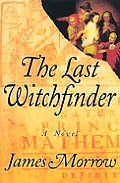
It is a very weird book. It is written from the point of view of another book, Sir Isaac Newton’s Mathematical Principles of Natural Philosophy, and starts off in the late 1600’s, as the Newton’s book falls in love with the main character of Morrow’s Witchfinder, Jennet Stearne.
As the book begins, you are reminded of sitting with a friend who talks too much. The book chats on and on, goes on detours, tells you too much about people you don’t even care to know, but somehow . . . you like this friend anyway, and tolorate the annoyance because somehow you come away better for knowing this person/this book.
And I really, really liked the main heroine, who is only 11 when we meet her, living in England, and studying with her aunt Isobel, who does all kinds of cool scientific experiments to demostrate principles from Newton’s books, using prisms and microscopes and calculations, and it all sounds very dull, but somehow – it isn’t. Jennet and Isobel are so irrepressably intelligent! and funny! and down to earth!
But there is a viper in all this merriment, and the viper is Jennet’s father, a witchfinder, who, when his sister-in-law, Isobel, is accused of witchcraft, proves the charges against her.
How do you prove a charge of witchcraft?
The signs, according to Jennet’s father were very clear. A witch caused bad things to happen, like your best rooster dies after you have cheated the witch, or your wife miscarries, or your crop fails. A witch had a “familiar spirit” around, like a cat. (You can see how that might make me very nervous.) A witch had a blemish, a mark of Satan, somewhere on her body, that doesn’t bleed when you stick a needle into it. A witch, when thrown into the water, will sink, not float. They had special equipment for testing for witches. Most people – a very few accused were men – failed the test.
Thousands of people, primarily women, failed the test throughout the 14th, 15th, 16th and 17th centuries in Europe. Entire villages near Trier in Germany were killed for the accusation of practicing witchcraft. Women were burned at the stake in France by the hundreds. Women who acted as midwives, or used herbal medicines were particularly vulnerable to the accusation of witchcraft, although men were also, from time to time, accused and convicted. And the accusers were often the jealous, the ignorant, the spiteful and at best – the misguided.
Jennet’s aunt Isobel failed the test. She failed, and she was burned at the stake. As she was lit afire, she shouts out to Jennet to create a “grande arguement”, a proof, using Newton’s Mathmatic Principles, that witchcraft / sorcery does not and cannot exist.
Jennet’s life is bigger than most people’s lives. Her family moves to the Americas – actually, her father is sent there because his profession as witchfinder is becoming an embarrassment in England. She is captured by and lives with American Indians for several years. She returns to “civilization” in time to experience the horrors of the Salem witch trials. She meets Benjamin Franklin, with whom she is shipwrecked on a Caribbean island. And those are just the bare bones!
The book is loaded with great characters, huge ideas, and visionary people, struggling to escape the tangles of the small minded religious fanatics, clinging to old and superstitious ways. And yet, the book is both scientific AND religious, coming to some grandly unifying propositions.
It sounds so dull, but it isn’t. There are lots of big words, but also a lot of humor. It is a book for people who loved Kurt Vonnegut, and who have read and relished John Kennedy Toole’s Confederacy of Dunces. It has a lot of the tongue-in-cheek theology of Good Omens by Terry Pratchett and Neil Gaiman. The characters are so alive, and so likable, and you will find yourself reading when you have other things to do, because you are eager for Jennet to succeed at her grand endeavor.
Read this book. You won’t be sorry. Available at amazon.com for a mere $10.85 plus shipping. I paid $15.95 plus tax at B&N ;-(
Book Meme – Too Much Temptation
Friday mornings in Kuwait can be VERRRRRY quiet. Today, I explored Technorati, and found people who have linked to me. One was PearLady and oh, what fun, she published a Book Meme.
I don’t do tags. I don’t do memes. Oh well, she found my weak spot. Here goes. Please read all the way to the bottom.
Hardback or paperback? I prefer paperback, just because I read all the time and paperback is more portable. And because I like to pass it along, and paperback is cheaper. But I buy hard cover when it is brand new from an author I love and I can’t wait.
Amazon or brick and mortar? Hands down Amazon, although if I am in the states, I can’t resist Barnes and Noble, and I always spend money there, and Half Price Books. Both ruin my weight allowance when I come to fly back to Kuwait.
Barnes & Noble or Borders? Either. Both. And all the little independent book sellers, too.
Bookmark or dog-ear? Bookmark is preferable, but occasionally I dogear sections I want to blog about. (Gasp) – occasionally I even underline.
Alphabetize by author, alphabetize by title or random? First by subject, then by author, but not by title.
Keep, throw away, or sell? Part with a friend??? Ah well, sometimes it is necessary. I even keep shelves of books for people to borrow, or to take. I buy multiples of the best ones, and trust that they will find new friends when they depart from my shelves.
Keep dust jacket or toss it? I take it off to read the book, then put it back on and give the book away. Hardcover books are too heavy to ship!
Read with dust jacket or remove it? Oops, see above.
Short story or novel? I love them both. Good science fiction often comes in short stories, stories you can remember years later. And novels – those are the friends that you keep around.
Collection (by same author) or anthology (by different authors)? Collection by the same author, because I am particular and don’t like all authors.
Harry Potter or Lemony Snicket? I prefer Harry Potter. I don’t know why, but I find Lemony Snicket a little creepy.
Stop reading when tired or at chapter breaks? Prefer to stop at chapter breaks, but sometimes I fall asleep and just have to give it up.
‘It was a dark and stormy night’ or ‘Once upon a time’? For me, once upon a time. Love history.
Buy or Borrow? Mostly buy, but sometimes the book I want to read isn’t available for sale, and have to borrow.
New or used? Both. Some books you can’t find new.
Buying choice: book reviews, recommendation or browse? Often look for specific authors, always looking for recommendations and often ask fellow travellers who look absorbed in what they are reading.
Tidy ending or cliffhanger? Tidy endings are nice, and I also find that the ones that end without resolution are the ones I think about the longest.
Morning reading, afternoon reading or nighttime reading? Any time. Usually, I use it as a carrot to make me get work done and projects finished, so normal is later in the day.
Standalone or series? Both. I like the Dickensian continuity of series.
Favourite series? Dorothy Dunnet’s Niccolo series. Fascinating characters and I learn so much. Great, vivid images, takes you back to the mid 1400’s.
tag…you’re all it…show me the meme! (If you don’t have a blog, you are welcome to comment below, or cut and paste.)
Donna Leon: Read and Savor
When I tell you about Donna Leon, I am really introducing you to a friend. I can’t remember when we met, but I can tell you that I seek her out whenever I can. Just listing her books, I realized there were several I hadn’t seen and I ordered them immediately, from the Amazon re-sellers.
“Why the resellers?” you are asking. Donna Leon is not that easy to find, in the United States. Some of the books in her series seem to have been printed only in the UK, which is a pity, because The Donna Leon books really need to be read in order.
While they can be a quick read, they are better read slowly and savored. It’s not that hard. Her humor is subtle, sometimes even sly. Commissario Guido Brunetti, her main character, lives in Venice. He has a family, a sweet wife – Paola, and a daughter and a son. He eats Venetian meals, he lives in an illegal Venetian apartment, he has a glass of wine or two with his lunch. It helps to read the books in order, as his children grow from childhood to teen-agers, and to grow older with him as he solves his cases.
But in Donna Leon’s books, solving the cases is not the goal. As often as not, even while Brunetti solves the case, justice is not served. The books are about the living conditions and social realities of life in Venice, and in Italy. The books are about painful subjects – child prostitution, traffic in women, blood diamonds and African immigrants, and about art fraud and Mafia crime and big business. And the book is about Venetian and Italian interconnections, so that some crimes just disappear, some evidence just disappears, and Brunetti’s dunderhead of a boss tells him to just look the other way.
While each book is deceptively short, and written in clear, simple language, the books are richly complex, weaving a myriad of details into each page.
Thanks to Donna Leon, I know what it is like on a cold, rainy day in Venice, when the water rises and you have to try to walk on raised boards to get where you are going. I know what it is like to have a family emergency and the police vaporetto is in use elsewhere and to try to figure out the fastest way to run home, crossing bridges, grabbing a taxi, complicated by the canal system and tourist infestations in Venice. I know when policement get together for lunch in Venice, you don’t talk business until AFTER you have finished your exquisite pasta with truffles, accompanied by a glass or two of the fabulous house wine. Donna Leon has taken me there.
In Death and Judgement, the book I just finished, Brunetti is called by a police sergeant who has arrested a former police sergeant and wants Brunetti to come to the station. Brunetti’s conversations with the arresting sergeant always require a lot of patience:
(Brunetti) “Did the people in Mestre tell you to make out an arrest report?”
“Well, no, sir,” Alvise said after a particularly long pause. “They told Topa to come back here and make a report about what happened. The only form I saw on the desk was an arrest report, so I thought I should use that.”
“Why didn’t you let him call me, officer?”
“Oh, he’d already called his wife, and I know they’re supposed to get one phone call.”
“That’s on television, officer, on American television,” Brunetti said, straining towards patience.
We’ve all been there. Dealing with those who think they understand, and their understanding is . . . imperfect.
In another part of this book, in which the major issue is the big business of trafficking in women for prostitution, Brunetti is having a conversation with his wife:
Paula pulled gently on his hand. “Why do you use them?”
“Hum?” Brunetti asked, not really paying attention.
“Why do you use whores?” Then, before he could misunderstand, she clarified the question. “Men, that is. Not you. Men.”
He picked up their joined hands and waved them in the air, a vague, aimless gesture. “Guiltless sex, I guess. No strings, no obligations. No need to be polite.”
“Doesn’t sound very appealing,” Paola said, and then added “But I suppose women always want to sentimentalize sex.”
“Yes, you do.” Brunetti said.
Paola freed her hand from his hand and got to her feet. She glanced down at her husband for a moment, then went into the kitchen to begin dinner.
If you are reading that interchange too quickly, too superficially, you will totally miss the significance of the last sentence. If you have been married a long time, you will totally understand that a whole lot happened. This is one of the things I love about Donna Leon.
Death at La Fenice
Death in a Strange Country
Dressed for Death
A Venetian Reckoning
Acqua Alta
The Death of Faith
A Noble Radiance
Fatal Remedies
Friends in High Places
A Sea of Trouble
Willful Behavior
Uniform Justice
Doctored Evidence
Blood From a Stone
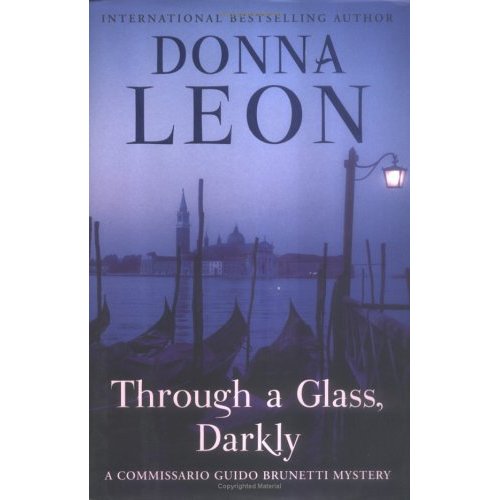
Through a Glass Darkly
Recent Comments
Cathy on No Grown-Ups in Charge intlxpatr on Waiting for Snow intlxpatr on Waiting for Snow Abou Tabblouleh on t… on Waiting for Snow Abou Tabbouleh on in… on Waiting for Snow Wikipedia Donate Button

Amazina


Early Voting in Florida


 Here There and Everywhere