Donna Leon: Read and Savor
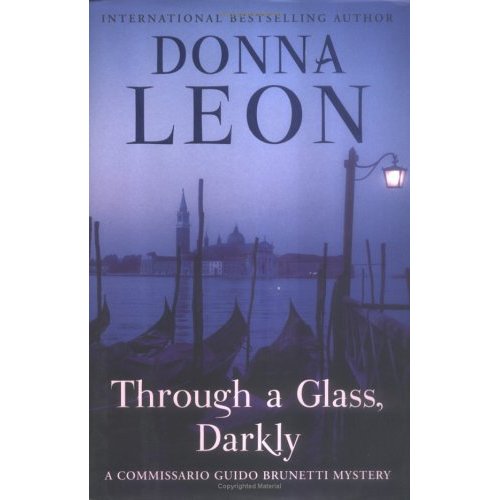
When I tell you about Donna Leon, I am really introducing you to a friend. I can’t remember when we met, but I can tell you that I seek her out whenever I can. Just listing her books, I realized there were several I hadn’t seen and I ordered them immediately, from the Amazon re-sellers.
“Why the resellers?” you are asking. Donna Leon is not that easy to find, in the United States. Some of the books in her series seem to have been printed only in the UK, which is a pity, because The Donna Leon books really need to be read in order.
While they can be a quick read, they are better read slowly and savored. It’s not that hard. Her humor is subtle, sometimes even sly. Commissario Guido Brunetti, her main character, lives in Venice. He has a family, a sweet wife – Paola, and a daughter and a son. He eats Venetian meals, he lives in an illegal Venetian apartment, he has a glass of wine or two with his lunch. It helps to read the books in order, as his children grow from childhood to teen-agers, and to grow older with him as he solves his cases.
But in Donna Leon’s books, solving the cases is not the goal. As often as not, even while Brunetti solves the case, justice is not served. The books are about the living conditions and social realities of life in Venice, and in Italy. The books are about painful subjects – child prostitution, traffic in women, blood diamonds and African immigrants, and about art fraud and Mafia crime and big business. And the book is about Venetian and Italian interconnections, so that some crimes just disappear, some evidence just disappears, and Brunetti’s dunderhead of a boss tells him to just look the other way.
While each book is deceptively short, and written in clear, simple language, the books are richly complex, weaving a myriad of details into each page.
Thanks to Donna Leon, I know what it is like on a cold, rainy day in Venice, when the water rises and you have to try to walk on raised boards to get where you are going. I know what it is like to have a family emergency and the police vaporetto is in use elsewhere and to try to figure out the fastest way to run home, crossing bridges, grabbing a taxi, complicated by the canal system and tourist infestations in Venice. I know when policement get together for lunch in Venice, you don’t talk business until AFTER you have finished your exquisite pasta with truffles, accompanied by a glass or two of the fabulous house wine. Donna Leon has taken me there.
In Death and Judgement, the book I just finished, Brunetti is called by a police sergeant who has arrested a former police sergeant and wants Brunetti to come to the station. Brunetti’s conversations with the arresting sergeant always require a lot of patience:
(Brunetti) “Did the people in Mestre tell you to make out an arrest report?”
“Well, no, sir,” Alvise said after a particularly long pause. “They told Topa to come back here and make a report about what happened. The only form I saw on the desk was an arrest report, so I thought I should use that.”
“Why didn’t you let him call me, officer?”
“Oh, he’d already called his wife, and I know they’re supposed to get one phone call.”
“That’s on television, officer, on American television,” Brunetti said, straining towards patience.
We’ve all been there. Dealing with those who think they understand, and their understanding is . . . imperfect.
In another part of this book, in which the major issue is the big business of trafficking in women for prostitution, Brunetti is having a conversation with his wife:
Paula pulled gently on his hand. “Why do you use them?”
“Hum?” Brunetti asked, not really paying attention.
“Why do you use whores?” Then, before he could misunderstand, she clarified the question. “Men, that is. Not you. Men.”
He picked up their joined hands and waved them in the air, a vague, aimless gesture. “Guiltless sex, I guess. No strings, no obligations. No need to be polite.”
“Doesn’t sound very appealing,” Paola said, and then added “But I suppose women always want to sentimentalize sex.”
“Yes, you do.” Brunetti said.
Paola freed her hand from his hand and got to her feet. She glanced down at her husband for a moment, then went into the kitchen to begin dinner.
If you are reading that interchange too quickly, too superficially, you will totally miss the significance of the last sentence. If you have been married a long time, you will totally understand that a whole lot happened. This is one of the things I love about Donna Leon.
Death at La Fenice
Death in a Strange Country
Dressed for Death
A Venetian Reckoning
Acqua Alta
The Death of Faith
A Noble Radiance
Fatal Remedies
Friends in High Places
A Sea of Trouble
Willful Behavior
Uniform Justice
Doctored Evidence
Blood From a Stone
Through a Glass Darkly
Washington Post Contest
This was sent to me by a good friend: These are entries to A Washington Post competition asking for a two line poem. The contest was to have the most romantic first line, and the least romantic second line.
My darling, my lover, my beautiful wife:
Marrying you screwed up my life.
I see your face when I am dreaming.
That’s why I always wake up screaming.
Kind, intelligent, loving and hot;
This describes everything you’re not.
Love may be beautiful, love may be bliss,
But I only slept with you ‘cause I was pissed.
I thought that I could love no other –
That is until I met your brother.
Roses are red, violets are blue, sugar is sweet and so are you.
But the roses are wilting, the violets are dead, the sugar bowl’s empty and so is your head.
I want to feel your sweet embrace;
But don’t take that paper bag off your face.
I love your smile, your face and your eyes –
Damn, I’m good at telling lies!
My love, you take my breath away.
What have you stepped in to smell this way?
My feelings for you no words can tell,
Except for maybe “Go to hell.’
What inspired this amorous rhyme?
Two parts vodka, one part lime.
“Was That Funny?”
When my son was little, he went through a time when he would make up jokes and tell us, and watch our reaction and ask “was that funny?” He wanted desperately to catch on to humor, but humor is a whole new way of thinking, and he was only four or five years old.
We started with riddles, I think, jokes in which words had more than one meaning, and then we moved on to knock knock jokes. But when he first started making jokes, he started with pure nonsense.
Around eight, we introduced him to Shel Silverstein, a brilliant poet, who writes books for kids that are also a joy for adults.

(photo courtesy of Amazon.com.)
Where The Sidewalk Ends
Light in the Attic
Falling Up
We all loved Shel Silverstein. Our son would read the poems aloud to us as we zipped around the back streets of Europe. We never got tired of him. His poems are funny to both children and adults “One Sister for Sale” “The King Who Loved Peanut Butter” . . . and sometimes poignant, or even sad.
Slowly, slowly, our son built up a huge repetoire of humor. Today, he is one of the funniest men I know, albeit most of his wit is very dry, and sometimes . . . I don’t always get it.
And that doesn’t begin to tackle the problem of “what is funny” crossing national and cultural boundaries! I think you have really arrived in a language when you can tell a joke in another language, and the native speakers find it funny.
Jean Plaidy and Courts of Love
My last day back in Seattle, I allowed myself a trip to the nearest Barnes and Noble. It was a shorter trip, only ten days, and full of family and family gatherings, centered around my father’s recent death. The days sped by, each full and exhausting.
I had already packed most of my bags. I do this so I know how much, if any, room I have. That way, I won’t buy too many books. I know myself. I know my vices. There is a part of me that says “how can there be too many books? How can there be too much of such a good thing?”
And then I am stuck trying to shovel books into an already overpacked suitcase, stuffing more into my stuffed backpack, shoving, re-arranging, tossing out old underwear to make way for yet another book.
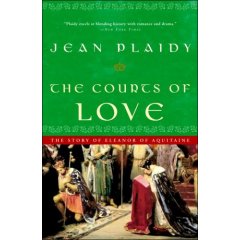
I only bought a few books, one of which was Courts of Love by Jean Plaidy. If you follow this link, you will find many reviews of this book that disagree with my opinion, and gave this book almost five full stars.
I have always held Eleanor of Aquitaine in great awe. Born in the Languedoc region of France, she was raised in a court full of literature and poetry, visitors from distant places bringing news. She was educated, and exposed to rule. She was expected to inheirit the rich province of Aquitaine until a younger brother was born, but, as was not uncommon in the times, he succumbed to a childhood illness, and she once again became the inheiritor of a fabulously wealthy and desirable province, the Aquitaine.
And if being the inheiritor of Aquitaine wasn’t enough, she was also thin, and elegantly beautiful, and educated, and she had spirit. She never felt herself limited by being a woman.
She first married Louis, King of France, who was nowhere near her match. She insisted on accompanying Louis on his crusade to free Jerusalem (failed) and upon her return to France met Henry, the heir to the English throne, secured a divorce from Louis of France based on the fact that they were distantly related, and then quickly married Henry, who was even less distantly related. She did as she wished.
Henry was several years younger than Eleanor, and they were both full of fire, and ambition. They had force, and strategic vision; as a couple, they were unbeatable. Eleanor gave birth almost yearly, mostly sons, and was happy until she discovered her husband’s multiple infidelities. His inability to be a faithful husband created a bitterness in her heart, a wall between the two of them. From time to time, Henry had Eleanor imprisoned to keep her out of his way. He believed she had turned his sons against him. But many times, he would need her, and call her out of her captivity to help him. It’s a bitch, being married to a king.
Where am I going with this review, you might ask?
I finished the book, and all I can wonder is how Jean Plaidy took such a fiery woman, a sensual and vibrant woman, and made her so wooden? It must be some problem in me, as the other reviewers give the book a much higher rating than I would, and I wonder if they are confusing their awe with the subject (Eleanor) with the quality of the book?
Or maybe I have become so used to Phillipa Gregory’s treatment that I am spoiled for Jean Plaidy? When you read The Queen’s Fool, The Other Bolyn Girl and The Constant Princess you are there, you are in their world, feeling their thoughts. The dialogue is rich and lively, you are surrounded by sensory clues, smells, feels, tastes – the world is richly created, and when you finish the book, you feel like you have travelled in time, as if you were really there.
Not so with Courts of Love.
I would rate this book far lower, because I DO admire Eleanor of Aquitaine, and I think she deserves an equally lively, richly sensual treatment. I want to know her world, I want to peek inside her mind and experience a little of what she experienced. I want Philippa Gregory to write about Eleanor of Aquitaine! Jean Plaidy, in my opinion, took an extraordinary woman, and make her less vibrant, and just a little drab. A grave injustice, in my book!
Unexpected Pleasure
As I was leaving Seattle, my niece, Little Diamond, passed a book along to me. It’s part of our family culture – we read, and we pass along.
When my son was in university, I remember him telling me that I had addicted him to books. His first memory of books was living in Tunis, and when we would be going on a long trip, or when he had done something particularly good, I would pull down a new book from the shelf high up in my closet. Knowing he was approaching reading age, I had stocked up on books before we left.
As a student, he told me that as he approached final exams at university, he would motivate himself by telling himself that as soon as his last final was over, he could go to the bookstore and buy whatever the newest book out was that he was eager to read. Reading – for fun – during his school breaks was his great reward.
It’s that way for all of us. Before any trip, we stock up on good books to read. Before I left Seattle, I stocked up books for my Mother to read! We seek out places like Half Price Books (I do NOT own stock in Half Price Books) and Amazon.com to feed our habits. In our concern against running out of good books, we all have piles by our bed of books we intend to read. Some of my books have been there almost a year – since I moved to Kuwait!
So I accepted the book, Snake Hips: Belly Dancing and How I Found True Love, although I looked at the cover in dismay, and actually took it off for the trip. It’s about a Lebanese-American girl who goes in search of her ethnic roots. While at first I didn’t like her, I kept reading in spite of myself – the book drew me in. Little Diamond reviews the book here, (as well as several others that sound really good.)
This book was an unexpected pleasure – as are many of the books my book-voracious niece reads. The main character in this book has an unexpected wryly objective view of herself, is painfully honest, and you find yourself hoping she will find herself, and true love, in spite of her clumsy attempts.
Mary Doria Russell Duo
Some of the very best books on cross-cultural miscommunications are written in science fiction, and by some of the greatest names, the oldies but goodies. Now I know by naming a couple, I am going to offend some of those out there by leaving out your favorites – please feel free to jump in (comments section) and make additonal recommendations.
One of the great classics is Robert Heinlein’s Stranger in a Strange Land. It is a hilarious book, with occasional moments of pathos, but an easy read, and an unforgettable book.
Ursula K. LeGuin’s The Left Hand of Darkness is another primer in the kinds of misunderstandings that can come with the best of intentions. She also deals with the changes that living in an alien culture makes in the visitor, as well as the visited.
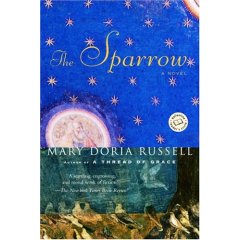
More recently written is a duo by Mary Doria Russell. Her hero, Father Emilio Sandoz, is a Jesuit priest. Sent as an intergalactic evangelist, he runs into some serious problems. These are very strong book, adult books with adult topics and sexual content, not for those who want an easy read and feel good at the end. It is about spiritual testing, as well as survival. There are parts of these two books where you will laugh out loud, and parts where you will be so depressed you don’t want to continue reading. At the same time, they are deeply spiritual.
The saddest, funniest, most horrible part of all is that the worst things happen as a result of the very best intentions. Russel’s characters try to get into one another’s way of thinking – and fail miserably. The results are horrorific.
And yet . . . in the end, there is redemption. These are books that get you thinking, and keep you thinking for a long time. They stretch your mind, opening topics you never dreamed existed.
You can read either of these two books, The Sparrow and The Children of God as a stand-alone read, or you can read them together. I personally found The Children of God the better book, but because I find Russell so addictive, so insightful, I recommend them both. They are available from Amazon at around $10/each in paperback.
Fog
Carl Sandburg. 1878–
THE fog comes
on little cat feet.
It sits looking
over harbor and city
on silent haunches
and then moves on.

Recent Comments
ExpatAlien on What Country am I Living … intlxpatr on Yellowstone: Old Faithful to C… Michelle on Yellowstone: Old Faithful to C… Cathy on No Grown-Ups in Charge intlxpatr on Waiting for Snow Wikipedia Donate Button

Amazina


Early Voting in Florida


 Here There and Everywhere