Wooo HOOOO Biden / Harris!

After more than three long depressing years, slogging through a presidency of a man I find totally unworthy to be the leader of the USA and the free world, finally, a breath of hope, a breath of fresh air.
I applaud Joe Biden, a decent man, with the stones to choose Kamala Harris, his sole genuine challenger in the Democratic race for the nomination, who challenged his position on race, and said it hurt her personally. I applaud him for listening. I applaud him for choosing a warrior woman, an unafraid woman, whom he can trust to tell it as she sees it. My position is that a leader needs to be surrounded by people who will tell the truth as they see it, and help him / her see different perspectives.
And Wooo HOOOO, Kamala Harris, WARRIOR WOMAN! Tell it! I may not aways agree with you, but I trust you. I trust your integrity, I trust your work ethic, and I trust your love for the United States of America and your compassion for our peoples.
Go team go! Fight, team, fight! WIN, TEAM, WIN!
Florida Breaks All Records for COVID Cases
First, to those of you who know me and are far away, we are well.
My Mother died of COVID in Seattle, in April. It was a shock. Although she was 96, she was mentally fit, very sharp, and her mother lived to 104. We all expected Mom to break her Mom’s record.
We don’t live in the biggest hot-spot, the Miami/Dade County area far to the south and east of Pensacola. No, we are in the eighth worst hit part of Florida, and part of the 18 greatest concerns for COVID according to the study out yesterday.
No one I know here has gotten sick. Almost everyone I know has the luxury of staying home, working from home, not needing to interface with the public unnecessarily. It is stunning, however, to think that one person in ten in this area has or has had the virus.
These graphs are not from the Florida Department of Health website. The person hired to design that website designed a great, comprehensive website to transparently share information. She was fired. She says she was fired for not agreeing to manipulate the information to make things look not so bad in Florida. Our governor is a total toady to President Trump, who is doing nothing to provide leadership to our country in fighting this pandemic, not providing comfort to those who suffer from it.
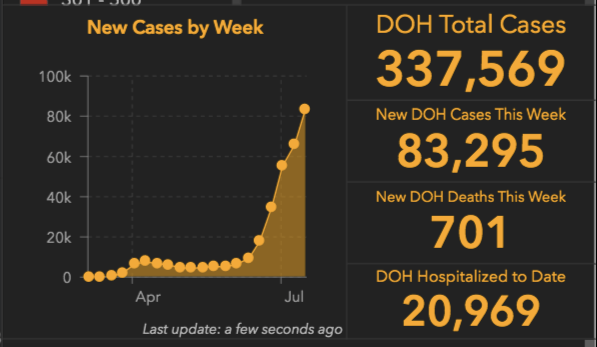
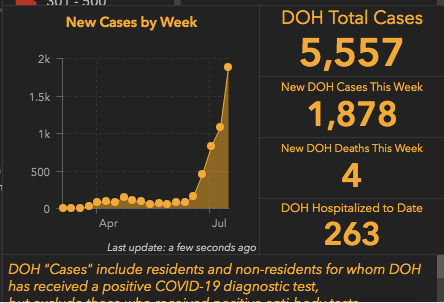

These snapshots are from her new website, which has much more accurate presentations of the situation in Florida than the official site. She, and others, gather information which may be obscure, but is available to the public, and publishes it. Her website is Florida Covid Action. She is a hero.
I live in a county where I have friends who support Trump and believe that the Democrats are over-hyping the problems for political reasons, so that Trump will lose his bid for re-election. They also believe masks are unnecessary. They don’t see any reason to socially distance. They perceive restrictions on their behavior as violations of their First Amendment rights.
So Trump has mandated our schools to open as normal – that means in August. The schools must offer an in-school option, which has many teachers frightened and/or furious. They also offer a remote school-day option, 6 hours in front of a computer, and an independent option, where a student completes a curriculum on his or her own. Those who attend school will not be required to mask or to social distance.
My grandchildren are 7 and 10. Their parents face having to choose the least bad of the three proposals. Parents all around the state are debating what to do. Many parents work, and child care is almost impossible to find and very costly. Many parents will have to send their children to school or leave them unattended and unsupervised at home.

The pediatric cases are for my county, Escambia County. The highest rate of transmission is among those 15 – 24. They’ve closed the bars, but the rate remains high, and rising. The rate of transmission among children is also rising.
I am outraged. We have handled this contagion worse that a third world country. We know masks work. We know social distancing, plus masks, plus conscientious hand-washing can flatten this curve, bring the number of cases down, and expect a rational re-opening. Nothing we have done, especially in Florida, has been rational. God help us. Lord, have mercy on us.
Pensacola Smashes Record Corona Virus Rate

Pensacola has had a full week of record breaking cases of Corona Virus, way up from where it was when we all began to shelter in place.
With news that the leadership has decided that testing is the problem, and that the government is beginning to withdraw support for testing, the cars are lining up at the local drive-through testing station, concerned people trying to get tested before testing goes away.
So what looks worse for re-election? Dealing with the problem, or pretending the problem doesn’t exist, not dealing the the problem, and pulling funding from studying the problem?
Forty-Seven Years
“Happy Anniversary!” smiled AdventureMan as he headed for the daybed in my office. He sets his alarm, gets up and comes into the office, curls up, pulls a quilt over him and goes back to sleep. Ragnar and Uhtred, who love a warm body, trail him in, and as soon as they hear him purring (as we call it) they snuggle right up.
Tropical Storm Cristobal is on our doorstop and with the bands of the storm come periods of light rain, occasional medium rain, and from time to time, lengthy showers of intense rain, sometimes sideways rain if the winds are blowing hard.
We still aren’t eating in restaurants, but I think when he wakes up I will suggest we talk with our son and his wife to see if they might like pizzas today, with us, from Ozone Pizza. While there are a couple expensive restaurants I like, my preference for celebration is always reliably good food, tasty food, and Ozone is tasty, reliably good, and has something to make every one of the six of us happy. On a rainy Sunday, this seems like a relaxed, family option.
The actual move is still stalled. We live our normal lives, waiting for the log jam to break. First, our son and his wife have to be able to close on their house, which is tied up in a legal glitch we expect to be soon solved. They move. We have the bedrooms and hallway painted, then we move. Sigh. These things just take time.
Meanwhile, I want to share something special with you – this was done by 8 downtown Pensacola religious leaders who years ago committed to meeting regularly for breakfast, getting to know and support one another. Their established relationship enabled them to come together to share their commitment to making Pensacola a better place for all races:
Amazing Women Visiting Pensacola
When I first came to Pensacola, a woman at our church who is very welcoming and kind to newcomers told me she “wanted to find just the right place for me to plug in.” A couple of her suggestions were not exactly what I wanted, but then she introduced me to Jena Melancon, the founder and director of the Gulf Coast Citizens Diplomacy Council, and I found my niche.
Jena is an amazing woman. She has created this organization. She has a data base of resources that allow her to tailor visits for foreign delegates so that they can meet the needs of their missions – Election Transparency, Entrepreneurship, Environmental Protection, Leading an NGO, Military and Civilian Community Cooperation, Domestic Violence, Creating Fair Policies, Programs for Enriching Disadvantaged Children – you name it, Jena can create a program that will enrich their understanding from an American perspective.
At the same time, Pensacolians who come into contact with the delegates sent by the Department of State find that their lives are also enriched. Many times they, too, learn something new and unexpected. Both groups benefit.
Jena also has a group in GCCDC that studies Great Decisions, and creates events throughout the year for membership participation. Members of the Gulf Coast Citizens Diplomacy Council can volunteer in Jena’s office, can host dinners for delegates and have some one-on-one time learning about customs in another part of the world, can sponsor a Pensacola child in an international exchange, can host teenagers here on an international exchange, or attend the famous Mint Julep party in Spring. Many in the GCCDC are also resources; the exchange of ideas bringing inspiration to both sides.
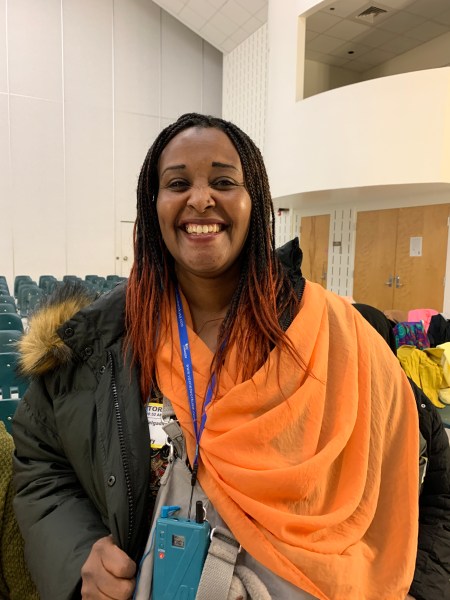
This week, I was honored to be able to work with a group of Women in Leadership, women from Chad, Iraq, Jordan, Saudi Arabia, Egypt and the Sudan. Each and every one of the women was a hero in her own right, making life better in their communities by stepping into leadership roles. Rehab, above, from the Sudan, works to empower women and to make the laws show greater equality in the treatment of men and women.

CPT Aseel is a police chief in Iraq.

Maki, from Chad, works to prohibit child marriages and female genital mutilation.

Mariam, from Saudi Arabia, is a high level journalist in the Saudi media industry, accepting honorary citizenship from the City of Pensacola city council chair Sherri Myers.

Wasfiya is a minister of parliament in Iraq.
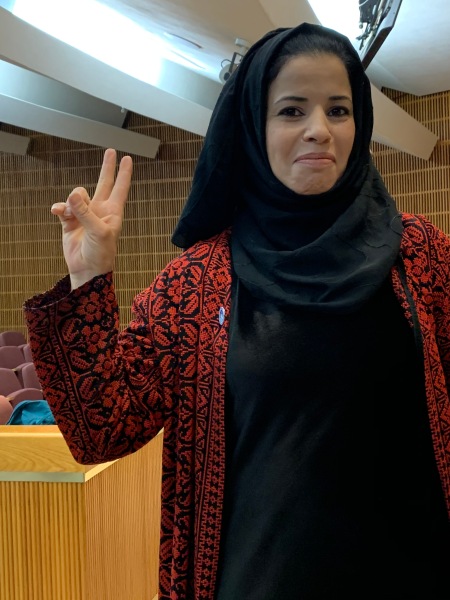
Ola is the delegate from Jordan.
I was honored to spend three days of my life with these women, and with Jena, and with other inspirational women of Pensacola at the Women in Leadership conference at UWF.
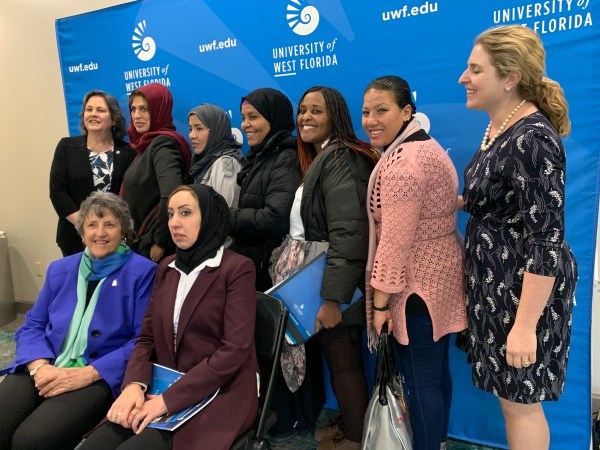
Here is most of the group with Judy Bense, President Emeritus of UWF, at the closing of the Women in Leadership conference, 2020. Life can be amazing when so many women of talent and confidence gather together to inspire one another.
Domme: One of the Best Days in the Dordogne
That title is misleading. We had so many best days, but later in this post you will learn why this one sticks out in my memories. Some days of the trip are cloudy, like “which day did we do this?” Other memories come out crystal clear.
(I just spent an hour of my life learning about Google’s Activity record – holy smokes! – and how, if I had had my location tracker turned on, I might have been able to provide you with the hilariously indirect routes we ended up on getting from place to place in the Dordogne. I am tempted. I don’t live a life with anything I need to hide. And yet, the thought of being TRACKED and a record being kept makes me uneasy.)

So arriving in Dome is kind of Wizard-of-Oz-y. It’s a very old city, built on a high hill, and streets are old and narrow. It’s sort of like those labyrinth puzzles you used to do as a kid when you needed to get from here to there. In this case, we totally depended on the Google lady, who said “turn right here” or “go 100 feet, turn left and then immediately right at the next street.” Getting from the entry gate, at the bottom of the hill, to L’Esplanade, at the top of the hill, was an exercise in indirection and circularity.
We got to the top. We could see our hotel. We had read about the parking, that there was no parking at the hotel and if you were very lucky, there might be parking on the street. There was not a single parking spot on the street. Even this late in the season, there were many tourists, and tourist buses, and some had drivers parked in no-parking places, with the engine on, ready to go and circle the city if the police came.
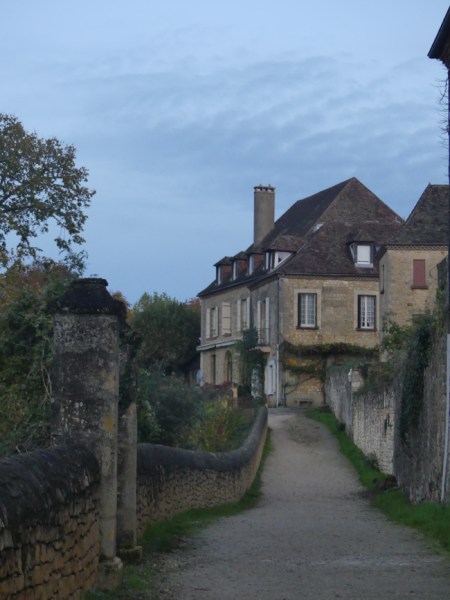
We decided to park in the pay lot, which had a lot of spaces. The night before, we had prepared our carry-bags with enough clothes for dinner and the next day, so we didn’t have to carry in our bags. It took us about 15 minutes to figure out the instructions. We put in the maximum in coins – I think 5 Euro, and that would take us to seven PM, when if we saw a parking space, we would move the car, and if we didn’t, we would put more money into the machine.
When we walked in, we received a very cordial and friendly greeting; the receptionist was Dutch and spoke English wonderfully. She told us that at seven, the parking machines are no longer monitored, and we are safe until ten the next morning, so that was a relief. She showed us to our room. You can see our room in the photo of L’Esplanade from the path, above; it is the corner room, one story up, and has a balcony.
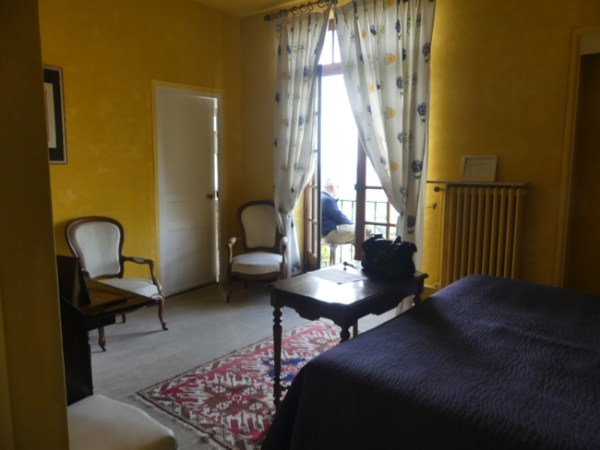
The room was gorgeous. Maybe not quite so spacious as our room(s) at Domaine de la Vitrolle, but very spacious for France, and beautiful. And just wait until you see the view. My heart sang. I wanted to stay on that balcony and just soak in that view.
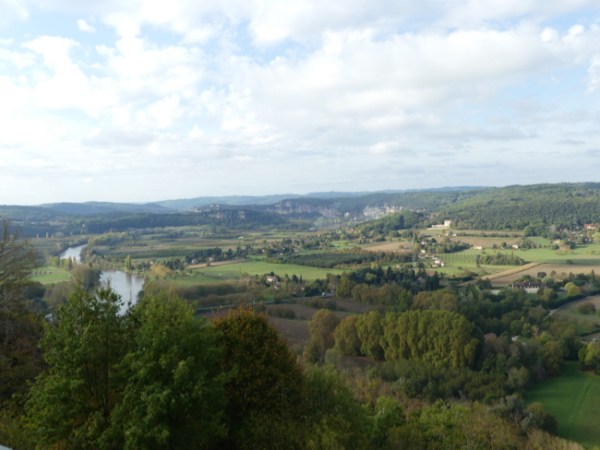




We can see all the way to La Roque-Gageac!

Beautiful Perigord farmlands . . .

Day is fleeting, and AdventureMan wants to explore, and rightly so. We are only in Domme for this one night. It was hard for me to leave that balcony; the view just sang to my heart.
Domme is walkable, and beautiful. There is something else about Domme – there are cats, lots of cats, and there are dishes out, hidden under benches, or visible on a step up to a house, or at the side of a doorway into a church. I imagine the cats keep the rats away, but it is lovely to see them repaid so generously and lovingly. The cats all looked very well fed.
Here is another church built in the same style as that of the church we saw in Audrix. I’m going to have to find out about this architecture. Domme is an old Templar town; I am wondering if this style is an indication of a Templar population?
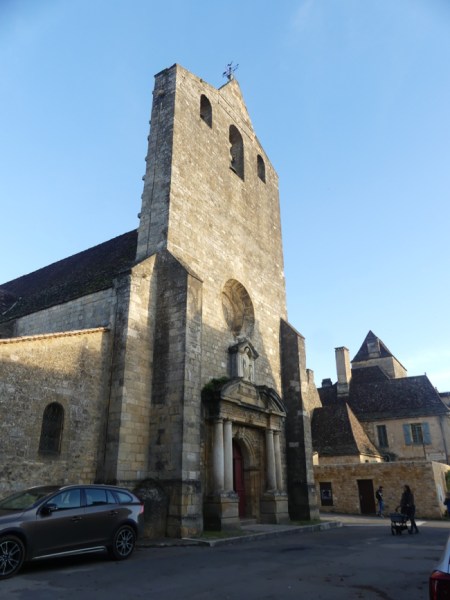
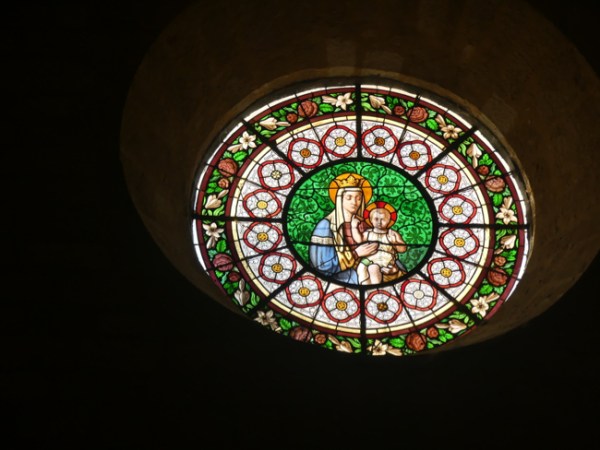
Look at this barrel roof! Is that not beautiful?

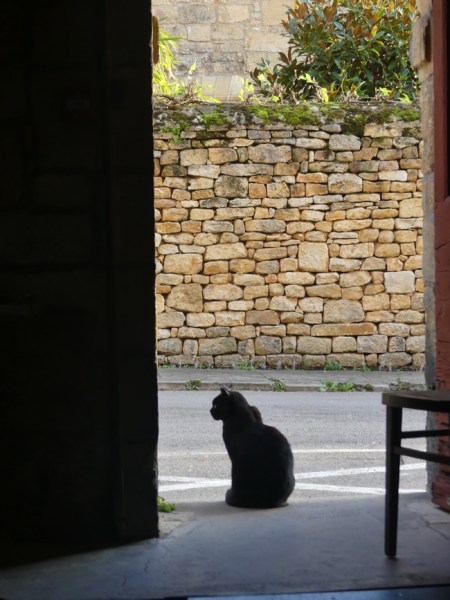
A view of the church from the market square. We attended the market the next morning, but it was very small, and there is only so much hand-made soap I can buy!

The above photo was taken from in front of a very cool bookstore, which even had a large English section. They had thousands of books in all genres, all languages, and new and used books all together. It was a little bit of heaven, right there on the main square.

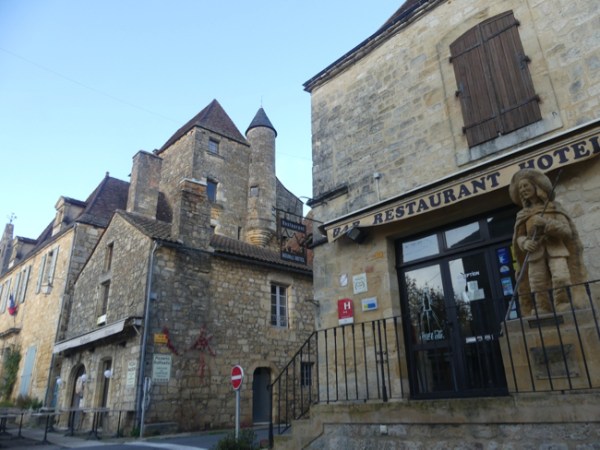


Actually, I lost my husband. He went into the bookstore, I took photos. I went into the bookstore, he wasn’t there! I tried to call him, and it did not go through. I knew if I went back to the hotel, we would eventually fine one another, but I kept looking, and we were both on the main square, just in different places. I too this photo in front of the wonderful book store.
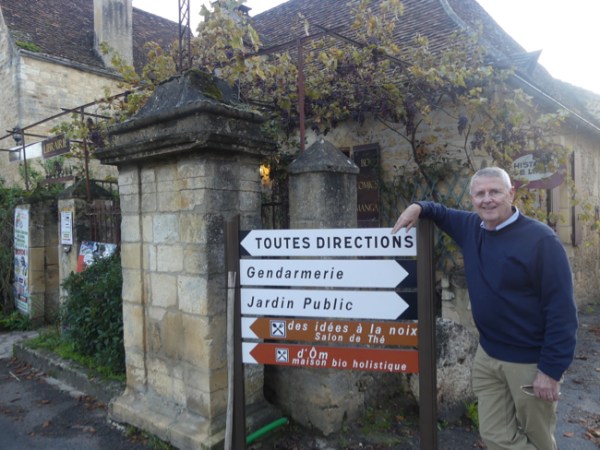
Beautiful city coat-of-arms, no?

This was a wonderful place for us. We found this building, with these arched windows (which I love) and my husband found a plaque telling us it was the former mint, the man who struck the coinage for the area. As we went around the corner, looking in the window, AdventureMan said (very brave man!) “I think we need to go in there.” I had not been paying a lot of attention, I was looking in a window where the you could see the jeweler’s studio, with works in progress, which was fascinating. My husband was right, there were some beautiful pieces. I tend to buy jewelry in places just like this, where you can find original pieces, and, well, jewelry and silk scarves transport well. 😉
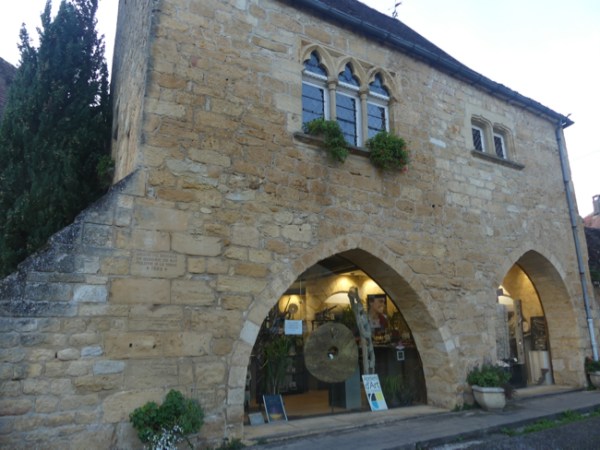

Inside, we met the jeweler’s son. As I picked out some pieces, my husband and him started a conversation, and as it got more interesting, I joined in. He talked about his family coming to Domme to seek new opportunities and new markets, and how wonderfully it had worked out for them.
I found the lovely chain-mail inspired neck;ace below in the tip of my stocking on Christmas morning 🙂

We talked about all kinds of social issues in France, and economic issues. We were all very cordial. At one point, Julien paused and then asked us, very haltingly, “You seem to be such nice people. How could you have elected a President like Trump?” We grimaced; it is a question Europeans ask us a lot. How could a country with the values we claim to share elect a man with no moral compass? He was horrified at what is happening in our country, and sad at our descent into corruption.
It was a hard conversation, and we all hung in there. At the end, we all hugged, and hoped for a better, more peaceful, less greedy world in the months and years to come. Sometimes the hardest conversations are those most worth having.
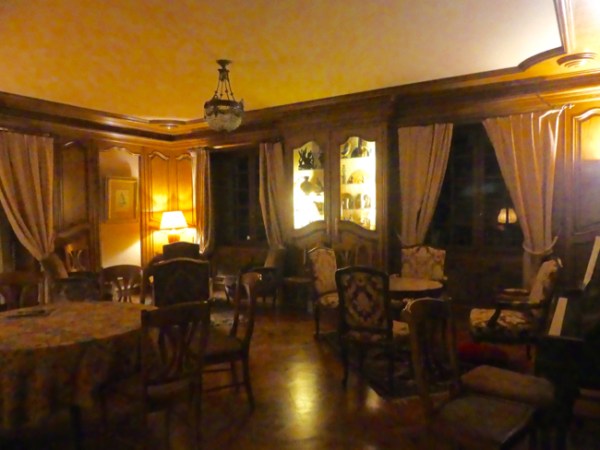
Meanwhile, back at L’Esplanade, we were eager to see what dinner would have to offer. L’Esplanade is well known for excellent cuisine, and we had reserved for dinner back when we made our hotel reservation. The dining room is lovely.
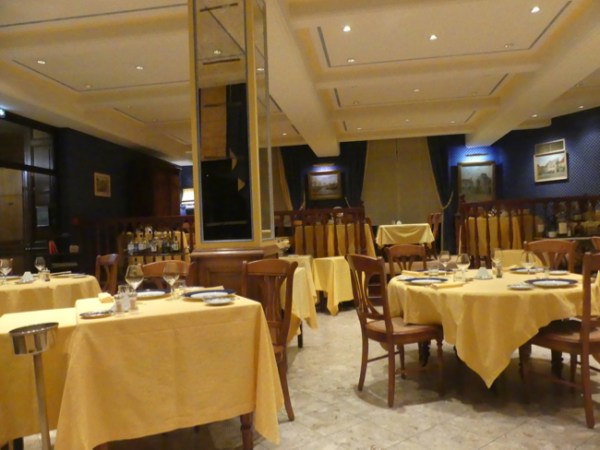

We think the settings are beautiful. There is a room where you can go have cocktails if the dining room is crowded and you have to wait, but tonight we only share the dining room with four other parties.
We order from the fixed menus. Our first course comes, a celery veloute’. It is a cream of celery soup, you can see it in the center of that great big black plate with a little recess in the center for the soup.

This was my main course, a little trout steak, decorated with a . . .potato chip. The little cubes of sweet potato were delicious.

AdventureMan had duck, again, decorated with a potato chip. He said the taste of the duck was exquisite.

His dessert was “Fig Three Ways” or maybe five, we couldn’t figure it out.
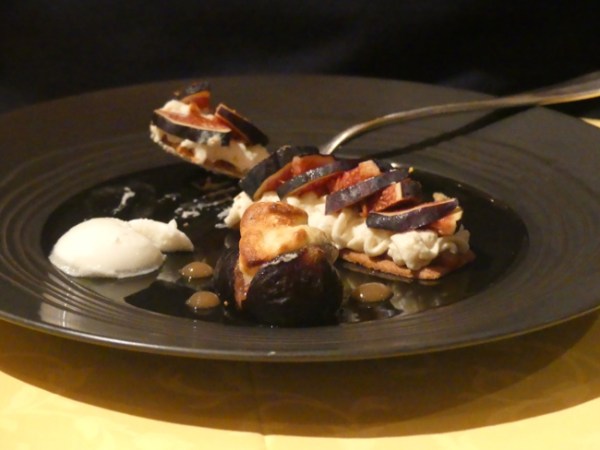
I loved my dessert, the raspberry sorbet part. It was decorated with passion fruit.

At the end of the meal, we were served this perfect little cookies.
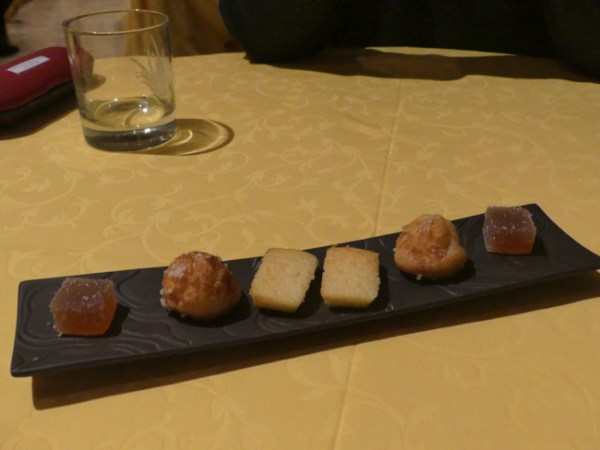
This was another very quiet, very dark night of great sleep.
The next morning, we had breakfast in what I would call the garden room, and the owner’s family were all there, too, eating breakfast on their way to school, work, etc. It was really fun just being able to see them all eat, converse, be a normal family eating their breakfast together in the hotel. I loved it.
Bordeaux: City of Many Discoveries
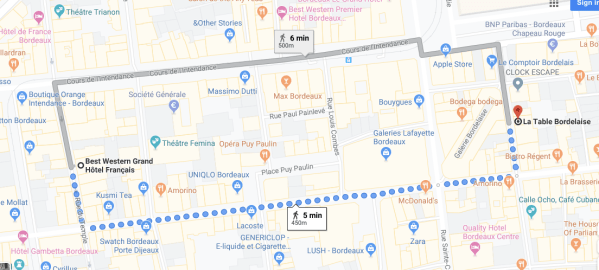
We’ve had a full morning, and head for the hotel, and then to see if we can find the restaurant our guide recommended when we were on our walking tour. It met all our favorite criteria – it is recommended and frequented by citizens of Bordeaux, it features Bordeaux specialties, and it is unpretentious. We love this kind of place.
We had a very short walk, and we are very hungry. We find the sign and board for the restaurant, and then the hilarity begins. We can’t find the door.
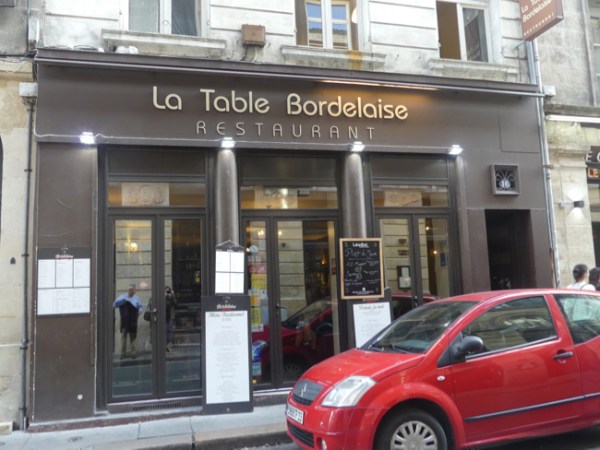

We find an entrance, and are greeted and seated quickly. When we look at the menu, and look at the clientele, it doesn’t feel right.

It’s not the same menu we saw posted at La Table Bordelaise. The manager can see we are puzzled, and he assures us we are in the right place. I asked about a particular dish, and he then agreed we were meant to be next door. I think he knew all along we were looking for the other restaurant, but this was the Bordelaise GRILL, and he graciously consented to let us go.
We were embarrassed, of course, but relieved. I don’t want to waste my calories, or my Euros, on a meal I don’t want. I will pay the price of a little embarrassment to be in the right restaurant.
So we go next door, and are happy to be seated in a very crowded restaurant. What I like is that there is a wide variety of ages, from twenty-somethings, to couples older than we are.

We order, maigret de canard (duck) for my husband, who for years has said “I only eat duck in France” and a fish for me. I was delighted to see the lady next to me, very French, had ordered the same thing. I was horrified to see how elegantly, delicately and thoroughly she was able to eviscerate the fish, top and bottom, while I struggled, leaving a lot of the fish on the plate. It was delicious, topped with almonds, and crispy skin with soft flesh. It’s not like I could take the excess with me, so I relished what I could get off the bones, and had no regrets for the rest.

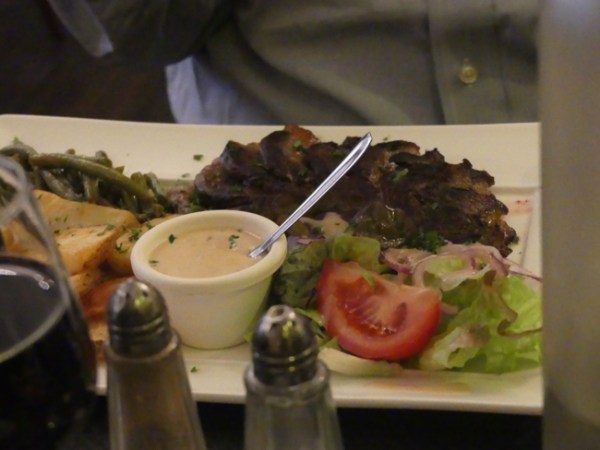
Somehow, I deleted the photo for my husband’s duck, but he remembers it was wonderful.

For me, this was the truly wonderful part. One of the desserts was pear ice cream. When it came, with the clear cold liquid in the tiny glass accompanying it, I knew it had to be a pear liquor. AdventureMan asked if I was going to drink it. I am diabetic. I don’t drink a lot of alcohol anymore.
“Yes,” I said, and poured it all on. There are times in life when you should be cautious, and there are times when you just need to throw caution to the wind. It was worth it. Every bite. The pear ice cream was very lovely, a sorbet, very pear-y, and the liquor was worth every second of my life I might have lost because I savored it all. Some things just make life more worth living.
My husband had the creme brûlée, below, which was actually not half eaten when it came to the table, but somehow I got so absorbed in my pear ice that I was late in taking a photo of his creme brûlée, which he determined was excellent.

Sated, and a little exhausted (big night when we farewelled the ship, big day at the market and the Aquitaine Museum) so we took the short walk back to the Grande Hotel Francaise and rested for an hour.
There are other years when we would have kept pushing, so much to see in Bordeaux. We’ve had to learn that for us, resting now and then when we need it is worth it, so we can build up our energy once again, and enjoy the rest of the day.

While resting, we heard chanting, and loud singing. Yellow jacketed strikers, making their protest in the nearby street. There were maybe fifty people, and mostly people not striking were just going on their normal course, not fazed by the protestors.
The tram lines in Bordeaux are wonderful, and new. We can get on steps away from our hotel, and go in any direction. We each have a Bordeaux City Pass, takes us on all the tram lines, bus lines and gets us in free to most of the places we want to go. We bought ours at the tourist office while we were on our walking tour. It doesn’t start until the first time you use it, and then it is good for 24 hours. You may be able to buy City Passes for longer, I don’t know. You can also buy tram cards which allow you to travel without cash for a certain amount of time, which varies depending on the card you buy.

We have a plan. We want to take the B line all the way to the end in both directions, and then maybe switch to the A or C lines. Riding the trams is fun, and you get to see parts of town that a tourist doesn’t see otherwise. I also got to see wonderful signs.

“You think your act is anonymous – but we see you!”

“A wandering/mischievous hand, one foot in prison!”

There is a mighty effort to confront sexism in France – who’d have thought, fifty years ago, this was even possible? We’ve seen some radical changes in the French culture. Women seem so much more independent and confident.
We ride the B tram all the way north and then back, but there are running signs inside the tram telling us the tram will stop running at 1830 because of the marathon. This is a BIG deal, streets closing for the runners, trams shutting down, it is amazing and wonderful to have so much support for a marathon. We remember when fitness in France was mostly limited to the military; now we see the French, male and female, embracing fitness with a vengeance. C’est merveilleuse!
We exit at St. Andre, which had been closed earlier in the day. I am a great fan of Eleanor of Aquitaine, who was married in this church – at age 13. It sounds awful, but girls from noble families expected to be married at an early age, and Eleanor was an extraordinary girl who eventually married two kings, France and England. She was aggressive and confident.

Being able to go into St. Andre’s is a thrill, and a bigger thrill at twilight, when people are quiet and respectful, and you can soak in some of the character of this church and the long history it has survived.
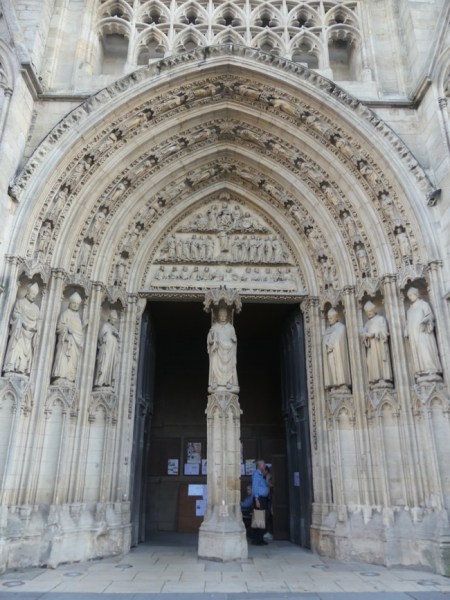


This is my favorite photo from the church:


There is a lot of marathon excitement going on outside St. Andre’s. It looks like some kind of staging area or some kind of water stop, or check-point, so we decide to find a place to eat and just watch the goings ons. We find the Ristorante Palazzo, salads, pizza and open air seating. It may be the end of October, but the temperatures during the day are hitting 70 F. and the night is still balmy. Every restaurant that can has seating outside tonight, so the Bordelaise can enjoy one of the last nights of dining al fresco before serious winter sets in.


Marathon set up

Fire trucks and emergency vehicles show up – and leave. Nothing much has happened in terms of the marathon, so we idle our way back to our hotel, just enjoying the lovely night. We had no idea that the French had adopted Hallowe’en, but evidence is everywhere.
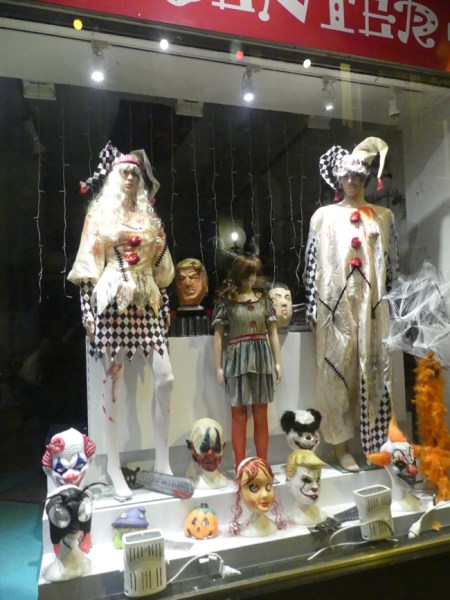
I’ve always loved French clothing for children.

Outdoor dining everywhere! We could stay in Bordeaux happily for weeks.
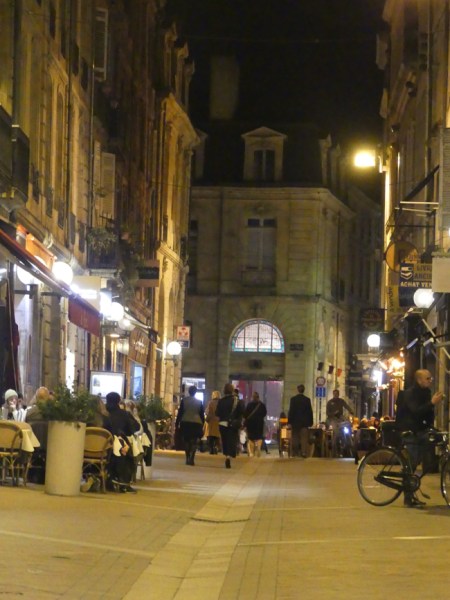
AdventureMan spotted the scallop shell indicating this was part of the pilgrimage route to San Diego Compostela. It was fun

Porte Dijeaux takes us back to the Saracen times in Spain, with their bands of dark and light on their arches:

Our hotel, Best Western Le Grand Hotel Francais, in the very heart of Bordeaux on a very quiet street, easy walk to theatre, opera and restaurants, close to tram lines.

We had just finished brushing our teeth and were getting ready for bed when we got an unexpected thrill – the Bordeaux Midnight Marathon was running right by our hotel :-). Every single runner was cheered – we love that kind of spirit.
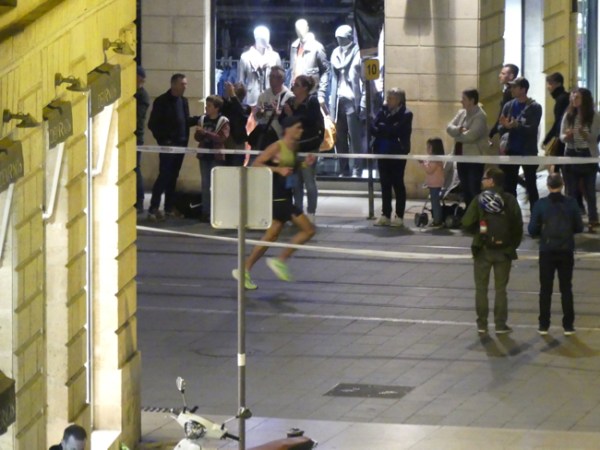
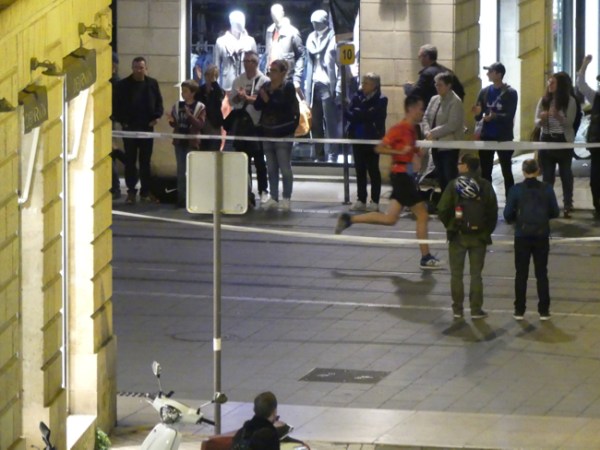
It went on for a long time. Longer than we stayed to photograph. We had a big day coming up and needed to get a good night’s sleep, which we did.
There were so many stores in Bordeaux, full of interesting things to buy, some very lovely, but I just didn’t feel the need to buy anything. We went into Galleries Lafayette, where I often used to buy clothes, but all the clothes were Ralph Lauren, Adidas, Tommy Hilfiger – things we can get in the USA! My preferred souvenirs are silk scarves and jewelry, clothing if I find something special that I will really wear. Other than that, we invest in experience and good food and wine, and comfortable hotels. I’m just so glad I don’t have to carry film anymore, although I do still carry a camera for better shots. We want to come back and spend more time in Bordeaux and the surrounding areas.
Thought from A Word A Day
If ever the time should come, when vain and aspiring men shall possess the highest seats in government, our country will stand in need of its experienced patriots to prevent its ruin.
–Samuel Adams, revolutionary (27 Sep 1722-1803)

I love A Word a Day, and it was one of the first websites I would recommend for my students aspiring to speak English well. I also recommend it for English speaking students who will be taking college entrance exams – vocabulary is a BIG part of succeeding on those tests.
He also includes a pertinent thought, which I often find provokes reflection, as does today’s.
The Texas Solution to Mass Shootings – More Guns
Forgive me for going political, but occasionally I have to let off steam.

I was raised with guns. My husband fought in Vietnam; we have great respect for weapons of all kinds, and when they are needed, and the damage they can inflict. We believe in protecting ourselves.
We don’t need an assault rifle.
When the governor of Texas pulled a sad face and talked about the need to protect Texans, without getting specific, the hair on the back of my neck started going up. Another politician hiding what he is really saying, I thought. When pushed, he referred to the eight new laws going into effect that very day, the same day another angry white American-born male had shot and killed seven people and wounded many more.
He carried an assault rifle. First killed was a policeman making a traffic stop.
The gun laws that the governor referred to as going into effect, each and every law, protect gun ownership and allow guns legally to be carried in more places.
Churches, synagogues and mosques.
Schools.
God forbid.
More guns, in my experience, do NOT make us more safe.
While we were with the military, guns which were not being used for training purposes (or war) were locked up. Every base, every unit has it’s own weapons storage center, kept under lock and key, and those are the rules for professionals with a huge familiarity with guns, and their proper handling, and their capabilities.
Any person can become temporarily insane. I myself have had moments when I knew I was capable of killing, especially to protect my child, or another innocent. None of us know what we are capable of under extreme stress or circumstances.
I can imagine NO circumstance under which it would be appropriate for me to carry an assault weapon.
Here, courtesy of CNN, are the eight new gun laws the governor cited in his lily-livered bow to the NRA:
A series of new firearm laws go into effect in Texas on Sunday, just hours after a shooting left seven people dead in the western part of the state.
Weapons on school grounds
Marshals at schools
Guns in foster homes
Weapons in apartments
Handguns during a disaster
Firearms in places of worship
“Do You Have a Heartbeat?”
This morning in Pensacola the temperature was a cool 71 degrees F. and the humidity was low. It makes all the difference in the world.
“How’s your day?” I asked my friend in the pool at the YMCA, and she grimaced. “I’m off to a bad start,” she said, “I hung my suit and towel and shoes on the line outside, and after the rain last night, everything was soaked this morning.
(We really needed the rain, and we got a soaker of a storm. Today, everything is blossoming in our yard and happy, moonflowers, African Irises, Ginger, plumbago, roses – they respond to a good soaking by blooming in delight.)
I grinned at her. “Did you wake up this morning? Do you have a heartbeat? Are you breathing? Are you here at the YMCA?” I was heartless, and persistent. She laughed.
I talked about the countries I’ve lived in; how in my first African country, Tunisia, back in the day, people competed for our garbage. My cleaning lady asked permission to take glass jars with lids, to take tuna cans. She asked that I give her any clothes I didn’t want. In the Middle East, there were restaurants where people waited near parked cars to beg for the leftovers we carried. Anything. Anything would do.
Some people didn’t have a towel, much less a swim suit, or shoes to hang on a line.
We live in the midst of plenty. Even Tunisia, when we went back twenty five years later, didn’t have the poverty we saw when we lived there. We didn’t see clubbed feet, we didn’t see hunched backs, we didn’t see crossed eyes. The little villa we had lived in had a second floor. There were signs everywhere of prosperity. We didn’t see any beggars, not one.
When I get all wrapped around the axel about the state of civility in my country, about our abuses at the border, about our increasing bureaucratic hardness-of-heart toward the least of these, I need to stop and take a deep breath and spend time acknowledging how very blessed we are. It gives me strength to go on fighting.
Recent Comments
Kitchen on Isiais: Winding Down intlxpatr on Shampoo Ginger tigerbutterya0c5ff1d… on Shampoo Ginger intlxpatr on British Soldier Kidnapped, Esc… John on British Soldier Kidnapped, Esc… Wikipedia Donate Button

Amazina


Early Voting in Florida


