Empowerment
I’m working with a group, one of whose goals is empowerment. They are all from the same country, but not the same parts of the country, nor the same ethnicities, but they all get along well with one another and the group does fine. I admire each of them, and even better, I like these women.
(Photo removed 17 Aug 2021 due to potential political impact on participants)
Here’s the LOL, empowered people have ideas and opinions. We have a format to adhere to, and empowered people come up with other ideas and alternatives. Here’s the problem: other ideas and alternatives, especially good ones, mean a lot of extra focus, it creates more work for facilitators and program managers. Sometimes you need permissions, sometimes you need transportation arrangements, and always, you need to assure a delegate’s safety. All this on top of the changes that will have to be made because of this unusual weather.
First, yesterday as I met the group, I had to apologize for the weather – usually mild, sunny Pensacola was having a howling storm; sheets of water being blown by a raging wind, tree limbs falling, the sky grim and dark and grey the entire day. In the midst of this, I was with one delegate on a tour of the Port of Pensacola, where it was like being in the middle of a huge storm at sea, with squalls. The man giving the tour carried on, they had a great discussion while the wind howled around us and at times the rain fell so hard on the tin roof that we couldn’t hear one another.
 (Those lines you see coming in through the door are wind blown rain. The drops on the camera lens – ditto)
Here is what I truly admire about this group, all their empowerment is for the good, their suggestions are making this visit even more productive and helping them exceed their goals. Their alternatives were doable, and will be accomplished. I can also tell you that at the end of a day dealing with a lot of good ideas and changes, my brain is happily fried. Guess the LOL is on me.
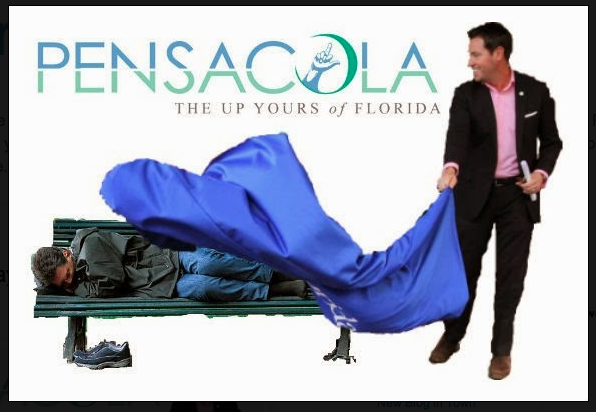
Hilarious Pensacola Blog: Dicksblog
Note to my Qatar, Kuwait and Saudi Arabian readers – YES. This is legal. This is what free speech looks like. This anonymous blogger can poke fun – and does – at everyone. He probably will want to remain anonymous because he does not discriminate in who he pokes and won’t have any friends if people figure out who he is, but yes. Yes. YES. This is legal, this is freedom of speech. He won’t go to jail.
Poking fun at appearance-over-substance Mayor Ashton Hayward, who made national news this week as he prayed, and rethought his ban on homeless people using blankets in Pensacola: Dicksblog goes viral:
Rape Goes Unpunished in US Military
This is disgusting. We’ve all known it’s true. The warrior culture protects those cowards who impose themselves sexually on both men and women. God willing, things will change. It’s already started, with the relieving of those in power who have imposed themselves on women who came forward with their complaints. Let there be more, until this culture is wiped clean of their disgrace.
Rape isn’t about sex. It’s about power. Rape is a personal violation.
It’s time for the good men and women in the military to police this up, to stop the outrage. Expose those bullies and cowards who prey on others.
Military Sex Abuse Investigation: Documents Reveal Chaotic Punishment Record
AP
by RICHARD LARDNER and YURI KAGEYAMA
TOKYO (AP) — At U.S. military bases in Japan, most service members found culpable in sex crimes in recent years did not go to prison, according to internal Department of Defense documents. Instead, in a review of hundreds of cases filed in America’s largest overseas military installation, offenders were fined, demoted, restricted to their bases or removed from the military.
In about 30 cases, a letter of reprimand was the only punishment.
More than 1,000 records, obtained by The Associated Press through the Freedom of Information Act, describe hundreds of cases in graphic detail, painting a disturbing picture of how senior American officers prosecute and punish troops accused of sex crimes. The handling of allegations verged on the chaotic, with seemingly strong cases often reduced to lesser charges. In two rape cases, commanders overruled recommendations to court-martial and dropped the charges instead.
Even when military authorities agreed a crime had been committed, the suspect was unlikely to serve time. Of 244 service members whose punishments were detailed in the records, only a third of them were incarcerated.
The analysis of the reported sex crimes, filed between 2005 and early 2013, shows a pattern of random and inconsistent judgments:
—The Marines were far more likely than other branches to send offenders to prison, with 53 prison sentences out of 270 cases. By contrast, of the Navy’s 203 cases, more than 70 were court-martialed or punished in some way. Only 15 were sentenced to time behind bars.
—The Air Force was the most lenient. Of 124 sex crimes, the only punishment for 21 offenders was a letter of reprimand.
—Victims increasingly declined to cooperate with investigators or recanted, a sign they may have been losing confidence in the system. In 2006, the Naval Criminal Investigative Service, which handles the Navy and Marine Corps, reported 13 such cases; in 2012, it was 28.
In two cases, both adjudicated by the 1st Marine Aircraft Wing, the accusers said they were sexually abused after nights of heavy drinking, and both had some evidence to support their cases. One suspect was sentenced to six years in prison, but the other was confined to his base for 30 days instead of getting jail time.
Taken together, the cases illustrate how far military leaders have to go to reverse a spiraling number of sexual assault reports. The records also may give weight to members of Congress pushing to strip senior officers of their authority to decide whether serious crimes, including sexual assault cases, go to trial.
“How many more rapes do we have to endure to wait and see what reforms are needed?” asked Sen. Kirsten Gillibrand, D-N.Y., chair of the Senate Armed Services personnel subcommittee. She leads a vocal group of lawmakers from both political parties who argue that further reforms to the military’s legal system are needed.
Air Force Col. Alan Metzler, deputy director of the Defense Department’s Sexual Assault Prevention and Response Office, said the department “has been very transparent that we do have a problem.” He said a raft of changes in military law is creating a culture where victims trust that their allegations will be taken seriously and perpetrators will be punished.
The number of sexual assault cases taken to courts-martial has grown steadily — from 42 percent in 2009 to 68 percent in 2012, according to DOD figures. In 2012, of the 238 service members convicted, 74 percent served time.
That trend is not reflected in the Japan cases. Out of 473 sexual assault allegations within Navy and Marine Corps units, just 116, or 24 percent, ended up in courts-martial. In the Navy, one case in 2012 led to court-martial, compared to 13 in which commanders used non-judicial penalties instead.
The authority to decide how to prosecute serious criminal allegations would be taken away from senior officers under a bill crafted by Gillibrand that is expected to come before the Senate this week. The bill would place that responsibility with the trial counsel who has prosecutorial experience.
Senior U.S. military leaders oppose the plan.
“Taking the commander out of the loop never solved any problem,” said Sen. Lindsey Graham, R-S.C., the personnel subcommittee’s top Republican. “It would dismantle the military justice system beyond sexual assaults. It would take commanders off the hook for their responsibility to fix this problem.”
Gillibrand and her supporters argue that the cultural shift the military needs won’t happen if commanders retain their current role in the legal system.
“Skippers have had this authority since the days of John Paul Jones and sexual assaults still occur,” said Lory Manning, a retired Navy captain and senior fellow at the Women in the Military Project. “And this is where we are.”
___
Lardner reported from Washington. Associated Press writer Leon Drouin-Keith in Bangkok and AP researcher Rhonda Shafner in New York contributed to this report.
Saudis Protest Female Death While Paramedics Barred from Campus
Promises, Promises (Lies, Lies!)
West Virginia is one of the poorest – and most beautiful – of the 50 United States, green with forests and uninhabited spaces. It also has pockets of some of the poorest people in the United States. It is a state which accepts that which other states might find unacceptable. And when the chemical spill poisoned the water of thousands of people, Freedom Industries, the responsible company, declared bankruptcy.
Even today, while their water has been declared OK, people say it tastes funny, and chemists have found unacceptable traces of chemicals that other tests were not even measuring. Today, we have this report that the spill was much worse that the company originally reported.
Its sad, and it is disheartening.
In Florida, there are constant proposals for land use restrictions being lifted. The military, the companies – they all promise that this (whatever) will have no impact on the environment. Why, no one could be more environmentally responsible than (_______) fill in the blank with whatever the requestor is.
Yeh. Right.
My guess is that if the true cost of the BP oil spill in the Gulf were known, it would bankrupt BP.

The West Virginia Department of Environmental Protection issued an update on Monday evening indicating that the Elk River spill in West Virginia earlier this month involved more gallons of chemicals than previously reported.
Freedom Industries, which owned the tank that leaked into a river supplying water in the state, now says that approximately 10,000 gallons of the chemicals 4-methylcyclohexane methanol (also known as MCHM) and PPH were released. The company initially said 7,500 gallons spilled, and failed to disclose the presence of the second chemical until last week. The leak, first reported on Jan. 9, left hundreds of thousands in the capital region without access to tap water for days. Though the formal advisory on the water has been lifted, some in the region say they are still concerned about the safety of their water.
The DEP’s press release provides Freedom Industries’ newest estimate, but notes, “It is not known how much material spilled into the Elk River and shut down the drinking water supply for citizens across nine West Virginia counties.”
“We are not making any judgment about its accuracy,” DEP Secretary Randy Huffman said in a statement, referring to the company’s latest spill figure. “We felt it was important to provide to the public what the company has provided the WVDEP in writing. We are still reviewing the calculation, and this is something that will be researched further during the course of this investigation.”
“This is the first calculation that has been provided concerning the amount of materials that spilled on Jan. 9,” Huffman said. “This new calculation does not change any of our protocols in dealing with this spill, nor does it affect the ongoing remediation efforts. Our actions have never been dependent on what Freedom has reported to us. From the start, we have acted aggressively to contain the spill and remediate the site.”
West Virginia Gov. Earl Ray Tomblin (D) has called for the storage facility to be torn down, and for a full remediation of the site.
The Invention of Wings by Sue Monk Kidd
This is one terrific book.

Amazon recommended this book to me, and as a person who loves just about everything Sue Monk Kidd writes, I bought it immediately. AdventureMan had also read a review and said it might be a good book for our book club, so he gets it next. Most of my friends have it on Kindle to read soon.
The book is written in two voices, that of Sarah Gremke’, white, and Charlestonian, of Charleston society families, and the other voice of Hetty/Handful, the slave given to Sarah for her 11th birthday. First Sarah tries to refuse the ‘gift,’ then, using her father’s law books, she writes a letter of emancipation for Hetty, and neither effort works. Sarah and Hetty are stuck with each other, stuck with the times, stuck with their situation, and stuck with the institutions that determine and limit what they will accomplish.
Or are they?
There were times, as I read the book, that I felt like I was going to suffocate. First, the heat and humidity of Charleston, South Carolina, are bad enough without the kinds of close-fitting clothing women were required to wear in that day; the thought of wearing those clothes makes me choke.
The limited expectations for women would stunt and damage the strongest female character in that society where those who thrived were those who were pretty, good at getting married, and good at bearing children, dressing appropriately and socializing endlessly at the same stale events.
Slavery damages everyone. No one should have that kind of power over another human being; studies show that when human beings are given power over another their very worst instincts come to the forefront. Why do we need studies? We have the real world to show us what that kind of power does, how it corrupts the one who holds the power so thoroughly that they don’t even know they are corrupted.
These are stories from my time living in countries where people from poorer countries came to work:
My maid had worked for a family where the men pestered her because she was full time and live-in. They assumed she was sexually available to them and made life very difficult for her. Her mistress saw a beautiful silk blouse she wore, a blouse she had saved for and only wore on her day off, and her mistress borrowed it, stained it, returned it and didn’t take any responsibility for ruining her one really nice blouse. It was never mentioned again. Only when the men complained about this woman was she allowed to leave; her mistress didn’t want the men tempted, she got her passport back and come to work for me. Her previous mistress wanted an ugly maid, and the men were hoping for someone more compliant.
The woman who bought my car had saved and saved, and was working under deplorable conditions in a day care. I told her that she had skills, get another job, and she told me that she hadn’t been paid for three months, and if she left she would never get that pay, and also her employer would never give her her passport or allow her to leave. She was, in effect, a slave.
Most of my friends are very good employers, taking good care of the people who come to work for them, but I have seen those (not my friends) who are violent and abusive. Being a slave is being trapped in an existence with no control over your own life.
Monk makes an interesting comparison of white women’s lives with their limitations being not unlike a variant of slavery. Maybe the conditions were a little better, but the un-free-ness was similar.
Sarah Grimke’ and her sister Angelina, against all odds, break free of family expectations and societal constraints. They forge their own way, with Angelina’s gift for rhetoric and Sarah’s keep legal writing. I had never heard of these women before, and I am so glad Sue Monk Kidd wrote this book to raise their visibility both as abolitionists and as some of the very first proponents for women’s rights to full equality.
As a quilter, I also loved in this book that Handfull’s mother is a quilter, and while she can neither read nor write, she puts down her history in an applique quilt which clearly spells out significant events in her life, and is a tool for passing family history from one generation to another.
Killing the Golden Goose in Pensacola
Every place we have ever lived in has it’s own politics, and the politics in Pensacola are opaque, and to me, bizarre. We have a very pretty mayor – great for photo ops – but WHAT IS HE THINKING???? He displays some of the very worst traits of the old-boy way of doing business. What are those traits? How about telling one of the top grossing restaurants in Pensacola that they now owe $5M because they haven’t been paying a percentage of their revenue to the City of Pensacola? How about voting a Dollar Store into an upper level residential neighborhood? Singlehandedly re-naming a small airport without a single international flight Pensacola “International” airport? How about allocating all the food services at our “International” airport to bland chains, rather than some of our really good local vendors?
Lots of behind the scenes machinations, not putting items on the agenda – countering the spirit of the Sunshine Laws and making the deals in public – giving those who will be impacted some input on the measures.
It’s killing the golden goose. When something is working – and the Fish House restaurant is a go-to place in Pensacola, a place you meet up with friends and a place you take your out-of-town visitors to show off the city – LEAVE IT ALONE! When good people like the Studers and Collier Merrill are investing in downtown Pensacola, and building downtown up as a destination, let them make a buck or two – they are breathing life into the city! Do not kill the golden goose!

“The Emperor Has No Clothes!”
In contrast to some of the places we have lived, Pensacola has an outspoken paper – Our favorite newspaper, Rick Outzen’s Independent News has several wonderful articles this week. It’s where you find out what is really going on in Pensacola. His paper will bravely call out when the emperor has no clothes. I have shamelessly copied and pasted from his website at the Independent News:
How Not To Do Business
 City vs. The Fish House
By Rick Outzen
The title of the Pensacola News Journal’s (PNJ) article on Tuesday, Nov. 26 could have easily been “Mayor Accuses Fish House of Cheating City Out of Millions.” It wasn’t, but that is how some interpreted the article about the default notice sent on behalf of Mayor Ashton Hayward to Collier Merrill, co-owner of the restaurant.
But PNJ readers didn’t know what Merrill knew—that the notice was a negotiation ploy by the city, unsupported factually or legally, according to his attorney. They also didn’t know that the notice itself was leaked, Merrill believed, to the media to hurt his business.
The notice demanded that Seville Harbour, Inc. (owned by Ray Russenberger) and Merrill Land LLC (owned by Burney, Collier and Will Merrill) pay as additional rent payments five percent of The Fish House and Atlas Oyster House’s gross sales since April 2000, plus interest—an amount that could total well over $5 million.
Seville Harbour, Inc. has the ground lease for Pitt Slip, the name given to the three parcels owned by the city that include the anchorage between the Port of Pensacola and Bartram Park. Merrill Land LLC bought in April 2000 the building on the property from Seville Harbour for $1.3 million and subleased the parcel upon which it was built.
The default notice stated that the two companies had 90 days to pay up or the city would terminate the master lease, which would shut down the two restaurants on Feb. 13, 2014.
The impact of the article on The Fish House was immediate. Merrill tried to prepare his staff for any questions from customers.
“I had a meeting with the managers the next morning at 9:30 after the written article came out,” he said. “As much as you can say everything is fine, a few were a little hesitant. They were getting calls from other restaurants; one guy was offered a job.”
Jean Pierre N’Dione, the general manager of the two restaurants, said that the holiday business has been slower than prior years. He’s also dealt with questions from customers.
“The day of the article, a couple came in and said they were here to get a meal before the restaurant closed,” said N’Dione. “They were thinking we were going to be shut down in a few days. It was difficult to say if they were jokingly saying that or if they really believed it.”
The restaurant’s party and catering businesses have also been hurt by the city’s threat.
“We’ve definitely lost business,” said Merrill. “Over Thanksgiving weekend, there were brides in town booking their parties for next October. They didn’t want to take the chance that we might not be in business next year. People are now hesitant to book their Christmas parties with us.”
Why would the mayor’s office resort to such strong-arm tactics? Many would expect a default notice to be sent by Mayor Hayward only after his negotiations with Seville Harbour and Merrill Land had hit an impasse, especially when the notice is a public record that could hurt two landmark restaurants.
However, there had been no negotiations with the city, though Russenberger’s attorney asked for the leases to be combined in 2009. The leases were properly renewed in July 2011, and the mayor had never sent them any written proposals for the properties.
Merrill told the IN that he had only two meetings with the Hayward administration on the lease—one in 2011 with City Attorney Jim Messer and then Chief of Staff John Asmar, the other this past September with City Administrator Colleen Castille. Neither time did the city officials bring up anything about the restaurants owing millions in back rent. Never did the city ask for five percent of his restaurants’ sales.
“We have been waiting for the city to get back to us,” said Merrill. “We had no idea this was an issue or the mayor’s position on the leases.”
Pensacola Landmark
For many, The Fish House is an iconic Pensacola landmark.
The restaurant has hosted presidents, governors, senators, congressmen and other celebrities. During the 2008 presidential election, John McCain, Rudy Giuliani and Fred Thompson held campaign fundraisers there. This past election cycle, GOP presidential hopeful Mitt Romney, with McCain, actor Jon Voight and Mayor Hayward, held a rally on The Fish House deck, pictures of which appeared in the Washington Post and New York Times.
Chef and co-owner Jim Shirley has served his famous Grits a Ya Ya for dignitaries in Washington, D.C. and New York City. Pensacola native, former congressman and author Joe Scarborough has hosted his MSNBC show “Morning Joe” several times from the restaurant.
Three reality shows have been filmed there. The Travel Channel aired an episode of “Bizarre Foods” that featured The Fish House’s grouper throats. “American Pickers” also filmed an episode from The Fish House, which featured the Merrill brothers trading some of their memorabilia for a model of the USS Atlanta. This past August, Chef Emeril Lagasse showcased The Fish House as part of his show “Emeril’s Florida” on the Food Network.
The Fish House and Atlas Oyster House have made Pitt Slip a destination for many visiting our area, serving an estimated 500,000 customers a year. They also are part of what was one of the city’s first public-private development projects.
In the 1980s, the Pensacola City Council wanted a marina built on Pitt Slip, the inlet across from the town’s historic district and outside the gates of the Port of Pensacola. Three parcels were combined—the water area for the docks (Parcel 1), the area along Barracks Street that the city leased from the state (Parcel 1A) and the lot south of the marina (Parcel III).
The intent was to lease to a developer the parcels for 30 years with a renewal option for an additional 30 years. When the original lease was executed in 1985, the city learned that its lease for Parcel 1A with the state only had 27 years remaining. The city had to amend the original lease to adjust its end date. The state required that it be renewed for five successive five-year periods.
The history of the development was filled with ownership changes and business failures. The project never was as successful as the council had hoped until Russenberger and the Merrills got involved.
In January 1998, Chef Jim Shirley rented the space formerly used by the closed Beef & Ale House in the Seville Harbour building on Parcel 1A. He opened the Fish House with Brian Spencer and Dr. Roger Orth as his investors. By the spring, Merrill brothers stepped in as investors in The Fish House, forming Great Southern Restaurant Group of Pensacola, Inc. that put about $2 million into the restaurant, according to Merrill. Spencer and Orth focused on Jackson’s, a restaurant they were opening on Palafox.
“At the time, my brothers and I had invested in several businesses downtown,” said Merrill. “We bought the Bass building on the corner of Palafox and Gregory and were the landlord to Jim Shirley and the Screaming Coyote. We bought Seville Tower on the corner of Palafox and Government streets, which is where my grandfather had his offices in the 1940s.”
He said, “We wanted to move downtown. At the time, our offices were near the mall at Madison Park. Though not a lot was going on downtown, we loved it and saw the potential.”
In 2000, Merrill learned Russenberger was looking to sell the Seville Harbour building. Merrill Land LLC, the brothers’ real estate development company, bought it for $1.3 million and agreed to sublease the ground lease for parcel 1A upon which it was built at the same terms of the master lease. The purchase and sublease were both recorded with the clerk of courts.
Great Southern Restaurant Group went from renting from Seville Harbour, Inc. to renting from Merrill Land LLC.
“Merrill Land got a loan to buy the building, on which it is still making payments,” said Merrill. “It’s like any business. It rents out spaces. We charge rent and hope that those collections are enough to cover our mortgage, lease payment to Russenberger for the ground lease, utilities, repairs and maintenance. At the end of the day, we hope to make a profit like any landlord does.”
Merrill admitted he has been surprised by how much he has come to like the restaurant business. He enjoys the positive feedback he receives from customers and is proud of the role The Fish House plays in the community.
“Maria Goldberg, our marketing director, and I get together once a week,” said Merrill. “We go over all the requests for donations from charities, and there’s always a stack of them. We try to help every one of them, from the high school booster clubs to the NICU at Sacred Heart.”
The Fish House caters events for charities, hosts parties and donates appetizers and the services of its chefs for other fundraising events. He said, “We’ve tried to be good citizens by giving back to the community, trying to get downtown going and helping to promote Pensacola.”
Legal Battle
The default notification from the city asserted that it was entitled to five percent of the gross sales of the restaurants because Merrill Land had been partially assigned the master lease when it bought the Seville Harbour building. The city claimed Great Southern Restaurant Group was a subsidiary or business combination of Merrill Land and therefore should have paid rent based on its gross sales.
Attorney Bruce Partington responded on Nov. 27 on behalf of Seville Harbour and Merrill Land LLC.
First, he made it clear that the leases had been properly renewed. According to Partington, the renewals required nothing more than delivery of a written notice. The letter exercising the renewals was sent July 21, 2011 by Leo Cyr on the behalf of Seville Harbour.
Seville Harbour never partially assigned its lease to Merrill Land.
“Seville Harbour retains multiple rights and duties with respect to the property sub-leased to Merrill Land,” said Partington. “The fundamental concept of an assignment is that the assignor’s entire interest is transferred to the assignee which did not occur here.”
He pointed out that the city had refused in 2000 to approve any assignment to Merrill Land, which is why the transaction was done as a sublease. He asserted that the city’s new position of the relationship between the two companies being an assignment was “irreconcilable and fundamentally inconsistent” with its position 13 years ago.
He pointed out the two restaurants are not owned by Merrill Land. The owner, Great Southern Restaurant Group, “is not, and has never been, a ‘subsidiary or business combination’ of Merrill Land.”
“Merrill Land has no ownership or other interest in Great Southern Restaurant Group, nor does Merrill Land receive any portion of the revenues from the operation of the restaurants on the property.”
Partington believed that the city’s position is without merit and based on “two dubious propositions which are unsupported factually or legally.”
He expressed Merrill’s concerns about how the daily newspaper got wind of the letter one day after the certified letter was received.
“It is extremely troubling that Seville Harbour’s multiple attempts over several years to meet with representatives of the city to discuss the lease were ignored,” wrote Partington, “and then, after years without a response, receive a notice of default, which was then leaked by the city to the media for dramatic effect.”
He put the city on notice that it was responsible for any damage that the leak may have caused Great Southern Restaurant Group.
The Leak
Merrill admitted that when he first received the letter from Daniel he was not that concerned. He was surprised the attorney brought up gross sales, but believed that the restaurants were on solid legal ground.
He said, “I wasn’t really worried about it. I don’t even think I told my brothers about it because I knew it was baseless.”
He sent the letter to Stephen Moorhead, Russenberger’s attorney, to review. Then on the afternoon of Thursday, Nov. 21, Merrill received a call from the PNJ saying that they had heard about a letter sent to him saying The Fish House owed the city millions of dollars. The reporter would not tell him how they got that information, but he admitted they had not yet seen the letter.
Merrill called City Administrator Colleen Castille, who denied any responsibility for the leak. “Colleen, I don’t think you understand the severity of this. This is going to be a front-page story and I’m going to lose business immediately.”
A meeting was set up for the following morning between the daily newspaper, Castille and Merrill. He hoped that the City Administrator, whom he had given the details of the leases in September, would say the letter was wrong. That did not happen.
According to Merrill, she said the letter was a negotiating tool.
“I said that’s fine if you want to sit down at the negotiation table. We’ve been wanting to do it for years,” Merrill recalls what he told Castille at the meeting.
“But to say something that bad about my business is just wrong. I told the City Administrator that to send out a totally baseless letter with inaccurate facts to hurt my business is almost criminal.”
The IN asked the city for an interview with Castille for this article. The city’s communications director, Tamara Fountain, replied the following week, “Colleen has decided not to do any further interviews.”
The city did not offer for anyone else to explain the mayor’s decision to send the default notice or talk about the negotiations and did not give the paper permission to talk to its attorney Nix Daniel.
Who does Merrill think leaked the letter?
“Obviously it had to come from the city. It was either someone with the city or they gave the information to someone who then leaked it to the News Journal,” he said. “The last thing I wanted was this inaccurate letter to come out, because it’s hard to get that genie back in the bottle. I knew people were going to think The Fish House owes the city millions and the city was going to shut us down.”
Merrill said that the city knows the letter is totally inaccurate. “We’ve paid every bit of rent we owe. We’ve shared our financial information. I’m shocked that the mayor’s office would use this tactic. We sat down with Colleen, explained all the details of the leases and we thought it was all good—until we got the default notice.”
He said for the city to send out a default notice demanding millions of dollars without any discussion is unconscionable. “We properly and legally renewed our leases in July 2011. We got a letter from the city attorney that our attorney responded to almost immediately. We received nothing in writing until two years later and it’s a baseless default notification about something that the city has never mentioned to us was even an issue.”
Merrill asked, “What kind of message does this to send to businesses looking to invest in Pensacola and possibly partner with the city?”
Editor’s notes: •Collier Merrill owns a five percent interest in the Independent News. Ray Russenberger owns 2.5 percent of the paper. Neither has, or has ever had, any control over the paper’s editorial coverage.
•At the time of print, the mayor and his attorneys had scheduled a meeting for Monday Dec. 9 to discuss Pitt Slip with Ray Russenberger, Collier Merrill and their attorneys.
———————————————
Don’t Forget The Airport
Mayor Hayward has been in a dispute with The Fish House over the food services contract at the Pensacola International Airport.
Hayward recommended to the city council at its Sept. 26 regular meeting the 10-year concession contract should be awarded to OHM Concessions—which included Chick-fil-A, Einstein Bros. Bagels, Surf City Squeeze and Corona Beach House. Collier Merrill’s The Fish House had joined forces with Bagelheads, Varona’s, and Pensacola Bay Brewery to offer a more local option that had placed second to OHM during the selection process.
The issue was tabled at the meeting when Merrill, the other local business owners, their employees and citizens spoke out in favor of their proposal. Since then, Mayor Hayward has pulled the item off the council’s agenda twice.
Those familiar with council politics say the mayor simply doesn’t have the votes to win approval for OHM. Did the mayor’s office leak the default notice to the daily newspaper to tarnish the image of Merrill and The Fish House to gain the one or two votes needed to bring Chick-fil-A to the airport?
“I certainly hope not,” said Merrill, “because I would hate to see them use those tactics (the notification of default and subsequent leak to the media) to win on a completely separate issue and to punish my 250 employees and my family.”
The next week in his “Upwords” newsletter Hayward criticized Merrill and the others who spoke out at the council meeting claiming they “ambushed” the council.
“It is a terrible idea to disregard our objective business processes in response to a few influential people politically strong-arming our elected officials,” said the mayor.
Merrill was dumbfounded by the mayor’s comments.
“I spoke before the city council because City Administrator Colleen Castille said that was what I should do,” he said. “She said she was going to let the Airport Director, Greg Donovan, stand on his own. We could make our argument and then we let the council make the decision.”
After the newsletter, he met with Castille and City Attorney Jim Messer and asked for explanation of the mayor’s comments.
“I asked Colleen, didn’t I do what you told me do?” he told the IN. “Basically she told me that she didn’t think we would be that organized.”
On Tuesday, Oct. 15 at his first “Mornings with the Mayor” session, Hayward bristled when asked about his “ambush” comment.
“That’s what I called it,” said Hayward, “It was an ambush.”
The IN asked how so, especially since Merrill had been instructed by the City Administrator to make his case at the council meeting.
“They did, but in my opinion I said it was an ambush,” said the mayor.
Mayor Hayward said of the upcoming council vote on the issue, “We will see what happens. They might win. If they do, we will move on. We’re going to support them and we’re going to say let’s make Pensacola a better place. I’m a big boy. Sometimes you win ’em; sometimes you lose ’em.”
When the council agenda for its Oct. 24 meeting was released, the food services contract was on it. The following Sunday, Hayward supporter Bob Kerrigan wrote a viewpoint in favor of OHM getting the contract. Ads appeared in the daily newspaper supporting the mayor’s proposal. A website was set up for Hayward supporters to send emails to council members.
Then at the council’s agenda review meeting, City Administrator Castille, on the mayor’s behalf, unexpectedly pulled it off the agenda. The mayor appeared no longer willing to lose on the issue.
The airport food services recommendation was not on any of the council’s agenda. On Dec. 2, Merrill received an email from the city that stated the issue would not come up in December either.
“Please be advised that the Airport Director will not be bringing the Food and Beverage concession lease agreement to the Pensacola City Council during its December, 2013 meeting,” wrote Airport Administration & Contracts Manager Michael Laven. “Both the Director and the Mayor will be out of the country on business. We believe that the scheduling of this concession will take place in January or February of 2014.”
Stay tuned.
“if You Can’t Prevent Rape, You Enjoy It”: Ranjit Sinha
The Chief of India’s Central Bureau of Investigation said this! Was he snorting cocaine in a drunken stupor? Of course he is apologizing, but his careless remark demonstrates the sentiments buried deep in his culture’s heart – it’s only women. Not worth much, not like us men. Outrageous.

NEW DELHI (AP) — India’s top police official apologized Wednesday for saying, “If you can’t prevent rape, you enjoy it,” a remark that has outraged women across the country.
Central Bureau of Investigation chief Ranjit Sinha made the remark Tuesday during a conference about illegal sports betting and the need to legalize gambling. The CBI, the country’s premier investigative agency, is India’s equivalent of the FBI.
Sinha said at the conference that if the state could not stop gambling, it could at least make some revenue by legalizing it.
“If you cannot enforce the ban on betting, it is like saying, ‘If you can’t prevent rape, you enjoy it,'” he said.
The remarks have caused outrage across India, which in the past year has been roiled by widespread protests following the fatal gang rape of a 23-year-old woman on a bus in New Delhi.
On Wednesday, Sinha said that his comments had been taken out of context and misinterpreted, and that he was sorry if he had caused hurt.
Angry activists, however, called for his resignation.
Communist Party of India (Marxist) leader Brinda Karat said Sinha’s comments were offensive to women everywhere.
“It is sickening that a man who is in charge of several rape investigations should use such an analogy,” Karat told reporters. “He should be prosecuted for degrading and insulting women.”
The New Delhi attack on the young woman last December caused nationwide outrage and forced the government to change rape laws and create fast-track courts for rape cases. New laws introduced after the attack make stalking, voyeurism and sexual harassment a crime. They also provide for the death penalty for repeat offenders or for rape attacks that lead to the victim’s death.
Wooo HOOO the New Q8 Books!
Brava! Brava, Fajer! What a great gift to the children and the community, to make Q8Books more accessible and family friendly. Woooo HOOOOO!
Reading and literacy are key to civilization. Brava!
From the Kuwait Times:
Kuwait’s community bookshop gets new life

Finding quality English books in Kuwait is a challenge as any book lover here knows. Local lawyer Fajer Ahmed, 26, recently took up the challenge when she acquired the small but well-loved bookshop, Q8 Books. She moved Q8 Books from downtown Kuwait City into a renovated space in Bayt Lothan, the non-profit arts and culture center located next to Marina Mall in Salmiya. Home to more than 15,000 titles of all genres including literature, general fiction, history, romance, thrillers and mysteries, westerns, classics, cook books, true crime, self help and motivation, family and lifestyle, business and philosophy and arts and crafts, Q8 Books has something to suit every reader’s taste.
By adding sofas, tables, chairs and beanbags, Q8 Books created a cozy, relaxed atmosphere along with free WiFi that invites customers to come and hang out. “We want to encourage reading, writing and communication in Kuwait, “Fajer explained. “As one example, we provide local writers with a place to display and sell their books free of charge, we also do all the administrative work for them.”
A community bookshop
Q8 Books also holds a free weekly story time for children, offers 50% store credit for trade ins, encourages book clubs and other responsible community groups free space to hold meetings and has an outreach project to support a library in Gambia. “We thank Bayt Lothan for giving Q8 Books a home,” Fajer said. “Without them none of this would have been possible.” Q8 Books’ erudite former owner, Jacob, started the bookshop almost a decade ago with only a handful of books. During his travels, he would browse used bookstores and markets to find quality titles that would be appreciated by the book-loving community in Kuwait. Jacob continues to help out at Q8 Books along with a group of dedicated volunteers and support from the Kuwait Writing Club.
Fajer also organizes regular events in order to build Q8 Books as a community space. On the first of November, Q8 Books hosted a Spooky Book night for kids, which included a story telling by local street artist Monstariam dressed in a bunny costume, a crafts and arts table, coloring and glitter, a costume contest and a chance for parents to browse and chat.
Kid and family friendly
“We really enjoyed Spooky Books night,” said Umm Sara, a mother of three children who attended the event all wearing ‘scary’ costumes. “The kids loved the story telling and we got several books. Much better than going to a mall and they got to draw and color and dress up.” The Kuwait Writing Club also took part, judging over 80 submissions for the writing competition. The winning submission will be published in Kuwait Times. “We also had a cover design competition for children to draw covers for the age appropriate horror story, Goosebumps, and every kid that took park received a free book of their choice,” Fajer explained.
Q8 Books will offer monthly events for children and parents with the goal of encouraging reading. “When kids come in playing games on electronic devices, we try to find books with the same characters and get them interested in reading,” Fajer noted. “Welovekuwait.com Children’s Bookshop has also donated coloring and reading books to give for free for every child that walks in.” Q8 Books encourages Kuwait’s community of readers to share their love of reading. They accept donations and offer store credit for traded in books. They also invite anyone to email ask@q8bookstore.com if they are interested in volunteering, donating or just want to talk to someone about suggestions for what to read.
Q8 Books is located in Bayt Lothan, next to Marina Mall. Store Hours: Weekdays 9am- 1pm and 5pm-9pm. Weekends 11am-9pm. Follow them on Instagram @q8bookstore
By Jamie Etheridge
Gospel for 9/11

Are we who we say we are?
Do we follow the spirit of The Word? Do we as believers pick and choose from our holy book(s) or do we humble ourselves, as Christ did, and do as he commands?
The Lord Jesus Christ commanded a very difficult life style. I have met holy people among all religions; I am forced to believe that “the way and the truth and the light” are behavioral, and that there will be many surprises when we get to the last days.
September 11th is a difficult day. This is a difficult Gospel reading for a difficult day:
Matthew 5: 38 – 47
Eye for Eye
38 “You have heard that it was said, ‘Eye for eye, and tooth for tooth.’h 39 But I tell you, do not resist an evil person. If anyone slaps you on the right cheek, turn to them the other cheek also. 40 And if anyone wants to sue you and take your shirt, hand over your coat as well. 41 If anyone forces you to go one mile, go with them two miles. 42 Give to the one who asks you, and do not turn away from the one who wants to borrow from you.
Love for Enemies
43 “You have heard that it was said, ‘Love your neighbori and hate your enemy.’ 44 But I tell you, love your enemies and pray for those who persecute you, 45 that you may be children of your Father in heaven. He causes his sun to rise on the evil and the good, and sends rain on the righteous and the unrighteous. 46 If you love those who love you, what reward will you get? Are not even the tax collectors doing that? 47 And if you greet only your own people, what are you doing more than others? Do not even pagans do that? 48 Be perfect, therefore, as your heavenly Father is perfect.
Recent Comments
ExpatAlien on What Country am I Living … intlxpatr on Yellowstone: Old Faithful to C… Michelle on Yellowstone: Old Faithful to C… Cathy on No Grown-Ups in Charge intlxpatr on Waiting for Snow Wikipedia Donate Button

Amazina


Early Voting in Florida


 Here There and Everywhere
