New Mexico Bill Would Criminalize Abortions After Rape As ‘Tampering With Evidence’
And Republicans wonder why they have problems getting elected, why they are accused of war on women. This proposed law is not a whole lot different than Morocco’s law that the rapist can escape prosecution by marrying the rape victim. Like let’s just go back a couple centuries where women have no rights, and a rape victim is considered damaged property. So a rape victim who has an abortion is prosecuted for destroying evidence???’
New Mexico is an interesting state, historically Republican but trending Democrat. No wonder . . .
New Mexico Bill Would Criminalize Abortions After Rape As ‘Tampering With Evidence’
Laura Bassett
lbassett@huffingtonpost.com
A Republican lawmaker in New Mexico introduced a bill on Wednesday that would legally require victims of rape to carry their pregnancies to term in order to use the fetus as evidence for a sexual assault trial.
House Bill 206, introduced by state Rep. Cathrynn Brown (R), would charge a rape victim who ended her pregnancy with a third-degree felony for “tampering with evidence.”
“Tampering with evidence shall include procuring or facilitating an abortion, or compelling or coercing another to obtain an abortion, of a fetus that is the result of criminal sexual penetration or incest with the intent to destroy evidence of the crime,” the bill says.
Third-degree felonies in New Mexico carry a sentence of up to three years in prison.
Pat Davis of ProgressNow New Mexico, a progressive nonprofit opposing the bill, called it “blatantly unconstitutional” on Thursday.
“The bill turns victims of rape and incest into felons and forces them to become incubators of evidence for the state,” he said. “According to Republican philosophy, victims who are ‘legitimately raped’ will now have to carry the fetus to term in order to prove their case.“
The bill is unlikely to pass, as Democrats have a majority in both chambers of New Mexico’s state legislature.
UPDATE: 12:25 p.m. — Brown said in a statement Thursday that she introduced the bill with the goal of punishing the person who commits incest or rape and then procures or facilitates an abortion to destroy the evidence of the crime.
“New Mexico needs to strengthen its laws to deter sex offenders,” said Brown. “By adding this law in New Mexico, we can help to protect women across our state.”
Indian Gang Rape Case Goes to Trial
From today’s Huffpost

India Gang Rape Trial Begins In New Delhi
By ASHOK SHARMA
NEW DELHI — The trial of five men charged with the gang rape and murder of a 23-year-old student on a New Delhi bus began in a closed courtroom Thursday with opening arguments by the prosecution lawyers in a special fast-track court set up just weeks ago to handle sexual assault cases.
The brutal attack last month set off protests across India and opened a national debate about the epidemic of violence against women. A government committee established in the wake of the attack has called for a complete overhaul of the way the criminal justice system deals with rape, sexual assaults and crimes against women in general.
The five men on trial – who face a maximum sentence of death by hanging if convicted – covered their faces with woolen caps as they walked into the courtroom Thursday surrounded by a phalanx of armed police. Two hours later, after proceedings were over, they were whisked away by the police.
Details of the day’s proceedings were not available. The courtroom was closed to the public and the media – a routine move in Indian rape cases – even though defense lawyers had argued that since the victim is dead, the proceedings should be opened. There was also a gag order on the lawyers to not reveal what happened inside the court.
Judge Yogesh Khanna turned down requests by journalists Thursday that they be briefed on the day’s proceedings and said the gag order would remain.
Since Friday is a public holiday in India, the next hearing in the case was set for Monday, when the defense will present its opening arguments.
A sixth suspect in the case has claimed he is a juvenile and is expected to be tried in a juvenile court.
On Thursday, a magistrate separately rejected a petition by Subramanian Swamy, a prominent politician, that no leniency be shown toward the accused who claims to be a juvenile because of the brutal nature of the crime, said Jagdish Shetty, an aide to Swamy.
Documents presented by prosecution last week to the Juvenile Justice Board indicated that the defendant was a juvenile at the time of the attack, which would make him ineligible for the death penalty.
Magistrate Geetanjali Goel is expected to rule on the suspect’s age on Jan.28.
The suspect, who is not being identified by The Associated Press because he says he is 17, would face three years in a reform facility if convicted as a juvenile.
After the fast-track court hearing, M.L. Sharma, a defense lawyer for Mukesh Singh, one of the accused, said he had withdrawn from the case. V.K. Anand, who represents Mukesh’s brother Ram Singh, will now defend both brothers. The two lawyers had been arguing over who was Mukesh Singh’s real lawyer.
Sharma said he left the case to save his client from being tortured to fire him. He has long maintained that the other defense lawyers were planted by the police to ensure guilty verdicts.
Dozens of police were outside the sprawling court complex in south New Delhi where the trial is taking place. Inside the court, about 30 policemen blocked access to the room where Khanna heard the prosecution’s case.
Outside the courtroom scores of journalists and curious onlookers crowded the hallway.
Prosecutor Dayan Krishnan warned defense lawyers that if they spoke to journalists he would slap contempt of court notices on them, said V.K. Anand, a defense lawyer.
Police say the victim and a male friend were attacked after boarding a bus Dec. 16 as they tried to return home after an evening showing of the movie “Life of Pi.” The six men, the only occupants of the private bus, allegedly beat the man with a metal bar and raped the woman with it, inflicting massive internal injuries to her, police said. The victims were dumped naked on the roadside, and the woman died two weeks later in a Singapore hospital.
Abhilasha Kumari, a New Delhi-based sociologist, said the attack could end up having a large impact on the country.
`’This case has brought the violence against women center stage and it has, out of sheer public pressure, forced the government to sensitize itself to crimes against women,” she said.
The trial began a day after a government panel recommended India strictly enforce sexual assault laws, commit to holding speedy rape trials and change the antiquated penal code to protect women.
The panel appointed to examine the criminal justice system’s handling of violence against women, received a staggering 80,000 suggestions from women’s groups and thousands of ordinary citizens.
Among the panel’s suggestions were a ban on a traumatic vaginal exam of rape victims and an end to political interference in sex crime cases. It has also suggested the appointment of more judges to help speed up India’s sluggish judicial process and clear millions of pending cases.
Law Minister Ashwani Kumar said the government would take the recommendations to the Cabinet and Parliament.
“Procedural inadequacies that lead to inordinate delays need to be addressed,” he told reporters.
Although I have marked this with “Women’s Issues,” it is only a women’s issue when violence is directed against women and women have a limited access to justice in the system. Rape is a crime of power, inflicting unwanted and uninvited invasion of the very most personal nature. It happens to men, too. Men are far less likely to come forward. They live with the shame; many commit suicide or turn to drugs and alcohol to escape the pain. One day, with women leading the way, men, too, will be able to come forward and claim justice against those who violate them.
Saudi Arabian Court Refuses to Charge Saudi Blogger
Raif Badawi: Court refuses to charge Saudi blogger
By Sebastian Usher
Arab affairs editor, BBC News
It is unclear what Mr Badawi’s fate will be now the court has refused to charge him
A court in Saudi Arabia has found that a liberal blogger accused of apostasy has no case to answer.
The court had the power to sentence Raif Badawi to death had it found him guilty.
But it refused to charge him, referring his case back to a lower court.
Mr Badawi, the young co-founder of a website called the Liberal Saudi Network, was arrested last year and accused of insulting Islam and showing disobedience.
His lawyer, Waleed Abu Alkhair, says he became a target for Saudi authorities after declaring 7 May last year a “day for Saudi liberals” – in order to have more open discussion about social and religious issues.
The evidence against him included the fact that he pressed the ‘Like’ button on a Facebook page for Arab Christians”
His wife, Ensaf, has stood by him but told the BBC of the personal cost of the case, with friends and family distancing themselves or even turning against them.
She now lives in Lebanon, but says she has received threatening messages.
“Two or three days after Raif’s hearing, I started to receive phone calls from unknown people, saying ‘we are going to kill your husband’. But I didn’t respond to them.”
This was after a judge in a lower court recommended that Mr Badawi should be tried for apostasy – for which he could have faced the death penalty – if the higher court had backed the charges.
The evidence against him included the fact that he pressed the “Like” button on a Facebook page for Arab Christians.
It is unclear what happens next, but sources close to Mr Badawi say he believes he will now be shuttled between various courts to keep him in prison without attracting the further international criticism that a guilty verdict might bring.
Mr Badawi’s case is not unique. It highlights the constant push and pull between reformist and deeply conservative forces in Saudi Arabia.
A prominent writer, Turki al-Hamad, is currently under a form of house arrest for recent tweets criticising Islamists – he, too, could be charged with apostasy.
Another writer and blogger, Hamza Kashgari, was extradited from Malaysia to Saudi Arabia almost a year ago on similar charges. He has repented in court, but remains in jail.
Obama and US Politics Today
LOL! This week’s New Yorker Magazine cover:

Online at the New Yorker you will also find this hilarious article by Andy Borowitz:
JANUARY 15, 2013
REPUBLICANS ACCUSE OBAMA OF USING POSITION AS PRESIDENT TO LEAD COUNTRY
POSTED BY ANDY BOROWITZ
Read more: http://www.newyorker.com/online/blogs/borowitzreport/2013/01/republicans-accuse-obama-of-using-position-as-president-to-lead-country.html#ixzz2IRa0GZf7
WASHINGTON (The Borowitz Report)—Responding to reports that President Obama is considering signing as many as nineteen executive orders on gun control, Republicans in Congress unleashed a blistering attack on him today, accusing Mr. Obama of “cynically and systematically using his position as President to lead the country.”
Spearheading the offensive was Rep. Steve Stockman (R-Texas), who charged the President with the “wanton exploitation of powers that are legally granted to him under the U.S. Constitution.”
Calling him the “Law Professor-in-Chief,” Rep. Stockman accused Mr. Obama of “manipulating a little-known section of the Constitution,” Article II, which outlines the power of the President.
“President Obama looks down the list of all of the powers that are legally his and he’s like a kid in a candy store,” Rep. Stockman said. “It’s nauseating.”
The Texas congressman said that if Mr. Obama persists in executing the office of the Presidency as defined by the Constitution, he could face “impeachment and/or deportation.”
Noting that the President has not yet signed the executive orders on gun control, Rep. Stockman said that he hoped his stern words would serve as a wake-up call to Mr. Obama: “Mr. President, there’s still time for you to get in line. But if you continue to fulfill the duties of President of the United States that are expressly permitted in the Constitution, you are playing with fire.”
Satanists Plan Rally For Rick Scott
Don’tcha just love Florida? You elect a governor who barely escapes conviction of multiple counts of fraud against the government, who slashes funds to education and environment, and states Florida will not participate in Obamacare (he’s had to back off that one), and now, he is backed by Satanists, LLLOOLLLL! Found this article on AOL/Huffpost:
Florida Governor Rick Scott, who suffers dismal approval ratings, has at least garnered favor with one unlikely group — Satanists.
On January 25, the members of the Satanic Temple will gather on the steps of Scott’s office in Tallahassee as a show of solidarity with the Governor, whom they believe “has shown unwavering fortitude and progressive resolve in his defense of religious liberty,” according to a press release.
Specifically, they’re referring to Scott’s recent approval of Senate Bill 98 that permits school districts to allow students to read inspirational messages of their choosing at assemblies and sporting events. It went into effect on July 12.
“The Satanic Temple embraces the free expression of religion, and Satanists are happy to show their support of Rick Scott who — particularly with SB 98 — has reaffirmed our American freedom to practice our faith openly, allowing our Satanic children the freedom to pray in school,” the release continues.
The bill dictates that school officials are not permitted to mediate, approve, or participate in these “inspirational messages,” which expand upon the two minutes of silence for quiet prayer or mediation previously observed in Florida public schools.
Although the word “prayer” was axed from early drafts of the bill, the legislation was largely seen as a way to sneak religion back into schools.
Backers of the bill, who likely didn’t have the Satanic Temple in mind, might be surprised at the group’s tenets, which include a dedication to American patriotism, the golden rule, compassion, as well as family values, according to their web site.
The groups states that while they support separation of church and state in that it protects freedom of religion, they also note that “secular authority devoid of religious guidance is an abomination, and secular authorities should not be inhibited from receiving religious guidance regarding issues of serious moral and society-wide spiritual import.”
So where does Satan come in? The temple believes he is “God’s proxy” on Earth and represents the central role of knowledge and wisdom in life.
“Satan was the force of design that urged humanity toward refined pleasures of the Arts and Sciences,” according the web site. “It was He who first brought the fruit of knowledge to Humankind that thereafter we might live not as naked brutes in the wild, but develop our cultural splendor into ever more aesthetically and technologically advanced heights.”
Their gathering in Tallahassee will be a “satanic coming out,” temple spokesperson Lucien Greaves told the Miami Helard’s Naked Politics blog. “This is not a hoax. This is for real.” More than 100 members are expected to attend the 1 p.m. rally.
Freakish Winter Weather Strikes Syrian Refugees in Jordan
As if they haven’t suffered enough, Syrian refugees from the civil war in the refugee camp in Zataari, Jordan, have been hit with unusually cold conditions, rain, wind and snow.

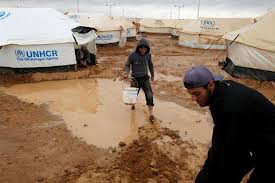
You’d think all the countries in the Middle East are warm, but there is nothing miserably colder than a desert country in the throws of winter . . .
French Intercede to Save Mali
Heard yesterday on NPR that France was stepping up to the plate on Mali, found the story on BBC this morning . . . it isn’t easy. It’s like people in the US don’t get news of countries like Mali unless they really seek it out. You can find more stories on Mali and the Tuareg / Al Qaeda alliance tormenting Northern Mali at the BBC link.


The Ansar al Din is imposing in Mali the kind of Islam that the Taliban imposed in Afghanistan – an Islam which forbids music, forbids women to participate in public life, enforced by a group of ignorant, uneducated thugs with weapons. Everything Ansar al Din stands for is contrary to the true nature of Islam.
Go France!
French troops continue operation against Mali Islamists
Mali: Divided nation
French Defence Minister Jean-Yves Le Drian said army units had attacked a column of rebels heading towards the central town of Mopti.
He also revealed that a French pilot had been killed in fighting on Friday.
The French troops deployed on Friday after Mali’s army lost control of a strategically important town.
Mali’s government said its forces had recaptured the town, Konna, after the air strikes, but it was not clear if all Islamist fighters had left the area.
‘Terrorist state’
Armed groups, some linked to al-Qaeda, took control of the whole of northern Mali in April.
They have sought to enforce an extreme interpretation of Islamic law in the area.
Regional and Western governments have expressed growing concern about the security threat from extremists and organised crime.
Mr Le Drian said on Saturday that hundreds of French troops were involved in the military operation in Mali.
The minister said Paris had decided to act urgently to stop the Islamist offensive, which threatened to create “a terrorist state at the doorstep of France and Europe”.
He also revealed that a French pilot was killed in Friday’s fighting – during an air raid to support Mali’s ground troops in the battle for Konna.
“During this intense combat, one of our pilots… was fatally wounded,” the minister said.
Speaking on Friday, French President Francois Hollande said the intervention complied with international law and had been agreed with Malian interim President Dioncounda Traore.
It would last “as long as necessary”, Mr Hollande said.
French officials gave few operational details.
Residents in Mopti, just south of Konna, told the BBC they had seen French troops helping Malian forces prepare for a counter-offensive against the Islamists.
Mr Traore declared a state of emergency across Mali, which he said would remain in place for an initial period of 10 days.
He used a televised address to call on Malians to unite and “free every inch” of the country.
‘Crusader intervention’
The west African bloc Ecowas said it was authorising the immediate deployment of troops to Mali “to help the Malian army defend its territorial integrity”.
UN Secretary-General Ban Ki-moon says the situation in Mali is becoming increasingly volatile
The UN had previously approved plans to send some 3,000 African troops to Mali to recapture the north if no political solution could be found, but that intervention was not expected to happen until September.
French Foreign Minister Laurent Fabius said the aim of the operation was to stop Islamist militants advancing any further.
It was not clear how far the French would go in helping Mali’s government retake territory in the north.
At least seven French hostages are currently being held in the region, and Mr Fabius said France would “do everything” to save them.
A spokesman for al-Qaeda in the Islamic Maghreb (AQIM) said he considered the French operation a “Crusader intervention”, and told France it would be “would be digging the tombs of [its] sons” if the operation continued, according to the Mauritania-based Sahara Media website.
France ruled Mali as a colony until 1960.
This chart is from a Blog called The Moor Next Door:

Saudi Government Informing ‘Responsible Male’ When Women Leave Saudi Arabia
Thank you, John Mueller, for this fascinating article from FRANCE 24:
Electronic tracking: new constraint for Saudi women – FRANCE 24
AFP – Denied the right to travel without consent from their male guardians and banned from driving, women in Saudi Arabia are now monitored by an electronic system that tracks any cross-border movements.
Since last week, Saudi women’s male guardians began receiving text messages on their phones informing them when women under their custody leave the country, even if they are travelling together.
Manal al-Sherif, who became the symbol of a campaign launched last year urging Saudi women to defy a driving ban, began spreading the information on Twitter, after she was alerted by a couple.
The husband, who was travelling with his wife, received a text message from the immigration authorities informing him that his wife had left the international airport in Riyadh.
“The authorities are using technology to monitor women,” said columnist Badriya al-Bishr, who criticised the “state of slavery under which women are held” in the ultra-conservative kingdom.
Women are not allowed to leave the kingdom without permission from their male guardian, who must give his consent by signing what is known as the “yellow sheet” at the airport or border.
The move by the Saudi authorities was swiftly condemned on social network Twitter — a rare bubble of freedom for millions in the kingdom — with critics mocking the decision.
“Hello Taliban, herewith some tips from the Saudi e-government!” read one post.
“Why don’t you cuff your women with tracking ankle bracelets too?” wrote Israa.
“Why don’t we just install a microchip into our women to track them around?” joked another.
“If I need an SMS to let me know my wife is leaving Saudi Arabia, then I’m either married to the wrong woman or need a psychiatrist,” tweeted Hisham.
“This is technology used to serve backwardness in order to keep women imprisoned,” said Bishr, the columnist.
“It would have been better for the government to busy itself with finding a solution for women subjected to domestic violence” than track their movements into and out of the country.
Saudi Arabia applies a strict interpretation of sharia, or Islamic law, and is the only country in the world where women are not allowed to drive.
In June 2011, female activists launched a campaign to defy the ban, with many arrested for doing so and forced to sign a pledge they will never drive again.
No law specifically forbids women in Saudi Arabia from driving, but the interior minister formally banned them after 47 women were arrested and punished after demonstrating in cars in November 1990.
Last year, King Abdullah — a cautious reformer — granted women the right to vote and run in the 2015 municipal elections, a historic first for the country.
In January, the 89-year-old monarch appointed Sheikh Abdullatif Abdel Aziz al-Sheikh, a moderate, to head the notorious religious police commission, which enforces the kingdom’s severe version of sharia law.
Following his appointment, Sheikh banned members of the commission from harassing Saudi women over their behaviour and attire, raising hopes a more lenient force will ease draconian social constraints in the country.
But the kingdom’s “religious establishment” is still to blame for the discrimination of women in Saudi Arabia, says liberal activist Suad Shemmari.
“Saudi women are treated as minors throughout their lives even if they hold high positions,” said Shemmari, who believes “there can never be reform in the kingdom without changing the status of women and treating them” as equals to men.
But that seems a very long way off.
The kingdom enforces strict rules governing mixing between the sexes, while women are forced to wear a veil and a black cloak, or abaya, that covers them from head to toe except for their hands and faces.
The many restrictions on women have led to high rates of female unemployment, officially estimated at around 30 percent.
In October, local media published a justice ministry directive allowing all women lawyers who have a law degree and who have spent at least three years working in a lawyer’s office to plead cases in court.
But the ruling, which was to take effect this month, has not been implemented.
Kuwait Celebrated Constitutional Jubilee with World Record Breaking Fireworks
Wooo Hooooo! And thank you, John Mueller, for forwarding this fabulous article. Holy smokes, it looks like double the number of viewers on the coast were in gridlock on the roads. For the original article, and to see a video of the fireworks live, go to Daily Mail:
Celebrating a golden jubilee Kuwait style: Gulf state spends £10million to put on the biggest firework display of all time
By PHIL VINTER
PUBLISHED: 21:12 EST, 10 November 2012 | UPDATED: 03:09 EST, 12 November 2012
For the paltry sum of just £10million Kuwait earned a place in the Guinness Book of Records last night as it celebrated the golden jubilee anniversary of its constitution in style by laying on the biggest fireworks display of all time.
A dazzling array of colours illuminated the skies above the country’s capital of Kuwait City as a staggering 77,282 fireworks were launched over the period of an hour.
A representative of Guinness World Records announced the achievement on Kuwait television at the end of the display which had been watched by tens of thousands of Kuwaitis and expatriates on the Arabian Gulf Road by the sea.
The visual presentation marked 50 years to the day since the late emir Sheikh Abdullah al-Salem al-Sabah announced that Kuwait had become the first Arab state in the Gulf to issue a constitution and have a parliament.
Before the festivities Emir Sheikh Sabah al-Ahmad al-Sabah pledged the government’s continuing commitment to democracy and made a plea for national unity as the wealthy Gulf state struggles with a political crisis.
Scroll down for video
 Exploding fireworks illuminate the sky over Kuwait City, Kuwait, last night, during celebrations on the occasion of the 50th Constitution Day jubilee
 The firework show which lasted for an hour was the largest of its kinds in the world and cost a reported £10million
 A dazzling array of colours illuminated the skies above the country’s capital of Kuwait City as a staggering 77,282 fireworks were launched over the period of an hour


A representative of Guinness World Records announced that the display was the biggest of all time on Kuwait television at the end of the display which had been watched by tens of thousands of Kuwaitis and expatriates on the Arabian Gulf Road by the sea
In the past 50 years parliament has been dissolved on nine occasions, while some articles of the constitution itself were frozen twice to suspend parliament for a total of 11 years in the 1970s and 1980s.
Last night’s celebration came as the government and opposition are locked in one of the worst standoffs in the country’s history, with the opposition accusing the government of staging a coup against the constitution.
More than 150 people and 24 policemen suffered minor injuries during three massive demonstrations held by the opposition to protest against the amendment of the electoral law ordered by the emir last month.
The opposition claims the amendment is in breach of the constitution and allows the government to influence the outcome of parliamentary polls due on December 1. It insists that the emir must repeal the amendment.
The opposition is marking the constitution anniversary with a huge rally in Kuwait City on Sunday.
Read more: http://www.dailymail.co.uk/news/article-2231223/Celebrating-golden-jubilee-Kuwait-style-Gulf-state-spends-10million-biggest-firework-display-time.html#ixzz2C1ZtoiKL
Follow us: @MailOnline on Twitter | DailyMail on Facebook
Election Day Fun
No more same old, same old. Today, Pensacola had a group of up-and-coming leaders from twelve African countries in town studying Grassroots Democracy and the US Elections. There is nothing like questions from non-US citizens to keep you on your toes and even give you a good laugh as you try to explain the eccentricities of our electoral system. This group, brought to Pensacola by the Gulf Coast Citizens Diplomacy Council, asked some great, probing questions.

Their questions were thoughtful and open-ended. At the end of the session, one delegate from Uganda summarized his observation that although we are deeply polarized in this election, we have confidence in our civil servants and the bureaucracy. While the leaders at the top may change, and while policies MIGHT change, they have to go through processes to change. It’s not like one leader or the other comes in and overnight, everything is changed, everything is done a different way.
AdventureMan says he loves that we live in a country where power is transferred peacefully – no coup. No revolution. We might have ugly elections, but they are peaceful, and when one triumphs, thousands of people supporting the losing side are not killed.
Had not thought about it that way. 🙂
These visitors are in Pensacola at just the right time for them to observe our biggest election. They have questions about everything, from the signs in our front yards to voter fraud and deceptive wording on proposed amendments. They talked today with the Supervisor of Elections, with elected officials, and with normal, everyday citizens. Tonight they will attend some of the parties around town, as the votes are counted. It is a very special experience for us, to see ourselves as others might see us, as we hold our elections.
Recent Comments
ExpatAlien on What Country am I Living … intlxpatr on Yellowstone: Old Faithful to C… Michelle on Yellowstone: Old Faithful to C… Cathy on No Grown-Ups in Charge intlxpatr on Waiting for Snow Wikipedia Donate Button

Amazina


Early Voting in Florida


 Here There and Everywhere