Woe to You!
We had a priest in Germany, a priest we dearly loved. He told us about how growing up, he would go to church with his Mom and after the sermon, she would say “I hope all those sinners were listening this morning!” AdventureMan and I sometimes say that after church, knowing full well that ‘those sinners’ is us.
It’s hard to read the scriptures for this morning, because Jesus is talking to religious people, and telling us that often the better we think we are, the farther we have to go.
Lord, clean us from the inside!
Matthew 23:13-26
13 ‘But woe to you, scribes and Pharisees, hypocrites! For you lock people out of the kingdom of heaven. For you do not go in yourselves, and when others are going in, you stop them.* 15Woe to you, scribes and Pharisees, hypocrites! For you cross sea and land to make a single convert, and you make the new convert twice as much a child of hell* as yourselves.
16 ‘Woe to you, blind guides, who say, “Whoever swears by the sanctuary is bound by nothing, but whoever swears by the gold of the sanctuary is bound by the oath.” 17You blind fools! For which is greater, the gold or the sanctuary that has made the gold sacred? 18And you say, “Whoever swears by the altar is bound by nothing, but whoever swears by the gift that is on the altar is bound by the oath.” 19How blind you are! For which is greater, the gift or the altar that makes the gift sacred? 20So whoever swears by the altar, swears by it and by everything on it; 21and whoever swears by the sanctuary, swears by it and by the one who dwells in it; 22and whoever swears by heaven, swears by the throne of God and by the one who is seated upon it.
23 ‘Woe to you, scribes and Pharisees, hypocrites! For you tithe mint, dill, and cummin, and have neglected the weightier matters of the law: justice and mercy and faith. It is these you ought to have practised without neglecting the others. 24You blind guides! You strain out a gnat but swallow a camel!
25 ‘Woe to you, scribes and Pharisees, hypocrites! For you clean the outside of the cup and of the plate, but inside they are full of greed and self-indulgence. 26You blind Pharisee! First clean the inside of the cup,* so that the outside also may become clean.
It’s Easy To Tell a Spy
This story interests me because I grew up in Cold War America, and when I was going to high school in Germany, we were surrounded by propaganda urging us always to be careful about anything we said, in public or even in private.
“It’s easy to tell a spy” the public service announcements would go, and show someone in a cafe, or in line waiting for a bus, or in the library giving out information on where her husband or father was deployed or when such and such a unit was going to the border, and a nefarious person writing it down to send back to their leaders, always the dreaded Russians.
They’re back. Did they ever go away?

NEW YORK -Nine people charged with operating as Russian spies entrenched in American suburbia were making long-shot bids to be released from jail pending trial Thursday, even as authorities scoured a Mediterranean island for an alleged co-conspirator who disappeared after he was granted bail.
Hearings were set for federal courts in Boston, New York and Alexandria, Va., for all but one of the 10 people arrested over the weekend by federal authorities in the United States.
Police searched airports, ports and yacht marinas Thursday to find an 11th person who was arrested in Cyprus but disappeared after a judge there freed him on $32,500 bail. The man, who had gone by the name Christopher Metsos, failed to show up Wednesday for a required meeting with police.
Authorities also examined surveillance video from crossing points on the war-divided island, fearing the suspect might have slipped into the breakaway north, a diplomatic no-man’s-land that’s recognized only by Turkey and has no extradition treaties.
In the U.S., Donald Heathfield and Tracey Foley, of Cambridge, Mass., were scheduled to appear Thursday at a federal court in Boston. Mikhail Semenko, Michael Zottoli and Patricia Mills, all of Arlington, Va., were set for a hearing before Magistrate Judge Theresa Buchanan in U.S. District Court in Alexandria. Defendants Richard Murphy, Cynthia Murphy, Juan Lazaro and Vicky Pelaez were to go before a judge in New York.
All have been charged with being foreign agents. Officials said the suspects will all eventually be transferred to New York, where the charges were filed.
Not due in court Thursday was Russian beauty Anna Chapman, the alleged spy whose heavy presence on the Internet and New York party scene has made her a tabloid sensation. She was previously ordered held without bail.
Eight of the suspects were accused by prosectuors of being foreign-born, husband-and-wife teams who were supposed to be Americanizing themselves and gradually developing ties to policymaking circles in the U.S.
Most were living under assumed identities, according to the FBI. Their true names and citizenship remain unknown, but several are suspected of being Russians by birth.
Heathfield claimed to be a Canadian but was using a birth certificate of a deceased Canadian boy, agents said in a court filing. His wife, Tracey Foley, purported to be from Canada, too, but investigators said they searched a family safe deposit box found photographs taken of her when she was in her 20s that had been developed by a Soviet film company.
Juan Lazaro had said he was born in Uraguay and was a citizen of Peru; he was secretly recorded by the FBI talking about a childhood in Siberia, according to court documents.
Two, Chapman and Mikhail Semenko, were Russians who didn’t attempt to hide their national origin, FBI agents said, but they had a similar mission: blend in, network and learn what they could.
Britain’s Foreign Secretary William Hague said the U.K. was investigating whether Foley might have used a forged British passport. The British spy agency MI5 is also investigating the extent to which Foley and Chapman had links to London, and will likely seek to find out whether either attempted to recruit British officials as informants.
There is evidence that at least some of the alleged agents had success cultivating contacts in the business, academic and political worlds.
The criminal complaint alleges that either Heathfield or Foley sent messages to Moscow talking about turnover at the CIA that was supposedly “received in private conversation” with a former congressional aide. Other messages described Heathfield establishing contact with a former high ranking U.S. national security official, and with a U.S. researcher who worked on bunker-busting nuclear warheads.
Moscow thanked Cynthia Murphy for having passed along “very useful” information about the global gold market and instructed her to strengthen ties with students and professors at Columbia University’s business school, where she was getting a degree, according to the FBI.
Among other things, the Russians wanted “detailed personal data and character traits w. preliminary conclusions about their potential to be recruited by Service,” according to one intercepted message.
Clare Lopez, senior fellow at the Center for Security Policy and a professor at the Centre for Counterintelligence and Security and a former operations officer for the CIA, said the alleged plotters might have someday been able to produce valuable information, if left in place long enough.
“Their value is not just in acquiring classified information,” she said. “There’s a lot that goes on that’s not simply stealing secrets and sending them back to Moscow.”
Metsos was charged with supplying funds to the other members of the ring.
Cypriot Justice Minister Loucas Louca on Thursday admitted that a judge’s decision to release him on bail “may have been mistaken” and said authorities were examining leads on his possible whereabouts.
“We have some information and we hope that we will arrest him soon,” Louca told reporters, without elaborating.
Cyprus has for decades been a hotbed of espionage intrigue as spies converge on the eastern Mediterranean island at the crossroads of Europe, Africa and Asia.
More recently, former CIA agent Harold Nicholson, in prison for espionage, recruited his 24-year-old son Nathaniel to meet with Russian agents in cities around the world from 2006 to 2008 to collect money owed by his former handlers. One of those cities was the Cypriot capital, Nicosia.
Heartache in Pensacola
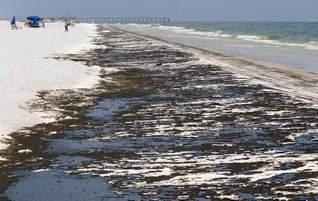
It’s a beautiful full moon over the oil soaked beaches of Pensacola. There is a beach advisory against children on the beach, against pregnant women or people with weak immune systems being on the beach. The surf is contaminated with oil and VOC, which is volatile organic compounds, whatever that means, it is bad.


Emir Pardons Saudis for Failed Coup Attempt in Qatar
Has there ever been any other mention of the failed coup attempt? Is the the one that was purported to have taken place late last summer?
Emir pardons Saudi prisoners
The Peninsula
Doha: In response to a desire by the Custodian of the Two Holy Mosques King Abdullah bin Abdulaziz of Saudi Arabia, the Emir H H Sheikh Hamad bin Khalifa Al Thani has issued an Emiri decision pardoning a number of Saudi nationals sentenced for their involvement in the failed coup attempt to destabilise security and stability in Qatar.
Those released left the country yesterday accompanying the Saudi Deputy Commander of the National Guard for Executive Affairs, Prince Mit’ib bin Abdulaziz, an official source at the Foreign Ministry said in a statement.
The Saudi king later expressed his profound appreciation of the Emir’s decision. The king praised the strong relations of kinship and good neighbourliness that bind the people of the two countries.
Kuwait or Qatar or Pensacola?
Showering after my water-aerobics class, I could hear voices discussing a local political-social situation. A benefits agency has groups of families working in it, and they know all the tricks. They know how to insure more of their own family members hired, and they know how to help all their family members (and friends) take advantage of all the entitlements.
Expats abroad call it nepotism, and scorn it as a third-world corruption. In truth, it happens everywhere.
There is an ongoing schism taking place in Qatar and Kuwait, countries that have been gracious and welcoming to me. The nationals of Kuwait and Qatar control citizenship carefully. The citizen base is about 20% of the population, on a good day. The rest of the population are people who are in Kuwait and Qatar to work. Most there to work can never hope for citizenship. For many, the poverty in their home country is so brutal that no matter how hard the working conditions, at least it is a salary, and they can send something home so that, literally, their families can eat. They dream – like we do – of educating their children so that they will have a better, more secure life.
Here is the problem. When 80% of the population is NON-Kuwaiti, or NON-Qatari, your country starts to change. One way in which things have changes is that in a very short time, the highways have gone from very quiet to gridlock, due to a dramatic increase in drivers and cars. In Qatar, the situation is made worse by nationalization of the taxi service, resulting in so few taxis that hotels now use private limo services, because finding a taxi at peak times is near to impossible.
That’s one issue. The second issue is language. Imagine your elderly parents going into shops to buy something – in their own country – and the clerks don’t speak their language. As they are stumbling and bewildered, some noisy “workers” walk in, state their needs, are understood, conduct their business and exit before you even get served. This is happening in Kuwait and in Qatar; everyone is speaking English. In a country where the workers are Indian, Nepalese, Philipino, Saudi, Yemani, Omani, Lebanese, Syrian, French, Dutch, English, Australian, South African, American (and about thirty or forty others) the common language has evolved to be English, not Arabic.
How do you think you would feel if it were happening here? If the great majority of cars on the road were not “us” but “guests” in our country? If the clerks in stores couldn’t understand what you want, because although they are in your country, they don’t speak your language?
Another problem is what to do with the huge, disproportionate number of geographically single males brought in to work as builders, cleaners, heavy equipment operators, dishwashers, drivers, security guards and other fairly low-paid positions? In Kuwait and in Qatar, non-married sex is strictly forbidden, even holding hands in public is considered an affront to morality. These men are banned from malls where families might gather, and from other public places. Their existence is grim, and they often find themselves unpaid, or paid far less than they were promised for their labor.
Last, but not least, this very modest Gulf culture has people – foreign guest workers – parading themselves on their streets in various states of undress. Think about it – that’s how we look to them. We have no shame. We bare our faces. We flaunt the glory of our uncovered hair. Sometimes a shawl might drop and a glimpse of bare arm or even a hint of cleavage might shock the modest eyes of a believer.
In Pensacola, there are also fundamentalists who wear long skirts, long sleeves, and determinedly modest clothing. I wonder what these believers think about the skimpy clothing on the beaches, or in the malls?
Coming home has been a real eye opener. It was easy for me to be critical of things I saw in Qatar and in Kuwait. Coming home, we joke all the time about “Kuwaiti drivers” here in the US, but the real joke is – they sure look a lot like us.
Last week, we saw a man here make a U-turn right in the middle of the road, and rock as he tried to regain control of his truck, and almost blast right through a red light he didn’t see. The back of his truck was down, and items loose in the truck bed were heading toward the highway – fortunately he figured that out, and last we saw, he had stopped to fix his rear door. Maybe he wasn’t sober. Maybe he had had an argument with his wife or boss or someone and was not paying close attention to his driving. All I know is that we have seen a goodly number of inattentive drivers here, too.
When a bureaucracy gets corrupted, when the rules are not applied equally to all, when select groups get favored treatment – here in Pensacola, at the immigration department in Kuwait or in the traffic department in Qatar – everyone suffers. It’s a political problem, a social problem, and a systemic problem. God willing, if we are truly evolving as a species, we will find a way to create truly fair and transparent systems which will work as they are ideally intended to work.
It’s on us. We have to make it happen. We have to want it badly enough to make it happen, even making sacrifices for the greater good.
I don’t have any answers. I don’t know how to make us better people that we are, how to make ourselves make the right choices. I do know this – whether it is a tiny village in Germany, or an eagle’s aerie in Kuwait, or the lush life of Doha – we are all more alike, and share more similarities and problems, than we are different. If we could only learn to see through one another’s eyes, maybe we could find ways to resolve our differences and learn to cooperate.
Kuwait Bans Blackberry?
I have always loved politics. I don’t love politick-ing, I love watching what politicians do. One of the first rules, in my book, is “Don’t pass laws you can’t enforce.”
It’s pretty basic. Have you ever watched parents who tell their children over and over “Don’t do (whatever)” but they are too lazy to get off their big bottoms to go over and distract the child or to enforce penalties for misbehavior? What happens? The child does – or continues to do – what he or she wants, while the parent either gives up or escalates to a punishment out of proportion to the infraction.
Governments are the same. Don’t make a big noise if you don’t intend – or can’t – follow through. Don’t create penalties you can’t or won’t enforce.
Trying to ban Blackberries in Kuwait – LLLLLOOOOOOLLLLLLLLL! Trying to ban message services? These tech-savvy young people can run circles around the politicians and bureaucrats who try. This is a total hoot.
BlackBerry Ban Eyed
KUWAIT CITY, May 23: The Ministry of Interior is planning to stop BlackBerry Messenger (BBM) service and a decision to this effect might be issued within the next few days, reports Al-Shahid daily. A security source said the service cannot be controlled by the Ministry of Communications or security authorities and hence, users of BlackBerry sets were taking advantage to spread rumors and call for strikes.
He added that the ministry came to the decision after conducting studies and holding several meetings in the last fortnight. The three telecommunication companies in Kuwait, however, said they had not received any official request from the Interior Ministry so far.
Arab Times Online
Victory at the Shrimp Basket
This is a moral victory. AdventureMan and I ate at the Shrimp Basket last week and we DID NOT eat fried food! We tried their non-fried platters, AdventureMan had the grilled fish and shrimp, and I had the blackened fish and shrimps. I took the photo before eating! (another victory, woooo HOOOO!)
Yes, I did dip my shrimp in the melted butter. I could not resist. This is one of the best seafood meals I have had in a long time, it was totally delicious.

On the table was this sign:
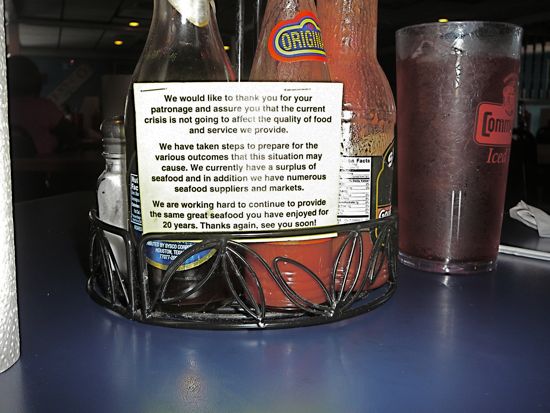
The oil has started coming ashore in Louisiana. It is thick and gooey, and it is sticking to the marshlands, clinging to delicate feathers on birds and suffocating wildlife. This is the beginning of a long, long, ugly process of trying to reclaim what nature never intended the oil to touch. It is devastating.
Music Banned in Somalia
We are in our own world these days, boxes needing unpacking, deliveries interrupting tasks, and no connection – no TV, no internet, no land line phone. We do have a cell phone, and Friday night our son called to ask us if we have heard about the weather.
Nope.
Heavy rains, strong winds, possibility of tornados. It was lively!
I hadn’t heard about Somalia, either.
This is really scary to me. This is the kind of thing I worry about in my own country – who makes the rules? Who gets to say what music I listen to, what movies I watch? Who gets to restrict my access to information?
Who gets to tell me that as a woman, I can’t have a checking account in my name? Or that I have to wear a burqa? Or that I am not allowed to wear a niqab (if that’s what I want?)
Somalia Radicals Declare Music ‘Un-Islamic,’ and Radio Goes Tuneless
POSTED: 04/25/10
If, as my colleague Sarah Wildman reports, the Francophonic world is intent on curbing expressions of fundamentalist Islam belief, then the radical Muslim world is taking no prisoners with the West, either. Last week, the Somalian fundamentalist Islamic group Hizbul Islam announced that music of any kind is “un-Islamic,” warning of “serious consequences” for those who dare to violate their decree. In response, radio stations all over the country, including those run by the moderate Muslim transitional government, cut all music from their broadcasts. Even intro music for news reports was scrapped. In its place? “We are using sounds such as gunfire, the noise of vehicles and the sound of birds to link up our programmes and news,” said one Somalian head of radio programming.
Get the new
PD toolbar!
Somalia has been wracked with inter-tribal violence for nearly two decades. In the last few years, increasingly radical Muslim militants, including the dominant Shabab group, have taken over large parts of the country and become closely affiliated with al-Qaeda. A moderate Muslim transitional government, helmed by a former teacher named Sheik Sharif Sheik Ahmed, controls a small part of the country. His government is largely propped up by African Union peacekeepers, with United Nations’ and U.S. support.
In the meantime, Islamic radicals like Shabab have gone on a campaign the New York Times described as “a quest to turn Somalia into a seventh century style Islamic state.”
The music decree follows a string of fundamentalist decrees, including prohibitions on wearing bras (also “un-Islamic”), the banning of modern movies and news channels, including the BBC and Voice of America.
As evidence of a power struggle between the moderate Muslim government and the hard-line radicals who control many parts of the country, Sheik Ahmed’s government responded last Sunday by saying any radio stations that stopped playing music would face closure. In the government’s eyes, those radio stations that complied with the ban were colluding with the radicals.
In the meantime, the radio stations have been caught between a rock and a hard place. “The order and counter-order are very destructive,” radio director Abukar Hassan Kadaf said in the Times article. “Each group are issuing orders against us and we are the victims.”
In the escalating tug-of-war between Western and Islamic powers over freedom of expression, what remains to be seen is how much of a causal relationship exists between the two. Is a proposed burqa ban in Quebec a result of the shuttering of a radio station in Somalia? Does a call for prohibition of headscarves in Paris force a bra-burning in Mogadishu?
If Islamic decrees do, in fact, fuel the fire for legal actions in the West (and vice versa), then continued and increased prohibition seems inevitable. But if radical Islam and a skeptical West are destined to one-up each other in a battle of bans, the powers that be might remember the men and women caught in the crossfire. That is, the women in the West who wear niqabs by choice, or the men and women in Somalia who just want to listen to music. What is perhaps most strikingly absent in all the brouhaha surrounding sharia vs. Western law are the voices of the moderate Muslims themselves. In the end, perhaps the gulf between the two sides will prove too great to be bridged, but for the immediate future, we would do well to remember the ground we share in common. Before there’s nothing left to ban.
Tax Day Tea Party in Pensacola
We don’t really understand the Tea Party. It is clearly against Obama, but then again, it is clearly the party of “against” and it is hard to find anything it is for. This is a problem; it is easy to tear down, and it is a lot more difficult to create – to formulate solutions which will provide benefits for the majority of participants.
As we were approaching our hotel, we saw this huge crowd of ‘protesters’ who appeared to be partying. But every sign was different! As 15 April is Tax Day, the day our income taxes are due, maybe about 10% were carrying signs that had to do with taxes, preferably NO taxes. The rest of the signs protested other things – constitutional amendments (what – women voting? black people being counted as full people? the repeal of prohibition?), no abortion, putting God first – it was a total potluck of causes.
The weather was mild, the sun was shining, there was a breeze – great day for an incoherent protest, LOL. I took pictures from the safety of our car, although everyone seemed very friendly:






Here is what cracks us up. Pensacola is a highly military reliant community. There is a huge military presence here, from Eglin Air Force Base to the Pensacola Naval Air Station. Pensacola is glad to have the military business. So where do they think the money comes from that pays the military salaries, and thus, gets spent in their economy, at their businesses? Few Americans have saved enough to comfortably retire, who do they think is contributing to their Social Security support, and Medicare, and Medigap? Tax dollars! Who do they think supports public education, and guarantees law and order? Who do they think runs the justice system? Who do they think provides emergency fire and medical services? Tax dollars! Who builds and maintains the roads and bridges, insures safety in our food supplies, construction and medicines? Our government, supported by our tax dollars!
Do I like paying taxes? No! Not one bit! But in the interest of the greater good, we pay our taxes honestly, and thank God to live in a society with order, thanks to our tax dollars.
Qatar Quits Instant Tourist Visa for US Citizens?
Rumor has it that The Government of Qatar recently informed the U.S. Embassy that as of May 1, 2010 U.S. citizens will no longer be able to apply for tourist visas on arrival in Qatar.
U.S. citizens who plan on travelling to Qatar after May 1, 2010 should contact their nearest Qatari Embassy (www.english.mofa.gov.qa) or the Ministry of Interior (www.moi.gov.qa/site/english) for details on how to apply for their visa.
That’s a fairly spectacular change, and sort of short notice . . .
Recent Comments
Kitchen on Isiais: Winding Down intlxpatr on Shampoo Ginger tigerbutterya0c5ff1d… on Shampoo Ginger intlxpatr on British Soldier Kidnapped, Esc… John on British Soldier Kidnapped, Esc… Wikipedia Donate Button

Amazina


Early Voting in Florida


