Sarah Palin and Hillary Clinton
If you missed Saturday Night Live’s spoof of Sarah Palin and Hillary Clinton (Tina Fey & Amy Poehler), see it now:
Watch it now, before they take it off!
9/11 Conspiracy Theories Live
When most Americans hear these theories, they just laugh – it never occurs to them that anyone could take them seriously. The New York Times does an article on 9/11 conspiracy theories just as that tragic anniversary approaches:

9/11 Rumors That Become Conventional Wisdom
Justin Lane for The New York Times
CAIRO — Seven years later, it remains conventional wisdom here that Osama bin Laden and Al Qaeda could not have been solely responsible for the attacks of Sept. 11, 2001, and that the United States and Israel had to have been involved in their planning, if not their execution, too.
Many in Cairo see the attacks as part of an anti-Muslim plot.
This is not the conclusion of a scientific survey, but it is what routinely comes up in conversations around the region — in a shopping mall in Dubai, in a park in Algiers, in a cafe in Riyadh and all over Cairo.
“Look, I don’t believe what your governments and press say. It just can’t be true,” said Ahmed Issab, 26, a Syrian engineer who lives and works in the United Arab Emirates. “Why would they tell the truth? I think the U.S. organized this so that they had an excuse to invade Iraq for the oil.”
It is easy for Americans to dismiss such thinking as bizarre. But that would miss a point that people in this part of the world think Western leaders, especially in Washington, need to understand: That such ideas persist represents the first failure in the fight against terrorism — the inability to convince people here that the United States is, indeed, waging a campaign against terrorism, not a crusade against Muslims.
“The United States should be concerned because in order to tell people that there is a real evil, they too have to believe it in order to help you,” said Mushairy al-Thaidy, a columnist in the Saudi-owned regional newspaper Asharq al Awsat. “Otherwise, it will diminish your ability to fight terrorism. It is not the kind of battle you can fight on your own; it is a collective battle.”
There were many reasons people here said they believed that the attacks of 9/11 were part of a conspiracy against Muslims. Some had nothing to do with Western actions, and some had everything to do with Western policies.

Again and again, people said they simply did not believe that a group of Arabs — like themselves — could possibly have waged such a successful operation against a superpower like the United States. But they also said that Washington’s post-9/11 foreign policy proved that the United States and Israel were behind the attacks, especially with the invasion of Iraq.
“Maybe people who executed the operation were Arabs, but the brains? No way,” said Mohammed Ibrahim, 36, a clothing-store owner in the Bulaq neighborhood of Cairo. “It was organized by other people, the United States or the Israelis.”
You can read the entire article at The New York Times.
Moroccan Blogger Jailed
You can read the entire story, which appeared today, on BBC News Africa:

A Moroccan blogger has been jailed for two years for showing disrespect to the monarchy, say the man’s family.
Mohammed Erraji, 29, was convicted after writing an article claiming King Mohammed VI’s charitable habits were encouraging a culture of dependency.
There has been no official comment on the case, but rights groups claim Erraji did not have a fair trial.
A BBC reporter says criticising the king is an offence in Morocco and the royal family remains a taboo subject.
Morocco has previously caused international outrage with its treatment of internet users.
Earlier this year, Fouad Mortada was sentenced to three years in prison for creating a false profile on the internet site Facebook using the identity of the king’s brother.
He received a royal pardon following protests from internet users around the world.
‘Disastrous’
Erraji claimed in an internet article that the king’s charity towards Moroccans was stifling development by encouraging people to be lazy.
“This has made the Moroccans a people without dignity, who live by donations and gifts,” he wrote.
The BBC’s James Copnall in the capital, Rabat, says he was particularly critical of the practice known as grima – giving lucrative licences to run taxis and other transport in exchange for begging letters.
Erraji said this did not happen in developed countries, where hard work rather than begging is rewarded.
He was arrested by the authorities last Friday and accused of “lacking the respect due to the king”.
In court on Monday, he was given a two-year prison sentence and fined 5,000 Dirham ($630:£356).
Building 7 Collapse Solved, No Mystery
Feds Say They’ve Solved 9/11 Mystery
By DEVLIN BARRETT, AP
GAITHERSBURG, Md. (Aug. 21) – Federal investigators said Thursday they have solved a mystery of the Sept. 11, 2001, attacks: the collapse of World Trade Center building 7, a source of long-running conspiracy theories.
The 47-story trapezoid-shaped building sat north of the World Trade Center towers, across Vesey Street in lower Manhattan. On Sept. 11, it was set on fire by falling debris from the burning towers, but skeptics have long argued that fire and debris alone should not have brought down such a big steel-and-concrete structure.
Federal investigators said Thursday they have resolved a lingering question from the Sept. 11, 2001, terror attacks: What caused World Trade Center 7 to collapse? They determined the building, which sat north of the World Trade Center towers, was brought down by fire started by debris from the twin towers.
Scientists with the National Institute of Standards and Technology say their three-year investigation of the collapse determined the demise of WTC 7 was actually the first time in the world a fire caused the total failure of a skyscraper.
“The reason for the collapse of World Trade Center 7 is no longer a mystery,” said Dr. Shyam Sunder, the lead investigator on the NIST team.
Investigators also concluded that the collapse of the nearby towers broke the city water main, leaving the sprinkler system in the bottom half of the building without water.
The building has been the subject of a wide range of conspiracy theories for the last seven years, partly because the collapse occurred about seven hours after the twin towers came down. That fueled suspicion that someone intentionally blew up the building in a controlled demolition.
Critics like Mike Berger of the group 9/11 Truth said he wasn’t buying the government’s explanation.
“Their explanation simply isn’t sufficient. We’re being lied to,” he said, arguing that there is other evidence suggesting explosives were used on the building.
Sunder said his team investigated the possibility that an explosion inside the building brought it down, but found there was no large boom or other noise that would have occurred with such a detonation. Investigators also created a giant computer model of the collapse, based partly on news footage from CBS News, that they say shows internal column failure brought down the building.
Investigators also ruled out the possibility that the collapse was caused by fires from a substantial amount of diesel fuel that was stored in the building, most of it for generators for the city’s emergency operations command center.
The 77-page report concluded that the fatal blow to the building came when the 13th floor collapsed, weakening a critical steel support column that led to catastrophic failure.
“When this critical column buckled due to lack of floor supports, it was the first domino in the chain,” said Sunder.
The NIST investigators issued more than a dozen building recommendations as a result of their inquiry, most of which repeat earlier recommendations from their investigation into the collapse of the two large towers.
In both instances, investigators concluded that extreme heat caused some steel beams to lose strength, causing further failures throughout the buildings until the entire structure succumbed.
The recommendations include building skyscrapers with stronger connections and framing systems to resist the effects of thermal expansion, and structural systems designed to prevent damage to one part of a building from spreading to other parts.
A spokeswoman for the leaseholder of the World Trade Center, developer Larry Silverstein, praised the government’s work.
“Hopefully this thorough report puts to rest the various 9/11 conspiracy theories, which dishonor the men and women who lost their lives on that terrible day,” said Silverstein spokeswoman Dara McQuillen.
In discussing the findings, the investigator Sunder acknowledged that some may still not be convinced, but insisted the science behind their findings is “incredibly conclusive.”
“The public should really recognize the science is really behind what we have said,” he said, adding: “The obvious stares you in the face.”
Copyright 2008 The Associated Press. The information contained in the AP news report may not be published, broadcast, rewritten or otherwise distributed without the prior written authority of The Associated Press. Active hyperlinks have been inserted by AOL.
Geraldine Brooks: March
Geraldine Brooks knocks my socks off. If she writes a book, fiction or non-fiction, I will buy it and read it. The first one I read by her was Nine Parts Desire: The Hidden World of Islamic Women, and the second most memorable book was her Year of Wonders, a book about how the plague comes to a 17th century English village and how the villagers cope with it – how some survive. She has a knack for keen observations, and for writing so as to place you squarely in the scene she is describing.
So when she came out with a new book extrapolating from the experiences protrayed in Louisa May Alcott’s classic favorite Little Women, why didn’t I rush to buy it? March is described by Publisher’s Weekly as “the Civil War experiences of Mr. March, the absent father in Louisa May Alcott’s Little Women.”

Didn’t you love Little Women when you read it? What’s not to love? Those wonderful sisters, their saintly mother, working together, suffering together, prevailing through sheer grit and determination – we can read that book over and over again, loving it every time.
Geraldine Brooks takes us with Mr. March into the grim realities of the American Civil War, the “war to free the slaves,” the war to keep the United States united, or the war between the states. This is not the idealized world of Little Women, this is not the memory we have of the nice letters he writes home from the field, this is the reality of war and all it’s ugliness. As the book opens, Mr. March is fleeing a massacre, struggling to survive, he is surrounded by the dead and seriously wounded, bullets are flying past him and he has to cross a deep, rushing river. A man grabs him who can’t swim, and he has to push him away to gasp for air. The man drowns, March survives, feeling deep guilt. When he finally finds a group of his men, drying out by the side of the river, he sits down and writes to his girls about the sweet breeze in the air. Not a word about the horrors he has witnessed, not his personal despair about having failed a wounded comrade.
As we experience the horrors of this war with Mr. March, we experience with him the brutality, cruelty, and crudity of all conflict. There are no good guys. There is no “just cause,” just winners and losers, and it’s very hard to tell what they are fighting for. Seeing this war from the point of view of the combatants, we realize that no-one will remain untouched; that this experience will resonate through the rest of their lives.
Geraldine Brooks knows how to grab us and keep us gripped. Every chapter reveals a new facet – how March and Marnee met and married, how they built a life together, how, in their idealism, they lost everything. Most discouraging of all is how, below the surface, they understand themselves and one another and their relationship so little.
I dare you to read this book. It isn’t an easy book, and at the same time, it is a book with timeless qualities, and a book that will get you thinking and keep you thinking for a long time. Isn’t that the definition of a good book?
Vanity Fair Spoofs Obama Cover
Vanity Fair Spoofs New Yorker Cover
From AOL News
(July 23) – Call it the battle, albeit friendly, of political cartoon satire. A little more than a week after The New Yorker magazine caused a commotion with its controversial magazine cover of Barack Obama and his wife, Vanity Fair decided it wouldn’t be outdone.

This week, the magazine published a spoof cover — published only on the Vanity Fair Web site — of John McCain and his wife in a similar pose and in the same Oval Office setting.
But this image may create some of its own controversy. It shows the 71-year-old McCain, often the butt of age jokes, using a walker, and his wife Cindy — who once had a drug problem — cradling an armful of prescription pill bottles. A portrait of President Bush hangs above a fireplace where the Constitution is burning.
Why Women Should Vote
“Courage in women is often mistaken for insanity.”
When I got this in the mail this morning, I had to smile. The woman who sent it to me is now in her 90’s. She was a mentor to me as a young woman, and she was a pistol. She taught me, over and over again, that women can do anything they put their mind to doing – that nothing can hold us back except ourselves. She’s a pistol. I want to be like her when I grow up. 🙂
It is always a shock to me to know that women in the United States have only had the right to vote for less than a hundred years. We take it for granted. We shouldn’t. We should make our vote a mighty force.
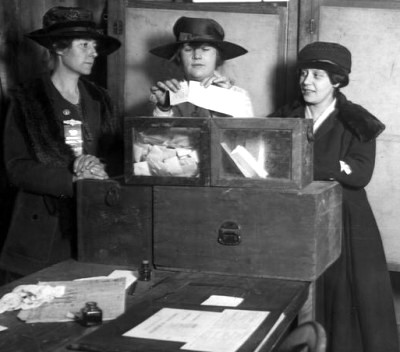
WHY EVERY WOMAN SHOULD VOTE
This is the story of our Grandmothers, and Great-grandmothers, as they
lived only 90 years ago. It was not until 1920 that women were granted
the right to go to the polls and vote.
Thus unfolded the ‘Night of Terror’ on Nov. 15, 1917, when the warden at
the Occoquan Workhouse in Virginia ordered his guards to teach a lesson
to the suffragists imprisoned there because they dared to picket Woodrow
Wilson’s White House for the right to vote. The women were innocent and
defenseless. And by the end of the night they were barely alive. Forty
prison guards wielding clubs and their warden’s blessing went on a
rampage against the 33 women wrongly convicted of ‘obstructing sidewalk
traffic.’
They beat Lucy Burn, chained her hands to the cell bars above her head
and left her hanging for the night, bleeding and gasping for air. They
hurled Dora Lewis into a dark cell, smashed her head against an iron bed
and knocked her out cold. Her cell mate, Alice Cosu, thought Lewis was
dead and suffered a heart attack. Additional affidavits describe the
guards grabbing, dragging, beating, choking, slamming, pinching,
twisting and kicking the women.
For weeks, the women’s only water came from an open pail. Their
food–all of it colorless slop–was infested with worms. When one of the
leaders, Alice Paul, embarked on a hunger strike, they tied her to a
chair, forced a tube down her throat and poured liquid into her until
she vomited. She was tortured like this for weeks until word was
smuggled out to the press.
So, refresh my memory. Some women won’t vote this year because–why,
exactly? We have carpool duties? We have to get to work? Our vote
doesn’t matter? It’s raining?
Last week, I went to a sparsely attended screening of HBO’s new movie
‘Iron Jawed Angels.’ It is a graphic depiction of the battle these women
waged so that I could pull the curtain at the polling booth and have my
say. I am ashamed to say I needed the reminder.
All these years later, voter registration is still my passion. But the
actual act of voting had become less personal for me, more rote.
Frankly, voting often felt more like an obligation than a privilege.
Sometimes it was inconvenient.
My friend Wendy, who is my age and studied women’s history, saw the HBO
movie , too. When she stopped by my desk to talk about it, she looked
angry. She was–with herself. ‘One thought kept coming back to me as I
watched that movie,’ she said. ‘What would those women think of the way
I use–or don’t use–my right to vote? All of us take it for granted
now, not just younger women, but those of us who did seek to learn.’ The
right to vote, she said, had become valuable to her ‘all over again.’
HBO released the movie on video and DVD. I wish all history, social
studies and government teachers would include the movie in their
curriculum. I want it shown on Bunco night, too, and anywhere else women
gather. I realize this isn’t our usual idea of socializing, but we are
not voting in the numbers that we should be, and I think a little shock
therapy is in order.
It is jarring to watch Woodrow Wilson and his cronies try to persuade a
psychiatrist to declare Alice Paul insane so that she could be
permanently institutionalized. And it is inspiring to watch the doctor
refuse. Alice Paul was strong, he said, and brave. That didn’t make her
crazy. The doctor admonished the men: ‘Courage in women is often
mistaken for insanity.’
Please, if you are so inclined, pass this on to all the women you know.
We need to get out and vote and use this right that was fought so hard
for by these very courageous women. Whether you vote democratic,
republican or independent party – remember to vote.
History is being made.
Bush Tours America To Survey Damage Caused By His Presidency
Hilarious video from The Onion.
Women Are Women: Abayas and Hijab
One of the questions I get most often when I am back in the US is whether I have to cover, whether I have to wear an abaya, whether I have to cover my hair.
I tell them that in Kuwait, it is still a choice. Many Kuwaiti women do not cover their hair, but most dress modestly and are still traditional and conservative in behavior.
I tell them that in Saudi Arabia, I had to wear the abaya, but that the embassy instructions were to carry a scarf, but only to wear it if the muttawa / religious police made a fuss, as it was not the law of the country. The law stated that Moslem women would be covered, but not non-Muslim women. The Saudi women would tell me all the time that I didn’t have to cover, but when I mentioned the Muttawa – they all just sighed and nodded, and said that some people have a funny idea about religion, but that this was not the real Islam.
What I loved about women in Saudi Arabia is that they have a lot in common with women everywhere. When confined, they have ways to press the envelope. For example, the malls are full of stores with the sexiest shoes I have ever seen – and when feet are one of the few things that CAN be seen, guess where the money gets spent? There were also entire floors devoted to perfumes, and women would pass and you could nearly swoon from the delicious scents, an entire cloud of scents as they passed, cloaked in anonymity. There were glove shops, with the sexiest, laciest gloves you have ever seen. At the time, most of the abayas and scarves in Saudi Arabia were plain black, although occasionally you might see one with a discreet little trim, or a tiny little sparkle.
The kids told me they could tell their family members; they learned to identify posture and voices. They didn’t have any problems picking out their Moms and sisters.
Women would approach me in stores, standing next to me, pretending to examine some goods and whisper “Hi! Where are you from?” and “Do you like it here?” Many times, on planes, husbands would make their wives change places so as not to be contaminated by sitting by the likes of me, a wicked western woman with her hair showing, but the women would smile shyly when the husband was looking the other way. Women are women. We have our ways. We manage to get around restrictions.
On the other hand, I want to share with my Western readers the trend in abayas and scarves in the last few years. They are GORGEOUS, and there are times I am tempted to buy just because they are gorgeous.
On a deserted morning, I found these shop windows to share with you:
These are going-out-calling dresses, worn under abayas

These would probably be worn to an evening event like a wedding

Even the younger girls have special evening clothes
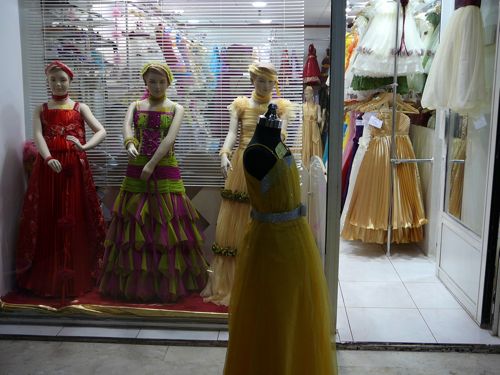
Not your old fashioned abayas

Love these details

Scarves to wear with abaya

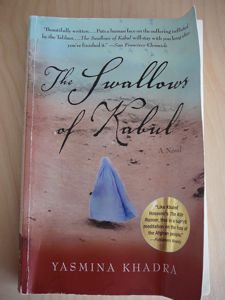
Khadra and The Swallows of Kabul
While waiting for our luggage to be offloaded, we were passing time, visiting with our greeter / expediter, asking about his family, his life in Zambia.
“How does this work, travelling with your son and your daughter-in-law?” he asked us. “Do you like her?”
Nothing on earth could disguise the delight on our faces as we both said “Yes!” We truly adore her.
When our son was only seven years old, a Christian speaker passing through said that if you have children, it is likely that their mates have also been born, so to start praying now for the unknown mate your child would choose, and we did.
When our son called us from university, and told us there was someone he wanted us to meet at graduation, and graduation was still months away, we knew, we just knew, that this might be THE ONE.
We were so delighted when we met her, we liked her immediately. What parent isn’t happy to see his/her son/daughter happy, and choosing well?
“But!” our meeter/greeter added, “how do you like her family?”
And we laughed again! We love her family! Her father is smart and very funny, and her mother is kind and practical, and we all share the same values on family and friends and living our lives. She comes from a large rowdy family that gathers when they can, and so do we.
And YOU are thinking “what does all this have to do with The Swallows of Kabul?” but I am getting there.
On the trip, we all had books for our quiet time, and I could see EnviroGirl deeply engrossed in this book. When I asked her, she said she had gotten it from her father’s wife, a woman with whom I often talk books, and that she (EnviroGirl) was trying to finish it so that she could leave it with me.
And thank goodness that she did! I couldn’t put it down!
First, you think it is written by Yasmina Khadra, but that is a pseudonym. The real author, Mohammed Moulessehoul, was Algerian army officer, and he used the pseudonym to avoid having to submit the manuscript for approval by military authorities. That got my attention right away.
The book is about Taleban era Afghanistan, and starts out with utter hopelessness, describing the deterioration in life brought about by the arbitrary imposition of religious rule, as interpreted by men who have memorized the Qur’an, but have a poor understanding of what they have memorized. Women lead a dismal, limited life, at the mercy of men who treat them as detestable if they are seen in public, even totally cloaked.
His language is beautiful, poetic and compelling, even describing despair and desolation.
We meet two couples, Atiq, a jailer, and his wife, Musarrat, who risked her own life to save his life back when he was seriously wounded and left for dead, and Mohsen, former member of a moderately successful merchant family, married to the love of his life, Zunaira, who is beautiful, educated and from a wealthy background. These men love their wives, and have a strong, genuine connection to them. Their ability to maintain that connection, and to stay connected to their own values, withers in the dry, dusty context of fundamentalist rule.
Their lives and relationships have been changing gradually, increasingly limited and undignified under the stress of Taleban rule, and the novel follows a rapid spiral of deterioration and folly. The steady decline of their lives speeds when Mohsen makes a terrible impulsive decision, has to live with the consequences, and confesses to his wife.
Atiq, too, faces dismal consequences. Even though we know he is limited, he becomes a sympathetic character. His hardness of heart covers a genuine grief that his wife is dying, and he can do nothing to stop it, nor to alleviate her pain.
We all face hard times. In our family, when someone lashes out unjustly, we often ask “is it something I have done, or am I just the nearest dog to kick?” It always gets a laugh, and it puts things back in perspective, puts us on the same side. Sometimes we can’t always vent our frustrations against those people or events creating the frustration, so we take it out on those we love – and who love us. It’s not right, it’s not fair or just, but it is very human, and once you get that out on the table, it is easier to discuss the real issue.
When Zunaira ends up in jail, Atiq’s world is shattered as if by an earthquake – the earth moves under his feet, all his understanding of life is shaken.
“As he cleans up, he cautiously lifts his eyes to the roof beam looming over the cell like a bird of evil augury, and his gaze lingers on the anemic little lightbulb, growing steadily dimmer in its ceiling socket. Screwing his courage to the sticking point, he walks back to the lone occupied cell, and there, in the very middle of the cage, the magical vision: the prisoner has removed her burqa! She’s sitting cross-legged on the floor. Her elbows are on her knees, her hands are joined under her chin. She’s praying. Atiq is thunderstruck. Never before has he seen such splendor. With her godess’s profile, her long hair spread across her back, and her enormous eyes, like horizons, the condemned woman is beautiful beyond imagination. She’s like a dawn, gathering brightness in the heart of this poisonour, squalid, fatal dungeon.
Except for his wife’s, Atiq hasn’t seen a woman’s face for many years. He’s even learned to live without such sights. For him, women are only ghosts, voiceless, charmless ghosts that pass practically unnoticed along the streets; flocks of infirm swallows – blue, yellow, often faded, several seasons behind – that make a mournful sound when they come into the proximity of men.
And all at once, a veil falls and a miracle appears. Atiq can’t get over it. A complete, solid woman? A genuine tangible woman’s face, also complete, right here in front of him? He’s been cut off from such a forbidden sight for so long that he believed it had been banished even from people’s imaginations. . . ”
Atiq has a friend, Mirza, who thrives under Taleban rule, as a soldier, and also running illegal businesses highly profitable under the current regime. He encourages Atiq to abandon his cancer-striken wife, to get rid of her and to find a fresh, young wife. He offers Atiq shady business opportunities, and tells him a wise man bends with the wind. Ignorance and chaos benefit Mirza, and he has no wish to see the good old days return.
In spite of the bleakness, the desolation, the crushing arbitrariness and inhumanity, there is hope, love, and compassion in a thin, steady stream throughout the book.
Once I started reading, I had to finish. It was a great book for the long trip back to Kuwait, one I am eager to pass along to the next avid reader.
Recent Comments
ExpatAlien on What Country am I Living … intlxpatr on Yellowstone: Old Faithful to C… Michelle on Yellowstone: Old Faithful to C… Cathy on No Grown-Ups in Charge intlxpatr on Waiting for Snow Wikipedia Donate Button

Amazina


Early Voting in Florida


 Here There and Everywhere