Kuwait to Provide Assistance in Dharfur
From today’s Arab Times:
Kuwait Red Crescent ready to fill aid agencies gap in Darfur
KUWAIT CITY, March 7, (KUNA): Kuwait Red Crescent Society (KRCS) said Saturday it was ready to fill the aid agencies gap caused by the withdrawal of a number of humanitarian organizations from Darfur.
KRCS Chairman Barjas Al-Barjas said in a letter he sent to Secretary-General of the International Federation of Red Cross and Red Crescent Societies (IFRC) Bekele Geleta, that KRCS believed the federation should cover the needs caused by the withdrawal of 16 non-governmental organizations from Darfur due to bad security conditions. He called IFRC to urge all humanitarian and charitable bodies, national societies, and the International Committee of the Red Cross (ICRC) to contribute to ending the deterioration of the humanitarian situation in Darfur. Al-Barjas said KRCS was ready to provide aid, as it always did to the needy around the world.
Meanwhile, the Arab League Council has decided to send an Arab-Afro delegation to the UN Security Council (UNSC) to defer the International Criminal Court’s (ICC) arrest warrant against Sudanese President Omar Al-Bashir. The council, meeting urgently at the foreign ministers’ level to discuss ICC arrest warrant, expressed dismay for the ICC decision and said it did not consider justice, stability and peace in Sudan. The council voiced solidarity with Sudan against any plans undermining the sovereignty, unity and independence of Sudan.
The foreign ministers underlined in a statement importance of the independence of the Sudanese judiciary. They refused any attempt to politicize the principles of the international justice which would jeopardize the unity, sovereignty and independence of countries around the world. They regretted the fact that article 16 of the Rome statute of the ICC was not provoked thus delay the arrest warrant for 12 months. They asserted that heads of state enjoy immunity in accordance with the 1961 Vienna agreement.
The arrest warrant does not consider the implementation of the peace agreement in Southern Sudan and preparation for the general elections in the second half of this year, said the ministers. The Arab foreign ministers urged the UN Security Council (UNSC) to live up its responsibility to preserving peace and stability in Sudan. They called on regional and international parties to provide suitable atmosphere for the political settlement between the Sudanese government and rebel groups in Darfur.
May God bless the work of their hands and their hearts.
Confessions of a Sudanese deserter
“Khalid”, a member of the Janjaweed tells about the Sudanese scorched earth policy in today’s BBC News:

The International Criminal Court is set to announce whether or not it is to issue a warrant for the arrest of the President of Sudan President al-Bashir, for alleged war crimes in Darfur.
The Sudanese government has always said the accusations are political but now one of the country’s former soldiers, who served in Darfur, has been telling his story to the BBC’s Mike Thomson.
Khalid (not his real name), a polite and softly spoken man from Darfur, seems reluctant to talk about his past. It is soon clear why.
“The orders given to us were to burn the villages completely,” he says.
“We even had to poison the water wells. We were also given orders to kill all the woman and rape girls under 13 and 14.”
Khalid, who is of black African origin, says he was forcibly recruited into President Omar al-Bashir’s Sudanese army in late 2002.
He and several other men where he lived were taken to the headquarters of his regiment which was based near the north-western Darfur town of Fasher.
He admits to having taken part in seven different attacks on Darfur villages with the help of Janjaweed militia.
The first one was in the Korma area in December 2002 several months before the conflict in Darfur officially began.
He claims to have been extremely reluctant to carry out the savage orders he was given.
“When they asked me to rape the girl, I went and stood in front of her,” he said.
“Tears came into my eyes. They said: ‘You have to rape her. If you don’t we will beat you.’ I hesitated and they hit me with the butt of a rifle.
“But when I went to the girl I couldn’t do it. I took her into a corner and lay myself on top of her as if I was raping her for about 10 to 15 minutes.
“Then, I jumped up and came out. They said: ‘Did you rape her?’ I said: ‘Yes, I did’.”
Khalid says that soon after this he and the other soldiers went back to base.
When they got there he was told to join another patrol immediately.
When he refused they beat and tortured him, inflicting severe burns on his legs and back.
He spent five weeks in a military hospital recovering from his injuries.
Before long, he said, he was ordered to join other brutal raids on Darfur villages.
I asked him what he was told to do with unarmed civilians who did not resist in any way.
“They told us, don’t leave anybody, just kill everybody,” he said.
“Even the children, if left behind in the huts, we had to kill them,” he said. “People would cry and run from their huts.
“Many couldn’t take their all their children. If they had more than two they had to leave them behind. If you saw them you had to shoot and kill.”
Khalid insists that he always fired over the heads of civilians and didn’t kill anyone himself despite the orders he was given.
He says he could do this without his fellow soldiers noticing but he admits that there was no way he could avoid carrying out orders to torch peoples homes.
The six-year conflict has spawned more than two million refugees
“I did take part,” he admitted. “They forced me. We had no choice. If you didn’t they would kill you.”
Did anyone refuse?
“Two of my colleagues refused and they were shot dead.”
You can read the entire article by clicking BBC NEWS: Dharfur
Eliot Pattison: Beautiful Ghosts
It almost always takes me a little while to get into Eliot Pattison’s books, and I can figure out why. He sets you down right in the middle of something going on, so you start off a little confused. You can read each of his Inspector Shan Tao Yun books as a stand-alone, but it helps to have read them in order – as I have.

Even though I have read them in order, I still find myself disoriented each time I start a new book. New names, a new situation, and it takes a few pages to get back in the rhythm of thinking about things in a new way. Within thirty pages, I am in a new world, and I am totally addicted. When I am reading one of the Inspector Shan Tao Yun books, I can hardly wait to get back to the book. My household chores suffer, my projects suffer – even AdventureMan suffers, as I seek to return to Tibet, the Tibetan Monks and the world of Chinese bureaucracy.
One of the things I love in this book – we saw a hint of it in the last book I reviewed, Bone Mountain – is that the worst of the bad characters can have a hint of humanity, and develop a full-blown redemption, as we are watching happen with the prison warden, Captain Tan. The process continues in Beautiful Ghosts. In this book, Pattison strikes several additional chords – he combines a good mystery with art, art thefts, public art and a little bit of history, a family reunion, father-son problems, and a lot of action. I’m a happy reader.
In Beautiful Ghosts, a murder happens, but it is hard to understand, at first, who was murdered, why the murder was committed, where the murder was committed as well as who committed the murder. One answer leads to another, and ultimately, to long buried treasures and long kept secrets.
A great tickle, for me, is that in this book Inspector Shan Tao Yun goes to my home town, Seattle, which he finds very strange, and grey and rainy. Pattison describes Chan’s bewilderment at how Americans live, and as Chan leaves Seattle, he comments on how he has not seen the sunshine in his entire time visiting there, working in co-ordination with an FBI office trying to track down some missing and stolen Tibetan art pieces, stolen from the hidden monasteries by corrupt Chinese bureaucrats.
Shan still stood, studying the strange buildings and the dozens of people who were wandering in and out of the open doorways off the huge main hall. There were shops, he realized, dozens of shops, two floors of shops. When he looked toward Corbett, the American was already ten feet in front of him. Shan followed slowly, puzzling over everything in his path. Adolescents walked by, engaged in casual conversation, seemingly relaxed despite the brass rings and balls that for some reason pierced their faces. He looked away, his face flushing, as he saw several women standing in a window clothed only in underwear. He saw more, nearly identical women, in another window adorned in sweaters and realized they were remarkably lifelike mannequins. One of the sweaters was marked at a few cents less than three hundred dollars, more than most Tibetans made in a year.
“Why did you bring me here?” Shan asked, as Crobett led him into a coffee shop and ordered drinks for both of them. “This place of merchants.”
“I thought you’d want to see America,” Corbett said with an odd, awkward grin, gesturing to a table, then sobored. “And this is where Abigail worked, before getting the governess job. People here knew her, told me stories about her, made her real for me.”
. . . .
Shan began to marvel at the rain itself. Beijing was a dry place, most of Tibet a near desert. He had not experienced so much rain since he was a boy, living near the sea. There were many qualities of American rain, and many types of rain clouds. One moment they were in a driving rain, like a storm, the next in a shower, the next in a drizzle that was little more than a thick fog. Once the water came down so violently, in such a sudden wind, that it struck at the car horizontally. . . .
You learn so much reading Eliot Pattison, more than I can absorb! There are detailed art works, there are geographic features, there are Buddhist customs, there are bureaucratic networks, there are mysteries of Chinese history and dynasties. There are tribal customs and learning to think like Tibetan monks.
Eliot Pattison is a gifted and poetic writer. If you like mysteries that turn out to be very complicated and which teach you a lot about a culture you have never experienced (or would like to learn more about) I would suggest you start at the beginning. These are the books about Inspector Chan in chronological order:
Skull Mantra
Water Touching Stone
Bone Mountain
Beautiful Ghosts
Kuwait Independence / Liberation Holiday Treat
My friends, run to the nearest newsstand and pick up a copy of today’s Arab Times. On page 3, one of Kuwait’s most eminent bloggers, Amer al Hilal, has a full page article; his diary as a soldier during the Liberation.
It is an awesome article. He brings the liberation period, with its thrills and challenges, to life. He is a very readable writer, and his story is compelling. Now! Right now! Go read the paper! Its YOUR history!
Thoughtful Opposition to proposed new Labor Law
”Segregating between women, men against human values”
Ghenwah Jabouri
Staff Writer
KUWAIT: There have been recent debates about the new Labor Law that is expected to go into motion soon. One aspect of the law, which 43 MPs voted in favour of during its first session, will prevent women working between the hours of 10 p.m. till 7 a.m. Many experts and individuals are questioning this law and challenging it, arguing that such a law goes against basic human rights. This topic is a contentious one and is seen by many as a setـback to women rights in Kuwait. Imposing this law will be difficult and unfeasible, argued many experts.
Labeed Abdal, attorney at law, Constitutional expert, and Head of the International Committee at the Kuwait Bar Association, said that the new draft law was a result of the Parliament, which still included some members who were “against women’s rights and the prevention from working at night, was related to some cases against some clubs and cafes depended in their services on ladies at night. However, this restriction was not realistic, especially when there are many female doctors or journalists and other women professionals that need to do their job in any time of the day.”
The expert went on to explain reactions about the new amendments related to the draft law. “So far, the new draft has received criticism from the local unions, women’s societies and above all the International Labor Organization (ILO), especially on the areas of canceling the sponsorship system, protecting the low paid and house workers, unions for foreign workers and the need to allow group cases.”
In regard to women workers, the law was criticized because it imposed new restrictions on women working at night, where the new law prevented women from working from 10 p.m. till 7 a.m. excluding hospitals.
“This restriction historically, was related to some restaurants, entertainment clubs and shisha cafes, where they depended on some women workers in late hours to attract customers and there were few incidents of women abuse and harassment that took place and was brought to the local/international media and the Parliament discussions,” Abdal explained.
He further said the matter could be organized by administrative measures to regulate those shops and oblige them to make necessary changes; for example, requesting the commercial license to provide the needed security and protection for women workers during the night. And providing safe transportation and to make sure that work in that area of business came after the consent of the worker.
“There is no need to prevent women from working at night in general as there are many professions that requires women to work during the night. These jobs include the professions of: doctors, lawyers, journalists, etc. Any generalization in that case is considered against the principles of equality which were mentioned in the constitution of Kuwait and can be considered as sexual discrimination between men and women which were prevented by the international conventions of civil and human rights and Kuwait has already signed,” the lawyer pointed out.
Abdal added that the new draft came closer to the ILO requirements to protect the working women’s rights. Moreover, it added some benefits which were not previously mentioned especially the benefits and holidays after pregnancy that would elevate equality in the workplace. The new law included some new changes, after the old law which was issued in 1964. The new law was approved in the first debate in the Parliament and will be reـdiscussed by the Parliament in the coming session.
“The new law has some new benefits, like improving the minimum wage, fighting visa traders, and providing more benefits to the working women after pregnancy,” he added however.
“The new Labor Law was long been awaited by labor unions and even from expatriates, especially the minimum wage issue, and we can say that it amended 70 percent of the old law which was released in 1964.”
Maryam AlـKandari, a Political Science Professor at Kuwait University said: “We need to think beyond the law; one cannot practice it as it is. We need to go beyond how much it will affect women and not only the nonـKuwaiti women but also Kuwaiti women.”
“NonـKuwaiti women are living in this society and there is a lot of misbehaviour towards these women and we should care about these women whether or not she is a Kuwaiti or a nonـKuwaiti,” she explained.
The political scientist pointed out that first, people needed to understand whom are they applying this law on; the Kuwaitis or the expats and the reasons behind applying the law and most importantly, “how are you going to apply this law? It is not achievable,” the expert stated.
“I have heard comments from some of the women say that they do not want to work after 7:00 p.m. Unfortunately, the majority of women are very shortـsighted because they are looking for their own interests. This law may work for them but not our daughters. In other words, the law is not practical, and even if it were to go with today”s society it may not necessarily suit future generations,” the academic explained.
“Restricting women”s duties according to time is absurd, and we need to fight for our rights. What we need is some organisations to hold a seminar, and undertake research such as an NGO organisation, socioـeconomic society where not only women but men too will undertake study to determine how such a law will affect our lives in the future and now,” she pointed out.
“Women who practice law, women who are political professors such as myself need to look into this issue more thoroughly, by looking at the weakness of this law and have a conference whereby we make a symposium relevant to the law,” the academic lamented.
AlـKandari emphasised that she was a human being before being a woman. “When you view yourself as a human being before being a woman, you will become more neutral and objective rather than being subjective and shortـsighted.”
The academic further pointed out that society today was very fortunate because the Amir of the Kingdom of Saudi Arabia announced recently that he would appoint a woman as Deputy Minister at the Ministry of Higher Education. “That offers us a beautiful relief for us Kuwaitis. We used to be pressured by other societies, whereas now we have been given a wonderful opportunity to move forward; other societies are changing and so should we,” the academic pointed out.
“Ultimately, we need to debate this law through a wider perspective and the new media. We need to address the younger generation by publicising the issue on facebook and other mediums that the younger generation use and not only through television and newspapers. Finding ways to engage the younger generation on this issue is important, this law does not only concern experts and academics, rather it concerns a society at large and everyone should have their say in this topic,” AlـKandari noted strongly.
Thabet AlـHaroun, Head of the International Labor Organization (ILO) highlighted issues dealing with the new Labor Law, saying that issuing it in the private sector became an inevitable necessity after its delay for more than thirty years. “Therefore we are pushing towards its adoption in its final form, even though we have comments on it,” he said.
“In respect to women’s work, definitely the rights as enclosed in the new Labor Law are better than the current applied law, it also carries in its articles more rights for the working women that were missing, and it regulates the work of women at night.”
He added: “The work of women at night is subject to regulatory decisions from the concerned Minister, and I hope that it will not be an obstacle for women in the workforce.”
“Furthermore, the law came to achieve justice and equality and it is in favour of all parties (government, employers and workers). It is a qualitative step towards the application of international labor standards and conventions. Thus, all parties will benefit from issuing this new Labor Law, whereby Kuwait will be able to achieve a main component of sustainable development where women play an important part,” AlـHaroun pointed out.
AlـHaroun pointed out that under the current law, women were not being given their full rights, whereas the new Labor Law considered the fact that women play a significant role in the labor market. “Therefore urging women to engage in the private sector instead of depending on work in the public sector; the new proposed law ensures many rights that might not be flawless, but is an important development for women,” he added.
“In my opinion, and according to my reading of the law, it does not constitute any hindrance to women’s work and does not diminish women’s rights. Even though we have some comments on the new law, this does not call us or women to reject the adoption of this evolving law in comparison to the previous one.
Women could effectively participate in the workers” organizations and prove her ability to challenge and therefore emphasizes that she is an important partner in the social and economic development process. Rights are not granted but it is a right to be seized. No matter how many articles we put either for women or men, if they don”t prove their abilities and commitment in their work and face the challenges and difficulties that cross their paths, then they will not be able to reach their goals,” he explained.
“I would like here to refer to the role of the employers” and workers” organizations in engaging women in various activities and events and opening the way for women to prove their presence enable women to resist the campaigns aimed to distance her and diminish her role as an essential partner of the community,” the official stressed.
The expert further stressed that “real development cannot be attained if women are absent from decision making and taking.”
AlـHaroun further emphasized that the proposed law supported women”s rights and enhanced her presence to a large extent. He remarked: “Moreover, women have to benefit from this significant achievement, and not await any grants, but to work and persevere and strive side by side with the male figure.”
AlـHaroun explained that “The ILO”s theme for International Women”s Day this year is “Work and Family,” and we want a working woman productive and capable of effectively participating in the economic growth. But at the same time, we need women to surround their families, caring for them and be the core of the advanced society. She should be able to combine her responsibilities at work and her role in a happy successful family.”
Brian Katulis, an editor at Freedom House, a United Statesـbased international nonـgovernmental organization, stated in a study entitled “Women”s Rights In Focus: Kuwait, Findings From Focus Groups With Kuwaitis On Women”s Rights,” that the need to “control” women and their sexuality is a frequent part of Kuwaiti men”s discussions about societal change.
“It is at this complex nexus of societal change, with all of the pushes of modernity and globalisation and the tugs of religion and tribe, where much of the debate in Kuwait on women”s rights takes place.”
This article is the first in a two part series which examines a proposed amendment to the Labor Law which would restrict women working between 10 p.m. and 7 a.m. ـ Editor
Last updated on Wednesday 18/2/2009
Obama’s Inaugural Address (Complete)
The New York Times published a complete transcription of Obama’s Inaugural address. He wrote most of it himself. Did you notice, he delivered it without looking at his notes? You can watch him give the speech by clicking on the blue type above. It isn’t too long.
Barack Obama’s Inaugural Address
Published: January 20, 2009
Following is the transcript of President Barack Obama’s Inaugural Address, as transcribed by CQ Transcriptions:
PRESIDENT BARACK Thank you. Thank you.
CROWD: Obama! Obama! Obama! Obama!
My fellow citizens: I stand here today humbled by the task before us, grateful for the trust you have bestowed, mindful of the sacrifices borne by our ancestors.
I thank President Bush for his service to our nation…
(APPLAUSE)
… as well as the generosity and cooperation he has shown throughout this transition.
Forty-four Americans have now taken the presidential oath.
The words have been spoken during rising tides of prosperity and the still waters of peace. Yet, every so often the oath is taken amidst gathering clouds and raging storms. At these moments, America has carried on not simply because of the skill or vision of those in high office, but because We the People have remained faithful to the ideals of our forbearers, and true to our founding documents.
So it has been. So it must be with this generation of Americans.
That we are in the midst of crisis is now well understood. Our nation is at war against a far-reaching network of violence and hatred. Our economy is badly weakened, a consequence of greed and irresponsibility on the part of some but also our collective failure to make hard choices and prepare the nation for a new age.
Homes have been lost, jobs shed, businesses shuttered. Our health care is too costly, our schools fail too many, and each day brings further evidence that the ways we use energy strengthen our adversaries and threaten our planet.
These are the indicators of crisis, subject to data and statistics. Less measurable, but no less profound, is a sapping of confidence across our land; a nagging fear that America’s decline is inevitable, that the next generation must lower its sights.
Today I say to you that the challenges we face are real, they are serious and they are many. They will not be met easily or in a short span of time. But know this America: They will be met.
(APPLAUSE)
On this day, we gather because we have chosen hope over fear, unity of purpose over conflict and discord.
On this day, we come to proclaim an end to the petty grievances and false promises, the recriminations and worn-out dogmas that for far too long have strangled our politics.
We remain a young nation, but in the words of Scripture, the time has come to set aside childish things. The time has come to reaffirm our enduring spirit; to choose our better history; to carry forward that precious gift, that noble idea, passed on from generation to generation: the God-given promise that all are equal, all are free, and all deserve a chance to pursue their full measure of happiness.
(APPLAUSE)
In reaffirming the greatness of our nation, we understand that greatness is never a given. It must be earned. Our journey has never been one of shortcuts or settling for less.
It has not been the path for the faint-hearted, for those who prefer leisure over work, or seek only the pleasures of riches and fame.
Rather, it has been the risk-takers, the doers, the makers of things — some celebrated, but more often men and women obscure in their labor — who have carried us up the long, rugged path towards prosperity and freedom.
For us, they packed up their few worldly possessions and traveled across oceans in search of a new life. For us, they toiled in sweatshops and settled the West, endured the lash of the whip and plowed the hard earth.
For us, they fought and died in places Concord and Gettysburg; Normandy and Khe Sahn.
Time and again these men and women struggled and sacrificed and worked till their hands were raw so that we might live a better life. They saw America as bigger than the sum of our individual ambitions; greater than all the differences of birth or wealth or faction.
This is the journey we continue today. We remain the most prosperous, powerful nation on Earth. Our workers are no less productive than when this crisis began. Our minds are no less inventive, our goods and services no less needed than they were last week or last month or last year. Our capacity remains undiminished. But our time of standing pat, of protecting narrow interests and putting off unpleasant decisions — that time has surely passed.
Starting today, we must pick ourselves up, dust ourselves off, and begin again the work of remaking America.
(APPLAUSE)
For everywhere we look, there is work to be done.
The state of our economy calls for action: bold and swift. And we will act not only to create new jobs but to lay a new foundation for growth.
We will build the roads and bridges, the electric grids and digital lines that feed our commerce and bind us together.
We will restore science to its rightful place and wield technology’s wonders to raise health care’s quality…
(APPLAUSE)
… and lower its costs.
We will harness the sun and the winds and the soil to fuel our cars and run our factories. And we will transform our schools and colleges and universities to meet the demands of a new age.
All this we can do. All this we will do.
Now, there are some who question the scale of our ambitions, who suggest that our system cannot tolerate too many big plans. Their memories are short, for they have forgotten what this country has already done, what free men and women can achieve when imagination is joined to common purpose and necessity to courage.
What the cynics fail to understand is that the ground has shifted beneath them, that the stale political arguments that have consumed us for so long, no longer apply.
The question we ask today is not whether our government is too big or too small, but whether it works, whether it helps families find jobs at a decent wage, care they can afford, a retirement that is dignified.
Where the answer is yes, we intend to move forward. Where the answer is no, programs will end.
And those of us who manage the public’s dollars will be held to account, to spend wisely, reform bad habits, and do our business in the light of day, because only then can we restore the vital trust between a people and their government.
Nor is the question before us whether the market is a force for good or ill. Its power to generate wealth and expand freedom is unmatched.
But this crisis has reminded us that without a watchful eye, the market can spin out of control. The nation cannot prosper long when it favors only the prosperous.
The success of our economy has always depended not just on the size of our gross domestic product, but on the reach of our prosperity; on the ability to extend opportunity to every willing heart — not out of charity, but because it is the surest route to our common good.
(APPLAUSE)
As for our common defense, we reject as false the choice between our safety and our ideals.
Our founding fathers faced with perils that we can scarcely imagine, drafted a charter to assure the rule of law and the rights of man, a charter expanded by the blood of generations.
Those ideals still light the world, and we will not give them up for expedience’s sake.
And so, to all other peoples and governments who are watching today, from the grandest capitals to the small village where my father was born: know that America is a friend of each nation and every man, woman and child who seeks a future of peace and dignity, and we are ready to lead once more.
(APPLAUSE)
Recall that earlier generations faced down fascism and communism not just with missiles and tanks, but with the sturdy alliances and enduring convictions.
They understood that our power alone cannot protect us, nor does it entitle us to do as we please. Instead, they knew that our power grows through its prudent use. Our security emanates from the justness of our cause; the force of our example; the tempering qualities of humility and restraint.
We are the keepers of this legacy, guided by these principles once more, we can meet those new threats that demand even greater effort, even greater cooperation and understanding between nations. We’ll begin to responsibly leave Iraq to its people and forge a hard- earned peace in Afghanistan.
With old friends and former foes, we’ll work tirelessly to lessen the nuclear threat and roll back the specter of a warming planet.
We will not apologize for our way of life nor will we waver in its defense.
And for those who seek to advance their aims by inducing terror and slaughtering innocents, we say to you now that, “Our spirit is stronger and cannot be broken. You cannot outlast us, and we will defeat you.”
(APPLAUSE)
For we know that our patchwork heritage is a strength, not a weakness.
We are a nation of Christians and Muslims, Jews and Hindus, and nonbelievers. We are shaped by every language and culture, drawn from every end of this Earth.
And because we have tasted the bitter swill of civil war and segregation and emerged from that dark chapter stronger and more united, we cannot help but believe that the old hatreds shall someday pass; that the lines of tribe shall soon dissolve; that as the world grows smaller, our common humanity shall reveal itself; and that America must play its role in ushering in a new era of peace.
To the Muslim world, we seek a new way forward, based on mutual interest and mutual respect.
To those leaders around the globe who seek to sow conflict or blame their society’s ills on the West, know that your people will judge you on what you can build, not what you destroy.
To those…
(APPLAUSE)
To those who cling to power through corruption and deceit and the silencing of dissent, know that you are on the wrong side of history, but that we will extend a hand if you are willing to unclench your fist.
(APPLAUSE)
To the people of poor nations, we pledge to work alongside you to make your farms flourish and let clean waters flow; to nourish starved bodies and feed hungry minds.
And to those nations like ours that enjoy relative plenty, we say we can no longer afford indifference to the suffering outside our borders, nor can we consume the world’s resources without regard to effect. For the world has changed, and we must change with it.
As we consider the road that unfolds before us, we remember with humble gratitude those brave Americans who, at this very hour, patrol far-off deserts and distant mountains. They have something to tell us, just as the fallen heroes who lie in Arlington whisper through the ages.
We honor them not only because they are guardians of our liberty, but because they embody the spirit of service: a willingness to find meaning in something greater than themselves.
And yet, at this moment, a moment that will define a generation, it is precisely this spirit that must inhabit us all.
For as much as government can do and must do, it is ultimately the faith and determination of the American people upon which this nation relies.
It is the kindness to take in a stranger when the levees break; the selflessness of workers who would rather cut their hours than see a friend lose their job which sees us through our darkest hours.
It is the firefighter’s courage to storm a stairway filled with smoke, but also a parent’s willingness to nurture a child, that finally decides our fate.
Our challenges may be new, the instruments with which we meet them may be new, but those values upon which our success depends, honesty and hard work, courage and fair play, tolerance and curiosity, loyalty and patriotism — these things are old.
These things are true. They have been the quiet force of progress throughout our history.
What is demanded then is a return to these truths. What is required of us now is a new era of responsibility — a recognition, on the part of every American, that we have duties to ourselves, our nation and the world, duties that we do not grudgingly accept but rather seize gladly, firm in the knowledge that there is nothing so satisfying to the spirit, so defining of our character than giving our all to a difficult task.
This is the price and the promise of citizenship.
This is the source of our confidence: the knowledge that God calls on us to shape an uncertain destiny.
This is the meaning of our liberty and our creed, why men and women and children of every race and every faith can join in celebration across this magnificent mall. And why a man whose father less than 60 years ago might not have been served at a local restaurant can now stand before you to take a most sacred oath.
(APPLAUSE)
So let us mark this day in remembrance of who we are and how far we have traveled.
In the year of America’s birth, in the coldest of months, a small band of patriots huddled by nine campfires on the shores of an icy river.
The capital was abandoned. The enemy was advancing. The snow was stained with blood.
At a moment when the outcome of our revolution was most in doubt, the father of our nation ordered these words be read to the people:
“Let it be told to the future world that in the depth of winter, when nothing but hope and virtue could survive, that the city and the country, alarmed at one common danger, came forth to meet it.”
America, in the face of our common dangers, in this winter of our hardship, let us remember these timeless words; with hope and virtue, let us brave once more the icy currents, and endure what storms may come; let it be said by our children’s children that when we were tested we refused to let this journey end, that we did not turn back nor did we falter; and with eyes fixed on the horizon and God’s grace upon us, we carried forth that great gift of freedom and delivered it safely to future generations.
Thank you. God bless you.
(APPLAUSE)
And God bless the United States of America.
(APPLAUSE)
A New Dawn (and Glimpses from the Inauguration)
“Are you able to watch the inauguration from work?” I type an IM to my son.
“Nah, I’ll have to catch some of it later,” he types back. He has victims to interview and briefs to prepare – it’s a normal day, not a holiday in his state.
I am glued to the screen. AdventureMan comes home and joins me, just in time for the swearing in and Inaugural address. WOW. Our new President is inspirational. He doesn’t tell us it is going to be easy. He says we are all going to have to work hard to turn things around. He reminds us that together, united – we can do it. Wow.
AdventureMan said what was most exciting to him was that we are celebrating 200 years of peaceful transition of power. The pendulum has swung right and left and center, administrations have changed, and by the Grace of God, it has happened peacefully.
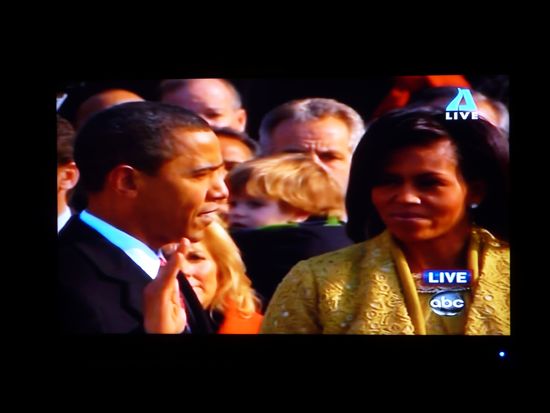
Taking the oath of office:

Crowds watching in Kenya:

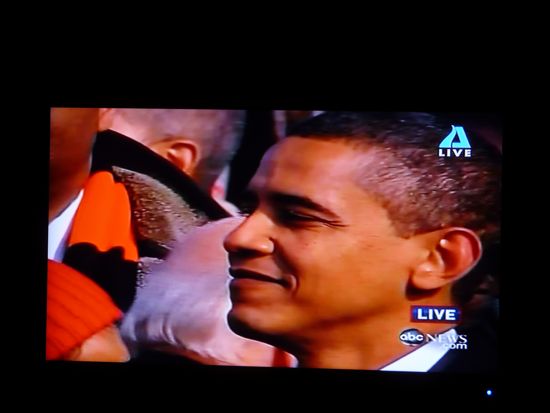
Inaugural speech:
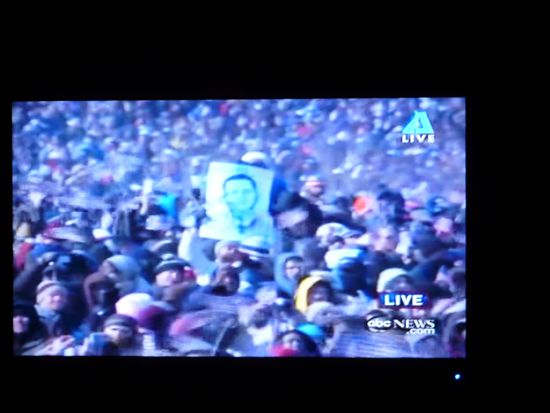
An estimated 1.4 million Americans stood hours to watch Obama become President in temperatures below freezing:


Singing the national anthem:


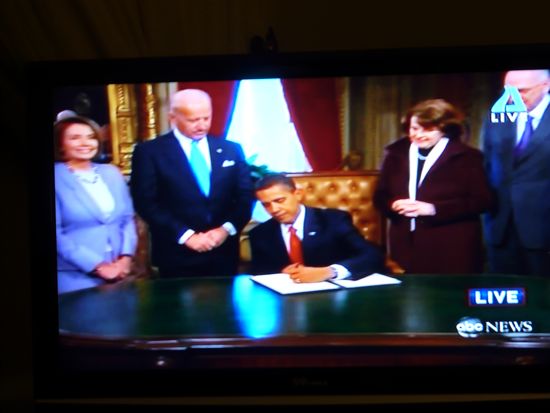
Signing his first documents as the US President:
What? You thought I forgot? Here is the new dawn in Kuwait – a pearly morning, another great day in Kuwait. Thanks for your patience. 🙂

Chris Rock: Hard to Make Fun of Obama
On this historic inaugural day – you’ve gotta keep a sense of humor. But making jokes about this President is not so easy, according to Chris Rock, a comedian I truly enjoy. Here is an excerpt from his interview with CNN, which you can read in whole by clicking on this blue type.
By Jacque Wilson
CNN
(CNN) — Chris Rock is best known for two things: being funny and being crass.
“If you’re the president you only have two jobs: peace and money,” Chris Rock said.
“This is what people come to see. I’m just doing my show,” the comedian said with a laugh.
He’s also known for his political commentary, but there’s one person he’s having a lot of trouble making fun of — president-elect Barack Obama.
This is apparent in his new DVD “Kill the Messenger,” which combines three shows from his international tour: New York; London, England; and Johannesburg, South Africa.
“It was a tour nobody wanted to do… because the general perception is that comedy doesn’t translate,” Rock said.
But thanks to the Internet, the world is a lot smaller than it was even 10 years ago. And people are digging the same jokes, he said, including ones about John McCain and Sarah Palin.
As the DVD readies for release on January 20, CNN talked with Rock about his lack of Obama jokes, Inauguration Day and why racism will never die. The following is an edited version of that interview:
CNN: I watched the special last night, and I noticed that you did a lot of jokes about John McCain — his age, his war hero story — but not so many about Barack Obama. Is it harder to make fun of Obama?
Chris Rock: He’s just one of those guys, you know, like Will Smith. There’s no Will Smith jokes. There’s no Brad Pitt jokes. You know, what are you going to say? “Ooh, you used to have sex with Jennifer Anniston. Now you have sex with Angelina Jolie. You’re such a loser.” What do you say? “Ooh, your movies are big. You make $20 million.” There’s nothing to say about Brad Pitt.
CNN: Why is Obama like that?
Rock: It’s like “Ooh, you’re young and virile and you’ve got a beautiful wife and kids. You’re the first African-American president.” You know, what do you say?
Chris Rock is irreverent and very very funny.
Why I Love A-Word-A-Day
This is today’s entry from Anu Garg’s A Word A Day.
Wordsmith.org The Magic of Words
This week’s theme
Words from Obama
This week’s words
cohere
with Anu Garg
Tomorrow Barack Obama will become president of the US, and not a moment too soon. This week we’ll feature words from Obama, words from his books, speeches, and interviews.
Unlike most politicians, who hire ghostwriters, Obama writes his own books. He’s a gifted writer. Reading his words you can see his thought process. He’s not one who sees the globe in black and white. He has lived outside the US and has been exposed to other cultures. He realizes that just because someone has a different set of beliefs, just because someone looks different, doesn’t mean he’s wrong — sometimes there can be two ways to do something and both can be right.
Obama is to be commended for his accomplishments. We’ve come a long way in this country. But we still have far to go before we can call ourselves truly unbiased. Real progress will be when any capable person can have a fair chance at winning the highest office, even someone who happens to be, say, a black gay vegan atheist woman.
Anything is possible… but don’t hold your breath.
cohere
PRONUNCIATION:
(ko-HEER)
MEANING:
verb intr.: To be united; to work or hold together.
ETYMOLOGY:
From Latin cohaerere, from co- (together) + haerere (to stick).
USAGE:
“I learned to slip back and forth between my black and white worlds, understanding that each possessed its own language and customs and structures of meaning, convinced that with a bit of translation on my part the two worlds would eventually cohere.”
Barack Obama; Dreams From My Father; Times Books; 1995.
A THOUGHT FOR TODAY:
I have a dream that my four little children will one day live in a nation where they will not be judged by the color of their skin but by the content of their character. -Martin Luther King, Jr., civil-rights leader (1929-1968)
Here is what Anu Garg isn’t saying, and my guess is he hasn’t thought twice about it. He is an American. He was not born in America, he immigrated to America – as most of us did, meaning our forefathers and mothers came from Europe, from Africa, from Asia and from India and the Middle East and – and – and. As an immigrant, as an American, he is free to say what he wants. Free to be happy Obama is president, and at the same time free to say that the system is not yet free enough.
I also totally love it that his quote for today is from Martin Luther King, who we are celebrating in America, on this national holiday.
We don’t have to agree. I love it that he is passionate about his beliefs, and that he provides A-Word-A-Day as a public service, entirely free, every day sending a new word, defined and used in context, to subscribers in every nation in the world. I admire people like him, like the Rajab family here in Kuwait, like Andrew Carnegie who started most of the small town libraries in the United States, people who use what they have been given to give back to the world-at-large.
You can see A Word A Day leads my blogroll. You can subscribe by clicking on the blue type above. 🙂
Qurain Cultural Festival Events Postponed
From today’s Kuwait Times:
KUWAIT: Secretary-General of the National Council for Culture, Arts and Letters Bader Al-Refai announced yesterday the postponement of concerts of the 15th Al-Qurain cultural festival in solidarity with the people of Gaza who are subjected to brutal Israeli aggression.
Al-Rifai, who heads the Higher Organizing Committee of the festival said in a press statement that the festival celebrated here few days ago the Palestinian Jerusalem as the capital of Arab culture for 2009.
He added that the tragic situation faced by the Palestinian people in Gaza is the reason for the postponement of activities including the final musical concert that was scheduled to be held on January 14 which would honor artist Abdel Mohsen al-Muhanna. He said the postponement was a common desire of the Council, al-Muhanna and the Kuwait National Music Band. – KUNA
Recent Comments
Kitchen on Isiais: Winding Down intlxpatr on Shampoo Ginger tigerbutterya0c5ff1d… on Shampoo Ginger intlxpatr on British Soldier Kidnapped, Esc… John on British Soldier Kidnapped, Esc… Wikipedia Donate Button

Amazina


Early Voting in Florida


