Inheritance of Loss
Most of the time, if I don’t like a book, I won’t even bother telling you about it. This book, The Inheritance of Loss, by Kiran Desai, is an exception for one reason – it IS worth reading.
Inheiritance of Loss showed up on the book club reading list for the year, and I ordered it. I read the cover when the book came, and it didn’t sound that good to me, so I read other books instead. The next time it came to mind was when a friend, reading the book, said she was having trouble with it, and asked me if I had started it. This friend is a READER, and a thinker. It caught my attention that she would have problems reading a book, so I decided to give it a try.
This is a very uncomfortable book. The characters live in the shadow of the Himalayan mountains. The most sympathetic character is a young orphaned girl, sent to live with her grandfather. With each chapter, we learn more about all the characters, how they came to be here, what they think, what their lives have looked like.
The author of this book has a very sour look on life. She has snotty things to say about every character. You can almost feel her peering around the corner, eyes slit with evil intent. She is that vicious neighbor who comes by and never says anything nice about anybody, and when you see her talking with your neighbor, you get the uneasy feeling she could be saying something mean about you, and she probably is.
The book covers a wide range of topics – Indian politics, Ghurka revolts, English colonization, Indian emigration to the US and UK, everyday vanities and pride in petty things, how people destroy their own lives, how people can be cruel to one another, oh it’s a great read (yes, that is sarcasm).
At the same time, this vicious unwelcome neighbor has a sharp eye for detail. You may not like what she is telling you, but you keep listening, because you can learn important tidbits of information from her. In my case, I learned a lot about how life is lived in a small mountain village in India, the struggles of illegals in America and how class lines are drawn, ever so finely, when people live together. I learned a lot about the legacy of colonialism, and the creep of globalization. This unwelcome neighbor has a sharp tongue, always complaining, and yet . . . some of her complaints have merit.
I don’t believe there was a single redeeming episode in the book. There was not a paragraph to feel good about. I am glad to be finished with the book – but, yes, I finished it, I didn’t just set it aside in disgust, or give it away without finishing.
Here is the reason I am telling you about this book – as uncomfortable as this book is to read, I have the feeling, upon finishing, that ideas and images from this book will stick with me for a long time. I have the feeling that it contributes to my greater understanding of how things work, how people think differently from other people, and on what levels we are very much the same.
Here is an excerpt from the book, at a time during which the Judge is a young Indian, studying in England:
The new boarding house boasted several rooms for rent, and here, among the other lodgers, he was to find his only friend in England: Bose.
They had similar inadequate clothes, similar forlornly empty rooms, similar poor native’s trunks. A look of recognition had passed between them at first sight, but also the assurance that they wouldn’t reveal one another’s secrets, not even to each other.
. . . Together they punted clumsily down the glaceed river to Grantchester and had tea among the jam sozzled wasps just as you were supposed to, enjoying themselves (but not really) as the heavy wasps fell from flight into their laps with a low battery buzz.
They had better luck in London, where they watched the changing of the guard at Buckingham Palace, avoided the other Indian students at Veeraswamy’s, ate shepherd’s pie instead, and agreed on the train home that Trafalgar Square was not quite up to British standards of hygiene – all those defecating pigeons, one of which had done a masala-colored doodle on Bose. It was Bose who showed Jemubhai what records to buy for his new gramophone: Caruso and Gigli. He also corrected his pronunciation: Jheelee, not Giggly. . . .
This it was that the judge eventually took revenge on his early confusions, his embarrassments gloved in something called “keeping up standards,” his accent behind a mask of a quiet. He found he began to be mistaken for something he wasn’t – a man of dignity. This accidental poise became more important than any other thing. He envied the English. He loathed Indians. He worked at being English with the passion of hatred and for what he would become, he would be despised by absolutely everyone, English and Indians both.
I consider this a review, and not particularly a recommendation. I read the book, I finished the book and I learned from the book. I didn’t like the book. I recommend it only as a challenge, for people who like to read and stretch their minds in new directions.
Walking Old Damascus (4)
I’ve really saved the best for last. I am about to take you into our very favorite restaurant in Damascus, Naranj. It is very close to The Talisman, at the Roman Arch on the Street called Straight, and just across from the Greek Patriarchate. We were lucky to eat there when we did – and to have a table where we could watch all the high Syrian Poo-Bahs come to dine. The food was – hands down – the best food we ate in Damascus, and we ate some truly fine food there. Unfortunately, we could only eat there once – all the other times, every table was reserved!
We don’t know why, but Naranj was also the only place we saw females working in a restaurant – one as a hostess and one as our waitress and one as the bread girl (bringing around baskets of fragrant freshly baked flat breads). We saw very few women working anywhere, in fact the only other women I can remember were running the ONAT – the very fine handicraft shop down near Bab Sharqi.
Naranj:
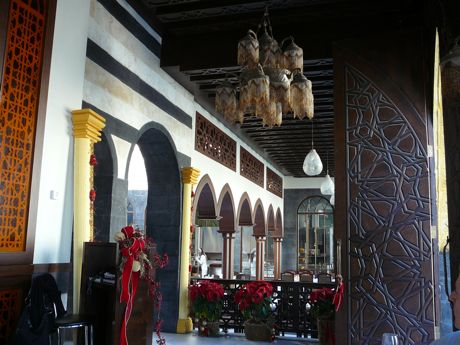
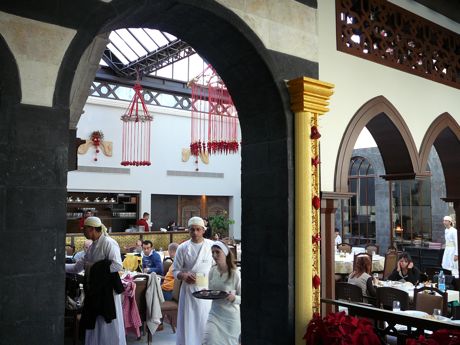
In the heavy black stone container (HOT!) is a dish called Hommos wa Burghul, or Garbanzos and Wheat. It must have had a ton of butter in it, to be so rich and so delicious, and with such simple ingredients. If any of you make this dish, I would love the recipe.


Along the Street Called Straight:

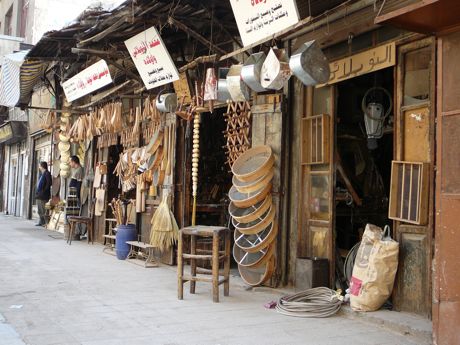
Silly me. I love copper and brass, and would have bought more, but I thought we were limited on Jazeera to 20 kg – that’s what the ticket said! It seems everyone else knows that it just isn’t so.

I loved the spaces in this building at the mosque end of the Hamadiyya Souk – and here is a view of the souk from one of the upstairs stores:

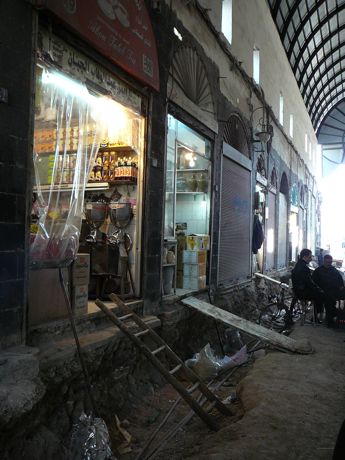
As the street lining the souks at the beginning of the Street Called Straight is under renovation, the shops still open, but people have to negotiate their way up ramps:
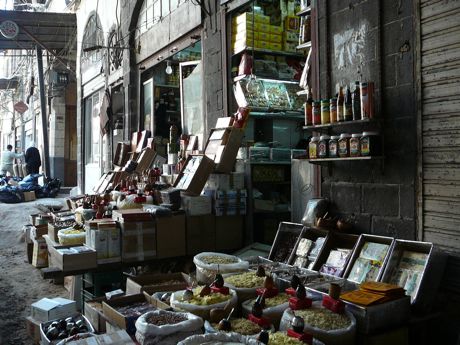
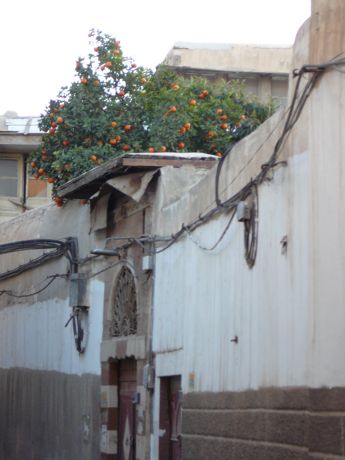
We discovered we are in Damascus just as all the oranges are ripening, and oh, the juice is so sweet and so delicious:
This beautiful statue is on the grounds of the Damascus Museum. You can’t take photos inside. We actually like the grounds of the museum better than we like the inside, currently. We think we remember a lot more stuff formerly, but it seems very spare now.

You know me, I can’t resist a good sunrise or sunset. This is the mosque behind the Talisman, at sunset:

And I saved my very favorite photo for the last – Damascus DOES have modern trucks that deliver fuel in the more modern part of the city, but in the tiny narrow streets of the old city, they still use a cart with a horse, who can get into the smaller spaces. This card delivers fuel oil, and as he goes along, he sounds a two-toned horn – not a loud horn, but a distinctive horn – so that if anyone needs coal oil, they run out and he gives it to them.

I have had responses that tell me Damascus is not for everybody. Even while I was there, I could imagine friends who would not love it as we do, might find it too old-fashioned, maybe too dirty, too inconvenient, lacking in up-to-date conveniences.
We also went knowing that as Americans, we might have problems. We never had a problem. We never met a single Syrian who wasn’t gracious and welcoming, and we were well treated at every turn.
We like adventure. We like history. We like walking, and we like good food. We like architectural details, we like fusion cultures, and we LOVE small, personal, charming hotels like the Talisman, with their excellent service. For us, this trip to Damascus was a supurb vacation.
Salary Belongs to Husband?
Muna al-Fuzai had a column yesterday in the Kuwait Times entitled Kuwaiti Women Accept Discrimination. (You can read the whole article by clicking on the blue type.)
In this article is one small paragraph that sends shivers down my spine:
A religious Islamic ruling was made recently to approve the husband’s right to take his wife’s salary because the time she spent outside was his own and thus he is entitled to take her salary, which she has worked so hard to earn.
It doesn’t sound to me as if it has the weight of law – like the first question I ask is:
• “do all Islamic religious rulers believe this to be true, or is this one guy’s opinion?”
• is it possible for this ruling to receive enough support to make it law?
• if it becomes law in Kuwait, does this law apply to all people living in Kuwait, or just to Kuwaitis?
This, to me, is a very scary ruling.
I’ve been married to AdventureMan for a long time. We’ve always discussed finances together, and we’ve both agreed on how to allocate our money and salaries. Sharing is very different from my earnings being controlled by someone else, no discussion. Or maybe discussion, but not necessarily.
But I am not Kuwaiti. If you are working, have ever worked, or intend to work, how does this ruling strike you?
As It Snows . . .
Catching up with the news, I was looking at the Thursday Kuwait Times when I came across a photo. I am not going to print the photo in my blog, but if you want to look at it, or one like it, you can see it at Yahoo News, just click here on the blue type.
The photo of the execution, titled Iran hangs 13 on a single day is extraordinary enough. I don’t think we print those kind of photos in American newspapers. Maybe in the tabloids; these photos are considered disturbing. I know they disturb me. This one in the Kuwait Times has big white balls in it and the caption reads: QOM, Iran: Three Iranian drug traffickers hang limply from the nooses as it snows in a square in this central city yesterday.
I remember cutting out a similar one from a paper in Saudi Arabia when I lived there. It didn’t have a photo, but the article was about the Taliban hanging of a convicted man in the stadium in Kabul. It stated the man was wearing a blue sharwal khamis. There was no mention of why this man was hung, of what he was convicted.
The Yahoo version of the same hanging of 13 states: Three Iranian drug traffickers hang limply from the nooses after being executed in a square.
To me, the mention of snow falling as people are executed, of the executed man seems . . . maybe poetic? Maybe some way of softening the horror? I don’t know. It’s not something we would do. Bad news is left bare, without a lot of dressing it up. I would love to get your input on this. For me, it’s a different way of thinking.
Fresh Start
I always get a burst of energy between Christmas and New Year’s. Truly, for me, new hope has come into the world. It doesn’t have to be rational, it’s just the way it is for me. I get all kinds of old messes cleaned up, I sort, I organize, I throw out or I hem/mend/ cut down to make something useful once again.
It made the dark months of winter pass more quickly in Seattle and in Germany, where many days go from black to dark grey and then back to black again. Here in Kuwait, with all the sunshine, it is just so much easier. Every day dawns in blues and pinks – how can life be bad when a day starts so beautifully?
There is one sharp sword hanging over me – taxes. *gnashing of teeth* I am pretty good about keeping receipts all in one place all year, but taxes for xpats can be complicated, and our tax guy sends a worksheet – like 14 pages – for us to fill out every year. It really isn’t that hard, but I dread it.
Over a year ago, the US government changed the way expats are taxed. Even worse, they snuck it in as an amendment, I think to a military appropriations or budget bill, and no one was aware of the implications until it was a done-deal. It is a nightmare. In one year, we went from qualifying for refunds to owing a burdensome debt of taxes. Aaarrgh.
I have a list of projects I want to do this year, some challenging, some just fun. Some projects left over from previous years I want to get done once and for all. I see 2008 as a great luxury, all those days, an entire year, stretching out before me in which I can get these things done. Woooo Hooooooo!
“Marionette . . . or Moron?”
This was sent by a good friend, 8 minutes by Keith Olbermann, ending with “Mr. Bush, you are a bold-faced liar.” This is from his December 6th broadcast.
Michael Malone: Handling Sin

Have I told you (only a hundred times?) that our family loves books? We buy them, we discuss them, and we pass them around. The one I am about to review came from my son, who got it from the wife of his wife’s father. Heee heee heeee, figure that one out!
Have you ever read A Confederacy of Dunces by John Kennedy Toole? As soon as you start reading Handling Sin, you get the same impression; this book is whacky, and will probably be an underground cult favorite. The author of Confederacy of Dunces, John Kennedy Toole, committed suicide – or so we are supposed to believe. I am not so sure. Handling Sin sounds SO like it, and they both heavily feature New Orleans.

Right off the top, this books starts out weird and keeps right on going. It opens with our hero, Raleigh Whittier Hayes at a Civitan (social and civic works group, kind of like diwaniyya) meeting at the local Chinese restaurant in Thermopylae, North Carolina, where his fortune cookie at the end of the meal says “You will go completely to pieces by the end of the month.” Raleigh sells insurance, he runs and watches what he eats because most of his family gets diabetes; and Raleigh likes order. When we meet Raleigh, he’s not all that likable.
His dying father takes off, leaving a message for Raleigh that he needs to do seven (crazy-sounding) tasks and meet him in New Orleans at a specific date and time, having accomplished these tasks, otherwise he won’t go back to the hospital for his cancer treatments.
His big fat best friend, Mingo Sheffield, insists on coming along. His wife, Aura, just laughs and tells him he needs to loosen up a little when he starts complaining about his Dad’s quest, and begins her campaign for mayor. His nice, safe structured little universe is flying apart, his twin teen-age daughters are out of control, reality as he knows it has just taken a big crunching shift and Raleigh is out of his element.
Perfect! It’s those times of maximum discomfort that we begin to achieve our maximum potential, isn’t it? If we stay in our safe little world, we aren’t challenged to grow, to think new thoughts, to see things from another perspective.
Handling Sin has a series of events that are at the same time heart warming, serious, and side-splittingly funny. I laughed out loud so many times reading this book, as our hero and his friend and all those he picks up along the way find themselves in the most outrageous and unlikely adventures, and learn what they are capable of (OK, for all you grammarians, do not end your sentences in a preposition, do as I say, not as I do!) I would not be at all surprised if this book were made into a movie, it is so much fun. As you rock along, Malone also deals with serious health issues, racial issues, family issues, political issues and law and order. You laugh, you cry, you learn a little and you laugh again. It’s a great read.
This was my back-up book on my flights back to Kuwait, and worth the weight – it’s a kind of big book. AdventureMan can hardly wait to get into it; he had started it but allowed me to read it while he caught up with his jet lag. Who knows who we will pass it along to when he finishes? It’s that good!
Dubai Rape Case Update
Here is an update on the case where the 15 year old French boy was kidnapped, taken to the desert and raped, and then the accused said it was consensual. The parents took them to court – and two have now been convicted; the third has yet to be tried. The doctor who examined this boy told the boy he was a homosexual, that there were no signs of rape. The parents were outraged, and pursued the case.
You can read the entire BBC Story HERE.
Emiratis jailed for raping youth
A court in Dubai, in the UAE, has jailed two men for 15 years for the abduction and sexual assault of a 15-year-old French-Swiss boy.
The men, one of whom is HIV positive, took the teenager to the desert and raped him at knifepoint.
The victim’s mother, Veronique Robert, says the authorities lied about the defendant’s medical status to hide the fact that Aids is present in the UAE.
“Fifteen years is nothing for someone who knew he had Aids,” she said.
A lawyer for the family said they would appeal against what they saw as a too-lenient sentence. A juvenile court is trying a third suspect in the same case.
The defence had claimed the victim had consented to sex and had lied to the authorities.
Treatment missed
Ms Robert has been campaigning to change the law in the United Arab Emirates to recognise homosexual rape as a crime and for more openness about HIV and Aids.
Bloggers Changing the Face of News in the Middle East
“So are the “new media” – blogs, websites, chatrooms – now becoming the only truly independent media in the Arab world?”
This article is from today’s BBC News in Depth:
New media dodge Mid-East censors
By Robin Lustig
BBC radio presenter
It’s never easy writing about media freedom.
Even in countries where there is no official censorship, all reporters know there will always be some restraints on what they can say – editors need to be persuaded, owners need to be kept happy, the law has to be obeyed.
Where there is official censorship – where, for example, it is a crime to “bring the government into disrepute” or to publish material which “insults the dignity of the head of state” – the problems are all the greater.
No freedom is absolute, yet some media are a great deal freer than others.
In the Arab world, in general, the media have been heavily politicised.
Governments have tended to control the main media outlets – the main daily newspaper, the main TV and radio networks – and where independent media have been allowed, they have often been owned by opposition parties or by businesspeople with clear links to political organisations. (The establishment of the Qatar-based al-Jazeera TV news station was a rare special case.)
But then, one day, along came the internet. And it was as if someone had blown open a few million doors.
Egyptian successes
Now, everyone can write – weblogs, or blogs, were born, giving everyone with access to the internet exactly the same opportunity to write and publish as the most powerful media tycoon.
You can read the rest of this article by clicking here, on BBC News.
Dharfur: Cat in Charge of Protecting the Mice
Today on an interview on BBC, I heard the UN Secretary General saying that the man appointed to be the Minister for Humanitarian Affairs had been responsible for co-ordinating and authorizing many of the Janjaweed attacks on Dharful villages. It’s the kind of thing that is so stunningly outrageous that sometimes I can barely wrap my mind around it.
I found an article on BBC News: Africa in which it says the following:
ICC prosecutor Luis Moreno-Ocampo said he had strong evidence that the Sudanese Minister for Humanitarian Affairs Ahmad Harun and the leader of the pro-government Janjaweed militia, Ali Kuchayb, were involved in attacks on civilians in Darfur.
The leadership of the Sudan pretends to be co-operating, pretends to be looking for solutions and working with the United Nations, and does exactly what it pleases, which is to work toward accomplishing the extermination of the people of Dharfur.
Recent Comments
ExpatAlien on What Country am I Living … intlxpatr on Yellowstone: Old Faithful to C… Michelle on Yellowstone: Old Faithful to C… Cathy on No Grown-Ups in Charge intlxpatr on Waiting for Snow Wikipedia Donate Button

Amazina


Early Voting in Florida


 Here There and Everywhere