Government limits freedom of expression
In the United States, news that people want buried comes out on Saturday night, when people are busy with other things and not paying a lot of attention. Does that happen in Kuwait?
I watched for anyone blogging on this yesterday, but saw nothing. I showed the newspaper to my Kuwaiti friends, who were shocked, and hadn’t heard anything about this. Some of it, I get. I am flummoxed by the forbidding of any mention of veterinary medicine!
From yesterday’s Kuwait Times.
KUWAIT: All newspapers, magazines, publishing houses and printing presses in Kuwait were yesterday issued a list by the government of the types of articles, advertisements and banners that can no longer be printed or published without official approval. Following is the list of the banned topics and the ministry concerned:
Interior Ministry:
1. Publication or display of slogans that glorify some countries against others.
2. Displaying pictures that glorify some political personalities or religious figures of countries where political or religious conflicts exist.
3. Publications or displaying slogans that glorify or support some political or religious parties outside Kuwait.
4. Publication of personal interviews with citizens who support or oppose a certain policy which may place the state at war with other countries.
5. Publication or displaying slogans that glorify or support some religious or political parties in Kuwait.
6. Announcement of seminars that may probe tribal or sectarian conflicts.
7. Sale of books on sorcery and magic.
8. Spiritual healing (without a licence).
9. Sorcery and ability to heal.
10. Massage without a licence (because those activities are subject to Law No. 15/1960 dealing with commercial companies).
11. Sale and trade of weapons by commercial companies, individual establishments and individuals (swords, sabers, daggers, spears, knives, arrows and arrowheads, pointy rods, spiked clubs, knives, brass knuckles, electric sticks), because licenses from the Interior Ministry to import these.
12. Sale of airguns without a licence from the Interior Ministry.
13. Fireworks and explosives.
14. Sale of surveillance cameras and listening devices (bugs) of all types without obtaining a licence from the concerned authority.
Education Ministry:
1. Publication of ads for private tuitions.
2. Publication of supplementary school notes.
3. Ads of private institutes and universities that are not accredited by the Ministry of Education.
Ministry of Health:
1. Conventional and veterinary medicine.
2. Botanic, animal or chemical formulae.
3. Foods that have health-enhancing effect, claimed to be prepared for treatment.
4. Preparations that claim to provide energy or reduce or increase weight.
5. Change of structures of body parts. (It is a must that a license be obtained from the licenses committee on advertisements related to health and nutrition).
Ministry of Social Affairs and Labor:
1. Donation and blood money ads.
2. Charity homes’ advertisements.
3. Ads for lectures, cultural and religious gatherings (unless a permission is obtained from the ministry).
The order was signed by Fahd Sayyah Al-Ajmi, Director of Local Press Affairs at the Ministry of Information.
Catbird Seat
Last week, I wrote a post on Cat’s Paw from A Word a Day, and today they sent me this one. The theme this week is words and phrases which refer to birds, and I have always wondered about the catbird seat. You hear it used in political journals more than anywhere else.
If you subscribe to A Word a Day they send you a fresh word every day, with a definition, they show how it is used in a sentence, and you can click on a link to hear it pronounced. I’ve been a member for over ten years now, and they are still surprising me with new words.
catbird seat (KAT-burd seet) noun
A position of power and advantage.
[A catbird (named after its catlike call) is known to build a pile
of rocks to attract a mate and sit on the highest point around. This
expression was often used by Brooklyn Dodgers baseball commentator
Red Barber and further popularized by the author James Thurber in his
story “The Catbird Seat” where a character often utters trite phrases,
including the expression “sitting in the catbird seat”.]
-Anu Garg (words at wordsmith.org)
“So, Stillking Films seems perched in the catbird seat. ‘Things
are going very well for us at the moment,’ David Minkowski says.”
Steffen Silvis; Stillking is Still King; The Prague Post
(Czech Republic); Apr 5, 2007.
Labyrinth by Kate Mosse
When I saw this book at the Barnes and Noble, I thought “isn’t Kate Moss a fashion model?” but that is a different Kate Moss, a Moss without the ‘e’ at the end.
This book was a New York Times bestseller, but then so was the Da Vinci Code, which I thought badly written and sometimes incoherent. The premise was interesting, but it was done years ago by French authors Michael Baigent, Richard Leigh and Henry Lincoln. Holy Blood, Holy Grail hypothesizes (and pulls together a load of hypothetical evidence to support) that the mystical grail is really a symbolic representation of the blood of Christ, that Jesus was not crucified but instead left Jerusalem with his wife Mary Magdeleine and went to France, and started a family there which eventually became the early French royal line.
I remember telling my son this story, as we travelled through the southern areas of France, and him saying in his smart-mouth-teenager way “only the French would be so arrogant as to believe the blood of God was flowing in their veins!”
We spent a lot of time travelling in France. We love France. So when I discovered that Labyrinth was about the beginning of the French crusade against the Cathars, I was delighted. We know this history. We know this area – it is one of the most beautiful areas of France. We know Carcassone, which in its renovation by Viollet-le-Duc is like Disney-does-fortified-city. It’s formidable, but it’s not entirely authentic.
Who are the Cathars? The Cathars were a break-away sect who were called by others ‘bons hommes’ or ‘bons Chretiens’ (good-Christians), but, pre-Luther, they saw many flaws in the way the Catholic church has become more political than spiritual.
They valued inner faith above outward display. They needed no consecrated buildings, no superstitious rituals, no humiliating obeisance designed to keep ordinary men apart from God. They did not worship images, nor prostrate themselves before idols or instruments of torture. For the ‘Bons Chretiens’ the power of God lay in the word. They needed only books and prayers, words spoken and read aloud. Salvations was nothing to do with alms or relics or Sabbath prayers spoken in a language only the priests understood. . . In their eyes, all were equal in the Grace of the Holy Father – Jew or Saracen, man and woman, the beasts of the fields and the birds of the air. There would be no hell, no final day of judgement, because through God’s grace all would be saved, although many would be destined to live life many times over before they regained God’s kingdom.
They believed the earth was created as a trap, by Satan, and that our lives here keep us apart from the glory of God. They believed we keep coming back, until we purify ourselves spiritually, and that in the end, if we get it right, we end up back where we came from, with God. And they believed we all have the right to read the bible, and to talk directly with God, without the necessity of a priest to interpret or to direct.
But this Crusade, the Fourth Crusade, is little known. This Crusade, declared by the Pope to wipe out the Cathar heresy (sometimes known as Bogomilism or Albigencian heresy) was really the tool of the nobility that was then France, less than half of the France of today, to grab the rich, lush southern lands of the Pays d’Oc. The Fourth Crusade was an opportunity for knights to increase their holdings. And it doubled the size of France.
The Labyrinth takes you inside the walls. The main character is not Cathar, but it didn’t matter – this war wasn’t really about wiping out the Cathars as much as subjugating an independant land and making it part of France. You may have heard one famous quote from this Crusade – as the Crusaders were attacking Besiers, the Abbot of Citeaux was asked how the soldiers could tell the good Catholics from the heritics. “Tuez-les tous. Dieu reconnaitra les sien,” he replied – Kill them all. God will know his own.
The book is lightweight, an easy read. The heroine, Alice, seems to have lived before, as Alais, and has memories she has never lived. You jump back and forth between today, and the time of the Crusade, in the early 1200s. Some of the plot mechanisms don’t make a lot of sense, but you do get a real sense of life in a fortified town during the 1200’s, and of the injustice done to this beautiful area in France. For a book I am lukewarm about in retrospect, I read it avidly, and enjoyed the read.
What I like about this book is that it brings to life a time in history that few pay any attention to. Somewhere in the book, it says that “history is written by the victors.” We see France today, and we know little about the struggle that united these diverse areas into one nation. This book illuminates a slice of time, a grave injustice, and a sense that religion is too often a tool for political ends.
Like the heroine, the big church in Carcassone, where the trials and tortures of the ‘heretics’ took place sends a cold chill up my spine, I can hear the screams of the tortured. I love churches, and I can’t go into this one. It feels unholy. Did you know that the origination of the Inquisition was not in Spain, as most people believe, but in this area of France? And it was aimed, first, at the Cathars.
All in all, not a bad book. Though light in plot, it is heavy in content, a book you will remember and think about in terms of issues, if not the main characters.
MOC Bans Porno Film Sites
Today’s Kuwait Times:
Internet Porno Film Sites
The Ministry of Communication has closed down all new sites that advertise pornographic films. The ministry of Communication represented by Undersecretary Eng. Abdulaziz Al-Osaimi and his counterpart at the Ministry of Information achieved this new step. This move was done in order to have control over the sites, which are being followed by the Ministry of Information. Al-Osaimi has assigned administration director Nassar Al-Kandari to work on closing those sites from the Internet and ensuring that companies do not use other systems to re-open it. The ministry succeeded in coordinating with local internet companies to close all porno sites, but lately the ministry realized that there are new sites marketing through drama films to porno films.
My comments:
I truly hate porn. I hate it because it creates a fantasy world that real women can barely compete with. I bet if men spent half the time and attention on their wives and families that they spend on porn, there wouldn’t be so much divorce. And guys – those women are PAID. They’re ACTING. Most of them would rather be doing anything but what they are doing, but they do it for the MONEY. It’s about as real as the World Wide Wrestling Federation Matches, it’s all staging and airbrushing and making money off YOUR fantasies.
Rant over – reality strikes. How do you ban pornography?
First, how do you define pornography? When I was a student in political science, we spent a week of class time trying to come up with a definition that everyone could buy into. We never succeeded.
There is some pretty powerful erotic literature, erotic art out there, stuff I don’t find pornographic in the least. So what are the guidelines?
Second, WHO defines pornography?
Third, how on earth will the Ministry of Communication and the Ministry of Information keep up with all the new porn sites that keep popping up? These sites make people a LOT of money, they have the money to pay ingenious high tech guys to keep devising new ways to get their product to market.
And last, who is the poor porno-guy who has to watch all this garbage and enforce the ban?
And – is your internet phone still working? 😉
NYT Article on “Shiitization of Syria”
My neice, Little Diamond wrote this morning referring to an excellent piece entitled Catalytic Conversion about persistent rumors of “Shiitization” in Syria. The article, by Andrew Tabler, is from today’s New York Times Sunday Magazine section, begins here:
The Middle East is abuzz with talk of “Shiitization.” Since the war in Lebanon last summer, newspapers, TV news channels and Web sites in Egypt, Saudi Arabia and elsewhere have reported that Sunnis, taken with Hezbollah’s charismatic Shiite leader Hassan Nasrallah and his group’s “resistance” to Israel, were converting to Shiite Islam. When I recently visited the semi-arid plains of eastern Syria, known as the Jazeera, Sunni tribal leaders whispered stories of Iranians roaming the Syrian countryside handing out bags of cash and macaroni to convert families and even entire villages to Shiite Islam.
You can read the original article from the New York Times Sunday Magazine section HERE.
Audio and Video Streaming Stopped?
My neice, Little Diamond, checking on Kuwaiti Censorship went to the Ministry on Information where she found this statement:
الإذاعة والتلفزيون
على الإنترنت
حتى إشعار أخر
Audio & Video Streaming is stopped
until further notice
And I just checked it, but I can’t figure out if it means they are discontinuing audio and video streaming from their site, or if they intend to discountinue audio and video streaming into Kuwait?
Anyone know anything?
A Beautiful Apology
Gere apologises over Shetty kiss
The kiss:
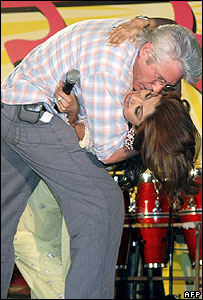
Actor Richard Gere has apologised for causing offence when he kissed Bollywood actress Shilpa Shetty.
The incident, at an Aids awareness event in Delhi, prompted public protests and then an arrest warrant for both stars over the “obscene act”.
Gere, 57, said he had misread Indian customs and that he regretted any problems he had caused Shetty.
You can read the whole story here, at BBC News.
I am guessing both Gere and Shetty got a lot of mileage out of the storm of publicity from his onstage behavior, and now he has graciously and sincerely apologized. Pardon my cynicism, but he has been in India before, I would think he would have been more sensitive.
Nonetheless, he made a beautiful apology. And I wonder why politicians don’t do the same? Why, when you realize you have stepped on someone’s toes, don’t you just make a full and gracious apology? No, it doesn’t change what has happened, but it can sometimes calm the troubled waters.
What if the Danish papers had made a full and gracious apology for publishing the cartoons of the Prophet Mohammed? It would not have changed the fact that they had been published, but it would not have hurt to acknowledge that they had hurt the sensitivities of a large portion of the world, and to apologize for the offence.
Kuwait conference calls for document on women rights
In yesterday’s Kuwait Times, there was a tiny paragraph in the reporting about Personal Law in Kuwait pertaining to women that stated
“Among the loopholes of that must be corrected is the provision empowering a woman’s father to marry her to whoever he likes or divorce her without consulting or even informing her . . . “
Is this possible? Does this still happen? I thought in Islam, a woman had to agree to accept a man as husband, and had a right to have clauses put into her marriage contract? And a father can have his daughter divorced from her husband without her even knowing about it, much less agreeing to it?
Here is today’s reporting from the Kuwait Times on the recommendations for legal changes:
KUWAIT: Participants in the Conference on the “Kuwaiti Women in National Legislations” have recommended the preparation of a comprehensive national document to facilitate women participation in the country’s development aspects under the sponsorship of the legislative and executive authorities as well as the civic society institutions.
At the conclusion of the one-day conference, organised by the National Assembly’s women affairs committee, the participants demanded improvement of legislative performance, promotion of the existing legislations and completion of the legal system in an introduction for the rise of women’s rights in the society.
To read the rest of the article, with the recommendations made by the committee, click on Kuwait Times, here.
Uighur People
I had never heard of the Uighur people until I read The Kite Runner, a steady best-seller by Khaled Hosseini (available from amazon.com for $8.40 plus shipping) about Afghanistan, his Afghani childhood, his best friend – a Uighur – and the changes wrought in Afghanistan with the revolution.
(Edit: True Faith accurately points out that the best friend was Hazara, not Uigher)
This article is from BBC News April 12th, about the steady campaign against the Uighur in China.
China ‘crushing Muslim Uighurs’
China has been accused by two US-based human rights groups of conducting a “crushing campaign of religious repression” against Muslim Uighurs. It is being done in the name of anti-separatism and counter-terrorism, says a joint report by Human Rights Watch and Human Rights in China.
It is said to be taking place in the western Xinjiang region, where more than half the population is Uighur.
China has denied that it suppresses Islam in Xinjiang.
It says it only wants to stop the forces of separatism, terrorism and religious extremism in the region, which Uighur separatists call East Turkestan.
Detentions and executions
The report accuses China of “opportunistically using the post-11 September environment to make the outrageous claim that individuals disseminating peaceful religious and cultural messages in Xinjiang are terrorists who have simply changed tactics”.
The authors of the report say it is based on previously undisclosed Communist Party and Chinese government documents, local regulations, press reports and local interviews.
The report says the systematic repression of religion in Xinjiang was continuing as “a matter of considered state policy”.
Such repression ranges from vetting imams and closing mosques to executions and the detention of thousands of people every year, it claims.
“Religious regulation in Xinjiang is so pervasive that it creates a legal net that can catch just about anyone the authorities want to target,” said Sharon Hom, Executive Director of Human Rights in China.
The report also reveals that almost half the detainees in Xinjiang’s re-education camps are there for engaging in illegal religious activities.
Uighurs make up about eight million of the 19 million people in Xinjiang.
Many of them favour greater autonomy, and China views separatist sentiments as a threat to the state.
Amazing Dubai
Today AOL’s Money section has an article on “Amazing Dubai. It starts off:
The Wonders of Dubai
“As one of the seven emirates that make up the oil-rich United Arab Emirates, Dubai has attracted world-wide attention through some mind-boggling, innovative real estate projects.
Sit back and peruse our photo gallery of some of the most amazing construction being done in the world today.”
You can access the article and the fabulous photos by clicking HERE.
Recent Comments
intlxpatr on Shampoo Ginger tigerbutterya0c5ff1d… on Shampoo Ginger intlxpatr on British Soldier Kidnapped, Esc… John on British Soldier Kidnapped, Esc… intlxpatr on British Soldier Kidnapped, Esc… Wikipedia Donate Button

Amazina


Early Voting in Florida


 Here There and Everywhere