“Just Kill them All!!”
We were in the kitchen at the church, setting out some refreshments, when I told my friend I was expecting houseguests from Saudi Arabia.
My friend, who is educated, and, most times, level headed, said with exasperation “I can’t believe you are doing that! They are destroying everything, beheading people, raping and selling off women! Just kill them all!”
I was dumbstruck.
Who are we? We are in a church, where our leader told us to love God, and to love one another. He told us to love our enemy. And, just as one crazed fanatic shooting up a bible study does not make all South Carolinians hateful racists, neither does ISIS and Al Shebab make all Muslims fanatic killers. She knows this.
“I’m so shocked that you would say that, I don’t even know where to start,” I said, numbly.
“Why is it we make so many allowances and excuses for their behavior and they get different rules, but they don’t make any allowances, just kill all those who do not agree with their beliefs!” she responded.
You can’t really have a discussion with someone when they are worked up, and I didn’t even try. It’s been weeks now, and every time I think of this discussion, I get a pit in my stomach. I am guessing that she, my good friend, is expressing her frustration with me for my positive views toward Muslims and Islam. I struggle with whether it is to speak or not to speak, knowing my views are very different from the majority around me.
One of the most influential books I have read was Rick Warren’s The Purpose Driven Life, where he begins with the premise that God creates us each uniquely, individually, no two of us the same, and that we have a reason for our unique creation. From the life I’ve been given, I can only assume part of my purpose was to have all my assumptions challenged, to observe and to learn to think differently, and that, returning to my own culture, it is to gently share what I have learned, that we are more alike than unalike, and that we worship the same God.
I know I must continue to share what I know, and I pray for the courage to do so effectively, gently, not alienating people I care about.
Ramadan Kareem and Pope Francis
“God bless the work of your hands!” was one of the Moslem sayings I most loved as I lived my daily life in various countries in the Middle East. So, Pope Francis, God bless the work of your hands yesterday in your encyclical saying we are all responsible for the price we pay for progress. You are a brave man, and you don’t hesitate to name corruption when you see it, and to do your best to correct us, and straighten the path of the Lord.

“Everything is related, and we human beings are united as brothers and sisters on a wonderful pilgrimage, woven together by the love God has for each of his creatures and which also unites us in fond affection with brother sun, sister moon, brother river and mother earth,” he writes.
It is not entirely a happy message for me. One of the items he castigates is air conditioning, and as Pensacola hits the nineties every day, I hate to think of how I would live without air conditioning. I think I would turn into a slug, swinging in my hammock for hours every day reading a book. My house would be full of dirty dishes and dust. And I remember living in Tunis, and in Jordan, without air conditioning. We managed, by the grace of God.
Meanwhile, during the hottest months of the year, yesterday, our Moslem brothers and sisters began Ramadan, the holy month of fasting and personal purification. Imagine, going all day without water and without food, breaking the fast only as the sun goes down. I wonder if the Pope made his world-changing address on the eve of Ramadan on purpose, as he clearly made it to all mankind, not only to his Catholic followers.
Ramadan Kareem, my Moslem brothers and sisters, whom I cherish, and who taught me so much. May your fasting bring you great insights and purity of spirit.
Female ISIL Recruits Surprised and Disappointed
They sign up for Hunger Games and get domestic drudgery and uber-control:
From Associated Press via Huffpost
PARIS (AP) — When three British schoolgirls trundled across the Syrian border; when a pregnant 14-year-old ran away from her Alpine home for the second time; when a sheltered girl from the south of France booked her first trip abroad — they were going to a place of no return.
Only two of the approximately 600 Western girls and young women who have joined extremists in Syria are known to have made it out of the war zone. By comparison, as many as 30 percent of the male foreign fighters have left or are on their way out, according to figures from European governments that monitor the returns.
In interviews, court documents and public records, The Associated Press has compiled a detailed picture of European girls and young women who join extremists such as the Islamic State group — a decision that is far more final than most may realize.
The girls are married off almost immediately, either in Turkey or just after crossing into Syria. With an estimated 20,000 foreign fighters — among them 5,000 Europeans — in Syria, there is no shortage of men looking for wives. That number is expected to double by the end of the year. Once among the jihadis, the women are not permitted to travel without a male chaperone or a group of other women and must remain fully covered outside, according to material published by Islamic State and researchers who follow the group. Otherwise, they risk a lashing or worse.
European women who blog about their lives under Islamic State tend to be chipper about the experience, but reading between the lines of an e-book of travel advice shows a life that will be radically circumscribed, with limited electricity, lack of even the most basic medicine, and practically no autonomy. Women do not fight, researchers say, despite the Hunger Games-like promises of recruiters.
“The lives of those teenage girls are very much controlled,” said Sara Khan, a British Muslim whose group Inspire campaigns against the dangers of extremist recruiters. “I don’t think that discussion ever comes up. It’s so romanticized, the idea of this utopia. I don’t even think those young girls have necessarily considered that there’s no way back now.”
The two exceptions to the rule of no return are perhaps most revealing in the very paucity of details about their journey — driving home how murky life is behind the Islamic State curtain.
Sterlina Petalo is a Dutch teenager who converted to Islam, and came to be known by the name Aicha. She traveled to Syria in 2014 to marry a Dutch jihadi fighter there and managed to return months later — apparently making her way to the border with Turkey, where her mother reportedly picked her up and brought her back to the Netherlands. Back home, she was immediately arrested on suspicion of joining a terror organization.
Her family, lawyers and prosecutors refuse to discuss the case. She was released from custody last November and has not been formally charged.
The second woman known to have made it out of the grip of Islamic State reconsidered after just a few weeks. The 25-year-old Briton, whom police have not named, had taken her toddler son all the way to Raqqa, the group’s stronghold, when she decided she had made a mistake and called home. She made her way back into Turkey and her father met her there. How she was able to travel the 250 kilometers (150 miles) from Raqqa to the Turkish border city of Gaziantep is not clear. Back in Britain, she was detained and is now free on bail pending formal charges.
Without knowing how the two escaped, it is difficult to say whether other girls and women could follow their path out of Syria, said Joana Cook, a researcher at King’s College London who studies the links between women and jihad.
“There are clearly many human smugglers working within Syria right now, helping Syrian civilians escape the violence, and I wonder if there is a similar, perhaps even growing market, for those trying to escape after joining ISIL,” Cook told The Associated Press in an email, using one of the acronyms for the Islamic State group. “There is great disillusionment for many who have traveled to Syria to join ISIL and you’ll find many stories of those who went abroad noting ‘this isn’t what we signed up for.'”
The question is whether the girls understood from the beginning how limited their choices would be once they crossed the frontier.
The case of a 15-year-old Avignon girl exemplifies such doubts. The girl hid her second Facebook account and Islamic veil from her moderate Muslim family, thereby managing to join a jihadi network, according to the family’s lawyer. Once within a unit of the al-Qaida offshoot Nusra Front, she was not permitted to leave, according to her brother, who went into Syria to fetch her and was turned away by the extremists. A French boy who joined the group around the same time was allowed to go home.
“I think they understand the premise of that, but not that they understand it in reality,” said Melanie Smith, another researcher at King’s College ICSR.
The networks that bring the women into Syria are increasingly organized around the extremists’ dream of building a nation of multinational jihadis, meaning European girls are particularly prized. Each new Facebook post, each new cheerleading Twitter account — and they pop up by the hour — helps them subvert government efforts to prevent young people from radicalizing and leaving.
The doggedness of jihadi methods for recruiting girls can be seen in the case of Amelia, a 14-year-old girl from France’s Alpine Isere region.
Amelia was first contacted on Facebook by a French fighter on Jan. 14, 2014 and within a month agreed to go to Syria and marry the man, who identified himself as “Tony Toxiko.” After she was turned back by airport border police in Lyon on her first attempt, “Tony Toxiko” persuaded another French adolescent girl to join him in Syria.
Amelia, meanwhile, ran away from home to Belgium, where an imam performed a religious ceremony that wed her to a different man, an Algerian jihadi. She returned to France homesick and pregnant, just long enough to speak to investigators building a case against a middleman who helped her run away. This winter, Amelia managed to deceive her family and left again — making it to Syria with the Algerian fighter, who is more than twice her age.
“It’s particularly difficult for these families. For them, radicalization is happening on the Internet and outside the family sphere,” said Sebastien Pietrasanta, a French lawmaker working on a program to de-radicalize young people. “For a girl of 14, I believe we can clearly save her from herself and save her from these barbarians.”
A French journalist got dangerously close to jihadi recruitment methods by creating a fake Facebook account that attracted a marriage proposal from a fighter in Syria.
Under the pseudonym Melodie, the journalist shared a video on the account, almost immediately getting a message from a man identified as Bilel, who asked how she’d liked the montage of him showing off in a 4X4 and with his weapons.
“I passed myself off as a 20-something, not stupid but a little lost, who suddenly found a huge response from a man in Syria,” said the journalist, who wrote a book “In the Skin of a Jihadist” under a pseudonym.
Bilel’s doubts about her began to grow as her reluctance to join him became clear. She ended up getting threats that she said would likely frighten a bewildered young woman into submission. As it was, the journalist, who never met Bilal in person, remains under constant police protection a year later.
“We’ll find you, we have the best operators here, you don’t know what you’re getting into, you’re messing with a terrorist group, you and your family will pay,” the woman said, recounting the litany of threats she received after returning to France. “If they were speaking to a 20-year-old, it would be very hard for her.”
___
Associated Press writer Mike Corder in Amsterdam contributed.
Small Glimpses of North Seattle
“As Sallam wa alaikum!” I smiled at the Sudanese women coming in to their jobs in our hotel.
They stopped still in their tracks.
“You speak Arabic!” they said, astonishment clear on their faces.
“Only a little!” I smiled back.
I had a whole squad of new friends.
Now that financial times are easing, many hotels we have visited over the last few months are renovating and getting new mattresses. This was a real bonus for our Sudanese friends, and all of their friends.
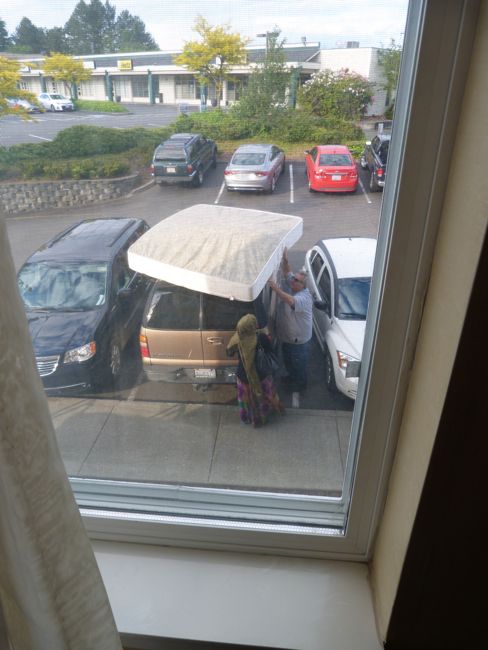

Have you ever tied a mattress on the top of your car and tried to drive? It is a wild and dangerous adventure; the wind lifts and pushes the mattress toward the back as you drive. Unless the mattress if firmly and thoroughly tied down, you are in for a wild ride.
And then again, if you are new in a country, and in need of a mattress, a wild ride is a small price to pay.
On our way back to the hotel, we see protestors in red shirts at every corner. This is not protestors Ferguson style, these are Seattle style protestors, making a big demonstration for fully funding public education, and all the signs are grammatical 🙂

We are so full from lunch that we just want a small dinner. We find a good Ethiopian restaurant listed near our hotel, and head there, but when we arrive, there is plywood over two windows and a sign saying “Sorry, dear customers, but due to car accident our restaurant is closed until it is fixed.”

We end up at Ivar’s Seafood Bar, which is quick food, but not cheap food, and very very good food. We are greeted by an older man as we enter, he says “Welcome to Ivars! I hope you have a great meal.” We thought he might be an official greeter, but no, he was a customer like us. We ended up sitting in a booth next to his, so he stopped on his way out to see what we had ordered (halibut and chips, smoked salmon chowder, Dungeness crab cocktail) and just to chat. It’s an Edmonds kind of thing, neighborliness and civility.
Mission, TX, Delights and Surprises
Mission, TX was full of surprises. It looked small on the map, like a little strip of city, not so much. We are here on a mission, AdventureMan wants to visit the National Butterfly Center (did you know the United States had a National Butterfly Center?) and I wanted to see the Rio Grande.
Mission was big, and modern. Contrary to much of our Texas experience, it has very new roads.
Mission, and McAllen, her next door sister city, are right on the Rio Grande. There is a huge Homeland Security presence in Mission and McAllen. Many of the TripAdvisor reports I had read to find a good hotel seemed to have been written by government workers, so I should have put it together, but I didn’t, and I found the hugeness of the security presence a little overwhelming, and seriously intimidating. I am guessing all the new infrastructure is in support of guarding our borders.
Our hotel was very new, very modern and welcoming. It was all polished surfaces and glossy textiles, clean white linens, totally lovely for a chain hotel. We jumped into our swimsuits to hit the equally lovely pool, only to discover it was really cold, and for an Alaska girl to say a pool is cold, it really has to be cold.
Fitness goals thwarted, we checked at the desk for a local restaurant recommendation. The desk clerk was very helpful, but recommended a chain, and we wanted something more truly local. Fortunately, there is Trip Advisor. In minutes, we found a place that thrilled our hearts. It was a Thursday night date night kind of place for the very married. People were flocking in and ordering platters of BBQ. The Lone Star was our kind of place.

We are not people who like to waste, so AdventureMan had to take about half of his beef brisket back to the hotel, thinking he would have some for breakfast. It was very lean and beautifully smoked. Unfortunately, we discovered we did not have a refrigerator in this lovely hotel, oh AARRGH, and the excess beef went to waste.

I had my favorite, BBQ chicken, and a really good potato salad. Normally, I am not a big potato salad fan, I don’t like too much mayonnaise, and I like flavor. This was really good potato salad, for me, and very tasty.

The entire time we were there, people were flooding in. We really liked the Lone Star BBQ. We do a lot of talking with locals, so we later learned that everyone goes to Lone Star for it’s famous grapefruit pie. Grapefruit pie had not sounded all that tempting to us, but before Homeland Security, Grapefruit was the mainstay of the Mission, TX economy, and Lone Star BBQ specializes in a wonderful, very sweet, Grapefruit Pie.
I have a feeling that in order to make grapefruit into a pie, it’s kind of like rhubarb, you have to use a lot of sugar, a LOT of sugar. I would rather like to try one spoonful of a grapefruit pie, just for a taste, but I am not all that sorry that we passed, only that it is something that Mission was once famous for.
Best Group Ever!
Sometimes, out of nowhere, comes a wallop, even a good wallop. Yesterday came such a startling change. The itinerary looked ordinary, do-able, nothing inspirational, but all get-the-job-done.
My group had a great weekend. They got to sleep, they got to walk on the beach, they got to eat a great meal or two. They had fabulous weather, a chance to chill and to integrate all the information we are piling on them, and a chance to walk away for a little while. They love Pensacola. Who wouldn’t, when the weather hits around 70° and the beach is white and the sky is blue?
First, we hit our volunteer experience, working at Manna to sort donations, making sure all the items were within acceptable expiration dates. At first, I wasn’t sure this group was going to “get” volunteering, but in a very short time, they were all focused and working hard, and working efficiently. As they sorted, other volunteers drove up in SUV’s, in big cars, in vans and we all helped unload. By the end of their experience, the warehouse manager said “You have processed enough food for over 1,000 people!” and complimented them. They glowed. None of them are from countries with a tradition of volunteerism, and this was a new – and thrilling – experience for them. It always gives me a thrill to see that light go on, to see oneself as part of something larger, organic, to see how connected we all are and to love being a part of something good, sharing. It thrilled my heart.
We ate lunch together downtown, and talked about events going on in each country, about the weekend, about their experiences. We bought coffee – oh! the universal need for caffein! – and headed on to our next appointment, which featured environmental issues and complex ways governments interact to combat the problems and enforce the regulations. It was a tough slog. These relationships are so complex that most of us don’t even think about it. These delegates have work to do; they are here to solve problems in their own countries, and they are persistent and dogged about getting solutions that they can apply in their own bureaucracies. It is a delight to see people so committed to solving problems that seem . . . almost unsolvable.
It is also inspiring, to me, to learn so much about Pensacola, in this job. When I was working on my Masters, I studied heroism, among other things. What I am loving about these office and field visits is that my education continues, and I see heroes at every level of bureaucracy, holding back the evil forces of laziness, corruption, and cronyism. And, sustaining my initial findings about heroes, heroines and heroism, they don’t even see themselves as heroes. They say, as all heroes do, “I am/was just doing my job.” They think anybody would do it. (They are wrong.)
At our very last appointment, I was thinking I would probably cut the day short. The speaker had given out information, the delegates had bags to pack, and all of a sudden, a spark, and an explosion! The good kind!
One delegate could not believe the head of this agency could maintain an important list with integrity. He kept drilling down on the structure, the details of how things worked (all the delegates were keen on the details of how the structures of organizations and bureaucracies worked to accomplish their missions) and where there were openings for corruption.
She was explaining how her employees were constantly trained, and how the agency was monitored to ensure fairness and an adherence to procedure. The delegates, all from countries where bureaucracies function differently, kept pressing her. Is there never anyone taken out of turn? Never?
“If I did that, I would lose my job,” she replied.
What followed was one of the most exciting hours of discussion I have ever experienced, as delegates from five different countries frankly compared their own challenges and experiences, and with great intensity tried to figure out how bureaucracies could function without corruption.
We tried to explain that we, also, are not immune from corruption, and cronyism, but that the combination of training and monitoring helps keep agencies within the boundaries, as best it can. Transparency doesn’t come overnight; we are still trying to achieve it.
As I listened, I could not stop grinning. These are young leaders, and the leaders of tomorrow. They admire what they see in our country. They want to bring trust into their own governments, but how do you create trust? How do you build trust? How do you maintain trust?
I don’t know those answers. And yet the process is working; the discussion was so inspiring, so heartfelt, and they had built enough trust in one another to share their challenges, without having to maintain that artificial facade that lack-of-trust builds.
Their liaison said “You will each have to find your own path; it won’t look exactly like the US path because it has to be a fit with your own culture.”
When I left the group, I told them “You are the best group I have worked with, ever.” There is a part of me that wanted to be a part of that discussion, because they were still deep in that discussion as we parted. My role had ended; I had done what I do.
And today, I am still grinning. I love this job, I love the people it brings me into contact with, international and local. I feel so blessed.
219 Girls Remain Missing; Nigerian Villages Beset by Boko Haram
Today, on AOL News, a report on the ravaging of two villages in Nigeria by Boko Haram, with satellite images showing the carnage and destruction as survivors tally more than 2,000 dead. The craven Nigerian Army claims the losses are more like 200.

Meanwhile, of the almost 300 girls kidnapped a year ago by Boko Haram, 219 are still missing. Those who returned, returned by escaping. No one rescued them. The remainder are likely “married” to their captors, slaves to the household and many of them are probably pregnant. To be pregnant by a Boko Haram soldier creates a severe social problem if they are ever freed or rescued – the family cannot marry off an impure daughter. The children of these unions face a desolate future, wherever they are.
The world watches when terrorists wreak havoc in Paris, thousands crush the cretins who kill in the name of God, but no-one lifts a finger to help these small villages in Northeast Nigeria, beset by destructive vermin.
JOHANNESBURG (AP) — Large areas of Nigerian towns attacked by Islamic extremists were razed to the ground in a widespread campaign of destruction, according to satellite images released Thursday by Amnesty International.
Amnesty International said the detailed images of Baga and Doron Baga, taken before and after the attack earlier this month, show that more than 3,700 structures were damaged or completely destroyed.
The images were taken Jan. 2 and Jan. 7, Amnesty International said. Boko Haram fighters seized a military base in Baga on Jan. 3 and, according to witnesses, killed hundreds of civilians in the ensuing days.
Daniel Eyre, Nigeria researcher for the human rights group, said in a statement that the assault on the two towns was the largest and most destructive of all the Boko Haram assaults analyzed by Amnesty International.
The group said interviews with witnesses as well as local government officials and human rights activists suggest hundreds of civilians were shot; last week, the human rights group noted reports of as many as 2,000 dead. The Nigerian military has cited a figure of 150 dead, including slain militants.
Nigeria’s home-grown Boko Haram group drew international condemnation when its fighters kidnapped 276 schoolgirls from a boarding school in northeast Chibok town last year. Dozens escaped but 219 remain missing.

You can find much more information in this article on BBC News/Africa.
Freedom of Speech: Je Suis Charlie
In our country, in the West, open discussion is a part of life. Your point of view may be ignorant, or repugnant to me, but I will defend to the death your right to express your opinion. One of the great weapons of freedom of speech is humor. It’s hard to maintain a dignified moral high-ground when one of the cartoonists piques with a cartoon showing the emperor has no clothes. Or at least the emperor has flaws, as do we all.
Pensacola is blessed with such an editorial cartoonist, Andy Marlette. Andy Marlette is controversial, and in a state with lax gun laws and pistol-packin-mamas, he risks his life daily, skewering the pomposity of us all. Occasionally, he is outrageous. Occasionally, he is offensive. That’s OK. If an editorial cartoonist isn’t skewering someone, or all of us at once, he isn’t doing his job. His job is to elicit discussion.





I have lived for so long in Moslem world that I take a risk now, offending my Moslem friends, by printing the cartoon of Mohammed weeping. It’s the cartoon that touched me to the bone. I have listened and learned in the Moslem world, and I have never met with hatred. The Mohammed I have read about in the Qu’ran and in hadith, and heard about in legend and stories from my Moslem friends portrayed a prophet who, like Jesus, was all about loving and serving the one true God. He would weep at what has been done in his name, as Jesus weeps for us, when we kill others in his service.

Where is Lafia, Nigeria?
Today the church prays for Lafia, Nigeria, which is near Abuja, in the part of Nigeria where Boko Haram runs rampant, and where over 250 girls were kidnapped from their school in 2014. Some few escaped, most were married off to poor young Boko Haram soldiers into hardship and near-slavery. Boko Haram does not believe in educating women. The Nigerian government at one point announced that Boko Haram had agreed to return the girls, but nothing happened. The Nigerian military and police do nothing to get them back.

Recent Comments
Cathy on No Grown-Ups in Charge intlxpatr on Waiting for Snow intlxpatr on Waiting for Snow Abou Tabblouleh on t… on Waiting for Snow Abou Tabbouleh on in… on Waiting for Snow Wikipedia Donate Button

Amazina


Early Voting in Florida


 Here There and Everywhere