Organizers for the 2022 FIFA World Cup in Qatar are certain that hosting rights to the tournament will not be taken away, despite a FIFA investigation into alleged bribery and corruption, according a report from Al Jazeera.
Qatari officials have denied misconduct, but allegations that the Gulf State bought the World Cup have persisted. Qatar 2022 communications director Nasser Al Khater told Al Jazeera that organizers are not concerned that the World Cup be stripped from the country:
“We are not worried, we are confident that the World Cup will take place in Qatar.”
Al Khater also said that Qatar has held itself to “the highest ethical standards” throughout the entire process.
Qatar was selected to host the 2022 World Cup in December 2010 over bids from the United States, Australia, Japan and South Korea. Since FIFA made its selection, rumors have persisted that Qatar bribed its way to victory, allegations that gained steam in March when The Telegraph reported that Qatari football official Mohamed Bin Hammam had paid millions of dollars to former FIFA vice president Jack Warner.
Since the report was released, pressure has mounted on FIFA to take action, or at least mount a serious investigation. A number of World Cup sponsors called on FIFA to look into the allegations, and politicians from both the United States and Britain have urged FIFA to take action.
FIFA’s ethics committee has been looking into the bribery allegations.
The 2022 World Cup has faced criticism for more than alleged corruption. Roughly 4,000 migrant workers in Qatar will die by time the 2022 World Cup starts if the current pace of worker fatalities remains stable. A number of media outlets, including ESPN and The Guardian, have published in-depth investigations into the country’s poor treatment of migrant workers, many of whom are building infrastructure and stadiums for the World Cup.
FIFA has also admitted that the 2022 World Cup may have to be played in the winter rather than the summer, as Qatar’s summer heat would be potentially dangerous for players.
Though FIFA president Sepp Blatter has said that awarding Qatar the 2022 World Cup was “a mistake,” he also labeled allegations of Qatar 2022 corruption as “racism.”
You’ll have to read this from the bottom up. I don’t even know if this is a for real or someone screwing with me, and in blog-world, it is more likely the latter. I was always careful in both Kuwait and Qatar to put the spotlight on issues by quoting real journalist sources: newspapers, Cable, National Public Radio, etc. I know sometimes journalists get the news wrong, but in this case, there has been a LOT in the news about labor abuses in Qatar related to the World Cup 2022. I believe he is just trying to bully me into pulling my post.
Pull the post? Hmmm. No. I don’t think so. Can WordPress be sued to eliminate my blog altogether, as he threatens? I don’t believe so. If so, it’s been an interesting ride and new blogs pop up all the time . . . 😛
He has also spelled his name Majed M. Garoup, Majed M. Group, and Majed M. Garoub. His English is atrocious and unprofessional.
His reply:
Hello,
We know that you have copied it from Dailystar Lebanese. But you don’t have the rights to publish this kind of news. You site don’t have any authority to publish such news and you are not an authorized person. We mailed you to notify you regarding this issue. If you are not willing to delete the post, we will file the case to delete your whole blog from wordpress hosting.
Majed M Group
Senior Legal Executive.
Sent: Friday, June 27, 2014 at 5:41 AM
From: intlxpatr@aol.com
To: civil.gov@lawyer.com
Subject: Re: Notice to remove the blog post
(my reply) LOL, it’s a reprint of a Lebanese newspaper article
—–Original Message—–
From: Majed M Garoub
To: Intlxpatr
Sent: Thu, Jun 26, 2014 12:34 pm
Subject: Notice to remove the blog post
Dear Admin,
Myself Majed M Garoup, senior legal Executive. We need to bring a
serious concern infront of you regarding an article which you have
posted on your blog https://intlxpatr.wordpress.com/. The article which
you have posted contains defamatory content about our country. It has
some news which is not relevant and also having some wrong statements
about the country which is purely illegal. Publishing this kind of half
true matters through online is a punishable offense. Before posting any
article about a particular country you need to verify those things to
us. You need to ask the story from both the parties while publishing
such kind of articles. But we haven’t recieved any such calls or mails
from your side. Posting such news without proper confirmation from the
relevant party is a serious crime.And you are a blogger and don’t have
any rights to publish this kind of news on your blog. So this page
should get remove imediately from your blog otherwise legal action will
be taken against your wordpress blog for posting defamatory content and
half true matters on your blog which is spoiling the reputation of our
country.
Myself Majed M Garoup, senior legal Executive. We need to bring a serious concern infront of you regarding an article which you have posted on your blog https://intlxpatr.wordpress.com/. The article which you have posted contains defamatory content about our country. It has some news which is not relevant and also having some wrong statements about the country which is purely illegal. Publishing this kind of half true matters through online is a punishable offense. Before posting any article about a particular country you need to verify those things to us. You need to ask the story from both the parties while publishing such kind of articles. But we haven’t recieved any such calls or mails from your side. Posting such news without proper confirmation from the relevant party is a serious crime.And you are a blogger and don’t have any rights to publish this kind of news on your blog. So this page should get remove imediately from your blog otherwise legal action will be taken against your wordpress blog for posting defamatory content and half true matters on your blog which is spoiling the reputation of our country.
The post is a reprint of an article on labor abuse in Qatar from a Lebanese paper. I guess he’s feeling a little touchy; Qatar is getting a lot of unwelcome publicity lately for labor abuses. How is that for a country whose labor laws give everyone except household help a day off?
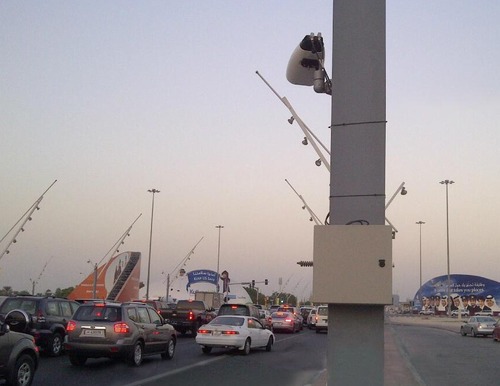
This kind of gives me the shivers. I guess it is supposed to make everyone safer, but it feels so intrusive. It may be a generational thing; my understanding is that people today have lower expectations of privacy . . . I wonder how their upkeep will be; sand and humidity being hard on security cameras, not to mention deliberate interference with their use?
Qatar’s Ministry of Interior is apparently stepping up enforcement of a law that requires businesses around the country to install closed-circuit camera surveillance on their premises.
Law No. 9 of 2011 mandates that surveillance cameras be installed in residential compounds, hospitals, malls, banks, hotels, warehouses and other locations, and is enforced by the MOI’s Security Systems Department (SSD).
The SSD was not immediately available for comment, but Qatar Tribune reports that the MOI has recently made the widespread installation of these cameras a priority.
Speaking to Doha News, a staffer at Lulu Hypermarket on D-Ring said that the store was previously told to install CCTV in its parking lot, but has now been asked to increase the number of cameras to cover the entire parking area.
Meanwhile, an employee at Lulu Gharafa said they are still in the process of installing some 300 ministry-approved cameras, following an instruction from last year. When asked why the extra surveillance was needed, he said it could help aid police investigations into incidents such as thefts from vehicles.
Additionally, the Peninsula reports the owner of a jewelry shop in the Gold Souq as saying:
“This year when I went for company registration renewal was asked of CCTV cameras are installed. Also inspectors are supposed to come to our shops and inspect if the surveillance cameras are functioning properly.
There are only very few places from which we should buy the CCTV cameras, they are very expensive and it cost me more than QR60,000 to purchase and fix the surveillance system,” he added.
However, City Center mall’s director told Doha News that though the SSD consistently comes to inspect the surveillance system, there have been no new requests for additional cameras in the past few months.
Requirements
A law governing the use of CCTV surveillance was passed in 2011. According to the legislation:
Businesses must have a control room and operate surveillance 24/7;
Recordings must be kept for 120 days, and cannot be altered before being handed over to competent government departments upon request;
Recording is prohibited in bedrooms, patient rooms, toilets and changing rooms for women; and
Those who violate the law could face up to three years in jail and fines of QR50,000, as well as the suspension or cancellation of their business license.
Last year, the law was brought back into the spotlight when the Supreme Council of Health reminded healthcare facilities to comply with the legislation and install cameras within three months, or face the loss of their business licenses.
Qatar makes some great laws – like fining those who go through red lights, or who drive near the speed of light. . . but when the violators turn out to be mostly young Qattari men, who pays the fines? Does anyone pay the fines?
In an effort to tackle bad driving in Qatar, the Ministry of Interior plans to set up speed radars every two to four kilometers on major roads, Traffic Department Director Brig. Mohamed Saad Al Kharji has said.
Additionally, some 120 radars are being installed to catch drivers who overtake others from the right lane, the Qatar Tribune reports Al Kharji as saying.
He added that the software of speed radars that are already installed on the roads would be updated so that they could also catch such violators.
No timeline for when the cameras would be installed was disclosed. But last fall, the MOI announced it would be rolling out radars to catch queue-jumpers.
Using the “slow” right lane to overtake vehicles in the left lane is a traffic violation punishable by a QR500 ticket, but among one of several rules flouted by motorists here.
Enforcement
In Qatar, traffic violators are rarely pulled over by police officers, despite brief campaigns to step up enforcement. In 2012, plainclothes police officers began ticketing drivers who overtook other vehicles on the right.
And at the end of last year, the traffic department began a three-month campaign to ticket those who violate road rules, including drivers who hadn’t fastened their seat belts, used their phones while driving, and rode without a license.
Both initiatives were lauded by many residents who said enforcement is key to improving safety on the roads, but neither seem to have lasted.
DUBAI: Qatar will likely face higher labor costs as a result of publicity about deaths of migrant construction workers building the infrastructure for the 2022 World Cup football tournament, the International Monetary Fund said. The Guardian newspaper reported in September that dozens of Nepali workers had died during the summer in Qatar and that laborers were not given enough food and water.
Qatar, which has denied the Guardian’s findings, has seen an increasing influx of foreigners, now estimated at 1.8 million, with its population rising 10 percent in 2013.
“Working conditions of some construction workers and domestic help have made global headlines and could affect the availability and cost of hiring new workers in the future,” the Fund said after completing annual consultations with Qatar.
“This would hinder growth since the success of Qatar’s current development model depends importantly on the ability to rapidly hire expatriate workers,” it said.
The gas-rich nation has planned to spend some $140 billion in the run-up to the World Cup on new infrastructure projects, including a metro, port and airport.
Such large public investments entail a possibility of overheating in the near term and low return and overcapacity in the medium term, the IMF warned. “In particular, the extent to which public investment will durably boost private sector productivity remains uncertainty,” it said.
Certain big-ticket projects such as the metro, port and airport have been scaled down or divided into phases to reduce the overcapacity risk, and the authorities are preparing a shortlist of critical projects, the IMF said without details.
However, the large-scale nature of the program has led to implementation delays and cost overruns and Qatar will continue facing the risk of cost escalation given its commitment to a compressed timetable ahead of the World Cup, it also said.
Increasing government spending may push the fiscal balance into a deficit over the medium term when combined with flat production of liquefied natural gas, falling crude oil output from mature fields and lower hydrocarbon prices.
“The public debt ratio is expected to fall, but the headline budget balance could … turn into deficit over the medium term, while the current account surplus could drop to 5 percent of GDP,” the IMF said.
The country’s fiscal surplus could shrink to 6.8 percent of GDP this year from an estimated 11.0 percent in 2013, and further to 4.2 percent in 2015, the IMF said, cutting its October forecasts of 8.4 percent and 5.8 percent, respectively.
The government intends to reduce public debt over time from an estimated 33.1 percent of GDP in 2013 by trimming foreign borrowings and domestic loans. It would continue issuing government securities to support bond market development.
The IMF also raised its forecast for economic growth to 5.9 percent this year and 7.1 percent in 2015, from 5.0 percent and 6.6 percent, respectively, in its October regional outlook.
Inflation should remain benign at 3.3 percent this year and 3.5 percent in 2015, the IMF said, less than 4.0 percent forecast for both years in October, as a decline in commodity prices will help reduce pressure from strong economic activity.
A version of this article appeared in the print edition of The Daily Star on March 10, 2014, on page 5.
Thank you, John Mueller, for this fascinating article from Science NOW:
Middle Eastern Virus More Widespread Than Thought
28 February 2014 12:45 pm
Bernard Gagnon/Wikimedia CommonsTrail of infection. Scientists have found MERS virus in camels from Sudan and Ethiopia, suggesting the virus is more widespread than previously thought.
It’s called Middle East respiratory syndrome, or MERS, after the region where almost all the patients have been reported. But the name may turn out to be a misnomer. A new study has found the virus in camels from Sudan and Ethiopia, suggesting that Africa, too, harbors the pathogen. That means MERS may sicken more humans than previously thought—and perhaps be more likely to trigger a pandemic.
MERS has sickened 183 people and killed 80, most of them in Saudi Arabia. A couple of cases have occurred in countries outside the region, such as France and the United Kingdom, but those clusters all started with a patient who had traveled to the Middle East before falling ill.
Malik Peiris, an infectious disease researcher at the University of Hong Kong, and colleagues expanded the search to Africa. In a paper published last year, they showed that camels in Egypt carried antibodies against MERS. For the new study, they took samples from four abattoirs around Egypt; again they found antibodies against MERS in the blood of 48 out of 52 camels they tested. But the most interesting results came from taking nose swabs from 110 camels: They found MERS RNA in four animals that had been shipped in from Sudan and Ethiopia.
Peiris cautions that it is unclear whether the infected camels picked up the virus in Sudan and Ethiopia or on their final journey in Egypt. Abattoirs could help spread MERS just like live poultry markets do for influenza, he says. “You cannot point the finger exactly at where those viruses came from,” he says. “But I would be very surprised if you do not find the virus in large parts of Africa.”
If so, that changes the picture of MERS considerably. No human MERS cases have been reported from Egypt or anywhere else in Africa, but if camels are infected, they may well occur, says Marion Koopmans, an infectious disease researcher at Erasmus MC in Rotterdam, the Netherlands. “It would be important to look systematically into that,” she writes in an e-mail. “Health authorities really need to test patients with severe pneumonia all across Africa for MERS,” Peiris says.
The researchers were able to sequence the virus of one of the camels almost completely, and it is more than 99% identical with viruses found in people. “I would be very surprised if this virus cannot infect humans,” says Christian Drosten, a virologist at the University of Bonn in Germany. But the virus also shows a few intriguing differences from known camel samples, he says. “We have to analyze this carefully in the next few days, but it looks like this sequence broadens the viral repertoire found in camels,” he says. If the viruses found in camels show more genetic variation than those isolated from humans, that is further strong evidence that camels are infecting humans and not the other way around.
Anthony Mounts, the point person for MERS at the World Health Organization in Geneva, Switzerland, says that it is very likely that human MERS cases occur in Africa. “Wherever we find [infected] camels, there is a good chance we’ll find [human] cases if we look closely,” he says. And humans may be exposed to camels in Africa much more often than in the Middle East: There were about 260,000 camels in Saudi Arabia in 2012, but almost a million in Ethiopia and 4.8 million in Sudan, according to the U.N. Food and Agriculture Organization. The more human cases there are, the higher the risk that the virus will one day learn how to become easily transmissible between people, which could set off a pandemic.
The researchers also looked at the blood of 179 people working at the camel abattoirs for antibodies against MERS virus, but found none. That shows that the virus is only rarely successful in infecting human beings, Peiris says. “What we need to find out now is the reason for these rare transmissions.”
Thank you, John Mueller, for forwarding me this story. We lived in luxury, next to a vacant lot where a few laborers lived with next to nothing. They were the lucky ones, but lived in fear of being caught without passports (their sponsors held their passports) and without any papers. The Indian and Nepalese were treated like animals, not like human beings. They are a means to and end, and treated as a resource, without humanity:
Boarding the bus back to their accommodation camp November 19, 2013
STANDING UP FOR THE LITTLE GUY
Azfar Khan: Laboring for Labor
February 07, 2014By Laura Secorun Palet
Share on facebookShare on Facebook Share on twitterShare on Twitter Share on emailEmail
Why you should care
Because migrant workers finally have an advocate worthy of their wants and needs in a place that believes they deserve none of the above.
Defending the little guy is a stance old as time, but you wouldn’t think the glitzy world of professional soccer would need that kind of advocate. But for the people who work so that others can play in new stadiums and watch from secure bleachers, it’s an entirely different story. And it’s the story being told by migrant workers in Qatar who are helping the city prepare for the world’s largest sports competition in 2022.
Cue Azfar Khan, a Pakistani native living in an increasingly unstable Lebanon because he sees an even greater threat facing the regions’ migrant workers.
“Sorry about the bad connection. There has been an explosion in the neighborhood,” Khan says in a surprisingly relaxed tone over the phone.
When you do something like this, it’s not only about the job — it has to be personal.
The senior migration specialist for the International Labour Organization (ILO) in Beirut, Khan monitors and advises Arab states on how to protect workers’ rights. He is talkative and cheerful, even in the face of bombs and sectarian violence.
Azfar Khan
“The security situation is pretty dire,” he says plainly.
If Khan doesn’t sound overly concerned about explosions, it’s because he’s focused on helping the countless immigrant workers who don’t make the headlines. As their champion, he is counseling the Qatar government on how to host the World Cup without violating any more international labor laws.
Working conditions in the region are “pathetic,” Khan says. He believes the kafala system — a traditional sponsorship scheme that binds each migrant worker to a single employer — is incompatible with modern-day labor because it puts workers in a very vulnerable situation.
Last year alone, 185 Nepalese workers — the single largest group of laborers in Qatar and also the lowest paid — died during the construction of the World Cup infrastructure. More than half, some as young as 16, died of heart attacks or workplace accidents, often after enduring 12-hour days and sharing unsanitary lodgings.
Surprisingly enough, Qatar has ratified most conventions on labor rights, which means all exploitative practices are technically illegal. But rules mean nothing if they’re not enforced.
”People with a little bit of assistance can do a better job about improving their lives than paternalistic policymakers.”
“The problem is an extreme lack of political will,” says Khan. “For example, Qatar has signed the convention on the elimination of forced labor but still allows the practice of withdrawing workers’ passports, which easily leads to forced labor.”
Source: Narendra Shrestha/EPA/Corbis
Nepalese domestic migrant worker Om Kumar Chaudhary, aged 23, fixes a goods lift at a 60 feet high construction building in Kathmandu, Nepal, December 16, 2013.
The Qatari government thinks Khan’s concerns are exaggerated, insisting, according to the Emir, that the country is “on the right track” and “truly committed to treating all workers fairly.”
Yet Qatar refuses to sign one convention — the very one Khan considers most crucial: the freedom of assembly and association. “Without any organization to adequately represent their interests, no matter how much we discuss, we are going to have problems,” he says.
And if you thought it was just a regional issue, think again. This unwillingness to take action is not unique to the Gulf states. According to Khan, “Labor law doesn’t get much attention anywhere, whether it is in developing countries or in developed ones.”
Pushing countries to implement these laws without the momentum of political will is like pushing water uphill, but Khan perseveres in his quest with modesty and conviction.
“I know that what I can do will not be earth shattering, but at least it is a cog in the wheel,” he explains.
Khan is himself a former immigrant who moved to Canada with his mother and sister from his native Pakistan at age 14. Raised in a household partial to Sufi philosophy, he was instilled with a sense of social justice from an early age.
“We were told that we had a commitment to people, and I guess championing the underdog was implicitly part of this teaching,” he says.
Source: Amnesty International/Corbis
Migrant worker sitting on a bunk bed in his accommodation in Qatar.
While in Canada, Khan’s dreams of cricketing stardom turned to aspirations of fighting for social justice. He studied economics at McGill University, specializing in development economics before moving to the U.K. and completing his Ph.D. on the impact of international migration on rural Pakistan. In the 1970s and ’80s, Khan noticed how many Pakistanis moved to the Gulf countries to earn money to send home and became concerned about the trend’s long-term effects.
In 1995, Khan started working for the ILO, where he promotes legal and social protection for migrant workers — a dream endeavor, but far from easy. A crucial part of his task is raising awareness among international organizations as well as the governments he already counsels. He thinks institutions should do more to empower those they seek to protect and stop viewing the poor as just another statistic.
What we really need are good institutions that will protect the workers like the unions used to.
Which explains why working face to face with people is Khan’s favorite part of the job. While running experimental community workshops in the region of Kochi, India, he realized “that people with a little bit of assistance can do a better job about improving their lives than paternalistic policymakers sitting in high offices can.” Grassroots work has become just as important to him as presenting reports in well-appointed meeting rooms.
Source: Fadi Al-Assaad/Reuters/Corbis
View of Doha city, under construction
The key to moving things in the right direction, he asserts, is public support — and Khan isn’t shy about using the media to get politicians’ attention. In Ukraine in 2003, for example, he surveyed how the restructuring of enterprises promoted by liberal policies was affecting workers’ security. The morning after he shared his results with the press, the issue was discussed in parliament, and his recommendations were adopted by the government.
Information is useful, Khan notes, but taking action is a whole other matter. “So what we really need are good institutions that will protect the workers like the unions used to,” he adds.
Unfortunately Khan’s work is as slow going as it is important, but he’s more than willing to put in the effort. Any moves toward social justice are worthwhile, he says, “regardless of the size.”
Khan’s genuine love of people seems to be the secret behind his boundless enthusiasm. After 20 years of working for the ILO, he will soon be forced to retire, but he plans to keep fighting for the proverbial little guy.
“When you do something like this, it’s not only about the job — it has to be personal. Do you believe in it or don’t you believe in it?” he asks rhetorically.
Spend a minute with Khan, and you too will believe.
A computer generated image shows the stadium to be built in Al-Wakrah.
From Agence France, a report that 191 Nepali laborers died in Qatar in ONE year:
Nearly 200 Nepali migrant workers died in Qatar last year, many of them from heart failure, officials said Monday, figures that highlight the grim plight of labourers in the Gulf nation.
Tens of thousands of impoverished Nepalis head every year to Qatar, where a construction boom is gathering pace as it prepares to host the 2022 football World Cup.
The Nepal embassy in Doha said it registered 191 deaths last year compared with 169 the year before, with a foreign ministry official describing many of the deaths as “unnatural”.
“In the year 2013, a total of 191 Nepali migrant workers died in Qatar,” Harikanta Paudel, a senior embassy official, told AFP by telephone.
“The highest number of deaths occurred in July when 32 workers died,” Paudel said.
Qatar is under mounting pressure over poor conditions for migrant labourers, particularly during the blisteringly hot summer, in the gas-rich nation’s booming construction industry.
A Kathmandu-based foreign ministry official told AFP that a third of the deaths recorded were due to “unnatural” heart failure.
“Young and healthy men in their twenties and thirties have died… it is unnatural,” said official Subhanga Parajuli.
“Cardiac arrest is followed by traffic accidents as another main cause of death. The third cause of death is injuries during work,” Parajuli said.
An Amnesty International report released last November said migrant workers in Qatar endured a series of abuses including “non-payment of wages, harsh and dangerous working conditions, and shocking standards of accommodation”.
The rights group said its researchers overheard one construction firm manager use the term “animals” to describe migrant workers, while a labourer told the watchdog that “Nepalis are treated like cattle”.
Qatari authorities last October said allegations of abuse of labourers working on World Cup facilities were exaggerated but insisted they took such claims seriously.
More than one million Nepali migrant workers toil in the Gulf region and Southeast Asia. Qatar alone hosts around 400,000 Nepalis as part of its two-million strong migrant workforce.


 Bernard Gagnon/Wikimedia CommonsTrail of infection. Scientists have found MERS virus in camels from Sudan and Ethiopia, suggesting the virus is more widespread than previously thought.


 Here There and Everywhere