‘Staggering’ Traffic in Qatar as Cars Exceed Highway Capacity
From the Gulf Times Qatar
By Bonnie James/Deputy News Editor
Increase in the number of vehicles beyond the carrying capacity of roads, improper driving manners of many motorists and road works are among the key factors behind the acute traffic congestion currently being experienced in Doha and suburbs, it has been pointed out.
Brigadier Mohamed Saad al-Kharji, director of the Traffic Department, was on record the other day that the number of vehicles in Qatar has exceeded 1mn.
The total number of registered vehicles in Qatar had stood at 876,039 in 2012, according to official statistics. This means, as many as 123,961 new vehicles have been added to the roads within nine months of this year, at the average rate of a 13,773 every month, whereas the 2012 average for new vehicles was only 5,138 per month.
“The increase in the number of new vehicles is staggering and at almost three times the monthly average from 2012, it now exceeds the carrying capacity of the roads of Doha and suburbs, even from a layman’s perspective,” a traffic safety expert said.
This is evident on Al Shamal Road, a vital link of the Qatar Expressway Programme and a major arterial thoroughfare, during peak hours from Sunday to Thursday. All the way from The Mall signal to the Gharrafa area, the highway is clogged with bumper-to-bumper traffic.
“The average speed on Al Shamal Road would be around 30kmh, as against the maximum allowed speed of 100kmh, and that too if there are no accidents,” observed a motorist who drives on the highway regularly.
The congestion on Al Shamal Road has gone from bad to worse ever since the reopening of schools on September 10, compared to the time before the summer vacation, asserted another resident.
“Al Shamal Road is the preferred choice of tens of thousands of motorists who have to travel to the northern parts of the country and back, but the carrying capacity of its busiest portions has been exceeded,” the expert maintained.
Though Al Shamal Road has three lanes each in either direction, they are proving thoroughly inadequate during the rush hours. “You have to go beyond the Gharrafa stretch to be able to drive at the maximum permissible speed, if proceeding to the north,” a motorist said.
Many road users also feel the traffic management strategy leaves much to be desired, especially with regard to Al Shamal Road.
“On Thursday, access from many service roads to Al Shamal Road was blocked off in a bid to ease congestion on the highway. But this led to vehicles being stuck on the service roads for up to 40 minutes,” a road user recalled.
A parent who drives his children from the Qatar Decoration area of Salwa Road to their school at Duhail, a distance of about 23km, said it took him more than one hour to reach the destination, as access to Al Shamal Road from the service road at Al Waab was blocked.
“My children were late for school the first time this academic year as we were stuck on a service road for nearly 40 minutes while vehicles were moving fast on Al Shamal Road, a rare sight these days,” he said.
Many motorists don’t use indicators or move ahead promptly when the vehicle in front moves. “It is a common sight to see people having their breakfast, putting on make up, or having animated conversations on a handheld phone, while they are behind the wheel, oblivious to the fact that they are holding up traffic and aggravating the congestion,” noted a woman who observes the road scenes from her front passenger seat.
The traffic situation on the Corniche is expected to take a turn for the worse, given that Grand Hamad Street’s intersection with Doha Corniche has been closed for 10 days from Thursday midnight.
“If I used to start from home at 6.30am before summer vacation, I leave 15 minutes early these days, but now I guess I have no option but to start even earlier,” another motorist added.
The helicopter patrol, introduced by the Traffic Department since last week, to help ease congestion on Qatar roads by giving guidance to police on the ground during morning rush hours has improved traffic flow by 30%, according to Brigadier al-Kharji.
Qatar Congestion Eases (FAIL)
This totally cracked me up; the Qatar Gulf Times publishes an article about how smoothly traffic flowed on the day the Indian schools opened, noting that Arab and Independent schools will open on succeeding days. They published this photo with the article:

Morning rush hour traffic on a Doha street yesterday. PICTURE: Najeer Feroke.
LLLOOOOOLLLLLLLLLLLLLLLL!
One New MERS Death in Saudi Arabia; One in Qatar
New in from Reuters, via AOL news:
DUBAI, Sept 8 (Reuters) – The MERS coronavirus has killed two more people in the Gulf, one in Saudi Arabia where the strain emerged last year, and one in neighbouring Qatar, health authorities said.
The death of a 74-year-old man in the Medinah region of western Saudi Arabia was the 45th fatality in the kingdom from Middle East Respiratory Syndrome Coronavirus (MERS-CoV) which can cause coughing, fever and pneumonia.
The Saudi Health Ministry also said on Sunday that three women aged between 64 and 75 had contracted the disease.
A 29-year-old Qatari admitted to hospital on Aug. 17 has died, Qatar’s Supreme Council of Health said in a statement dated Sept. 6, adding that another citizen who had contracted the disease while abroad had recovered.
The World Health Organization said last month the number of confirmed infections worldwide in the past year was 102, of whom almost half had died.
In a study into what kind of animal “reservoir” may be fuelling the outbreak, scientists said this month they had found strong evidence it is widespread among dromedary camels in the Middle East.
The virus has been reported in people in Tunisia, France, Germany, Italy, and Britain. (Reporting by Sami Aboudi in Dubai and Amena Bakr in Qatar; Editing by Robin Pomeroy)
For Unto Us a Child is Given . . .

I am hearing those wonderful lines from Handel’s Messiah, because on this wonderful day, just after noon, a new child came into this world, a treasured girl-child, a warrior-princess is born. Thanks be to God, al hamd’allah!
Her Mother’s prayer for her is that she be the child that God created her to be. She hopes her daughter has courage, and a heart for adventure. When we met her, this amazing daughter-in-law, she played rugby, and she went off to France for a year to teach English.
We all pray that she will be healthy, and compassionate, with a heart for others. Courageous and passionate, and a woman of strength who will, like her Father, “give voice to those who have no voices.”
It is taking all our strength not to run to the hospital to visit. We feel very Middle-Eastern at this time; I am remembering my friend who went to Hamad hospital to have her babies. I took her daughters there the next morning, laden with canisters of coffee to serve guests.
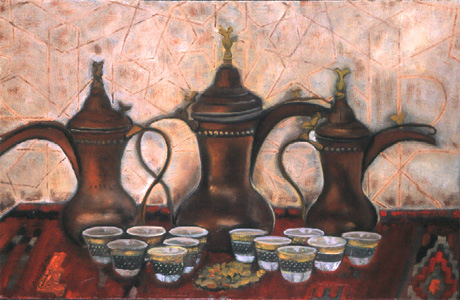
“Guests?” I thought to myself. I had NO idea. Our Western idea is to give the new parents and their new baby time to recover from the physical and mental exertion of giving birth, time to bond as a small family unit.
When we got to Hamad Hospital, my friend had a huge suite, like a hotel suite, and her hospital bed was maybe King sized, with a curtain that could be drawn around it. She had a wall of mirrored closets and a seating area for about twenty people. No. I am not kidding.
We got there around seven in the morning, and within fifteen minutes, guests started arriving, all women, of course, come to give congratulations to the new Mom. Each came, greeted the new Mother, sat and drank a couple cups of coffee served by the delighted older daughters, greeted their friends, cousins and new arrivals, and then departed. Waves of guests arrived, and, thank God, waves of re-inforcing coffee pots.
So so different from our own customs, but today, oh, how I would love to fill a canister or two and be at the hospital sooner, rather than later, to greet the parents and to meet my new little lion-hearted grand-daughter, who insisted she would arrive when SHE wanted, LOL, not on schedule.
Here is the quilt I made for her:
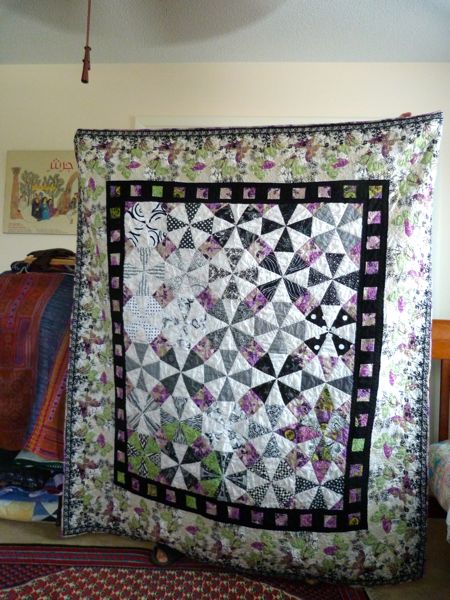
And here is the guide to the colors; I bought the border five years ago:

When AdventureMan say it, he said “that doesn’t look like a baby quilt” because it is so black and white, but, if you have eyes to see, it isn’t all black and white, it also has shades of purple, fuchsia, and a celery Spring green. I made the center Kaleidoscope pieces with a variety of blacks and whites, because babies LOVE black and white, and it can fascinate them and calm them.
I call it “I See Things Differently” because no, it doesn’t look like a baby quilt, but it is very much a baby quilt, it just doesn’t meet our cultural expectations. The longer I live, the less I meet any one’s expectations, LOL!
Thanks be to God! Thanks be to God for the safe delivery of this precious baby!
“It’s Just Like Living in Alaska, Mom . . . or Kuwait . . . “

My Mom was concerned; the temperatures are approaching 90°F in Seattle, and most of Seattle does not bother with air conditioning. At night, the temperatures go down into the fifties, cooling everything off, but the day time highs can be more than a little uncomfortable.
“How do you manage?” she asks. “I see the temperatures in (nearby) Mobile are in the 90’s almost every day.”
“It’s not that hard; it’s like living in Alaska – or Kuwait,” I tell her. “When it gets cold in Alaska, you dress warmly, you turn on the heat, you stay inside, and when you need to go out, you get into your car in the heated garage, go in your heated car to a heated store, and you come back home. You don’t spend a lot of time outside.”
I do pretty much the same thing I did in Qatar and Kuwait. I get up and do my devotional readings, and on some days I go to my aqua-aerobics class. on other mornings I volunteer. If I need something, I stop at a store on the way home. Sometimes, I clean house, or do laundry. We often go out for lunch, from the air conditioned car to the air conditioned restaurant and back 🙂 In the afternoons, I quilt or I read, or I quilt and I read.
AdventureMan grew up in the South, he is comfortable with the heat and the humidity. He works out in his gardens; once the temperatures go over 80° I rarely even visit the gardens, maybe when October comes and the temperatures drop. Yesterday morning I looked out as the sun was rising over the gardens and all I could see was swarms of insects rising. I don’t think they were mosquitoes, they looked like little no-see-up kind of things, all speeding around in the rising sun. I don’t do insects, the same way I really don’t do heat and humidity.
The Qatari Cat loves the heat. Part of his daily routine is to eat, then to go into the garage and sleep on one of the cars. It’s like an oven in the garage; it must remind him of living on the streets of Qatar when he was just a tiny thing. He is no longer a tiny thing. When we have international guests over for dinner, they always ask to take photos of him; he has grown to be a very long, tall cat, kingly but gracious.
Yesterday morning, as I headed out, there was a hint of – well, it was not coolness, but it was just not blasting me with heat. It was a respite from the relentless heat. I don’t begin to think it was a hint of winter to come; the summer torment has really just begun and is unlikely to end before late October, but I treasure even a hint of “not a blast of heat.”
AdventureMan asks me if I miss Seattle. Not so much, really, traffic has gotten so bad there, but I miss the climate. I feel energized by the cool mornings, even rain doesn’t bother me. I love the sound of the wind whistling around, I love taking a walk along the waterfront after lunch or dinner. I don’t find it at all surprising that diabetes is associated highly with countries with hot climates; heat makes you lethargic, inactive, all the things that encourage sloth.
Torrential rains are forecasted for this 4th of July weekend; in Pensacola there is a possibility they will diminish just in time for the fireworks. Hmmm. Heat. Humidity. Mosquitoes . . . I love fireworks . . . weighing my options 🙂
Arabs wary of expressing their opinions online
Fascinating study results published in Qatar’s Gulf Times:

Northwestern University in Qatar has released new findings from an eight-nation survey indicating many people in the Arab world do not feel safe expressing political opinions online despite sweeping changes in the aftermath of the Arab Spring.
From over 10,000 people surveyed in Lebanon, Tunisia, Egypt, Saudi Arabia, Bahrain, Qatar, Jordan and the UAE, 44% expressed some doubt as to whether people should be free to criticise governments or powerful institutions online.
Over a third of Internet users surveyed said they worry about governments checking what they do online.
According to the report, “The implied concern (of governments checking what they do online) is fairly consistent in almost all countries covered, but more acute in Saudi Arabia, where the majority (53%) of those surveyed expressed this concern.”
The study – titled ‘Media Use in the Middle East – An Eight-Nation Survey’ – was undertaken by researchers at NU-Q to better understand how people in the region use the Internet and other media. It comes as the university moves towards a more formalised research agenda and is the first in what will be a series of reports relating to Internet use.
The survey includes a specific chapter on Qatar, the only country where those surveyed regarded the Internet as a more important source of news than television. “We took an especially close look at media use in the State of Qatar – a country with one of the highest Internet penetration rates in the Arab world—and internationally,” said NU-Q dean and CEO Everette Dennis.
These findings follow a preliminary report NU-Q released last April that showed web users in the Middle East support the freedom to express opinions online, but they also believe the Internet should be more tightly regulated. “While this may seem a puzzling paradox, it has not been uncommon for people the world over to support freedom in the abstract but less so in practice,” Dennis explained.
Among other findings, the research shows: 45% of people think public officials will care more about what they think and 48% believe they can have more influence by using the Internet.
Adults in Lebanon (75%) and Tunisia (63%) are the most pessimistic about the direction of their countries and feel they are on the ‘wrong track.’
Respondents were far more likely to agree (61%) than disagree (14%) that the quality of news reporting in the Arab world has improved in the past two years, however less than half think overall that the news sources in their countries are credible.
Online transactions are rare in the Middle East, with only 35% purchasing items online and only 16% investing online.
The complete set of results from the survey is available online at menamediasurvey.northwestern.edu. The new interactive pages hosting the survey on the website have features that allow users to make comparisons between different countries, as well as between different demographics within each country.
Dennis confirmed that the research report is the first in an annual series of reports produced in collaboration with the World Internet Project; one of the world’s most extensive studies on the Internet, in which NU-Q is a participating institution.
NU-Q and WIP signed an agreement earlier in the year, providing a global platform for the current research.
Lamborghini Aventador: Qatari Royal’s £350k supercar towed in Knightsbridge
LLOOOLLLLL! Great story, thanks John Mueller!
Little cross cultural problem going on . . . no license? No registration? No problem, you know my uncle, right, the Amir of Qatar . . . LOL!
Batman wouldn’t stand for it: Police peer inside the garish car’s doors (Picture: SWNS)

It’s hard not to notice a bright purple Lamborghini with orange trim. So the driver of this £350,000 supercar was asking for trouble when he went for a spin without a front numberplate.
Police spotted the infringement and impounded the vehicle after its 24-year-old owner – thought to be a member of the Qatari royal family – was unable to produce evidence that he had a driving licence or insurance.
Crowds gathered as the 220mph Aventador was towed away in London’s Knightsbridge.

Arab playboys descend on the wealthy neighbourhood each summer in costly cars flown from home and often hit trouble for lacking the correct papers.
The mean machines are a draw for petrolheads but the roaring engines annoy residents.
Off we tow: The Lamborghini Aventador is loaded onto a truck (Picture: SWNS)
Dozens of onlookers gathered to photograph the scissor-doored supercar, which has been customised by a Japanese tuning company.
One fan said: ‘It is great when the wealthy foreign tourists come over to London every summer as you always see these amazing supercars.
‘The Lamborghini looked like something out of Tron, it was absolutely stunning.
‘Hopefully there was just some confusion over the correct paperwork and it will be back on the road
UPDATE:
First it was carted off on the back of a truck, then it faced the crusher, now glow-in-the dark Lamborghini is ticketed in Mayfair
- Police impounded £350k supercar after owner failed to produce documents
- But he was slapped with ticket just hours after retrieving it from police
- Purple Lamborghini Aventador customised to glow in the dark
- Owner believed to be Nasser Al-Thani, 24, of Qatar’s ruling family
PUBLISHED: 04:49 EST, 5 July 2013 | UPDATED: 14:32 EST, 5 July 2013
He was only a hair’s breadth away from seeing his beloved £350,000 supercar crushed to a pulp after it was seized by police for driving offences.
So you might think the owner of this glow-in-the-dark Lamborghini would be a bit more careful next time.
But within hours of retrieving his purple sports car from the Metropolitan Police, he found himself on the wrong side of the law again after being slapped with a parking ticket.
Recent Comments
ExpatAlien on What Country am I Living … intlxpatr on Yellowstone: Old Faithful to C… Michelle on Yellowstone: Old Faithful to C… Cathy on No Grown-Ups in Charge intlxpatr on Waiting for Snow Wikipedia Donate Button

Amazina


Early Voting in Florida


 Here There and Everywhere