New Virus in Middle East Kills 50% Victims
I found this on WeatherUnderground News this morning. What scares me is that there may be more victims, many more, shepherds who work with goats, laborers, people thought to have very bad colds, maybe even pneumonia, who don’t have the kind of money to fly to London to be diagnosed. If one man spread it to two family members, imagine how many people he had contact with on that airplane flying to London.
LONDON, Feb 27 (Reuters) – The emergence of a deadly virus previously unseen in humans that has already killed half those known to be infected requires speedy scientific detective work to figure out its potential.
Experts in virology and infectious diseases say that while they already have unprecedented detail about the genetics and capabilities of the novel coronavirus, or NCoV, what worries them more is what they don’t know.
The virus, which belongs to the same family as viruses that cause the common cold and the one that caused Severe Acute Respiratory Syndrome (SARS), emerged in the Middle East last year and has so far killed seven of the 13 people it is known to have infected worldwide.
Of those, six have been in Saudi Arabia, two in Jordan, and others in Britain and Germany linked to travel in the Middle East or to family clusters.
“What we know really concerns me, but what we don’t know really scares me,” said Michael Osterholm, director of the U.S.-based Center for Infectious Disease Research and Policy and a professor at the University of Minnesota.
Less than a week after identifying NCoV in September last year in a Qatari patient at a London hospital, scientists at Britain’s Health Protection Agency had sequenced part of its genome and mapped out a so-called “phylogenetic tree” – a kind of family tree – of its links.
Swiftly conducted scientific studies by teams in Switzerland, Germany and elsewhere have found that NCoV is well adapted to infecting humans and may be treatable medicines similar to the ones used for SARS, which emerged in China in 2002 and killed a tenth of the 8,000 people it infected.
“Partly because of the way the field has developed post-SARS, we’ve been able to get onto this virus very early,” said Mike Skinner, an expert on coronaviruses from Imperial College London. “We know what it looks like, we know what family it’s from and we have its complete gene sequence.”
Yet there are many unanswered questions.
Spotlight on Saudi Arabia, Jordan
“At the moment we just don’t know whether the virus might actually be quite widespread and it’s just a tiny proportion of people who get really sick, or whether it’s a brand new virus carrying a much greater virulence potential,” said Wendy Barclay, a flu virologist, also at Imperial College London.
To have any success in answering those questions, scientists and health officials in affected countries such as Saudi Arabia and Jordan need to conduct swift and robust epidemiological studies to find out whether the virus is circulating more widely in people but causing milder symptoms.
This would help establish whether the 13 cases seen so far are the most severe and represent “the tip the iceberg”, said Volker Thiel of the Institute of Immunobiology at Kantonal Hospital in Switzerland, who published research this month showing NCoV grows efficiently in human cells.
Scientists and health officials in the Middle East and Arab Peninsular also need to collaborate with colleagues in Europe, where some NCoV cases have been treated and where samples have gone to specialist labs, to try to pin down the virus’ source.
“One Big Virological Blender”
Initial scientific analysis by laboratory scientists at Britain’s Health Protection Agency (HPA) – which helped identify the virus in a Qatari patient in September last year – found that NCoV’s closest relatives are most probably bat viruses.
It is not unusual for viruses to jump from animals to humans and mutate in the process – high profile examples include the human immunodeficiency virus (HIV) that causes AIDS and the H1N1 swine flu which caused a pandemic in 2009 and 2010.
Yet further work by a research team at the Robert Koch Institute at Germany’s University of Bonn now suggests it may have come through an intermediary – possibly goats.
In a detailed case study of a patient from Qatar who was infected with NCoV and treated in Germany, researchers said the man reported owning a camel and a goat farm on which several goats had been ill with fevers before he himself got sick.
Osterholm noted this, saying he would “feel more comfortable if we could trace back all the cases to an animal source”.
If so, it would mean the infections are just occasional cross-overs from animals, he said – a little like the sporadic cases of bird flu that continue to pop up – and would suggest the virus has not yet established a reservoir in humans.
Yet recent evidence from a cluster of cases in a family in Britain strongly suggests NCoV can be passed from one person to another and may not always come from an animal source.
An infection in a British man who had recently travelled to Saudi Arabia and Pakistan, reported on Feb. 11, was swiftly followed by two more British cases in the same family in people who had no recent travel history in the Middle East.
The World Health Orgnisation says the new cases show the virus is “persistent” and HPA scientists said the cluster provided “strong evidence” that NCoV, which like other coronaviruses probably spreads in airborne droplets, can pass from one human to another “in at least some circumstances”.
Despite this, Ian Jones, a professor of virology at Britain’s University of Reading, said he believes “the most likely outcome for the current infections is a dead end” – with the virus petering out and becoming extinct.
Others say they fear that is unlikely.
“There’s nothing in the virology that tells us this thing is going to stop being transmitted,” said Osterholm. “Today the world is one big virological blender. And if it’s sustaining itself (in humans) in the Middle East then it will show up around the rest of the world. It’s just a matter of time.”
Catastrophic Vanishing Water in Middle East
I found this article in the Weather Underground News this morning:
DOHA, Qatar — An amount of freshwater almost the size of the Dead Sea has been lost in parts of the Middle East due to poor management, increased demands for groundwater and the effects of a 2007 drought, according to a NASA study.
The study, to be published Friday in Water Resources Research, a journal of the American Geophysical Union, examined data over seven years from 2003 from a pair of gravity-measuring satellites which is part of NASA’s Gravity Recovery and Climate Experiment or GRACE. Researchers found freshwater reserves in parts of Turkey, Syria, Iraq and Iran along the Tigris and Euphrates river basins had lost 117 million acre feet (144 cubic kilometers) of its total stored freshwater, the second fastest loss of groundwater storage loss after India.
About 60 percent of the loss resulted from pumping underground reservoirs for ground water, including 1,000 wells in Iraq, and another fifth was due to impacts of the drought including declining snow packs and soil drying up. Loss of surface water from lakes and reservoirs accounted for about another fifth of the decline, the study found.
“This rate of water loss is among the largest liquid freshwater losses on the continents,” the authors wrote in the study, noting the declines were most obvious after a drought.
The study is the latest evidence of a worsening water crisis in the Middle East, where demands from growing populations, war and the worsening effects of climate change are raising the prospect that some countries could face sever water shortages in the decades to come. Some like impoverished Yemen blame their water woes on the semi-arid conditions and the grinding poverty while the oil-rich Gulf faces water shortages mostly due to the economic boom that has created glistening cities out of the desert.
In a report released during the U.N. climate talks in Qatar, the World Bank concluded among the most critical problems in the Middle East and North Africa will be worsening water shortages. The region already has the lowest amount of freshwater in the world. With climate change, droughts in the region are expected to turn more extreme, water runoff is expected to decline 10 percent by 2050 while demand for water is expected to increase 60 percent by 2045.
One of the biggest challenges to improving water conservation is often competing demands which has worsened the problem in the Tigris and Euphrates river basins.
Turkey controls the Tigris and Euphrates headwaters, as well as the reservoirs and infrastructure of Turkey’s Greater Anatolia Project, which dictates how much water flows downstream into Syria and Iraq, the researchers said. With no coordinated water management between the three countries, tensions have intensified since the 2007 drought because Turkey continues to divert water to irrigate farmland.
“That decline in stream flow put a lot of pressure on northern Iraq,” Kate Voss, lead author of the study and a water policy fellow with the University of California’s Center for Hydrological Modeling in Irvine, said. “Both the UN and anecdotal reports from area residents note that once stream flow declined, this northern region of Iraq had to switch to groundwater. In an already fragile social, economic and political environment, this did not help the situation.”
Jay Famiglietti, principle investigator of the new study and a hydrologist and UC Irvine professor of Earth System Science, plans to visit the region later this month, along with Voss and two other UC Irvine colleagues, to discuss their findings and raise awareness of the problem and the need for a regional approach to solve the problem.
“They just do not have that much water to begin with, and they’re in a part of the world that will be experiencing less rainfall with climate change,” Famiglietti said. “Those dry areas are getting dryer. They and everyone else in the world’s arid regions need to manage their available water resources as best they can.”
It’s Just Not Right

How can this be? Pensacola is hotter, at seven in the morning, than Kuwait or Doha at mid-afternoon? It is almost 70° at seven in the morning, in JANUARY??? This isn’t right.
I get my daily weather information from Weather Underground. They have a page that allows me to keep track of several cities at one time; they appear at the top of the page of my Pensacola report. 🙂
Happy New Year, Kuwait and Qatar!
It’s just about time! Happy New Year to all our friends in Kuwait and Qatar!


May God bless you and your families abundantly in the coming year 🙂
Vitamin D Fights Auto-Immune Diseases
When we were living in Qatar, there was a study published in the Qatar Gulf Times about the increasing problem of Vitamin D deficiency among women who are covered. It suggested that just ten minutes a day, uncovered, in full sunshine, could help relieve this common deficiency.
Part of the problem may be a lack of private area where a covered woman will feel comfortable being outside, uncovered, free from prying eyes. Another problem is cultural, where whiter skin is valued more highly than darker skin, or freckled skin.
What cost beauty? There are long term ramifications of Vitamin D deficiency, and the consequences can be dire. The cure is so easy . . .
By Diana Rodriguez
Medically reviewed by Lindsey Marcellin, MD, MPH
Your body needs a wide range of nutrients so that each cell performs the way it’s supposed to and all your body functions run smoothly. One important source that’s been getting a lot of buzz? Vitamin D — this essential vitamin helps build strong bones and much more.
Now researchers are discovering that vitamin D may be a powerful tool in understanding, and perhaps even preventing, certain health problems, including a group of conditions that currently has no cure — autoimmune diseases.
Autoimmune diseases occur when your immune system turns against your own body instead of fighting harmful invaders like bacteria and viruses. Autoimmune diseases affect different areas of the body. For instance, psoriasis is an autoimmune disease that affects the skin, while Graves’ disease is an autoimmune disease that affects the thyroid gland.
Little is known about how and why autoimmune diseases occur, what can be done to prevent them, and how to reduce your autoimmune disease risk. But that could be about to change.
The Scoop on Vitamin D’s Benefits
One recent study discovered that people who are deficient in vitamin D, which comes from both food sources and sunlight, have an increased autoimmune disease risk. The study also found that vitamin D can affect how your genes function by binding to them in particular spots. These binding locations may help researchers better understand genes that trigger diseases related to vitamin D.
We know that vitamin D plays a role in protecting the immune system. And researchers found that not getting enough vitamin D increases your risk for rheumatoid arthritis, multiple sclerosis, and type 1 diabetes, among other autoimmune diseases. Unfortunately, researchers can’t yet pinpoint exactly how and why this is the case, or how getting enough vitamin D may help to ward off the onset of autoimmune disease symptoms.
5 Ways to Up Your Daily Dose of D
It’s clear that much more research needs to be done to better understand both autoimmune diseases and the impact of vitamin D on reducing autoimmune disease risk. But we already know that not getting enough vitamin D can be devastating to bones, leading to osteoporosis and fractures.
For overall good health, it’s essential to meet vitamin D requirements, up to 600 international units, or IU, each day. If your doctor tests your blood vitamin D level and finds a low level, you may be advised to get higher amounts. Where can you find this bone-building, immune-boosting vitamin? Here are some simple ways to get the recommended daily intake of vitamin D:
Feed on fish. Specifically, canned pink salmon, mackerel, and sardines offer the highest amounts of vitamin D.
Choose fortified beverages. Both soy and cow’s milk are available fortified with vitamin D. Some brands of orange juice also come with an added dose of D.
Eat egg yolks. Though they’re sometimes a concern because of cholesterol, egg yolks are a good source of vitamin D.
Start your day with cereal. Dry cereals and instant oatmeal that have been fortified with vitamin D are a great way to start your day.
Keep it simple with a supplement. Vitamin D supplements can make it easy to get all you need each day — just take one pill.
Exposure to the sun also helps your body to produce vitamin D. Relaxing in the sun for a brief period of time (just 5 to 10 minutes) a few days per week without sunscreen can help your body create enough vitamin D to ward off a deficiency. Just remember to guard against the potential damage of the sun — keep your exposure limited to reap the vitamin D benefits without harming your skin.
Qatar National Day 2012
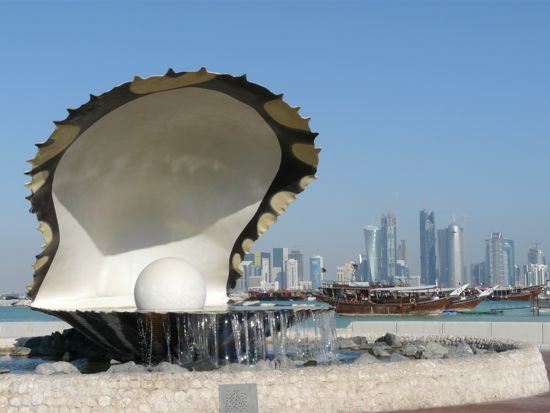
Congratulations to all our Qatari friends and greetings on your National Day, December 18, 2012. One of my new favorite sources of information out of Doha, the Doha News, has published a great article, Everything You Need to Know About Qatar’s National Day 2012, which you can access by clicking on the blue type.
Sorry for laughing, but this year they have forbidden people to decorate their cars and some of the displays common on National Day. Good luck with that!
National Day in Qatar might be a lot of fun, if it weren’t for the crowds, and the grid-locked streets. If you want to watch the fireworks – and they are truly fabulous, the Amir and his supporters spare no expense, it is truly bread and circus time in Qatar – you just have to grit your teeth and buy into getting through all the traffic to a viewing site.
We found a great – and relatively remote – site from which to watch, us and our 300 closest Qatari friends, over at the Marriott marina; it was a great view, and only maybe two hours trying to get home afterwards, LOL, fighting our way through the party-SUVs with their foam sprays and their decor, and young Qatari males dancing on the top of the SUVs, yes, they did, I am not kidding.
Qatar ‘ONE OF US’ Campaign – Nice Touch
Expat women who don’t wear enough clothing has long been a bone of contention for traditional and conservative Qatari women, who find themselves a minority in their own country. I remember well the anguish in the voice of one of my friends talking about how the salesgirl her mother was speaking with was showing “everything” AND she didn’t even speak Arabic, only English. Her mother was wondering whose country Qatar was?
Qatar doesn’t want to go to the extreme lengths of Saudi Arabia, they just want the non-Moslem, non-local women to cover up a little. Oh! Not just the women, the men, too! It’s a cute campaign – If you’re here, you’re one of us. I like it. It has a welcoming sound, but at the same time it politely reminds the expat that we are a guest in their country. This is the expectation, stated politely. Here is one of the visuals
(I found this article on Doha News)
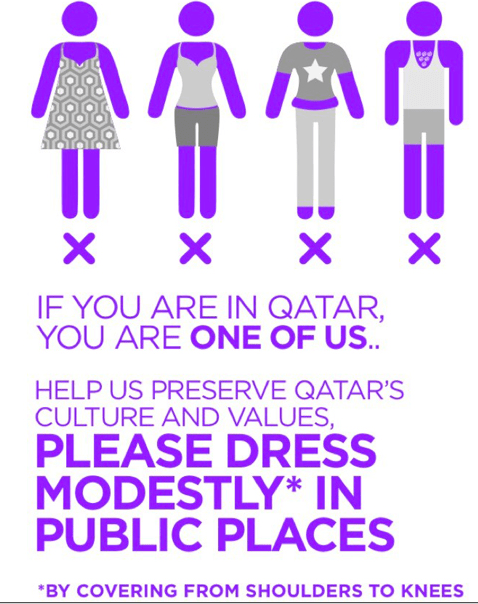
A grassroots modesty campaign started by a group of Qatari women this summer has received the backing of the Qatar Tourism Authority, with the goal of helping visitors and expat residents “avoid embarrassment” and “feel welcome” here, the group has announced.
The “One of Us” drive, which was launched in June, highlights the part of the Qatari penal code that prohibits wearing “indecent” clothing in public, but adds to it by clarifying what exactly is deemed inappropriate – namely, bare shoulders and legs.
QTA will ensure that the dress code campaign guidelines will be displayed on posters in shopping malls and public spaces. They will also be posted on the QTA website and in future guides and brochures that the group publishes.
In June, campaign organizer Najla Al-Mahmoud told Doha News:
I don’t blame foreigners as they come from a different culture and they don’t know that it’s not acceptable… that’s why a group of ladies from different group of age gathered and decided to do something for Qatar…
We don’t want to interfere with anyone’s religion and force them to wear hijab … we only want modest clothing. It’s a matter of etiquette and class. We want to be able to go to public places without a lot of flesh around us.
Despite organizers’ efforts not to raise hackles, the campaign sparked a fierce debate on social media and Doha News about local/expat relations and the definition of decency.
Commenter J wrote:
This is a tricky issue for ex-pat women here as being “modest” is relative. And there are lots of mixed messages. You may see a young Muslim woman wearing a Shayla, a long, loose skirt, and the tightest long-sleeve shirt you’ve ever seen, leaving little to the imagination. And men wear tight t-shirts, tight skinny jeans, and shirts with the first three buttons open showing their chest. I think this campaign should not be aimed at everyone, not just at ex-pat women.
Others said they supported the campaign and expressed appreciation for having concrete guidelines to follow.
Meanwhile, Qatar University rolled out its own dress code in September, to mixed reaction from the student body, who are now prohibited from wearing tight, revealing clothing (including tight abayas) and casual wear like sweatpants and Bermuda shorts.
Libyans Say “Sorry” In Counter-Protests
I was living in Qatar, and the Libyan ambassador’s wife had invited me, along with several other women, to morning coffee. It’s what people did. I was sitting between one of my Libyan friends and my good Iranian friend, and I started laughing. I said “Oh, what is this good little American girl doing sitting between a Libyan and an Iranian?” and then we all laughed. We weren’t Libyan, or American, or Iranian, we were just women who liked each other; we got along.
We were all religious women. Not the same religion, but all believers in the Abrahamic tradition. I felt more comfortable with them than I felt around non-religious women. We had a lot of fun together, and we liked each other.

It breaks my heart when bad things happen, and I know how good these people are, and that the people on the attack have their own agenda which has nothing to do with Islam, or Christianity, and everything to do with power. If they prevail, I fear for my good friends.
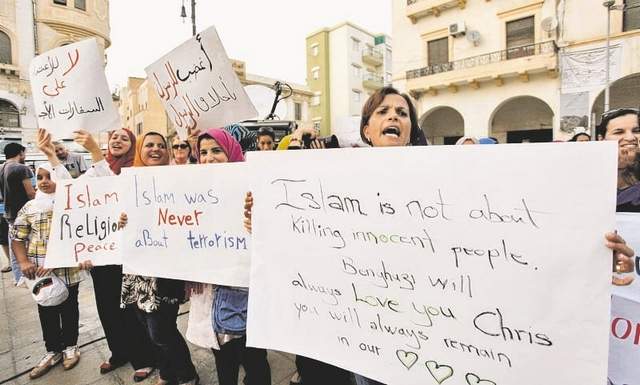
This article from USA Today made me cry this morning. Ambassador Stevens was loved, and these brave people are risking their futures to tell us so.
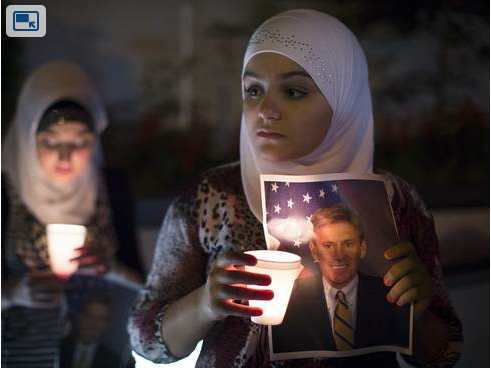
Libyans express sorrow over killing of Americans
by Donna Leinwand Leger, USA TODAY
Hours after learning of Ambassador Chris Stevens’ death, the Libyan Youth Movement transformed its Facebook page into a tribute to the slain diplomat. It changed its cover photo from “Free Libya” graffiti sprayed on a Tripoli wall to a somber photo of Stevens with the tag “RIP Christopher Stevens1960-2012.”
“As North America wakes up, dread washes over me. What a rough night. I’m sorry for the horrible day the world is about to face,” the administrator of the Shabab Libya page wrote. “We are sorry.”
As anti-American protests swept across North Africa and the Persian Gulf, a counter-protest of apology emerged. Photos of Libyans carrying hand-lettered signs condemning the violence and expressing contrition for their countrymen appeared on Facebook. “Sorry” became the trending mantra of Libyans on Twitter.
At one counter-protest, an unidentified man carried a crude sign phonetically written in English with blue marker on lined notebook paper, “Sorry People of America this not the Pehavior of our ISLAM and Profit.”
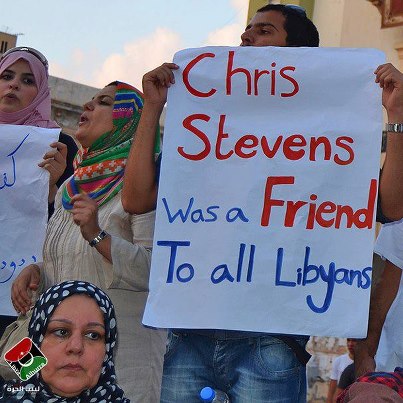
Another sign in red, white and blue read: “Chris Stevens wasa friend to all Libyans.”
On Facebook, one group formed The Sorry Project, designed to collect thousands of personal, written apologies from Libyans. Its profile photo is a man holding a sign, “USA. We are sorry. We are sad.”
“We Are Sorry,” the group wrote on the page created Sept.11. “We would like show that as Libyans we do not support on the actions committed by these criminals. USA, we are sorry and we will say it one thousand times over. Our apologies will never be enough, but the Libyan people will always be grateful for you since you were the first to stand by us in our fight for freedom and hopefully you will continue supporting us.”
One commenter, Hajer Sharief, vowed to avenge Stevens’ death by rebuilding a “new civilized democratic Libya.”
“We promise, we will not tire, we will not falter, and we will not fail,” Sharief wrote. “This is the way real Libyans will pay you back Mr. Ambassador Chris Stevens.”
At the ceremony Friday outside Washington to repatriate the remains of the four American victims, President Obama acknowledged Libya’s internal conflict.
“I know that this awful loss, the terrible images of recent days, the pictures we’re seeing again today, have caused some to question this work. And there is no doubt these are difficult days. In moments such as this — so much anger and violence — even the most hopeful among us must wonder,” Obama said. “But amid all of the images of this week, I also think of the Libyans who took to the streets with homemade signs expressing their gratitude to an American who believed in what we could achieve together. I think of the man in Benghazi with his sign in English, a message he wanted all of us to hear that said, ‘Chris Stevens was a friend to all Libyans.’ “
Addicted to Change?
Today I attended a meeting at which there was a program on surviving change and thriving through it. The speaker described change as that which happens outside your control, and transition as that which you do to adapt to the change that is happening. A change can be positive if you have chosen it, or negative, if someone else has made a choice, or something has happened, over which you have no control or input, but it impacts on you.
Interesting, huh?
I’m not all that good at listening for very long, so my mind drifted to all the moves I’ve made (31) and all the adapting I’ve done. I didn’t mind the moving so much; I was good at it. Toward the end, the packing up became oppressive as I took more and more of it into my own hands. I had my reasons, as I learned that no matter how ‘caring’ the movers are promoted as being, they don’t care about my things the way I do.
First bad surprise: my son’s engraved silver baby cup disappearing. Those packing ladies showed up with great big handbags. I should have known. Thirty years later I am still fuming over the loss of that cup.
Second major bad surprise: We watched everything carefully packed up and crated, but when we got to the next post we discovered someone had changed the orders and UNCRATED our goods so they could go by air, without re-packing all the fragile goods, so everything came loose. What a mess. Furniture cracked and broken, irreplaceable friable Tunisian pottery in pieces, broken, broken broken, good and bad alike. Oh aarrgh.
Third bad surprise – my riding boots thrown in on top of my formal gowns. Shock and horror.
Slowly, slowly I began packing up my precious things inside other things, so no-one would ever see them. I began packing up my own clothes, which made it a whole lot easier to unpack; like was together with like. Movers would sometimes take clothes to cushion things, so you’d find sweaters wrapped around dishware or decorative items.
Last really bad surprise: Everything was carefully packed, but one box didn’t make it. I had packed the box myself – it was full of quilting books, books I used to teach quilting in Qatar and Kuwait, books which had new ideas and techniques. I knew no one wanted those books, but someone had dumped the box because, I imagine, they didn’t want to carry it, or it didn’t fit in the crate, or . . . I will never know. Those books were worth thousands of dollars, and some were private issue or out of print and irreplaceable.
There is nothing you can do about human malice, or random bad luck.
It just made me more and more compulsive, as I tried to control more and more so as not to have damage or loss, or just to help the move be more organized. It was a choice. I knew I didn’t have to work that hard, but I chose it, to have more control over what got lost or damaged. There is always a point, though, where you realize you don’t ever, not ever, have perfect control, and if you try, you can just make yourself crazy. You have to let it go.
Then, there is the moving in.
I was good at it. When it came to putting things away, it was always get the beds set up first, and made up. Everything was carefully labeled. Put the flatware in the flatware drawer, have a couple pots and pans and a few time-tested utensils. All the boxes are marked for the right room, and then – it’s just one box at a time, one room at a time, and you just stick at it until it’s finished.
Except for the move to Qatar, when I got sick and my angel friend came and unpacked my quilt room and put everything away. If you are a quilter, you will know what kind of effort that was, LOL! I also had a maid who was more like a friend. She was always doing more than I told her to do, God just made her heart that way, and she took care of tearing down all the boxes and saving all the paper, a task that makes me crazy, and as she did it she showed so much grace.
But now, it’s been two years since my last move. The possibility of Hurricane Isaac helped me deal with some of the time-to-move heebie-jeebies. AdventureMan asked if he needed to buy me a new house. (Our joke was always that I was low maintenance; I didn’t want big jewels or high end clothing, just buy me a house now and then, LOL!) No, I don’t need a new house. I need to handle this cold turkey; I’ve become so addicted to change that I’m not very good at settling down. The only way you can get good at something is to practice it. I need to more practice at this being settled, but oh, it is so uncomfortable for me.
Here are some rolling stone kind of songs, no not Rolling Stones, but rolling stone, as in Mama was a Rolling Stone, LOL.
Trial Run: Lessons Learned
We have most everything put away now, a real pain in the neck, but we keep in mind that it is not as much a pain in the neck as losing everything, or having to hack a hole in your own roof to escape a flood which completely ruins a house so you have to rebuild and live somewhere else while you are rebuilding. It’s even a lot easier than having a window or roof or garage breached, and the resulting damage from wind-driven rain, or just sheets of rain.
Today has had higher gusts of wind and frequent showers, and an occasional breakthrough of Pensacola sunshine.
We know how long it takes to put on our window protection – and take it off. We know how long it takes to clear all the potential flying objects out of our backyard. We know a couple vulnerable points, and that it’s going to be expensive to get a fix big enough to give us complete protection. It’s a gamble.
Here is something else I know, very valuable.
I know that I can keep hot coffee and hot water HOT for five days.
This great thermal jug from Qatar had coffee still warm after five days – not hot, but warm.

This little thermos from Starbucks kept coffee very warm, but not hot:

And this is a large thermos/ server I found in Kuwait and used for three years for large groups of ladies. Six years later, it is still working great. I poured boiling water into it on Sunday night, and on Thursday afternoon, it was still almost boiling hot. It was hot enough you can use it to make soup, which is just what you need to be able to do when you have no electricity and need to fix something that can warm you up.

The WINNER!
Recent Comments
intlxpatr on Yellowstone: Old Faithful to C… Michelle on Yellowstone: Old Faithful to C… Cathy on No Grown-Ups in Charge intlxpatr on Waiting for Snow intlxpatr on Waiting for Snow Wikipedia Donate Button

Amazina


Early Voting in Florida


 Here There and Everywhere