Doha, Qatar on House Hunters International
Oh what fun – last night on House Hunters International, I got to search for an apartment in Doha. Well, not really, but virtually. Here is what the episode description says on HGTV:
Just after getting married to Meena, architect Ken jumped at the chance to help design Doha’s new international airport. So, they’re trading in the golden state of California for the golden lands of Qatar. But as these newlyweds discover each other, the new city of Doha is also discovering its own identity as it moves towards the future. From sleek new development to traditional neighborhoods, real estate agent Ana Figueiredo will help them navigate Doha’s changing landscape. Watch as House Hunters International uncovers all that glitters in Doha, Qatar.
I checked YouTube; the episode is not yet up. It was so much fun, seeing this young couple in the Souks, down near Al Saad in Mirqab, and out at the Pearl. The apartment they settled on was in Al Ashmak, near the Corniche; I think it was one of the Bilal apartment buildings.
Worst Drivers in the World: Traffic Fatalities by Country
Driving in the Middle East is a whole other world, a world of chaos until you realize that the rules are different, no matter what the published rules are. To drive in Qatar, I started at 0430 on a Friday morning, when there was little or no traffic (things have changed) and would drive until traffic began to thicken. Eventually, I knew the city and gained confidence that I could drive without getting killed. In Kuwait, for months, I would only drive to relatively nearby shopping areas, or drive only on back roads carefully plotted on the map during low traffic hours. After a while, you begin to get a sense of things, and the sensation of imminent death lessens.
Adventures in Qatar: a radiator dropping off a truck in front of me, being hit on purpose by a man who didn’t like women driving, being pushed into a round about by a Hummer, being nearly assaulted by two young Qataris who believed we had insulted them by being in the lane where they wanted to be, watching men drive up the wrong side of the ring roads because they were too important to wait in line, later standing and laughing at their crashed cars – Daddy would buy them another. It sounds crazy, but you get used to it.

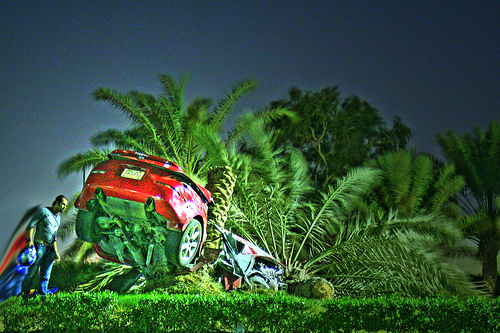
Kuwait was a whole different ball game, controlled chaos at high speeds. Adventures in Kuwait: the sleeping elderly man driving in the lane next to me who almost hit me, watching drivers drive through red lights as if they were green, sparks off the fenders of SUVs on Highway 30 as people wove quickly in and out of traffic, the dramatic crashed and burned out cars on the sides of the highways, the car impaled on a palm tree – 10 feet above the road. Kuwait was so surreal that I couldn’t even begin to imagine how some of the accidents happened; I learned to be a very prayerful driver.
So out of idle curiosity, today I looked up highest rate of traffic fatalities per country, and found this on Wikipedia. So here’s a surprise . . . Kuwait’s fatalities statistic is roughly equal to that of the United States. Qatar’s is significantly higher, and many countries are even double or triple Kuwaits fatality rate. I’m having trouble wrapping my mind around this.
List of countries Fatalities per 100,000 inhabitants
World 20.8
Afghanistan 39.0
Albania 13.9
Angola 37.7
Argentina 13.7
Armenia 13.9
Australia 5.71
Austria 8.2
Azerbaijan 13.0
Bahamas 14.5
Bahrain 12.1
Bangladesh 12.6
Barbados 12.2
Belarus 10.9
Belgium 10.1
Belize 15.6
Benin 31.2 1
Bhutan 14.4
Bolivia 16.7
Bosnia and Herzegovina 10.9
Botswana 33.8
Brazil 19.9
British Virgin Islands 21.7
Brunei Darussalam 13.8
Bulgaria 8.8
Burkina Faso 31.1
Burundi 23.4
Cambodia 12.1
Cameroon 28.1
Canada 9.2
Cape Verde 25.1
Central African Republic 32.2
Chad 34.3
Chile 13.7
China 5.1
Colombia 11.7
Comoros 30.3
Republic of the Congo 28.8
Cook Islands 45.0
Costa Rica 15.4
Croatia 9.1
Cuba 8.6
Cyprus 10.4
Czech Republic 10.4
Denmark 3.1
Dominican Republic 17.3
Ecuador 11.7
Egypt 42.0
El Salvador 12.6
Eritrea 48.4
Estonia 7.5
Ethiopia 35.0
Fiji 7.0
Finland 6.5
France 5.5
The Gambia 36.6
Georgia 16.8
Germany 4.5
Ghana 9.32
Greece 14.4
Guatemala 14.7
Guinea-Bissau 34.4
Guyana 19.9
Honduras 13.5
Hungary 9.9
Iceland 3.8
India 11.1
Indonesia 16.2
Iran 35.8
Iraq 38.1
Republic of Ireland 3.51
Israel 3.7
Italy 8.7
Jamaica 12.3
Japan 3.85
Jordan 34.2
Kazakhstan 30.6
Kenya 34.4
Kiribati 7.4
Republic of Korea 11.3
Kuwait 16.9
Kyrgyzstan 22.8
Laos 18.3
Latvia 8.7
Lebanon 28.5
Lesotho 26.7
Liberia 32.9
Libya 40.5
Lithuania 14.8
Luxembourg 9.0
Madagascar 33.7
Malawi 26.0
Malaysia 24.1
Maldives 18.3
Mali 32.1
Malta 3.4
Marshall Islands 7.4
Mauritania 35.5
Mauritius 11.1
Mexico 20.7
Federated States of Micronesia 14.4
Mongolia 14.5
Montenegro 14.6
Morocco 28.3
Mozambique 7.0
Myanmar 23.4
Namibia 28.6
Nauru 9.9
Nepal 15.1
Netherlands 3.9
New Zealand 8.6
Nicaragua 14.2
Niger 37.7
Nigeria 32.3
Norway 5.4
Oman 21.3
Pakistan 25.3
Palau 14.8
Palestinian territories 5.6
Panama 12.7
Papua New Guinea 14.2
Paraguay 19.7
Peru 21.5
Philippines 20.0
Poland 10.7
Portugal 7.9
Puerto Rico 12.8
Qatar 23.7
Republic of Macedonia 6.9
Republic of Moldova 15.1
Romania 9.4
Russia 19.5
Rwanda 31.6
Saint Lucia 17.6
Saint Vincent and the Grenadines 6.6
Samoa 12.8
San Marino 0
Sao Tome and Principe 33.0
Saudi Arabia 29.0
Senegal 32.5
Serbia 9.8
Seychelles 18.5
Sierra Leone 28.3
Singapore 4.8
Slovakia 7.1
Slovenia 10.4
Solomon Islands 16.9
South Africa 33.2
Spain 6.9
Sri Lanka 13.5
Sudan 34.7
Suriname 15.8
Swaziland 26.3
Sweden 2.9
Switzerland 4.7
Syrian Arab Republic 32.9
Tajikistan 14.1
Thailand 19.6
Timor-Leste 16.1
Togo 28.1
Tonga 7.0
Trinidad and Tobago 15.5
Tunisia 34.5
Turkey 13.4
Turkmenistan 18.6
Tuvalu 9.5
Uganda 24.7
Ukraine 11.2
United Arab Emirates 37.1
United Kingdom 3.59
United Republic of Tanzania 34.3
United States of America 12.3
Uruguay 12.8
Uzbekistan 9.7
Vanuatu 18.6
Venezuela 21.8
Vietnam 16.1
Yemen 29.3
Zambia 25.6
Zimbabwe 27.5
Like all statistics, I think some are honest, and some need to be taken with a grain of salt. I found reading through them fascinating. You can get more information, accidents per thousand cars, total accidents, etc.
Harlem Shake, Qatar Style :-)
Loved seeing this from ILoveQatar:
Qatari Amir Buying up Greece
Ah . . . It’s great to be an Amir. And how wonderful, to buy your own wonderland, and help the locals while you are at it, LOL. No plans for development, just use by his wives and children . . . (Thank you again, John Mueller!)
http://www.guardian.co.uk/world/2013/mar/04/qatar-emir-buys-six-greek-islands
Qatari emir buys six Greek islands for a song
Helena Smith in Athens
The Guardian, Monday 4 March 2013 20.23 GMT
The Greek island of Oxia, was the Qatari emir’s first purchase, which cost €5m.
The suitor is one of the world’s wealthiest men; the location happens to be the eurozone’s poorest country. But in an unlikely coming together of economic circumstances, the emir of Qatar, Hamad bin Khalifa Al Thani, has opted to splash out €8.5m (£7.35m) on six idyllic isles in the Ionian sea.
Closure of the deal – the latest in a global shopping spree that has seen the sheikh’s property portfolio spread from London to Beijing – has been met with glee in Greece, the west’s most bankrupt state, and Doha, where the royal household experienced 18 months of excruciating drama to take possession of the outcrops.
“Greece is that kind of place,” said Ioannis Kassianos, Ithaca’s straight-talking Greek-American mayor. “Even when you buy an island, even if you are the emir of Qatar, it takes a year and a half for all the paperwork to go through.”
The isles, known as the Echinades, caught the oil-rich monarch’s fancy when he moored his super-yacht in the turquoise waters off Ithaca, took in the view and liked what he saw. That was four summers ago.
Qatar’s Emir and his wife. Photograph: Yves Herman/Reuters
When the royal eventually got off the yacht, he inquired about the pine-covered chain as he strolled about Ithaca in sandals and shorts. “They have a fund with a couple of hundred million in it,” enthused Kassianos, a former US economics professor who assumed the mayorship of Homer’s fabled isle three years ago. “And as far as I know they want to buy all 18 of the islands, the whole lot.”
The purchase, the biggest private investment in Greece, appears to have been a windfall for the emir, who drove a hard bargain in a market where investors are few and far between. The first island, Oxia, initially came with a price tag of €7m before its Greek-Australian owners agreed to let it go for just under €5m. Last week, Denis Grivas, whose family has owned the title deeds to the other five almost since the foundation of modern Greece, also settled on a price.
“The islands have been in my family for over 150 years but we are not rich enough to be able to keep such valuable properties any longer,” he said, ruing the soaring taxes the crisis-hit Greek state has slapped on real estate. “We are very, very happy to see them go. They have been on the market for nearly 40 years.”
With their pristine beaches, ancient olive orchards and natural coves, the uninhabited isles are “an ideal opportunity for a solid business investment with unlimited possibilities”, says the high-end “private island online” site, describing the properties as Mediterranean pearls. “The potential for development is very big … from developing tourist-style Club Meds or hotel facilities, to villas to sell or rent.”
But the Gulf royal does not appear in any mood to create tourist resorts on the retreats. Instead, said Kassianos, his aim is to build palaces for the exclusive pleasure of his 24 children and three wives. The architects have already moved in, drawing up plans to create a private idyll, although he has run into trouble with Greek law.
“There is a stupid law because in Greece we do everything upside down,” lamented Kassianos. “That law says that whatever the size of your land, your home can be no bigger than 250 sq m. The emir has reacted to this saying his WC is 250 sq m and his kitchen alone has to be 1,000 sq m, because otherwise how is he going to feed all his guests?”
To appease the locals, the Qatari, who is also being heavily courted by the government to invest in Greece, has promised to come bearing gifts. “His people said ‘what present can we give you?’ and I said the island needs water desperately,” said Kassianos. “A study to lay a pipeline from the mainland is already under way. That’s not bad when we’ve been trying to get a new port here for the past 40 years.”
The emir plans to moor his yacht off his new property this summer. Locals on Ithaca are getting ready. An honorary citizenship beckons along with a feast fit for a very modern Homeric hero.
“The next time he comes we hope to get him and his family off his yacht and into our restaurants,” said Ithaca’s mayor.
Emir’s Grecian passion
This is not the first time the 56-year-old emir of Qatar has shown interest in Greece. Three years ago, when the country’s economic crisis erupted, the Gulf kingdom pledged to invest as much as €5bn in real estate, tourism, transport and infrastructure, including habours and airports. But perennial delays and the perils of Greece’s Byzantine bureaucracy were such that Qatar pulled out of the projects.
Last month, following a visit to Doha by the Greek prime minister, Antonis Samaras, interest was rekindled when Qatar signed up to take part in an international tender to develop Athens’ former international airport at Elliniko, one of the most sought after slices of real estate in Europe. The Gulf state has also shown interest in purchasing the famous beachfront Astir Palace hotel, once a stomping ground for celebrities outside the capital.
The emir may be rich but he is business savvy. He had wanted to buy the Ionian isle of Skorpios, where Jackie Kennedy married Aris Onassis. The deal fell through when the late shipowner’s granddaughter, Athina Onassis, refused to come down in price. She is selling for €200m.
• This article was amended on 5 March 2013. The original referred to one of the most sort after, rather than sought after, slices of real estate in Europe. This has been corrected.
New Virus in Middle East Kills 50% Victims
I found this on WeatherUnderground News this morning. What scares me is that there may be more victims, many more, shepherds who work with goats, laborers, people thought to have very bad colds, maybe even pneumonia, who don’t have the kind of money to fly to London to be diagnosed. If one man spread it to two family members, imagine how many people he had contact with on that airplane flying to London.
LONDON, Feb 27 (Reuters) – The emergence of a deadly virus previously unseen in humans that has already killed half those known to be infected requires speedy scientific detective work to figure out its potential.
Experts in virology and infectious diseases say that while they already have unprecedented detail about the genetics and capabilities of the novel coronavirus, or NCoV, what worries them more is what they don’t know.
The virus, which belongs to the same family as viruses that cause the common cold and the one that caused Severe Acute Respiratory Syndrome (SARS), emerged in the Middle East last year and has so far killed seven of the 13 people it is known to have infected worldwide.
Of those, six have been in Saudi Arabia, two in Jordan, and others in Britain and Germany linked to travel in the Middle East or to family clusters.
“What we know really concerns me, but what we don’t know really scares me,” said Michael Osterholm, director of the U.S.-based Center for Infectious Disease Research and Policy and a professor at the University of Minnesota.
Less than a week after identifying NCoV in September last year in a Qatari patient at a London hospital, scientists at Britain’s Health Protection Agency had sequenced part of its genome and mapped out a so-called “phylogenetic tree” – a kind of family tree – of its links.
Swiftly conducted scientific studies by teams in Switzerland, Germany and elsewhere have found that NCoV is well adapted to infecting humans and may be treatable medicines similar to the ones used for SARS, which emerged in China in 2002 and killed a tenth of the 8,000 people it infected.
“Partly because of the way the field has developed post-SARS, we’ve been able to get onto this virus very early,” said Mike Skinner, an expert on coronaviruses from Imperial College London. “We know what it looks like, we know what family it’s from and we have its complete gene sequence.”
Yet there are many unanswered questions.
Spotlight on Saudi Arabia, Jordan
“At the moment we just don’t know whether the virus might actually be quite widespread and it’s just a tiny proportion of people who get really sick, or whether it’s a brand new virus carrying a much greater virulence potential,” said Wendy Barclay, a flu virologist, also at Imperial College London.
To have any success in answering those questions, scientists and health officials in affected countries such as Saudi Arabia and Jordan need to conduct swift and robust epidemiological studies to find out whether the virus is circulating more widely in people but causing milder symptoms.
This would help establish whether the 13 cases seen so far are the most severe and represent “the tip the iceberg”, said Volker Thiel of the Institute of Immunobiology at Kantonal Hospital in Switzerland, who published research this month showing NCoV grows efficiently in human cells.
Scientists and health officials in the Middle East and Arab Peninsular also need to collaborate with colleagues in Europe, where some NCoV cases have been treated and where samples have gone to specialist labs, to try to pin down the virus’ source.
“One Big Virological Blender”
Initial scientific analysis by laboratory scientists at Britain’s Health Protection Agency (HPA) – which helped identify the virus in a Qatari patient in September last year – found that NCoV’s closest relatives are most probably bat viruses.
It is not unusual for viruses to jump from animals to humans and mutate in the process – high profile examples include the human immunodeficiency virus (HIV) that causes AIDS and the H1N1 swine flu which caused a pandemic in 2009 and 2010.
Yet further work by a research team at the Robert Koch Institute at Germany’s University of Bonn now suggests it may have come through an intermediary – possibly goats.
In a detailed case study of a patient from Qatar who was infected with NCoV and treated in Germany, researchers said the man reported owning a camel and a goat farm on which several goats had been ill with fevers before he himself got sick.
Osterholm noted this, saying he would “feel more comfortable if we could trace back all the cases to an animal source”.
If so, it would mean the infections are just occasional cross-overs from animals, he said – a little like the sporadic cases of bird flu that continue to pop up – and would suggest the virus has not yet established a reservoir in humans.
Yet recent evidence from a cluster of cases in a family in Britain strongly suggests NCoV can be passed from one person to another and may not always come from an animal source.
An infection in a British man who had recently travelled to Saudi Arabia and Pakistan, reported on Feb. 11, was swiftly followed by two more British cases in the same family in people who had no recent travel history in the Middle East.
The World Health Orgnisation says the new cases show the virus is “persistent” and HPA scientists said the cluster provided “strong evidence” that NCoV, which like other coronaviruses probably spreads in airborne droplets, can pass from one human to another “in at least some circumstances”.
Despite this, Ian Jones, a professor of virology at Britain’s University of Reading, said he believes “the most likely outcome for the current infections is a dead end” – with the virus petering out and becoming extinct.
Others say they fear that is unlikely.
“There’s nothing in the virology that tells us this thing is going to stop being transmitted,” said Osterholm. “Today the world is one big virological blender. And if it’s sustaining itself (in humans) in the Middle East then it will show up around the rest of the world. It’s just a matter of time.”
Catastrophic Vanishing Water in Middle East
I found this article in the Weather Underground News this morning:
DOHA, Qatar — An amount of freshwater almost the size of the Dead Sea has been lost in parts of the Middle East due to poor management, increased demands for groundwater and the effects of a 2007 drought, according to a NASA study.
The study, to be published Friday in Water Resources Research, a journal of the American Geophysical Union, examined data over seven years from 2003 from a pair of gravity-measuring satellites which is part of NASA’s Gravity Recovery and Climate Experiment or GRACE. Researchers found freshwater reserves in parts of Turkey, Syria, Iraq and Iran along the Tigris and Euphrates river basins had lost 117 million acre feet (144 cubic kilometers) of its total stored freshwater, the second fastest loss of groundwater storage loss after India.
About 60 percent of the loss resulted from pumping underground reservoirs for ground water, including 1,000 wells in Iraq, and another fifth was due to impacts of the drought including declining snow packs and soil drying up. Loss of surface water from lakes and reservoirs accounted for about another fifth of the decline, the study found.
“This rate of water loss is among the largest liquid freshwater losses on the continents,” the authors wrote in the study, noting the declines were most obvious after a drought.
The study is the latest evidence of a worsening water crisis in the Middle East, where demands from growing populations, war and the worsening effects of climate change are raising the prospect that some countries could face sever water shortages in the decades to come. Some like impoverished Yemen blame their water woes on the semi-arid conditions and the grinding poverty while the oil-rich Gulf faces water shortages mostly due to the economic boom that has created glistening cities out of the desert.
In a report released during the U.N. climate talks in Qatar, the World Bank concluded among the most critical problems in the Middle East and North Africa will be worsening water shortages. The region already has the lowest amount of freshwater in the world. With climate change, droughts in the region are expected to turn more extreme, water runoff is expected to decline 10 percent by 2050 while demand for water is expected to increase 60 percent by 2045.
One of the biggest challenges to improving water conservation is often competing demands which has worsened the problem in the Tigris and Euphrates river basins.
Turkey controls the Tigris and Euphrates headwaters, as well as the reservoirs and infrastructure of Turkey’s Greater Anatolia Project, which dictates how much water flows downstream into Syria and Iraq, the researchers said. With no coordinated water management between the three countries, tensions have intensified since the 2007 drought because Turkey continues to divert water to irrigate farmland.
“That decline in stream flow put a lot of pressure on northern Iraq,” Kate Voss, lead author of the study and a water policy fellow with the University of California’s Center for Hydrological Modeling in Irvine, said. “Both the UN and anecdotal reports from area residents note that once stream flow declined, this northern region of Iraq had to switch to groundwater. In an already fragile social, economic and political environment, this did not help the situation.”
Jay Famiglietti, principle investigator of the new study and a hydrologist and UC Irvine professor of Earth System Science, plans to visit the region later this month, along with Voss and two other UC Irvine colleagues, to discuss their findings and raise awareness of the problem and the need for a regional approach to solve the problem.
“They just do not have that much water to begin with, and they’re in a part of the world that will be experiencing less rainfall with climate change,” Famiglietti said. “Those dry areas are getting dryer. They and everyone else in the world’s arid regions need to manage their available water resources as best they can.”
It’s Just Not Right

How can this be? Pensacola is hotter, at seven in the morning, than Kuwait or Doha at mid-afternoon? It is almost 70° at seven in the morning, in JANUARY??? This isn’t right.
I get my daily weather information from Weather Underground. They have a page that allows me to keep track of several cities at one time; they appear at the top of the page of my Pensacola report. 🙂
Happy New Year, Kuwait and Qatar!
It’s just about time! Happy New Year to all our friends in Kuwait and Qatar!


May God bless you and your families abundantly in the coming year 🙂
Vitamin D Fights Auto-Immune Diseases
When we were living in Qatar, there was a study published in the Qatar Gulf Times about the increasing problem of Vitamin D deficiency among women who are covered. It suggested that just ten minutes a day, uncovered, in full sunshine, could help relieve this common deficiency.
Part of the problem may be a lack of private area where a covered woman will feel comfortable being outside, uncovered, free from prying eyes. Another problem is cultural, where whiter skin is valued more highly than darker skin, or freckled skin.
What cost beauty? There are long term ramifications of Vitamin D deficiency, and the consequences can be dire. The cure is so easy . . .
By Diana Rodriguez
Medically reviewed by Lindsey Marcellin, MD, MPH
Your body needs a wide range of nutrients so that each cell performs the way it’s supposed to and all your body functions run smoothly. One important source that’s been getting a lot of buzz? Vitamin D — this essential vitamin helps build strong bones and much more.
Now researchers are discovering that vitamin D may be a powerful tool in understanding, and perhaps even preventing, certain health problems, including a group of conditions that currently has no cure — autoimmune diseases.
Autoimmune diseases occur when your immune system turns against your own body instead of fighting harmful invaders like bacteria and viruses. Autoimmune diseases affect different areas of the body. For instance, psoriasis is an autoimmune disease that affects the skin, while Graves’ disease is an autoimmune disease that affects the thyroid gland.
Little is known about how and why autoimmune diseases occur, what can be done to prevent them, and how to reduce your autoimmune disease risk. But that could be about to change.
The Scoop on Vitamin D’s Benefits
One recent study discovered that people who are deficient in vitamin D, which comes from both food sources and sunlight, have an increased autoimmune disease risk. The study also found that vitamin D can affect how your genes function by binding to them in particular spots. These binding locations may help researchers better understand genes that trigger diseases related to vitamin D.
We know that vitamin D plays a role in protecting the immune system. And researchers found that not getting enough vitamin D increases your risk for rheumatoid arthritis, multiple sclerosis, and type 1 diabetes, among other autoimmune diseases. Unfortunately, researchers can’t yet pinpoint exactly how and why this is the case, or how getting enough vitamin D may help to ward off the onset of autoimmune disease symptoms.
5 Ways to Up Your Daily Dose of D
It’s clear that much more research needs to be done to better understand both autoimmune diseases and the impact of vitamin D on reducing autoimmune disease risk. But we already know that not getting enough vitamin D can be devastating to bones, leading to osteoporosis and fractures.
For overall good health, it’s essential to meet vitamin D requirements, up to 600 international units, or IU, each day. If your doctor tests your blood vitamin D level and finds a low level, you may be advised to get higher amounts. Where can you find this bone-building, immune-boosting vitamin? Here are some simple ways to get the recommended daily intake of vitamin D:
Feed on fish. Specifically, canned pink salmon, mackerel, and sardines offer the highest amounts of vitamin D.
Choose fortified beverages. Both soy and cow’s milk are available fortified with vitamin D. Some brands of orange juice also come with an added dose of D.
Eat egg yolks. Though they’re sometimes a concern because of cholesterol, egg yolks are a good source of vitamin D.
Start your day with cereal. Dry cereals and instant oatmeal that have been fortified with vitamin D are a great way to start your day.
Keep it simple with a supplement. Vitamin D supplements can make it easy to get all you need each day — just take one pill.
Exposure to the sun also helps your body to produce vitamin D. Relaxing in the sun for a brief period of time (just 5 to 10 minutes) a few days per week without sunscreen can help your body create enough vitamin D to ward off a deficiency. Just remember to guard against the potential damage of the sun — keep your exposure limited to reap the vitamin D benefits without harming your skin.
Qatar National Day 2012
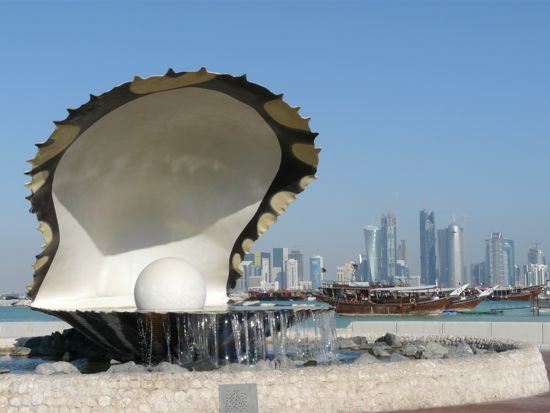
Congratulations to all our Qatari friends and greetings on your National Day, December 18, 2012. One of my new favorite sources of information out of Doha, the Doha News, has published a great article, Everything You Need to Know About Qatar’s National Day 2012, which you can access by clicking on the blue type.
Sorry for laughing, but this year they have forbidden people to decorate their cars and some of the displays common on National Day. Good luck with that!
National Day in Qatar might be a lot of fun, if it weren’t for the crowds, and the grid-locked streets. If you want to watch the fireworks – and they are truly fabulous, the Amir and his supporters spare no expense, it is truly bread and circus time in Qatar – you just have to grit your teeth and buy into getting through all the traffic to a viewing site.
We found a great – and relatively remote – site from which to watch, us and our 300 closest Qatari friends, over at the Marriott marina; it was a great view, and only maybe two hours trying to get home afterwards, LOL, fighting our way through the party-SUVs with their foam sprays and their decor, and young Qatari males dancing on the top of the SUVs, yes, they did, I am not kidding.
Recent Comments
Kitchen on Isiais: Winding Down intlxpatr on Shampoo Ginger tigerbutterya0c5ff1d… on Shampoo Ginger intlxpatr on British Soldier Kidnapped, Esc… John on British Soldier Kidnapped, Esc… Wikipedia Donate Button

Amazina


Early Voting in Florida


