Sex or Backbiting?
Most of you know, I do the daily readings from The Lectionary (you can always click on it from my Blogroll, down to the right) as part of my spiritual discipline. I also read the daily meditations on Forward Movement, (also in the blogroll.)
Rarely do I share them with you, but this one is where Christianity and Islam are so closely intertwined that I dance for joy – that much can be forgiven to one who loves, but our tongues get us into a lot of trouble.
I know that backbiting is one of the great sins to be avoided during the upcoming holy season of Ramadan, too.
James 3:1-12 The tongue is a fire…a world of iniquity…a restless evil, full of deadly poison.
I sometimes wonder if the churchfolk who seem obsessed with sexual behavior are reading the same Bible I am. If I said that someone was “living in sin,” I know what parts of the body you’d think I was talking about. Yet if it were James or other New Testament authors talking, they would probably be referring to the tongue.
For every reference in the New Testament to sins involving sex, there must be ten concerning speech. Why? Because while sex is certainly one form of communication, speech is a more potent one in the daily life of a congregation. Words have power.
God creates the world and keeps in touch with it, after all, by his Word; and words are how we keep in touch with each other. But the word that can create can also destroy–a reputation, an institution, a life. Words tell us who and how we are and whether we belong; words bind the community together-or tear it apart. Sexual misconduct is bad–and easy to recognize as bad.
The sniping, backbiting, spite, and deceit that go on in some communities are often hard to see, let alone root out. Yet their effect is more corrosive over the long term. How did our priorities get so mixed up?
PRAY for the Diocese of South Carolina (United States)
Ps 38 * 119:25-48; 1 Kings 9:24-10:13; Mark 15:1-11
The Street of Ramadan Lanterns
Over 15 years ago, this article appeared in the March/April edition of SaudiAramco World.
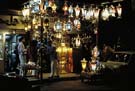
Blessed is He who made constellations in the skies and placed therein a lamp and a moon giving light; and it is He who made the night and day to follow each other: For such as have the will to celebrate His praises or to show their gratitude.
The Qu’ran, Chapter XXV (Al-Funqan, The Criterion), Verses 61-62
Written and photographed by John Feeney
No one knows for certain when the use of children’s Ramadan lanterns began, but it is a very old Egyptian tradition. Indeed, lanterns and lamps of various kinds, of many hues and degrees of brightness, and even both real and imaginary, have always been special to Egypt. For centuries before the coming of electricity, Cairo itself was noted for its spectacular use of lanterns to illuminate the city, especially during the holy month of Ramadan.
Ramadan, the ninth month of the Muslim lunar year, is a time of fasting, blessings and prayers. It also commemorates the revelation of the first verses of the Qur’an to the Prophet Muhammad.
As a way of giving thanks to God during this holy month, and as a way of unifying the worldwide community of believers, Muslims – with special exceptions for the sick, nursing mothers, pregnant women and travelers – spend the daylight hours fasting. The hours of the night, until dawn, are marked by prayers, ceremonial meals and celebration of the day’s spiritual victory over human desires. After sunset, streets and squares all over the Muslim world are thronged with people out buying food after the long day’s fast, or visiting friends, or preparing for sahur, the last meal of the night, which will be taken before dawn. It is then that young Cairenes, allowed to stay up late because of Ramadan, traditionally gather in groups of three or four to go out among the crowds, swinging their glowing lanterns and chanting their ancient song of Ramadan – just as children in other lands go caroling – hoping to receive in return a few nuts or sweets for their vocal efforts.
Passed on by children from generation to generation, the traditional song, in colloquial Egyptian Arabic, accompanies the swinging of the lanterns in the little ones’ hands. It goes like this:
Wahawi, ya wahawi
iyyahah
You have gone, O Sha’ban,
You have come, O Ramadan,
iyyahah
The daughter of the Sultan
is wearing her caftan,
iyyahah
For God the forgiver
Give us this season’s gift.
Some believe that the children’s lantern song comes all the way from Pharaonic times, like the ancient Egyptian song called O-Faleh in the Pharaonic tongue and al-Bahr Sa’id in Arabic (meaning “The River Has Risen”). In the days before the Aswan Dam was built, that song was sung by groups out in small boats on the night the Nile reached the peak of its annual flood. Certainly, the lantern song is very old, and very Egyptian.
The opening lines – “Wahawi ya, wahawi iyyahah” – have no known meaning. “You have gone, O Sha’ban” refers to the month that comes before Ramadan in the Muslims’ lunar hijri calendar, and “the daughter of the Sultan is wearing her caftan” means she is dressed in the garment worn when going out, maybe to the mosque. “Give us this season’s gift” refers to the small presents children receive from family and friends at the time of the ‘Id or holiday that follows the month of fasting.
In the days leading up to Ramadan, children become more insistent about having a lantern; many can hardly wait to start swinging and singing – for what child, from its earliest years, is not attracted by a glowing, magical lantern? Yet Cairo children may be the most “lantern-struck” of all: Recent research by Dr. Marsin Mahdi of Harvard University indicates that Scheherezade’s ‘Alaa’ al-Din (Aladdin) of the magic lamp may well have been a Cairo boy.
One week before Ramadan begins, part of Ahmad Maher Street, for most of the year a humble thoroughfare in the old medieval quarter of Cairo, is transformed. Usually home to tinsmiths, marble-cutters and makers of mousetraps, for one glorious month it becomes “The Street of the Lanterns.”
Filmmaker John Feeney, who has lived in Cairo for a quarter century, is a long-time contributor toAramco World. He wishes to thank Laila Ibrahim, renowned authority on Mamluk Egypt, for her help with this article.
This article appeared on pages 14-23 of the March/April 1992 print edition of Saudi Aramco World.
You can read the rest of this fascinating article HERE.
I love the Ramadan lanterns. I’ve been to Cairo, and found the heat and the teeming population, the gridlocked traffic and all the begging a little scary. But I would go back in a heartbeat to see this street of lanterns!
For my non-Muslim readers, I found a wonderful site while researching Ramadan lanterns that gives a simple overview of Ramadan: Hamad El Afandi’s Ramadan Kareem. It is heavily illustrated with photos.
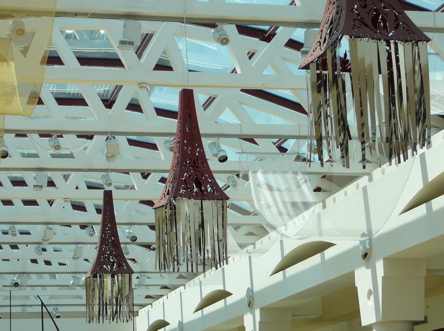
Tash Ma Tash takes on Muttawa?
I love NPR. Today, in a Ramadan special, they discussed the 16th season of the Saudi Arabia soap Tash ma Tash. I remember it got a lot of attention a couple years ago. NPR says that this year, they are taking on the Committee for the Promotion of Virtue and Supression of Vice. There is a village where the morals police have determined that women should not be riding their donkeys on the same trails the men are, or that perhaps they should be fully enclosed in some kind of bubble, or maybe a special underground tunnel should be built solely for the use of women to keep them from view of the men.
Is anyone following this? National Public Radio also said that this year the topic was too hot for the official Saudi channel to handle, so it is being shown on MBC. I am not there – can you tell me how it is working?
Ramadan Fastathon
While I have learned to stream NPR (National Public Radio) on my computer in Kuwait, nothing beats listening to it in “real time” here. Today, while listening, I learned that university students locally are fasting in support of their Islamic brothers and sisters, and they call it a “Fastathon”. They sign up to fast for a day, and can attend that night’s Ifthar supper. Local merchants will donate money to some charity for every person who signs up.
The interviews – some students got it – that fasting cleanses the system, that it is to experience sympathy with the poor . . . and then there is one poor sap who says “Yeh, I heard of Ramadan. I think it is a political party that causes problems in the Middle East.” Doh.
My Mother just called to ask if Omar, my father’s health care aid, can eat the lentil soup I fixed for their supper. “No! No!” I cry, “it has Jimmy Dean sausage in it!” but Mom says it is no problem, as Dad really wants the chicken noodle soup from last night, and that one is totally halal. Omar can’t eat until seven, so they are waiting so they can all eat together. Ramadan awareness is definitely on the rise here.
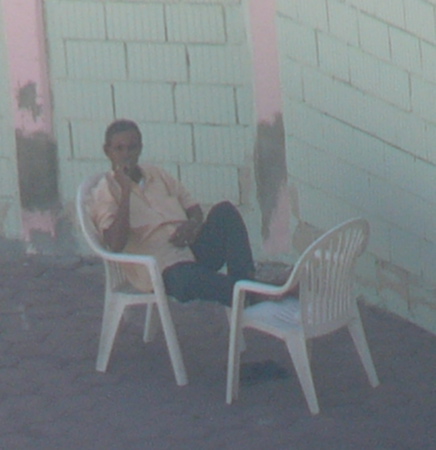
Dude, You are SOOOOO Busted
What was he thinking? ? ?
“I can’t go another minute without a cigarette. I’ll hide a chair behind the wall and go grab a quick cigarette where no one can see me. . . .ahhhhhhh! All alone. . . Great place to sneak a cigarette. . . no one can see me . . .”
Except for everyone living in the 20-something highrises across the street, you idiot!
Recent Comments
ExpatAlien on What Country am I Living … intlxpatr on Yellowstone: Old Faithful to C… Michelle on Yellowstone: Old Faithful to C… Cathy on No Grown-Ups in Charge intlxpatr on Waiting for Snow Wikipedia Donate Button

Amazina


Early Voting in Florida


 Here There and Everywhere