“I Have No Need of You”
From this morning’s Lectionary Readings:
1 Corinthians 12:12-26
12 For just as the body is one and has many members, and all the members of the body, though many, are one body, so it is with Christ.13For in the one Spirit we were all baptized into one body—Jews or Greeks, slaves or free—and we were all made to drink of one Spirit.
14 Indeed, the body does not consist of one member but of many. 15If the foot were to say, ‘Because I am not a hand, I do not belong to the body’, that would not make it any less a part of the body. 16And if the ear were to say, ‘Because I am not an eye, I do not belong to the body’, that would not make it any less a part of the body. 17If the whole body were an eye, where would the hearing be? If the whole body were hearing, where would the sense of smell be?
18But as it is, God arranged the members in the body, each one of them, as he chose. 19If all were a single member, where would the body be? 20As it is, there are many members, yet one body. 2
1The eye cannot say to the hand, ‘I have no need of you’, nor again the head to the feet, ‘I have no need of you.’ 22On the contrary, the members of the body that seem to be weaker are indispensable, 23and those members of the body that we think less honourable we clothe with greater honour, and our less respectable members are treated with greater respect; 24whereas our more respectable members do not need this. But God has so arranged the body, giving the greater honour to the inferior member, 25that there may be no dissension within the body, but the members may have the same care for one another. 26If one member suffers, all suffer together with it; if one member is honoured, all rejoice together with it.
Small Groups and the Seven Deadly Sins

One of the great calming forces in my life is meeting with my small groups. One is a monthly book club; we are not all of the same mind; we bring different perceptions, and it is good for us. New doors open, we see things differently. Yesterday, I was confronted by a woman who reminded me that when she was reviewing a book she loved, and wondered why it was not popular, there was a silence. And then I said “Well, it was poorly written.” I expected a rebuke, but she said that having given it some thought, now she agrees. Whew!
(I hate confrontation. And I also have a big problem with lying. I believe lying hurts the person receiving the lie, and it hurts the liar. I think lies are seeds that grow wildly, creating a thicket of evil. Unintended consequences.)
My other small group doesn’t meet all the time, just for studies two or three times a year. Small group are where real connections are made, so the church makes an effort to help us connect with one another. This small group has met at the same time with the same leader for several years. It has several people who have been with this group for a long time. New people come once or twice and are never seen again, and some come and settle in for the long haul. We are diverse, from all segments of the church, and we have a wonderful gift in common. As we study and apply scripture, we laugh at ourselves. On rare occasions, we cry with one another. It is a band of buddies, and our buddies keep us safe in life.
Last night we were working on Envy. It was fascinating, and I learned something new. There is a technical difference between jealousy and envy. Jealousy is having something/someone and being afraid of losing what you have. Envy is wanting something – or something better than – someone else has, or something you lack. That’s food for thought for the rest of the week.
As a group, we thought the illustration for Envy was fabulous. One member asked to look at all the eyes, all green, and notice how cold envy is. Another said that Envy is the only deadly sin that gives no pleasure. We only have six weeks; it makes me laugh to know that the deadly sin of Lust is optional.
During an epoch when I find events stirring in me emotional turbulence, I leave these groups feeling at peace, and I sleep well at night. The world goes on. We find our people. They help us shoulder our burdens and march alongside us. Thanks be to God.
Bored of Peace

The man who mercilessly called Joe Biden “Sleepy Joe” dozes through his own “Peace” meeting. Pony up a billion dollars and anyone can join. Maybe his son-in-law gets in for free.
What will greed and corruption contribute to the Palestinian situation in Israel? When Trump talks of villas and high rises facing a Mediterranean basin, is he talking about housing for Palestinians? Is he talking about establishing a beautiful Palestinian state on the Gaza strip?
Or is he seeking to monetize and take advantage of a political void to eliminate the Palestinian inhabitants and create a sleazy nouveau riche community a la Mar-a-Lago?
A Tale of Grace
For perspective, this is the legendary acquisition by Father Abraham of the first Jewish purchase of land. It is a tale of grace, hospitality, and sharing between two cultures:
Genesis 23:1-20
23
Sarah lived for one hundred and twenty-seven years; this was the length of Sarah’s life. 2And Sarah died at Kiriath-arba (that is, Hebron) in the land of Canaan; and Abraham went in to mourn for Sarah and to weep for her.
3Abraham rose up from beside his dead, and said to the Hittites, 4‘I am a stranger and an alien residing among you; give me property among you for a burying-place, so that I may bury my dead out of my sight.’
5The Hittites answered Abraham, 6‘Hear us, my lord; you are a mighty prince among us. Bury your dead in the choicest of our burial places; none of us will withhold from you any burial ground for burying your dead.’
7Abraham rose and bowed to the Hittites, the people of the land. 8He said to them, ‘If you are willing that I should bury my dead out of my sight, hear me, and entreat for me Ephron son of Zohar, 9so that he may give me the cave of Machpelah, which he owns; it is at the end of his field. For the full price let him give it to me in your presence as a possession for a burying-place.’ 10Now Ephron was sitting among the Hittites; and Ephron the Hittite answered Abraham in the hearing of the Hittites, of all who went in at the gate of his city,
11‘No, my lord, hear me; I give you the field, and I give you the cave that is in it; in the presence of my people I give it to you; bury your dead.’ 12Then Abraham bowed down before the people of the land. 13He said to Ephron in the hearing of the people of the land, ‘If you only will listen to me! I will give the price of the field; accept it from me, so that I may bury my dead there.’ 14Ephron answered Abraham,
15‘My lord, listen to me; a piece of land worth four hundred shekels of silver—what is that between you and me? Bury your dead.’ 16Abraham agreed with Ephron; and Abraham weighed out for Ephron the silver that he had named in the hearing of the Hittites, four hundred shekels of silver, according to the weights current among the merchants.
17 So the field of Ephron in Machpelah, which was to the east of Mamre, the field with the cave that was in it and all the trees that were in the field, throughout its whole area, passed 18to Abraham as a possession in the presence of the Hittites, in the presence of all who went in at the gate of his city. 19After this, Abraham buried Sarah his wife in the cave of the field of Machpelah facing Mamre (that is, Hebron) in the land of Canaan. 20The field and the cave that is in it passed from the Hittites into Abraham’s possession as a burying-place.
“Your Mission is to Shine”
Today, our priest took on the brave task of dealing – not with politics or political events, (God forbid!) but addressing how we, as members of the body of Christ, are to respond to these events. We are to be light. We are to do what the bible tells us to do. We are to treat our fellow human beings – even those who are not like us, who do not share our opinions, with the dignity and love with which every human being were created.
Holy Smokes! That’s a tall order. We are to love one another. We are to welcome the stranger. We are to share. We are not to gossip or say mean things about our friends – or anyone!
In the resources posted online for his sermon, he quotes C. Andrew Doyle, 9th Bishop of Texas, from his blog. Because it is publicly posted, I am sharing because when he posts, he expects people to read.
Tuesday, January 27, 2026
An Embodied Christian Call to De‑escalation, Dignity, and Truthfulness in Immigration Enforcement
O God,… we thank Thee for Thy Church, founded upon Thy Word, that challenges us to do more than sing and pray, but go out and work as though the very answer to our prayers depended on us and not upon Thee… Help us to realize that man was created to shine like the stars and live on through all eternity. Keep us, we pray, in perfect peace, help us to walk together, pray together, sing together, and live together until that day when all God’s children, Black, White, Red, and Yellow, will rejoice in one common band of humanity in the kingdom of our Lord and of our God, we pray. Amen.
— Martin Luther King Jr.
A pastoral and theological statement for this moment — with particular concern for Minnesota.
Introduction
Episcopal Bishop of Minnesota Craig LoyaI write this statement not as a political pundit but as a pastor and teacher of the Christian faith, as a bishop in the line of the Apostles, now having served in that particular office for 18 years. I have read and followed events regarding immigration throughout my time as bishop and have made no secret of my belief that the church is called to serve all people. Over the last month, I have been watching events across the country, with particular interest in Minnesota.
The Church exists to care for souls, which means I will care for souls on both sides of any partisan debate. I will speak both to Republicans and Democrats, to Independents and the politically exhausted, to immigrants and citizens, to agents and to those who fear the agents, to people who protest and to people who feel threatened by protest. I will not tell anyone how to vote. But neither will I stand silently when fear overwhelms our public life. How could I? Our hearts grieve at what we are bearing witness to in the world around us, especially as it has to do with immigration.
Across the country, immigration enforcement has become a flashpoint of fear and rage. In Minnesota, that tension has sharpened into tragedy and public crisis.
In recent weeks, Minnesota has seen increased federal immigration enforcement, described by the DHS as the largest operation ever, alongside mass arrests, major protests, and increasingly fraught encounters between federal agents and Minnesotans. This includes multiple shootings involving federal immigration agents in Minneapolis this January alone, including both the killing of Renée Good and this weekend’s shooting that killed Alex Pretti. Nationwide demonstrations have followed over the past week, bringing unrest beyond Minnesota state lines.
Many Minnesotans who support aggressive enforcement are motivated by real concerns: the rule of law, public safety, fairness to those who immigrate legally, and the fear that communities can’t absorb disorder. Those concerns deserve a hearing. But no concern, however sincere, justifies dehumanization, disproportionate force, or policies that treat human beings as leverage.
In parallel with this violence, we have watched the conflict escalate rhetorically and tactically: on threats to invoke the Insurrection Act, talk of “occupation,” and weaponized public speech hardened into competing moral absolutes.
This is precisely the kind of moment that Christians should practice what I have elsewhere called an embodied apologetic: arguing not merely with words but demonstrating publicly, concretely, and nonviolently what we believe about the human person, the nature of authority, and the lordship of Jesus Christ.
By demonstrating, I mean far more than marching or civil disobedience. I mean demonstrating the love of Christ to all people. Remembering that in the migrant in our midst, we see the neighbor as defined by Jesus and the stranger God tells us to care for.
Groundwork: immigration enforcement and the theological depth of creation
To sit quietly while immigrants are demonized, blamed for crime, or dehumanized is to sit quietly while Christian doctrine is being threatened.
The Christian claim is that the Word became flesh, that humanity is encountered, named, and raised to new life in the material particularity of Jesus Christ. The Christian faith does not treat bodies, human lives, or human faces as incidental. When Christians claim that the incarnation altered the universe, we mean that the material world has theological depth.
Every human being bears the image of God, including the migrant at the border and the undocumented worker. That includes the asylum seeker fleeing gunfire and the citizen bystander who gets caught in the middle. It includes the protester holding a sign in the street and the federal agent wearing the uniform.
Human dignity is not conferred by paperwork, politics, or popularity. Human dignity is linked to God by the very generosity of the Godhead to bring us into being.
And when we understand human sinfulness not simply as “bad behavior” but as the fracture between what God has made and our too-often selfish desire to remake creation in our own image…well, then we have a theological framework for our contemporary moment.
The doctrine of sin explains our predicament. But the Christian gospel that Jesus Christ entered into our fractured humanity to redeem and reconcile us to God is our explanation of how things change.
As Christians understand human brokenness and healing, we are neither naïve about fear and disorder nor resigned to it. We recognize sin; we name it; we flee from it. But we do not stand and watch it with holy indifference.
We do not sanctify fear, baptize cruelty, or call dehumanization “prudence.” To insist otherwise isn’t pragmatism; it’s theological divorce: declaring some aspects of creation safe for politics and using Christian language to justify policies or tactics that degrade human dignity or scapegoat racial and ethnic minorities. The Church cannot allow this faith, the faith of every Christian generation, to be twisted in the service of anti-immigrant cruelty.
Which means we cannot accept a public order so structured that it trains us, through constant repetition and a steady diet of dehumanizing rhetoric, to see some people as contaminants, vermin, or existential threats by virtue of their very existence. That’s not realism. It’s idolatry.
And when that mythology attaches itself to nation-states, bullets inevitably follow. The Church has seen where such theological claims lead when fused with nationalism, racial mythology, and demands for unquestioned allegiance.
Christ alone is Lord. No other power takes precedence over the Church in Christ. And when any political ideology inclines that way, Christians must stand against it. If race-craft and nationalist mythology run rampant unchecked in our politics, they will destroy our democracy. Worse still, they are in the end a theological threat to the church.
If federal agents lose sight of their own humanity or basic constitutional rights amid tense confrontations, everyone loses. We are not only witnessing a newfound morality that allows harm, but we are also allowing a state to do moral injury to those who serve in law enforcement.
De‑escalation is Christian obedience
Because Christ is Lord, we cannot tolerate panic as policy. Christian leaders should call for immediate de‑escalation tactics in Minnesota and nationwide, especially from federal leaders, federal agencies, and ICE. Here’s why and how:
Because life is not a bargaining chip. When policies or tactical shifts treat human bodies as leverage, political leverage, intimidation leverage, violent “force multiplier” leverage, the state courts us into an anti‑human logic that Christians cannot affirm. It’s that simple.
Because fear is contagious. When immigration enforcement looks like a militarized invasion, everyone gets trained to be afraid: parents who teach their kids to hide, workers who avoid hospitals and schools, congregations that fear gathering for worship, citizens who fear recording with their phones, and agents who become afraid, too (more reactive, more quick to see every person of color as a threat).
That fear feeds on itself. Dehumanization multiplies. When any human group is treated as subhuman, everyone’s capacity for recognizing humanity begins to slip away, including the humanity of agents ordered to do their jobs.
Because the Church has something unique to say about what it means to be human.
Unlike many voices in our public life, the Church does not merely talk about human dignity; our allegiance to Christ compels us to embody it. Our witness must not be a slogan; it must be a public pattern of life: prayerful, truthful, courageous, nonviolent, hospitable, committed to the dignity of our neighbors and the strangers who live among us.
For these reasons and more, what we’re seeing must be named:
Agents are operating with increasing combat‑style visibility: helmets and vests, crowd‑control weaponry designed for more confrontational policing, tactical vehicles, and face masks.
Such a posture is often experienced as intimidation rather than order, and it can train communities toward avoidance and suspicion.
Whether you believe immigration law is too harsh or not harsh enough, Christians cannot remain silent about how our public life is changing. Domination is not justice.
When repeated lethal encounters happen across a concentrated operation, even if investigations ultimately exonerate agents in each incident, the moral burden shifts.
The question is no longer simply, “Was this legal?” but “What kind of society are we becoming, if incidents like this become normalized?”
Immediate steps we are asking for, nationwide
Stop. Take a breath. Listen. De‑escalate.
How can federal agencies and federal leaders de‑escalate tactics and posture immediately?
Pause operations that have produced multiple lethal encounters over a short period of time and inflicted widespread trauma across immigrant communities. Commit to visible accountability: name badges, clear chains of command, and timely release of video and incident documentation consistent with due process. Prioritize de‑escalation techniques in training materials and practices — especially community‑engaged operations where children and bystanders are likely to be present. End tactics that reasonably read as intimidation. Even if lawful, if their predictable effect is widespread fear and trauma in communities, stop them and adopt alternatives.
The DHS itself has framed this Minnesota operation as “the largest enforcement operation we’ve ever conducted in Minnesota.” That is cause for additional, not lesser, scrutiny.
What can state and local leaders do to protect both public safety and civil liberties?
Fully protect lawful protest while continuing to hold protesters civilly and criminally accountable should violence occur. Commit to clear nonviolent crowd‑management techniques that don’t replicate wartime intimidation. Do everything in your power to lower the temperature, rather than rhetorically inflaming the situation. Provide additional support and resources for communities experiencing disproportionate fear, including immigrant communities, communities of color, and neighborhoods receiving saturation enforcement.
What can protesters and activists do to practice disciplined nonviolence?
Commitment Card for Peaceful Protests
You are angry. You are grieving. Many of you are operating in understandable fear for your lives. But Christians do not get to numb ourselves to moral agency in the adrenaline of a crowd. Violence is not leadership. If you condemn dehumanization, you cannot then dehumanize the person in the uniform. If you are going to protest for dignity, you must demonstrate dignity.
What can the Church do?
Hold public prayers for peace and truthfulness.
Explicitly call on Christians to lower the temperature where they are: online, in-person, wherever misinformation, dehumanization, and fury are allowed to settle and fester.
Teach our people that anger is human, but vengeance is demonic. Demand better of our leaders. Insist on civil institutions that honor human dignity.
Open churches for pastoral care where needed.
For immigrants afraid to leave their homes. For families disrupted by ICE raids and detentions. For anxious citizens who feel too afraid to leave their homes. And yes, for agents’ families who love their children too much to let them keep policing. In the Diocese of Texas, we do not have the luxury of believing only one side of this conflict sits in our pews.
Consider organizing accompaniment/aid in lawful and disciplined ways: Food. Shelter support. Transportation to court hearings. Connections to legal resources. Trauma care. Emergency family preparedness plans. We are currently doing this in the Diocese of Texas, as are many dioceses around the country. You can contribute to our legal fund here. You can contribute and learn more about our convening a multi-faith initiative here feeding people. We will have a new immigration portal up in the near future. I hope this will inspire you to gather local leaders to demonstrate God’s love in Christ in various ways to our immigrant neighbors near our churches.
Train de‑escalation teams for vigils/demonstrations: Teams whose explicit task is to lower the temperature, protect the vulnerable, and prevent further harm. Consider training specific leaders for this ministry if it does not already exist in your community.
Preach and teach the holistic truth of Christian anthropology starting now. That Scripture does not sort people into worthy and unworthy buckets as our habit of Christian life. That there is no politics or policy so vital that we should make an idol of it. That we will not hand the American Church over as a get-out-of-accountability-free card to any national leader or political party that demands our silence or allegiance in return for temporary power.
Christianity is a serious faith precisely because it comes with a seriousness of expectation: that we will love our neighbors as ourselves. That we will speak truth to power. That we will love our enemies. And while Christians are not the silent majority, perhaps the silent Church will speak now.
The Associated Press has reported clergy in Minnesota risking arrest as part of their public witness.
People of faith are beginning to recognize what’s at stake in this moment.
We preach forgiveness, and we preach against sin.
We preach that Christ alone is Lord.
If we say the Word became flesh, we cannot allow policies and tactical shifts that treat human flesh as disposable. If we say Christ alone is Lord, we will not give the silence of the Church to any leader, any political party, or any government agency that demands our blessing as the price of patriotic cooperation.
Social de‑escalation is not merely political point‑scoring. It’s a confession that God’s government doesn’t require us to terrorize our neighbors into obedience, that Christ doesn’t radiate power through humiliation, and that the Spirit produces something other than fear within those who follow him.
Friends, we have been here before in our nation’s history. During my tenure, it was not that long ago that we faced the George Floyd period, among others. Yet, many who will read this can remember the fight for desegregation. We must rise to our better angels again in this moment, wherever we find ourselves. So I say:
To the anxious in our congregations: you are not forgotten.
To immigrant communities in our states: you are not alone.
To officers and agents who feel beyond the reach of critique or moral accountability: you are wrong about that. And, you are also not beyond God’s grace.
To the Church: we must not become the chaplain of fear.
Friends: de‑escalate.
Let’s insist publicly, prayerfully, and steadfastly for social de‑escalation in Minnesota and nationwide. Let’s demand accountable governance and policies that recognize our common dignity. Let’s refuse every ideology that functions by dehumanization. And let’s practice an embodied Christianity that shows our neighbors what it looks like when citizens are governed, not by panic, but by the peace of Christ.
Because otherwise it is not merely a political failure – it is a spiritual failure: a society willing to forget what a human being is. May God give us the courage to tell the truth. The discipline to refuse violence. And the grace to become, together, the kind of people who can carry that peace into a frightened world.
Posted by C. Andrew Doyle at 9:06 AM
Labels: ICE, immigrant, immigration, immigration reform, minneapolis, minnesota
EPSTEIN Files, Please, DOJ Pam Bondi

While we watch aghast as ill-trained ICE agents take down and kill American citizens, and Pam Bondi demands voter registration rolls from Minnesota (and according to the Brennan Center for Justice and Democracy Docket, looking for “sensitive” voter registration information from ALL states), 2 million (estimated) Epstein files have yet to be released.

Minnesotans are the least likely “domestic terrorists” ever, dressed in their buffalo plaid wool shirts and snow boots. Minnesotan, those white bread Scandinavian immigrants from long ago, Paul Bunyan-esque in strength an behavior, amicably welcomed their Somali newcomers, and are now protecting them as best they can while staying alive.
We all have to step back and ask ourselves “Am I a DOMESTIC TERRORIST?”
Look at these good church-going Minnesotans, shuttling immigrant children to school, picking up and delivering groceries to them surreptitiously, taking families hidden in their SUV’s to medical appointments. Do these seem like people who are afraid of their immigrant neighbors?
I respect Customs officials. I respect the rules of our nation. I do not respect those who overstep their jobs, who take delight in the adrenaline rush of attacking protestors, who shoot, rather than exhibit the self-rstraint we expect of law-enforcement. Most of us have no problem with ICE going after, as they state, violent criminals, few as they are.
It’s a Numbers Game
What we object to is going after people who are NOT criminals just because the Toddler-In-Chief wants to be able to show numbers. Trump, you started off your campaign in 2015 going after those rapists, criminals and drug addicts. We didn’t believe you then, and we sure don’t believe you now. We believe our own eyes. We are witnesses to violations of our Constitution by people who should be models of legal behavior.
Corrupting the FBI to investigate political appointments, and firing prosecutors when they tell you there is not evidence to get a conviction is not the American Way.
We know you want to keep your party in power. We know you’re afraid you are going to lose big in upcoming elections, and that is the purpose behind bullying the blue states and trying to intimidate their officials is to get an upper hand on the elections. YOU, who complain about rigged elections, YOU who whine that you really won the 2020 election (and your own elections supervisors would not support your claims) YOU are trying to bully, intimidate and subdue the population so that YOU can rig the elections!
Props to Minnesota! Props to them for showing fortitude, for being good neighbors, for welcoming the stranger (as Moses and Jesus taught us) and for showing self-restraint in the face of thugs and goons itching for a fight. Trump is eager to invoke the Insurrection Act, we know because he says so! Props to you, Minnesota, and to you, Portland for having the maturity and persistence and yes, a sense of humor to outlast, outplay and survive this despicable tyrant.
Oh! The People You’ll Meet! (Apologies to Dr. Seuss)
Under the category of Stranger in a Strange Land, things change. My generation revolted (and were sometimes revolting) and rioted and demonstrated against the VietNam War and for Equality, Diversity and Inclusion. We marched. We made documentaries. Oh, we were so idealistic.
AdventureMan, my husband, was a warrior from the beginning, and fought in that unpopular war. When he returned home, people were harassing returning soldiers, even spitting on them.
Emotions have calmed through the years, and many surviving fighters in that war, men and women, have had a tough time dealing with their participation in the war. We often see homeless veterans here in Pensacola; the homeless find Pensacola comfortable, and temperate. You can sleep rough most of the year.
My husband keeps his eye open for fellow vets. When he sees someone with a VietNam vet bumper sticker, or wearing a VietNam Vet bill cap, he’ll go over, shake hands, and swap old war stories. It can be a very moving moment for both parties involved. War-fighting is intense. There are things you don’t forget. There are things you do forget, and years later, they come back in dreams, not good dreams.
And there are also fraudsters out there. Some are well-meaning, well enough, or just oblivious. Some are trying to fake an experience they didn’t have.
We had a homeless man here in Pensacola we helped occasionally. When he told us he had also been in the military, AdventureMan started talking with him and soon started looking very confused. “He’s never been anywhere near being in the military,” he told me, “No one in the military forgets where they did their basic training or can’t remember where they were stationed.” Nothing makes a person mad like someone straight out lying.
Other times, it isn’t so manipulative, it is just ignorant. In the local Apple Market, AdventureMan shook a man’s hand and asked where he’d been in VietNam and the man just looked foolish and said, “It isn’t really my hat, a friend gave it to me.”
More recently, out at Peg Leg Pete’s on the beach, as we were leaving, AdventureMan stopped to talk with a man wearing a 7th Cav hat. But no, he had never been in the 7th Cav; he had been in the Navy, and he was a Cowboy Re-Enactor. He also looked sheepish.
People are tribal. The like association. Kids wear Nikes because they want to play basketball like Michael Jordan. Some people wear Florida State hats because they hope Florida State wins the big game, not because they have ever set foot on the Florida State campus. Or Hawaiaan shirts, or turquoise squash blossom jewelry, or Yosemite sweatshirts (me), because of the association. It’s just the way we are, expressing ourselves with tribes, aspirational or not.
It’s a bad idea to give an impression, knowingly, which may be easily discovered to be false. I had a friend once who found an old sorority pin in a thrift store and wore it as costume jewelry. I told her it was a bad idea, that sororities inspire deep loyalties, and wearing a pin to a sorority that you don’t belong to could damage your reputation. I think she chose to wear it ironically.
Living in Doha, where designer copies were cheap and plentiful, one of my Japanese friends told me that she would NEVER buy a copy; that people who know what details to look for would know you were a pretender. Once you got that reputation, you would always be known as a person who couldn’t afford the real thing. I listened and learned!
AdventureMan says, “Be careful what you wear because of the message that it sends. If you didn’t earn it, don’t wear it.” His Dad was a SeaBee, but he would never wear his Dad’s insignia. People may not be trying to fool people, but people will see what you are wearing and make assumptions.
The majority of people wearing military memorabilia actually have a legitimate connection to that unit, and greeting them results in truly wonderful moments of sharing and camaraderie.
Also – if you believe no women were serving in VietNam, you need to read Kristin Hannah’s book, The Women. Women served as nurses, medics and doctors, as Red Cross workers, and in administrative roles. Although not in combat, they served their country and were shot at, wounded, killed, hit by explosives, died in helicopter evacuations. They suffered PTSD and were treated as poorly as the other wounded vets that came out of that war.

EUPHROSYNE/SMARAGDUS OF ALEXANDRIA
MONASTIC, 5TH c.
From today’s lectionary, one of my favorite stories of early Saints
Prayer for today: (contemporary language)
Merciful God, who looks not with outward eyes but discerns the heart of each: we confess that those whom we love the most are often strangers to us. Give to all parents and children, we pray, the grace to see one another as they truly are and as you have called them to be. All this we ask in the name of Jesus Christ, our only mediator and advocate. Amen.
“Saint Euphrosyne of Alexandria (fl. 5th century CE) was a female saint who adopted male attire and lived at a local monastery as an ascetic.
Euphrosyne was the beloved only daughter of Paphnutius, a rich man of Alexandria, miraculously born in her parents’ old age in answer to a monk’s prayer. Her loving father desired to marry her to a wealthy youth.
But having already consecrated her life to God and under pressure to break her vow, she dressed as a man and assumed the identity of “Smaragdus” (“emerald”). She then escaped to a nearby men’s monastery, where she made rapid strides toward a perfected ascetic life. She was under the guidance of the abbot, who also happened to be the same monk who had prayed for her birth.
Years later, when Paphnutius appealed to the abbot for comfort in his bereavement, the abbot committed him to the care of Euphrosyne, still under the guise of Smaragdus. Paphnutius received from his own daughter, whom he had failed to recognize, helpful advice and comforting exhortation. Not until she was dying did Euphrosyne reveal herself to him as his lost daughter. After burying her, Paphnutius gave up all his worldly goods, and became a monk in the same monastery. There, he used his daughter’s old cell until his own death ten years after. “
from Wikipedia

A dying Euphrosyne reveals herself to her father
As I read today’s lectionary, I am struck by how very blind we are to the realities of God’s creation, that in every tribe and every nation, there are those who are outside the normal boundaries of gender, and who are, at the same time, the people God created them to be. How cruel we are! We judge, and we call names, we cast out – in every tribe and nation in the world – those who are Other, who do not fit into our tiny human conception of “right.” I can imagine the overwhelming revelation as we transcend into the after life.
Morocco Malta and the Med: Last Day at Sea
I love this itinerary, and I love that we have a day at sea to hit the spa and pack our bags with no rush. On this last day, there is no rush at all; tomorrow, we will be in Barcelona, and people will be heading home or to their next destination.

Leisurely breakfast on the outside deck as we plan our packing strategy. AdventureMan’s strategy is to go to the fitness center while I pack and to stay out of my way, LOL. Smart man. He has less to pack and he doesn’t overthink the way I do.

We make time to try tea late in the afternoon. I don’t think it is our thing.

Oops, sun is setting and I am on the wrong side of the ship!

Morocco, Malta and the Mediterranean: Another Great Adventure
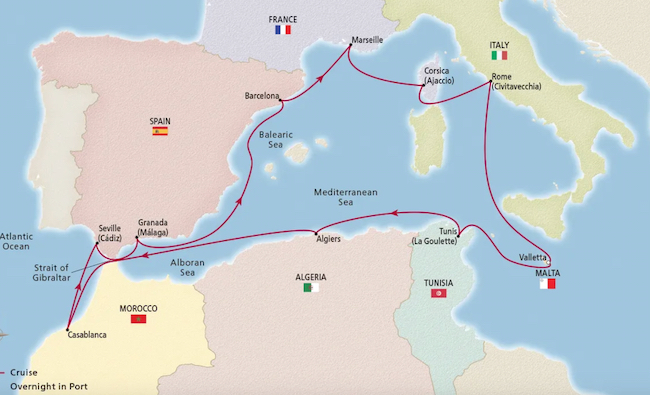
We thought we were done with cruising (this happens a lot) when suddenly this trip popped up on Viking’s new itineraries. We waited only two days, and called to reserve. The cabin area we want was already almost sold out! We got the last cabin, not the normal cabin we reserve, and felt lucky to get it. I checked the cabin catagories; the ship was almost entirely sold out.
Algiers. Malta. Ajaccio. Places we had never been before. It got our hearts racing.
We tried something new; for Barcelona, we booked a tour through Viator to visit the hillside Monastery of Monserrat. For Tunis, where we lived so many years ago, we booked through Tours for Locals, so that we could have a personalized visit to see things that mattered to us. We paid in advance – like more than a year in advance.
We are cautious with our money, so this was a little scary for us. Booking private tours in expensive. Between booking and implementing, a lot can happen. And what if the guides don’t show up??? What is your fallback? By faith, we bit that bullet and it worked out great for us.
It was also a long trip with 23 days total and various climates, so I did not believe I could do it with a carry-on. I used a bigger suitcase, again, by faith, and checked it. We never had a problem, and I was thankful to have a variety of clothing appropriate to the cultures and climate.
This trip took place from mid-November to early December. Today, AdventureMan asked me how I wanted to spend the weekend, and I said “I want to write up the trip for the blog.” In between getting home and now, I had to get Christmas decorations up, bake Christmas dishes, do Christmas Eve dinner, Christmas Day brunch, deal with having norovirus (me, just before Christmas), deal with AdventureMan having norovirus (shortly after Christmas, and with AdventureMan getting a papercut that turned into a severe infection with heavy duty antibiotics. Take Christmas down. Oh, and jury duty. And welcome the New Year with friends.
We are just now getting back to normal. At the end of this month, we start a major bath reconstruction that will disrupt us for six to eight weeks. Now is the time 😊.
International Cooperation: How to
I came across this article by accident, and it communicates how I believe we can make this world a better, safer place – by rubbing shoulders with “the other.”
I spent many years living in Germany and a variety of countries in the Middle East. It was always, initially, very uncomfortable. Slowly, in each country, I met people who were kind to me. At first, I would hear their strange languages as harsh, even hostile. As I rubbed shoulders with them, I came to learn that we had important things in common. Most of my friends were religious, just not the same religious expression as mine. Most loved their families and wanted the best for their children. Some were as suspicious of me as I was of them, and as time passed, surprising thngs happened – we became friends.
This article confirms my own belief – working together, spending time together, diminishes fears and hostilities.
80th Flying Training Wing at SAFB celebrates ENJJPT graduation
KFDX Wichita FallsTYSHIN DAWSON
October 18, 2024 at 9:05 PM
WICHITA FALLS (KFDX/KJTL) — It’s a program unlike any other in the world, where students from the U.S. and 14 NATO countries train side by side to become the best pilots in the skies.
The Euro-NATO Joint Jet Pilot Training Program is one of a kind, and here is why.
“We like to focus on how do we break down that communication barrier, with other nations, how they interact with us, as well as build out those relationships with each other, to kind of further our combat capabilities, around the world, as well as fostering those relations so we can work with them more clearly.”

ENJJPT Wing Commander Jeff Shulman said with so much going on overseas; this program is especially important.
“For some of these nations, we are the sole source and production of their fighter pilots, so if I do not produce quality fighter pilots on time for that nation, they do not have a combat air force, including right now is doing a lot of things in Europe. And he’s right in their backyard. So for them, right, it’s a strategic imperative that my program produces quality fighter pilots on time for the need of minds,” Shulman said.
As you can imagine, these pilot graduates are put through a very rigorous process. They take about a year of training, which involves 12-hour days, 5-6 days a week. These are some of the top academic graduates in the world.
ENJJPT Graduate 1st Lt. Giles Beebe talked about his experience in the program.
“I think, and just has kind of some advantages that a lot of pilot training is doing. Mainly international, working with people from different nations. I think that’s huge for multiple reasons, and really, we have, like, instructors that are worth their weight in gold here,” Beebe said.
His parents praised the mentorship aspect of the ENJJPT Program.
“We could see as our son was going through that, the journey, how incredible the program is in terms of all that mentoring and leadership that’s embedded throughout even before this. It’s really, really quite a program.”
When the call of duty rings, we can proudly say that the aviators who are walking out of this program will be more than prepared to hold the line.
Recent Comments
ExpatAlien on What Country am I Living … intlxpatr on Yellowstone: Old Faithful to C… Michelle on Yellowstone: Old Faithful to C… Cathy on No Grown-Ups in Charge intlxpatr on Waiting for Snow Wikipedia Donate Button

Amazina


Early Voting in Florida


 Here There and Everywhere
