Christmas Mercies
By the grace of God, we got through the first week of December. By the grace of God, we managed to enjoy our first week in December!

The first week in December this year followed directly after Thanksgiving. Often, there is a weekend between Thanksgiving and December, but this year, December started on Sunday, and there goes one weekend before Christmas. You might wonder why this is even important, but for some reason, there are so many things scheduled the first week of December, on top of the normal things scheduled for the first week of every month – you know, small things like bill paying and making sure your finances are in order 🙂
So we had our normal first week of the month – Book Club, babysitting, exercise classes, bible study – AND. And we had a house guest, a very old friend, a friend from all the way back in Tunis, when we were all studying languages, our guest and my husband learning Arabic and me learning French. Our guest and I sang in the community choir together, and he was very much a part of our small expat family. Having him in our home was so easy, we came and went, fortunately at different times. On top of all this, we also had a couple of annual Christmas related events, social events, we had to attend. By the grace of God, it all went smoothly, and – this is the mercy – enjoyably. We weren’t stressed.
I was stressed a little yesterday. The last two days have been horrible for me, in terms of climate. You know, I like NO air conditioning, I like temperatures in the 60s and 70s (F) but the temperatures were almost 80 and HUMID. Bad enough I had to turn on our A/C last night so I could sleep, and feeling so grumpy. I really need to get the Christmas decorations up this weekend so I can get on with my December, enjoy the Christmas ambiance and not have to stress about getting things done. But how do you get Christmas decorations up when you are hot and sweaty, it just isn’t right.
Major mercy – when I woke up this morning, I was wrapped warmly in my quilts and . . . I wasn’t feeling hot or sweaty. As as matter of fact, overnight the temperatures had fallen into the 40’s! Woooo HOOOO, out came all the Christmas boxes and tubs; AdventureMan got busy putting up the lights, I pulled out the other things and we got busy. Around lunch time we had a wonderful lunch, and then went searching for more light; I hadn’t bought enough to cover the length of our porch. After four fruitless stops (the lights had to match or it was all for nothing) we came home empty handed and I checked online for where this brand was sold. It was Home Depot, the one store we hadn’t stopped at because I was so sure I hadn’t bought them there. Wooo HOOOO, one quick trip and we have all the lights we need and AdventureMan got them all up.
AdventureMan is more scrupulous than I am about some things. He . . . . read the instructions on the lights. Have you ever done that? Like where it talks about amps and resistance and fire warnings? LOL, I love a lot of lights, and will string lights on lights on lights. Somewhere in the dim recesses of my mind I sort of knew it might be dangerous, but AdventureMan takes those things seriously. The good thing is that we are still married, and much more safely wired than when I was doing it.
I can hear my son scoffing when I say that today was God’s mercy on me, but to him I say God makes it to rain on the righteous and the unrighteous, and as undeserving as I am, today he gave me exactly what I needed – a chilly, Christmas-decorating kind of day. Thanks be to God.
Your Emotional Intelligence
AOL News has this fascinating article on successful people and emotional intelligence:
How Emotionally Intelligent Are You? Here’s How To Tell
The Huffington Post | By Carolyn GregoirePosted: 12/05/2013 8:39 am EST | Updated: 12/05/2013 2:22 pm EST


What makes some people more successful in work and life than others? IQ and work ethic are important, but they don’t tell the whole story. Our emotional intelligence — the way we manage emotions, both our own and those of others — can play a critical role in determining our happiness and success.
Plato said that all learning has some emotional basis, and he may be right. The way we interact with and regulate our emotions has repercussions in nearly every aspect of our lives. To put it in colloquial terms, emotional intelligence (EQ) is like “street smarts,” as opposed to “book smarts,” and it’s what accounts for a great deal of one’s ability to navigate life effectively.
“What having emotional intelligence looks like is that you’re confident, good at working towards your goals, adaptable and flexible. You recover quickly from stress and you’re resilient,” Daniel Goleman, psychologist and author of Focus: The Hidden Driver of Excellence, tells The Huffington Post. “Life goes much more smoothly if you have good emotional intelligence.”
The five components of emotional intelligence, as defined by Goleman, are self-awareness, self-regulation, motivation, social skills and empathy. We can be strong in some of these areas and deficient in others, but we all have the power to improve any of them.
Not sure how emotionally intelligent you are? Here are 14 signs you have a high EQ.
1. You’re curious about people you don’t know.

Do you love meeting new people, and naturally tend to ask lots of questions after you’ve been introduced to someone? If so, you have a certain degree of empathy, one of the main components of emotional intelligence. Highly Empathetic People (HEPs) — those who are extremely attuned to the needs and feelings of others, and act in a way that is sensitive to those needs — have one important thing in common: They’re very curious about strangers and genuinely interested in learning more about others.
Being curious about others is also a way to cultivate empathy. “Curiosity expands our empathy when we talk to people outside our usual social circle, encountering lives and worldviews very different from our own,” Roman Krznaric, author of the forthcoming Empathy: A Handbook For Revolution, wrote in a Greater Good blog post.
2. You’re a great leader.

Exceptional leaders often have one thing in common, according to Goleman. In addition to the traditional requirements for success — talent, a strong work ethic and ambition, for instance — they possess a high degree of emotional intelligence. In his research comparing those who excelled in senior leadership roles with those who were merely average, he found that close to 90 percent of the difference in their profiles was due to emotional intelligence, rather than cognitive ability.
“The higher the rank of a person considered to be a star performer, the more emotional intelligence capabilities showed up as the reason for his or her effectiveness,” Goleman wrote in Harvard Business Review.
3. You know your strengths and weaknesses.
A big part of having self-awareness is being honest with yourself about who you are — knowing where you excel, and where you struggle, and accepting these things about yourself. An emotionally intelligent person learns to identify their areas of strength and weakness, and analyze how to work most effectively within this framework. This awareness breeds the strong self-confidence that’s a main factor of emotional intelligence, according to Goleman.
“If you know what you’re truly effective at, then you can operate from that with confidence,” he says.
4. You know how to pay attention.

Do you get distracted by every tweet, text and passing thought? If so, it could be keeping you from functioning on your most emotionally intelligent level. But the ability to withstand distractions and focus on the task at hand is a great secret to emotional intelligence, Goleman says. Without being present with ourselves and others, it’s difficult to develop self-awareness and strong relationships.
“Your ability to concentrate on the work you’re doing or your schoolwork, and to put off looking at that text or playing that video game until after you’re done … how good you are at that in childhood turns out to be a stronger predictor of your financial success in adulthood than either your IQ or the wealth of the family you grew up in,” Goleman says. “And we can teach kids how to do that.”
5. When you’re upset, you know exactly why.

We all experience a number of emotional fluctuations throughout the day, and often we don’t even understand what’s causing a wave of anger or sadness. But an important aspect of self-awareness is the ability to recognize where your emotions are coming from and to know why you feel upset.
Self-awareness is also about recognizing emotions when they arise, rather than misidentifying or ignoring them. Emotionally intelligent people take a step back from their emotions, look at what they’re feeling, and examine the effect that the emotion has on them.
6. You can get along with most people.

“Having fulfilling, effective relationships — that’s a sign [of emotional intelligence],” says Goleman.
7. You care deeply about being a good, moral person.

One aspect of emotional intelligence is our “moral identity,” which has to do with the extent to which we want to see ourselves as ethical, caring people. If you’re someone who cares about building up this side of yourself (regardless of how you’ve acted in past moral situations), you might have a high EQ.
8. You take time to slow down and help others.

If you make a habit of slowing down to pay attention to others, whether by going slightly out your way to say hello to someone or helping an older woman onto the subway, you’re exhibiting emotional intelligence. Many of us, a good portion of the time, are completely focused on ourselves. And it’s often because we’re so busy running around in a stressed-out state trying to get things done that we simply don’t take the time to notice (much less help) others.
“[There’s a] spectrum that goes from complete self-absorption to noticing to empathy and to compassion,” Goleman said in a TED talk on compassion. “The simple fact is that if we are focused on ourselves, if we’re preoccupied — which we so often are throughout the day — we don’t really fully notice the other.”
Being more mindful, in contrast to being absorbed in your own little world, plants the seeds of compassion — a crucial component of EQ.
9. You’re good at reading people’s facial expressions.

Being able to sense how others are feeling is an important part of having a good EQ. Take this quiz from UC Berkeley to find out just how skilled you are at reading others’ emotions.
10. After you fall, you get right back up.

How you deal with mistakes and setbacks says a lot about who you are. High EQ individuals know that if there’s one thing we all must do in life, it’s to keep on going. When an emotionally intelligent person experiences a failure or setback, he or she is able to bounce back quickly. This is in part because of the ability to mindfully experience negative emotions without letting them get out of control, which provides a higher degree of resilience.
“The resilient person isn’t papering over the negative emotions, but instead letting them sit side by side with other feelings,” Positivity author Barbara Fredrickson told Experience Life. “So at the same time they’re feeling ‘I’m sad about that,’ they’re also prone to thinking, ‘but I’m grateful about this.’”
11. You’re a good judge of character.

You’ve always been able to get a sense for who someone is pretty much right off the bat — and your intuitions are rarely wrong.
12. You trust your gut.

An emotionally intelligent person is someone who feels comfortable following their intuition, says Goleman. If you’re able to trust in yourself and your emotions, there’s no reason not to listen to that quiet voice inside (or that feeling in your stomach) telling you which way to go.
13. You’ve always been self-motivated.
Were you always ambitious and hard-working as a kid, even when you weren’t rewarded for it? If you’re a motivated self-starter — and you can focus your attention and energy towards the pursuit of your goals — you likely have a high EQ.
14. You know when to say “no.”

Self-regulation, one of the five components of emotional intelligence, means being able to discipline yourself and avoid unhealthy habits. Emotionally intelligent people are generally well equipped to tolerate stress (a bad-habit trigger for many of us) and to control their impulses, according to Goleman.
For a Sunny Cold Day in Pensacola

Normally, I sleep my best in cold weather, but last night the Qatari Cat decided sleeping closely snuggled up to me was preferable to the snug heated bed we bought him, and which he normally loves.
The Qatari Cat is a large cat. When we have our delegate dinners for the GCCDC, we keep him in another room. Most often, delegates will hear him complaining and ask if we would let him out. I am willing to bet that there are more photos of delegates with the Qatari Cat in circulation than with us! All that aside, when he snuggles up, he takes up a lot of room. When you want to change positions, he is a snoring, uncooperative lump, and you have to arrange yourself around him. I did not sleep so well as I like to sleep on cold November nights.
Yes, he is a spoiled cat.
Today’s Psalm from the Lectionary Readings is a delight for a chilly, early November day, warms things right up:
Psalm 34
Of David, when he feigned madness before Abimelech, so that he drove him out, and he went away.
1 I will bless the Lord at all times;
his praise shall continually be in my mouth.
2 My soul makes its boast in the Lord;
let the humble hear and be glad.
3 O magnify the Lord with me,
and let us exalt his name together.
4 I sought the Lord, and he answered me,
and delivered me from all my fears.
5 Look to him, and be radiant;
so your* faces shall never be ashamed.
6 This poor soul cried, and was heard by the Lord,
and was saved from every trouble.
7 The angel of the Lord encamps
around those who fear him, and delivers them.
8 O taste and see that the Lord is good;
happy are those who take refuge in him.
9 O fear the Lord, you his holy ones,
for those who fear him have no want.
10 The young lions suffer want and hunger,
but those who seek the Lord lack no good thing.
11 Come, O children, listen to me;
I will teach you the fear of the Lord.
12 Which of you desires life,
and covets many days to enjoy good?
13 Keep your tongue from evil,
and your lips from speaking deceit.
14 Depart from evil, and do good;
seek peace, and pursue it.
15 The eyes of the Lord are on the righteous,
and his ears are open to their cry.
16 The face of the Lord is against evildoers,
to cut off the remembrance of them from the earth.
17 When the righteous cry for help, the Lord hears,
and rescues them from all their troubles.
18 The Lord is near to the broken-hearted,
and saves the crushed in spirit.
19 Many are the afflictions of the righteous,
but the Lord rescues them from them all.
20 He keeps all their bones;
not one of them will be broken.
21 Evil brings death to the wicked,
and those who hate the righteous will be condemned.
22 The Lord redeems the life of his servants;
none of those who take refuge in him will be condemned.
“Mind Your Own Business”

You can be married for a long time and still be surprised. 🙂
I was thinking about other cultures, and then I thought about growing up in Alaska. Alaska is one of those kind of end-of-the-line places. Maybe it’s changed, but except for the native Americans, most people had come from somewhere else. Very few were second generation.
People at end-of-the-line places often have backstories they don’t want to talk about – bad divorces, or worse – bad marriage – no divorce, criminal records, or a million other situations they don’t want to talk about. From an early age, you learn not to ask. There were also a lot of laconic Scandinavians around; they talk about fishing and hunting but are seriously tongue-tied if asked a personal question. So again – you learn not to ask.
“Mind your own business,” I can remember my own mother saying, so I thought it was a rule. “Don’t be a Nosey-Parker.”
All my life I thought that was the rule. It was the way I was raised. Every now and then that curtain of pre-conceptions parts and a light gleams through. I was thinking about other cultures and it occurred to me to ask AdventureMan if he grew up with the same rule.
He just laughed. He looked at me in utter amazement, and laughed.
“I grew up in a town of 3,000,” he laughed, “and some of those were relatives, aunts, uncles, grandparents, cousins – everyone knew everything!”
“There’s no such thing as ‘mind your own business’ when your entire life is known by every single person in town!”
He hooted with laughter at the very thought.
“Everyone knew everything!” he repeated.
It’s expat world right here in my own house. This is a whole new way of thinking about things. I’ve always thought personal privacy was sort of universal, but not so.
One of the many times we lived in Germany, we lived in a small village where people told us everything. It was amazing, a whole different world, being on the inside, but not really being a part of it all. People seemed to feel we needed to be filled-in. One family didn’t speak to another family in the village, and it was awkward, because there were only like 300 people in the village, but many years ago someone’s grandmother had a terrible disagreement with the other family’s grandmother and no one in the families speak to one another now, even though no one can remember the reason.
I’ve escaped a lot of that being an expat, not sticking around longer than five years max, not long enough to develop a reputation you can’t shake. 🙂 But it makes me wonder if things are looser these days, if you can grow and change and be allowed to outlive your mistakes in small places where everything is everyone’s business . . .
Not The Day We Expected . . .
And once again, we have to laugh at God’s perfect timing.
I love Thursdays. Thursdays are the only day I have unscheduled. Once a month on a Thursday I have a meeting, but other than that, Thursdays are mine, and I luxuriate in them.
This morning I slept in an hour, then went leisurely through my Lectionary readings and scanned my e-mail. AdventureMan had other plans, but as we talked over our day, decided he wanted to come with me to the commissary. It’s fine with me. We have always had some of our best conversations in the car, and he doesn’t follow me around in the commissary asking questions like “do we really need this?” the kinds of questions that drive wives to homicidal thinking. There are some benches in the commissary, AdventureMan calls them the Old Farts benches, and he picks up his specialty bird seeds and supplies, then settles in to watch for me coming down the last lane.
Four minutes after we left the house, we got a call from our son, tied up on a case, that little Q broke his arm on the playground, could we go pick him up? We were only about five minutes from his school and were there in a flash. AdventureMan/BaBa rode in the ambulance while I drove over to our son’s home to care for the baby while Q’s Mom zipped to meet them at the hospital emergency room.
It took all day. Between the transporting and the paperwork and the x-rays and the setting of the bones (yep, two bones broken), by the time we all met up again, I no longer had any interest in hitting the commissary. I will try again tomorrow, God willing.

Meanwhile, we marvel at how wonderful it is to be here in Pensacola, to be on call for emergencies like this, and that we were just minutes from his school when our son’s call came. We love it that we can be useful in these emergencies, that we are here to help and that we can be helpful. Once again, we thank God for his perfect timing.
Meanwhile, Mom called and gave me no sympathy whatever. She laughed! “Remember your sister broke both her arms before she was six, and you both broke legs skiing!” she chortled. Ouch! I guess little boy Q comes from a family of risk-takers. His dad broke exactly the same arm in the same place jumping to grab on to a high bar once. His son said “I thought I could fly. . . but I can’t.” It’s in the genes. :-}
“Open His Eyes That He May See”
Some of the historical books of the bible have the most amazing stories. What I love about this one is that when the servant’s eyes are opened, he sees the unseen heavenly beings which surround us. Imagine, too, the King of Israel preparing a feast for the warrior force sent against him, and sending them peacefully on their way back after eating and drinking. This is the old testament reading from today’s Lectionary:
2 Kings 6:1-23
6Now the company of prophets* said to Elisha, ‘As you see, the place where we live under your charge is too small for us. 2Let us go to the Jordan, and let us collect logs there, one for each of us, and build a place there for us to live.’ He answered, ‘Do so.’ 3Then one of them said, ‘Please come with your servants.’ And he answered, ‘I will.’ 4So he went with them. When they came to the Jordan, they cut down trees. 5But as one was felling a log, his axehead fell into the water; he cried out, ‘Alas, master! It was borrowed.’ 6Then the man of God said, ‘Where did it fall?’ When he showed him the place, he cut off a stick, and threw it in there, and made the iron float. 7He said, ‘Pick it up.’ So he reached out his hand and took it.
8 Once when the king of Aram was at war with Israel, he took counsel with his officers. He said, ‘At such and such a place shall be my camp.’ 9But the man of God sent word to the king of Israel, ‘Take care not to pass this place, because the Arameans are going down there.’ 10The king of Israel sent word to the place of which the man of God spoke. More than once or twice he warned such a place* so that it was on the alert.
11 The mind of the king of Aram was greatly perturbed because of this; he called his officers and said to them, ‘Now tell me who among us sides with the king of Israel?’ 12Then one of his officers said, ‘No one, my lord king. It is Elisha, the prophet in Israel, who tells the king of Israel the words that you speak in your bedchamber.’ 13He said, ‘Go and find where he is; I will send and seize him.’ He was told, ‘He is in Dothan.’ 14So he sent horses and chariots there and a great army; they came by night, and surrounded the city.
15 When an attendant of the man of God rose early in the morning and went out, an army with horses and chariots was all around the city. His servant said, ‘Alas, master! What shall we do?’ 16He replied, ‘Do not be afraid, for there are more with us than there are with them.’ 17Then Elisha prayed: ‘O Lord, please open his eyes that he may see.’ So the Lord opened the eyes of the servant, and he saw; the mountain was full of horses and chariots of fire all around Elisha. 18When the Arameans* came down against him, Elisha prayed to the Lord, and said, ‘Strike this people, please, with blindness.’ So he struck them with blindness as Elisha had asked. 19Elisha said to them, ‘This is not the way, and this is not the city; follow me, and I will bring you to the man whom you seek.’ And he led them to Samaria.
20 As soon as they entered Samaria, Elisha said, ‘O Lord, open the eyes of these men so that they may see.’ The Lord opened their eyes, and they saw that they were inside Samaria. 21When the king of Israel saw them he said to Elisha, ‘Father, shall I kill them? Shall I kill them?’ 22He answered, ‘No! Did you capture with your sword and your bow those whom you want to kill? Set food and water before them so that they may eat and drink; and let them go to their master.’ 23So he prepared for them a great feast; after they ate and drank, he sent them on their way, and they went to their master. And the Arameans no longer came raiding into the land of Israel.
“Is Your Cat Always Fractious?”

“Fractious” isn’t a word you often hear. Clearly the veterinary tech had just read the word off the record, perhaps there is some warning in there about the Qatari Cat.
The Qatari Cat was born on the streets of Qatar, and had a bumpy start with another owner. While the man and his daughter liked him just fine, the wife and her mother did not. When the Qatari cat came to live with us, he was very wary of me. It took a couple years for him to fully trust me. He watched my feet all the time. He quailed in fear, ears back, if I used a loud voice. He was terrified of the sound of plastic bags.
Slowly, slowly, we built a relationship. Today, ten years later, he is a sweet cat.
He is a sweet cat every single day of the year, but he still has his street instincts. AdventureMan has learned that you can’t play rough with the Qatari Cat; you play rough, you lose. I never speak loudly to him; it just won’t work, it just gets his back up. Because he knows I am the boss, I speak sternly, but softly to him and he will do just what I ask him to do.
Our first visit to the vet went badly. You can read about it here. He was fine until the buzzing razor hit his bottom and then all his survival instincts kicked in. He’s been back twice, and he has been as good as gold, but somehow . . . that notation has stuck.
“No!” I replied, maybe a little bit too loudly.”No! He is a sweet kitty! He is snuggly and loving and quiet and good! But if he is scared, he wants to defend himself.” I told the tech about the Italian vet the Qatari Cat fell in love with in Kuwait, she snuggled him and told him how beautiful he was and how much she loved him and he was putty in her hands. I was almost jealous. I thought maybe she distilled some catnip and mixed it with her perfume or something, Qatari Cat’s eyes glazed a little in sheer adoration when he was around her, and he even drooled a little. She could take his temperature, give him a shot and check his innards and he never complained, just looked at her adoringly.
The tech shot a skeptical look at me and exited the room. I could hear her repeat this to the vet, and muffled laughter before she entered the room again.
So the vet came in and snuggled Qatari Cat, and told him he was pretty, and while she did not say it with an Italian accent, Qatari Cat was clearly intrigued – and on his best behavior. It doesn’t take much . . . he’s a male. Snuggle him a little, rub his fur the right way, chat him up . . . it doesn’t have to be rational, it’s all in the tone of voice and the flirtation. He totally digs it, he eats it up. A little grope here, a quick look at the teeth, a quick injection and he’s finished, not a fractious moment in the entire visit.
On the way home, we laughed thinking of our sensitivity at having our cat called “fractious.” We remember the indignant response of friends whose cat was annotated as “vicious” by a German vet. The cat was diabetic and objected to the roughness with which the vet wanted to take his blood. I think if you are a veterinarian, you might have an understanding that a sick animal, or a scared animal, might act unpredictably or defensively, there are big thick gloves you can wear if an animal seems wired up.
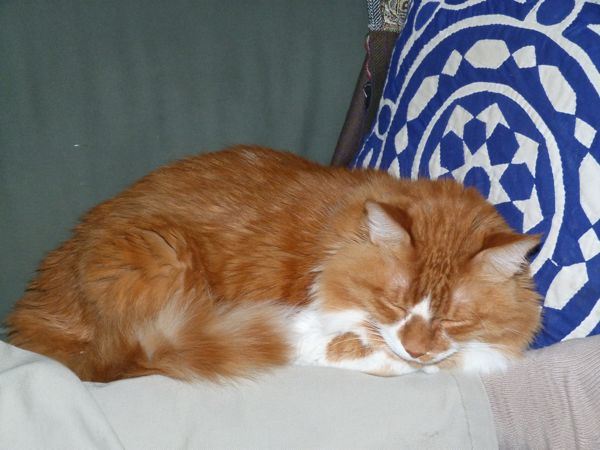
Does this look like a fractious cat to you?

Every Day Sadists Walk Among Us

“Trust your feelings,” my friend told me when I was telling her about a person who seemed so nice, but made me uncomfortable. This article says the same thing; if you feel like a person takes pleasure from humiliating or hurting others, stay far far away. It’s only a matter of time before they turn on you.
Everyday Sadists Walk Among Us, Study Says
(From AOL News/Every Day Health)
Although we may think of sadism in a sexual or criminal context, sadistic tendencies are common in everyday life.
By Laurie Sue Brockway, Everyday Health Staff Writer
Whether it’s the Marquis de Sade, the evil stepmother from Snow White, or Nurse Ratched from One Flew Over The Cuckoo’s Nest, all sadists take great pleasure in inflicting pain on others. Fortunately, you are unlikely to meet those particular three anytime soon, but according to an unusual duo of studies conducted in Vancouver, British Columbia, and published in Psychological Science this week, it is very possible you will bump into a boss, a colleague, or even a family member who may be considered an “everyday sadist.”
While most people try to avoid hurting others — and will feel guilty, remorseful, and distressed if they do hurt someone intentionally or unintentionally — an everyday sadist enjoys being cruel and may find it exciting.
“We have probably all encountered people in our daily lives who — at least seem to — enjoy hurting others,” said lead researcher Erin Buckels, MA, who conducted this work as part of her master’s thesis in Social-Personality Psychology at the University of British Columbia. She is now a doctoral student at the University of Manitoba in Winnipeg.
“Everyday sadists lack empathy, and they possess an internal motivation to hurt others. However, they are unlikely to act in a way that would be criminal or dangerous — at least in most contexts, where such behavior is met with social disapproval or punishment,” Buckels said.
Everyday sadists may be cousins to classic sociopaths in their lack of empathy, but they are not considered a danger to society in the same way. “It is only in situations where cruelty is encouraged or socially acceptable that dangerous behavior might enter the equation,” said Buckels. “Both sadistic personality and situational pressures are necessary for sadism to manifest with everyday people. War is one example of this confluence — we have all seen the images of the Abu Ghraib prisoner abuse. All forms of cruel behavior have the potential to be motivated by sadistic pleasure, including bullying and abuse by others. If it were done purely for pleasure, then it would be sadism.”
If You Like to Hurt Bugs, You May Be a Sadist
It’s one thing to take an empty mayonnaise jar to catch fireflies when you are a kid and accidentally forget to poke holes in it, causing the fireflies to die. It’s another thing to enjoy harming bugs (or animals). Buckels used a bug-crushing exercise to draw the everyday sadists out in a controlled laboratory environment. For the experiment, she defined sadists in two ways: Their cruel behavior and felt pleasure in the lab, and personality characteristics consistent with sadism. A group of 71 participants were asked to fill out a sadism personality questionnaire and also given a list of four tasks they could choose from:
Killing bugs
Helping the experimenter kill bugs
Cleaning dirty toilets
Enduring pain from ice water
A bug-crunching machine fashioned out of a coffee grinder made distinct crunching sounds. Placed close to this machine were cups containing live pill bugs that were labeled with names like Muffin, Ike, and Tootsie. Those who selected bug-crushing were told to put the bugs into the machine and grind them up. Unbeknownst to them, there was a barrier that prevented the bugs from being dropped into the grinder. No bugs were killed for this experiment, but it brought the sadists out of the closet. Of 71 participants, nearly 28 percent chose to kill bugs.
What Exactly Is a Sadist?
Sadistic personality disorder was once defined as a mental illness, but over time sadism has been considered more of a lifestyle choice or a personality quirk or trait. The new Diagnostic and Statistical Manual of Mental Disorders (DSM-5), does include sexual sadism disorder. “This is marked by recurrent and intense sexual arousal from the suffering of others as manifested by fantasies, urges, and behaviors,” said Wilfried Busse, PhD, a psychotherapist based in Bethesda, Md. “To meet full criteria for the disorder, an individual also has to act on such urges by inflicting harm on a non-consenting individual, or must experience such uncontrollable urges to cause significant social and occupational impairment.”
“The central feature of sadism is deriving pleasure from watching or inflicting physical or psychological harm on others,” added Dr. Busse. “In the extreme form a sadist will seek to inflict suffering on another for the psychological gratification derived from such an action.”
Buckel’s study did not use classic criteria to define sadism – most widely known as sexual or criminal behavior – and instead explored sadism as it exists in the “subclinical” range of personality, an aspect of sadism not considered a mental illness.
“There is clearly a difference between a person who gets pleasure from killing bugs and a person who kills other humans for pleasure,” said Buckels. “That being said, the core experience of sadism is probably pretty similar for both of them. Our research has also revealed both similarities and differences between people who enjoy acting cruelly, or direct sadists, and those who simply enjoy watching cruelty, or vicarious sadists.Regardless of whom the victim is, direct aggression requires a certain amount of callousness and a lack of distress towards the suffering of another living creature.”
How to Spot a Sadist
There is a big difference between the kind of evil sadists we know from history and movies and people with sadistic impulses, who fall into a category of sadism that is considered a personality trait rather than a personality disorder.
“It is very important to differentiate between an antisocial, or sadistic, personality disorder and sadistic impulses,” said psychologist Fran Walfish, Psy.D., a family therapist and author in Beverly Hills, Calif.
“Antisocial personality disorder is very rare,” Walfish said, offering examples such as Hitler, murderers who enjoy torturing their victims and watching them suffer, and, possibly, Syrian President Bashar Assad. “But the rest of us have unconscious sadistic impulses. Even the kindest, most loving person, when terribly mistreated, can feel an impulse of hate very strong,” she added.
Walfish explained that there are several sub-types of sadists:
Explosive sadist. When disappointed and/or frustrated with their lives, humiliated or hopeless, they lose control and seek revenge for the mistreatment to which they feel subjected. They are known for being unpredictably violent. This manifests through tantrums, fearsome attacks on others, especially family members, and uncontrollable rage.
Tyrannical sadist. They are frightening and cruel because they appear to relish the act of menacing and brutalizing others; forcing their victims to cower and submit gives them satisfaction.
Enforcing sadist. They tend to be military sergeants, deans of universities, prison overseers, police officers or people with other authoritative functions who feel they should be the ones controlling and punishing people who have broken rules, regulations or laws.
Spineless sadist. They are typically deeply insecure and act like cowards. In anticipation of real danger, they project their hostile fantasies and strike first, hoping thereby to forestall their antagonist and ask questions later. They use aggressive hostility to send the message to others that they aren’t intimidated or fearful, so that they can control their inner feelings and display the exact opposite of how they actually feel. They seek out scapegoats to gang up on, which allows them to assault the exact things that exist within themselves that they want to deny.
Everyday sadist. There is a renewed interest in studying subclinical sadism as a personality trait, said Walfish. Subclinical psychopathy, narcissism, Machiavellianism, and everyday sadism form the so-called “Dark Tetrad” of personality.
“These people aren’t necessarily serial killers or sexual deviants but they gain some emotional benefit in causing or simply observing others’ suffering,” said Walfish. “The type of person the study is referring to are, for instance, the co-worker who repeatedly humiliates you and smiles or appears to reap pleasure from hurting you. If you self-advocate and say something that inflames your co-worker, she retaliates with evil revenge, further humiliating you.”
Exercise Caution Around Everyday Sadists
The British Columbia researchers surmised that everyday sadists are not the most popular people.“A person who has a high score on a sadism personality questionnaire is unlikely to be regarded as a nice and loving person,” said Buckels. “That is not to say that they are always nasty or that they can’t love others; but in general, high scorers tend to be less nice than average.”
How does someone become an everyday sadist? “In general, the cause or reason someone wants to go the extra effort to hurt another is because someone terribly mistreated them,” said Walfish. “That someone is usually their mother, father, or an older sibling. The sadist was a receptacle, or container, for hostility and evil meanness. These toxic feelings become too much for one to bear. They have no choice but to find a weaker victim and spew their venom onto the other.”
“Within their own families and in the workplace these people cannot be trusted,” Walfish observed. “No one can ever feel safe with them. Therefore, they do not have real relationships. They engage by exploiting, manipulating, and using other people as a means to their own end. The best thing to do is keep reasonable distance from these people. Always be pleasant so you don’t become their target. This does not mean to kiss up. It just means you present yourself as a benign nice guy. Never do business or get close to one of these people. They will always take you down.”
Buckels said she was surprised to find such a low baseline of positive emotions reported by sadists. “They are not just acting out to compensate for deep-rooted insecurity or low self-esteem,” she said. “Interestingly, after an act of cruelty, their moods seemed to lighten, suggesting instead that the sadist’s appetite for cruelty derives from some diabolical need. Although speculative, our hypothesis is that sadists have an underlying deficit that is sated through cruelty’s rewards.”
Kuwait Marriage and Divorce 2013
The presentation is a little confusing, but I have to guess that if 19% of the divorces are “non-Kuwaiti” by which they mean that one member of the marriage is not Kuwaiti. So what they are not saying is that 80% of the divorces are Kuwaitis married to Kuwaitis.
They also did not say how long marriages lasted – how many of those marriages were divorced in the first year, how many after many years? If the statistics are accurate, Kuwait is doing OK – more than half the marriages are succeeding.
OOps – found second report in the same Kuwait Times! See below
9,404 Kuwaiti marriages, 4,067 divorces in 2012
KUWAIT: More than 9,000 Kuwaiti couples married last year and more than 4,000 marriages ended in divorce the same year, a local daily reported yesterday quoting official statistics.
The statistics released by the Ministry of Justice and published by Al-Qabas daily indicate that 9,404 marriages between Kuwaitis took place last year compared to 4,067 divorces, or 43.3 percent.
The same statistics also indicated that 4,910 marriages took place between a Kuwaiti and non-Kuwaiti spouse in 2012, compared to 2,605 divorces in the same category. In detail, the statistics show that 814 Kuwaiti men married non-Kuwaiti women in 2012, while 648 Kuwaiti women married non-Kuwaiti men the same year.
The percentage of Kuwait couples in the total number of marriages last year reached 65 percent, according to the statistics, while 19 percent took place between non-Kuwaiti couples. 10 percent of marriages took place between a Kuwaiti man and a non-Kuwaiti woman, while marriages between a non-Kuwaiti man and a Kuwaiti woman also reach 10 percent.
Regarding divorce percentages, the statistics show that 19 percent of divorce cases happened between non-Kuwaiti couples; 12 percent between couples in which the husband is Kuwaiti and the wife is non-Kuwaiti, and 7 percent between couples in which the husband is non-Kuwaiti and the wife is Kuwaiti.
Regarding academic qualifications, the statistics show that 35 percent of women married last year have university degrees, 30 percent have high school degrees, and 19 percent have diplomas, whereas 29 percent of men have university degrees, 24 percent have high school degrees, 21 percent have middle school qualifications and 20 percent have diplomas. On the other hand, the statistics show that the majority of women divorced last year have university degrees (29 percent), while the majority percentage of divorced men have middle school qualifications (29 percent).
55% couples married in last 4 years seek divorce
KUWAIT: Almost 55 percent of couples filing for divorce in Kuwait have been married for four years only, including 25 percent who are yet to celebrate the first anniversary of their wedding, a local daily reported yesterday quoting official statistics. The statistical report released by the Research and Statistics Department in the Ministry of Justice and obtained by Al- Qabas daily further indicates that out of 5,662 couples who sought marriage counseling, only 20 percent had their issue successfully resolved.
Lack of willingness to coexist was identified as the primary cause for divorce requests, with 32 percent of the requests made by husbands and 23 percent by wives.
The statistics further indicate that 77 percent of couples who attended marriage counseling were Kuwaitis compared to 22 percent non-Kuwaitis.
Meanwhile, 62 percent of those couples do not have children, 34 percent have one to three children, and 2.7 percent have between four and six children.
Regarding age groups, the statistics show that 42 percent of couples seeking marriage counseling are aged between 25 and 34, 22 percent aged between 35 and 44, and 20 percent aged between 15 and 25. And according to the couples’ academic levels, the statistics indicate that 28 percent of husbands have middle school degrees, 22 percent have high school degrees and 21 percent have university degrees, whereas 27 percent of wives have high school degrees, 23 percent have university degree, 22 percent have diploma and 20 percent have middle school
One Thing Leads to Another
“I’m afraid to go home,” AdventureMan told our son. “She’s moving the furniture.”
“She can do that without consulting?” our son asked.
“Yeh, she can,” AdventureMan responded, “And I count myself lucky that she hasn’t bought another house and said we’re moving.”

Moving furniture is one of those things I do. I get tired of everything the same-old same-old. If I’m not moving, it gives me a chance to re-think things, and try something else to see if that works better.
We have a dining room we hardly ever use. We have never eaten a meal in there. We had too much furniture, and besides, in the family room we have a huge circular teak table that seats eight. It’s less formal and a lot more fun. The dining room is in a very quiet part of the house, so we talked about turning it into a library (see! we talked!) and that is what I did. But when you move a piece of furniture, or get rid of another, or both, you end up also having to evaluate all the things inside that piece of furniture, and having to think through where things need to go.
Life is so different. As an Army wife, we entertained all the time. I hit the sales in Czechoslovakia and have bar ware and wine glasses for our 48 closest friends, and we just don’t entertain like that any more. We don’t even drink like that!
We do entertain; we host the monthly book club some months, I have my quilting group in frequently, and we have dinners for family and dinners for visiting IVLP delegates. We entertain people we like. It’s a whole different world when it’s a choice. I’m getting rid of a lot of pieces I’ll never use again and I’ll never miss once they’re gone.
I’m getting rid a lot of irrelevant things, including an old TV cabinet, you remember them? They enclosed an old fashioned TV, had shelves for videos (remember them?) and little drawers for CDs? I’ve been using it as storage for art work and a thing that plays music from an iPod or two. I’ll hang some of the art work, get rid of some, and find another place for the MP3 player.
Yesterday was the big work, the figuring out how to change furniture and carpets into new positions. Of course, once you move something, you have to clean the places no one ever sees, so it takes more time, but you’ve got to do it right.

Today was the small but time-consuming work of getting things put away in a kind of order so that they can be found again. When I put books on the shelves three years ago, it was like fiction here and non-fiction there, and I never went back. Now, I have them sorted into subjects and country, art related, or religious. Got rid of about half my CD’s but still have too many.
It’s a messy process; you take something fixed, turn it into chaos and slowly, slowly, bring a new pattern into being. Tomorrow I need to hang some more art work. It’s been three years.
Then we live with the changes and see if they work for us. If not . . . the process starts over, but in the meanwhile, got rid of some stuff! One of these days, need to tackle the closets . . . Have an entire closed full of evening clothes I never wear, and can’t bear to part with . . . yet.
Recent Comments
ExpatAlien on What Country am I Living … intlxpatr on Yellowstone: Old Faithful to C… Michelle on Yellowstone: Old Faithful to C… Cathy on No Grown-Ups in Charge intlxpatr on Waiting for Snow Wikipedia Donate Button

Amazina


Early Voting in Florida


 Here There and Everywhere