A Woman Scorned
I subscribe to a website called GoodReads.com, where I keep track of the books I read and get great recommendations from seeing what my GoodReads friends are reading. They also send me a newsletter a couple times a month, one a general newsletter, and one customized based on authors it sees me reading regularly. This morning, I got the general newsletter (which I actually do skim) and when I reached the end, I read this chilling poem.
Chilling?
When we lived in Kuwait, the first two lines of the poem were a reality. A first wife whose husband was taking a second wife set fire to the celebration tent where the women were celebrating. While the bride escaped, several lives were lost in a horrifying fire, fed by an accelerant.
Joan Colby captures the power and rage of the woman, scorned, in every culture.
A Woman Scorned
by Joan Colby (Goodreads Author)
A woman scorned sets fire to the tent
Where the new wife is celebrating.
Carves her name and yours into a tree
Then chops that tree down with her nail file.
Cages a bird and teaches it to speak
In a language where every verb is an obscenity.
Combs her hair with broken glass until
It glitters like a million diamonds
That you stroke until your hands bleed rubies.
Watches how you sit quietly near the water
While she poisons the tea she is about to serve.
Drives a team of black horses down the avenue
Of your lovers whipping them white as judges.
Climbs through the window that you forgot to secure
Wearing a burglar suit sewn of her eyelashes.
Picks a bouquet of jimson weed, hydrangea,
Lily of the valley, poison ivy, rhododendron
To prove the base and beautiful can both be lethal.
Paints graffiti on the wall of your Facebook
And for good measure stamps a letter with your heartsblood.
Enters your dream unbidden
Wearing the scarlet dress you once admired.
Paces up and down, up and down
Before your place of business.
Removes all the signposts pointing to
The street you used to live on when you were happy.
Women’s Rights a Threat to Society?
Society changes. Cable television has had a huge influence, travel to other countries changes perceptions, education gives a wider perspective, The genie is out of the bottle; women are equal people. No woman should need someone else’s permission to travel, work, or to use contraception.
Egypt’s Muslim Brotherhood: Women’s Rights Could Destroy Society, Countries Should ‘Reject And Condemn’ UN Declaration
Reuters | Posted: 03/14/2013 5:40 pm EDT


By Michelle Nichols
UNITED NATIONS, March 14 (Reuters) – Egypt’s ruling Muslim Brotherhood warns that a U.N. declaration on women’s rights could destroy society by allowing a woman to travel, work and use contraception without her husband’s approval and letting her control family spending.
The Islamist party of President Mohamed Mursi outlined 10 reasons why Muslim countries should “reject and condemn” the declaration, which the U.N. Commission on the Status of Women is racing to negotiate a consensus deal on by Friday.
The Brotherhood, which was elected to power in June, posted the statement on its website, http://www.ikhwanweb.com, on Thursday.
Egypt has joined Iran, Russia and the Vatican – dubbed an “unholy alliance” by some diplomats – in threatening to derail the women’s rights declaration by objecting to language on sexual, reproductive and gay rights.
The Muslim Brotherhood said the declaration would give “wives full rights to file legal complaints against husbands accusing them of rape or sexual harassment, obliging competent authorities to deal husbands punishments similar to those prescribed for raping or sexually harassing a stranger.”
U.S. Ambassador Susan Rice last week touted at the commission – a global policy-making body created in 1946 for the advancement of women – progress made by the United States in reducing the rate of violence against women by their partners.
“All 50 states in our union now have laws that treat date rape or spousal rape as just as much of a crime as rape by a stranger,” Rice said. “We cannot live in truly free societies, if women and girls are not free to reach their full potential.”
The contrasting views show the gap that needs to be breached in negotiations on the declaration, which this year is focused on urging an end to violence against women and girls. The commission failed to agree a declaration last year on a theme of empowering rural women due to similar disagreements.
WORLD IS WATCHING
Egypt has proposed an amendment, diplomats say, that would allow countries to avoid implementing the declaration if it clashed with national laws, religious or cultural values. But some diplomats say this would undermine the entire declaration.
The Muslim Brotherhood warned the declaration would give girls sexual freedom, legalize abortion, provide teenagers with contraceptives, give equality to women in marriage and require men and women to share duties such as child care and chores.
It said the declaration would allow “equal rights to homosexuals, and provide protection and respect for prostitutes” and “equal rights to adulterous wives and illegitimate sons resulting from adulterous relationships.”
A coalition of Arab human rights groups – from Egypt, Lebanon, the Palestinian Territories, Jordan and Tunisia – called on countries at the Commission on the Status of Women on Thursday to stop using religion, culture, and tradition to justify abuse of women.
“The current positions taken by some Arab governments at this meeting is clearly not representative of civil society views, aspirations or best practices regarding the elimination and prevention of violence against women and girls within our countries,” said the statement issued by the Coalition for Sexual and Bodily Rights in Muslim Societies.
Michelle Bachelet, a former president of Chile and head of U.N. Women, which supports the commission, said the commission was unable to reach a deal a decade ago when it last focused on the theme of women’s rights and ending violence against women.
“Ten years later, we simply cannot allow disagreement or indecision to block progress for the world’s women,” Bachelet told the opening session of the commission last week. “The world is watching … the violence needs to stop.” (Editing by Mohammad Zargham)
Long Term Care Insurance: Buy it Young
I have a whopping bill to pay, and while I hate to do it, it is necessary. Women in my family live a long time. People in America are living longer. While retirement funds can look generous at the time you retire, health care costs and late-life care can eat those funds down to nothing . . . and then what?
It’s not like the old days. There was a time when we didn’t live so long, and women didn’t work. Who, these days, has time to stay home and care for the ailing elderly? Because we live longer, by the time we become ailing-elderly, our children are borderline elderly themselves, unable to do the heavy lifting that comes with helping the elderly do even the smallest of everyday tasks, bathing, grooming, eating, dressing – it takes strength.
I found this article on AOL’s Daily Finance page.
Long-Term Care Insurance Should Be Part of Your Financial Plan
by Michele Lerner, Mar 12th 2013 5:00AM
In the world of insurance products, long-term care insurance is a relative newcomer. It was introduced in the late 1970s, but in recent years, it has become a much more important element of retirement planning thanks to twin rises in health care costs and longevity. (Life expectancy in 1930 was just 59.7; in 2010 life expectancy for Americans was 78.7.)
Many people associate long-term care insurance with nursing homes, but it also pays for in-home care and assisted living facilities. According to the American Association for Long-Term Care Insurance, 50 percent of long-term care insurance benefits in 2011 went to pay for in-home care, 31 percent for nursing home care, and 19 percent for an assisted living facility.
How Long-Term Care Insurance Works
Each long-term care insurance policy is slightly different, but most benefits kick in based on a similar definition of “disability”: either you have severe cognitive impairment or you need help with at least two daily living activities. These activities include bathing, dressing, eating or using the bathroom.
In other words, you don’t just automatically receive the benefits when you think you could use some help or when you move into a retirement community. Policies are typically purchased with fixed daily benefits for a fixed period of time such as three years or five years.
Can You Cover These Costs Without It?
On an hourly, daily and monthly basis, the cost of the kinds of services covered by long-term care insurance really add up.
A 2012 MetLife Survey of Long-term Care Costs found:
The national average monthly base rate in an assisted living community cost $3,550 in 2012.
The national average daily rate for a private room in a nursing home cost $248; a semi-private room ran $222 per day.
The national average daily rate for adult day services was $70.
The national average for hourly rates for home health aides was $21.
While many people recognize the value of having insurance coverage to help pay for their care when they age, not everyone purchases it.
A 2012 Generational Research project by Financial Finesse showed that just 10 percent of people age 45 to 54 have purchased long-term care insurance, and only 16 percent of people age 55 to 64 have it.
Why are people forgoing coverage? It comes down to cost, according to the AARP.
How Much Does Coverage Cost?
Long-term care insurance can vary widely depending on your age at the time of purchase, the length and amount of coverage, and policy characteristics including whether your benefits are adjusted for inflation and the length of any waiting period before benefits are paid, among other things.
According to the American Association for Long-Term Care Insurance, the average annual premium for long-term care insurance in 2012 for a policy for a 50-year old with a daily benefit of $200 for three years of coverage and a 3 percent automatic compound inflation coverage was $2,235. Your policy can’t be cancelled (except for non-payment) and premiums for long-term care insurance cannot be increased on an individual basis for your age or health reasons. Still, insurance companies can raise the premiums for an entire class of policyholders (such as everyone age 75 and older).
Obviously, the older you are when you purchase long-term care insurance, the more expensive the policy and the higher the likelihood that you will be turned down for the coverage. Underwriters look at your health records as well as mortality risk to determine your eligibility for coverage.
Some companies give you a discount if you’re married because they assume spouses are likely to take care of each other longer before resorting to a nursing home.
Four Reasons You Need Long-Term Care Insurance
So how do you know if you need this kind of insurance? If you have more limited retirement savings, long-term care insurance should probably be part of your financial plan. And even if you have $2 million or $3 million in the bank for your retirement and future health care needs, don’t dismiss these policies before you examine the benefits more closely. Consider, for example:
How much longer we’re living these days. The longer you live, the higher your chances of needing some type of long-term care, either in your home, in a nursing home or in an assisted living facility.
Rising health care costs. AARP says that health care costs have historically outpaced the overall rate of inflation. If you need to live in a nursing home for more than a year or two, you could need $250,000 or more to pay for it.
How far your retirement investments will really take you. Your 401(k) may look good when you retire at 65, but if you need to pay for assisted living or even a home health aide the income generated by your retirement investments could get eaten away very quickly. If one spouse needs to live in a nursing home but the other can stay at home, you’ll need enough savings to cover two separate living expenses.
Your family’s emotional and financial health. Even wealthy families often choose to purchase long-term care insurance because the policy can make decisions about how to care for loved ones easier by giving them more options. Instead of draining their inheritance, your family members can use insurance benefits to pay for home health care or to cover some of the expense of a more costly nursing home.
Financial experts suggest purchasing long-term care insurance between age 55 and 64, but remember that the younger you are when you buy it, the lower your premiums will be. If you or your parents are 50 or 55, it’s time to discuss your options with an insurance agent.
Another Thorny Issue
It is one of those glorious days in Pensacola. I love winter here anyway, I love the cold temperatures and a chance to wear some of my old German sweaters and coats, but today, the threat of deep freeze seems past, it is just warm enough to prune the roses and the bougainvilleas.
I used to garden, I gardened well. I gardened in Seattle, and in Germany, mostly, although I also had gardens in Jordan, and in Qatar. In Qatar, I will admit, my function was mostly to buy the plants and buy the pots and tell the gardener where to place them. He came to my door when I tried to do it myself, and he said “Madam, this is MY job. Please don’t take my work away from me.”
Now that AdventureMan is also a Master Gardener, my gardening responsibilities – and my gardening prerogotives – have declined substantially. I tried gardening when we got here; I can garden just fine in November – April, but the summer heat and humidity and mosquitos defeat me. Oh? Yes? You’ve heard this before? I am so sorry!
I still retain personal interest in the bougainvillea and the roses. I love the bougainvillea, and it is now three years old. I am trying to grow it tall, so it will cascade over the end of my porch area, as it does in the more tropical countries. Yes, it is a challenge.
I also love trimming, rooting, and creating new rose bushes from the beautiful old white rose bush we have, with it’s delicate coloring and scent.

Old White Roses
I was careful. I wore leather globes. But when you are working with bougainvillea (great big huge thorns!) and with roses (smaller, but equally lethal thorns) you can get very scratched up. I did, indeed, get very scratched up, but I succeeded in getting the bougainvillea gathered and trimmed, some new bougainvillea starts made, and several new rose bushes started. I think next time I will at least wear long sleeves; my Master Gardener suggested long leather gauntlets!
The Master Gardener pruned the roses. 🙂 He had a class in pruning roses a couple weeks ago, and wanted to tackle the roses, but he wanted our marriage to survive. Today was the perfect day; a day we could both be outside. We discovered we have very similar styles in pruning roses, and our marriage is better than intact 🙂
A Thorny Sermon: The Prodigal Son
From today’s Lectionary reading, the Gospel:
GOSPEL: Luke 15: 1 – 3, 11b – 32 (RCL)
Luke 15: 1 – 3, 11 – 32 (Roman Catholic)

Gustave Dore: The Prodigal Son in the Arms of his Father
Luke 15:1 (NRSV) Now all the tax collectors and sinners were coming near to listen to him. 2 And the Phar’isees and the scribes were grumbling and saying, “This fellow welcomes sinners and eats with them.”
3 So he told them this parable:
11 Then Jesus said, “There was a man who had two sons. 12 The younger of them said to his father, “Father, give me the share of the property that will belong to me.’ So he divided his property between them. 13 A few days later the younger son gathered all he had and traveled to a distant country, and there he squandered his property in dissolute living.
14 When he had spent everything, a severe famine took place throughout that country, and he began to be in need. 15 So he went and hired himself out to one of the citizens of that country, who sent him to his fields to feed the pigs. 16 He would gladly have filled himself with the pods that the pigs were eating; and no one gave him anything.
17 But when he came to himself he said, “How many of my father’s hired hands have bread enough and to spare, but here I am dying of hunger! 18 I will get up and go to my father, and I will say to him, “Father, I have sinned against heaven and before you; 19 I am no longer worthy to be called your son; treat me like one of your hired hands.” ‘
20 So he set off and went to his father. But while he was still far off, his father saw him and was filled with compassion; he ran and put his arms around him and kissed him. 21 Then the son said to him, “Father, I have sinned against heaven and before you; I am no longer worthy to be called your son.’ 22 But the father said to his slaves, “Quickly, bring out a robe–the best one–and put it on him; put a ring on his finger and sandals on his feet. 23 And get the fatted calf and kill it, and let us eat and celebrate; 24 for this son of mine was dead and is alive again; he was lost and is found!’ And they began to celebrate.
25 “Now his elder son was in the field; and when he came and approached the house, he heard music and dancing. 26 He called one of the slaves and asked what was going on. 27 He replied, “Your brother has come, and your father has killed the fatted calf, because he has got him back safe and sound.’
28 Then he became angry and refused to go in. His father came out and began to plead with him. 29 But he answered his father, “Listen! For all these years I have been working like a slave for you, and I have never disobeyed your command; yet you have never given me even a young goat so that I might celebrate with my friends. 30 But when this son of yours came back, who has devoured your property with prostitutes, you killed the fatted calf for him!’
31 Then the father said to him, “Son, you are always with me, and all that is mine is yours. 32 But we had to celebrate and rejoice, because this brother of yours was dead and has come to life; he was lost and has been found.'”
Sometimes people will leave off the part about the elder son, and just concentrate on the return of the younger son, focusing on the father watching always, hoping for the return of the younger son, ready to forgive and welcome before the words can even get out of the younger son’s mouth.
It is wonderful, and reassuring, for those of us sinners.
Many, however – including me – can also identify with the oldest son who says “I’ve always done everything right and you’ve NEVER given me a tiny goat, much less a fatted calf, and you’re throwing this party for the son who blew his entire fortune on louche living???”
It doesn’t seem fair, does it? Isn’t that really the point of the story, that we can’t behave our way into heaven, it is sheer grace, the love of the heavenly creator, that allows us in? It’s not an easy concept to wrap my mind around, so today I struggle to take it in, and I give thanks for Father Neil who tackles the hard questions and doesn’t just sweep them under the carpet because they are inconvenient. (The sermon isn’t up yet, but when it is available, you will find it here)
Stay With A Violent Man, You End up Dead
No, no, this was not Rihanna and Chris Brown, it just sort of SEEMED familiar, like their story. Bottom line, Law and Order SVU is saying, if a guy hits you, abuses you, it is not likely to get better. You stay, you risk, at the very least, continued and increasing damage at best, increasing violence toward those you hold dear, even brothers, sisters, mothers, fathers and CHILDREN to the self-centeredness of the violent abuser, and ultimately, many abuse victims end up dead. It’s not a story about Rihanna and Chris; it’s a story about every woman who stacks up economic realities against a violent outcome and chooses to stay.
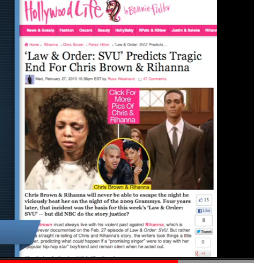
‘Law & Order: SVU’ Tackles The Chris Brown-Rihanna Story Of Abuse, Reconciliation
It’s a staple of the “Law & Order” franchise to rip stories straight from the headlines. For the latest episode of “Law & Order: Special Victims Unit,” the case was one that is very familiar to music fans, and remains as controversial today as it was when the story first broke in 2009. Using obvious counterparts, “SVU” tackled the Chris Brown and Rihanna story.
Brown assaulted Rihanna in 2009 before the Grammy Awards. The two have since reconciled and have remained linked romantically off and on since then. In the “SVU” episode they were Micha and Caleb. Just like Rihanna, Micha was assaulted by Caleb. The case went to trial, but the two reconciled. But “SVU” took their story further down a dark path.
In this fiction, Caleb finally went too far and killed Micha. “Shocked fans gathered in Manhattan tonight to mourn the death of rising talent, Micha Green, whose body was discovered a few hours ago in Bermuda,” a reporter said in the aftermath of hear death.
Did they take it too far? E! wondered that very thing, while Hollywood Life worried that the ending could hit too close to home for the real couple, writing, “Overall, the show took some liberties … but pretty much wrapped things up exactly as they are: Chris is a violent man and Rihanna accepts a bad man in her life. How sad!”
Relationship Anxiety Hard on Your Immune System
Relationship Anxiety Is Hard On The Immune System, Study Says
Katherine Bindley
katie.bindley@huffingtonpost.com
This is from AOL News/Huffpost:
Relationship anxiety is known to be tough on a person’s mental well-being, but a new study suggests that fear of rejection — and worry that someone doesn’t love you enough — can also serve as chronic stressors that tax the immune system.
In a study of 85 couples who’d been married for an average of 12 years, a team of researchers led by Lisa Jaremka with Ohio State University College of Medicine examined the level of anxiety participants had about close relationships, as well as samples of their blood and saliva.
They found that the levels of cortisol — a hormone associated with stress — were on average 11 percent higher in people with higher levels of attachment anxiety than those who were less anxious. In addition, the more anxious people had between 11 percent and 20 percent fewer T-cells, which help the body to fight off disease.
“The thing that was surprising was the magnitude of the difference, especially in the immune cells that we saw,” Jaremka told The Huffington Post. “Some of the differences in the immune cell numbers, between the higher and the less high anxious attached people, were on the magnitude of what you’d see between obese and non-obese people.”
Attachment styles are believed to be derived from the type of caregiving people experienced in childhood, but the effects extend to, and impact, relationships in adulthood.
Most people are bound to have some level of concern and stress during the ups and downs of a relationship, Jaremka explained to HuffPost. But those with higher levels of attachment anxiety are hypersensitive to signs that a person they’re close to will leave them on a regular basis. They’re also more likely to seek reassurance and interpret their partner’s behaviors in a negative way.
Because the team did not include study participants who fell on the very high end of the anxiously attached spectrum, it’s possible that the effects of relationship anxiety could be even greater than the study suggests. Incidentally, while more women in the study suffered from higher levels of attachment anxiety, the researchers saw the same elevated levels of cortisol and lower T-cells in the men who were anxious.
Previous research had already established that relationship anxiety can have negative effects on a person’s physical health, but less was known about how exactly the anxiety and the health effects related to one another.
According to the Wall Street Journal, it’s believed that about 20 percent of the population falls on the anxious side of the anxiously attached spectrum. Another 25 percent fall into the avoidant category, which means those people may not get close to their partner out of fear that it could lead to a loss of autonomy.
Experts told the Journal that emotional opposites are often initially attracted to one another, but they may eventually face obstacles if they exacerbate one other’s attachment tendencies. For example, an anxious person might push for more affection and attention. This behavior might make an avoidant partner pull further away, in turn, making the anxious person even more insecure.
Despite the negative effects that attachment styles can have on a person’s relationships and physical health, Jaremka explained these traits are not inalterable.
“Anybody that is experiencing something that feels like high levels of attachment anxiety would think, ‘Oh great I’m doomed, but I think it’s important to acknowledge the fact that just because you are highly anxiously attached now doesn’t mean you have to be that way forever,” Jaremka told HuffPost. “We do know based on research that people can change and people can be very anxiously attached in one relationship and not at all in a different relationship.”
So what kind of relationship can serve as an antidote to pre-existing anxiety? One with a secure partner.
“If they are a very caring and loving and responsive partner, who attends to your needs when you need them, who is there for you when you’re stressed…Those relationships seem to be the types of relationships that people are able to feel secure in and are able to overcome anxieties in, if they have them,” Jaremka said.
The study, titled “Attachment Anxiety Is Linked to Alterations in Cortisol Production and Cellular Immunity,” is slated to be published in the journal Psychological Science.
Karen Thompson Walker and The Age of Miracles
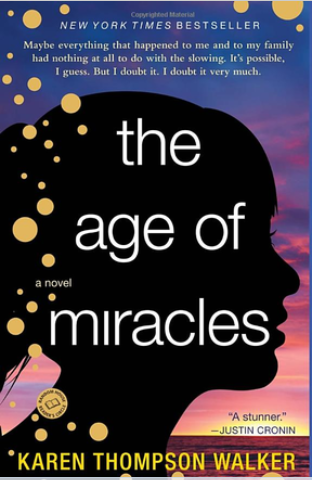
The Age of Miracles is a very odd name for this book, which starts off in a beautiful little coastal town in California, a very normal, modern town, and then everything changes. Suddenly, the earth’s rotation is slowing, incrementally, but resulting in longer and longer days and longer and longer nights. The difference is small at first, but grows.
Julia is in sixth grade, a painful time anyway in most lives where your body suddenly changes and all your relationships with all your friends change, and boys become a major factor. Imagine. All this AND the earth’s rotation is slowing.
No one knows what to expect. No one knows why or how the rotational slowing is happening, and no one has a clue how to fix it. Do you stay on a 24 hour clock, as the days grow to 30 hours? Forty hours? Can you even function in a forty hour day, or sleep a 40 hour night? How do you stay on a 24 hour clock and force yourself to sleep when the sun is shining brightly overhead? How do you have a school day entirely in the middle of the darkest part of the night? How does food continue to grow? What impact does this have on birds? Migrations? How does kicking a soccer ball feel when earth’s gravitational field starts to lessen?
The author does a brilliant job in a what-if situation, and manages to make it quite real. Don’t read this book if you are the suggestible type – it’s just one more thing you’ll start worrying about when you don’t need to. If you can read speculative fiction without letting it influence you, then by all means read this book, it is a good read.
The Death of Bees by Lisa O’Donnell
Death of Bees was another powerful recommendation by National Public Radio.

I believe in a greater power, in a God who sends things my way and that I am meant to be paying attention. Several books have been recommended to me lately which I didn’t choose, or might have avoided had I known how painfully they dealt with poor parenting and children in the depths of horrific poverty.
Here is what the lead into the book says:
Today Is Christmas Eve,
Today is my birthday,
Today I am fifteen,
Today I buried my parents
in the back yard.
Neither of them were beloved.
Oh my goodness! I am sucked in immediately. And immediately I am overcome by the grinding nature of poverty, the enormous amount of energy it takes just to be fed, to have a roof over your head, to function in the bureaucracy that seeks to ameliorate the burdens of poverty.
I am horrified by the lives of innocent children in the hands of people who should never have responsibility for anyone, even themselves, their decision making skills are so non-existent. There are parents who have no idea what self-sacrifice GOOD parenting requires, who raise children who are often trying to survive their own parents.
The Death of Bees has redemption. It has two sisters who love one another and are smarter than the average child. It has a neighbor who notices, not in a snoopy or intrusive way, but in a kind, helping and ultimately sacrificial way. It has moments of black humor, when the neighbor’s dog keeps digging at the parental graves in the backyard and bringing bones inside just at the worst moments.
Ultimately, it is a tale of survival, in spite of the parents, in spite of the system, in spite of betrayals by family and friends. There is a glimmer of hope that life may be different for these sisters, if they can survive their upbringing and overcome their childhood.
Now, go read the book 🙂
Recent Comments
ExpatAlien on What Country am I Living … intlxpatr on Yellowstone: Old Faithful to C… Michelle on Yellowstone: Old Faithful to C… Cathy on No Grown-Ups in Charge intlxpatr on Waiting for Snow Wikipedia Donate Button

Amazina


Early Voting in Florida


 Here There and Everywhere