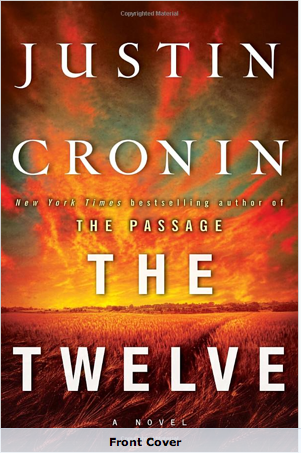
I had downloaded The Twelve to my iPad for a trip, but didn’t get to it, and sort of forgot it was there until my son mentioned he was listening to it on audio-books, and it was good, maybe even better than the first book in the trilogy, The Passage. He had loaned me The Passage several years ago when it came out, and as soon as I finished, I got on the list to download as soon as the next book came out – it was that good.
Cronin’s gift is an ability to create a future world entirely different from our own, with a devastating enemy – the virals – who, literally, are us, transformed. Cronin can make the enemy terrifying, destructive, truly horrifying – and can make them also captive to their repugnant nature and even pitiable. I think that is an amazing dance for an author to accomplish.
The setting is post-apocalyptic USA; the government had a sector working on a secret weapon which – of course – was not able to be contained, creating 12 super vampire-like creatures called Virals, who in turn create hordes of minions. This volume, The Twelve, is set more than 100 years later, but shifts back to earlier times to help us understand how this disaster occurred, and how characters relate back to the earliest times of the disaster. The populations live in fear of sudden attacks; one family, out on a picnic, are almost totally wiped out by an eclipse for which the Virals were prepared – and the families were not.
As I read his books, I find them very cinematic, but, as my son and I discussed, too complex for a movie; it would need a gritty HBO series like The Wire, or OZ, or Deadwood to capture the subtleties, the nuances that make this a best-selling series. The heroes and heroines are all make for the screen, their relationships – and inter-relationships – make them interesting, and then, as we learn more, interesting again. We never know enough to make a final judgement on any character; the characters are complex and the relationships obscure until the author chooses to reveal. It makes it fun to try to spot them before he tells us. I missed a couple!
Although it can be read as a great-adventure stand-alone, you’ll be happier if you read The Passage before you read The Twelve. If you have a problem with postponing gratification, you might want to wait until the third and conclusive volume of the trilogy is published – and that may be a year or so.
July 13, 2013
Posted by intlxpatr |
Adventure, Books, Character, Community, Fiction, Health Issues, Living Conditions, Political Issues, Relationships, Social Issues, Survival | Post Apocalypse, virals |
Leave a comment
It doesn’t matter how enlightened the legislation – if the law is not enforced, the rules on the book are laughable. It gives the illusion of a lawful society, but if citizens know that they will not be penalized for breaking the law, they will scoff at the law and do as they please. People who came to the country expecting to make a fair wage and be treated decently and with dignity find themselves without proper paperwork due to the corruption of their employer or recruiter.
If the MOI in Qatar enforces this law, a terrible situation will be slightly better. This, from The Qatar Gulf Times:
By Ramesh Mathew/Staff Reporter
| With the Ministry of Interior (MoI) taking a firm stand on ID cards, residents believe that this will safeguard the interests of workers as their employers will now be forced to abide by the rules. |
A report in the Tuesday edition of Gulf Times had quoted a senior official as saying that residents should always carry their residence permit ID cards and produce the same whenever asked by the authorities concerned. Those failing to do so would be fined up to QR10,000, the report had said, adding that the MoI could also transfer the sponsorship of expatriates if they proved that they were abused by sponsors under Law No 4/2009.
Welcoming the MoI’s decision, legal expert and rights activist Nizar Kochery said this would make employers more accountable as any long delay or failure on their part to stamp the visas of their staff would invite a hefty fine.
“There have been cases of companies refusing to stamp visas for long periods and workers being picked up by the law-enforcing agencies for failing to produce valid residence proof,” said Kochery, adding that the ministerial reaffirmation would force employers to stamp visas promptly.
Reacting to the report, an Asian diplomat said his country’s mission frequently received complaints from people alleging that their employers had not stamped their visas even months after their arrival in Qatar.
“The embassy receives such complaints from expatriates every week though there has been a drastic fall in their numbers in recent times due to strict enforcement of the rules by the local authorities,” he added.
Kochery said there should also be stringent implementation of the rules pertaining to expatriates’ passports. “Though the ministry issued guidelines more than three years ago on the issue of custody of passports, complaints of violation of this norm continue,” the legal expert said.
The ministry had instructed employers to hand over the passports of employees after the completion of formalities. However, there have been cases of some employers retaining the passports in violation of the local rules.
“A similar fine (like the one for not carrying IDs) should be imposed on erring employers for illegally keeping their workers’ passports,” he said.
A few years ago, this newspaper had reported about a theft in a manpower company’s office in Musheireb. More than 150 passports of workers, which the firm had kept in its custody in violation of rules, went missing in the incident. Meanwhile, residents have also said similar penalties were required to curb violations regarding exit permits as well. A social activist in the Indian community said there have been complaints of employers failing to arrange exit permits for their workers on time even during emergencies.
There have also been reports of residents, mainly drivers, lodging complaints with embassies, alleging that their sponsors take away their licences when they go on vacation.
“The MoI should consider imposing hefty fines on such employers as well. Like a passport, a driving licence is not only the property of an individual, but is also a proof of identification under the local rules,” said Kochery.
July 11, 2013
Posted by intlxpatr |
Bureaucracy, ExPat Life, Interconnected, Kuwait, Law and Order, Leadership, Lies, Living Conditions, Pet Peeves, Qatar, Relationships, Scams, Social Issues, Transparency, Work Related Issues | exit permits, Ministry of Interior, passports, resident IDs |
Leave a comment
Don’t you love technology? It’s like working on a complex puzzle, and all of a sudden seeing how disparate pieces relate 🙂 This is a fascinating discovery from AOL/Huffpost:
Ancient DNA Linked To Living Descendants In Genetic Study
The Huffington Post | By Macrina Cooper-White Posted: 07/09/2013 2:24 pm EDT | Updated: 07/09/2013 9:12 pm EDT
What if you could trace your ancestry back to around 5,000 years ago? Researchers were able to do just that in a fascinating new DNA study, which found adirect genetic link between the ancient remains of Native Americans and their living relatives.
“It’s very exciting to be able to have scientific proof that corroborates what our ancestors have been telling us for generations,” study co-author and participant Joycelynn Mitchell said in a written statement. “It’s very amazing how fast technology is moving to be able to prove this kind of link with our past.”
In the study, U.S. and Canadian researchers used mitochondrial genome (mitogenome) sequencing to analyze DNA inherited exclusively through mothers. Looking at the mitogenome is cheap, easier to sequence than nuclear DNA, and skirts around the problem that European men mixed with Native American women.
The researchers collected DNA from 60 living indigenous people belonging to the Tsimshian, Haida and Nisga’a tribes in the northern coast of British Columbia. The tribes’ oral histories and archaeological sites indicate they have lived in the region for generations, which made them good candidates for tracing their lineage back so many years.
Complete mitogenomes were extracted from the remains of four Mid-Holocene individuals found in British Columbia’s Lucy Islands and Dodge Island, and then that information was compared to the DNA of the study participants.
What was found? The research team discovered one of the living individuals carried this same “mitogenomic signature” as a young adult female who lived on Dodge Island 2,500 years ago — which also matched the mitogenome of the remains of a woman who lived in the Lucy Islands 5,500 years ago. Wow.
Three other living participants had mitogenomes that linked back to the remains of another individual found on Dodge Island, who may have lived around 5,000 years ago.
“This is the beginning of the golden era for ancient DNA research because we can do so much now that we couldn’t do a few years ago because of advances in sequencing technologies,” study co-author Dr. Ripan Malhi, an anthropology professor at the University of Illinois and Institute for Genomic Biology professor, said in a written statement. “We’re just starting to get an idea of the mitogenomic diversity in the Americas, in the living individuals as well as the ancient individuals.”
The new study was published online on June 3, 2013 in the journal PLoSONE.
July 10, 2013
Posted by intlxpatr |
Circle of Life and Death, Cultural, Family Issues, Generational, Interconnected, Local Lore, Relationships | British Columbia, Dodge Island, Haida, Lucy Islands, mitogenome, Nisga, Tsimshian |
Leave a comment
“I miss the highs. . . ” my friend said – just before she went off her meds.
I totally understood what she was saying. We belonged to a quilting group, and when she was beginning a manic phase, she produced knock-out quilts, quilts combining colors in unusual ways, and she could stay up all night to finish one. She was a lot of fun to be around, totally up and enthusiastic and creative. As the phase progressed, however, she got thinner and thinner, fell in love with the wrong men, and I always knew when she was just about to crash because she looked fabulous – new clothes, lots of shoes, and she talked a mile a minute.
Then the crash. Her biggest fear was the credit card bills; when she was on a high, she felt like it didn’t matter. When she slid into depression, it was complicated by the fact that she had real things to be depressed about – STDs, huge bills, and concerns at her workplace and her security clearance.
As long as she was on her meds, she was fine, but the medications made her feel sluggish; she said even colors were less colorful on her meds. She said it was like spending your life underwater, where things were not so clear. She said it was dull.
It’s easy, when you are not bi-polar, to say “stay on your meds.” It’s really hard to do it when the meds can make you feel like you are living in a prison.
My friend recommended a book by Kay Redfield Jamison called An Unquiet Mind. It was one of the most helpful books I have ever read, helping me to understand just how hard it is to give up the mania in spite of the huge price you pay for it with the depressions.
I hope my friend is still alive.
This article is from AOL Health News:
4 Surprising Signs of Bipolar Disorder
Fewer than half of Americans with bipolar disorder are properly diagnosed and treated, recent research shows. Could you spot bipolar symptoms – in yourself or in someone close to you?
Many people with bipolar disorderdon’t even know they have it.
Fewer than half of people in the United States who show classic signs of bipolar disorder actually get diagnosed and treated, says a recent Archives of General Psychiatry report on a survey of more than 61,000 adults in 11 countries — the United States, Mexico, China, Japan, Brazil, Colombia, India, Lebanon, Bulgaria, Romania, and New Zealand. Bipolar patients in lower-income nations get even less treatment — in some cases, as few as 25 percent receive help.
Compared to the other 10 countries studied, the United States had the highest rate of bipolar disorder (4.4 percent of those surveyed fell somewhere on the bipolar spectrum). India had the lowest (0.1 percent). Overall, about 2.4 percent of those interviewed in the face-to-face survey could be classified as having bipolar disorder.
Bipolar Disorder’s Most Surprising Symptoms
It may be buzz-worthy these days, but many people don’t fully understand bipolar disorder and the symptoms that can lead to proper diagnosis and treatment. Bipolar, also sometimes called manic-depressive disorder, is characterized by shifts from extreme highs (known as mania) to emotional lows (depression), with “normal” moods in between.
It’s bipolar disorder’s manic phase that most sets it apart from other common mental health issues, such as depression and anxiety. While many people associate mania with high energy and exaggeratedly good moods, these other key symptoms are more subtle:
- Reckless spending. If a friend is blowing her paycheck on shopping sprees she can’t afford, watch out. A person in a manic phase of bipolar disorder is more likely to take big risks, including spending splurges that can lead to mountains of unmanageable debt.
- Super-charged sex drive. A sudden revving up of a person’s sex drive, obsessively thinking or talking about sex, or engaging in sexual encounters he otherwise wouldn’t (like a one-night stand or sex with someone he doesn’t know well) are all symptoms of hypersexuality, another less-obvious mania clue.
- Alcohol or drug abuse. These often go hand-in-hand with manic episodes: As many as 60 percent of people with bipolar disorder have abused alcohol or drugs at some point in their lives. Depressants such as alcohol or pain pills can send a person with mania straight into depression, while stimulants like cocaine can have the opposite effect.
- Skimping on shut-eye. Little need for sleep is another red flag that a person may be having a manic episode.
Keep in mind that bipolar disorder can vary greatly in severity, and not everyone experiences every symptom. In fact, some patients experience hypomania, a less mild form of mania. But even hypomania, if left untreated, could spin into depression or develop into full-blown mania.
One important takeaway from the Archives study is that across all countries, patients with bipolar disorder faced challenges in their daily lives and were at increased risk of such health problems as panic attacks, substance abuse, and suicide. Untreated bipolar disorder can also lead to troubled relationships with friends and family and problems at work. If you’re concerned about yourself or a friend or loved one, get more information here on the best treatments for bipolar disorder.
Last Updated: 08/08/2012
July 9, 2013
Posted by intlxpatr |
Arts & Handicrafts, Character, ExPat Life, Financial Issues, Germany, Health Issues, Relationships | bipolar disorder, manic-depression, Mental health issues |
3 Comments

The first time I read anything by Jeannette Walls, I had not read her autobiographical best-seller, The Glass Castle. If I had, when I read the opening pages of one of my all-time-favorite books, Half Broke Horses , three young children out checking on the cows in America of the mid-1800’s, I would have said “Oh, yes, this is Jeannette Walls” instead of being so shocked that these three children were so far from home with a storm approaching. Not only does the storm approach – the oldest sister pushes her younger sister and brother up a tree and they are stuck there through a violent storm all night. No adult comes looking for them.
“Where is their mother?” in shock I thought, “a mother with three children out in the storm goes looking for them!”
Not if you are a Jeannette Walls mother. To ‘get’ Jeannette Walls, you really have to start with The Glass Castle, and learn about how she and her siblings are at the mercy of an alcoholic mother and father, both big liars, maybe with some attendant mental problems. Half Broke Horses is fiction, based on her own grandmother, who, at 15 rides 28 days across Indian territory to teach at a far-away school (What mother lets her 15 year old DAUGHTER ride for a month across dangerous country ALONE??)
I was on the send-as-soon-as-it’s-published list for Silver Star. And even once it arrived, I waited until I knew I might have a few free hours in the evening to read it – once you start Jeannette Walls, you can’t put it down. Her heroines in this novel are 15 year old Liz and 12 year old Bean (Jean) whose mother ran away from her hometown in Virginia to pursue a career in music. The mother has a small inheritance to sustain them; when life sours, as it often does for her, she packs the girls into her worn Dodge Dart and takes off. She isn’t always good about paying her bills. She talks to her girls about what a great team they are, and then takes off for a day or two, usually with some man, leaving them to eat chicken pot pies. Then, she abandons them with no sign of when she will be back.
The girls are pistols. They are survivors, much like Jeannette Walls grandmother in Half Broke Horses. When social services start coming around asking where their mother is, they take off headed for their Mom’s old home town, across the continent, in Virginia.
The heart of the story finds the girls living in the old family mansion, scouting for odd jobs, learning more about themselves and their heritage, and learning how a small community can smother, judge and support their community members in unexpected ways.
If you are a negligent, man-oriented, self-absorbed mother, you don’t want to have a writer for a daughter. Jeannette Walls is having a ball; her books are both sad and hilarious, and she has utter scorn for mothers who do not take the reins of motherhood and behave like grown-ups.
July 2, 2013
Posted by intlxpatr |
Books, Character, Community, Cultural, Family Issues, Fiction, Financial Issues, Humor, Living Conditions, Parenting, Relationships, Women's Issues |
Leave a comment

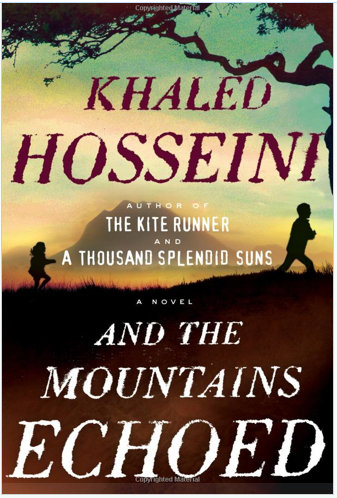
I danced when I saw the Amazon box; rarely do I buy hardcover (hurts too much when they fall over if I fall asleep reading, too bulky to carry on planes) but this one I was on the waiting list for, mail it as soon as it is published! Khaled Housseini, author of Kite Runner and A Thousand Splendid Suns has a new runaway best-seller; thanks to him I’ve just spent three days in Afghanistan, Paris and Los Angeles.
As the book opens, I am big brother to a baby sister whose Mom died in childbirth, living in a remote village in Afghanistan. Life is tough, but through the eyes of these children, life is idyllic, even though food is scarce and winters are cold. We have a huge oak tree with a swing, we play with the other children, and we have each other. Our father’s new wife is kind enough, but is busy with her own children, and the drudgery of cooking, cleaning and making do in a very small, poor Afghan village.
Later, I am Pari, living in Paris with an alcoholic, self-absorbed mother, making a life for myself, but always with a nagging feeling of something just outside my peripheral vision, another life . . .
The tale is told through the eyes of many, and on the way to the end of the tale we meet a wide spectrum of humanity, suffer the ills of war, callousness and unintended cruelties. We find that the man with superficial charm also saves and changes the lives of many, we find a doctor who finds fulfillment serving in the poorly resourced hospitals of Afghanistan, and we feel the agonies of a dutiful daughter watching her father fade into the world of Alzheimer’s.
It’s a wonderful, wild ride, richly textured, and when it finishes, you are not ready for it to end.
June 21, 2013
Posted by intlxpatr |
Adventure, Books, Bureaucracy, Character, Circle of Life and Death, Cross Cultural, Cultural, ExPat Life, Family Issues, Fiction, Living Conditions, Marriage, Mating Behavior, Paris, Political Issues, Relationships | Afghanistan |
4 Comments

I don’t know what it is about summer reading, but now and then I go on a theme-fest; a couple years ago it was Nigerian literature, and, once hooked . . . when my friend who is now living in Lagos recommended The Secret Lives of Baba Segi’s Wives, I ordered it right away, thinking from the title it would be maybe light and sweet and humorous.
From the start, that assumption was blown. This is a direct and edgy Nigeria, darker, rougher and full of family secrets, domestic details and messy relationships.
It is a very Nigerian book – this is a good thing. There are cultural things that are not explained, but it all ends up making sense in the end. There are foods I have never heard of – ekuro with shrimp sauce, asun. There is a rudeness in the way they speak to one another, (“Is this a parking lot?” “Do I look like a parking attendant?”), a crudeness in the constant need to carry small bills for bribes, even on public streets. People speak their minds, with little or no mitigation, depending on the status of the person and their own personal goals and agendas.
At the weekly meeting of wives, the senior wife, Iya Segi, doles out rations of household supplies to the other wives, including chocolate powder and hair conditioner . . . and as the senior wives complain about the new wife thrown in their midst, she says:
“You will trip over in your hate if you are not careful, woman. Your mouth discharges words like diarrhea. Let Bolanle draw on every skill she learned in her university! Let her employ every sparkle of youth! Let her use her fist-full breasts. Listen to me, this is not a world she knows. When she doesn’t find what she came looking for, she will go back to wherever she came from.”
There is a whole other world in that one paragraph – a whole other way of seeing life and expressing thoughts. The culture may be alien, but I thoroughly enjoyed being a tiny mouse in the corner at that meeting – and others – and inside the minds of the wives, of Baba Segi, of the driver – so many good stories, so many points of view, and I learned things from behind those high compound walls and closed and locked doors that I might never otherwise have learned. Alien as it was, for me, this was a very good book, new ways of looking at things, and a great recommendation from my friend in Lagos.
June 18, 2013
Posted by intlxpatr |
Africa, Books, Character, Circle of Life and Death, Civility, Community, Cross Cultural, Cultural, Customer Service, Family Issues, Living Conditions, Mating Behavior, Relationships, Values, Women's Issues | Nigeria |
Leave a comment
I don’t know that this has been studied closely, or that there is any evidence supporting the theory, but it is a hilarious theory – blame men for menopause!
By: Tia Ghose, LiveScience Staff Writer
Published: 06/13/2013 05:04 PM EDT on LiveScience
Ladies, here’s one more thing you can blame on men: menopause. At least, that’s according to a new theory.
Women go through menopause because men have consistently preferred younger women in recent evolutionary history, according to a study published today (June 13) in the journal PLOS Computational Biology.Thus, menopause is not evolutionarily advantageous and may be the result of a series of random, harmful mutations that accumulated in women but weren’t acted on by evolution because the women had already reproduced by the time the mutations affected them.
“Our first assumption is that mating in humans is not random with respect to age, which means men of all ages prefer to mate with younger women,” said study co-author Rama Singh, an evolutionary biologist at McMaster University in Canada. “If mating is with younger women, any deleterious mutations which affect women’s reproduction later in life will accumulate because they are not being acted on by natural selection.”
Menopausal mystery
Menopause, in which women stop menstruating and become infertile, has been a long-standing puzzle for biologists: Why would evolution have led to a trait that essentially reduces the reproductive potential of an animal?
Most other animals don’t go through menopause (although killer whales do). Even chimpanzees, humans’ closest living relatives, seem to reproduce into old age in the wild, and males even prefer older females.
Biologists have proposed the grandmother hypothesis to explain the conundrum. The hypothesis holds that menopause allows a grandmother who is done rearing her own kids to help rear the young of her children, thereby increasing the survival odds of her grandkids, and therefore, her genes.
But grandchildren and grandparents share just a quarter of their genes, versus half for children and their parents, so menopause would have to dramatically boost survival of grandchildren to be evolutionarily advantageous. Past studies have shown that maternal grandmothers boost their grandkids’ survival rates, though exactly how much depends on the society.
Younger women
For thousands of years (at least), men have, on average, mated with younger women, Singh said.
That’s because, if all else is equal, “those who reproduce earlier, their genes are passed on faster,” Singh told LiveScience.
So the researchers created a computer simulation to model that preference.
Early on, both men and women in the model reproduced until death. But over time, the model found, men’s preference for youth reduced older women’s odds of reproducing.
Simultaneously, people accumulated random mutations, some of which decreased later-life reproductive ability. But since older women were left out in the cold anyways, those mutations didn’t impact their reproductive success, whereas mutations in men that could reduce late-life reproduction were weeded out. (Men who stopped reproducing at some point in life would produce fewer offspring than those who didn’t, and the late reproducers would outcompete those who stopped breeding earlier.)
Over 50,000 to 100,000 years, the accumulation of all those mutations could have led to universal menopause, the researchers suggest. Menopause would then be another form of aging akin to graying hair or wrinkles.
If later childbearing becomes the norm, as current societal trends suggest, women who can reproduce at older ages might gain an evolutionary advantage, and menopause could, in theory be pushed later, Singh said.But it’s more plausible that technological changes such as fertility treatments will artificially extend women’s ability to reproduce, Singh said.
Questionable assumptions
But the new model might have the causation reversed, wrote Kristen Hawkes, an anthropologist at the University of Utah, who was not involved in the study, in an email to LiveScience.
As human life spans increased, women might have had many healthy years after fertility. As a result, men grew to prefer younger women because older women couldn’t reproduce.
Supporting that hypothesis, female chimpanzees see their egg reserves decline around the same age as human females, Hawkes noted. But unlike humans, they die shortly after this age, whereas humans have decades of healthy life left.
“The preference men have for young partners is a striking contrast with other primates,” Hawkes said. “My guess about that has been it’s a consequence of our life history.”
June 15, 2013
Posted by intlxpatr |
Aging, Circle of Life and Death, Family Issues, Generational, Health Issues, Mating Behavior, Parenting, Relationships, Statistics, Women's Issues | Fertility, menopause |
Leave a comment
We had a great weekend, and thank you for all your good wishes. 🙂
In spite of the storm warnings, Friday and Saturday were glorious beach days, and oh what fun we had in the pool with our son, his wife, and our grandson, who is becoming a real swimmer. Then, some time during the night, a storm really did blow in, lowering the temperatures, lowering the skies and creating the perfect opportunity to get back home to the Qateri Cat.
The sitting area in our room; around the corner was also a little kitchen 🙂




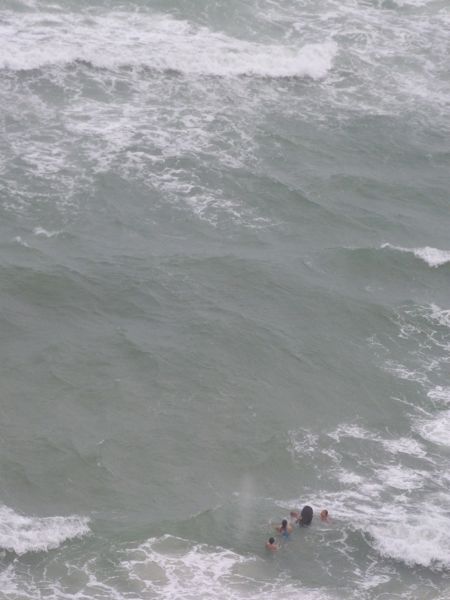
In contrast the the previous two days, this morning was cool and very very rainy and windy, a great day to head back home. There were people body surfing those waves!


Thank you, AdventureMan. After all these years, so many great times, so many adventures, and the fun continues. 🙂
June 10, 2013
Posted by intlxpatr |
Adventure, Beauty, Family Issues, Living Conditions, Marriage, Pensacola, Relationships, Sunsets |
2 Comments

This morning, driving to the commissary, about ten feet apart on the highway, I saw the smooshed bodies of three little kittens. They must have been about five or six weeks old. I felt sick; I still do. What kind of animal would throw little kittens out the window of a car to let them die in terror on a busy highway? Who raises these people who could act with such cruelty?
I am a believer; I believe God put each one of us here for a purpose. I think we often misunderstand some of God’s intentions; I think sometimes we get it very wrong. I fantasize that maybe these little cats and dogs we adopt are really our guardian angels, who will speak up for us on the last days and tell the Lord Jesus how we treated his little ones. Imagine the punishment for hurting a helpless animal! Imagine the penalty for hurting an innocent, defenseless child!
June 3, 2013
Posted by intlxpatr |
Circle of Life and Death, Crime, Family Issues, Florida, Living Conditions, Pensacola, Pets, Random Musings, Rants, Relationships, Spiritual, Survival, Values |
Leave a comment










 Here There and Everywhere