Hotel at the Corner of Bitter and Sweet by Jamie Ford
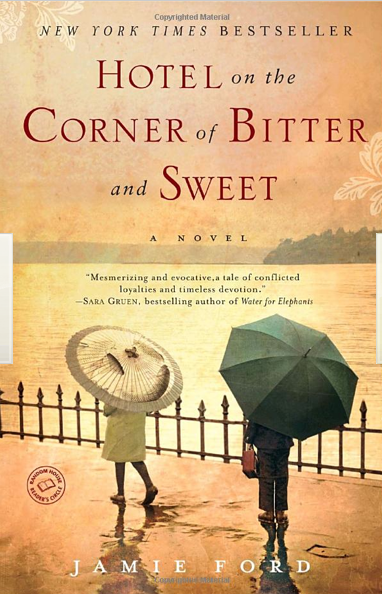
This book had everything going for it, and still I had a hard time getting into it. The book was given by Little Diamond to my Mom – Little Diamond often passes along the very best, thought-provoking books, and in our family we pass the best along, so I knew it would be good. I love the title. The book is set in a part of Seattle now called – euphemistically – The International District, but as I was growing up, and among older Seattle-ites, it is called Chinatown, even though that is not politically correct, or geographically correct. Chinatown was never Chinatown, it was a group of distinct populations – Chinese, Japanese, later Vietnamese, Korean, even later Ethiopian, Sudanese, Somali, Pakistan . . . you could call it immigrant-ville, I suppose, if you were really, really politically incorrect. My Chinese friends still call it Chinatown.
Last, but not least, Jamie Ford started this book as a short story at a camp run by Orson Scott Card, one of my favorite authors, especially to recommend to young people. Orson Scott Card knows how to capture the painful contradictions of being teens and young adults, the conflicts with parents, the loves, requited and un, and most of all, he understands how the young see things clearly as unfair; it’s only later when we start seeing shades of grey.
In spite of all those positives, I hated his voice. I hated the smug little Chinese boy he started as, a scholarship student, first generation born in the US, mocking his parents, fighting off bullies. . . Here is what I hated the most. He had a girlfriend, and he didn’t understand chivalry, like walking her home. He protected her, but he was a pretty self-absorbed little boy.
I kept reading because he had some interesting friends. I liked his friend the jazz player, and I liked the gruff lunchroom lady, and I liked his friend Keiko. I understood his parents pushing him to excel, and their not understanding the struggles this caused Henry; I liked his parents. Because the book jumps around in time, I also liked his wife, and felt annoyed that Henry was all caught up in this old romance when he had a perfectly good wife, but I kept reading.
I am so glad I did. About a third into the book, we begin to see Henry transform into the man he will become. He gets help, he gets mentoring from unexpected people, and he becomes more likable.
The book also deals with a terrible time in US history, a time when we turned on our own citizens and sent our citizens of Japanese descent to concentration camps right here in the USA. The Japanese were a class act; most of them were hurt and outraged, but compliant. Many men volunteered to fight in the war in spite of this slap in the face, this accusation of potential treason. It is a shameful time in our own history, and particularly so for Henry, who loves a Japanese girl, Keiko.
By the end, I loved this book. I hope you will, too.
Somalia’s al-Shabab bans mixed-sex handshakes
From BBC News
Somalia’s al-Shabab bans mixed-sex handshakes
SOMALIA – FAILED STATE
Men and women have been banned from shaking hands in a district of Somalia controlled by the Islamist group al-Shabab.
Under the ban imposed in the southern town of Jowhar, men and women who are not related are also barred from walking together or chatting in public.
It is the first time such social restrictions have been introduced.
The al-Shabab administration said those who disobeyed the new rules would be punished according to Sharia law.
The BBC’s Mohamed Moalimuu in Mogadishu says the penalty would probably be a public flogging.
The militant group has already banned music in areas that it controls, which include most of central and southern Somalia.
Somalia has not had a stable government since 1991.
The UN-backed government only controls parts of Mogadishu and a few other areas.
Shopping Styles: Predatory, Social or Desperation?
As AdventureMan once said, I am not entirely sure I agree with what I am about to say. Feel free to jump in.
Today I was mopping the floors, washing the floors and vacuuming the carpets. This is not – way not – something I like to do, but something I do because long ago somewhere in my tiny little brain, a seed was planted that a dirty floor was a shameful thing. I remember once thinking “people could eat off my floor; there must be a whole meal here!” when I left it unwashed for a few days. In my last three incarnations, in Kuwait and in Qatar, I was blessed with wonderful women who came in and took care of my floors for me, also the dusting, and the laundry, and the windows, and all the things I now do. It takes a surprising chunk of time out of my day. 😦
Oh! Yes. The shopping.
I just wanted you to know that I am not cleaning my house willingly or joyfully, but dutifully. I have discovered, however, that mindless physical activity frees the mind, and you never know where a free mind will go.
I have a friend coming to visit, and this friend and I have had so much fun together, through the years, exchanging books, going out on double dates with our husbands to wonderful places in France and Germany, and . . . shopping.
Finding a person who shops the way you do is a real blessing. I say I am not much of a shopper, but we all have to shop sometimes. Mostly, I shop alone, I am a predator. I am looking for specific game, and I want the juiciest prey at the best price. Most of my friends are like me – we don’t hunt in packs, because when you shop in packs a group mentality surfaces, and you get home with things you never would have bought.
I do shop with other solitary predators from time to time; this is how you know them. You don’t shop together. You shop the same stores, sometimes just the same mall, meeting up to compare items and to go on to the next stop. Most of my predatory shoppers friends know their own style, know their own preferences, and few ask me what I think, nor do I ask them. We do exclaim gleefully over our purchases.
In the military, in Germay, there would be shopping tours to take you to places. Sometimes I took them, most times I didn’t. It depended on whether or not you had to stay together. I saw people buy some truly appalling things because it had a particular name or a particularly low price. The fact that it was obviously inferior did not even seem to strike their consciousness, once the herd shopping mentality kicked in. If the tour were going to a village, and people were on their own and then met up, I would do that. I went to Paris on such a trip; leaving
Germany at midnight, leaving the tour at six in the morning for croissants and coffee at La Duree at its original location on Rue Royale arranging to meet up with them later.
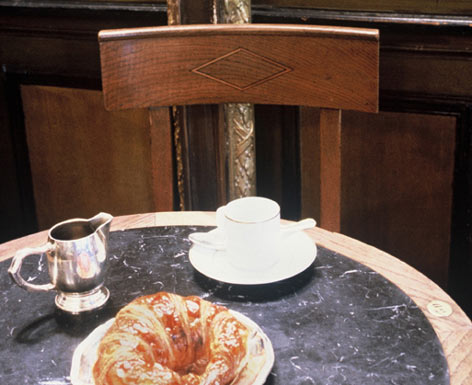
The Musee D’Orsay had just opened, and I was dying to see the exhibit. I spent the morning there, leaving as the hoardes started arriving, had a little lunch of Vietnamese salad rolls on the Left Bank, and strolled over the bridge to the shopping areas around Rue Royale. I found three great outfits at Galleries Lafayette, grabbed a salad from their gorgeous food court, and met up with my group at six to depart. I was home by midnight. 🙂 I would have liked a friend, but I didn’t know anyone, once again I was new, and Paris is so easy that just 12 hours there was a piece of cake.
Social shoppers find us solitary predators very strange. They live in a different world than we do. They consult. Their shopping goals are not so much the goods as the experience. They enjoy the company, and they like having someone to help them make their purchasing decisions. They often meet up for shopping and lunch, and some even shop to kill time. (What luxury! In my whole life, I have never had time to kill; I always have projects, and lists of things that need doing!)
I have been one other kind of shopper, though, and that is a desperation shopper. It was when I was a young mother. Shopping was for survival. I never knew when the baby would start to cry, need to be nursed, or need a change. When I had a babysitter, I was always aware of how little time I had and how much I had to get done. Once a month, I would go to the commissary, about twenty miles away, to buy a month’s worth of diapers, meat (we ate more meat then), canned goods and paper goods.
I see the same desperation in the elderly here in Florida; shopping takes energy and you never know when your energy will desert you. As you can see, I am still thinking about my experience at the Navy Commissary, and I now I can empathize. I might be grumpy and aggressive, too, when I reach a stage where I remember having energy, and now I don’t know where it has gone. I may even scowl at cheerful, energetic people because I wish I still were . . .
We’re all wired so differently. There may be some shopping styles to which I am oblivious. Can you think of any?
The King’s Speech
“The movie is sold out!” my friend exclaimed as she and her husband joined me in the theater. We had really good seats. I had accidentally managed to get there early enough to get seats right in the center, close enough, but not too close. People looked at the seats I was saving for my friend and her husband with envy, and it was all I could do not to make a sign against the ‘evil eye.’ 🙂

Whoda thunk? Who would have thought a movie about an English king with a speech problem would sell out the entire theatre?
Must be word of mouth. The film is really, really good, and takes a personal tragedy and turns it into an inspiration. You wouldn’t think there could be anything funny about tackling such a problem, but the movie has some very very funny moments – the king, George VI, actually CAN speak without a stammer when he is swearing, when he is singing, or when he is very very angry.
His unorthodox speech tutor gives the King a new vision of himself, and helps him find insights into how the problem developed. There are some very moving moments, and some highly inspiring ones, too. All in all, the movie keeps moving, keeps you informed and makes you glad you spent the money on movie tickets.
Marriage Myths
Found this today on AOL News: 10 Myths About Marriage – Marlo Thomas and found it to be full of wisdom.
Marriage is hard. We probably need all those myths (and estrogen and testosterone) or we would never get married, and the human race might fizzle! It helps to know that no matter what a marriage looks like on the outside, on the inside, each and every marriage has its own struggles.
Our moms passed down a lot of old “rules” about marriage. But ask anyone who’s been there and she’ll probably tell you that some of them just don’t apply to her marriage… me included. So I asked relationship expert Dr. Dale Atkins what she thinks about those bits of marital conventional wisdom. Read what she had to say – it turns out the knight in shining armor isn’t the only marriage myth!
Hi Marlo, and thanks for asking about the “rules” of marriage, or, as I call them, the myths! Really, so many of them are just that – they raise unrealistic expectations and can lead to disappointment and frustration.
I encounter people in my practice who think that a good marriage is built on romantic love and luck. One woman recently told me that she thinks a couple shouldn’t have to work at marriage if they are truly in love. The reality is that most successful marriages are built on commitment, respect, and companionship – and, of course, a shared history and a desire to support each other.
Coming to a better understanding of each other is the real key to a successful marriage. Now, let’s debunk some of those marriage myths:
MYTH #1: Your spouse is your other half, and now you are complete.
REALITY: A healthy person is complete in herself. Couples don’t complete each other, they complement each other (and they need to compliment each other, too!)
MYTH #2: Marriage is filled with romance and love.
REALITY: It is – but it’s also filled with anger and frustration, disappointment and confusion. It’s filled with lots of emotions, and couples should expect to experience peaks and valleys. The everyday problems and challenges of married life can often obscure romantic, loving, tender feelings, which is why couples need to remember the commitment that’s at the core of their marriage and realize there are full times and empty times.
MYTH #3: Your marriage should make you happy.
REALITY: You need to make yourself happy! Your spouse is not your source of happiness – that must come from within yourself. Marriage can and should augment a person’s individual happiness, but it’s not what makes you happy.
MYTH #4: You should never go to bed angry.
REALITY: That’s unrealistic – there are times you will go to bed with an unresolved issue, one that still has you fired up at day’s end. It’s not great to be lying next to someone while seething in anger, but it does happen. The best strategy is to table things so you don’t feel like you want to murder him! Remind yourself of all the positive things about him; ideally, you’ll have a fresh eye in the morning. By the way, one of you sleeping on the couch for a night is not the end of the world if you need time to think. If that one night turns into days or weeks at a time, that’s a problem. But taking a break for a night to have a calmer conversation the next day just might be more productive.
MYTH #5: A baby will bring you closer.
REALITY: Parenting together is a wonderfully intimate experience that can indeed make a couple feel closer. But it’s so hard on the body, mind, and emotions! New parents are exhausted and constantly questioning whether they are doing things right. Often the woman feels she is doing waaay more than her fair share and is resentful and disappointed in her partner. Then there are the hormones – a woman’s body goes nuts during and after pregnancy! A couple would be wise to recognize that these are all just normal feelings after having a child, and they shouldn’t feel let down that they’re not head-over-heels in love with each other: Take a deep breath, reserve some baby-free time for one another, and know that this is simply a new stage in your long-term relationship.
MYTH #6: Your husband should be your best friend.
REALITY: If you think this way, you’ll be in for a big disappointment. Over the years, you definitely develop an amazing friendship with your spouse. But it doesn’t necessarily start off that way, and it doesn’t replace the need for friends in your life. A best friend is someone you go to the movies with, someone you have a lot in common with, someone you can talk to. A spouse is the one you can go through life with, depend on forever – that takes time, so don’t expect to be girlfriend-close with him right away. And you may not tell him everything – for some things you want a friend’s help. It doesn’t mean you are not close to your spouse.
MYTH #7: You shouldn’t fight in front of the kids.
REALITY: If you don’t teach your children how to disagree respectfully, who will? I feel strongly about this – it can be frightening for children to observe parents going at it, but it’s instructive for them to see you work out differences in a civil manner. Most people don’t fight fair – they call each other names and diminish each other. Children don’t know what to do and they mimic it – and then what have you accomplished? If you fight fair in front of the kids, then make up in front of them, they’ll see that this is a process. You have a responsibility to teach your children how to interact with others in both good times and difficult ones. As a bonus, if you learn how to fight civilly, you’ll probably fight less – you’ll learn how to come to solutions rather than argue.
MYTH #8: You shouldn’t worry if you’re not having sex.
REALITY: It’s true that people can be so busy, and so tired, that sex becomes just one more thing they have to do. Sometimes in every relationship the couple’s sex life goes on hold for a while. And every couple is different – some make love a lot, some less. But most people who have really good marriages do have a sex life. So if you’re not having sex, it is something to examine. The frequency and intensity may change as you get older, but you still need to get what you need. You don’t want to fall into a boring pattern in which you are no longer interested in your mate or want to share your life with him.
MYTH #9: Your spouse should know what you need without your having to say it.
REALITY: Nobody is a mind reader, and it’s unrealistic (and unkind) to expect someone to know your every thought and feeling. It is imperative to communicate what is going on regarding your thoughts, feelings, and your needs.
MYTH #10: You shouldn’t take your spouse for granted.
REALITY: Well, this is partially true – you don’t want to treat each other like old shoes! But you should be able to take certain things for granted – that’s what trust is all about. After all, if you can’t rely on your spouse, who can you rely on? Just remember that it works both ways: If you want to let your guard down and walk around in sweats, that’s okay – you can take for granted that he’ll still think you’re beautiful. But be sure to keep that in mind when you see him in the dirty T-shirt!
Dale V. Atkins, PhD, has more than 25 years of expertise as a relationship specialist helping couples and families. She runs a private practice in New York City.
“I’m The Present!”
As we were puffing away in one of the partners-exercises in Water Aerobics, my friend mentioned he would be heading up to Atlanta for the next couple weeks to visit children and grandchildren.
“Are you driving?” I asked between huffing and puffing.
“Nope, flying.” His answers were a lot shorter.
“You taking presents?” I asked, trying to keep my mind off my aching limbs.
“I AM the present!” he responded, and we both laughed.
When I was a kid, my favorite present was getting the small wrapped hotel soaps my Dad would bring back from his trips. To this day, I still like soaps!
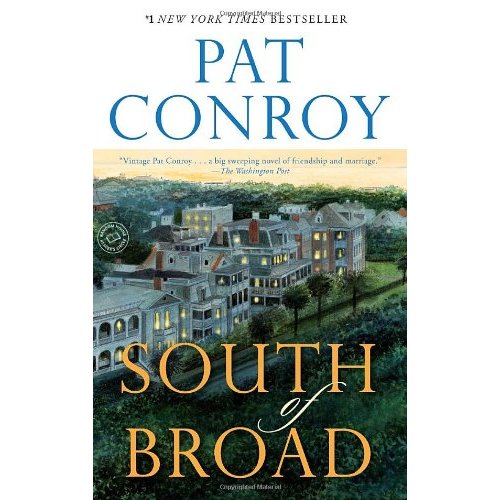
Pat Conroy and South of Broad
I don’t know where to start, telling you how much I like this book. I couldn’t wait for reading time to read it. It never flagged, every page kept me glued. I want you to read it, I want to be able to talk about it with you, but there is so much in this book that I don’t want to spoil it for you.
There are huge themes. There are some very bad people. There are some very good people. Sometimes the very good people can do very bad things, and sometimes the bad people can have some redeeming moments.
We meet the main character as he is about to begin his senior year in college. On the day we meet him, his life changes. Several new people come into his life. Two orphans. A beautiful sister and equally beautiful brother. A black football coach and his son. Three rich kids kicked out of the best private school in town for doing dope.
There are two ‘characters’ who are not people. One is the city of Charleston, SC, and there are entire paragraphs in this book which will make you fall in love, through Pat Conroy’s eyes, with this complicated, beautiful city. Another is Hurricane Hugo, which is as destructive as Charleston is beautiful.
South of Broad covers a time of tumult and change, and you see it through the eyes of of Conroy’s endearing characters. Times changes, society changes and change comes hard for those who stand to lose the most. Conroy deals with segregation, integration, child abuse, suicide, gay sex, economic discrimination, and psychiatric illness, a psycopathic criminal, who happens to be the father of two of this friends, and a hurricane.
For me, what was most engrossing was the complicated question of who is righteous? It’s what I want to talk about with you. Who is most like Jesus? (LOL, give examples) Which characters would you expect think themselves closest to God? Do you think they are? (Be prepared to defend your opinion.) What is a good parent? In this book, who do you think was the best parent?
If you decide to buy this book, please buy a copy with the Reader’s Guide in the back – an interview with Pat Conroy and questions that help you think about the book. I’d like to share with you a segment of the interview which I found so brightly illuminating:
. . . . I found the Parisians rarified, vigilant, hypercritical and fabulous. They had made themselves worthy of the great city they lived in. They oozed style and they ate like kings. . . . The Parisians seem special to both the world and themselves. Then it hit me: My God, they are like Charlestonians.
As I see it, you can take out Charlestonians and substitute Kuwaitis. Or New Yorkers. Or Romans. In fact, just about every society I have visited have their elite, who consider themselves rarified and special, and fight to keep themselves so.
So not only is the book dealing with spiritual righteousness, but also with themes of entitlement and deprivation, bullies and the bullied, parenting, self-fulfillment, and the very real and over-arching theme of friendship and the power of a close circle of friends.
I don’t want to tell you too much. I loved this book. I’m still thinking about it. I hope you’ll read it and think about it, too, and then come back and tell me what you’re thinking. 🙂
“Why Are Barns Painted Red?”
This is what I love about long road trips with AdventureMan. We have hours together in the car, and you just never know where the conversations will go.
We saw a lot of barns. Most of them are red.

“Why are barns red?” AdventureMan asked. “Like we just accept that barns are red, when we are kids and we are told to draw a barn, we reach for the red crayon, why is that? Why red?”
So we looked it up at the next wireless stop and found the answer on Wiki answers:
Centuries ago, European farmers would seal the wood on their barns with an oil, often linseed oil — a tawny-colored oil derived from the seed of the flax plant. They would paint their barns with a linseed-oil mixture, often consisting of additions such as milk and lime. The combination produced a long-lasting paint that dried and hardened quickly. (Today, linseed oil is sold in most home-improvement stores as a wood sealant).
Now, where does the red come from?
In historically accurate terms, “barn red” is not the bright, fire-engine red that we often see today, but more of a burnt-orange red.
Farmers added ferrous oxide, otherwise known as rust, to the oil mixture. Rust was plentiful on farms and is a poison to many fungi, including mold and moss, which were known to grown on barns. These fungi would trap moisture in the wood, increasing decay.
Regardless of how the farmer tinted his paint, having a red barn became a fashionable thing. They were a sharp contrast to the traditional white farmhouse.
As European settlers crossed over to America, they brought with them the tradition of red barns. In the mid to late 1800s, as paints began to be produced with chemical pigments, red paint was the most inexpensive to buy. Red was the color of favor until whitewash became cheaper, at which point white barns began to spring up.
Today, the color of barns can vary, often depending on how the barns are used.
My dad and grandpa have been farmers their entire lives and they used to tease us kids that the barn was red because it was the most noticeable when the snow was falling sideways and you could barely see because of the sleet and hail.
Just How Emirati Do You Have to Be? (Mixed Marriages)
Thank you, Little Diamond, for sending the article from The National. I totally love this article, and hats off to it’s author, Sultan Al Qassemi.
Mixed marriages bring strength upon strength to the UAE
Sultan Al Qassemi
Not too long ago, I boarded a plane in Dubai bound for the United States. There were a number of Emirati families on board, some of whom I recognised and greeted. After a 14-hour direct flight, we descended from the plane and made our way to passport control.
One Emirati family walked towards the line for US citizens and, in my naivety, I almost told them they were standing in the wrong queue. I hesitated, correctly it turned out. They were American citizens and obliged to stand in the US citizens section.
Many people who hear this story immediately assume that the mother was a foreigner. Not only is that incorrect – the mother is a true-blue Emirati – but she also works in the UAE government.
In the past week, I was reminded of this by an article in The National relating to mixed parentage. The Grand Mufti of Dubai, Dr Ahmed al Haddad, made controversial comments questioning whether there should be restrictions on Emiratis marrying outside their nationality.
In truth,a substantial number of talented Emiratis have been born to mixed marriages, a point that Dr al Haddad’s comments did not seem to take into consideration. According to one person who was present at the panel discussion, Emiratis from mixed marriages may have “mixed loyalties”. So are they Emirati enough?
Well, let us take a look at some of these Emiratis to find out. Ali Mostafa, the director behind City of Life, is the product of a mixed marriage. City of Life, which depicts contemporary life in Dubai in a powerful and realistic fashion, has become an international ambassador for the UAE after opening in Australia and Canada with a screening scheduled in Washington DC. Is its director Emirati enough?
Omar Saif Ghobash and Yousef al Otaiba, the UAE ambassadors to Russia and the United States respectively, both have foreign-born mothers and yet they serve the UAE with as much attention and dedication as any other Emirati ambassador. I have written before about how Mr al Otaiba has worked tirelessly on behalf of the country, in particular on the nuclear 123 agreement with the United States. Mr Ghobash speaks six languages and was heavily involved in bringing New York University to the UAE’s capital. Are they Emirati enough?
Razan al Mubarak is also a product of a mixed marriage. Her late father, like Ambassador Ghobash’s, gave his life for the country. Ms al Mubarak, in her roles as assistant secretary general of the Environment Agency – Abu Dhabi and managing director of the Emirates Wildlife Society, is busy protecting the country’s wildlife on both land and sea. Is she Emirati enough?
At Abu Dhabi’s strategic investment arm Mubadala, the chief operations officer, Waleed al Mokarrab al Muhairi, also happens to be chairman of Yahsat, Advance Technology Investment Company and Cleveland Clinic Abu Dhabi. But perhaps most importantly, he is credited with being “one of the principal architects behind the Abu Dhabi 2030 Economic vision”. And yes, Mr al Mokarrab comes from a mixed family.
Wael Al Sayegh is a writer, poet, translator and founder of the consultancy firm Al Ghaf, which delivers “inter-cultural induction programmes to multinational organisations serving the region”. Mr Al Sayegh has spoken to many multinational corporations about UAE culture and offered a Dubai perspective to foreign news outlets, including the BBC, during recent high-profile criminal cases. Is he Emirati enough?
Sarah Shaw, an Emirati whose biological father is English, currently works at the General Secretariat of the Abu Dhabi Executive Council and is a huge supporter of Emiratisation. Is she Emirati enough?
Other Emiratis from mixed families who have made substantial contributions include the director general of the Dubai World Trade Centre, Helal Saeed al Marri, the film director Nawaf Janahi and the columnist Mishaal al Gergawi, among many others.
There are examples in my immediate circle of Emirati friends who genuinely care about this country, not despite one of their parents being foreign born but perhaps because of it.
Should the UAE, and specifically Dubai, known for being hospitable and welcoming to people of all ethnicities, backgrounds and cultures, make our very own citizens feel unwelcome?
The truth is the UAE is a richer country because of these individuals of mixed backgrounds. What we should concentrate on is strengthening the ties that people have to this great nation. I have previously suggested military service for Emirati high school graduates, cultural immersion and social volunteering as ways to build civic participation.
Frankly, it would be insulting to question the loyalty of Emiratis who are born to a foreign parent. It is also unfair, un-Islamic and ultimately in this case un-Emirati to generalise about people of any background. The Emirates is a vibrant country of many colours – only seeing a single shade excludes too many of its strengths.
(The author, Sultan Sooud Al Qassemi is a non-resident fellow at the Dubai School of Government)
Why People Give
An urgent message came out today asking us to help the homeless people in Pensacola – and there are a lot of them, thanks to the warm climate. With all the rain recently, sleeping rough has been doubly rough, and it has been made worse by a sudden humidity-moisture related surge in the mosquito population.
As I talked with AdventureMan about our donation, he laughed. I was in fund-raising for a while, and was unexpectedly good at it. One thing I learned, there are a lot of ways to persuade people to donate, and then again, sometimes people will donate and you haven’t a clue as to why they felt this urge to be generous.
AdventureMan laughed; he totally got it. I used to work with a homeless, a long time ago, so I have a soft spot where they are concerned. Mosquitos also love me, and I get these horrid great but huge itchy bumps any time I am anywhere near a mosquito, AdventureMan always says he keeps me nearby because they head straight for me and ignore him.

Of course we donated. Wet homeless people and mosquitos, it was a golden combination. If you would like to donate, too, you can, through the EscaRosa Coalition on the Homeless (Working to Eliminate Homelessness). They will hold an Annual Fundraiser on Saturday September 11th from 7pm – 11pm at The Garden Center.
Recent Comments
ExpatAlien on What Country am I Living … intlxpatr on Yellowstone: Old Faithful to C… Michelle on Yellowstone: Old Faithful to C… Cathy on No Grown-Ups in Charge intlxpatr on Waiting for Snow Wikipedia Donate Button

Amazina


Early Voting in Florida


 Here There and Everywhere