Ramadan Mubarak 2009

(image from Islam101/Ramadan)
Greetings and best wishes from AdventureMan and me to all of our Muslim friends, fasting and purifying themselves during the Muslim month of Ramadan. May your fasting and your prayers bless you abundantly, and may the month build your spiritual wholeness in every good way.
Friday, during our church service, our priest asked the congregation if any of us had literature explaining why the Muslim God was not the same as the Christian God. We all looked at him in shock. Not one person raised his or her hands.
Then he smiled, a great big broad grin and said “Good! There is only one God, and our Moslem brothers and sisters worship the same one-God we do.”
His sermon was on one of the “hard teachings” of Jesus, teachings even those closest to him had trouble understanding. That there are not exceptions to the rules, that the rules apply across the board, to us all, to all creatures God created. When the Jews, the chosen ones, rejected Jesus, they had allowed a focus on the laws to take the place of the spirit of the law – that we love God, and that as a part of loving God, we serve him by loving and serving one another, regardless of divisions, of denominations or sects.
May all the blessings of the true spirit of Ramadan be yours, my brothers and sisters.
(Yes, Purg, you ARE my brother. 🙂 )
Maggie O’Farrell and The Vanishing Act of Esme Lennox
Maggie O’Farrel’s The Vanishing Act of Esme Lennox is also a book club pick, but oh, what a pick! I remember somewhere reading a review; I might never have picked this book up if I hadn’t needed to read it for the club. And oh, what I might have missed!

It’s like the scariest book ever written, scary in a Margaret Atwood kind of way, a reminder that women have not had rights for very long, and that those rights are still very fragile. When economies go bottoms-up, when unemployment begins rising, women are often the first to suffer, and women’s rights the first to go. In hard times, men will be preferred hirings, because they have families to support, laws to “protect” women are passed, especially laws which “protect” her finances, meaning gives the power of the money management to some man to do for her, or “protect” her person by requiring that some man accompany her to keep her from dangers. Protection = control. It keeps some smart, thinking women submissive to men who are in every way their inferior.
In Vanishing, Maggie O’Farrel writes of such a woman, Esme Lennox, who is a fey spirit, born in India, with the eyes of an artist. While her “good” sister Kitty obeys the rules, walks the straight and narrow path, Esme is messier. As she grows to adolescence, her eccentricity and her rebellion against the constricts of the life in turn-of-the-century Scotland chafe, she yearns for more room to breathe, intellectually, socially, as her family, her community and her society continues to pressure her to conform.
One of the key events in the book is the death of Esme’s baby brother, of typhoid fever. Abandoned, Esme sits holding her dead brother’s body for three days until her family returns (the baby-keeper also died and the other employees deserted while Esme’s family was away). Esme is devastated, but the focus is on her mother, who is wrought with guilt and isolates herself, and Esme, only a little girl, is forbidden to even say her beloved baby brother’s name. Part of what plays a huge role in this book is society, expectations, and all that is hidden and unspoken – as Esme becomes, a family secret, locked away for sixty years.
Their grandmother swept into the room ‘Kitty,’ there was an unaccustomed smile on her face, ‘stir yourself. You have a visitor.’
Kitty put down her needle. ‘Who?’
Their mother appeared behind the grandmother. ‘Kitty,’ she said ‘quickly put that away. He’s here, he’s downstairs . . . ‘
. . . .
Esme watched from the window-seat as her mother started fiddling with Kitty’s hari, tucking it behind her ears, then releasing it. . . . . Ishbel turned and, catching sight of Esme at the window, said ‘You, too. Quickly now.’
Esme took the stairs slowly. She had no desire to meet one of Kitty’s suitors. They all seemed the same to her – nervous men with over-combed hair, scrubbed hands and pressed shirts. They came and drank tea, and she and Kitty were expected to talk to them while their mother sat like an umpire in a chair across the room. The whole thing made Esme want to burst into honesty, to say, let’s forget this charade, do you want to marry her or not?
She dawdled on the landing, looking at a grim, grey-skied watercolour of the Fife coast. But her grandmother appeared in the hall below. ‘Esme!’ she hissed, and Esme clattered down the stairs.
In the drawing room, she plumped down in a chair with high arms in the corner. She wound her ankles round its polished legs and eyed the suitor. The same as ever. Perhaps a little more good-looking than some of the others. Blond hair, an arrogant forehead, fastidious cuffs. He was asking Ishbel something about the roses in a bowl on the table. Esme had to repress the urge to roll her eyes. Kitty was sitting bolt upright on the sofa, pouring tea into a cup, a blush creeping up her neck.
Esme began playing the game she often played with herself at times like this, looking over the room and working out how she might get round it without touching the floor. She could climb from the sofa to the low table and, from there, to the fender stool. Along that, and then –
She realized her mother was loooking at her, saying something.
‘What was that?” Esme said.
‘James was addressing you.’ her mother said, and the slight flare of her nostrils meant, Esme knew, that she’d better behave or there would be trouble later.
As with many inconvenient women, Esme ends up committed at a loony-bin, and sixty years later, is released into the custody of a grand-niece who never even knew Esme existed.
The thoughts, trials and escapades of three women, Esme, her sister Kitty, and Iris, the grand-niece, intertwine through out the book, and the picture is cloudy at first, blurry, shifting, fragmented The pattern becomes more and more clear as the three threads of thought are woven – ever more tightly – together.
I could not put this book down. Finding out how the picture came together became more important than checking my messages, my blog, or fixing dinner. It was compelling, and resulted in a quick and unforgettable read.
Kuwait Wedding Fire: Did Bride Survive?
AOL News is carrying this report, saying “it is unclear whether the bride survived.” I know I read in the Kuwait Times yesterday that the bride did survive, but her mother and sister did not. Which is true?
Fatal Wedding Fire Called Criminal Act
Kuwaiti Newspaper Says Groom’s Angry Ex-Wife Started Deadly Blaze
By DIANA ELIAS, AP
KUWAIT CITY (Aug. 17) – Kuwaiti authorities have apprehended the person suspected of setting fire to a wedding tent and killing 41 people and said Monday the motive was personal. Local newspapers reported the groom’s ex-wife was the arsonist.
The inferno Saturday night in the tribal area of al-Jahra, west of Kuwait City, ate up the women’s tent in just three minutes and left behind bodies so charred they were unrecognizable. Guests likely crushed one another in a desperate attempt to flee. It was still unclear if the bride had survived.
Kuwaiti authorities said Monday that a deadly wedding tent blaze was set by someone for personal reasons. Local newspapers identified the suspect as the groom’s ex-wife. The intense fire, which lasted only three minutes, killed 41 women and children. Fifty-two others were hospitalized. Here, burnt debris litters the area in Kuwait City.
‘A Horrific Scene’
Kuwaiti officials said 41 women and children died when a fire broke out at a wedding party in Kuwait City on Saturday. The deadly inferno lasted just three minutes. Authorities said 58 injured were still in hospitals, including seven people in serious condition with severe burns. Here, burnt debris litters the area.
The alleged arsonist has been identified and “confessed to committing the crime for personal reasons,” Interior Ministry spokesman Col. Mohammed al-Saber told state-owned Kuwait television.
Al-Saber’s statement made no reference to an ex-wife, and he did not answer telephone calls seeking comment Monday. But Kuwaiti newspapers speculated on the cause of the fire, saying that the groom’s former wife was to blame. The headline in the English-language Kuwait Times was “‘Scorned’ Woman Unleashed Fury.”
The independent Al-Qabas daily said the groom’s former wife, who is 23 years old, poured gasoline on the tent and lit it because she felt her ex-husband mistreated her when they were married.
A statement Monday from the Interior Ministry carried by the Kuwait News Agency said the perpetrator was in custody, but no name or details were given.
The “final and exact” death toll discussed in a high-level security meeting Monday was 41, said Kuwaiti Fire Department chief, Brig. Gen. Jassem al-Mansouri. Earlier reports Monday had raised the death toll to 43 after two people died overnight from burns. But al-Mansouri said after further investigation authorities determined that only 39 people died during the initial blaze. He said the bodies were so badly burned, it was difficult for investigators to determine how many people perished.
The chief, who described the fire as the worst disaster he’s seen in almost four decades of service, said 6 bodies were still unidentified and it was not known if the bride survived the carnage.
You can read this entire account by clicking HERE.
Written Communication, Plusses and Minuses
I was e-mailing back and forth this morning with a dear friend who is traveling. She was about to visit an old school friend, and before visiting, dug out all the letters she had received from the friend – an enormous collection – and read through them all. She said it was a very moving experience, and I could tell that even before visiting her friend, she was feeling close from having read all those letters.
When was the last time you got a letter?
I have some letters my husband has written, saved away. 🙂 Most of my written communications these days are done by e-mail, instant-message, or texting. I used to have files of e-mails, but as they grew bigger and bigger, I sort of stopped saving them, except for important ones, or business-related ones.
These blogs are also written communication, but more like books, less personal and you never really know who is reading on any given day, and who isn’t, so like it is not the most reliable way to communicate something important, especially to one person or a small group of people; e-mail just makes more sense. Or picking up the telephone, which I don’t do all that often as I am not so much of a telephone person and many people I would call are in different time zones.
But it makes me wonder what record we will have of these times? I told my friend when I was in college, I worked part time in the university xerox department, and most things in the Northwest Collection came to me. I could read them as I copied them – diaries, letters, to-do lists, shopping lists – ephemeral things, but written on paper, and they give us a tiny peephole into the daily lives of people who lived a couple hundred years ago.
Think of your life, and how things have changed, even if you are in your twenties. Two hundred years from now, people will have so many questions about our lives, how we lived, why we did the things we did. With fewer lasting pieces of paper, will the record be so complete?
Think of our electronic storage devices – remember floppy disks? My computer wouldn’t even be able to read a floppy disk! Think of the tiny little USB devices we are saving onto now – how long will that technology last? In another generation, it will be as opaque and accessible as the ancient inscribes stones buried in the deserts.
As we go more and more paperless, how are we saving the ephemera?
As I upload a couple years worth of photos to be printed, I think of the scrap booking craze, how you take a few photos and decorate all around them, but do the resulting albums give you truth, or do they give you a fantasy of the truth?
I think of the photographs from a hundred years ago – people with somber faces. Serious faces. No one ever smiled for the photos. There are photos of my earliest relatives in Seattle, they are truly a grim looking bunch, I think it was the style then, and I have a feeling that they didn’t look like that most of the time; our family culture is pretty jokey. So I am also wondering about family lore, family history and realities. Like most of us expunge the photos of us that are unflattering – and destroy letters we would never want anyone to read. In so doing, we don’t change the real history, but we do change the transmission of history! Much of what gets transmitted ends up being censored, by us!
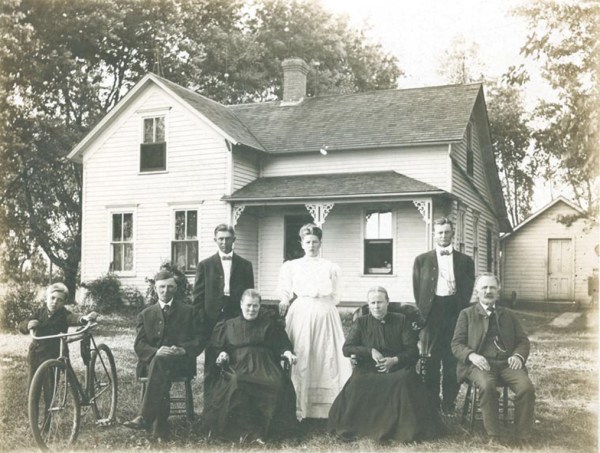
(This is not my family, just a photo from the early 1900’s from rootsweb.ancestry.com)
For years, I have taken my photos and put them in books – and they are heavy. But we actually take them out and look at the photos from time to time, whereas now, most of my photos are stored on the computer, and rarely do I take the time to upload them to be printed. I wonder what the photographic record will be, if there will be a downturn in photos showing what was going on because so few are printed in a relatively lasting format.
I have so much on the internet – photos, writing, etc. What is something happens to the internet. I haven’t even been saving back ups of the blogs. I used to, like the first six months, but, frankly, so much of it is trivial that I stopped backing it up. And if I lost everything, would it be a tragedy – or a huge relief? I think of friends who have lived through terrible events and who live their lives more lightly now – fewer purchases, fewer emotional turmoils – going through something horrible can truly streamline your life.
I guess I am just babbling.
Whoda Thunk? People Get Happier as they Age
I never dreamed it when I was younger. Who would want to be OLD? Having nice tight little bodies is fun, right? Even if you have to pay the price of worrying all the time about maintainence, LOL!
As it turns out, people get happier as they get older. Whoda thunk it?
People ‘get happier as they age’
From BBC Health News
Older people appear better able to control their emotions
Most people get happier as they grow older, studies on people aged up to their mid-90s suggest.
Despite worries about ill health, income, changes in social status and bereavements, later life tends to be a golden age, according to psychologists.
They found older adults generally make the best of the time they have left and have learned to avoid situations that make them feel sad or stressed.
The young should do the same, they told the American Psychological Association.
Ageing society
The UK is an ageing nation – in less than 25 years, one in four people in the UK will be over 65 and the number of over-85s will have doubled.
And it is expected there will be 30,000 people aged over 100 by the year 2030.
According to University of California psychologist Dr Susan Turk Charles, this should make the UK a happier society.
By reviewing the available studies on emotions and ageing she found that mental wellbeing generally improved with age, except for people with dementia-related ill health.
Work carried out by Dr Laura Carstensen, a psychology professor at Stanford University, suggested why this might be the case.
Dr Carstensen asked volunteers ranging in age from 18 to mid-90s to take part in various experiments and keep diaries of their emotional state.
She found the older people were far less likely than the younger to experience persistent negative moods and were more resilient to hearing personal criticism.
They were also much better at controlling and balancing their emotions – a skill that appeared to improve the older they became.
TIPS FOR A HAPPY OLD AGE
Envisage ways to thoroughly enjoy the years ahead and imagine living to a healthy and happy 100
Design your life and daily routines to reinforce this goal
Don’t put all your “social” eggs in one basket – invest time outside of your family and career too
Dr Charles explained: “Based on work by Carstensen and her colleagues, we know that older people are increasingly aware that the time they have left in life is growing shorter.
“They want to make the best of it so they avoid engaging in situations that will make them unhappy.
“They have also had more time to learn and understand the intentions of others which helps them to avoid these stressful situations.”
Dr Carstensen said the young would do well to start preparing for their old age now.
This includes adopting a healthy daily routine and ensuring some social investment is spent outside of the workplace and family home.
Andrew Harrop, head of public policy at Age Concern and Help the Aged, said the findings were encouraging.
“For many people, older age and later life is often looked upon with dread and worry.
“Far too many younger people assume that getting older is a process that will inevitably mean sickness, frailty and lack of mobility and greater dependence. However, this is far from the truth in very many cases.
“Many older people lead active, healthy lives enriched by experience and learning.
“This positive advantage can be brought to bear across so many aspects of daily life which – in turn – hugely benefits our ageing society.
“It’s vital that there is growing acceptance that just because someone is getting older, it doesn’t mean they no longer have a significant contribution to make.
“This study is one of many which shows that later life can be a enormously positive experience.”
China Trusts Prostitutes More than Chinese Politicians
LLLOOOLLLL, thank you, BBC News for livening up the deadly August news scene:
China ‘trusts prostitutes more’
China’s prostitutes are better-trusted than its politicians and scientists, according to an online survey published by Insight China magazine.
The survey found that 7.9% of respondents considered sex workers to be trustworthy, placing them third behind farmers and religious workers.
“A list like this is at the same time surprising and embarrassing,” said an editorial in the state-run China Daily.
Politicians were far down the list, closer to scientists and teachers.
Insight China polled 3,376 Chinese citizens in June and July this year.
“The sex workers’ unexpected prominence on this list of honour… is indeed unusual,” said the China Daily editorial.
“At least [the scientists and officials] have not slid into the least credible category which consists of real estate developers, secretaries, agents, entertainers and directors,” the editorial said.
Soldiers came in fourth place.
I can’t help but wonder how the same survey would result in other countries?
“Lord, Please Don’t Let Me Grow Up to Be a Dirty Old Man”
“So,” said AdventureMan, sitting down with me to eat a pizza after an unusually disrupted Friday, our day off, “tell me more about King David. Like wasn’t he the one who killed Goliath?”
He is asking, because the sermon at our church this morning was like eight sermons in one sermon. While the priest stuck close to the gospel and readings, he made so many good points that we had already discussed with our friend over breakfast, but there were still so many to discuss.
“Yeh, King David is problematic, once you get to be a grown-up,” I started. We have to start with the Israelis arrival in the promised land.”
“Israelites.” He corrected me.
“Yes. Them. They wanted a king. God said ‘no’ that they didn’t need a king, but they kept whining that all the other peoples had a king and they wanted one, too.”
(Please keep in mind, I am not a theologian, and this is my summary, as best as I can figure it out, so you can argue with me, I am no expert, but I DO read scripture.)
“They kept begging for a king, and I am guessing it annoyed God so much that he gave them one. (Who knows what God is thinking?) The prophet Samuel annointed Saul, and Saul became king over all the tribes of Israelites, but he got in major trouble because he didn’t do what God told him to do.”
“What did he do?” AdventureMan is fascinated.
“He was supposed to kill ALL the males of the tribe he had conquered, but he didn’t. When Samuel confronted him, he argued, then he said he would go back and kill the ones he had promised God he would kill and he had promised these guys he would not kill them, but he went back and killed them anyway. He thought going back and doing what he was supposed to do would make it all right with God, but it didn’t.”
“Where does David come in?” AdventureMan asks.
“Samuel anoints David king, at God’s instruction, so for a while there are two kings of Israel.” I explain.
“Isn’t that the one where Samuel looks at all the sons and doesn’t see the one who is supposed to be king?” AdventureMan asks. (Good! He was listening in Sunday school!)
“Yep. God told him none of the sons he saw was the one, so he asked the father if he didn’t have any other sons and he sent for David, who was out taking care of the sheep in the fields, and God said ‘that’s the one.
So David kills Goliath, and Saul invites him to come live with him in the castle, and Saul’s son Jonathan loves David and David loves him, and Saul’s daughter Michal also loves David, and David marries her. Saul knows God’s spirit isn’t with him anymore, and he has these fits when he tries to kill David because David is very successful in battle and the people love him and Saul has a sneaking suspicion that God’s spirit is with David, so he is really jealous, even though a part of him loves David. There are a lot of times he throws his spear at David, trying to kill him, and finally Michal and Jonathan help David escape totally.
Eventually Saul dies, David becomes king, but David has some odd behaviors.”
“I remember last week, or the week before, when the arc of the covenant was being moved and David told one man to stop and it ended up killing that man,” AdventureMan said, “it was supposed to be about moving God’s home on earth, but it turned into being all about David.”
“Yeh, during that same procession, he took off all his clothes and danced wildly. It may have been exultation, but there is this strange verse about Michal watching from her window and despising him in her heart. Really an odd event.”

“OK, so what happened with Bathsheba?” he asks.
“Pretty much what we heard today in the gospel reading.” I respond. “After Uriah is killed in battle, she marries the king and bears him a son who becomes Solomon, who turns out to be really wise.”
“So what is your problem with David?” AdventureMan asks.
“We all grow up thinking he is a great guy, but the bible tells us he was also greatly flawed,” I respond. “After Michal helped David get away, Saul married her to another guy, and they really loved each other, but once David became king, he sent his men to take her away from the other guy, even though he already had two other wives. He did that naked dancing thing. God made him really sick for disobeying, and being more focused on his kingliness than this responsibilities, but David repents heartily, and tells God if God will heal him, he will serve God with all his heart. I guess it is a mystery to me why God loves David so much. But it might have more to do with Solomon than with David.”
It’s not often that AdventureMan and I are so engrossed in a bible reading that we discuss it over dinner, and the discussion went on and on, because it was such a human story, and also sort of a mystery.
During the sermon, the priest made us vote as to who was wrong, Bathsheba, for bathing on her roof, or David. We all voted, every single person, for David being in the wrong.
At the end of the service, when the priest sends us forth to love and serve God, he added this prayer, which I am certain referred to King David, but it caused a collective gasp nonetheless:
“Lord, please keep us far away from pornography. Please don’t let me grow up to be a dirty old man.”
We love this priest. He is direct. Very straightforward. At the same time, he is very practical about people and their fallibilities. I suspect we will be thinking about this sermon the whole week. That’s a really good sermon!
(I found a fascinating discussion of the passage about King David dancing naked in a writing on Passionate Spirituality and Worship written by a Mennonite theologian which presents another interpretation / explanation of what is going on)
Angel Wings
Every now and then, a blessing happens that is just so magnanimous, so unexpected, that I am just overwhelmed with awe at it all.

One of my sweet friends flew into Doha to help me unpack boxes. I was stuck; the room I was unpacking required lots of decisions, and I just couldn’t see my way to making them. I was just overwhelmed.
My angel friend showed up on my doorstep and whirled through the boxes, unpacking, shooing me out of the room, getting everything put away while I worked elsewhere. The room is now in order, and, as she says, I can re-order it to my liking a little piece at a time, but meanwhile, I can work in there without having a panic attack from all the boxes not unpacked.
When she had finished unpacking and putting away, she put her hand on her hips and said “That’s all??? No more boxes???” I was tempted to let her loose on AdventureMan’s room, but I resisted the temptation. LLLOOOLLL, I was so stuck, and she really rescued me.
The Little Prisoner and Child Abuse
Of all the books our book club read this year, The Little Prisoner by Jane Elliott (not her real name) was the most troublesome. The first one to finish said it was boring and repetitive. The second refused to read it at all, that the content would have images that would polute her mind. Both were right, and at the same time, if we refuse to look at what troubles us, we collude with the abuser.
I hate bullying. A man who beats and plays sexual games with a child is a bully and worse – he is a betrayer of trust. Children come into the world pure, clean slates. They can create their own mischief, their own evil, but to be corrupted by an adult – that is the absolute worst sin.
Today’s Gospel reading in The Lectionary is about this very behavior – that betrayal and/or corruption of a child is a huge sin against God:
Matthew 18:1-14
18 At that time the disciples came to Jesus and asked, ‘Who is the greatest in the kingdom of heaven?’ 2 He called a child, whom he put among them, 3 and said, ‘Truly I tell you, unless you change and become like children, you will never enter the kingdom of heaven. 4 Whoever becomes humble like this child is the greatest in the kingdom of heaven. 5 Whoever welcomes one such child in my name welcomes me.
6 ‘If any of you put a stumbling-block before one of these little ones who believe in me, it would be better for you if a great millstone were fastened around your neck and you were drowned in the depth of the sea. 7 Woe to the world because of stumbling-blocks! Occasions for stumbling are bound to come, but woe to the one by whom the stumbling-block comes!
8 ‘If your hand or your foot causes you to stumble, cut it off and throw it away; it is better for you to enter life maimed or lame than to have two hands or two feet and to be thrown into the eternal fire. 9 And if your eye causes you to stumble, tear it out and throw it away; it is better for you to enter life with one eye than to have two eyes and to be thrown into the hell* of fire.
10 ‘Take care that you do not despise one of these little ones; for, I tell you, in heaven their angels continually see the face of my Father in heaven.* 12 What do you think? If a shepherd has a hundred sheep, and one of them has gone astray, does he not leave the ninety-nine on the mountains and go in search of the one that went astray? 13 And if he finds it, truly I tell you, he rejoices over it more than over the ninety-nine that never went astray. 14 So it is not the will of your* Father in heaven that one of these little ones should be lost.
The book was, in one sense, an easy read. It only took about three hours to read it. It was, as the first reader said, repetitive, but then once a bully has found a victim, the behavior does tend to be repetitive, and, as in the book, it also escalates.
The victim’s father bullied her, and he abused her sexually from the time she was four until she was seventeen. He terrorized his wife and other children, and he terrorized the neighborhood with his violence and threats of violence. To this day, the author and her family live far away, and fears her step-father finding out where she is.
I found the writer unlikeable. I wanted to feel more compassion for her than I did. I think part of my problem was that she stayed in the situation even into her teens, even into early adulthood, without seeming to rebel, without taking any steps to get herself out of the situation. She tells us straight away that she has personality defects, troubles with trust and betrayal, and that she sometimes turns to drink. A part of me knows that people who have been systematically abused over a long time can lose that ability to resist, rebel, to ask for help, but another part of me can’t understand it at all. A part of me is impatient with her weakness, I want her to stand on her feet and make her life a testament to her survival, I want her success in overcoming her childhood to be the sweetest kind of revenge. Unfortunately, life is more complicated than that, and her murky ending is probably the more realistic. Abuse leaves lasting damage.
The Little Prisoner is not an easy read in terms of content. There were times I felt she exaggerated to sell the book; to make hers just a little more interesting than the other ones out there with which her book is competing. There is a part of me that would prefer not to see, not to have those images in my mind.
We know, from all the literature, that children who are abused can grow up to be abusers. I have had friends who were abused who refused to have children at all, afraid they would perpetuate the behavior, even though they had a horror of the violence, and were gentle and peaceful people. How do we intervene, how do we break the chain of abusers begetting abusers? How do we change the behaviors? Can abusers really change?
The Little Prisoner brings up a whole host of uncomfortable questions. We can read, we can discuss – but if we choose to look the other way, aren’t we in a small way colluding with the abusers, allowing them to continue while we look the other way?
Baking Cookies for Palestine
When I was just starting out my own life, I had an idea what kind of life I wanted, but I had no clue how to get it. When AdventureMan and I met, we had the same vision, it was so cool, so unbelievable. We married, and this amazing life has unfolded.
Not everyone is born to move. You have to be good at change. Change can be daunting. Some people are better at staying in one place, sinking deep roots, developing lifetime relationships. Some people – like AdventureMan and me – have a need for stimulation, and we get it by changing locations. We feel so blessed.
It is always painful leaving the place we have been living, pulling up roots is just plain painful. The transplantation process takes time for the organism to adjust, for new roots to develop and take hold. Sometimes, the plant fails. In our case, we have had our failures to thrive, but for the most part, every move has helped us to learn and grow in new ways. We feel truly blessed; we have the lives we were born to lead.
Arriving back in Doha, I called my good friend. We have never lost touch, with e-mail and visits we have stayed in contact, and now I am calling her so she has my new number in Doha.
“You must come Tuesday morning!” she enthused, “We are baking cookies for Palestine!”
This wonderful woman was my teacher for reading and writing Arabic, and she did a great job. I read and write about as well as a five-year-old, but I can sound out words, and can write my name. Best of all, I adored this teacher, and when she called and asked me if there was something I could teach her daughters during the long hot Doha summer, I said “yes” and a new adventure began.
One of the things that happened is that I learned I never really knew what the day might bring. Getting to know her, her daughters, and her family better, I learned now ignorant I am of how totally differently others live their lives and see the world. I was learning all the time, and most of it was from the daughters. On one occasion, the daughters called me at 6 in the morning – they are never up at six! They asked if I would take them to the hospital to see their mother, and I sleepily said “Yes, of course,” and asked what time they wanted to go.
“Now!” they replied, joyfully, for this was a birth.
My sweet daughter-in-law was visiting, with our son, and so the two of us rushed over to pick up the girls, who came loaded with carafes loaded with coffee, boxes of finjan (tiny Arabic coffee cups) and sweets, loading up the car with goods and joyful laughter. When we got to the hospital, we had a quick visit with the Mom and then – the guests started arriving.
First – the room. Our friend was in a king sized bed, surrounded by lush curtains which could be pulled. She had a marble floor and a marble private bathroom with private shower, and a small dressing room. There was a visiting area with velvet covered seating for around 16 people, and mahogany paneling everywhere. This is the poshest maternity ward I have ever seen.
Many of the guests were stopping on their way to work. “When you visit someone in the hospital,” the girls informed me, “a thousand angels pray for you, for having made this visit.” These visits are de rigueur, an absolute must. We were there an hour, a constant stream of women came and went, staying around ten minutes, each receiving a small coffee. Then, the girls told us we could go, that they would stay to take care of serving the coffee and sweets.
The entire episode, we never had one clue as to what we were doing, or what was going to happen next. I learned just to go with whatever was happening, stay quiet, watch and learn. Sometimes, I ask questions, if there is a quiet moment.
So when my friend says come bake cookies, I go. I remember when she first baked her first cookie; she called me to come. She didn’t have a mother, growing up, and there were gaps – like how to bake cookies. We spent a morning learning how to make mamool, and it took me three days to get the smell of butter out of my hands. It was so much fun.
As I entered the workroom twenty pair of eyes looked up at me. Everyone was neatly dressed in aprons and headscarves, but my friend wasn’t there! I found my friend, we exchanged greetings, and she came to workroom to get me started. I had my own apron with me, and they provided me with a headscarf; we all looked a lot alike, little baker women. As a beginner, I got to put out the dough, later put the date paste on each piece of dough, later roll the dough around the date paste and put a hole in the top.
Most of the women, vastly more experienced than I, were using little tweezer tools to crimp the dough into the fabulous tiny ridges you can see in the photo. My friend explained that one of the women’s husbands had made the special tools for making the holes in the dough, and the table for them to use packing up the cookies and wrapping them, another had provided a portable oven for baking the cookies, another donated semolina (the flour) and another the dates.
Working once a week, making these beautiful cookies, (biscuits, if you are British trained) the women have built two wells in Palestine, and are currently building a bakery. They took their grief and outrage over Al Raza and turned it into the most amazing effort for good. They feed the hungry, give water to the thirsty, they clothe the poor, they take care of families whose men are imprisoned.

“You must come back!” one woman says as I am heading out the door. “You are a good worker!”
I wouldn’t miss it for the world. 🙂
Recent Comments
intlxpatr on Shampoo Ginger tigerbutterya0c5ff1d… on Shampoo Ginger intlxpatr on British Soldier Kidnapped, Esc… John on British Soldier Kidnapped, Esc… intlxpatr on British Soldier Kidnapped, Esc… Wikipedia Donate Button

Amazina


Early Voting in Florida


