Travel Nerds
We are a bunch of travel and geography nerds in my family. Nothing makes us happier than jumping in a airplane, reaching an exotic location and driving, getting our feet on new ground, seeing new things, learning new ways. We all have cameras glued to our hands and laptops stuffed in backpacks.
All my married life, people have looked at me with pity and tole me how they can’t believe I live with such uncertainty, never knowing where I will be in the next year – even the next few months. What I tell them is this – the truth is, we ALL never know. We ALL never know when something will happen that will change our lives dramatically, forever. We live day to day, not thinking about all the things that can happen. If we think too much about them, we might go crazy.
I consider myself blessed. I was created with a restless spirit, a spirit for new experiences and new ways of thinking. I was given a life where all those things became my daily bread.
What is fun for me is watching the next generation of young adults discovering their own lives, who they are meant to be.
My nephew, at Google Earth took his love of geography to new heights. He works in a place he loves, doing work he loves. He wrote to me yesterday, to tell me about a new game being played, a grown-up version of the old “Where in the World is Carmen Sandiego.” (one of the earliest computer games for kids) He has published a really really hard one on the Google team LatLong blog (as he says, he has the home court advantage in this game!) and he refers us to another blog, Where on GoogleEarth? where there are a series of contests to see if you can identify landmarks, special places, from the sky.
Here, for example, is the photo from contest #22 – and people have to write in telling what it is. Can YOU tell what it is? 🙂

The Annunciation
Do you have a million ways to avoid doing what you know you really need to do? (Like taxes?)
The Forward Day by Day reading for today had to do with Mary saying “yes” to God.
For my American readers – I bet most of you don’t know that there is an entire chapter in the Qura’n devoted to Mary, and that Muslims also believe Mary conceived as a virgin. I bet you!
Because I have more serious things to do, I spent some time looking for artistic works that showed what I think the Annunciation would have looked like. (To my Muslim readers, The Annunciation is the formal name for when the angel Gabriel – Jabreel – visits Mary and tells her she has been chosen to bear Jesus/Issa and Mary has a choice – and Mary says “Yes!”) (To my American readers – Yep, Gabriel is also in the Qura’n, and also John the Baptist appears as Yahyah.)
Before I go any further, the point of today’s reading is that we are supposed to say “yes” to God/Allah when he gives us a mission to do.
But I got distracted, looking for what I thought the Annunciation would look like. If you are curious, just Google “Annunciation + Art” and you can wile away your life on a huge array of artworks.
I selected a few to share with you that caught my eye.
The first one – this is just truly awful! Look at their sour expressions! The Angel Gabriel looks like he thinks God made a big mistake choosing this wench, and the Virgin looks like she thinks Gabriel is a con man or something. Look at the body language! Look at Gabriel’s hands, it is almost like he is shaking his finger at Mary. Look at Mary, see how she is pulling her robe tighter and looking like “Get this lunatic away from me!” See what you think of this painting by Martini:

To me, this one comes the closest in what I think Mary would have looked like – a 14 year old Palestinian girl. Even her clothing looks right to me. And look at her hands – her hands say “it is too awesome for me to understand, and I accept. It is a Coptic icon:

I love the feeling of this one, and that the artist captures the simplicity of “Mary” caught in her normal daily routines, surrounded by her household items and the awe and astonishment of the moment:

And here is my very favorite by Caravaggio. I love the protective posture of the angel, and the complete submission in Mary’s posture, I love the presence of God in the light shining on them both, and I love the way Caravaggio captures the feeling of enormous awe – it doesn’t take gilt and sumptuousness, the glorious essence of this moment was simple – Mary said “yes.”:

Bullying and 19 Minutes; Jodi Picoult
When my blogging friend Chirp makes a recommendation, I have learned to order the book and read it. She reads books that make you think! The latest book is Jodi Picoult’s 19 Minutes, a book about a kid who is sensitive and kind and funny, and plays by the rules – he is good at sharing, and listening and all the things we try to teach our children to be good at.
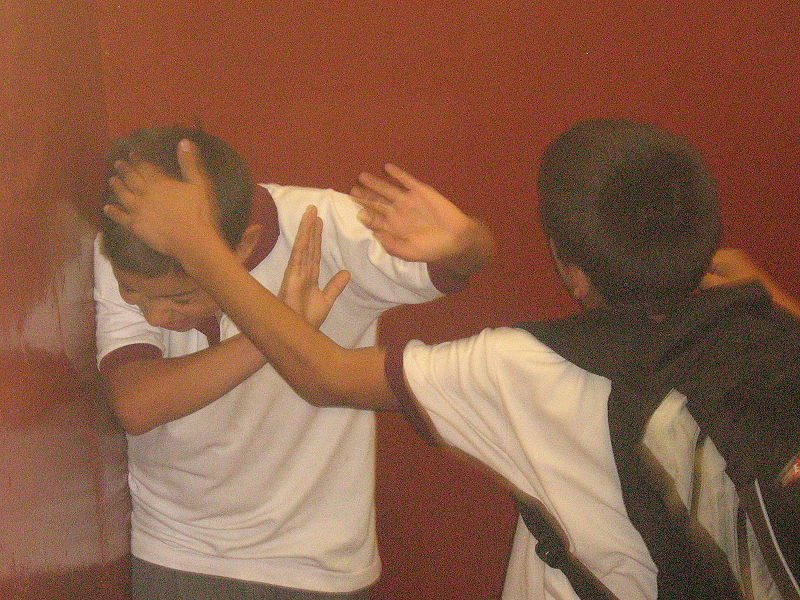
He gets bullied. From the time he starts school, he is bullied physically and mentally and emotionally. He does the right thing – he reports it. The schools do nothing, or so little that it only makes things worse for him. Pushed too far, one day snaps, he goes ballistic. He walks into the school and shoots 19 of his classmates.
One problem is access to weapons. Literally, physically teenagers have not yet developed the judgement areas of the brain. I am guessing in males it takes even longer, and I only guess that because of all the traffic fatalities and physical damage adolescent boys inflict upon themselves – and their victims. Maybe it is that fatal combination of poor judgement and testosterone that pushes them too far. Access to weapons – guns, knives, fast cars – makes them even more lethal.
Before I wrote this review, however, I had to do a lot of thinking. This book is about bullying, and even as adults we come across bullies. Our household helpers are terrified of the police – those who are here to protect us. The police use their position to try to bully phone numbers out of pretty Kuwaiti girls, and to exact sexual favors from the Asian domestics. Not all police are bullies, but if a person has that tendency, the position allows him/her to use that power wrongly.
And bullying doesn’t stop with graduation from high school. We are seeing the same kinds of behavior at universities – Virginia Tech – and in the workplace – “going postal” and GMAC just to name two. People who are bullied sometimes turn, they go out in a blaze of glory.
I’ve been bullied. People who are raised to have good manners are often victims of those who are willing to overstep the boundaries. We make excuses for them – we say they are oblivious. I am beginning to think that many a bully is NOT oblivious, but has learned to push to get his or her own way.
With men, the bullying is more physical, and it’s all about jockying for position – number one in the pecking order, the next promotion, the boss’s golf partner, etc. If you think women are gossips – you oughta hear the men! When I hear men “bantering” it’s all about who’s got the “biggest.” Or maybe, the devil whispers in my ear, it’s about who can make you THINK his is the biggest.
With women, in my experience, most of the bullies are physically bigger. They are women who – literally – throw their weight around. They are women who will interrupt anyone and override their suggestion with a loud voice. They are women who have temper tantrums, and hurt feelings, who go from person to person forming alliances that dissolve with the next disagreement. That’s the sad truth – a bully wants his or her own way – all the time. Once you go against them, you have to watch your back.
Picoult has done her homework. Bullies are often likeable enough people! A bully carries his/own burden, however – and that is a desperate need for popularity. You can see this in animal behavior; once a creature has achieved dominance, it takes enormous energy to maintain that position, so much energy that the rest of your life shrinks as your focus must be on maintaining dominance.
The UK, Canada, and the US all have websites about bullying, trying to put a stop to it in the schools. What do they define as bullying?
People calling you names
Making things up to get you into trouble
Hitting, pinching, biting, pushing and shoving
Taking things away from you
Damaging your belongings
Stealing your money
Taking your friends away from you
Posting insulting messages on the internet or by IM (cyberbullying)
Spreading rumours
Threats and intimidation
Making silent or abusive phone calls
Sending you offensive phone texts
Bullies can also frighten you so that you don’t want to go to school, so that you pretend to be ill to avoid them
What can people with manners do against a bully?
In general, the first thing to do is tell an adult – it doesn’t have to be your parents. Additonal suggestions suggest creating your own support network – create a wide network of friends. Join interest groups, in our out of school.
When our son was bullied in school, he worked hard and earned a black belt in karate, and then went on to earn further degrees, and to teach karate – while still in high school. Just knowing that he had a lethal skill made him walk differently, made the bullies afraid to target him. He went to a magnet school, where there was a high degree of chaos, and he sought out and made friends with the biggest people he could find. He used his head. He made it through. Of all his accomplishments, one of the things that made us most proud of him was his ability to stick it out and to prevail.
I worked in a high school. My office was a safe haven for many kids, kids who found high school dynamics pure hell. Most of them were emotionally years ahead of the crowds roaming the hallways, the cruel kids, for whom high school will probably be the highlight of their lives.
“You’re going to love being an adult,” I would tell them. “Hang in there. For them, this may be as good as it gets, but your life is going to get better and better.”
Geeks don’t always get a lot of respect. The two guys that graduated high school at the bottom of the class with my son already had a flourishing computer networking business going. If you haven’t noticed, most of the people who are making it big financially are people who have learned how to use their heads.
I have learned something else. You can beat a bully at his or her own game. Bullies usually rely on instilling fear in others, but rarely do they do their homework.
Choose your battles. Bullying hurts everyone. If you see someone being bullied and you can do something about it then and there, stand up for the person being bullied. All you have to do is say “that’s not funny, just stop.” Many times bullies are so shocked at being challenged, they will stop! If your judgement tells you it would be unsafe to say anything, quickly tell an adult, a supervisor, a manager, what you have seen.
If a bully is trying to push through something you believe is wrong, you can quietly discuss things one on one with others, and make a plan. You can call for a vote! You can quietly stand up to a bully. You can tell a bully “it’s my turn to talk” and they have to shut up! (When you do this, you have to be very careful to listen when the bully is speaking so that everyone knows it really IS your turn to talk.) You can use a little gentle humor – bullies usually only like humor when it is aimed at someone else. They haven’t a clue what to do when it is aimed at them!
If it is annoying, but not something worth fighting over, let the bully get his or her own way. They usually end up shooting themselves in the foot, self-destructing. The adult bully ends up driving people away, and then wondering why he/she has no friends?
Living your own life well is your best revenge!
Thank you, Chirp, for another book that really made me think!
A Case of Two Cities with Inspector Chen: Qiu Xiaolong
When my sister Sparkle recommends a book, I have learned to listen. I think I ordered this book about six months ago, but never cared enough to actually read it. After reading a recent Donna Leon (like dessert, I use it as a reward for reading something more challenging) I decided it was time to tackle Qiu Xiaolong.
I believe A Case of Two Cities is the first in the series; I tried very hard to make sure it was. When I first started reading it, it was difficult, but it didn’t take long to adjust. When you read a detective story written in a foreign culture, you have to park your old way of thinking, and quickly adapt to a new way of thinking. First, you have to learn what that new way of thinking is. They don’t just tell you at the beginning of the book “Here are the differences in values – you will notice . . .” no, but Qiu Xiaolong is courteous enough to take us by the hand and lead us gently into the Chinese way of thinking, the Chinese way of getting things done, and the technicalities of Chinese detective work.
As we meet Inspector Chen, a published poet, and a detective, ten pages into the book, a new anti-corruption campaign is starting in Shanghai, and Inspector Chen has been given a special assignment – a qinchai dacheng – as “Emperor’s Special Envoy with an Imperial Sword.” Even though imperial days are long gone, this warrant gives him emergency powers to search and arrest without reporting to anyone – and without a warrant. He is to seek and find Xing, a corrupt businessman who has caused huge loss to the national economy and is in danger of tarnishing the Chinese national image, and Xing’s associates.
Just as in the Donna Leon books about Commissario Guido Brunetti, and the Bowen books about Gabriel duPre, and James Lee Burke’s books about New Orleans, and Cara Black’s books about Aimee LeDuc, the detectives and investigators have to walk a fine line between going after the criminal and overstepping their warrant – stepping on the toes of those also engaged in corruption so entrenched that it has become a way of life. Each of these detectives has to maneuver that treacherously fine line – who determines when corruption has become too much? It usually puts their own lives in danger at some point, as those manipulating the system and making a fortune out of it do not want to be caught, do not want to be exposed, and will go to great lengths to protect their ill-gotten gains.
And just as in the above books, the book is more about the actual process than the crime itself. Inspector Chen must go about his task indirectly, having chats here and there, gathering threads of information with which he tries to weave a plausible tapestry of events.
As I was reading A Case of Two Cities, I kept making AdventureMan take me out for Chinese food! The meetings are often held over food, and the descriptions are mouth-watering.



Best of all, when you read these books, you get a tiny little glimpse into another way of thinking, another way of doing business. We are all human, we all have the same needs, and we differ in how we go about getting those needs met. We differ in the way we think. It helps to enter another way of living, another way of thinking, it helps to visit through these books so that we can increase our own understanding that our way of doing things is not the only way, maybe (gasp!) not even the “right” way! Maybe (crunching those brain cells really hard to output this thought) there is more than one “right” way?
Qatteri Cat Sinks in Sleep
The Qatteri Cat loves to find new places to slumber down. Today he is on the back of one of the loveseats, literally sinking as he sleeps. I am watching to see how far he will sink before he will rouse himself and get out of the crevice.

Eventually, he will scramble out, and being a cat, he will be embarrassed, but he will pretend like it never happened.
Donna Leon: Suffer the Little Children
After reading Zanzibar Chest I decided it was time to give myself a break, and I allowed myself another Donna Leon book, this one Suffer the Little Children. I am currently reading another detective series, recommended by my sister, set in China. What they all seem to have in common is a very tired, sad, jaded view of corruption in society, and particularly among the poorly paid police. Sigh.

In this book, a Doctor and his wife are invaded in the middle of the night by the carabinieri, a kind of police in Venice. I am not sure how the two agencies differ, maybe it is like the difference between state police and local police in the US, but when the paper was faxed over coordinating with Brunetti’s office, it got lost somewhere, and the action was never coordinated, and Brunetti gets a call in the middle of the night.
The doctor and his wife have adopted a child illegally. They bought an unwanted child from an Albanian woman, paid for her pregnancy expenses, paid a huge fee to her, and then had the child taken from them. Here is the saddest part of the story – the child’s mother doesn’t want the child, the illegally adopting parents want him back desperately, but the child is sent to a state orphanage, because of the illegal adoption.
It is a very sad book.
Here is why I read Donna Leon – some of her paragraphs are just brilliant. Memorable. Unforgettable.
“Brunetti’s profession had made him a master of pauses: he could distinguish them in the way a concert-master could distinguish the tones of the various strings. There was the absolute, almost belligerent pause, after which nothing would come unless in response to questions or threats. There was the attentive pause, after which the speaker measured the effect on the listener of what had just been said. And there was the exhausted pause, after which the speaker needed to be left undistrubed until emotional control returned.
Judging that he was listening to the third, Brunetti remained silent, certain that she would eventually continue. A sound came down the corridor: a moan or the cry of a sleeping person. When it stoped, the silence seemed to expand to fill the place.”
When you read Donna Leon, you forget you live anywhere else. For one brief moment, you become Venetian, you live in Guido Brunetti’s shoes. The speak the Venetian dialect, you think like a Venetian. What an escape!
The paperback edition will be out in April for $7.99 at Amazon.com for $7.99 plus shipping.
Leap Year Reversals
Here it is, gals, a chance that only comes up once every four years – and only one day – February 29.
In Western culture, it is the day that women can propose to men!
I don’t know anyone who has actually done this, proposed on February 29, but it’s an old legend.
The below is from About.com: Leap Year Traditions where you can read all kinds of information about today’s uniqueness.
Leap Year has been the traditional time that women can propose marriage. In many of today’s cultures, it is okay for a woman to propose marriage to a man. Society doesn’t look down on such women. However, that hasn’t always been the case. When the rules of courtship were stricter, women were only allowed to pop the question on one day every four years. That day was February 29th.
Stealing My Ideas?
Yesterday I was happily working in the project room. The Qatteri Cat, feeling neglected, came yowling back a few times, then went and got his baby and came back to be with me, and went to sleep. He looked so sweet. We don’t know what the baby is all about. Maybe he is lonely? Maybe we all need something small to comfort us when we are feeling neglected? All we know is that wherever we are, the QC will bring his baby back to be with us – and then, often he will leave it, as if we are the baby sitters or something.
So here is the Qatteri Cat and his baby:

You know when your cat – or your child – does something so sweet, you kind of think he’s the only one in the world that has ever done something that cute?
When I checked in with I Can Haz Cheezburger? this morning, I found this:

Enter the ICHC online Poker Cats Contest!
I think they must have plucked the thoughts out of my brain. 
Saudi Men Arrested for Flirting
This is in today’s BBC News.
Saudi men arrested for ‘flirting’
Relations between the sexes outside marriage is against the law
Prosecutors in Saudi Arabia have begun investigating 57 young men who were arrested on Thursday for flirting with girls at shopping centres in Mecca.
The men are accused of wearing indecent clothes, playing loud music and dancing in order to attract the attention of girls, the Saudi Gazette reported.
They were arrested following a request of the Commission for the Promotion of Virtue and Prevention of Vice.
The mutaween enforce Saudi Arabia’s conservative brand of Islam, Wahhabism.
Earlier in the month, the authorities enforced a ban on the sale of red roses and other symbols used in many countries to mark Valentine’s Day.
The ban is partly because of the connection with a “pagan Christian holiday”, and also because the festival itself is seen as encouraging relations between the sexes outside marriage, punishable by law in the kingdom.
You can read the whole article HERE.
I wonder . . . is this what is going to happen in Kuwait? So like they segregate the university. . . then they segregate all the schools, EVEN THE PRIVATE SCHOOLS, so there is no choice. . . then they start patrolling the malls?
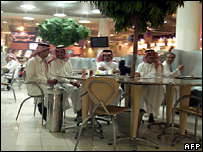
I lived in Saudi Arabia, and I remember the mutawaaeen were NOT police, but sometimes they took on the prerogatives of the police. So I have to wonder, like who made the arrest in the malls? Was it the police? Was it the mutawa hitting the boys with their little sticks? Did they call the boys parents? I have SO many questions!
How Decisions are Made in Kuwait
Here is the problem expats have in any country: you don’t know what you don’t know.
If you know you don’t know something, you can learn it. If you don’t know that you don’t know, there is this huge void in your understanding. Many times you can suspect there is a void, and if you ask, people will look at you like you are a little odd, and they will tell you there is no difference.
There IS a difference.
Working together with people of different nationalities, I have learned that some nationalities just forge on ahead and do things. Some nationalities use a more consultative process. Some nationalities expect to be told what to do and don’t do what they are not told to do.
In Friday’s Kuwait Times (February 21) is a column by Shamael Al-Sharikh, called The red, white, green and black. She talks about Kuwait National and Liberation Days, she talks about the shared heritage of all Kuwaitis (honestly, I would love to link you directly to this article but the website is still down) and then – I got a huge “AHA!” She talks about how decisions are made in Kuwait. I will quote a brief section, but I urge you all to find this column and read it in it’s entirety.
“. . . it has become painfully clear that there are nationals of this country who have no sense of belonging to it whatsoever.
However, the storm is about to subside. In a move that shows just how ready Kuwaitis are to mobilize for the sake of their national pride, a few diwaniyas in Kuwait signed a petition and sent it to the Takatul Shaabi political alliance at the National Assembly. It stated that unless MPs Adnan Abdulsamad and Ahmad Lari are asked to withdraw their membership from the Takatul Shaabi, none of it’s members will be welcome in Kuwait’s diwaniyas nor at weddings and funerals.
The move worked: the MPs have been asked to leave. . . the petitions included diwaniyas from all corners of the Kuwaiti society, both Sunni and Shiite, and it covered all sorts of ethnic backgrounds. . . I have never been more proud to support the red, white, green and black than I have now, and I am so proud to be a Kuwaiti.”
Not being welcome in diwaniyas, at weddings or at funerals is not something I would have considered political pressure. It matters here. It mattered enough that when diverse communities within Kuwait made the threat, it was effective. Who knew? Thanks to this column, I learned something I didn’t even know I didn’t know.
Recent Comments
intlxpatr on Shampoo Ginger tigerbutterya0c5ff1d… on Shampoo Ginger intlxpatr on British Soldier Kidnapped, Esc… John on British Soldier Kidnapped, Esc… intlxpatr on British Soldier Kidnapped, Esc… Wikipedia Donate Button

Amazina


Early Voting in Florida


