Cross Cultural Flummox
Scanning through the blogs yesterday, I saw one I almost didn’t check. It seemed to be a no-brainer. LaialyQ8 asked if you would share your password with your husband/wife.
Sheerly out of idle curiousity, I checked. And I was stunned to see the responses. Almost every person said they WOULD.
I’ve thought about it all day. It has to be a cultural difference. Hands down, I bet most of my friends would say “no way!” It isn’t a question of how much you love someone, to me, I just need some areas of my life that are private. I don’t keep secrets from my husband – I share things with him gladly.
But do I think he needs access to my correspondence with old girlfriends, friends I knew before I knew him? If they confide details of some crisis to me, does he need access to that information?
He trusts me. He should! And he would never, never ask me for my password, and I wouldn’t ask for his. Of course we share passwords for financial records and access, but not for our e-mail accounts.
It never for a heartbeat occurred to me there was another way of thinking about it. I was flummoxed (that’s for you, Zin!) And it is good information; I need to think about this and integrate it and try to understand it. That’s one of the things I love about living in a foreign country; challenges my assumptions and forces me to think differently, outside the box.
Happy Birthday, Law N’ Order Man
We drove to the hospital the night of December 2nd – it was a very cold clear night, and it seemed we could see every star in the sky, bright, twinkling, as excited as we were about the coming of this child. We were such kids, and we thought we were all grown up.
You, dear son, you taught us what being grown-up was all about. We thought we were ready for parenthood. We didn’t have a clue.
You were such a pretty baby, born early that cold cold morning in the hospital by the Chesapeake Bay. So pink and delicate we could see your veins through your skin.
We still marvel at you. After all these years, we still thank God for sending you to us, and we wonder at God’s mercy and sense of humor. You taught us everything we know about being good parents.
Oh! The fun we had! You were so funny, and so serious. We are so eager to see you, and your lovely bride.
And son, we are so proud of you. Happy Birthday, dear one, and thank you for being our son.
Arabesk and Jon Courtenay Grimwood
I am blessed with friends and family who share books, and Pashazade came into my life courtesy of Little Diamond, my globe-trotting glamourous niece. She always leaves a trail of books as she wanders hither and yon. Some of them are just too deep for me, or need too much attention. This series, the Arabesk Trilogy by Jon Courtenay Grimwood almost fell in that category.
I missed a clue. I kept trying to start the first volume, Pashazade, but was having a problem keeping up with the plot and the technology. I would go back and read again, trying to figure out what I was missing. I know I’m living in Kuwait, but I read! I keep up with the news! When did all this new stuff happen?
And then I just happened to look at the cover of the book and it all became clear – it is a parallel world, it is science fiction, and once I started reading and accepting all the strange words and implants as literary license, the book became fun, and intriguing, and very very hard to put down. And then I had to wait while the second and third volumes (Effendi and Felaheen) because the series is that much fun.
The main character, Ashraf al-Mansur has a complicated past. The plot is complex enough, but Ashraf doesn’t know who he is, we don’t know who he is, and we have to take time out from the plot now and then to get another piece of the puzzle. Fortunately, the puzzle pieces are in all kinds of cool places – Alexandria (but a different Alexandria from current day Alexandria) and the Sudan) but a slightly different Sudan, with a prophetic edge to it) and Seattle and a mental institution, and Tunis and the desert oases . . . oh, this is a lot of fun.
So Ashraf starts out in Alexandria, with his Aunt Nafisa who lives in this marvelous old madresa in Al Iskandriya, but then his aunt is killed, Ashraf becomes guardian to an exceedingly bright and introverted young girl, and falls in love with a young woman with whom he refused an arranged marriage.
Ashraf has friends in high places, is believed to have relations in high places, and although he gets into the worst situations, he has WASTA and a lot of problems just disappear. (For my non-Kuwaiti readers, wasta is sort of like the-power-of-connection-and-who-you-know-and-maybe-who-owes-you-a-favor-or-might-be-open-to-a-little-encouragement). These connections get people killed in the Arabesk trilogy, threaten chaos and mutilation and disaster, and take you on a great ride. Oh! Did I mention this is also a mystery, romance and has political intrigue, too?
It’s modern day – or maybe a year or two in the future – and with a huge twist in the universe here and there, so that it seems familiar, but it isn’t. There are dark shadows and differences that can be critical. And it has a whole raft of “who’s your ally?” kind of situations. It is a richly textured romp, and you are along for the ride. Don’t fight it, just lean back and hang on.
It is pure escapism, no great deep thoughts here. When the trilogy ends, however, you remember the characters, you remember the plots, and you still grin about them months later.
Pashazade, the first volume, is available through Amazon in hardcover and paperback. Paperback starts under $5.00, through used vendors.
Effendi is available from $10.20, new paperback edition.
Felaheen is available new and used from $8.99

Still Learning – Alhamdallah
Another Side of Thanksgiving . . .
My friend asked about my father, and when I told her he was slipping away, losing a little more every day, she said “Alhamdallah!”
I was caught up short. Her face was smiling. I had just told her my father is dying and she says “Thanks be to God?”
I know this woman like my own sister. Her daughters are my own daughters. I am welcome in every corner of her house, I pray for every one of her children, and being in her home is like being in my own home, we are all so comfortable together.
“No,” I said, “You’ve misunderstood what I said!” and she hugged me and said “I understood, but no matter what happens, we say ‘alhamdallah’. If you father is dying, we say ‘alhamdallah’. If Hurricane Katrina strikes, we say ‘alhamdallah’. All things come from Allah, and He knows all things. It is his will, so we say ‘alhamdallah’.”
We are both religious women. My faith says the same thing, to give thanks in all things. In my daily life, I sometimes forget. Truly, in my culture, you would never say “thanks be to God” if someone had just told you something very sad.
Being exposed to the Islamic world has complemented my own faith. No, I don’t need to be a Muslim; I think the differences between us are much smaller than the similarities. But truly, I thank God for all that I learn about my own faith by living is Moslem countries.
I love the call to prayer; nothing wrong with being reminded during the day – and night – to love and honor God. I love living among people who give thanks to God so many times a day, even for Hurricane Katrina, even for my failing father. I love watching the fathers and sons headed to the mosque on Fridays. There’s even a very gentle station with Moslem films in English that I watch from time to time because it is so peaceful, and tolerant and sweetly loving.
My friend took time from her very busy life and made a special trip to the bookstore to buy me a book called Don’t Be Sad. It’s a wonderful book by ‘Aaidh ibn Abdullah al-Qarni with chapters like “How to deal with bitter criticism,” “Do Not Carry the Weight of the Globe on Your Shoulders,” Do Not be Shaken by Hardships'” “Jealousy is Not Something New” and one of my favorites – “Do Not Be Sad – Do Good to Others.” This book is helpful to me in so many ways, including giving me good sura that are very similar to writings in our own book. This helps me clarify to others in my culture how alike we are, and how similar our faith is. My friend loves me, and I know she wants only the best for me. I give thanks to have her as a friend.
Every now and then, I come across something that shakes me – like when my friend said “alhamdallah” about my Father . . . but in the end, I learn something and my understanding broadens. Alhamdallah!
Qatteri Cat
We were flying back to Qatar after visiting our son. It was December, and we would not see him at Christmas; he was in his first real-life grown-up job and couldn’t get the time off for the long trip to Qatar and back. We were desolate.
I turned to my husband and said “I need a cat.” I expected a fight. “You work all the time, and I need a cat to keep me company.”
He said “I need a cat, too.” His eyes were kind of teary.
When we came to Qatar, we came with a 14 year old diabetic cat. When I arrived at the airport, without the right papers, the customs guy told me he would have to hold her overnight while I got the right papers from the Department of Agriculture. I started digging out all the hypodermic needles, and her insulin, and telling him she needed her shot at exactly seven in the morning and seven at night and he looked at me in shock and said “take her! take her!” and I scampered out of there as fast as I could, before he could change his mind.
When she died, the Gulf War was starting. In the middle of an important meeting, my husband came home because I kept thinking maybe she wasn’t really dead. It was heartbreaking. She was like a member of our family. My husband said “No more cats; I can’t go through this again.”
So it was only 9 months later when he agreed we could get another cat.
I went straight to the vet, who said he had just the cat for me. He was the longest, skinniest cat I had ever seen, with a great big fluffy tail like a fox. I adored him.

When he got home, he wouldn’t have anything to do with me. Every time I came near him, he cringed, and ran and hid. But the minute my husband walked in the door – it was love at first sight. Later on, we met his original owners, and one of the women said “is he still such a naughty cat?” and we said NO! that he was a good cat! The truth was that when he got scared, he would forget and use his claws and teeth. I still have the scars to prove it. It took a long time to teach him to trust again, but now, he is the sweetest and most loving cat you could meet. It just took time.
It took time for him to trust me. Now, he hangs out with me all day, and he loves to curl up with me. I don’t kid myself that this is love – he just loves my warm body and he loves that I feed him.
True love is when my husband comes home. Qatteri Cat can hear him coming long before he opens the door. He will leap from wherever he is sleeping and run for the door, and sit there waiting like a dog until my husband comes in the door. His body quivers with anticipation. He leaps for joy, and runs like a crazy cat around the house, scraping all the carpets into piles as he tries to get a grip on the marble tile floors.
When my husband showers or bathes, the Qatteri cat is there. When he works at his computer, the Qatteri cat is on his desk, or at his feet. He is content just to look at my husband with utter adoration.
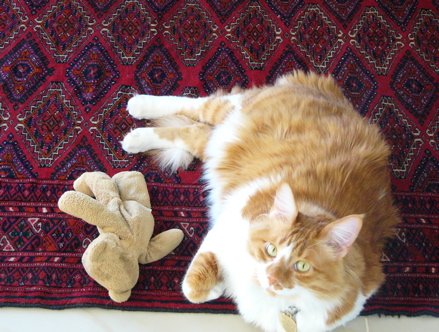
And then, in the morning, when my husband leaves, the Qatteri cat cries. His cries would break your heart. He sits by the door and asks why my husband has abandoned him, once again. And then he goes and gets his babies, one by one, and puts them by the door. Who knows what this cat is thinking?

Philippa Gregory and Catherine of Aragon
Being sick has one advantage. . . you can catch up on some of your reading. Philippa Gregory is one of my favorite writers of historical fiction.
To my great shame, I have a very difficult time reading history. Unless it is vigorously written, it puts me to sleep. It is particularly embarassing when my husband has a degree in History, and his eyes light up discussing battles and strategems and who said what to whom and why it matters. It has to do with my hard-wiring, it’s not even a gender thing.
So I gravitate toward historical fiction; give me people and motivations and interactions any day, and I can remember it. Sometimes, I even learn something. Philippa Gregory never lets me down. She researches, she documents, and she might speculate, but you always have a clear idea what is real (historically documented) and what is a good story, putting meat on the bones of the history.
Out of sequence, I read The Queen’s Fool and The Other Boleyn Girl. Each of these books is peripheral to the story of Catherine of Aragon. The first features a woman chosen to be a Fool at the court of Queen Mary, Catherine’s daughter. She is of Jewish descent, hiding as a Christian, escaped from the fires of the Spanish Inquisition. She lives in fear of being caught out in her deception. With her father, a printer, she tries to secrete and maintain many of the books of Moorish Spain, the knowledge of the ancients, which the church begins to declare heretical in England. The second book, The Other Boleyn Girl, is about Anne Boleyn, but told from the perspective of her sister, Lady Mary, who was also mistress to Henry, King of England, while he was married to Catherine of Aragon. The Boleyn girls are portrayed as mere pawns in the great game of power in the English court.
So this newest book, The Constant Princess, opens in Spain, as Queen Isabella of Castile, Catherine’s mother, and King Ferdinand of Aragon fight to eliminate the Moors and to unite their lands into one Kingdom. The little girl, whose mother is the chief strategist and who fights in armor alongside her husband, learns battlefield tactics at her parent’s feet and in their camps and learns diplomatic skills in their throne rooms.
We follow Catherine to England, married first to Arthur, then after Arthur’s death, to Henry. She assures them her marriage to Arthur was never consummated, that Arthur was too young, and impotent. Gregory assumes this was a lie. We don’t know. I would guess that it was one of those lies that nobody believes but was convenient to all to pretend to believe, for money, for power, for alliances.
We stand with Catherine as she sends Henry off to fight the French, then leads her own troops up to vanquish the Scots. We agonize with her as she strives to become pregnant, to carry an heir to the throne full term to birth, and as she loses a seemingly perfect baby boy to infant death. We sit with her in stragegic councils, watch her balance the budgets for court and state, and scheme to protect the English borders against all threats. Whew! Being a Queen of England is hard work!
The book ends with Catherine facing the eccliastical trial as her own husband disputes the validity of her marriage to him and seeks to set her aside for his freedom to marry Anne Boleyn.
I don’t review every book I read, but I was captivated by the cross cultural threads in this book, and by the fact that while we all know the basic facts of the story – Henry divorces Catherine of Aragon to marry Anne Boeyn – Catherine’s history, her talents, her strengths and victories were news to me. The influence of her upbringing in Moorish Spain and the influence it played on her growing understanding of the world is a golden thread woven throughout the story.
Early in her first marriage, the young princess tells her beloved husband of her childhood in Grenada:
” . . . We walk in their gardens, we bathe in their hammams, we step into their scented leather slippers and we live a life that is more refined and more luxurious than they could dream of in Paris or London or Rome. We live graciously. We live, as we have always aspired to do, like Moors. Our fellow Christians herd goats in the mountains, pray at roadside cairns to the Madonna, are terrified by superstition and lousy with disease, live dirty and die young. We learn from Moslem scholars, we are attended by their doctors, study the stars in the sky which they have named, count with their numbers which start at the magical zero, eat of their sweetest fruits and delight in the waters which run through their aquaeducts. Their architecture pleases us: at every turn of every corner we know that we are living inside beauty. . . . We learn their poetry, we laugh at their games, we delight in their gardens in their fruits, we bathe in the waters that have made flow. We are the victors, but they have taught us how to rule. . . .”
I can hardly wait for a trip to Spain!
Sweet, Sweet Luxury
My husband whisked me away for the weekend yesterday, a break we both need badly. We arrived early, checked in, had lunch in an old favorite restaurant, and took a driving tour around Doha, our former home. Whew! Little Doha is all grown up! Continuous building of high rising towers on the Corniche, huge road building and traffic improvement program, and of course, amazing new construction for the upcoming Doha games. We joked that we would love to have had the contract just for the signage for the games – they are awesome, and they are everywhere.
(I forgot to bring my photo-uploading-stick – I will upload some photos when I get back.)
And then, back to the room, to continue enjoying the sweetest luxury of all – time alone together. Just for today, no dinners with friends, no planned activities – we have the books and magazines we have been intending to read, there is a spa and great masseuse here, but best of all – just time together, time to catch up on all the little conversations we haven’t had time to have, time to dream a little about the future, time to give thanks for what we have.
Today, we will attend services in our former church, meet with old friends for brunch and then again for dinner. These are the friends who walk through the tough times with one another, who laugh together and cry together, and who know where all your skeletons are hidden – friends you can trust, friends who wear well over a lifetime. Tomorrow, a big charity bazaar and an evening event. In between – more time together. Thanks be to God for the luxury of time and for our good friends!

Doha Dhow and Skyline Before
Little Diamond
My neice is blogging! She started just as I did, without telling anyone. When I saw her on Friday, she very casually mentioned it in passing. Woooo Hoooooo! She is beautiful, and articulate, and always full of amazing information, and a lot of fun. Her website is A Diamond in Sunlight.
Kuwait’s Ms. America
It was a loooonnnnngggg trip. There were what we call “travel mercies” – blessings. On two very crowded flights, I had an empty seat next to me. I ran into some really caring cabin crew members, people who looked like they really like what they are doing. For a trip with a lot of potential for disaster, it went well. As my husband says – any time the number of successful landings equal the number of take-offs, it’s a good trip.
The flight into Kuwait had a majority of two kinds of people – Dutch soldiers, who came onto the plane already drunk (and REEKING of alcohol) who were drinking all the way to Kuwait, and tired businessmen, who sacked out – I was surrounded by a symphony of snores. I didn’t mind that at all; I am betting they work hard and have families waiting for them, and just needed to catch up on a little sleep before getting back to Kuwait.
We all have our little pet phobias. I have a horror of airplane lack-of-cleanliness, and I have little slippers I put on as soon as I get on the plane. Arriving in Kuwait, I changed back into my boots, but horrors! My toes feel all cramped up; I am so used to wearing sandals. I think my feet swelled during the flights!
Everything goes smoothly, even another line opening up as I get to immigration, and my bags come off the flight right away, customs doesn’t ask me any questions, not even about the canned Alaska smoked salmon – now these are more travel mercies! But then, with my poor little feet screaming in dismay, I have to make the long walk down what I think of as the Miss America runway.
For those of my readers who do not live in Doha or in Kuwait, who have never visited me and experienced this for yourself, I will explain. Imagine, when you arrive, as you exit customs, you have to walk about 100 yards to where you will be met. Imagine along the route, there are hundreds of people waiting for others to arrive. Their full attention is on whoever is on the “runway” at the moment. My toes behave; I will NOT limp as I stride down the runway, refraining from doing a queenly wave at those along both sides of the the parade route.
But I can’t help but have a big goofy grin on my face at the hilariousness of running this ordeal at the end of a long trip, skin alligatored by hours of moisture-sucking airplane air, feet swollen, clothes rumpled, make-up worn off . . .now this is where having an abaya and veil makes a lot of sense.
And the greatest travel mercy of all, my husband waiting at the end of the long walk, the car nearby, and a quick exit and trip home. It is well after midnight, but we have so much to catch up on, even though we talked twice a day while I was gone. Today, I slept until noon and I am making a very very slow start on the day.
“We Don’t Judge You By Our Standards”
It’s never a good thing when a sentence starts with “we don’t judge you by our standards.” You know that whatever comes next isn’t going to be good.
It was our favorite time during Arabic studies. We were sitting around in the majlis room, sprawled against the cushions. We had finished all the lessons of the day, practiced new verbs, done all the dialogues to death, and we had a few minutes left before classes ended. Our teachers were really special women, and during these last minutes it was always question time, when we could ask them anything, anything, and they would answer, even if sometimes to laugh and tell us it was none of our business. We had so many questions!
“When we go downtown, ” I had started, “we have a good time. We laugh and we talk and chat among ourselves as we shop. But when we see local women shopping, we see you in groups, but you aren’t laughing or chatting. Is there some prohibition against it?”
There was a long silence. I really liked this teacher, and she really liked me. I knew, as the silence dragged on, she was seeking for a way to be kind. Finally, she spoke.
“You know, we understand you have other ways, not our ways. We don’t judge you by our standards. . .” and she gave a little sigh.
“In our culture, for a woman to laugh out loud in public . . .it would be taken as lack of self control. People could criticize. It could keep a young woman from making a good marriage.”
You could hear the collective gasp. Although it was said with great kindness, it was a serious blow.
When you are first learning a new language, and a new culture, it can be intimidating, but mostly, if it is well taught, it is fun, exciting, and stimulating to be mastering a new skill. The women at this language center went to a lot of trouble to insure that we were entertained while we were learning. They taught us Ramadan customs, they prepared an Iftar supper for us, they brought in all their jewelry and produced a bride. They henna’d our hands, and poured us tiny cups of qa’wa and chai with milk and spices. They took us on field trips. They treated us like sisters, or daughters. They were so kind, and babied us along as we struggled with the new language.
I give this teacher a lot of credit. She could have finessed the question, but she didn’t. She considered her answer, she knew it could offend us. And she chose to answer us honestly, trusting we would deal with it.
I had a physical reaction. I wanted so badly to “get” Arabic, to understand all the customs . . . but to give up laughter? I went through all the stages of grief, staying longest with denial and anger. I thought of all the times I headed for the souks in a gaggle of laughing women, and I felt ignorant, and ashamed, and also angry. It was a real struggle for me, a blow to my pride, an embarrassment. I felt sick to my stomach, and stayed depressed for a couple weeks. I didn’t want to change. I didn’t want to have to give up laughter.
And then one day, somehow, it stopped mattering so much. Time did its work. Life went on. The teacher kept teaching, we kept learning. I no longer go downtown in groups of more than three, and we keep our voices down. We’re still our loud, noisy selves most of the time, among ourselves, but in public – we don’t want to be thought of as women who lack self-control.
Recent Comments
ExpatAlien on What Country am I Living … intlxpatr on Yellowstone: Old Faithful to C… Michelle on Yellowstone: Old Faithful to C… Cathy on No Grown-Ups in Charge intlxpatr on Waiting for Snow Wikipedia Donate Button

Amazina


Early Voting in Florida


 Here There and Everywhere