The Golden Crown
I was folding the laundry, and I could hear my Dad scolding my Mom in the next room.
“Those health care workers are for me! They’re not supposed to be ironing, or vacuuming, or helping you, they are supposed to be helping ME!”
She had just finished asking him for a check, so I could take her out to buy a couple new pair of pants. Back in the house now, he is busy retaking lost territory and asserting who’s the boss.
In the car, she weeps.
“What am I going to do?” she asks me.
Inspiration strikes.
“Mom, remember the golden crown you wore at the rehersal dinner, the night before the wedding? I saw it on the top shelf of the linen closet when I was putting things away.”
She looks at me like I am out of my mind.
“Mom, when he talks to you that way, don’t talk back. Just go get the crown and put it on. Don’t say anything, just wear the crown.”
She starts to giggle. Good. Got her laughing.
“Why would I wear a crown?” she demands.
“Because it will drive Dad crazy. Eventually, he will have to ask you why you are wearing the crown, and you can just tell him it reminds you of a time when you were treated with respect, and you were happy.”
At this point, we both dissolve in giggles. I don’t think she will ever put the crown on – she has her own ways of dealing with Dad. But at least she remembers that things have not always been this way, and she can hold her head high.
My husband reminds me that one day, we too will be facing the challenges of being, we hope, very old. He says we will probably be nasty and angry, too at losing control over our lives, at losing independance. Having that kind of input is one of the benefits of having been married to the same person for a long time. Hope someone gives me a golden crown.
Cousin Time
We met up at the nearby Barnes and Noble; he got stuck at the office and called to say he would be late. Leaving me to wander in a Barnes and Noble is like leaving an alcoholic alone in a room with an open bottle of Jim Bean . . . I had a bagfull of books by the time he got there.
As we were discussing the problems of dealing with aging parents, I told him about the bank manager I met with earlier who had looked me in the eye and said “it’s an epidemic. People are living longer, but while not demented enough to be declared incompetant, they are making bad decisions.” My Dad, while wheelchair bound, has a phone and a computer, and could, if he chooses, do a lot of damage to himself and my mom.
My cousin and I have always been on track, from the time we were very young. He and I scored one point apart on our SATs, we researched the same family issues, we have kids the same age – and he was the first one I called when we had a concern about a family matter.
He leaned across the table and grinned. “The problem with dealing with paranoid people is that it forces the loved ones to do exactly what the paranoid is accusing them of doing!” We both laughed. He is exactly right – we have to go behind and see what checks are being written, we have to listen at doors to hear who he is talking to and what he is saying, and the very worst – we have to talk about him behind his back.
If you looked at my father, if you talked with him for a short time, you would think him very smart, and even charming. And he is all that.
If you are with him a little longer, however, he will start talking about dreams he has been having – vivid, very wierd dreams, very scary dreams. Because he doesn’t hear very well, he might accuse you of saying something you didn’t say, and get very angry with you. He is not quite tracking. He gets angry. If he weren’t so weak, he might be violent.
My cousin and I have other family members who have lived long enough to enter into dementia. It haunts us to think we might end up the same way.
The Fraud Syndrome
When I finally got to graduate school, I was in shock. There was me, one other woman, and a classroom full of men. It might sound like heaven, but it was testosterone-city. We were studying national security affairs, a sub-group of International Relations, and most of my classmates were in different branches of the military.
My professor, a former military intelligence colonel, was knowledgable, and good at presenting his lessons. He was very professional, very businesslike. Not exactly cold, but neither was he collegial.
In any graduate courses, there is a whole new vocabulary to master. I felt like I had grabbed onto a train that was leaving the station; I was holding on for dear life. I read all my assignments, made sure I copies all my notes, and . . . never said a word in class for the first two weeks. I was too scared. All the guys were blah blah blah and I just hoped they wouldn’t figure out that I barely had a clue.
One of my fellow students came up to me on break. He was nice. He asked if I had seen a recent article in the paper on The Fraud Syndrome, and I said “no” that I hadn’t. He just happened to have a copy of it with him, which he gave to me.
Here is what Wikipedia has to say about the Fraud Syndrome:
The Impostor Syndrome, or Impostor Phenomenon, sometimes called Fraud Syndrome, is not an officially recognized psychological disorder, but has been the subject of a number of books and articles by psychologists and educators. Individuals experiencing this syndrome seem unable to internalize their accomplishments. Regardless of what level of success they may have achieved in their chosen field of work or study, or what external proof they may have of their competence, they remain convinced internally that they do not deserve the success they have achieved and are really frauds. Proofs of success are dismissed as luck, timing, or otherwise having deceived others into thinking they were more intelligent and competent than they believe themselves to be. This syndrome is thought to be particularly common among women, particularly women who are successful in careers typically associated with men, and among academics.
When time came to take our first test, I studied and studied. I knew I wasn’t getting any credit for participating in class, so I really needed a good grade on the test. I did my best. I hoped to pass.
When the professor gave us back our tests, he put the scale on the board. The lowest grade was a C-. I had passed! Even if I got the C-, I had passed! Then he started talking about all the mistakes, including one really bad one – a person who had used a quote, and the quote was not accurate.
My heart fell. I had quoted George Kennan on deterrence, quote marks and everything. I thought I had it word perfect, but I must have screwed it up. I was so embarrassed.
One paper, he said, had no red marks on it. He said he has never had a paper before on which he didn’t make a single correction, that this was a first in his history of teaching. I barely paid attention – I had passed, even if I blew the Kennan quote.
Yeh – the paper with NO red marks was mine. I thought there must have been some mistake, but the professor held me after class, and told me that for my next homework, he wanted me to speak up in class. And he congratulated me on the test. Only one guy guessed it was my paper with no corrections – the same guy who had told me about the fraud syndrome. Through our two years in grad school, we became good friends, and would share notes with one another if one of us had to be out of town on assignments.
It was October. I remember there was fog on the road, and a great big full round white moon glowing through the fog on my drive home. I had so much adreneline pumping through me that I howled “Wooooooooo Hoooooooooo!” at the moon that night.
Sunny, Crisp October
It’s been years since I have been in this part of the country in October. I’m busy hitting the stores for long-sleeved T-shirts, and a couple pair of non-sandal type shoes, and socks!
The mornings are very foggy. The fog burns off early in the afternoon, and the sky is a deep bright blue, against which the reds and burgundies, oranges and yellows of the leaves contrast brightly. My camera is always on the seat next to me, and I have thousands of photos of leaves. I can’t resist. It is so beautiful.
My good friend Barbara and I picked up take-out fish and went down to a park to watch the sun set over the mountains and water. It was a beautiful evening, a record hot day for October, and the beach was full of people, children, walkers, barbeque-ers – all out enjoying this rare autumn evening. But as soon as the sun went behind the mountain – BRRRRRrrrrrrrrr! A wicked cold wind arose, and we quickly finished and headed home again.
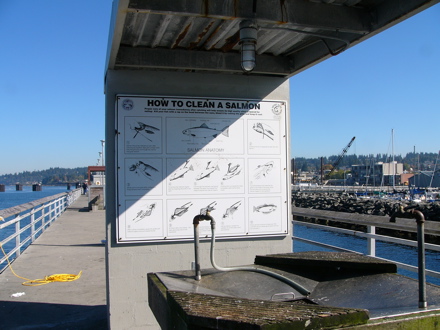
A sign from the pier:
Change Two
It’s a continuing theme – the Locard Exchange Principal in every day life. We live in foreign cultures, we pick up foreign ideas. Change 1 was one of the earliest entries in the blog – investment. Investment is not alien to my culture; investing to protect yourself against an uncertain future, as insurance and as protection for your children – that got through to us and accelerated the investment process. Starting early in our married life paid off big dividends.
Change Two came in Jordan. We had finished an amazing dinner at a private home, mezze’s, a mensef (huge platter of rice flavored with leban, spices and sultanas, with meat – in this case, lamb, but we have also had goat or chicken served as mensef). The host was peeling an orange and had that look in his eye that tells you he is thinking about something and isn’t sure whether he should voice it or not. He struggles, and then he goes ahead . ..
“I don’t understand one thing about your culture” he says. I am surprised; this is a very sophisticated man, well educated, holding a high position. He has travelled. . . it will be interesting to see what comes next.
“Why is it you kick your children out of the house at such an early age? You love your children – I just don’t understand.”
We had observed the opposite – that in Jordan, young people lived with their parents, even after graduation from university, sometimes even after being married. . . and it seemed very alien to us, very uncomfortable.
We are raised knowing that the goal is to be independent, to live on our own. It is very very scary, but a rite of passage. You leave school, you find a place to live, you pay rent, you pay your own bills, you look for a mate – all on your own. You are supposed to be educated and wise, but you still feel very young and not at all sure of your own judgement. You can ask your parents for advice, but you are expected to make your own decisions. Eventually, you get the hang of it.
But . . . through the years, that question nagged at us. It opened us up to a new way of thinking. It would come up from time to time. Just that one little question, popping into our minds. Having friends from other cultures who helped their kids out well beyond college gave us some different ideas, a different model.
It’s a fine line. We don’t want to intrude on our son’s privacy; we want to be close without being interfering. And at the same time, he will inheirit everything from us – why should we not be helpful now, during the years of struggle, when he and his wife could use the help?
At the same time, we don’t want to be so generous as to preclude them from developing their own financial strategies, from learning thrift, and the thrill of finding a good buy. We want them to know the thrill of discovering for themselves how to balance spending and savings, investment in major purchases and investment in family.
We are so thankful for that thoughtful friend, a friend with the courage to risk asking a question that might be perceived as impolite.His question caused us to do things a little differently. It wasn’t immediate, but a long term effect; it caused us to question our own way of doing things and moderate it into a more supportive approach.
Tradition of Aunthood
We have a tradition of aunthood in my family. I remember my aunts with so much admiration and fondness. They took me to art museums, taught me about having lunch out with the ladies, taught me about civic commitment and good works, set examples for us with family celebrations, dinners, and even contests. We had an annual dinner on Christmas at which we each, no matter how young, had to come up with a poem for someone whose name we had drawn at the feast of Thanksgiving. Oh, the laughter! And each of us had our first exposure, at that time, of having to speak publicly, as we read our poems.
And now, my sisters and I get to be aunts in our turn, helping to raise, and now mentor, one another’s children – children? Young adults!
As my son and I were IM’ing the other day, I came up with a dream team – all our young people in the next generation. My superheroes.
LawNOrderMan: He wanted to be Superman when he was young, and put away the bad guys – now he is a felony prosecutor.
AmbassadorGirl – she speaks several languages fluently, gets published with regularity and loves living in Beirut and Damascus.
GlobalGuy – he holds nations accountable by exposing them, in graphic detail, to the rest of the world.
BrethalyzerLady – She manages a state-wide program and instructing others how to install alcohol detecting devices which disable cars.
BioGenius – Fearless explorer of the human body on a molecular level
EnviroGirl – Working to make the world a better, cleaner place.
Can you feel my pride in this next generation? Not that we are willing to pass the torch yet, but we feel such joy in seeing these young people achieve their full potential. WooooHoooooooo!
We Need to Talk About Kevin
This morning on BBC, as part of the coverage on the horrorific murders in the peaceful Amish country of Pennsylvania, they interviewed Lionel Shriver, author of the award winning book “We Need to Talk About Kevin.”
This is not a recommendation. Shriver’s book, which has won several awards for literary excellence, is not for the faint-hearted. It is a tough, muscular, bleak examination of a similar, fictional incident, written after the Columbine High School massacres.
My best friend and I read this book at the same time – it was a book club selection, paired with another book on a similar theme, “Early Leaving.” We ended up exchanging horrified e-mails every morning, discussing events in the book as if they were a part of our daily life, and speculating on where this was all going.
It is from a mother’s point of view, written to her husband, from whom she is separated after . . . .something . . . We don’t know what that something is. The book unfolds steadily and relentlessly. You want to stop. Truly you do, I am not exaggerating. The book rolls on, so dark, so ominous, you know it is leading up to something truly horrible. You don’t want to look. And you can’t stop reading.
“Why are we reading this???” we asked each other in agony. And we didn’t stop.
“Why did you want me to read this?” your friends will say, as you pass this book along, and then, shell shocked, they will come to you to discuss it. Most often, I didn’t even recommend the book, but friends would overhear other friends talking about it in hushed, horrified voices, and would insist.
The book is the scariest, most real book I have ever read. It hits at the heart of every mother’s secret fears – what if we have done something wrong while raising our child? What if our child turns into a monster? Do we ever really know anyone – our children? Our husbands? Ourselves? We are all so vulnerable in our mothering skills, so quick to blame ourselves for our children’s failings, and this book bravely explores that fear, that vulnerability, without taking the easy way out and giving easy answers.
If you read this book you will find yourselves talking about it months – even years – after you read it. It is a terrifying book.
And after you read it you will understand why my heart is breaking for everyone involved in this unthinkable killing in Pennsylvania. Were I some superstitious person, it would be so easy – it is clearly the devil’s work. I can’t imagine what this man could have been thinking, but he chose his victims – young, innocent girls – with purpose. My heart aches for his wife and children, who will bear this shame for the rest of their lives, and for his parents, who will wonder where they went wrong. My heart breaks especially for the peaceable Amish, revered throughout America for their simplicity and commitment in living their faith, who must try to find a way to forgive the man who took their innocent daughters’ lives.
“Only Trashy Girls Get their Ears Pierced”
“Only trashy girls get their ears pierced!” my Dad roared as the nightly battle at the dinner table commenced. Every night, I presented facts and evidence supporting my need for pierced ears, only to engage his fierce and fiery disapproval.
“No daughter of MINE will ever have pierced ears!” rang in my ears, but I wasn’t giving up. The battle raged on.
Meanwhile, my next youngest sister went out and got her ears pierced, and showed up at dinner with bright, shiny gold earrings. I was dumbfounded. Flabbargasted – and aghast. What would my Father do?
I expected rage. He looked at her is shock. I think he went a little pale. He was angry, but . . . so mild! She really looked cute in those new gold earrings.
“You’re grounded for a week.” he told her coldly. The rest of the meal passed in silence, my sister grinning and preening quietly.
I went out the next day and had my ears pierced, too, so we could “serve our time” on restriction together. The next week, my Mom and youngest sister went downtown and had their ears pierced too. They didn’t get grounded.
Now he lies in a hospital bed, weak, old, and subdued, sliding between hallucinations and lucidity. What I wouldn’t give to see his fiery spirit back again.
Date Night in Kuwait
Because my husband’s weekend is Friday, Thursday night is our date night in Kuwait. We have a tradition of going out for a nice dinner together.
We used to drive our son crazy. We would say “Hey, want to go to Rio Bravo (Mexican) with us?” and about a third of the way there, my husband would say “You know, I just have this yen for sushi!” and I would go “Oh! Me too!” and our son would pipe up “No! No! No! That’s ‘bait and switch!’ No! That’s not fair!”
(Now he laughs and tells us that it runs in the family; that he and his wife do the same thing – and, he now also eats sushi. My sisters’ families tell me they do it too – it must be a family culture thing.)
So last night we were on our way to Biella’s at the Marina Crescent. But oh, the traffic on the Corniche! Maybe we should just eat Chinese in the neighborhood? What about the seafood buffet at the Crown Plaza? Or . . . finally we decided on Paul’s down at Fehaheel, and hoped there was a parking space.

They have a new mall opening just across the main street from the Al Kout Mall, Al Manshar, with a great big apartment building and a great big new hotel, a Chili’s, a Johnny Rocket’s and a food court – a few of the merchants and restaurants are already open – but only like 40 parking spaces???? Go figure! Even worse, it is right next to a beautiful mosque, so at prayer time, there is NOWHERE for anyone to park. And the driving in Fehaheel at night is crazy . . . minimally better than Gulf Road. Take another look at the photo – those two outcroppings are perfect for a bridge, a la Marina Mall – connecting one mall to the other, and sharing parking spaces.

At Paul’s in Fehaheel it was comfortable enough, with their fans, to eat outside, by the big shallow water-fountain pavillion. Great food – we had the Camembert – noisette salad, onion soup and the smoked salmon pasta, most of which we brought home because the soup and salad had been so good. Best of all was just being together, sharing our week and having a relaxed, delicious meal together.

And it was there I told him about my blog. I don’t like keeping secrets from my husband. I wanted to see if blogging was something I really wanted to do before I told anyone. Last weekend, when he was asking me to explain blogging to him, I was afraid he was on to me. He wasn’t; it was a co-incidence, but I knew someone was bound to figure it out sooner or later, and I really wanted to tell him. I was ready.
Last night when we got home I showed him the blog and he was amazed. It is so cool to have such a great evening together, great meal, great conversation, and, after all these years being married, to be able to surprise him now and then – in a good way. It was one of our best dates.
“I’m Not Japanese Anymore”
she said, and we dissolved into gales of giggles. We struggled to regain control over ourselves. She was the Japanese ambassador’s wife, my dear friend, and we would hide out and have coffee together whenever our busy schedules would allow. We always sought out the quietest time of day, the most remote tables, so we could have complete and utter privacy as we shared our week, our worries about our kids, our lives.

Our topic was a recurring one in our conversations – that once you have left your native country and lived elsewhere, you aren’t the same anymore. Your eyes change, and you see things differently, your taste buds change and the unfamiliar becomes familiar. Unacceptable color combinations become acceptable, the cacaphonous and discordant become music to your ears. Once you have lived in a foreign country, you can never be truly the person you were before you left.
“I’m not so patient with ceremony any more,” she continued, and we dissolved into laugher again, because her life was full of endless ceremonial events. The great blessing in all this for both of us, is that we are both married to men who are at the same time traditional and ceremonial, and secret iconoclasts. Every now and then we could even get together, all four of us, and share an evening of relaxation and laughter, mostly laughing at ourselves and the difference between how others perceived us, and how we really are.
We treasure these friends. They are the kind that could call us late in the day and say “We are unexpectedly free tonight – can you meet us?” and if there was any way we could, we would. They were our playmates; when we were together we were free to be totally ourselves.
Sometimes in life we are handed roles to play, and if we are honorable people, we play them as best we can. The secret is to keep a very clear idea of where the role ends and we begin. We show respect where respect is due, we carry out the rituals that give richness and tradition to our lives, and heritage to our children.
But glory and honors are transient. Roles and job titles come and go. Good friends and those who keep your worst secrets – they are worth more than gold and diamonds.
Recent Comments
ExpatAlien on What Country am I Living … intlxpatr on Yellowstone: Old Faithful to C… Michelle on Yellowstone: Old Faithful to C… Cathy on No Grown-Ups in Charge intlxpatr on Waiting for Snow Wikipedia Donate Button

Amazina


Early Voting in Florida


 Here There and Everywhere