American Shedding Reliance on Cars
. . . in bigger cities where good public transportation is available, at least. But across the board, Americans are driving less. When I was a young woman living in Seattle, I took the bus to work. It was fast, reliable and I got to read going to and fro. A generation later, my son would park his car at the park and ride lot and take the bus into downtown. When you have GOOD public transportation, it makes a lot of sense. Found this article on AOL Auto News:
Commuters are shedding their reliance on cars.
They’re not driving to work in their own vehicles as often as they once did. They’re not carpooling with other workers as often. They’re increasingly using public transportation or simply working from home.
Those are the conclusions of a study released this week by U.S. PIRG, which reviewed data from the Federal Highway Administration, Federal Transit Administration and U.S. Census figures.
It says the proportion of workers commuting in private vehicles, either alone or in a car pool, declined in 99 of the 100 largest urban areas in America between since 2000.
Newark, New Jersey saw the greatest percentage of workers put down their keys, with a 4.8 percent drop, followed by Washington D.C., down 4.7 percent and Austin, Texas, down 4.5 percent.
In recent years, there have been numerous indications that Americans overall are shifting away from driving. The number of per capita vehicle miles traveled reached its peak in 2004. This study claims to be the first to specifically look at the decline in American cities.
“Many existing transportation plans continue to reflect outdated assumptions that the number of miles driven will continue to rise steadily over time,” wrote Phineas Baxandall, senior analyst at U.S. PIRG and the study’s author. “Officials at all levels should revisit transportation plans to ensure they reflect recent declines in driving and new understandings of the future demand for travel.”
The U.S. PIRG study details changes that on a market-by-market basis. Among its other findings:
– The proportion of residents working form home has increased in every one of the 100 largest urban areas since 2000
– The proportion of households without cars increased in 84 of the 100 largest markets between 2006 and 2011
– The proportion of households with two cars or more decreased in 86 of the 100 largest markets between 2006 and 2011
One of the more notable trends appears to be the death of carpooling as a commuting option. Between 2000 and 2011, carpooling declined 17.8 percent, according to the U.S. PIRG study. Only 9.7 percent of workers now report they share rides to work.
The results are not entirely surprising: The number of Americans who work from home increased 45 percent between 1997 and 2010, according to an earlier study conducted by the U.S. Census Bureau.
Curiously, the decline in driving hasn’t dampened demand for cars. Automakers expect to sell approximately 16.4 million vehicles this year, according to the latest projections released earlier this week. It’s the best year for auto sales since 2007, when more than 17 million cars were sold.
Pete Bigelow is an associate editor at AOL Autos. He can be reached via email at peter.bigelow@teamaol.com and followed on Twitter @PeterCBigelow.
Qatar National Day: What Not to Do

LOL, This is exactly what everyone does. Not doing any of these things will not prevent the absolute gridlock that develops as everyone in the country drives into Doha.
From Qatar Gulf News:
The Traffic Department has urged motorists not to violate traffic norms while celebrating National Day.
In this connection, the department has reminded motorists of certain common violations that are seen during this time and asked them not to commit the same during this year’s celebrations.

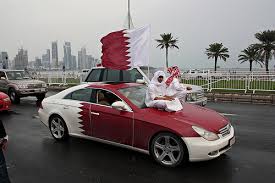
These violations include placing pictures, posters and flags on the entire car, thereby completely changing the look and colour of the vehicle; shading the windshield and rear window of the car, obstructing the driver’s view (both of the road in front of him and behind the car) and hiding the car plates; climbing on to the roof and bonnet of a car; getting out through the car’s windows and sunroof, which exposes passengers to the risk of falling down, besides affecting the control of the driver; and blocking traffic and parking in no-parking zones.
The department has appealed to all motorists to celebrate the occasion in a safe and secure manner and not to commit violations that may jeopardise the safety of other road users.
The Green Parrot on Panama City Beach
Our first day in Panama City Beach, I watched AdventureMan’s head swivel 120° to the left as we drove down the main drag.
“Did you see that?” he exclaimed! “A ‘Mediterranean’ restaurant!! Woooo HOOOOOOO!”
We’ve come to learn that ‘Mediterranean’ is code for comfort food. It is not Mediterranean-Italian, or Mediterranean-Greek, it is Mediterranean like Lebanon or Syria or Palestine . . . it is comfort food.
Sigh. Or close enough. There is no machboos, and sometimes the felafel aren’t home made. Still, we know we’ll give it a try.
On our last night in town, it is the perfect night to go. 

The owner is a delightful Lebanese import named Hani, and he is a word-of-mouth phenomenon on Panama City Beach. He has many fanatically loyal customers, and people recommend him all the time. We can see why. He loves what he is doing, and it shows.

Mixed appetizers/Mezze
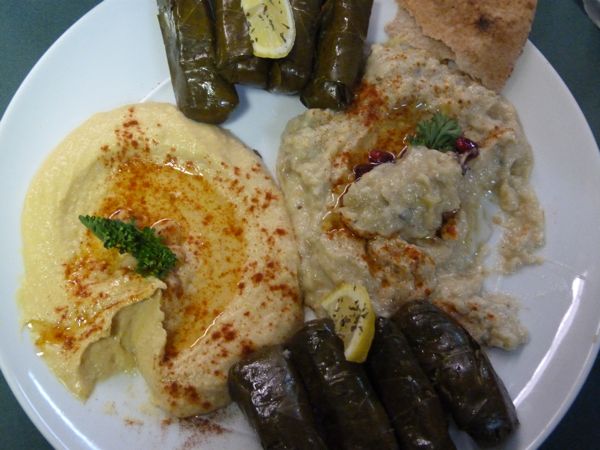
His food is DELICIOUS 🙂


Everything tasted so good. We can understand how he is developing such a following – his food is really good.

A View from the Sunset Inn, Panama City Beach
We love this place, the Sunset Inn, a little Mom and Pop kind of motel, hard to find in over-developed Panama City Beach with its huge soulless condominiums towering over the white sands.
As we walk in the door, the view hits us and we breathe in the sea air and go “Ahhhhhhhhhhhh.” The minute we walk in the door, we start to feel relaxed.

We both have cooking to do, so we get busy, but busy with glances at the view, and trips to our balcony to breathe. It is COLD, with a cold wind, but so gorgeous, so breath-takingly gorgeous, and we are happy.
Soon, there are cranberries cooking for Mom’s Cranberry Salad and hot juice brewing for the punch, redolent of cinnamon and cloves and orange peel, wonderful smells filling our room – and that view. Life is sweet.

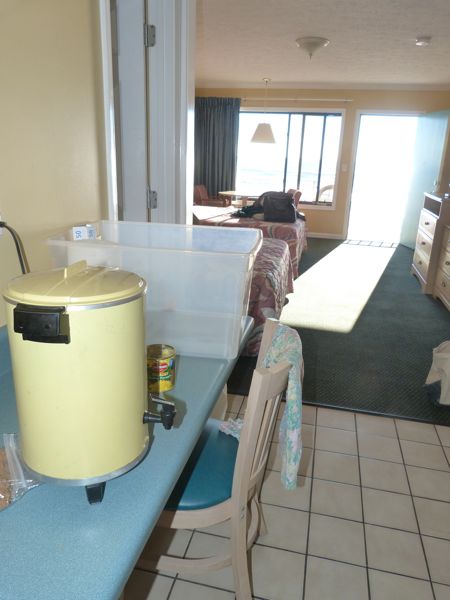
And then, just when you think it can’t get any better, the sun starts to set, the light goes all golden and soft and oh, life is sweet.

PF Chang in SanDestin: A Much Needed Stop
After you’ve been married so many years, your mate knows exactly what buttons to push, and not just in bad ways.
“Hey! Look at the time! It looks like we’ll be near PF Changs for lunch!” said AdventureMan, pretending to be excited. Chinese food is comfort food to me, and he likes it OK, but he is relatively – relative to me – indifferent. And while PF Changs is pretty good, it is also good relative, relative to Pensacola, Navarre, Crestview, Niceville, Destin, Panama City – pretty good. It is a chain, and it is not San Francisco, or Seattle, or other cities where good Chinese food is sought after and valued.
So he feigns excitement, knowing I will happily eat at PF Changs, because relatively speaking, I am yearning for some good Chinese food.
We get there just as the Thanksgiving lunch crowd is beginning to head into the restaurants to take a break from shopping. We are happy; we can see many empty tables still. There are times this restaurant has been so packed that we have chosen to go elsewhere.
“It will be about ten to fifteen minutes before I can get you to a table,” the hostess says, bustling by and barely giving us a glance.
Oh oh. I can see AdventureMan’s testosterone level rising. But he has learned a lot in his years, so he tackles the problem nicely: “But I can see empty tables,” he says, and gestures to the large assortment of empty tables.
She seems annoyed to be interrupted in whatever her busy-ness was, and annoyed at being questioned.
“I have the tables,” she said shortly, “but I’ve had to call in extra staff to wait on them. They should start arriving shortly.”

The wait is actually short, and that welcome was the worst part of our meal, and not even that was so bad. Actually, AdventureMan and her had a nice chat while I wandered off to find the ladies room. When I came back, he had been seated, and we quickly ordered a big pot of tea and lunch. It arrived quickly, was hot and beautifully presented, and was delicious, seasoned by our hunger.
Our server was attentive and efficient without being intrusive. He made excellent suggestions and made sure our orders were customized – AdventureMan wanted his extra spicy, and he got lots of fabulous peppers. AdventureMan had Kung Pao Scallops and I had Spicy Chicken. We both had the Hot and Sour Soup, which we thought was pretty good.
I think his was better . . .
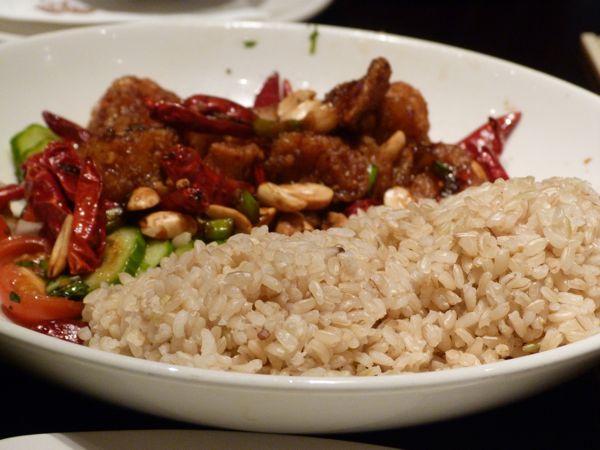

I am thankful for a lunch at PF Changs AND I am yearning for Seattle, and the countless places to get authentic and tasty Chinese food.
Qatar Fields Huge New Traffic Force
This is from ILoveQatar.net, reprinted from Gulf News. I think I loveQatar.net is a very cool website, and I am thankful they continue to send me updates: 🙂
A BIG Wooo HOOOOO on Qatar for training and implementing a PROFESSIONAL traffic force. Woooo HOOOOO! I can only hope the laws they will enforce include children in the back seats in car seats and seat belts for every passenger. I pray that part of the training included instructions that traffic rules are to be applied equally and fairly against all nationalities, including citizens.
A new highway patrol police force that will augment the efforts of the Ministry of Interior (MoI) in improving road safety will start work in 2014, it was announced at the graduation of the first batch of the force.
Consisting of 50 officers and cadets, the graduation ceremony of the first batch was held at the headquarters of the Traffic Department. The training programme was implemented by the Northwestern University, Chicago.
The team has received specialised training in enforcing traffic laws and booking common violations like tailgating, use of mobile phones, exceeding speed limits and not wearing seat belts.
The officers also acquired advanced skills in investigation of accidents, modern methods to interrogate drivers, preservation of evidence and making specialised reports on accidents.
According to Traffic Department officials, the new force will use both radar and lidar, a device used to monitor speed using laser.
The officers were also trained on skills needed to manually control traffic flow and its mechanisms in addition to the use of tools and methods for data collection.
The initiative was organised in collaboration between the Ministry of Interior and RasGas in the context of the priority given by the MoI and the National Committee for Traffic Safety (NCTS) to ensure responsible and safe driving.
The graduation ceremony was attended by Traffic Department director Brig Mohamed Saad al-Kharji, NCTS secretary Brig Mohamed Abdullah al-Maliki, traffic safety adviser at MoI Ademola Ilori and Brett Doherty, safety, health, environment & quality chief officer, RasGas.
Speaking on the occasion, al-Kharji said that the new force would support the MoI’s efforts in road safety.
“The new force will monitor and enforce road safety measures on highways. It includes monitoring speed limit, keeping space between vehicles and handling accidents and emergency situations.”
He added that the trainees got theoretical and practical lessons on controlling traffic movement on highways, safe parking and stopping of vehicles on highways as well as training on dealing with the public.
Speaking on the sidelines, al-Kharji said that there was a plan to equip traffic police vehicles with speed radars so they could catch violators while on the move.
He thanked RasGas for its collaboration with the MoI in this initiative and said the move would play a proactive role in reducing traffic accidents.
Al-Maliki said that the initiative came as part of NCTS and thanked RasGas and Northwestern University for their support for the initiative.
He awarded trainees with certificates and exchanged mementos with RasGas and Northwestern University. Gifts and appreciation certificates were awarded for lecturers and translators.
Others present on the occasion were RasGas public affairs manager Abdulla Hashim, Security & Emergency services manager Faisal al-Hajiri, road safety adviser John Cling, safety systems head Jive Price, road safety training head at Northwestern University, Antony Patila.
El Tenampa in Kissimmee
“So where are you eating tonight? asked Alessandro, and we told him El Tenampa. His face lit up with a huge smile. “You’re going to love it!” he said. “Do you like spicy food?”
Oh yes. Yes, we do.
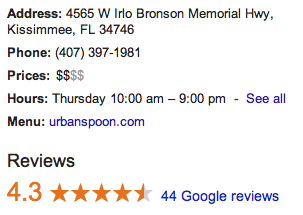
El Tenampa is a challenge. It is the highest rated Mexican restaurant in the Kissimmee/Disney/Lake Buena Vista area, but commenters on Google and Urban Spoon have complained about the service, the waiting time to be seated, the long wait for dinner, not understanding what was on the menu . . . as good as the food is, there were a lot of complaints.
It’s Orlando. Running a restaurant in Orlando must be a nightmare. Thousands of people from all over the world, and everyone wants service. What incentive is there to provide top-notch customer service when you know these people are passing through and you will never see them again? What incentive is there to be first-rate when many of them are poor tippers – by US standards – or just plain cheap? We went to El Tenampa fully aware that it might be problematic.
It was anything but.
It is hard to find, even though it is right on the main drag, it has poor signage. It shares a building with La Hacienda Meat Market and is next door to the India Diner and the Rodeway Motel . . . it all kinda looks low rent.
“Don’t mind how it looks from the outside,” Alessandro warned us. “It’s different inside.”

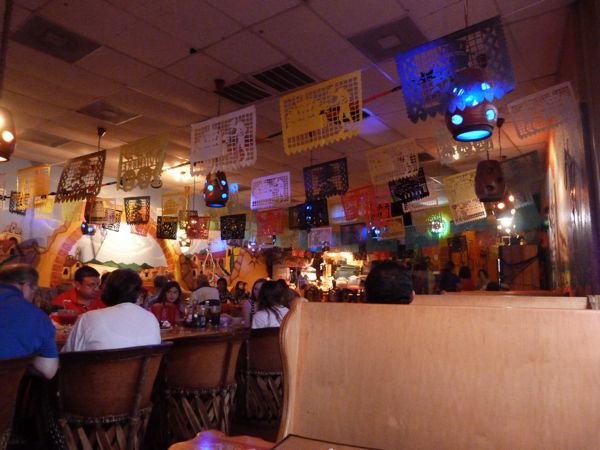
Marco, at the door, greeted us warmly and sat us right away. There was a lot going on, family parties, one of nearly twenty people, several large groups, but lots of booths and tables. The place LOOKS chaotic, but we got our drinks and menus right away, chips, salsa and guacamole very shortly and our dinners within a reasonable time. The wait staff was hopping – very busy – but we never felt slighted or neglected.
The menu was inclusive, and the food was fabulous. Marco told us it was a slow night, which meant that you could walk right in and have a table, no waiting.
AdventureMan ordered a la carte, a carnitas tostado and a tamale and salad; I had the pescado Veracruz, steamed in foil with spices and vegetables, oh wow.
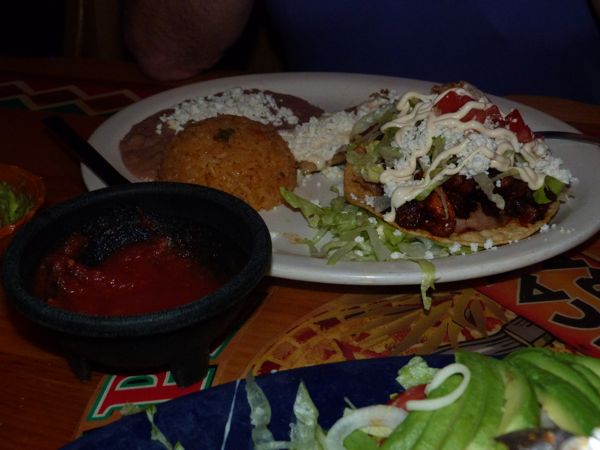
Well worth the trip. Great food, great service and a great atmosphere, all decorated for the day of the dead/Halloween.
Our bill was a shock. All that great food, and the bill was under $25. Amazing.

God-With-A-Sense-of-Humor at King O Felafel in Orlando
After driving seven and a half hours to get to the convention hotel, AdventureMan and I needed dinner! We settled in to our hotel and took a quick look at the menu – nope. We needed something comforting, something familiar. And there it was, just one minute, I am not kidding, from our hotel, the King O Felafel.
God-with-a-sense-of-humor had plopped us splat down in a hotel in the middle of Middle-Eastern-Land. Minutes from Disney, minutes from all the shoddy tackiness of Orlando, we find ourselves “home.”
The King O Felafel’s shop was full of regulars, including one very large family taking up about five tables all put together, and having a wonderful time. The King himself makes his own felafels, using that little felafel making tool, he was so quick. The was clean clean clean, and service was quick.
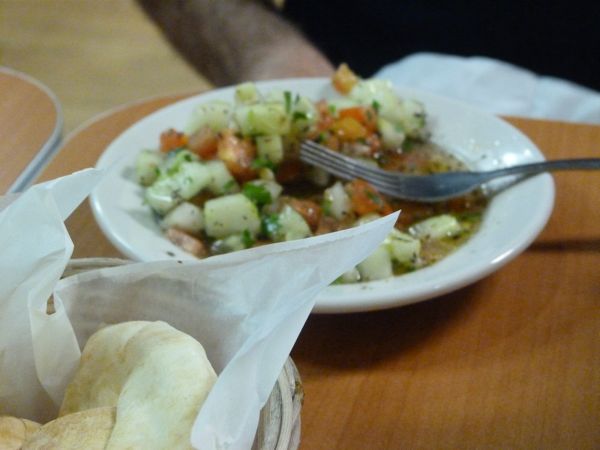
We started with lentil soup, and I ordered the Vegetarian Platter (which was like a mezze) and AdventureMan ordered a Felafel Sandwich.
Oh, how we have been yearning for the simple joy of a felafel sandwich done right. The King O Felafel was heaven for us.

Thank goodness I remembered to take a picture before we demolished the entire platter!

So simple, so good. A homemade felafel. Perfection.

This shop is not undiscovered. He has a large clientele of all kinds of people who appreciate superb food, beautifully and tastily prepared.
Across the street from the King O Felafel is a mosque which also has a gym and a meeting hall. There are several other ‘Mediterranean’ restaurants nearby, and several hookah lounges. There are so many shops in this little area of Kissimmee with ‘halal’ foods and even groceries selling halal meats. Wow.
Mosque – my photo was blurry, so I grabbed this from Google Maps. I guess it used to be a computer shop; now it has arabic writing on it and a sign that says it is the AMYL Center (Masjid Shadi)


‘Staggering’ Traffic in Qatar as Cars Exceed Highway Capacity
From the Gulf Times Qatar
By Bonnie James/Deputy News Editor
Increase in the number of vehicles beyond the carrying capacity of roads, improper driving manners of many motorists and road works are among the key factors behind the acute traffic congestion currently being experienced in Doha and suburbs, it has been pointed out.
Brigadier Mohamed Saad al-Kharji, director of the Traffic Department, was on record the other day that the number of vehicles in Qatar has exceeded 1mn.
The total number of registered vehicles in Qatar had stood at 876,039 in 2012, according to official statistics. This means, as many as 123,961 new vehicles have been added to the roads within nine months of this year, at the average rate of a 13,773 every month, whereas the 2012 average for new vehicles was only 5,138 per month.
“The increase in the number of new vehicles is staggering and at almost three times the monthly average from 2012, it now exceeds the carrying capacity of the roads of Doha and suburbs, even from a layman’s perspective,” a traffic safety expert said.
This is evident on Al Shamal Road, a vital link of the Qatar Expressway Programme and a major arterial thoroughfare, during peak hours from Sunday to Thursday. All the way from The Mall signal to the Gharrafa area, the highway is clogged with bumper-to-bumper traffic.
“The average speed on Al Shamal Road would be around 30kmh, as against the maximum allowed speed of 100kmh, and that too if there are no accidents,” observed a motorist who drives on the highway regularly.
The congestion on Al Shamal Road has gone from bad to worse ever since the reopening of schools on September 10, compared to the time before the summer vacation, asserted another resident.
“Al Shamal Road is the preferred choice of tens of thousands of motorists who have to travel to the northern parts of the country and back, but the carrying capacity of its busiest portions has been exceeded,” the expert maintained.
Though Al Shamal Road has three lanes each in either direction, they are proving thoroughly inadequate during the rush hours. “You have to go beyond the Gharrafa stretch to be able to drive at the maximum permissible speed, if proceeding to the north,” a motorist said.
Many road users also feel the traffic management strategy leaves much to be desired, especially with regard to Al Shamal Road.
“On Thursday, access from many service roads to Al Shamal Road was blocked off in a bid to ease congestion on the highway. But this led to vehicles being stuck on the service roads for up to 40 minutes,” a road user recalled.
A parent who drives his children from the Qatar Decoration area of Salwa Road to their school at Duhail, a distance of about 23km, said it took him more than one hour to reach the destination, as access to Al Shamal Road from the service road at Al Waab was blocked.
“My children were late for school the first time this academic year as we were stuck on a service road for nearly 40 minutes while vehicles were moving fast on Al Shamal Road, a rare sight these days,” he said.
Many motorists don’t use indicators or move ahead promptly when the vehicle in front moves. “It is a common sight to see people having their breakfast, putting on make up, or having animated conversations on a handheld phone, while they are behind the wheel, oblivious to the fact that they are holding up traffic and aggravating the congestion,” noted a woman who observes the road scenes from her front passenger seat.
The traffic situation on the Corniche is expected to take a turn for the worse, given that Grand Hamad Street’s intersection with Doha Corniche has been closed for 10 days from Thursday midnight.
“If I used to start from home at 6.30am before summer vacation, I leave 15 minutes early these days, but now I guess I have no option but to start even earlier,” another motorist added.
The helicopter patrol, introduced by the Traffic Department since last week, to help ease congestion on Qatar roads by giving guidance to police on the ground during morning rush hours has improved traffic flow by 30%, according to Brigadier al-Kharji.
Recent Comments
ExpatAlien on What Country am I Living … intlxpatr on Yellowstone: Old Faithful to C… Michelle on Yellowstone: Old Faithful to C… Cathy on No Grown-Ups in Charge intlxpatr on Waiting for Snow Wikipedia Donate Button

Amazina


Early Voting in Florida


 Here There and Everywhere