Local Man Acquitted of Abusing American Woman
Man cleared of abusing expat woman
By Nour Abuzant
From The Gulf Times Court RoundUp
A Doha court acquitted a man, for lack of evidence, of the charge of abusing an American woman on July 15, 2008.
According to the chargesheet, the 36-year-old accused entered the woman’s bedroom at night and “fondled” her while she was sleeping next to her husband.
The woman, 34, told interrogators that the accused local was a family friend and he had unsuccessfully tried to start a relationship with her.
The judges were told that the husband confronted the intruder, “who injured himself while fleeing the scene.”
The Nepali security guard at the compound where the alleged incident took place said that he saw a man trying to enter the compound and he tried to prevent him from entering the building.
However, the guard failed to identify the man at a police parade stating “it was too dark to recognise anybody.”
The defendant’s lawyer said his client had tried to call the woman on July 14 as he was a close friend of the family.
Explaining the “non guilty” verdict, the court of first instance said neither the American couple nor the security guard could recognise, beyond any reasonable doubt, the intruder. “Also no fingerprints were taken from the scene.”
The court said that the circumstantial evidence was insufficient to convict the accused.
How Norway Beats MRSA
This is the most amazing article. Are we willing to give up our abuse and overuse of antibiotics to keep ourselves well in the long run? Found this on AOL/Sphere/Health News:
Solution to Killer Superbug Found in Norway
Margie Mason and Martha Mendoza
AP
OSLO, Norway (Dec. 30) — Aker University Hospital is a dingy place to heal. The floors are streaked and scratched. A light layer of dust coats the blood pressure monitors. A faint stench of urine and bleach wafts from a pile of soiled bedsheets dropped in a corner.
Look closer, however, at a microscopic level, and this place is pristine. There is no sign of a dangerous and contagious staph infection that killed tens of thousands of patients in the most sophisticated hospitals of Europe, North America and Asia this year, soaring virtually unchecked.
The reason: Norwegians stopped taking so many drugs.
Twenty-five years ago, Norwegians were also losing their lives to this bacteria. But Norway’s public health system fought back with an aggressive program that made it the most infection-free country in the world. A key part of that program was cutting back severely on the use of antibiotics.
Now a spate of new studies from around the world prove that Norway’s model can be replicated with extraordinary success, and public health experts are saying these deaths — 19,000 in the U.S. each year alone, more than from AIDS — are unnecessary.
Kirsty Wigglesworth, AP
Dr. Lynne Liebowitz, a microbiologist, works in Queen Elizabeth Hospital in Kings Lynn, England.
“It’s a very sad situation that in some places so many are dying from this, because we have shown here in Norway that Methicillin-resistant Staphylococcus aureus (MRSA) can be controlled, and with not too much effort,” said Jan Hendrik-Binder, Oslo’s MRSA medical adviser. “But you have to take it seriously, you have to give it attention, and you must not give up.”
The World Health Organization says antibiotic resistance is one of the leading public health threats on the planet. A six-month investigation by The Associated Press found overuse and misuse of medicines has led to mutations in once curable diseases like tuberculosis and malaria, making them harder and in some cases impossible to treat.
Now, in Norway’s simple solution, there’s a glimmer of hope.
—
Dr. John Birger Haug shuffles down Aker’s scuffed corridors, patting the pocket of his baggy white scrubs. “My bible,” the infectious disease specialist says, pulling out a little red Antibiotic Guide that details this country’s impressive MRSA solution.
It’s what’s missing from this book — an array of antibiotics — that makes it so remarkable.
“There are times I must show these golden rules to our doctors and tell them they cannot prescribe something, but our patients do not suffer more and our nation, as a result, is mostly infection free,” he says.
Norway’s model is surprisingly straightforward.
— Norwegian doctors prescribe fewer antibiotics than any other country, so people do not have a chance to develop resistance to them.
— Patients with MRSA are isolated, and medical staff who test positive stay at home.
— Doctors track each case of MRSA by its individual strain, interviewing patients about where they’ve been and who they’ve been with, testing anyone who has been in contact with them.
Haug unlocks the dispensary, a small room lined with boxes of pills, bottles of syrups and tubes of ointment. What’s here? Medicines considered obsolete in many developed countries. What’s not? Some of the newest, most expensive antibiotics, which aren’t even registered for use in Norway, “because if we have them here, doctors will use them,” he says.
He points to an antibiotic. “If I treated someone with an infection in Spain with this penicillin, I would probably be thrown in jail,” he says, “and rightly so, because it’s useless there.”
Norwegians are sanguine about their coughs and colds, toughing it out through low-grade infections.
“We don’t throw antibiotics at every person with a fever. We tell them to hang on, wait and see, and we give them a Tylenol to feel better,” Haug says.
Convenience stores in downtown Oslo are stocked with an amazing and colorful array — 42 different brands at one downtown 7-Eleven — of soothing, but non-medicated, lozenges, sprays and tablets. All workers are paid on days they, or their children, stay home sick. And drug makers aren’t allowed to advertise, reducing patient demands for prescription drugs.
In fact, most marketing here sends the opposite message: “Penicillin is not a cough medicine,” says the tissue packet on the desk of Norway’s MRSA control director, Dr. Petter Elstrom.
He recognizes his country is “unique in the world and best in the world” when it comes to MRSA. Less than 1 percent of health care providers are positive carriers of MRSA staph.
But Elstrom worries about the bacteria slipping in through other countries. Last year almost every diagnosed case in Norway came from someone who had been abroad.
“So far we’ve managed to contain it, but if we lose this, it will be a huge problem,” he said. “To be very depressing about it, we might in some years be in a situation where MRSA is so endemic that we have to stop doing advanced surgeries, things like organ transplants, if we can’t prevent infections. In the worst-case scenario, we are back to 1913, before we had antibiotics.”
—
Forty years ago, a new spectrum of antibiotics enchanted public health officials, quickly quelling one infection after another. In wealthier countries that could afford them, patients and providers came to depend on antibiotics. Trouble was, the more antibiotics are consumed, the more resistant bacteria develop.
Norway responded swiftly to initial MRSA outbreaks in the 1980s by cutting antibiotic use. Thus while they got ahead of the infection, the rest of the world fell behind.
In Norway, MRSA has accounted for less than 1 percent of staph infections for years. That compares to 80 percent in Japan, the world leader in MRSA; 44 percent in Israel; and 38 percent in Greece.
In the U.S., cases have soared and MRSA cost $6 billion last year. Rates have gone up from 2 percent in 1974 to 63 percent in 2004. And in the United Kingdom, they rose from about 2 percent in the early 1990s to about 45 percent, although an aggressive control program is now starting to work.
About 1 percent of people in developed countries carry MRSA on their skin. Usually harmless, the bacteria can be deadly when they enter a body, often through a scratch. MRSA spreads rapidly in hospitals where sick people are more vulnerable, but there have been outbreaks in prisons, gyms, even on beaches. When dormant, the bacteria are easily detected by a quick nasal swab and destroyed by antibiotics.
Dr. John Jernigan at the U.S. Centers for Disease Control and Prevention said they incorporate some of Norway’s solutions in varying degrees, and his agency “requires hospitals to move the needle, to show improvement, and if they don’t show improvement, they need to do more.”
And if they don’t?
“Nobody is accountable to our recommendations,” he said, “but I assume hospitals and institutions are interested in doing the right thing.”
Dr. Barry Farr, a retired epidemiologist who watched a successful MRSA control program launched 30 years ago at the University of Virginia’s hospitals, blamed the CDC for clinging to past beliefs that hand washing is the best way to stop the spread of infections like MRSA. He says it’s time to add screening and isolation methods to their controls.
The CDC needs to “eat a little crow and say, ‘Yeah, it does work,'” he said. “There’s example after example. We don’t need another study. We need somebody to just do the right thing.”
—
But can Norway’s program really work elsewhere?
The answer lies in the busy laboratory of an aging little public hospital about 100 miles outside of London. It’s here that microbiologist Dr. Lynne Liebowitz got tired of seeing the stunningly low Nordic MRSA rates while facing her own burgeoning cases.
So she turned Queen Elizabeth Hospital in Kings Lynn into a petri dish, asking doctors to almost completely stop using two antibiotics known for provoking MRSA infections.
One month later, the results were in: MRSA rates were tumbling. And they’ve continued to plummet. Five years ago, the hospital had 47 MRSA bloodstream infections. This year they’ve had one.
“I was shocked, shocked,” Liebowitz says, bouncing onto her toes and grinning as colleagues nearby drip blood onto slides and peer through microscopes in the hospital laboratory.
When word spread of her success, Liebowitz’s phone began to ring. So far she has replicated her experiment at four other hospitals, all with the same dramatic results.
“It’s really very upsetting that some patients are dying from infections which could be prevented,” she says. “It’s wrong.”
Around the world, various medical providers have also successfully adapted Norway’s program with encouraging results. A medical center in Billings, Mont., cut MRSA infections by 89 percent by increasing screening, isolating patients and making all staff — not just doctors — responsible for increasing hygiene.
In Japan, with its cutting-edge technology and modern hospitals, about 17,000 people die from MRSA every year.
Dr. Satoshi Hori, chief infection control doctor at Juntendo University Hospital in Tokyo, says doctors overprescribe antibiotics because they are given financial incentives to push drugs on patients.
Hori now limits antibiotics only to patients who really need them and screens and isolates high-risk patients. So far his hospital has cut the number of MRSA cases by two-thirds.
In 2001, the CDC approached a Veterans Affairs hospital in Pittsburgh about conducting a small test program. It started in one unit, and within four years, the entire hospital was screening everyone who came through the door for MRSA. The result: an 80 percent decrease in MRSA infections. The program has now been expanded to all 153 VA hospitals, resulting in a 50 percent drop in MRSA bloodstream infections, said Dr. Robert Muder, chief of infectious diseases at the VA Pittsburgh Healthcare System.
“It’s kind of a no-brainer,” he said. “You save people pain, you save people the work of taking care of them, you save money, you save lives, and you can export what you learn to other hospital-acquired infections.”
Pittsburgh’s program has prompted all other major hospital-acquired infections to plummet as well, saving roughly $1 million a year.
“So, how do you pay for it?” Muder asked. “Well, we just don’t pay for MRSA infections, that’s all.”
—
Beth Reimer of Batavia, Ill., became an advocate for MRSA precautions after her 5-week-old daughter Madeline caught a cold that took a fatal turn. One day her beautiful baby had the sniffles. The next?
“She wasn’t breathing. She was limp,” the mother recalled. “Something was terribly wrong.”
MRSA had invaded her little lungs. The antibiotics were useless. Maddie struggled to breathe, swallow, survive, for two weeks.
“For me to sit and watch Madeline pass away from such an aggressive form of something, to watch her fight for her little life — it was too much,” Reimer said.
Since Madeline’s death, Reimer has become outspoken about the need for better precautions, pushing for methods successfully used in Norway. She’s stunned, she said, that anyone disputes the need for change.
“Why are they fighting for this not to take place?” she said.
Martha Mendoza is an AP national writer who reported from Norway and England. Margie Mason is an AP medical writer based in Vietnam, who reported while on a fellowship from The Nieman Foundation at Harvard University.
New Qatar Traffic Violations and Fines
Update: LLOOLL, I went to QatarLiving.com and discovered that these “new” laws came out in 2007. These are great laws, deterrents to bad driving and aggressive driving, but the laws mean nothing without enforcement. Do I still see many many children sitting in the front seat? Are people driving while talking on their mobile phones? And not a word about one of the worst offenses these days – texting.
A recent study showed texting is even more dangerous while driving than talking on a mobile phone:
The crash risk attributable to texting is substantial. One possible explanation is that drivers who text tend to decrease their minimum following distance and also experience delayed reaction time. For example, in the Drews et al. study, drivers’ median reaction time increased by 30% when they were texting and 9% when they talked on the phone, compared with their performance in a driving-only condition.
Notwithstanding the safety risk of texting while driving, previous research by Drews and colleagues at the University of Utah — not to mention crash data and widespread legislation — makes clear that using a phone while driving is dangerous.
(To check my source, just click on the blue type, above)
We were talking about people who were saying “Qatar is the most dangerous place to drive in the world” and wondering where this is coming from? Most of us have driven in more dangerous places, but this is the new quote floating around, with no foundation, no statistics, no studies, at least not any I can find with a simple Google.
The topic of new laws came up next over Christmas dinner. New laws? New fines?
“I never saw a word about this in the paper,” I said, peevishly.
“Oh, didn’t I tell you?” said AdventureMan.
People who have been married a long time will understand the urge to kill . . .
Someone else jumped in,
“I think the different companies are passing it around. The Education Foundation has it. Some of the universities have it. That’s the way it is in Qatar, news of new laws filters out.”
LLLOOOLLL. News of new laws “filters out?”
I found it online HERE, at Team BPH and it looks exactly like the copy AdventureMan brought home yesterday, but there is no attribution. Who put this out? There is no kind of official marking on it at all.
IF ENFORCED, these laws would have a serious effect on Qatar traffic.
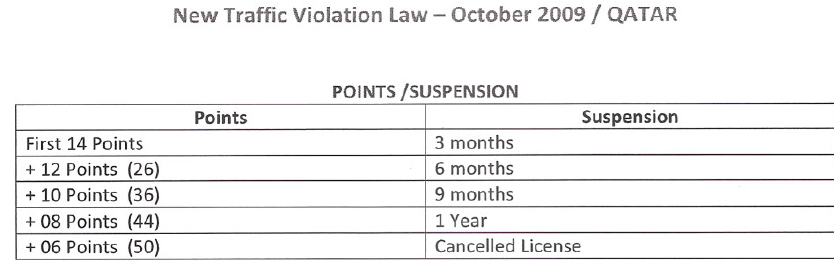

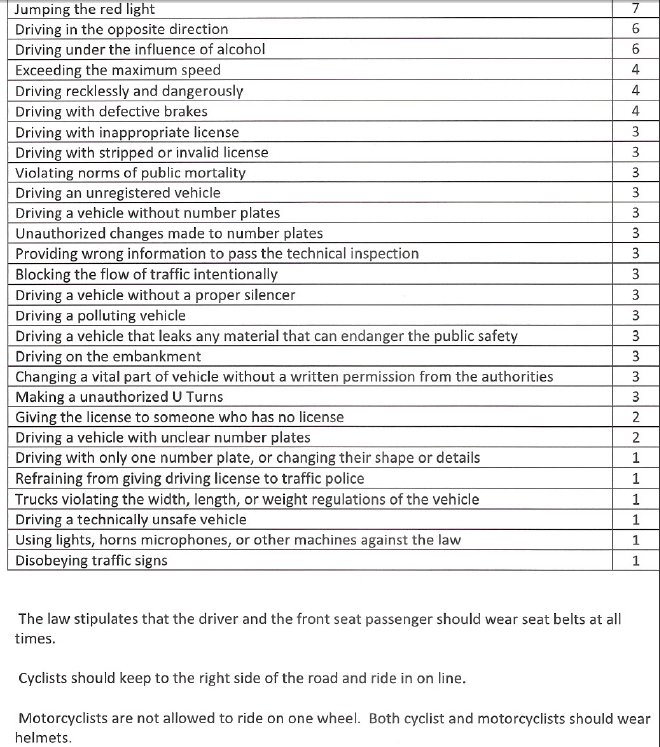
In theory, these went into effect in November 2009, just last month. Who issued these? Has there been any coverage in the newspapers? TV? How can people be held accountable for violating laws of which they are not aware? Or is this something one of the companies printed up, anticipating new laws?
Defense: It’s The Cops Fault; He Was Chasing Me!
Court asks motorcycle rider to pay blood money
Web posted at: 12/19/2009 2:30:29
Source ::: THE PENINSULA
DOHA: A young man who rode a motorcycle and killed a pedestrian in a bizarre crash has been asked by the court to pay QR200,000 as blood money to the family of the deceased.
The court fined the convict QR10,000 for violating traffic law. But how the man was caught by the law-enforcement agencies is quite interesting.
It so happened that the Police Patrol saw two men riding motorbikes with tremendous speed. They gave the duo a chase but in vain. They vanished in think air. But soon the police was informed that a pedestrian was hit by a speeding motorbike.
When a police party reached the spot of the crash it saw a motorbike lying near the body of the victim.
The cops were quick to realize that this was one of the two motorbikes they had given a chase sometime ago.
With help from its registration plate they zeroed in on the culprit and referred the matter to the court after investigation.
The defense lawyer argued in the court that the crash occurred because they motorbike was chased by the cops. The court, however, did not buy the argument and convicted the man.
QR 200,000 sounds like a fortune, but it is $55,000 for taking a man’s life. For a young man who was running from the cops and then tries to claim their chasing him as a defense! This case sounds like a perfect opportunity to give a community service penalty in addition to the blood money; expose this young man to the consequences of motorcycle accidents, and accident victims, allow him to see with his own eyes, and serve, the victims. It could change his life, and change his callous attitude.
“You’re Such a Good Driver”
Twice in the last two weeks, friends riding with me have said “You’re such a good driver.” You’d think I would be flattered, but instead, it makes me aware of how much I have adapted to driving conditions in Doha. The truth is, I am pretty good. The truth is, that’s not a good thing.
Doha is smaller than Kuwait. The trick in Doha is to know which roads are closed, (that is usually in the newspaper,) and to have two or three routes to get to the same place. The trick is to know where the lanes are going to go wonky with all the people needing to make a left turn, and at the same time, how to avoid the mandatory left turn lane that can catch you by surprise.
The trick is to yield to the bigger vehicle, especially if he is a cement truck, crane, or similar very heavy vehicle, unless you think you can quickly get ahead of them so you won’t have to go 15 km/hr for the next thirty miles. The trick is to avoid being behind a truck loaded with not-secured concrete blocks. The trick is to know that new cameras are going up all the time – have you noticed? Even the locals are slowing down, so I am guessing that the fines here are being imposed across the board.
Last week, I even saw a policeman pull a truck over for an illegal left turn – he turned from the lane next to the legal turn lane – he got pulled over. I don’t know if he got a citation, but he got a talking to. He seemed to be listening respectfully. I was shocked. There are times you will see three lanes turn left, only one of which is the legal left turn lane. It’s so common, you take it for granted. But things seem to be changing.
I have also caught myself doing some things I would never ever think of doing in the US. I needed to use a cash machine, and all the parking spaces were filled. I gave it 5 seconds thought, parked my car behind two cars right by the cash machine, and prayed no one would need to move while I was getting my money. Unfortunately – no one did. My bad behavior was positively reinforced.
The other night, picking up food on the way home, I begged some workers to let me park in a marked “no parking” spot so I could pick up my food.
“Bas hamsa deqiqa” I smiled as I ran to pick up my food, which, fortunately was ready and I paid, ran back out, tipped a little for the spot and drove off.
These are things I would never never never do in the United States. I do it here because it makes my life easier and because . . . everybody else does it.
I can still hear my Mother’s voice saying “and if everyone were jumping off a bridge, would you do that?” That’s what mother’s say. I probably said it myself. And here I am, knowing I shouldn’t do it, and doing it.
When I first got here, a woman was taking me shopping and as we got to the roundabouts, she said “You’ve just got to commit!” and she would whirl through the roundabout with seconds to spare. An Iranian friend got us from the airport to the Diplomatic Club once in 17 minutes in peak night-time traffic. It was easier for me to watch the clock than to watch her drive; she didn’t even look left when she entered the roundabouts. And she got us across town in 17 minutes. I still wonder at that accomplishment, and feel myself, at the same time, quaking in my boots at her confidence.
So I wonder if my admiring friends feel the same way, if I have become so used to local driving that I am adapting dare-devil tactics in my driving as well as in my parking?
I shudder at the re-education I will have to undergo when I return to the US for good.
Qatari Police Balloon?
I thought this was so cute when I passed it on B-ring today:

I don’t know what it’s all about, but I like it that he has on bright clothing and a reflector vest to help him be safe while he is directing traffic. 🙂
Doha: Keep Your Camera Handy
Today I had one of those experiences I have so often in Doha, a “no-one-would-believe-me” moment, but I have learned to keep my camera handy, and fortunately we were stopped in traffic so I could snap this one without endangering any lives, especially my own.
Traffic is steady, busy, but pretty mellow. Yeh, there are the normal “I’m-going-to-make-a-left-turn-from-the-right-lane” guys; I’ve lived here for so long it doesn’t even rate a roll of the eyes. It’s part of the Doha / Kuwait driving culture.
This, however, I only see in Qatar. Mr. I’m-So-Important-I-Can’t-Wait is this guy in the white Land Cruiser.
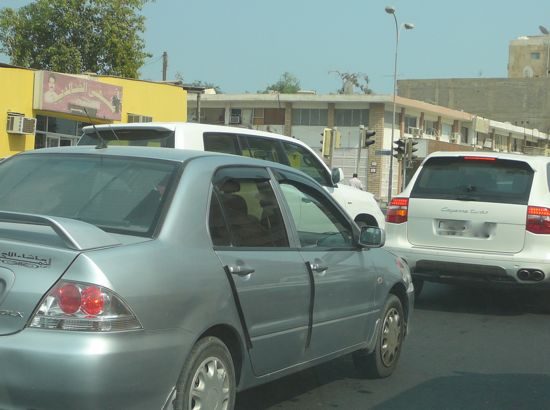
He is sitting half on top of the street median, trying to get back into traffic going in his direction. To get there, he drove down the wrong way down the street on the other side of the divider. At first, there was no traffic, but when traffic came, he got up on the divider so he was only HALF blocking traffic from the other direction, and he is bullying his way back into the line he was too important to wait in.
I carry my camera now, every day, in my purse, because I know if I just tell you about these things, you won’t believe them.
I have seen this also at major roundabouts. Some yahoo drives up the other side of the road to the roundabout to avoid waiting in the line. Up over the medians, facing oncoming traffic. I know, I know, what are they thinking?
In Kuwait, I was sickened by the number of young men killed on the roads every week, every month. If it were an epidemic killing young men, people would do something about it, but tell these guys to obey the law? Make them pay fines for reckless driving? Make them wear seat belts? Their behavior tells me that no one has ever held them accountable for their arrogant and dangerous driving habits.
While we are told that “no one is above the law” somehow the message hasn’t made it to these guys.
The More Things Change
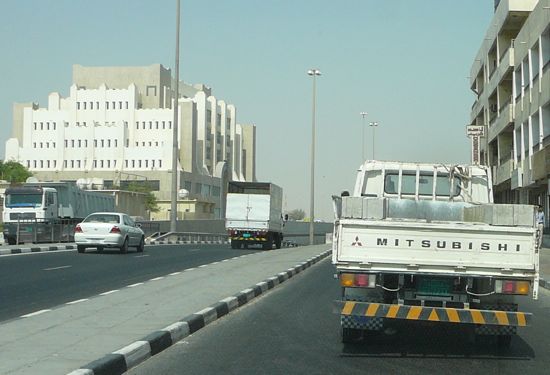
“. . . When we first came to Doha,” I laughed to my friend, “the first thing my husband warned me was never never to get behind a truck carrying concrete blocks. They weren’t tied down, and now and then a bump or a lumpy corner would send concrete blocks all over the roads. They don’t do that any more. They have rules now.”
Spoken too soon.
The very next week, I saw three trucks in a row, laden with concrete bricks, moving slowly down B-ring; one red, one white, one blue. I got stuck, first behind one, then behind the second.
No one was endangered as I took these photos. Traffic was at a standstill.

The Social Contract
Without accountability, does the social contract exist?
Wikipedia on the Social Contract:
Social contract describes a broad class of theories that try to explain the ways in which people form states and/or maintain social order. The notion of the social contract implies that the people give up some rights to a government or other authority in order to receive or maintain social order through the rule of law. It can also be thought of as an agreement by the governed on a set of rules by which they are governed.
Social contract theory formed a central pillar in the historically important notion that legitimate state authority must be derived from the consent of the governed. The starting point for most of these theories is a heuristic examination of the human condition absent from any structured social order, usually termed the “state of nature”. In this condition, an individual’s actions are bound only by his or her personal power, constrained by conscience. From this common starting point, the various proponents of social contract theory attempt to explain, in different ways, why it is in an individual’s rational self-interest to voluntarily give up the freedom one has in the state of nature in order to obtain the benefits of political order.
Recent Comments
ExpatAlien on What Country am I Living … intlxpatr on Yellowstone: Old Faithful to C… Michelle on Yellowstone: Old Faithful to C… Cathy on No Grown-Ups in Charge intlxpatr on Waiting for Snow Wikipedia Donate Button

Amazina


Early Voting in Florida


 Here There and Everywhere