Expat Teacher Murdered In Qatar After Night of Clubbing?
Qatar expats shocked after UK teacher’s suspected murder
 By Yolande KnellBBC News, Doha, Qatar
 Lauren Patterson had gone to a nightclub with a friend before she went missing
The suspected murder of a young primary school teacher from south-east London has deeply upset British expatriates living in the Gulf state of Qatar.
However, two weeks after Lauren Patterson disappeared following a night out in the capital, Doha, officials have given few details about her disappearance.
DNA tests have been carried out on the remains of a body found in a remote area of desert but the results have not yet been released.
At the Newton British School, where Ms Patterson worked, one mother paid tribute to a talented teacher who she said had been a favourite of her little son.
However, staff refused to comment, saying they had been advised not to.
“We’re a small, close-knit community and we’re all in deep shock,” explained headteacher Katherine Dixon. “We are dealing with small children here.”
Security camerasWhen 24-year-old Ms Patterson went out on 11 October she had just returned from a trip home to the UK for her grandmother’s funeral.
She and a female friend decided to go to Club 7 on the seventh floor of the luxury La Cigale Hotel.
It is a popular venue where all nationalities mingle on the dance floor as DJs play ambient house music.
Groups sip cocktails around low tables decorated with colourful, illuminated ice buckets.
Everyone entering the club has their ID checked and they are watched by burly bouncers and security cameras.
It is believed that in the early hours of the morning, the two women left with two local men they knew who had offered to drive them home.
Ms Patterson’s companion was dropped off safely but she went missing.
The alarm was raised by her friend who called the police the next day.
Arrests
Reports say a falconer found a badly burnt corpse shortly afterwards. Two suspects were detained although no details about them have been confirmed.
 Public prosecutor Mohammed Rashed al-Binali says violent crime is “very rare” in Qatar
The case has been referred to the attorney general.
“Violent crime is very rare in Qatar,” public prosecutor, Mohammed Rashed al-Binali told me in his smart office surrounded by shining skyscrapers in central Doha.
“We are continuing to investigate the case. We cannot give more details at the moment but the Ministry of Interior did arrest the suspects within 24 hours.”
Alison Patterson has flown to Doha and is awaiting further news about her daughter.
She told the BBC she would only make a statement “when I feel the time is right and I have received all the information concerning Lauren”.
Meanwhile, the British Foreign Office says it is providing the family with consular assistance.
Qatar, which will host the 2022 World Cup, is generally considered one of the safest places in the Middle East for Westerners.
The tiny, but very wealthy Gulf state, which is the biggest exporter of natural gas in the world, relies heavily on its growing foreign workforce.
It now has some 17,500 British residents. Most are attracted by the high living standards and high tax-free salaries.
Yet work permits can be easily revoked and this makes employees from overseas very wary of upsetting the authorities.
While Qatar has recently supported opposition movements pushing for greater freedom across the Arab world, the nation itself remains very conservative and tightly controlled.
Here Comes Karen
As I’ve watched Pensacola weather over the three years we have lived here, I have seen a hilarious co-incidence. If there is ever going to be a cold spell, or a lengthy rainy spell, it is going to hit for the weekend. It’s a pity, the beaches in Pensacola are at their most glorious in October, no tourists, just locals enjoying the God-given beauty of sun, sand and surf. The restaurants are accessible, you can find parking . . . and then the rain hits.
Long term forecasts for the summer were that while the rest of the USA would have record highs, we would have cooler, overcast skies. I don’t remember them mentioning record rains, that would rot the crops in the fields.
Last night, at an event, a friend said she and her closest 300 friends were going camping, but she had heard there might be something blowing in this weekend. Sure enough, when I checked WeatherUnderground this morning, there are bit warnings for Tropical Storm Karen to hit – you guessed it – on Saturday. Oh aarrgh.
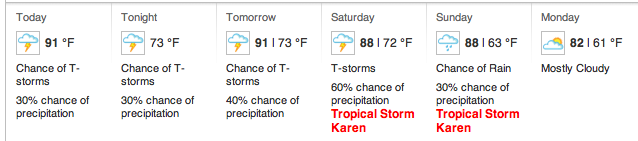
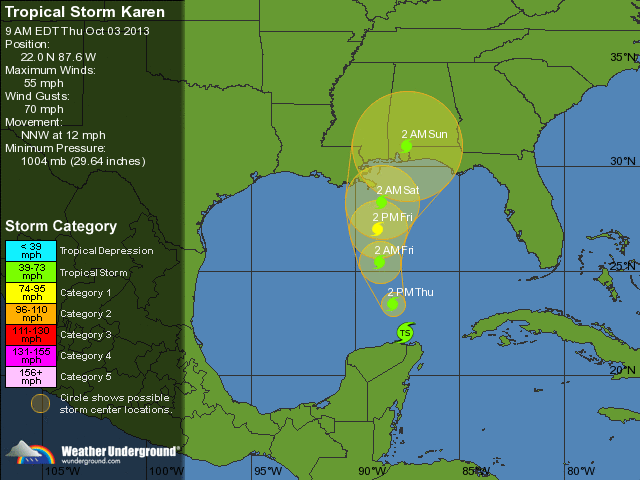
Batten down the hatches, matey. Oh wait, Talk-like-a-pirate-day was last week.
‘Staggering’ Traffic in Qatar as Cars Exceed Highway Capacity
From the Gulf Times Qatar
By Bonnie James/Deputy News Editor
Increase in the number of vehicles beyond the carrying capacity of roads, improper driving manners of many motorists and road works are among the key factors behind the acute traffic congestion currently being experienced in Doha and suburbs, it has been pointed out.
Brigadier Mohamed Saad al-Kharji, director of the Traffic Department, was on record the other day that the number of vehicles in Qatar has exceeded 1mn.
The total number of registered vehicles in Qatar had stood at 876,039 in 2012, according to official statistics. This means, as many as 123,961 new vehicles have been added to the roads within nine months of this year, at the average rate of a 13,773 every month, whereas the 2012 average for new vehicles was only 5,138 per month.
“The increase in the number of new vehicles is staggering and at almost three times the monthly average from 2012, it now exceeds the carrying capacity of the roads of Doha and suburbs, even from a layman’s perspective,” a traffic safety expert said.
This is evident on Al Shamal Road, a vital link of the Qatar Expressway Programme and a major arterial thoroughfare, during peak hours from Sunday to Thursday. All the way from The Mall signal to the Gharrafa area, the highway is clogged with bumper-to-bumper traffic.
“The average speed on Al Shamal Road would be around 30kmh, as against the maximum allowed speed of 100kmh, and that too if there are no accidents,” observed a motorist who drives on the highway regularly.
The congestion on Al Shamal Road has gone from bad to worse ever since the reopening of schools on September 10, compared to the time before the summer vacation, asserted another resident.
“Al Shamal Road is the preferred choice of tens of thousands of motorists who have to travel to the northern parts of the country and back, but the carrying capacity of its busiest portions has been exceeded,” the expert maintained.
Though Al Shamal Road has three lanes each in either direction, they are proving thoroughly inadequate during the rush hours. “You have to go beyond the Gharrafa stretch to be able to drive at the maximum permissible speed, if proceeding to the north,” a motorist said.
Many road users also feel the traffic management strategy leaves much to be desired, especially with regard to Al Shamal Road.
“On Thursday, access from many service roads to Al Shamal Road was blocked off in a bid to ease congestion on the highway. But this led to vehicles being stuck on the service roads for up to 40 minutes,” a road user recalled.
A parent who drives his children from the Qatar Decoration area of Salwa Road to their school at Duhail, a distance of about 23km, said it took him more than one hour to reach the destination, as access to Al Shamal Road from the service road at Al Waab was blocked.
“My children were late for school the first time this academic year as we were stuck on a service road for nearly 40 minutes while vehicles were moving fast on Al Shamal Road, a rare sight these days,” he said.
Many motorists don’t use indicators or move ahead promptly when the vehicle in front moves. “It is a common sight to see people having their breakfast, putting on make up, or having animated conversations on a handheld phone, while they are behind the wheel, oblivious to the fact that they are holding up traffic and aggravating the congestion,” noted a woman who observes the road scenes from her front passenger seat.
The traffic situation on the Corniche is expected to take a turn for the worse, given that Grand Hamad Street’s intersection with Doha Corniche has been closed for 10 days from Thursday midnight.
“If I used to start from home at 6.30am before summer vacation, I leave 15 minutes early these days, but now I guess I have no option but to start even earlier,” another motorist added.
The helicopter patrol, introduced by the Traffic Department since last week, to help ease congestion on Qatar roads by giving guidance to police on the ground during morning rush hours has improved traffic flow by 30%, according to Brigadier al-Kharji.
New Florida Law Bans Texting While Driving
From today’s Pensacola News Journal, where you can read the entire story by clicking here:
TALLAHASSSEE — Florida is joining 40 other states in the U.S. where it is illegal to text and drive.
The ban is one of more than two dozen laws passed by the Republican-controlled Legislature scheduled to kick in on Tuesday. Other new laws include one that gives citizens the right to speak at government meetings.
The prohibition on texting while driving comes after several years of trying by legislators. Previous attempts stalled in the face of House Republican opposition, with conservative members worried about government intrusion into people’s lives.
Some have called the law “watered down” since it is only a secondary offense to read or send a text, email or instant message on a smartphone while driving. That means police have to first stop drivers for another offense like an illegal turn.
Sen. Nancy Detert, R-Venice and the sponsor of the legislation, says it will still act a deterrent — especially among teenagers just starting to drive.
“My whole purpose in the law is just to be able to tell teenagers that texting while driving is against the law,” said Detert, who plans to visit a Sarasota County high school on Tuesday to point out the new ban. “I’m not sure how many of them are going to pull down a copy of the Florida statutes.”
The Department of Highway Safety and Motor Vehicles also plans to target teenage drivers to remind them about the ban. The agency is running a public service announcement in 69 high schools across the state on Tuesday and again on Oct. 15.
The Department of Transportation plans to remind drivers about the ban through its digital billboards along state highways.
Drivers who text take their eyes off the road for almost five seconds, according to the Federal Motor Carrier Safety Administration, which regulates the trucking industry. At 55 mph, a driver can cross the equivalent of a football field while not looking.
There were 256,443 reported crashes in Florida in 2012. In 4,841 of those crashes, a driver had been texting or otherwise using an “electronic communication device” while driving, according to a preliminary report from the Florida Department of Highway Safety and Motor Vehicles.
Every Day Sadists Walk Among Us

“Trust your feelings,” my friend told me when I was telling her about a person who seemed so nice, but made me uncomfortable. This article says the same thing; if you feel like a person takes pleasure from humiliating or hurting others, stay far far away. It’s only a matter of time before they turn on you.
Everyday Sadists Walk Among Us, Study Says
(From AOL News/Every Day Health)
Although we may think of sadism in a sexual or criminal context, sadistic tendencies are common in everyday life.
By Laurie Sue Brockway, Everyday Health Staff Writer
Whether it’s the Marquis de Sade, the evil stepmother from Snow White, or Nurse Ratched from One Flew Over The Cuckoo’s Nest, all sadists take great pleasure in inflicting pain on others. Fortunately, you are unlikely to meet those particular three anytime soon, but according to an unusual duo of studies conducted in Vancouver, British Columbia, and published in Psychological Science this week, it is very possible you will bump into a boss, a colleague, or even a family member who may be considered an “everyday sadist.”
While most people try to avoid hurting others — and will feel guilty, remorseful, and distressed if they do hurt someone intentionally or unintentionally — an everyday sadist enjoys being cruel and may find it exciting.
“We have probably all encountered people in our daily lives who — at least seem to — enjoy hurting others,” said lead researcher Erin Buckels, MA, who conducted this work as part of her master’s thesis in Social-Personality Psychology at the University of British Columbia. She is now a doctoral student at the University of Manitoba in Winnipeg.
“Everyday sadists lack empathy, and they possess an internal motivation to hurt others. However, they are unlikely to act in a way that would be criminal or dangerous — at least in most contexts, where such behavior is met with social disapproval or punishment,” Buckels said.
Everyday sadists may be cousins to classic sociopaths in their lack of empathy, but they are not considered a danger to society in the same way. “It is only in situations where cruelty is encouraged or socially acceptable that dangerous behavior might enter the equation,” said Buckels. “Both sadistic personality and situational pressures are necessary for sadism to manifest with everyday people. War is one example of this confluence — we have all seen the images of the Abu Ghraib prisoner abuse. All forms of cruel behavior have the potential to be motivated by sadistic pleasure, including bullying and abuse by others. If it were done purely for pleasure, then it would be sadism.”
If You Like to Hurt Bugs, You May Be a Sadist
It’s one thing to take an empty mayonnaise jar to catch fireflies when you are a kid and accidentally forget to poke holes in it, causing the fireflies to die. It’s another thing to enjoy harming bugs (or animals). Buckels used a bug-crushing exercise to draw the everyday sadists out in a controlled laboratory environment. For the experiment, she defined sadists in two ways: Their cruel behavior and felt pleasure in the lab, and personality characteristics consistent with sadism. A group of 71 participants were asked to fill out a sadism personality questionnaire and also given a list of four tasks they could choose from:
Killing bugs
Helping the experimenter kill bugs
Cleaning dirty toilets
Enduring pain from ice water
A bug-crunching machine fashioned out of a coffee grinder made distinct crunching sounds. Placed close to this machine were cups containing live pill bugs that were labeled with names like Muffin, Ike, and Tootsie. Those who selected bug-crushing were told to put the bugs into the machine and grind them up. Unbeknownst to them, there was a barrier that prevented the bugs from being dropped into the grinder. No bugs were killed for this experiment, but it brought the sadists out of the closet. Of 71 participants, nearly 28 percent chose to kill bugs.
What Exactly Is a Sadist?
Sadistic personality disorder was once defined as a mental illness, but over time sadism has been considered more of a lifestyle choice or a personality quirk or trait. The new Diagnostic and Statistical Manual of Mental Disorders (DSM-5), does include sexual sadism disorder. “This is marked by recurrent and intense sexual arousal from the suffering of others as manifested by fantasies, urges, and behaviors,” said Wilfried Busse, PhD, a psychotherapist based in Bethesda, Md. “To meet full criteria for the disorder, an individual also has to act on such urges by inflicting harm on a non-consenting individual, or must experience such uncontrollable urges to cause significant social and occupational impairment.”
“The central feature of sadism is deriving pleasure from watching or inflicting physical or psychological harm on others,” added Dr. Busse. “In the extreme form a sadist will seek to inflict suffering on another for the psychological gratification derived from such an action.”
Buckel’s study did not use classic criteria to define sadism – most widely known as sexual or criminal behavior – and instead explored sadism as it exists in the “subclinical” range of personality, an aspect of sadism not considered a mental illness.
“There is clearly a difference between a person who gets pleasure from killing bugs and a person who kills other humans for pleasure,” said Buckels. “That being said, the core experience of sadism is probably pretty similar for both of them. Our research has also revealed both similarities and differences between people who enjoy acting cruelly, or direct sadists, and those who simply enjoy watching cruelty, or vicarious sadists.Regardless of whom the victim is, direct aggression requires a certain amount of callousness and a lack of distress towards the suffering of another living creature.”
How to Spot a Sadist
There is a big difference between the kind of evil sadists we know from history and movies and people with sadistic impulses, who fall into a category of sadism that is considered a personality trait rather than a personality disorder.
“It is very important to differentiate between an antisocial, or sadistic, personality disorder and sadistic impulses,” said psychologist Fran Walfish, Psy.D., a family therapist and author in Beverly Hills, Calif.
“Antisocial personality disorder is very rare,” Walfish said, offering examples such as Hitler, murderers who enjoy torturing their victims and watching them suffer, and, possibly, Syrian President Bashar Assad. “But the rest of us have unconscious sadistic impulses. Even the kindest, most loving person, when terribly mistreated, can feel an impulse of hate very strong,” she added.
Walfish explained that there are several sub-types of sadists:
Explosive sadist. When disappointed and/or frustrated with their lives, humiliated or hopeless, they lose control and seek revenge for the mistreatment to which they feel subjected. They are known for being unpredictably violent. This manifests through tantrums, fearsome attacks on others, especially family members, and uncontrollable rage.
Tyrannical sadist. They are frightening and cruel because they appear to relish the act of menacing and brutalizing others; forcing their victims to cower and submit gives them satisfaction.
Enforcing sadist. They tend to be military sergeants, deans of universities, prison overseers, police officers or people with other authoritative functions who feel they should be the ones controlling and punishing people who have broken rules, regulations or laws.
Spineless sadist. They are typically deeply insecure and act like cowards. In anticipation of real danger, they project their hostile fantasies and strike first, hoping thereby to forestall their antagonist and ask questions later. They use aggressive hostility to send the message to others that they aren’t intimidated or fearful, so that they can control their inner feelings and display the exact opposite of how they actually feel. They seek out scapegoats to gang up on, which allows them to assault the exact things that exist within themselves that they want to deny.
Everyday sadist. There is a renewed interest in studying subclinical sadism as a personality trait, said Walfish. Subclinical psychopathy, narcissism, Machiavellianism, and everyday sadism form the so-called “Dark Tetrad” of personality.
“These people aren’t necessarily serial killers or sexual deviants but they gain some emotional benefit in causing or simply observing others’ suffering,” said Walfish. “The type of person the study is referring to are, for instance, the co-worker who repeatedly humiliates you and smiles or appears to reap pleasure from hurting you. If you self-advocate and say something that inflames your co-worker, she retaliates with evil revenge, further humiliating you.”
Exercise Caution Around Everyday Sadists
The British Columbia researchers surmised that everyday sadists are not the most popular people.“A person who has a high score on a sadism personality questionnaire is unlikely to be regarded as a nice and loving person,” said Buckels. “That is not to say that they are always nasty or that they can’t love others; but in general, high scorers tend to be less nice than average.”
How does someone become an everyday sadist? “In general, the cause or reason someone wants to go the extra effort to hurt another is because someone terribly mistreated them,” said Walfish. “That someone is usually their mother, father, or an older sibling. The sadist was a receptacle, or container, for hostility and evil meanness. These toxic feelings become too much for one to bear. They have no choice but to find a weaker victim and spew their venom onto the other.”
“Within their own families and in the workplace these people cannot be trusted,” Walfish observed. “No one can ever feel safe with them. Therefore, they do not have real relationships. They engage by exploiting, manipulating, and using other people as a means to their own end. The best thing to do is keep reasonable distance from these people. Always be pleasant so you don’t become their target. This does not mean to kiss up. It just means you present yourself as a benign nice guy. Never do business or get close to one of these people. They will always take you down.”
Buckels said she was surprised to find such a low baseline of positive emotions reported by sadists. “They are not just acting out to compensate for deep-rooted insecurity or low self-esteem,” she said. “Interestingly, after an act of cruelty, their moods seemed to lighten, suggesting instead that the sadist’s appetite for cruelty derives from some diabolical need. Although speculative, our hypothesis is that sadists have an underlying deficit that is sated through cruelty’s rewards.”
One Night in Hawali; Cops Book 995 “To Fight Chaos On the Roads”
KUWAIT: Traffic police in the area of Hawalli have set a record by booking 995 drivers and motorcycle riders in a one-day campaign to fight chaos on the roads. “A large team of traffic policemen was deployed in the area to check the extent of discipline and compliance with the law on the roads,” security sources told local daily Al-Rai. “The policemen detained 20 people and impounded their cars. Among them, there were five people who did not have a driving licence, seven who were utterly reckless in their driving, three who staged a race and five who did not have licences to ride their motorcycles,” the sources said. According to the figures he revealed, 23 cars and five motorbikes were impounded in the crackdown conducted on Friday.
Lesser violations included uninsured vehicles, tinted windows, not wearing seat belts and parking in areas for people with special needs, the sources said. Traffic officers in Kuwait have been actively engaged in relentless campaigns to restore order in a sector plagued by a high toll of accident fatalities, reckless driving and non-compliance with administrative procedures. Foreigners who repeatedly broke the law have been deported for endangering lives while citizens have been deprived of their vehicles or licences.
Abdul Fattah Al Ali, assistant undersecretary for traffic and the force behind the campaigns, who had come under attack, mainly from the opposition, for his strong approach towards foreign drivers who commit several traffic offences, said that the trend to end the chaos and impose road discipline would continue.
“I am not an abusive person, but I do apply the law and assume my responsibilities to save lives and protect people from reckless drivers,” he said. “The expatriates who do not respect the law should be sent home. We will deport the irresponsible expatriates who do not respect the laws of the country,” he said. “We have also extended the vehicle impounding period from two to four months and drivers can now be held for 48 hours for the sake of the investigation and the normal procedures.”
The crackdown led the authorities to discover that 20,000 forged driving licences had been issued since 2010. “We have withdrawn 7,000 forged licences, and we are working on tracking down and cancelling all the others,” Al-Ali has said.
He added that expatriates summoned to the traffic directorate should come forth and hand their licences, assuring them that there would be “no questions asked”. However, those who fail to show up to hand back the licences will face forgery charges and will be deported, he said.
Comment: 20,000 forged licenses??? 20,000???
Kuwait Traffic Deaths Plunge from 50 to 19 Per Month
From the Kuwait Times, an awesome statistic. In just months, the Al-Ali states the traffic deaths per month have dropped from 50 to 19. That’s incredible:
Traffic chief criticizes ‘non-cooperative’ departments
KUWAIT: Maj Gen Abdulfattah Al-Ali has been credited for positive changes seen on roads around Kuwait ever since he assumed post as Undersecretary Assistant for Traffic Affairs at the Interior Ministry five months ago. The senior official recently said that he did not come up with anything new but merely made sure that the existing laws were enforced. Al-Ali was interviewed by Al-Qabas as he spoke of efforts which have helped reduce traffic violations by 30 percent, cut road deaths and eased traffic jams. “We still have a long way to go because traffic awareness does not happen overnight”, he said, “and there is a lot of work to do before we can reach a level of contentment”.
During the interview Al-Ali criticized several state departments who he accused of being ‘non-cooperative’ with proposals to address the traffic jam problem. “There are ministries who remain unwilling to take simple decisions that can help reduce traffic congestions”, Al-Ali said. He also criticized the Kuwait municipality for allowing contractors to build apartments without allocating enough parking space. He also indicated that efforts to license parking lots with a capacity of 120 vehicles are often rejected. On Tuesday Al-Qabas published figures that Al-Ali mentioned during the interview, including withdrawal of 4,000 driver’s licenses which were obtained through wasta, as well as reducing a monthly rate of issuing licenses from 7,000 to 1,200. The official credited extensive traffic campaigns for reducing the average road deaths from 50 to 19 per month.
The General Traffic Department in the Interior Ministry launched extensive campaigns last April and these have resulted in thousands of traffic tickets, millions of Kuwaiti dinars collected in fines, and the deportation of thousands of expatriate drivers, in addition to firmer penalties against Kuwaiti offenders. No timetable is set for the end of campaigns and Major General Al-Ali has repeatedly indicated that crackdowns will continue as part of the department’s efforts to reduce traffic jams, curb the number of road fatalities and fight traffic offenses. Al-Ali also spoke to Al-Rai daily who quoted his statements yesterday in which he reiterated that fines should be paid to avoid a travel ban and suspension of license.
According to the senior official, the Interior Ministry has so far managed to collect KD 38 million out of KD 41 million it is owed, and withdrew more than 7,000 out of nearly 20,000 forged licenses issued since 2010. Meanwhile, Al-Watan quoted an Interior Ministry source yesterday who blamed state departments for “failure of implementing the General Traffic Department’s plans to reduce traffic”. Speaking on the condition of anonymity, the source stated that unnamed state departments have been ignoring offers to change timings that the traffic departments have been proposing since 2005. Major General Al-Ali attended a meeting last week with officials from the Ministry of Education and the Civil Service Commission, but no consensus was reached to change schools timings ahead of the beginning of the academic year. —
Whittier and Chenega Bay on the M/V Kennicott
Today we awoke in Whittier, a major shipping hub into the interior of Alaska,
and a connector to Anchorage. Although the town has only a population around
500, it is a very busy little port, acres of shipping containers, miles and
miles of train tracks, and trains coming in and out every few minutes.



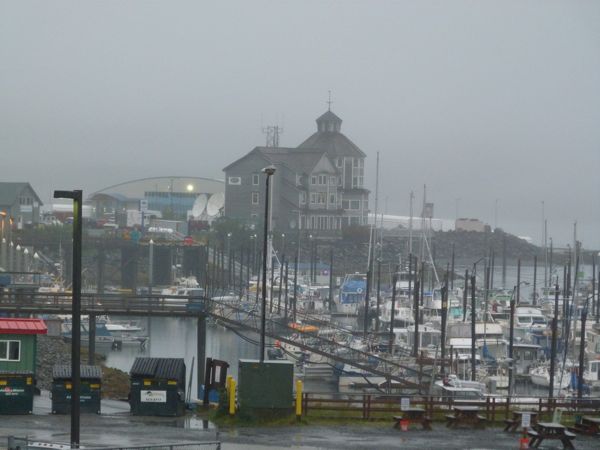

There is an old government building, it looks like something the Soviets built.
It is huge, and was damaged by a bad earthquake several years ago so it has been condemned as unusable, but would be so expensive to destroy that they haven’t torn it down yet. It has become a sort of cult place, a favorite for raves and spontaneous parties, young people camp there. It is rumored to be haunted, which only makes it more alluring. No matter how secure they try to make the building, someone finds a way in.

There is some confusion in my mind about arrivals and departures – they are not
the same as the list I so carefully printed off from the website. If I had known we would be in Whittier until 10:30 we would have debarked, which we are allowed to do if we have tickets and ID to get back on. My little calendar showed a 0800 departure, so we waited, and waited – but the ferries make their own rules, according to weather and tides and what they are porting from one seaside village to another. We watched containers full of goods come on for the more remote locations.
I used to surprise my Kuwait friends, telling them it was a lot like Alaska, and the longer I am back here, the more parallels I see. One is that almost
everything you eat or wear or build with has to come from somewhere else. That
requires shipping, or flying something in. I remember my Mother used to order
our snow suits in August, so they would arrive before the ships stopped coming
in. Like Kuwait, groceries are expensive, especially specialty items that are
imported. Like Kuwait, people are dressed modestly, all the important parts
covered – it’s cold! Most women are covered from their toes to their wrists! If
the weather is bad enough, even their hair is covered, and occasionally their
faces! Men, too! Very modest people, these Alaskans 🙂

AdventureMan wanted to take a shower, but the ferry system asks that we not
shower while in port; they like not to dump waste water in port, so as soon as
we departed, he jumped in the nice warm shower. Once again, almost all we can
see is open water, en route to Chenega Bay, and fog.


During the trip to Chenega Bay, the big excitement is the once-a-week fire drill, and this time, the fire was near our cabin (pretend fire.) I am guessing some people would rather ignore the fire drills, but think about it – aren’t you glad the crew goes through these exercises in case there is some emergency? Aren’t you glad they know what to do? One of the guys laughed and said “We get a lot of respect and people step aside when they see us carrying these fire extinguishers!” The purser told me that sometimes people STEAL the signs they put on doors – imagine!
Lifeboat being lowered:

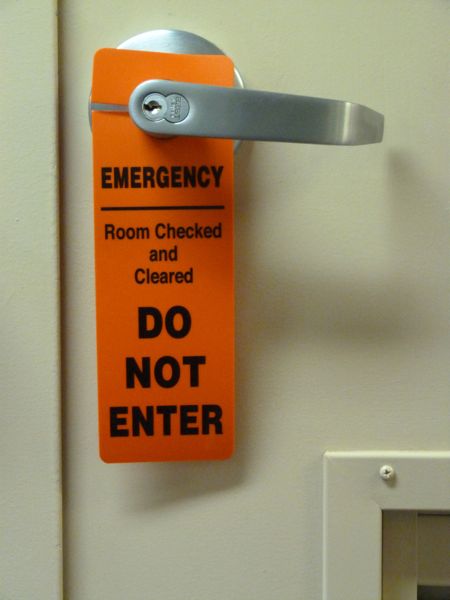
Do Not Enter tag on our door:
Chenega Bay – We arrive, foggy but no rain, to find an eagle perched in nearby tree, welcoming us.


Very short turn around time shown, so once again, we do not leave the ship, but wish we had when departure time is postponed. The dock is not near anything, but a short walk over the hill takes you to the small village of Chinega Bay and a beautiful Russian Orthodox Church and an Alaska Native arts museum named after fisherman Johnny Totenoff.
What love what happens here – this village of only maybe 50 people are welcomed on board whenever the ferry docks. They are isolated, remote. The men, women and children ride their ATV’s down the hill to the ferry, come aboard, and chow down on hamburgers, fries, and soft ice cream cones. Some of the young girls are dressed in long dresses, sort of odd, maybe a religious group. Others are wearing short short skirts and tank tops in the cool, foggy weather. Before the ferry departs, the Chenega Bay residents all have to debark.
Departing Chenega Bay:

Beginning to see snow peaked mountains en route to Kodiak Island

Non-Essential State Department Personnel Ordered to Leave Yemen
I know, I know, it is not a funny headline. But here is the thing. People have egos. You might wonder why anyone would stay in the face of a threat so grave. It isn’t by coincidence that so many prisoners were busted out of prison – hundreds in Iraq, in Yemen, also if I remember correctly, in Pakistan.
These countries, under international understandings and agreements, provide security for one another’s embassies. Like WE provide security for the Saudi and the Yemeni and French diplomats in the United States. When a country suffers massive prison breaks, it is only prudent to wonder how well they might be able to protect international diplomats – it’s all security.
But – and here is why a very serious headline can make me laugh so early in the morning – who wants to be “non-essential?” I’ve lived through similar situations; people want to think themselves important – you would be surprised how many people will choose to stay, knowing the dangers, because they want to consider themselves “mission-essential”. 🙂

WASHINGTON — The State Department on Tuesday ordered non-essential personnel at the U.S. Embassy in Yemen to leave the country following the threat by al-Qaida that has triggered temporary shutdowns of 19 American diplomatic posts across the Middle East and Africa.
The department said in a travel warning that it had ordered the departure of non-emergency U.S. government personnel from Yemen “due to the continued potential for terrorist attacks” and said U.S. citizens in Yemen should leave immediately because of an “extremely high” security threat level.
“As staff levels at the Embassy are restricted, our ability to assist U.S. citizens in an emergency and provide routine consular services remains limited and may be further constrained by the fluid security situation,” the travel warning said.
The U.S. Embassy is located in Sanaa, the capital of Yemen.
The State Department on Sunday closed a total of 19 diplomatic posts until next Saturday. They include posts in Bangladesh and across North Africa and the Middle East as well as East Africa, including Madagascar, Burundi, Rwanda and Mauritius.
This is only an excerpt from AOL/Huffpost World News where you can read the rest of the story by clicking the blue type here.
The Official Worst Drivers in America: Miami
Slate.com has figured out which city has the worst drivers in America: Miami, Fla.
Slate looked at years of data about traffic accidents, automotive fatalities, alcohol-related driving deaths and pedestrian strike rates as indicators of bad driving.
Three out of the five cities with the worst drivers are found in the Sunshine State, with Miami topping the list as the absolute worst. Miami is first in auto fatalities and pedestrian strikes and, according to Slate, first in “obscenity-lace tirades of their fellow driver”. Fellow Floridian cities Hialeah, which comes in at number three, and Tampa at number four also seem to host a populace with a passion for running down pedestrians and fatal car accidents.
Miami shows up on more than just Slate.com’s worst list. The Huffington Post reported that Miami also had the most hit-and-runs in Florida last year, an incredible 35 a day. Transportation for America also ranked the most dangerous cities in America to drive in, with the top four all in Florida. Maybe Floridians should look into buying heavy-duty trucks and steering clear of sidewalks.
From the original report at Slate.com where you can read the entire article:
Adjusting the Allstate rankings for mileage this way has significant effects. Washington, D.C. remains the worst driving city using the insurance claims data, but Philadelphia surges to second worst. Hialeah drops seven places, from fourth to 11th.
Next we consider additional indicators. Car crashes are bad, but some accidents are worse than others. In July 2012, the Centers for Disease Control and Prevention published automobile fatality data for major cities and metropolitan statistical areas from the year 2009. It’s useful for our purposes, but it comes with a couple of caveats. The researchers didn’t publish data for some of the smaller cities on our list. In those cases, we’ll use data from the larger metropolitan area. In addition, three cities (Boston, Newark, N.J., and Providence) had fewer than 20 fatalities, but the precise number is unpublished. We’ll assume that each of these cities had 10 fatalities, so we have a number to enter into the calculations.
Drunk drivers are bad drivers, and some cities have far more of them than others. Not all locales publish reliable data on drunk driving fatalities, so we’ll turn to the Century Council, an association of distillers organized to combat drunk driving. The group published the number of fatalities from alcohol-related car accidents in 2011. The data are, unfortunately, broken down by state rather than city. So, for our purposes, the sins of the state will be visited upon the cities. (New York City has reliable data, so we can use city-specific data in that instance.) We can’t adjust the statewide data for mileage, because our mileage numbers relate only to cities themselves. So DWI fatalities will have to be computed per capita, unadjusted for how many miles residents of a city drive.
Pedestrian strikes are another key metric. For this indicator we turn to the CDC’s WONDER, a searchable database of morbidity and mortality statistics. It’s a priceless epidemiological tool as well as a bottomless source of trivia. The most granular data on pedestrian injuries and deaths is by county.
You might object to the use of pedestrian injuries as a metric of driver incompetence, because some cities have far more pedestrians than others. That’s a fair point, but consider New York City. It is, by far, the most walked city in the United States. Two-thirds of New Yorkers either walk or use public transit to get to work. According to the website WalkScore.com, only 2 percent of New Yorkers live in neighborhoods where cars are necessary. While every pedestrian strike is a tragedy, there are fewer in New York than you might expect. Miami-Dade County, a significantly less walked city, had 20 percent more pedestrian strikes per mile driven between 2006 and 2010 than New York.
. . . . .
And now, America, on to the cities with your worst drivers.
No. 5: Baltimore. Baltimoreans just can’t keep from running into each other. They were outside the top 10 in fatalities, DWI deaths, and pedestrian strikes, but their rate of collision couldn’t keep them out of the top five overall.
No. 4: Tampa, Fla. Tampa doesn’t do any single thing terribly, but it is consistently poor: 18th worst in years between accidents, fifth in traffic fatalities, tied for 11th in DWI fatalities, and 10th in pedestrian strikes. If the city had managed to get outside the bottom half in any individual category, Tampa residents might have avoided this distinction.
No. 3: Hialeah. The drivers of Hialeah get into a middling number of accidents, ranking 11th among the 39 candidates. But when they hit someone, they really mean it. The city finished third for fatalities. They also have a terrifying tendency to hit pedestrians.
No. 2: Philadelphia. Drivers in the city of brotherly love enjoy a good love tap behind the wheel. Second-places finishes in collisions and pedestrian strikes overwhelm their semi-respectable 16th-place ranking in DWI deaths.
No. 1: Miami. And it’s not even close. First in automotive fatalities, first in pedestrian strikes, first in the obscenity-laced tirades of their fellow drivers.
A couple of other noteworthy findings: Californians did reasonably well. Although the Golden State had seven cities among our 39 candidates, only Glendale finished in the top half of the table. Louisiana’s two entries, Baton Rouge and New Orleans, finished 6th and 15th, owing to the state’s terrible record of drunk driving fatalities.
Washington, D.C., the whipping boy of the Allstate rankings, dropped to 16th, owing to low numbers of DWI fatalities. Boston drivers don’t deserve the torment they receive. They have few automotive fatalities and rarely kill people in alcohol-related accidents. It goes to show how flawed opinion polls can be.
Recent Comments
ExpatAlien on What Country am I Living … intlxpatr on Yellowstone: Old Faithful to C… Michelle on Yellowstone: Old Faithful to C… Cathy on No Grown-Ups in Charge intlxpatr on Waiting for Snow Wikipedia Donate Button

Amazina


Early Voting in Florida


 Here There and Everywhere