Dusk in Kuwait
Dusk anywhere is one of my favorite times of day. In Riyadh, my husband and I would head down to the Dira’a souk, usually arriving just before the Isha call to prayer. We would buy a couple felafel sandwiches and a juice drink and sit in the large courtyard by the fort and eat our sandwiches while all the shops were closed for prayers. The sky would go from deep blue to a very deep blue purple, and it was that moment we waited for – the stars just visible and this just-before-black incredible color.
In my mind there is also a hush, but that is unlikely, as there were usually women and their children waiting in the same area for the men to finish their worship, and the children would be playing.
We are still looking for felafel sandwiches that taste that good. We would laugh; eating out for under $2 and it felt like such luxury.
In Kuwait, we are usually on our way to meet up with friends or somewhere around dusk. I always have my camera handy – you just NEVER know what you might see.
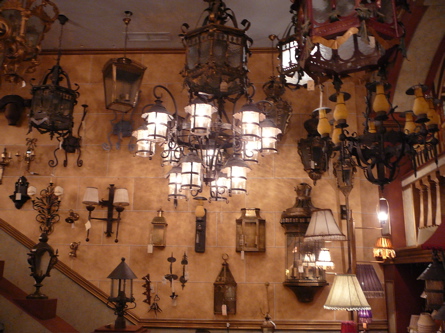
This isn’t really dusk, but it is dusky, in the interiors/exteriors shop as you enter the Free Trade Zone in Shwaikh – I can’t help it, I love this shop:
Not crisp, but the skyline is so eccentric:

Dwarfed in downtown Kuwait:

Almost dark – the mosque in the circle, downtown Kuwait:

Hats off to Saudi Women
Last week in the May 10th Kuwait Times, Dr. Sami Alrabaa wrote a fascinating article on Saudi Women, Saudi Arabia and some shifts in press coverage in Saudi Arabia.
This is how the article starts:
Anti-Woman Culture
More and more Saudi women are speaking out against preachers in their country. Fatma Al-Faqih, a columnist at the daily Saudi Al-Watan accuses preachers (April 17) of “denigrating women” and “inciting discrimination against women.” “Day in day out, our preachers flood us with accusations against women and beg men to defend the virtues of society that women corrupt,” Al-Faqih writes. This “anti-woman culture”, Al-Faqih continues, causes women to feel mentally and psychologically inferior, “like a quarrelsome child who must be constantly supervised, intimidated, and punished into performing her duties.”
It is also unprecedented that the Saudi print media are allowing women to air their indignation and frustration. Al-Faqih also writes, “Women are good Muslims as men are. But our preachers insist on producing a distorted picture of women, which has nothing to do with true Islam. The Prophet Mohammed (PBUH) never discriminated against women. He respected them. He valued their opinions and occasionally sought their advice. He treated them as full-fledged human beings. Our preachers however, depict women as spoilt minors who have got to be constantly instructed to behave themselves. They cannot be trusted.”
Al-Faqih also wonders, “Where is it written in the holy Quran and Hadeeth that women are not allowed to drive their own cars? Where is it stated that women are forbidden to travel alone, leave their houses, or travel alone with the family’s chauffeur? Where is it stated that women are forbidden to have a passport without permission from their male closest relatives, forbidden to go to school or university without permission, forbidden to take a job without permission, forbidden to open a bank account without permission, forbidden to name their own children without their men’s approval?”
Further, Al-Faqih complains, “Where is that divine law which does not allow women to sue their husbands for divorce? Where is it written that women’s voice is a sexual organ and hence she is not allowed to speak in public and express her concerns? Where is that sacred law that does not allow women to keep their own children after divorce? Where is it written in Islam that women are not allowed to vote or run for office?”
Al-Faqih concludes, “Are we in Saudi Arabia a special brand of Muslims? In other Muslim countries, women have become presidents (in Bangladesh for example), prime ministers (in Turkey and Pakistan), ministers in Egypt, Syria, Morocco, Kuwait and other Arab countries. In all Muslim countries, women have the right to vote and run for office. No, we are not a special brand of Muslims. It is our preachers who interpret Islam their own way.”
You can read the rest of the article by clicking HERE.
My comment: When I lived in Saudi Arabia, my eyes were opened. My Saudi Arabian women friends were SO smart, and they really knew their Quran. They also knew hadith, and they knew the weight of each hadith, which were strong and which were weak. They didn’t just memorize suura; they thought about them, they discussed them and analyzed them.
Through them, I understoon Islam in a whole new way, and understood the revolutionary thinking of the Prophet, who was kind to women, took council from women, and treated women fairly. In an age when female babies were routinely killed, he stood against the tide of tradition, and forbid the killing of female babies, and insisted on rights of inheiritance for females (and this in the 7th century).
And no one found it more ironic than the Saudi women that Saudi Arabia has become a worldwide symbol for repression of female rights. My Saudi sisters claim that in the birthplace of Islam, Islam has become distorted, a weapon used against women.
My Saudi women friends often told me I was not required to wear a scarf. My embassy told me the same thing, that it was a voluntary sign of submission to Islam. The embassy also told me to carry a scarf, and if accosted by the mutawa,(religious police, the “The Committee for the Promotion of Virtue and the Defense Against Vice” or something like that) to put it on until he was out of view, and then to take it off again, that the scarf was not mandatory. The mutawa felt differently, and would boom out in loud, offended voices: “MADAME, COVER YOUR HAIR!”
I would comply. But the unfairness never failed to rouse my ire. Excuse me? My hair might cause YOU to have a lustful thought? You control YOURSELF and your thoughts, and let ME worry about my morality.
So my scarf – errr hat – is off to these Saudi women who have the bravery to write these well thought out position papers to the Saudi papers.
The interesting thing to me is that the Saudi press is printing the women’s complaints now. . . perhaps, insh’allah, some changes are in the air.
And a muse – So when a Saudi woman comes to Kuwait, for example, or to France – is she allowed to drive? We know it is illegal for her to drive in Saudi Arabia, but is it also immoral for her to drive in Saudi Arabia? Or is it immoral for her to drive anywhere? So like is it immoral for all us women to be driving anywhere?
Saudi Dies in Court
As an ironic tie-in to an earlier blog article today about Kuwaiti women seeking legislations on Women’s Rights, here is a related article from today’s Kuwait Times 23 April 2007:
JEDDAH: An elderly Saudi man dropped dead in court after it banned him from stopping his three daughters from getting married, newspapers reported yesterday. The man apparently had a heart attack once the cassation court judge in Makkah told the three women, aged 36, 39 and 40, that they could marry over their father’s objections, Okaz reported.
The women, whose father had on several occasions turned down their requests to marry, can now marry “honest men” who follow their religious duties, the Islamic court ruled, according to Al-Madina newspapers.
The Kuwait Left Turn
I actually first came across the first left turn in Saudi Arabia, and would watch in horrified fascination at the stoplights. Saudi Arabian driving was the worst I have seen, ever, anywhere in the world, but the driving has some inner logic if you are there long enough to get used to it. (I had thought I would hate not driving, but in Saudi Arabia, I was happy not to drive.)
In Saudi Arabia, there was no respect for lanes at all. At a junction there might be four legal lanes; one marked for people turning left, one for people turning right, and two for going straight ahead, but when the light turned red, there would be six or seven or eight cars lined up, all squeezed together, almost door to door. If there is a space, a car will fill it.
And maybe four or five of those cars would turn left, but not necessarily the four cars closest to the left. One might be in the far right turn lane, but going left. Yes, there were accidents, but not so often as you would think.
In Kuwait, they have refined the right-turn-lane-left-turn down to an art. I’ve gotten so used to it I hardly notice it any more, and that is why I am blogging about it now, so I will have it down before it falls of the screen.
Here is how it works. The guy in the far right lane realizes he needs to turn left. First move – he turns the wheels left and inches forward. Second step – this is optional – he gets the attention of the guy to his left and indicates he needs to go left. This is done with a combination of desperate looking eyes and a hand motion. Third step – he continues inching forward. Last step – just as the light is about to change/is changing he shoots out into the intersection, across four lanes of traffic, making his left turn.
There’s no honking. People are used to it.
That the lane second to the left also often goes left, although it is marked to go straight ahead, is a given.
It happens so often, we take it for granted.
The second variation on a left turn is that in Kuwait there are long stretches between stoplights or roundabouts, but there are conveniently marked areas where you can make a u-turn. There are left turn lanes that make it easy. But often, there are people who don’t want to get in line, or maybe realize too late that this is where they need to turn. No problem. They just get right up next to you and start edging their way in. It can be really scary when that someone is a big cement truck, or a bus full of workers.
Sometimes there can be two or three cars making that left turn at the same time. You would think it would be a disaster, and somehow, it all seems to work.
All this is . . . . very creative, refusing to be limited to what the law says is permissible. The problem becomes switching tracks when you go back to a country where the laws are less flexible.
Santa’s Wish List: Cookbooks
You might think I love to cook. You would be very wrong.
I had a great friend for many years, one of those Southern gals with a last name first name, and when one day I told her of my secret guilt – that cooking wasn’t FUN for me, she said “what we do, every day, is SURVIVAL cooking. We just meet the expectation of getting a meal on the table. That doesn’t have to be fun, it just has to be done.”
That’s pretty much what I do, and why I have been giving you all these great recipes. The truth about the recipes I am giving you is that most of them are EASY and they taste good. A few require special equipment and mastering a new skill, but it’s like swimming – once you’ve done it, it’s easy. There is nothing complicated about the recipes I am sharing with you – they are ones I use, too!
Books About Food and Eating
First I will share with you two books available through third party vendors at Amazon. The first is Food Lover’s Companion (A Comprehensive Definition of Over 4000 Food, Wine and Culinary Terms) by Sharon Tyler Herbst, which is available starting at $14.93, and the second is M.F.K Fisher’s The Art of Eating, also available through Amazon at $11.53. The Companion is invaluable when someone uses a term for a cooking technique or ingredient you don’t know; it has words for everything! My husband reads this book sometimes just for fun and is always sharing new information he has learned. The MFK Fisher book is just plain fun reading about food, full of information and anecdotes and stories, written in an enormously readable way.


Beginner Cookbooks
The first cookbook I used was the McCalls Cookbook – no longer in print. It had photos of how do do the things I found so intimidating, and that is where I got my earliers Christmas cookie recipes – the Russian Tea Cakes and the Candy Cane Cookies. The second was The Joy of Cooking, which I mentioned in an earlier blog entry. What is good about these books is that they keep it really simple. In Joy, they give you a long theoretical section, which you can read if you have the time, and which helps, but at the beginning it isn’t always easy to even understand the basics. That takes time. Then you can go back and read later and go “Aha! Now I understand!”
Cookbook Secrets
Actually, I love reading cookbooks. I have a huge collection. And almost all of them are Junior League Cookbooks. So here’s the secret – when you are looking for cookbooks, look for ones where women who contribute have to put their names. If their name is on the recipe, you can trust that the recipe will work, and that it will be one of their best recipes – they don’t want to be embarrassed!
The majority my cookbooks are from the South. And narrowing it down even further, most of my favorites come from Louisiana or Georgia.
The first one I ever bought was Talk About Good! And oh, it WAS good!

These recipes use ingredients like real cream and real butter and lots of salt. Southern people have some of the lowest life-expectancy rates in the United States – I suspect their eating habits have a lot to do with it. But if it isn’t a habit to eat so richly, every now and then it just tastes SO GOOD to use these ingredients. You will also notice that it has what they call a “plastic comb” binding. That means when you open it up to follow a recipe, it will lie flat. That’s a really good thing!
My second favorite is Quail Country, by the Junior League of Albany, Georgia. You would really have to scour the book stores to find this out-of-print classic, because so few people would ever want to part with it. Another gem is The Fort Leavenworth Collection, if you can get your hands on it – again, yard sales, used book stores would be your best bet.
There is a wonderful group of stores in the USA called Half Price Books. If books are not being bought as gifts, if you plan to just read a book and pass it along, or if you like to have a few on hand to pass along because you think they are so great, Half Price Books is a great place. They have the most obscure books, books you never thought you would see again. Many of their books are new, but remaindered (left over from book stores that couldn’t sell the, or from publishers who published too many copies) so they are sold at half price. They will also buy used books from you, but to me, they offer so little that I would just as soon give them away. (No, I don’t own stock in Half Price Books.)
There are some other fabulous Junior League cookbooks – the California Heritage Cookbook, the Seattle Classics, and there are other cookbooks produced by churches and charities that also have “real people” recipes that are drop-dead good. I remember once sharing a recipe for Chocolate Cheesecake from Seattle Classics. My friend told me she made it for Christmas dinner, but everyone was too full to eat dessert. But she said all night she heard doors opening and closing, as people snuck down to the kitchen to slice a little of the cheesecake and eat it, and in the morning, only a fragment was left!
Seeking out the best cookbooks can make every vacation an adventure. I have cookbooks from Kenya and Tunisia, Qatar, Jordan and Saudi Arabia . . . all full of great recipes, recipes with names attatched. I wish you a grand adventure seeking out cookbooks that will thrill your heart. Happy Hunting!
Evening out: Learning to be Flexible
A post from Little Diamond on having passport photos taken in Lebanon reminds me of how differently we live in our foreign adventures. She tells how patiently the photographer dealt with her, encouraging her to comb her hair, and finally, after showing the first photos, convinced her to clean up her act for a second, more glamorous, round.
I read a book Almost French by Sarah Turnbull, in which she describes her arrival in Paris, dressed in typical Outback Australian style, and her adventures learning that in Paris, you don’t even leave the apartment in sweatpants to run to the baker because “it might hurt his eyes.”
I remember returning home from life in Germany and thinking “the women here are so COMFORTABLE in their own skin. They wear jeans, even into their 80’s, they go hiking, they go without makeup, and they look happy!” and I wanted that for myself. In my neck of the woods, too much make-up is a big no-no. And too much is anything beyond mascara.
Identity photos in the USA are simply expected to be awful, so no one thinks too much about it, and we all just avoid showing our ID’s if we can help it (maybe that’s why we drive so lawfully, so that we don’t have to show our dismal drivers’ licenses?)
So when I had to have my first residence card done in Saudi Arabia, I didn’t go to a lot of effort. I cleaned up, combed my hair, put on my abaya and scarf around the neck, and went to the local photo guy and got the photo taken. It happened to fall on the day of a significant birthday, you know, one of those with a zero in it. Later that day, when we picked up the photos from the beaming photographer, I looked, and I mentally gasped. The photo looked fabulous.
What to do? I know the law says photos are to be unretouched, but this photo is clearly a little doctored. As any woman would, I decided to just go with the local customs. I even bought a few more enlarged versions to sent to my family. I still grin when I look at that photo. Yes, I even framed one for myself.
Here in Kuwait, I have had to had these photos taken several times, I don’t know why, for several different cards, and then the cards take time and someone loses the photos and I have to have them taken again. There is a very nice man, he takes them and I can get them almost instantly from him. I even got to pick out the one I wanted, and then, he started airbrushing.
“What are you doing??” I exclaimed, as he brushed broad strokes across my face.
“Oh Madam, I am just evening out your makeup a little bit,” he said, as freckles, crow’s feet, shadows, and any blemish totally disappeared. I wasn’t wearing any makeup, only mascara.
Hypocrite and vain as I am, I just rolled with it. It’s another culture, and I know, because I asked, that everyone gets the same treatment, the re-touch, so all the ID photos look pretty good. Mine would draw attention if it weren’t retouched, I tell myself.
Tash Ma Tash takes on Muttawa?
I love NPR. Today, in a Ramadan special, they discussed the 16th season of the Saudi Arabia soap Tash ma Tash. I remember it got a lot of attention a couple years ago. NPR says that this year, they are taking on the Committee for the Promotion of Virtue and Supression of Vice. There is a village where the morals police have determined that women should not be riding their donkeys on the same trails the men are, or that perhaps they should be fully enclosed in some kind of bubble, or maybe a special underground tunnel should be built solely for the use of women to keep them from view of the men.
Is anyone following this? National Public Radio also said that this year the topic was too hot for the official Saudi channel to handle, so it is being shown on MBC. I am not there – can you tell me how it is working?
Get Out of Jail Free Card
Who could be whispering my name?
I was in the Jarir bookstore, on my way to the airport after a three week visit to Saudi Arabia. My husband wanted me to get a feel for the place before moving there to be with him. To my surprise, I really liked Saudi Arabia, what little I had seen of it. And I really wanted to be with my husband. But who could be calling my name?
“I can’t believe it! Is that you, teacher?”
I turned to see a traditionally garbed man, whom I instantly recognized as my former student in classes I had taught back in the US.
“Khalid! Khalid! I am so glad to see you!” I exclaimed, and I was. Khalid was one of my very best students, before he disappeared from classes. He was bright, he studied hard, and from time to time, he would even practice hard and tell a joke in English. He was a student any teacher would remember. He had more maturity than the other students, who treated him with respect, but he also had a delightful sense of humor.
Instantly, my husband and two other men who had come with us to the bookstore were standing between Khalid and me. I knew they were protecting me, so I quickly explained who Khalid was, and introduced him to the men with me.
“You remembered my name!” he said with an astonished look.
“Of course!” I assured him, “You were one of my best students. I missed you when you left.”
“Truly God works in mysterious ways,” Khalid looked dazed. “I never dreamed I would see you again, and here you are, in my country.”
We had to leave. Khalid gave me his card, and asked that I call so his mother could invite me for tea. I told him I wouldn’t be back for a couple months, and he said he was hoping to start legal studies in London in January.
In the car, my husband and the other two guys were cracking up, slapping their knees, almost howling with laughter. I was annoyed; what was so funny about my running into an old friend?
“He’s a muttawa!” they exclaimed, continuing their cackles, “You’re friend is a muttawa!”
The muttawa, the religious police in Saudi Arabia, are kind of the boogeyman, and we scare one another telling Muttawa stories. The problem is that you never know what new rules are going to go into effect, or what old rules they will begin enforcing. Our embassy guidance, for example, was that we were NOT to cover our hair, that it was a choice made by Moslem women, but not a requirement for non-Moslem women. We were also told to carry a scarf and not to argue if a muttawa told us to cover our hair, but to cover, and to take it off again when out of sight.
We were told that if our abaya was too short, a muttawa might hit our legs with sticks. We were told not to laugh, and to keep our eyes lowered to the ground to avoid problems. We were told that sometimes you might be arrested and not even know what you were being arrested for, and to always carry your cell phone with the embassy number on speed dial. In short, we lived in terror of arbitrary powers of the dreaded muttawa.
“Khalid is muttawa?” I couldn’t believe my ears. My husband explained how you could identify muttawa, the short robes, the lack of egal, the sandals, and that Khalid had probably broken the rules he was in Jarir to enforce by having spoken to me.
I never saw Khalid again, not in the Jarir bookstore, not anywhere. I am guessing by the time I returned to live in Riyadh, he was in London studying. But I often think of his amazement, and my own, in that one-time encounter. I often think, as he said, that “God works in mysterious ways.” I wish him well.
For me, I was never again terrified of the Muttawa. Khalid was muttawa, and he was a good man. I carried Khalid’s card with me, and figured if ever I was arrested (never even came close) that I would tell them to call Khalid, and he would help me. I thought of it as my “Get out of Jail Free” card.
Going back to the Locard Exchange Principal . . . knowing Khalid as a student and as a person made a difference to me. It colored my ideas about the muttawa, made me less afraid. If the Locard Exchange Principal works on a social and spiritual level, I wonder if knowing me has colored his perceptions?
Recent Comments
intlxpatr on Shampoo Ginger tigerbutterya0c5ff1d… on Shampoo Ginger intlxpatr on British Soldier Kidnapped, Esc… John on British Soldier Kidnapped, Esc… intlxpatr on British Soldier Kidnapped, Esc… Wikipedia Donate Button

Amazina


Early Voting in Florida


