Saudis Protest Female Death While Paramedics Barred from Campus
Study Shows Muslim Nations Differ on How Women Should Dress
Digg started sending me articles, I don’t know why, but every now and then something turns up truly interesting. This is a Pew Research Center Study found in Slate Online Magazine:

Charted: How People in Seven Muslim Countries Believe Women Should Dress
By Joshua Keating
As the chart above, created by the Pew Research Center, goes, there’s quite a bit of variation over what constitutes proper dress for women in the Islamic world. The data for the chart come from the Middle Eastern Values Survey conducted by the University of Michigan’s Institute for Social Research. (Several hundred people comprising what the researchers describe as a nationally representative sample in terms of education, religion, and social class were polled in each country. The gender breakdown was close to 50–50 in each of them.)
As you’ll see, the majority overall said that a woman should completely cover her hair but not her face. The majority in conservative Saudi Arabia favored the face-covering niqab, while relatively liberal Lebanon and Turkey had the highest support for no covering at all. (Hijabs are still prohibited for women in a number of jobs in Turkey.)
Overall, Tunisia had the highest number of respondents (56 percent) saying it is “up to a woman to dress whichever way she wants.” Only 14 percent of Egyptians agreed. Interestingly, given that it has the most stringent legal dress codes of any country sampled, 47 percent of Saudis said women should be able to dress how they wish.
Saudi Women Working in Shops
This weeks New Yorker, with a delightful cartoon of Pope Francis on the cover, making snow angels (Isn’t it great to see a powerful man having so much fun doing his job?)

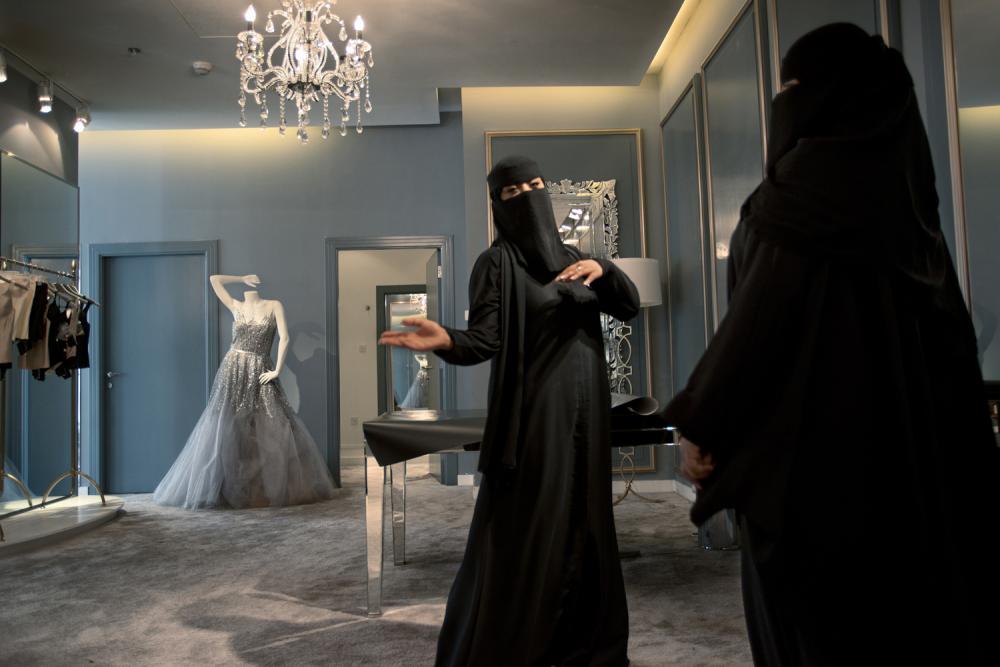
. . . there is also a truly wonderful article, sympathetic and well written, about Saudi women being allowed to work in select shops. New Yorker only allows me to print an few lines from the article, but I loved how it captured the delight these women take in having a little bit of life outside the home to call their own. It also covers the dilemma of dealing with the religious police, the Muttawa, who are in a fit because now women will be in contact with MEN and who knows what might happen?
I had not read anything in the papers – our papers rarely cover smaller details of life in the Middle East. We were there when men were in every shop, selling underwear, selling abayas, and not a woman to be seen. This is a major change, done so so quietly, and women who need more space to breathe are finding a little bit of that space.
Not every woman wants to work outside the home, but many are bored and restless. When they talk about working, they talk about the friendships they form with other women, the pride they take in having a purpose to their daily life, and the increased respect with which they are treated by family members – all good things. The article is sensitively and sympathetically written.
LETTER FROM RIYADH SHOPGIRLS: The art of selling lingerie.
BY KATHERINE ZOEPF
DECEMBER 23, 2013
A women’s revolution has begun in Saudi Arabia, although it may not be immediately evident. This fall, only a few dozen women got behind the wheel to demand the right to drive. Every female Saudi still has a male guardian—usually a father or husband—and few openly question the need for one. Adult women must have their guardians’ permission to study, to travel, and to marry, which effectively renders them legal minors. It took a decree from King Abdullah to put tens of thousands of them into the workforce. For the first time, they are interacting daily with men who are not family members, as cashiers in supermarkets and as salesclerks selling abayas and cosmetics and underwear.
One afternoon in late October, at the Sahara Mall, in central Riyadh, the Asr prayer was just ending. The lights were still dimmed in the mall’s marble corridor, but the Nayomi lingerie store had been unlocked. The rattle of steel and aluminum could be heard as security grilles were raised over nearby storefronts. Twenty-seven-year-old Nermin adjusted a box of perfume on a tiered display near the entrance, then turned to greet six saleswomen as they filed out of a storeroom, preparing to resume their shift. Nermin started working at Nayomi eighteen months ago, as a salesclerk herself. She was warm and engaging with customers, and was recently promoted to a position in which she oversees hiring and staff training for Nayomi stores across four Saudi provinces. All the employees wore long black abayas and niqabs, which revealed nothing but their eyes. They positioned themselves among the racks of bras, underpants, nightgowns, and foundation garments—black-cloaked figures moving against a backdrop of purples, reds, and innumerable shades of pink.
Nermin is one of the Nayomi chain’s longest-serving female employees. She was hired nearly a year after King Abdullah issued a decree, in June of 2011, that women were to replace all men working in lingerie shops. Early in 2012, on a visit to the Nayomi store in a mall near her house with her younger sister, Ruby, Nermin noticed a poster advertising positions for saleswomen. The sisters had never considered working, since there were virtually no jobs for women without a college degree or special skills. Nermin and Ruby mostly spent their days watching television, exercising, and surfing the Internet. In a blisteringly hot city with few parks, the mall was one of the only places to go for a walk. They filled out applications on the spot, and their family encouraged the idea. “I was surprised to find that I like to work,” Nermin said. Ruby, who got a job at the same store, is now the manager there. She wore its key on a yellow lanyard around her neck; pink-trimmed platform sneakers were visible beneath the hem of her abaya. After graduating from high school, she had spent four years feeling increasingly trapped at home, she said. “Nayomi gave me the chance to go on with life.” . . .
Most MERS Cases Undetected, report shows
Interesting, Qatar announced today their fourth case – this article says they have had eight confirmed cases and one Tunisian who visited Qatar and came down with MERS. From the Gulf Times:
Most Mers cases going undetected, study says
Researchers estimate that for each case that has been found, five to 10 may have been missed
- Gulf News Report
- Published: 21:32 November 16, 2013

- Image Credit: Reuters
- The Mers coronavirus typically causes severe respiratory problems.
Dubai: A new analysis of Mers case data suggests a large number of infections are going undetected, with the researchers estimating that for each case that has been found, five to 10 may have been missed.
The scientific paper, from European researchers, further suggests that transmission of the Mers virus is occurring at a rate close to the threshold where it would be considered able to pass from person to person in a sustained manner. In fact, the authors say based on the available evidence they cannot rule out the possibility that person-to-person spread is the main mode of transmission of the virus at this point. The other option, they say, is that the virus is spreading via a combination of animal-to-person and then person-to-person transfer.
“We conclude that a slow growing epidemic is underway, but current epidemiological data do not allow us to determine whether transmission is self-sustaining in man,” they write in the article, published in the journal Lancet Infectious Diseases.
The scientists are from Imperial College London, the University of Edinburgh and the Institut Pasteur in Paris. The work was done with funding from Britain’s Medical Research Council, the Bill and Melinda Gates Foundation and other agencies.
To date there have been roughly 155 confirmed MERS cases and at least 65 of those infections have ended in death. All the cases trace back to infections in a handful of countries on the Arabian Peninsula: Jordan, Saudi Arabia, Qatar, the United Arab Emirates and Oman.
On Wednesday, Kuwait reported its second case Mers coronavirus for a man who just returned from abroad, the health ministry said.
In a statement cited by the official KUNA agency, the ministry said the new case was for a 52-year-old Kuwaiti national who was in a stable condition. Media reports said the patient had just returned from a visit to neighbouring Saudi Arabia.
The announcement came hours after Kuwait reported its first case of the Mers virus for a 47-year-old Kuwaiti man who was in critical condition.
Last weekend, Omani officials widened health checks following the country’s first death blamed on Mers. Officials looked for any sign of the virus in people who came in contact with a dead 68-year-old man.
Neil Ferguson, from Imperial College’s MRC Centre for Outbreak Analysis and Modelling, said that while publicly available data are spotty, calculations based on what is known support the argument that only a small proportion of cases are coming to light.
“At the very least there probably have been double that number of infections,” Ferguson said in an interview.
“But it’s considerably more likely in my view that we’ve had maybe five to 10 times more human infections than that. And symptomatic human infections, I would say.”
He stressed that he and his co-authors are not suggesting that the Mers-affected countries are hiding cases, just that the way they are looking for them is not capturing the full scope of the outbreak.
Experts have previously expressed concern that surveillance systems that look only for Mers among people who seek hospital care will only catch the sickest of cases. And in at least one affected country, Saudi Arabia, the criteria for who gets tested for Mers may be less inclusive still.
Dr. Anthony Mounts, the World Health Organisation’s leading expert on Mers, said the agency has been told Saudi health officials are focusing their testing on people with Mers-like symptoms who are gravely ill.
“I know that their surveillance strategy is focused on intensive care patients,” Mounts said in an interview. “That’s the focus of their surveillance strategy.”
Mounts agrees that many Mers cases are probably being missed. But he noted that some other affected countries are taking a different testing approach. For instance, Qatar has tested over 3,000 specimens over the past six months, looking for Mers in people who seek medical help for influenza-like illness, and all people diagnosed with pneumonia.
“They really are testing a lot of people and they’re not seeing this,” he said.
Eight Qataris have been diagnosed with MERS since the virus hit the global public health radar in September 2012. As well a man from Tunisia who contracted the virus is believed to have been infected on a visit to Qatar.
Because of the scarcity of publicly available data, Ferguson and his colleagues used some different approaches to try to estimate the state of the outbreak. He acknowledged that their calculations are estimates, and said of the analysis “it’s not definitive … but I still think it’s informative at least.”
“I would say we’re doing the best we can with the data available to try and address a couple of key questions,” he said. “We would certainly be in a better position if there was fuller [case] reporting.”
A commentary by Canadian epidemiologists lauded the team for the techniques they used to reach their conclusions. Dr. David Fisman and Ashleigh Tuite, who are with the University of Toronto’s Dalla Lana Faculty of Public Health, also hinted that the often-seen instinct to withhold information during infectious disease outbreaks may be futile in the era of computational biology.
“The ability to draw inferences about diseases from non-traditional data sources will hopefully both provide alternate means of characterising epidemics and diminish the temptation towards non-transparency in traditional public health authorities,” they wrote.
One of the questions Ferguson and his co-authors tried to answer relates to whether the virus is spreading person to person at this point or whether what is being seen are infections from an animal source that is igniting limited spread in people.
To do that, they tried to calculate what is known as the virus’s reproductive number — the number of people, on average, an infected person would pass the virus on to. For a virus to sustain itself in people, each person needs to infect at least one other person, a reproductive number of 1.0 or greater.
They could not come to a definitive conclusion, saying with what is known, either scenario is possible. But they said the evidence suggests the reproductive number is near 1.0.
— with inputs from agencies
MERS Found in Saudi Arabian Camel
RIYADH, Saudi Arabia (AP) — The Saudi Health Ministry says it has discovered a deadly virus in a camel in Jiddah province, on the western coast of Saudi Arabia.
The ministry’s statement released Monday is considered an important development in the search for the origin the deadly illness. There have been more than 60 deaths from the virus known as Middle East respiratory syndrome, or MERS, with all but a handful of the fatalities in Saudi Arabia.
The ministry said a sample from the camel was tested near the home of a patient infected with the virus.
An international research team in August found the mysterious virus that is related to SARS in a bat in Saudi Arabia. They suspected it was perhaps another animal that was spreading the virus directly to humans.
Happy Islamic New Year
My good friend and commenter, Daggero, left this comment for us yesterday announcing the new Islamic year:
For your information yesterday we entered the Islamic year 1435 Hijri ( hijri = immigration ) which marks the year the prophet Muhammad peace be upon him, emigrated after 13 years of calling people to Islam from Mecca to Medina, ( where he is burried in his Mosque , Masjid an Nabawi, the second holliest mosque in Islam after the Mecca )

So total Islam time from begining to now is 1448 years, and on this auspicious occasion i wish you , AdventureMan and your family and the little ones a happy and a blessed New Islamic year.
We wish you the same, Daggero, and I smiled as I read that you discussed the topic we were discussing with your daughter on the drive to school in the morning. I remember those days so well, as young people begin to draw off into their own lives and the time we spend with them in cars can be so precious. Happy New Year to you and your family.
We had a friend from Libya whose family name meant “from Madina;” before we had ever lived in any Middle East country, he had told us a little about Madina, and what a beautiful city it is. The mosque is very beautiful. I think the tradition is that green was the prophet Mohammed’s favorite color?
Happy New Year, too, to all our Moslem friends.
Saudi Women Drive, No Problem
For your delight of the day, please go to YouTube and watch this hilarious Saudi video, No Woman, No Drive! Click on the blue type above 🙂

From The Guardian:
Dozens of Saudi Arabian women drive cars on day
of protest against ban
-
Staff and agencies
- theguardian.com, Saturday 26 October 2013 12.03 EDT
Activists say at least 60 joined call to allow female drivers – making it country’s biggest ever demonstration against the ban
More than 60 Saudi women got behind the wheels of their cars as part of a protest against a ban on women driving in the kingdom, activists have claimed.
A Saudi professor and campaigner, Aziza Youssef, said the activists have received 13 videos and another 50 phone messages from women showing or claiming they had driven, the Associated Press reported.
She said it had not been not possible to verify all of the messages. But, if the numbers are accurate, they would make Saturday’s demonstration the biggest the country has ever seen against the ban.
Despite warnings by police and ultraconservatives in Saudi Arabia, there have been no reports from those who claimed to have driven of being arrested or ticketed by police.
A video clip of a protest by May al-Sawyan, a 32-year-old economics researcher and mother of two, was uploaded on the YouTube channel of the October 26 driving for women group, along with several other videos of women purportedly driving in defiance of the ban in Riyadh, al-Ahsa and Jeddah. It was not possible to verify when they were filmed. Another video to feature on YouTube was the spoof No Woman, No Drive.
“I am very happy and proud that there was no reaction against me,” she told AP. “There were some cars that drove by. They were surprised, but it was just a glance. It is fine. They are not used to seeing women driving here.”
Sawyan said she had obtained a driver’s licence from abroad. She said she was prepared for the risk of detention if caught but added that she was far enough from a police car that she was not spotted.
“I just took a small loop. I didn’t drive for a long way, but it was fine. I went to the grocery store,” she said.
Her husband and family waited at home and called her when she arrived at the shop to check on her, she said. She drove with a local female television reporter in the car. They were both without male relatives in the vehicle.
“I know of several women who drove earlier today. We will post videos later,” one of the campaign organisers told Reuters.
The Associated Press reported that a security official said authorities did not arrest or fine any female drivers on Saturday.
Youssef said she and four other prominent women activists received phone calls this week from a top official with close links to Interior Minister Prince Mohammed bin Nayef, warning them not to drive on Saturday, the day the campaign set for women’s driving.
She also said that “two suspicious cars” have been following her everywhere all day. “I don’t know from which party they are from. They are not in a government car,” she said.
Activists said they have 16,600 signatures on an online petition calling for change. Efforts to publicise the issue have been described as the best-organised social campaign ever seen in Saudi Arabia, where Twitter has millions of users and is used to circulate information about the monarchy and official corruption.
Previous attempts to promote change fizzled out in arrests for public order offences and demoralisation. In 2011, the activist Manal al-Sharif made a YouTube video urging women to drive their own cars, and was imprisoned for more than a week. But the signs are far more positive now.
Three female members of the shura (advisory) council – among 30 appointed by the 90-year-old King Abdullah – recommended this month that the ban be rescinded, though no debate has yet taken place.
Latifa al-Shaalan, Haya al-Mani and Muna al-Mashit urged the council to “recognise the rights of women to drive a car in accordance with the principles of sharia and traffic laws”.
The three – praised by supporters for “stirring the stagnant water” – framed their argument with careful references to religious edicts banning women from being in the company of an unrelated male driver. Other ideas designed to reassure critics are appointing female traffic police and driving instructors. Cost is another big factor, with families having to employ chauffeurs, as is convenience.
Though no specific Saudi law bans women from driving, women are not issued licenses. They mostly rely on drivers or male relatives to move around.
Powerful clerics who hold far-reaching influence over the monarchy enforce the driving ban, warning that breaking it will spread “licentiousness.” A prominent cleric caused a stir when he said last month that medical studies show that driving a car harms a woman’s ovaries.
Happy 7th Blog-iversary to Me!
Once a year I get to troll the internet looking for cakes. It is so much fun. I had no idea there is so much creativity out there, so much daring. I found a wedding cake that is tilted! Something in me loved it, loved the spirit of a woman who would marry knowing life is often off-kilter and messy.
I love white roses, so this year I have sent some to myself:

Come on by, have some virtual cake with me to celebrate seven years of blogging:



And here, an elegant combination of cake and white roses:

Seven years ago in Kuwait, I started blogging. There was a wild blogging scene in Kuwait, a lively community. Blogs were candid, and many were substantial, dealing (carefully) with political and economic issues in Kuwait. I remember reading and learning, and finally gathering up my courage to write my very first entry, and it has been a recurring theme, cross-cultural communication. I learned so much from my life in the Middle East, Tunisia, Jordan, Saudi Arabia, Qatar and Kuwait. I made the most amazing friends. It changed my life and my perceptions utterly.
Of the three Kuwait female bloggers who inspired me to start blogging, Jewaira has gone private, 1001 Nights is a good friend, a mother, and an author 🙂 and Desert Girl is still going strong. Mark, at 2:48 a.m. is also still going strong, so strong that he has been able to leave his full time employment and operate on a consultant basis.
Of course, as any blogger will, I sometimes think of quitting. There are days I find myself with nothing to say, nothing in my life so interesting that I think it is worth sharing, not even a news story worth noting. So I’ve had to ask myself why I continue.
I do it for myself. When I started, I had a reason and that reason still stands. I forget things. This isn’t age-related, it’s busy-life busy-world related; we forget the details.
My Mother saved all my letters from Tunisia. I remember reading them and laughing because at three, my son’s best friend in his day school was a boy he called Cutlet. I know his real name is Khalid, but Cutlet was as close as this little American boy in a French-Tunisian school could get. I had totally forgotten, until I read the letter. So my primary reason for continuing to blog is documentary – just plain record keeping, like an old fashioned diary. Noting things in my daily life or the life around me.
Even now, sometimes I see a post written long ago, usually one of our Africa trips, Botswana, Namibia, Tanzania, Zanzibar, Zambia – will start getting a rush of stats. It thrills my heart. It makes it all worthwhile, knowing something I have put out there is helping others, even years later. Perhaps one day, I will quit blogging, but leave the blog up, with these informational articles.
My stats make no sense at all, one of my biggest stat gainers this year was a news article I tossed off about the prank on the South Korean pilot names after the plane crash landed in San Francisco. It just made me giggle, and I couldn’t resist printing it. It ended up with a life of its own, as many entries do – and you just never know. Someone pins an image and you get a million (ok hyperbole here) hits you never expected.
In the end, I believe that those who keep blogging do it because as Martin Luther once said, “I cannot other.” We do it because something within needs to be expressed, even if it is just some kind of daily record. I know it’s why I blog.
Recent Comments
ExpatAlien on What Country am I Living … intlxpatr on Yellowstone: Old Faithful to C… Michelle on Yellowstone: Old Faithful to C… Cathy on No Grown-Ups in Charge intlxpatr on Waiting for Snow Wikipedia Donate Button

Amazina


Early Voting in Florida


 Here There and Everywhere