Anna Julia Haywood Cooper
Today the church honors Anna Julia Haywood Cooper, an extraordinary woman who prevailed against prejudice.
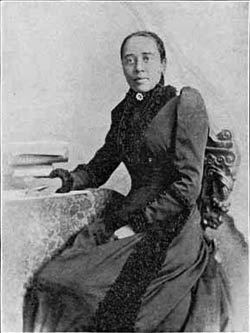
ANNA JULIA HAYWOOD COOPER
EDUCATOR
(1964)
Anna Julia Haywood Cooper (August 10, c1859- February 27, 1964). Educator, advocate and scholar. Born in Raleigh, North Carolina to an enslaved woman and a white man, presumably her mother’s master, Anna Julia was an academically gifted child and received a scholarship to attend St. Augustine Normal School and Collegiate Institute, a school founded by the Episcopal Church to educate African-American teachers and clergy. There she began her membership in the Episcopal Church. After forcing her way into a Greek class designed for male theology students, Anna Julia later married the instructor, George A.C. Cooper, the second African-American ordained to the Episcopal priesthood in North Carolina.
After her husband’s death in 1879, Cooper received degrees in mathematics from Oberlin College, and was made principal of the only African American high school in Washington D.C.. She was denied reappointment in 1906 because she refused to lower her educational standards.
Throughout her career, Cooper emphasized the importance of education to the future of African Americans, and was critical of the lack of support they received from the church. An advocate for African-American women, Cooper assisted in organizing the Colored Women’s League and the first Colored Settlement House in Washington, D.C. She wrote and spoke widely on issues of race and gender, and took an active role in national and international organizations founded to advance African Americans.
At the age of fifty-five she adopted the five children of her nephew. In 1925, Cooper became the fourth African-American woman to complete a Ph.D degree, granted from the Sorbonne when she was sixty-five years old. From 1930-1942, Cooper served as president of Frelinghuysen University.
from the Episcopal Women’s History Project
League of Women Voters: State of Union Bingo Cards
Gotta love those ladies in pearls, although lately the League has been attracting a much younger group of activists. An amazingly non-political group, the League looks at issues and candidates, and encourages INFORMED voters. All people are welcome; in spite of the name, the league also includes men. This is a group that makes a difference.

With their wicked sense of humor, the National League encourages all Americans to watch the dreaded State of the Union speech tonight, and has published a set of Bingo Cards to keep you engaged. You can download them for yourself and your family members at League of Women Voters: State of the Union Bingo or you can print these, which I downloaded from their website.



Yes, I am a member of this group. They keep up with the important issues, and they invite speakers to meetings to explain the substance to the public. They educate people about voting rights without bias.
They help with elections, and, where allowed, they help register new voters – people turning 18, new citizens, people who haven’t voted before. The current stereotype of this group as elderly educated women in pearls is quickly changing as super-charged young people seek to exert their rights in an orderly, lawful fashion.
By uniting women from all parties and all walks of life, they have a big voice and have effectively challenged unjust and unconstitutional laws at the local, state, and national levels. They take their commitment voting rights, issues, and impartiality very seriously.
And, they have a wonderful sense of humor 😄.
Bravo, Judge Leon!
Judge Leon blocks Pentagon and Hegseth in prosecution to punish Mark Kelly over ‘illegal orders’ video
U.S. District Judge Richard Leon, an appointee of former President George W. Bush, noted that while serving in the armed forces, military forces have limitations on some of their freedoms, but said that no court had ever extended that doctrine to retired service members, and he would not be the first to do so.
“This Court has all it needs to conclude that Defendants have trampled on Senator Kelly’s First Amendment freedoms and threatened the constitutional liberties of millions of military retirees,” the judge wrote.
Leon quoted singer-songwriter Bob Dylan to say, “You don’t need a weatherman to know which way the wind blows.” ”
The Judge had some pithy and appropriate things to say about military retirees and their rights to free speech, and in particular to Kelly’s position not only as a retired veteran, but also as a current Senator, where his responsibility to represent his electorate would be severely hampered by intimidating threats to take away or reduce his pension, or bring him back on duty to court-martial him for his “crime.”
His crime? Senator Kelly appeared in a video with five other veterans serving in the Senate reminding service members they have a responsibility NOT to obey illegal orders.
After WWII, many German leaders tried to excuse their crimes by saying “We were only following orders.”
When orders violate the Constitution, we do not have to comply. Constitutional rights apply to all people living in the United States, all residents; every person is authorized due process of the law.
These Constitutional Rights are being tested. Judge Leon is a Bush appointed judge, a man with years of judicial procedures behind him.
We are finding some ironic ways in which our President is unifying us. Republicans and Democrats alike recoiled in horror at the goon-squad “policing” in Minnesota. Republican and Democrat judicial appointees are correcting mistaken applications of power and brute force, and corraling them back where they belong. And God Bless Bad Bunny for reminding us that America is two continents, and that we are all stronger together. The vast majority of Americans on both continents were ready for some joy, and words of brotherhood, liberty and equality. We have more in common than we have differences.
If the United States of America is to continue to be a land welcoming those seeking opportunity and freedom, we all have to work towards this together, supporting our common values and finding ways to cooperate, even in areas where we disagree.
By the way, under the catagory of unanticipated consequences, Senator Mark Kelly received a huge surge of financial contributions to defend himself against this intimidation by our Secretary of Defense. This is a man who could successfully run for President, with his presence, his courage, his background and his steadfast approach.
So Much For Health and Transparency

It started during COVID. Politicians and their Administrations stopped publicizing statistics when the stats revealed their government was doing little or nothing to prevent spread of disease. Now, under the cover of cost reductions and eliminating fraud they are gutting the agencies that maintain the statistics and restricting publications of what few statistics are being gathered. Fortunately, private institutions and individuals are watching, keeping track, and doing their best to keep a vulnerable population informed.
EUPHROSYNE/SMARAGDUS OF ALEXANDRIA
MONASTIC, 5TH c.
From today’s lectionary, one of my favorite stories of early Saints
Prayer for today: (contemporary language)
Merciful God, who looks not with outward eyes but discerns the heart of each: we confess that those whom we love the most are often strangers to us. Give to all parents and children, we pray, the grace to see one another as they truly are and as you have called them to be. All this we ask in the name of Jesus Christ, our only mediator and advocate. Amen.
“Saint Euphrosyne of Alexandria (fl. 5th century CE) was a female saint who adopted male attire and lived at a local monastery as an ascetic.
Euphrosyne was the beloved only daughter of Paphnutius, a rich man of Alexandria, miraculously born in her parents’ old age in answer to a monk’s prayer. Her loving father desired to marry her to a wealthy youth.
But having already consecrated her life to God and under pressure to break her vow, she dressed as a man and assumed the identity of “Smaragdus” (“emerald”). She then escaped to a nearby men’s monastery, where she made rapid strides toward a perfected ascetic life. She was under the guidance of the abbot, who also happened to be the same monk who had prayed for her birth.
Years later, when Paphnutius appealed to the abbot for comfort in his bereavement, the abbot committed him to the care of Euphrosyne, still under the guise of Smaragdus. Paphnutius received from his own daughter, whom he had failed to recognize, helpful advice and comforting exhortation. Not until she was dying did Euphrosyne reveal herself to him as his lost daughter. After burying her, Paphnutius gave up all his worldly goods, and became a monk in the same monastery. There, he used his daughter’s old cell until his own death ten years after. “
from Wikipedia

A dying Euphrosyne reveals herself to her father
As I read today’s lectionary, I am struck by how very blind we are to the realities of God’s creation, that in every tribe and every nation, there are those who are outside the normal boundaries of gender, and who are, at the same time, the people God created them to be. How cruel we are! We judge, and we call names, we cast out – in every tribe and nation in the world – those who are Other, who do not fit into our tiny human conception of “right.” I can imagine the overwhelming revelation as we transcend into the after life.
Morocco Malta and the Med: Casablanca and El Jadida
I can’t be staying in bed when we are coming into port in a new city.

This was seriously disturbing.

That mist looks sulfuric!


We are warned that Casablanca is an industrial port. No kidding!


Quick breakfast and we are off to El Jadida, an old Portuguese fortress city. We were actually here ten years ago on our very first cruise, The Moors in Spain and Morocco. We really love Morocco. One year we came here at Christmas, which was also Ramadan, rented a car and drove all around Morocco with our son. We had such a great time.



Our guide tells us this area near El Jadida is famous for raising horses for racing and showing.


Me and my stone walls!


Getting close to El Jadida:











An old Portuguese Catholic Church in El Jadida. The people around Casablanca make it a point to discuss frequently how tolerant the area is, with Jewish and Christian populations as well as Muslim and Berber. Our guide was proudly Berber.
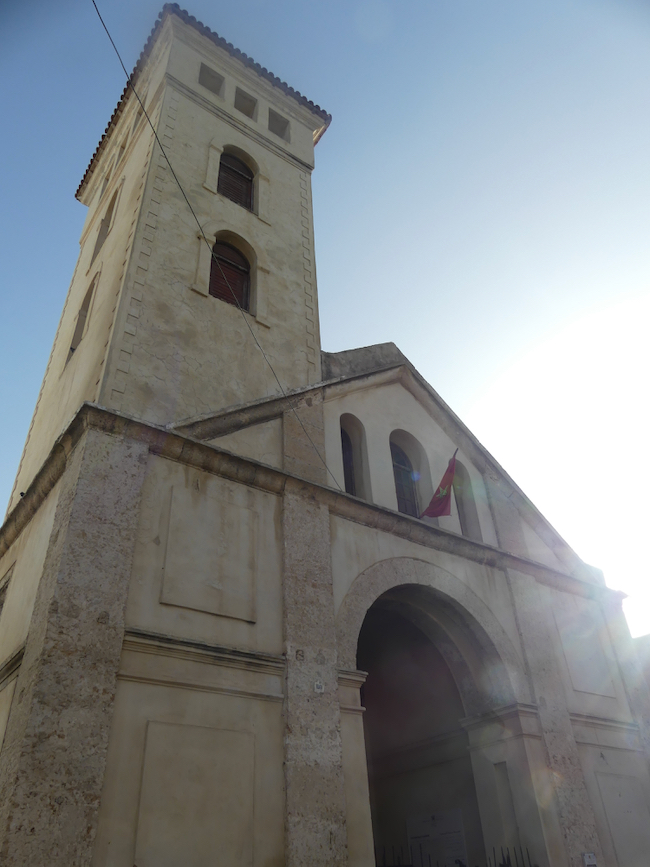
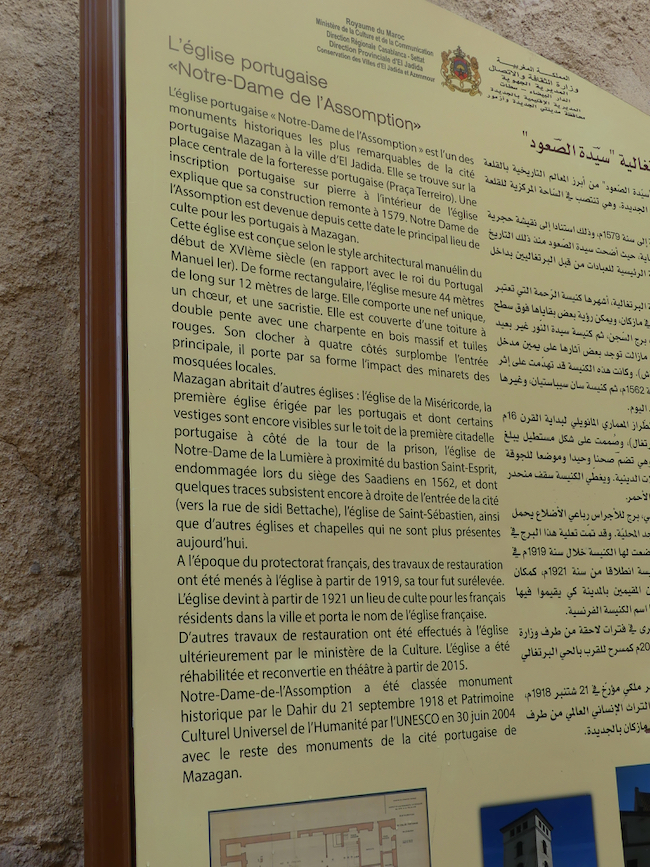




We had been warned that the beautiful old Portuguese Cisterns were closed for restoration, so the photo below is the exterior only, but I have a treat for you. Below the shot of the exterior is a photo of the interior I took ten years ago. I still love to look at it. The cisterns are so beautiful as well as functional.


I don’t consider this cheating; I consider it . . . um . . . illustrating. . . or embellishing to show you what you might see when you go to El Jadida.
Below are Moroccan silk weavings.








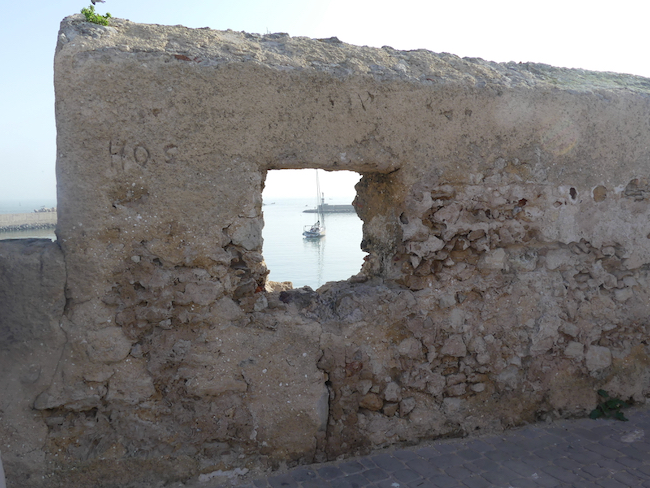


I believe this is the old Jewish bakery.



When you read old histories or bible stories about prisoners being cast into a well, it could look a lot like this:







This picture below is hilarious because I am wearing an expensive pair of shoes that I find clunky. The trip description said it was challenging, with uneven hikes, rocks, and hills. It was a very mild hike; I could have worn my sandals.
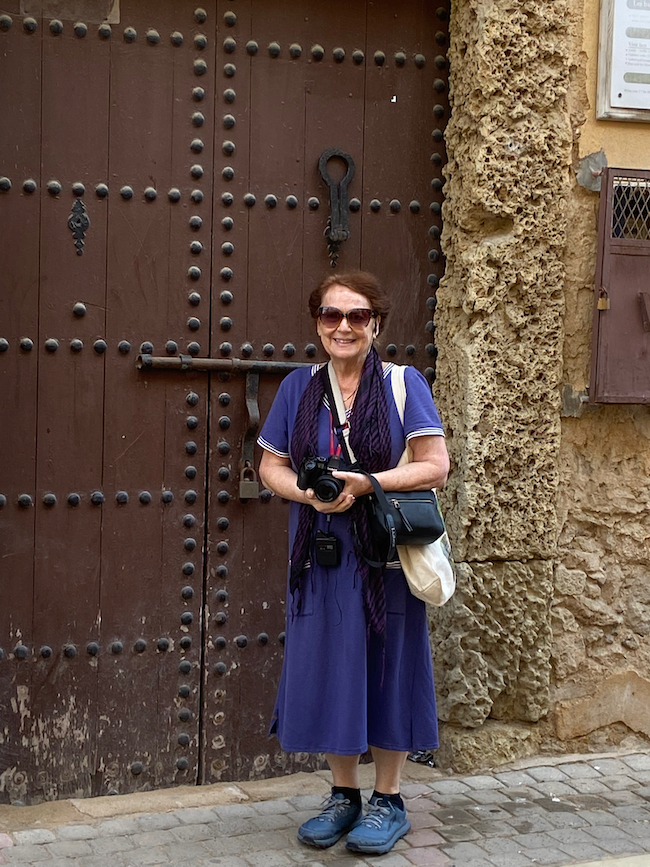


My husband took this photo below; he loved the contrast of the drawing of the cisterns and the laundry hung to dry over the cisterns.


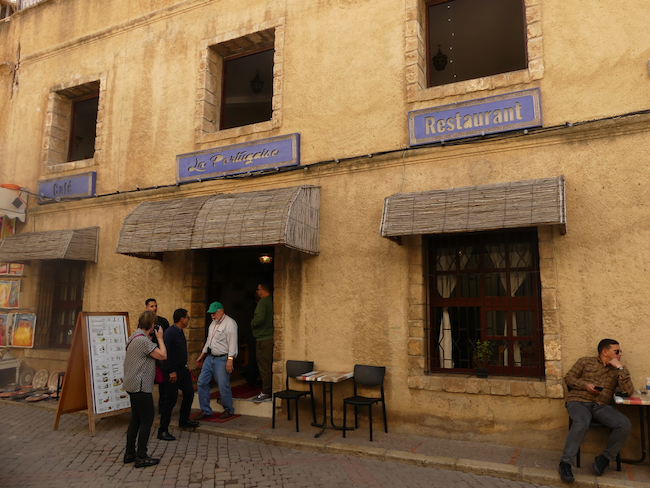
It’s going to be a couple hours ride back to the ship, but the guide has a treat for us – “Snacks” at a local restaurant, part of the tour, no extra charge. The small restaurant was just big enough to hold all of us, had a nice clean restroom and place to wash up, and served these delicious sandwiches, followed by a selection of house baked Moroccan cookies, and Turkish coffee or Mint Tea. The owner and his wife were so hospitable. They made us feel like very special guests. It really was a treat!






As we sail away from Casablanca, that same ship continues to be surrounded with that yellow steamy cloud.

For us, we have seen everything we wanted to see. We think Cadiz and Malaga will be pretty tame after the excitement of Ajaccio, Malta, Tunis and Algiers. (We were wrong!)
The “Righteous Gentiles”
Today in our church Lectionary, we celebrate those who stood up to the Nazi policies and shielded and rescued thousands of Jewish people who might otherwise not have survived the torture, imprisonment and extermination, solely for being “the other.”
PRAYER (contemporary language)
Lord of the Exodus, who delivers your people with a strong hand and a mighty arm: Strengthen your Church with the examples of the Righteous Gentiles of World War II to defy oppression for the rescue of the innocent; through Jesus Christ our Lord, who lives and reigns with you and the Holy Spirit, one God, now and for ever. Amen.
“THE RIGHTEOUS GENTILES”
Although the phrase “Righteous Gentiles” has become a general term for any non-Jew who risked their life to save Jews during the Holocaust, it here appears to apply specifically to: Raoul Wallenberg [Swedish, d. 1947] Hiram Bingham IV [d. 1988, American]; Karl Lutz [d. 1975, Swiss]; C. Sujihara [d. 1986, Japanese]; and Andre Trocme [d. 1971, French].

Raoul Wallenberg (August 4, 1912 – July 17, 1947?) was a Swedish humanitarian who worked in Budapest, Hungary, during World War II to rescue Jews from the Holocaust. Between July and December 1944, he issued protective passports and housed Jews, saving tens of thousands of Jewish lives.
On January 17, 1945, he was arrested in Budapest by the Soviets after they wrested control of the city from the Germans, and was reported to have been executed while a prisoner at Lubyanka Prison, although this is not entirely certain.
Wallenberg has been honored numerous times. He is an honorary citizen of the United States, Canada, Hungary and Israel. Israel has also designated Wallenberg one of the Righteous among the Nations. Monuments have been dedicated to him, and streets have been named after him throughout the world.
— more at Wikipedia

Hiram “Harry” Bingham IV (July 17, 1903 – January 12, 1988) was an American diplomat. He served as a Vice-Consul in Marseille, France, during World War II, and helped over 2,500 Jews to flee from France as Nazi forces advanced.
In 1939, Bingham was posted to the US Consulate in Marseille, where he, together with another vice-consul named Myles Standish, was in charge of issuing entry visas to the USA.
On June 10, 1940, Adolf Hitler’s forces invaded France and the French government fell. Several influential Europeans tried to lobby the American government to issue visas so that German and Jewish refugees could freely leave France and escape persecution.
Anxious to limit immigration to the United States and to maintain good relations with the Vichy government, the State Department actively discouraged diplomats from helping refugees. However, Bingham cooperated in issuing visas and helping refugees escape France. Hiram Bingham gave about 2,000 visas, most of them to well-known personalities, speaking English, including Max Ernst, André Breton, Hannah Arendt, Marc Chagall, Lion Feuchtwanger and Nobel prize winner Otto Meyerhof.
— more at Wikipedia
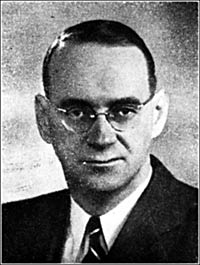
Carl Lutz (b. Walzenhausen, 30 March 1895; d. Berne, 12 February 1975) was the Swiss Vice-Consul in Budapest, Hungary from 1942 until the end of World War II. He helped save the lives of tens of thousands of Jews from deportation to Nazi Extermination camps during the Holocaust.
Lutz immigrated at the age of 18 to the United States, where he was to remain for more than 20 years. Lutz’s sojourn in the United States ended with his assignment as vice-consul to the Swiss Consulate General in Jaffa, in what was then Palestine.
Appointed in 1942 as Swiss vice-consul in Budapest, Hungary, Lutz soon began cooperating with the Jewish Agency for Palestine, issuing Swiss safe-conduct documents enabling Jewish children to emigrate.
Once the Nazis took over Budapest in 1944 and began deporting Jews to the death camps, Lutz negotiated a special deal with the Hungarian government and the Nazis: he had permission to issue protective letters to 8,000 Hungarian Jews for emigration to Palestine. Lutz then deliberately misinterpreted his permission for 8,000 as applying to families rather than individuals, and proceeded to issue tens of thousands of additional protective letters, all of them bearing a number between one and 8,000. He also set up some 76 safe houses around Budapest, declaring them annexes of the Swiss legation. Among the safe houses was the now well-known “Glass House” (Üvegház) at Vadász Street 29. About 3,000 Jews found refuge at the Glass House and in a neighboring building.
— more at Wikipedia
Chiune Sugihara (1 January 1900 – 31 July 1986) was a Japanese diplomat, serving as Vice Consul for the Japanese Empire in Lithuania. During World War II, he helped several thousand Jews leave the country by issuing transit visas to Jewish refugees so that they could travel to Japan. Most of the Jews who escaped were refugees from German-occupied Poland or residents of Lithuania. Sugihara wrote travel visas that facilitated the escape of more than 6,000 Jewish refugees to Japanese territory, risking his career and his family’s life.
When asked why he did it, he responded:
“You want to know about my motivation, don’t you? Well. It is the kind of sentiments anyone would have when he actually sees refugees face to face, begging with tears in their eyes. He just cannot help but sympathize with them. Among the refugees were the elderly and women. They were so desperate that they went so far as to kiss my shoes, Yes, I actually witnessed such scenes with my own eyes. Also, I felt at that time, that the Japanese government did not have any uniform opinion in Tokyo. Some Japanese military leaders were just scared because of the pressure from the Nazis; while other officials in the Home Ministry were simply ambivalent.
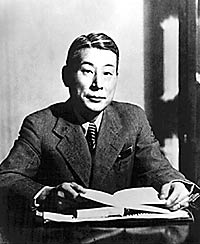
People in Tokyo were not united. I felt it silly to deal with them. So, I made up my mind not to wait for their reply. I knew that somebody would surely complain about me in the future. But, I myself thought this would be the right thing to do. There is nothing wrong in saving many people’s lives …. The spirit of humanity, philanthropy … neighborly friendship … with this spirit, I ventured to do what I did, confronting this most difficult situation —and because of this reason, I went ahead with redoubled courage. ”
When asked why he risked his career to save other people, he quoted an old samurai saying: “Even a hunter cannot kill a bird which flies to him for refuge.”
— more at Wikipedia
André Trocmé ( April 7, 1901 – June 5, 1971) and his wife Magda (née Grilli di Cortona, November 2, 1901, Florence, Italy – Oct. 10, 1996) are a couple of French Righteous Among the Nations. For 15 years, André served as a pastor in the town of Le Chambon-sur-Lignon on the Plateau Vivarais-Lignon in South-Central France. He had been sent to this rather remote parish because of his pacifist positions which were not well received by the French Protestant Church. In his preaching he spoke out against discrimination as the Nazis were gaining power in neighboring Germany and urged his Protestant Huguenot congregation to hide Jewish refugees from the Holocaust of the Second World War.

In 1938, André Trocmé and Reverend Edouard Theis founded the Collège Lycée International Cévenol in Le Chambon-sur-Lignon, France. Its initial purpose was to prepare local country youngsters to enter the university. When the refugees arrived, it also took in many Jewish young people wishing to continue their secondary education.
When France fell to Nazi Germany, the mission to resist the Nazis became increasingly important. Following the establishment of the Vichy France regime during the occupation, Trocmé and his church members helped their town develop ways of resisting the dominant evil they faced. Together they established first one, and then a number of “safe houses” where Jewish and other refugees seeking to escape the Nazis could hide. Many refugees were helped to escape to Switzerland following an underground railroad network. Between 1940 and 1944 when World War II ended in Europe, it is estimated that about 3500 Jewish refugees including many children were saved by the small village of Le Chambon and the communities on the surrounding plateau because the people refused to give in to what they considered to be the illegitimate legal, military, and police power of the Nazis.
— more at Wikipedia
I am thankful for Sawtucket, who has kept me up with my daily Lectionary readings for more than 22 years. I thank Sawtucket for today’s reading, reminding us that we are all of one blood, one humanity, no matter our skin color, our nationality, nor our religion. We are human beings, and our job is to watch over one another.
More Than 500 Mass Shootings in USA 2023
This week I needed to make a trip to WalMart. For the first time, I asked AdventureMan to go with me. I felt unsafe, going to WalMart. Pensacola is rife with emotionally unregulated people carrying guns. Florida is worse. Do gun “rats” enthusiasts not realize that most gun deaths are people shooting people in their own families or social circles, or shooting themselves? The mass shootings below are just the tip of the iceburg.
This is from Axios:
U.S. surpasses 500 mass shootings in 2023


Share on email (opens in new window)https://datawrapper.dwcdn.net/oLfvX/Data: Gun Violence Archive; Note: Includes incidents where at least four people were shot or killed, excluding the shooter; Chart: Simran Parwani/Axios
There have now been 501 mass shootings in the U.S. this year.
Driving the news: A shooting that wounded four people in Denver, Colorado, on Saturday night marked the country’s 500th mass shooting in 2023, according to the Gun Violence Archive.
- Hours later, that increased to 501 mass shootings after one person died and five others were wounded in El Paso, Texas, early Sunday.
By the numbers: Just five years ago, the country had never experienced 500 mass shootings in one year:
- 2018: 335 mass shootings
- 2019: 414 mass shootings
- 2020: 610 mass shootings
- 2021: 689 mass shootings
- 2022: 645 mass shootings
Flashback: The 500 mass shootings threshold was crossed in September in the past two years, according to the archive.
- In 2020, it occurred in October.
Between the lines: The FBI does not define or quantify what constitutes a mass shooting.
- Gun Violence Archive, an independent research and data collection organization, defines a mass shooting as a shooting in which four or more people were shot or killed, not including the shooter. This makes its numbers higher than some other sources with varying definitions.
Of note: A January shooting on the eve of Lunar New Year in Monterey Park, California, a largely Asian American area, has caused the most deaths so far in 2023. Eleven people were killed and nine others injured in the massacre.
- The most injuries related to gun violence occurred in April at a birthday party shooting in Dadeville, Ala., that left four people dead and 32 others injured.
The big picture: With increasing personal experiences, more Americans view gun violence as a public health concern.
- One in six Americans have personally witnessed someone being shot, according to survey data from earlier this year.
Zoom in: Gun violence has greatly affected children. Firearms are the top killer of kids in the country.
- Gun deaths among children hit a record high in 2021, per data released in August.
- There were 305 school shootings in 2022 and 230 by Sept. 5 in 2023, according to the K-12 School Shooting Database.
Go deeper: Gun deaths among U.S. children hit a new record high
Recent Comments
ExpatAlien on What Country am I Living … intlxpatr on Yellowstone: Old Faithful to C… Michelle on Yellowstone: Old Faithful to C… Cathy on No Grown-Ups in Charge intlxpatr on Waiting for Snow Wikipedia Donate Button

Amazina


Early Voting in Florida


 Here There and Everywhere