“Give Me Your Tired, Your Poor . . . “
Who are we?
I’m listening to a heartbreaking discussion on National Public Radio’s Diane Rehm show about the masses of children heading toward the southern border of the United States.

Anti-immigration is nothing new, not in the United States, not in newer countries. It is shocking to me, however, that people who came from somewhere else are so strongly opposed to allowing these desperate children in. If they are running for our border – and they are – they are desperate. They are desperate to escape violent death, and death by starvation, death of the spirit eeking out a living day to day.
“They come here for a hand-out!” is the most common complaint.
Read your American history. Very few immigrants – your ancestors, American citizens – arrived with money. Most relied on friends, family, the immigrant community, social services – whatever they needed to survive until they could get on their feet.
And get on their feet they did. Immigrants to America come here to work hard, believing that working hard will give them a chance at a better life. Your ancestors and mine – they came and worked hard, scraping together the money to build a business and/or to send their kids to schools. If you’ve ever attended a citizenship ceremony, you will love the jubilation. They don’t want a handout. They want a chance at building a decent life.
So now it’s “I’ve got mine, go back where YOU belong?”
When I grew up, not even in the United States proper, but in a U.S. territory, we sang a wonderful song, from a poem by Emma Lazarus, The New Colossus, which is on a plaque on the Statue of Liberty:
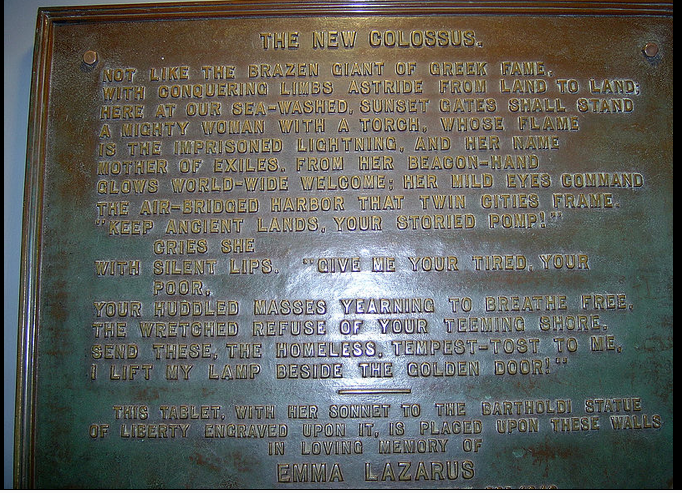
Not like the brazen giant of Greek fame,
With conquering limbs astride from land to land;
Here at our sea-washed, sunset gates shall stand
A mighty woman with a torch, whose flame
Is the imprisoned lightning, and her name
Mother of Exiles. From her beacon-hand
Glows world-wide welcome; her mild eyes command
The air-bridged harbor that twin cities frame.
“Keep, ancient lands, your storied pomp!” cries she
With silent lips. “Give me your tired, your poor,
Your huddled masses yearning to breathe free,
The wretched refuse of your teeming shore.
Send these, the homeless, tempest-tost to me,
I lift my lamp beside the golden door!”
I’ve never forgotten those words we all sang as children. The immigrant flows into America are our life-blood. You can keep your stale traditions and meaningless pomp, she cries, send me those willing to work hard and yearning for freedom.
How can we refuse CHILDREN seeking asylum? Each child we feed, house and educate will have a chance to become contributing citizens. The face of our nation is changing, has already changed greatly and will continue to change, and what we choose today will have a critical effect on what our society will look like tomorrow.
Do we still yearn for liberty for all? Do we want a highly stratified society where some are born to high paying jobs and others relegated to trades (I’ve seen how this works in another country; it’s stultifying.) Restricting access to all that we enjoy will create a wholly different society, a zero-sum-game society, where your loss is my gain, instead of an everyone wins society, where my success lifts you, too. Our country thrives on the creation of wealth; ideas are generated, resources and labor pools are created, they are not finite, they transition. Immigrants fuel the kind of innovation and population flow that keeps the lifeblood of our country flowing.
My family has been in the US a long time. We qualify as daughters-of-just-about-everything. We were immigrants; we were not native-born. The entire United States, other than the First People, are immigrants. We are immigrants, all of us. It makes us strong.
Alcuin: Faith is an Act of Free Will
Today, from Forward Day by Day, we remember Alcuin, advisor to King Charlemagne, who, among other things, told King Charlemagne not to kill people who did not believe as he did.

Today the church remembers Alcuin, Deacon, and Abbot of Tours, 804.
A breath of fresh air swept across Western Europe in what we call the Age of Charlemagne. There was relative peace, security, and prosperity. Learning and the arts revived. The leading spirit of this renaissance was Alcuin of York, the foremost teacher of his day. He revived “letters.” Indeed, he is credited with the invention of the running script we use today. He was a competent theologian, poet, and author. He was a pioneer in conceiving the idea of a university.
After serving for some years as Master of the Cathedral School in York, England, he traveled to Italy to study. There he met Charlemagne and they became fast friends. Alcuin served as royal tutor and as the great king’s chief advisor in religious and educational matters. In 796 he became abbot of the monastery at Tours, France, and there he founded a famous library and school. From there he exercised great influence in correcting misunderstandings of the Christian faith and in discouraging practices which seemed inconsistent with this faith, both in morals and in forms of worship.
We beseech you to shed upon your whole church the bright beams of your light and peace, and help us to follow the good example of your servant Alcuin. Amen.
Almighty God, in a rude and barbarous age you raised up your deacon Alcuin to rekindle the light of learning: Illumine our minds, we pray, that amid the uncertainties and confusions of our own time we may show forth your eternal truth; through Jesus Christ our Lord, who lives and reigns with you and the Holy Spirit, one God, for ever and ever. Amen.
Wikipedia tells us that as early as 797, Alcuin told King Charlemagne not to kill people who did not believe as he did:
In this role as adviser, he tackled the emperor over his policy of forcing pagans to be baptised on pain of death, arguing, “Faith is a free act of the will, not a forced act. We must appeal to the conscience, not compel it by violence. You can force people to be baptised, but you cannot force them to believe.” His arguments seem to have prevailed – Charlemagne abolished the death penalty for paganism in 797.[9]
Pregnant Sudanese Woman Sentenced to Death for ‘Apostasy’
She is also charged with adultery, for marrying a Christian man and (gasp) having sex with him. Now pregnant with her second child, Mariam claims she has never been a Muslim, was raised Christian, but the judge is applying new and strict Sharia laws.

As you might guess, I do not usually use Fox News as a news source, but this is an update on a story I am following:
International outrage grows for Sudanese woman sentenced to death for apostasy
Published May 16, 2014FoxNews.com
Meriam Ibrahim and Daniel Wani married in a formal church ceremony in 2011. The couple has an 18-month-old son, Martin, who is with Meriam in jail.
International outrage is mounting over the death sentence a Sudanese judge ordered for the pregnant wife of an American citizen — all because she refuses to renounce her Christian faith.
Meriam Ibrahim, 26, was sentenced Thursday after being convicted of apostasy. The court in Khartoum ruled that Ibrahim must give birth and nurse her baby before being executed, but must receive 100 lashes immediately after having her baby for adultery — for having relations with her Christian husband. Ibrahim, a physician and the daughter of a Christian mother and a Muslim father who abandoned the family as a child, could have spared herself death by hanging simply by renouncing her faith.
“We gave you three days to recant but you insist on not returning to Islam,” Judge Abbas Khalifa told Ibrahim, according to AFP. “I sentence you to be hanged to death.”
But Ibrahim held firm to her beliefs.
“I was never a Muslim,” she answered. “I was raised a Christian from the start.”
Ibrahim was raised in the Christian faith by her mother, an Orthodox Christian from Ethiopia. She is married to Daniel Wani, a Christian from southern Sudan who has U.S. citizenship, according to sources who spoke on condition of anonymity.
“I was never a Muslim. I was raised a Christian from the start.”
– Meriam Ibrahim
The cruel sentence drew condemnation from Amnesty International, the U.S. State Department and U.S. lawmakers.
“The refusal of the government of Sudan to allow religious freedom was one of the reasons for Sudan’s long civil war,” Rep. Chris Smith, R-N.J., chairman of the House congressional panel that oversees U.S. policy in Africa, said in a statement. “The U.S. and the rest of the international community must demand Sudan reverse this sentence immediately.”
Amnesty International called the sentence a “flagrant breach” of international human rights law and the U.S. State Department said it was “deeply disturbed” by the ruling, which will be appealed.
Khalifa refused to hear key testimony and ignored Sudan’s constitutional provisions on freedom of worship and equality among citizens, according to Ibrahim’s attorney Al-Shareef Ali al-Shareef Mohammed.
“The judge has exceeded his mandate when he ruled that Meriam’s marriage was void because her husband was out of her faith,” Mohammed told The Associated Press. “He was thinking more of Islamic Shariah laws than of the country’s laws and its constitution.”
Ibrahim and Wani married in a formal ceremony in 2011 and have an 18-month-old son, Martin, who is with her in jail. The couple operate several businesses, including a farm, south of Khartoum, the country’s capital. Wani fled to the United States as a child to escape the civil war in southern Sudan, but later returned. He is not permitted to have custody of the little boy, because the boy is considered Muslim and cannot be raised by a Christian man.
Sudan’s penal code criminalizes the conversion of Muslims into other religions, which is punishable by death. Muslim women in Sudan are further prohibited from marrying non-Muslims, although Muslim men are permitted to marry outside their faith. Children, by law, must follow their father’s religion.
Islamic Shariah laws were introduced in Sudan in the early 1980s under the rule of autocrat Jaafar Nimeiri, whose decision led to the resumption of an insurgency in the mostly animist and Christian south of Sudan. An earlier round of civil war lasted 17 years, ending in 1972. In 2011, the south seceded to become the world’s newest nation, South Sudan.
Sudanese President Omar Bashir, an Islamist who seized power during a 1989 military coup, said his county will implement Islam more strictly now that the non-Muslim south is gone. A number of Sudanese have been convicted of apostasy in recent years, but they have all escaped execution by recanting their faith. Religious thinker and politican Mahmoud Mohammed Taha — a vocal critic of Nimeiri — was sentenced to death after his conviction of apostasy and was executed at the age of 76 in 1985.
Ibrahim’s case first came to the attention of authorities in August, when members of her father’s family complained that she was born a Muslim but married a Christian man. They claimed her birth name was “Afdal” before she changed it to Meriam. The document produced by relatives to indicate she was given a Muslim name at birth was a fake, Mohammed said.
Ibrahim refused to answer the judge when he referred to her as “Afdal” during Thursday’s hearing.
Ibrahim was initially charged with having illegitimate sex last year, but she remained free pending trial. She was later charged with apostasy and jailed in February after she declared in court that Christianity was the only religion she knew.
The US-based Center for Inquiry is demanding that all charges against Ibrahim be dropped, saying the death sentence is a clear violation of the International Covenant on Civil and Political Rights, which forbids persecution or coercion of religious beliefs and the right to marry.
“Religious belief must never be coerced and free expression must never be punished, through threat of imprisonment, violence, or any other means,” the group wrote in a letter to Sudan’s UN ambassador, H.E. Hassan Hamid Hassan. “This cannot go unanswered, and the world will not stand for it.”
Fox News’ Joshua Rhett Miller and The Associated Press contributed to this report.
Heroes At The Dinner Table
“That’s Jollaf rice!” the Nigerian journalist said, a note of delight in her voice. She is famous for her passion and persistence drawing attention to the environmental issues in the Niger delta related to oil extraction and production. I told her that here in the Gulf, it’s called Jambalaya, but we all agreed that it very likely had African roots. She delighted my heart; she had three helpings.
When we have visitors from foreign countries, I try to serve foods they can identify – grilled vegetables, a chicken dish, several salads, a dessert. This time, because we had no Moslems, we used a real Cajun sausage in the jambalaya (pork), and jumbo shrimp.
The award-winning Finnish environmentalist has his own online website and a goal of planting 100 million trees by 1017. He is well on his way, visiting and planting trees in new countries every week. He also has his own band and has a CD out with Finnish music.

Our South African guest manages a large rhino reserve, protecting the rhinos from those who would kill them for their horns, thinking it renews sexual energy. Poor rhinos! He was quiet, but an acute observer, and the highlight of the evening was as he sang the haunting South African national anthem, Nkosi Sikelel’, with the Finnish guest. They did not sing all 11 verses (!) in all the different languages; just one verse, it was very moving:
Our own sweet environmentalist was with us. We think our son and his wife are super heroes; they fight for justice and a clean environment. This evening, our son stayed at home with the grandchildren and his wife, who works with clean water, was able to join and talk shop over dinner with her counterparts from other parts of the world.
It isn’t so easy anymore to get these dinners on the table, off the table, dessert served, etc. I used to be able to do these easily, for more than 20 people, but I also had help, LOL! But these dinners give us so much joy that I can’t imagine giving them up any time soon.
Chimamanda Ngozi Adichie: Americanah

“Ouch! Ouch, Chimanda! Stop!”
(Oh wait.)
Don’t stop.
It’s me who can’t stop. I read everything Chimamanda Ngozi Adichie writes. I only started reading her by accident, when I was facilitating the Kuwait Book Club I never intended to belong to, and found myself reading so many books by authors I had never heard of. We were reading Half Of a Yellow Sun and all of a sudden, I WAS Nigerian. She can do that. She uses the senses, she uses the thoughts in our head. We are really not so alien, us and the Nigerians I start to think. I have Nigerian friends, from the church. We all get along. We have a good time together.
“Not so fast!” Chimamanda tells me in Americanah, her newest book, which I put off buying until I could find it in paperback. “You are very different! You think differently! And growing up in a country where there are black and white, race becomes an issue that it is not when you are black, and everyone is black, and you are growing up in Nigeria.”
Hmmm. OK. That makes sense. I mean, I thought I was Nigerian because in Half of a Yellow Sun, I was Igbo, living in an academic community in Nigeria, and hmmmm. You’re right, Chimamanda, there were no white people around. Just us Nigerians.
Chimamanda, with her sharp, all-seeing eyes, her sharp ears and her sharp tongue make me cringe as she comes to the USA and comes up against assumptions many have about Africa. Do you even know where, exactly, Nigeria is? Do you know where Ghana is? Most Americans can find Egypt on a map of Africa, and MAYBE South Africa, but the rest is . . . mostly guesswork. Because we send clothing and food aid to African countries, we have the idea that all Africans are poor, but that is not so, and is insulting to the middle-class and upper class Africans who travel elsewhere for leisure – and education.
I don’t know how much of Chimamanda Ngozi Adichie’s book is autobiographical and how much is fiction. I know that her observations are acute, she nails expat friendships, she spotlights our blind spots and hypocricies, and she holds you in her grip because she is no less harsh with herself – if, indeed, her Ifemelu, the main character in Americanah, is reflecting Chimamanda’s own experience. The experiences, coming here, the overwhelming differences in manners and customs, even volume of voice and width of hand expression, are so immediate, so compelling, so well described that they have to have been experiences she herself had, and had the eyes to see. She must have taken notes, because she totally nails the expat experience.
Book ads and book reviews focus on Americanah as a book about being black in America, and it truly is that – as seen from the eyes of a non-American black, as she often reminds us.
She is hard on herself, returning to Nigeria, and quick to note that much of the change is in herself and her changed perspective. While I love the romantic storyline, I was disappointed by the fantasy ending, given how self-disciplined Adichie is at keeping it real in every other facet of the novel. On the other hand, I am still trying to think of an ending that would work for me, and I can’t. While her ending wraps it all up neatly, it’s the one part of the book where her sharpness dulls.
One of the things I liked best about the book was going behind the scenes, being Nigerian, going to school, having coffee, working, going to parties with other Nigerians, chatting with my girlfriends. We’ve done things with nationals of different countries before, but you know as soon as you walk in that your presence changes things. Chimamanda Ngozi Adichie takes me with her and no one knows I am there, observing, learning, figuring out how things are done when it’s “just us” Nigerians.
Here’s why I am a Chimamanda Ngozi Adichie addict. She keeps it real. She has eyes that see, and ears that hear, and a gift for capturing what she sees and hears and a gift for writing it down. She has insight, into herself, into others, into character and motivations. She is sophisticated and unpretentious, she admires and she mocks, but when she mocks, it is as likely to be self-mockery as mockery of another person, class, ethnicity or nation. Reading Adichie, I understand our similarities – and our differences. I believe she would be a prickly friend to have, but I would chose her as a friend.
Awards
● Winner of the 2013 National Book Critics Circle Award for Fiction
● One of The New York Times’s Ten Best Books of the Year
● Winner of the The Chicago Tribune 2013 Heartland Prize for Fiction
● An NPR “Great Reads” Book, a Washington Post Notable Book, a Seattle
Times Best Book, an Entertainment Weekly Top Fiction Book, a Newsday Top 10 Book, and a Goodreads Best of the Year pick.
Kuwait: ‘Police occasionally arrested alleged rapists . . . ‘
Some dry, but fascinating reading. This is an excerpt from US Report On Human Rights In Kuwait State Department Issues Annual Assessment from the Arab Times: Kuwait. You can read the entire report by clicking on the blue hypertext which will take you to the Arab Times Website.
Women
Rape and Domestic Violence: Violence against women continued to be a problem. Rape carries a maximum penalty of death, which the country occasionally imposed for the crime; spousal rape is not a crime. The media reported hundreds of rape cases, but government statistics indicated that only 34 cases were reported to the police. Social stigma associated with publicly acknowledging rape likely resulted in underreporting. Many victims were noncitizen domestic workers. Police occasionally arrested alleged rapists. The courts tried and convicted three rapists during the year, but authorities did not effectively enforce laws against rape, especially in cases of noncitizen women raped by their employers.
The law does not specifically prohibit domestic violence, but courts try such cases as assault. A victim of domestic violence may file a complaint with police requesting formal charges be brought against the alleged abuser. Each of the country’s 83 police stations reportedly received complaints of domestic abuse. Victims, however, did not report most domestic abuse cases, especially outside the capital. Police officials rarely arrested perpetrators of domestic violence even when presented with documented evidence of the abuse, such as eyewitness accounts, hospital reports, and social worker testimony, and treated such reports as social instead of criminal matters. Individuals also reportedly bribed police officials to ignore assault charges in cases of domestic abuse. Although courts found husbands guilty of spousal abuse in previous years, those convicted rarely faced severe penalties. Noncitizen women married to citizens reported domestic abuse, and inaction or discrimination by police during the year.
A woman may petition for divorce based on injury from abuse, but the law does not provide a clear legal standard regarding what constitutes injury. Additionally, a woman must provide at least two male witnesses (or a male witness and two female witnesses) to attest to the injury. There were no shelters or hotlines specifically for victims of domestic violence, although a temporary shelter for domestic workers housed victims during the year. The government completed construction of a high-capacity shelter for domestic workers in 2012, but the shelter was not fully operational by year’s end.
Harmful Traditional Practices: The penal code penalizes honor crimes as misdemeanors. The law states that a man who sees his wife, daughter, mother, or sister in the “act of adultery” and immediately kills her or the man with whom she is committing adultery will face a maximum punishment of three years’ imprisonment and a fine of 225 dinar ($790), slightly less than a month’s earnings at the public-sector minimum wage. Sentencing guidelines for honor crimes do not apply to Bidoon. In February the court convicted and sentenced five foreign residents to life in prison for the June 2012 “honor killing” of a 19-year old female family member.
Sexual Harassment: No specific law addresses sexual harassment, but the law criminalizes “encroachment on honor,” which encompasses everything from touching a woman against her will to rape, and police strictly enforced this law. The government deployed female police officers specifically to combat sexual harassment in shopping malls and other public spaces. Perpetrators faced fines and jail time. Nonetheless, human rights groups characterized sexual harassment against women in the workplace as a pervasive and unreported problem.
Reproductive Rights: There were no reports of government interference in the right of couples and individuals to decide freely the number, spacing, and timing of children. Decisions regarding access to contraceptives, family size, and procedures involving reproductive and fertility treatments required the consent of both husband and wife. The information and means to make those decisions, as well as skilled attendance during prenatal care, essential obstetric care, childbirth, and postpartum care were freely available. While the government did not provide any formal family planning programs, contraceptives were available without prescription to citizens and noncitizens.
Discrimination: Women have many political rights, including the right to vote and serve in parliament and the cabinet, but they do not enjoy the same rights as men under family law, property law, or in the judicial system. Sharia (Islamic law) courts have jurisdiction over personal status and family law cases for Sunni and Shia Muslims. Sharia discriminates against women in judicial proceedings, freedom of movement (see section 1.d.), marriage, and inheritance. Secular courts allow any person to testify and consider male and female testimony equally, but in the sharia courts, the testimony of a man equals that of two women.
The law prohibits marriage between Muslim women and non-Muslim men. The law does not require a non-Muslim woman to convert to Islam to marry a Muslim man, but many non-Muslim women faced strong economic and societal pressure to convert. In the event of a divorce, the law grants the fathers custody of children of non-Muslim women who fail to convert. A non-Muslim woman who fails to convert is also ineligible for naturalization as a citizen and cannot inherit her husband’s property unless specified as a beneficiary in his will.
Inheritance is also governed by sharia, which varies according to the specific school of Islamic jurisprudence followed by different populations in the country. In the absence of a direct male heir, a Shia woman may inherit all property while a Sunni woman inherits only a portion, with the balance divided among brothers, uncles, and male cousins of the deceased.
In June the National Assembly passed an amendment that gave divorced and widowed women additional house ownership and rent allowance rights and allocations, but authorities had not implemented the law by year’s end. In July the Ministry of Social Affairs and Labor granted a “housewife allowance” to nonworking women age 55 and older.
Female citizens remain unable to pass citizenship to their noncitizen husbands or their children; exceptions were made for some children of widowed or divorced female citizens. Male citizens married to female noncitizens did not face such discrimination.
The law states a woman should receive “remuneration equal to that of a man provided she does the same work,” although it prohibits women from working in “dangerous industries” and in trades “harmful” to health. According to international assessments, the average working woman earned 6,600 dinar ($23,385) annually, compared with 18,691 dinar ($66,231) for the average working man. Only 14 percent of managers, legislators, and senior officials were women. Educated women maintained the conservative nature of society restricted career opportunities, although there were limited improvements. Women comprise 72 percent of annual college graduates, according to statistics from 2011, but account for just 53 percent of the 270,000 citizens working in the public sector and 44 percent of the 60,000 citizens working in the private sector.
The law requires segregation by gender of classes at all universities and secondary schools. Public universities enforced this law more rigorously than private universities.
Two members of the 50-seat parliament elected in July were women. By early December a parliamentary committee for women’s and family affairs had not yet been established or staffed, although such a committee existed in previous parliaments. Some women attained prominent positions in business as heads of corporations. Two women served as ministers in the cabinet.
There were no female judges. For the first time, however, the Judicial Institute accepted 22 women during the year. Graduation from the institute is a prerequisite for employment as a prosecutor or judge.
Where is Rwanda and How Do They Celebrate a Genocide Anniversary?
Today the church prays for the diocese of Byumba, in Rwanda. There is Rwanda, below, right in the heart of Africa, nestled between the Democratic Republic of the Congo, Uganda, Kenya, Tanzania and Burundi.
 Rwanda was in the news this last week for something very special. Most of our western news stations gave it zero coverage, but you could catch a glimpse online. This, from the Christian Science Monitor: on an amazing event just twenty years after one of the worst genocides in my memory. To me, it is wonderful and inspiring that they forgive one another and love one another to live in peace with one another. It gives me hope for our world.
What to celebrate in Rwanda’s genocide anniversary
The 20th anniversary of the Rwanda genocide should focus as much on how the African nation worked toward reconciliation through forgiveness as on the mass slaughter itself.
This month, Rwanda marks the 20th anniversary of an event that its name is most associated with – the 1994 mass slaughter of the Tutsi minority and many in the majority Hutu. Over 100 days starting April 7, more than 800,000 people were killed, many by neighbors incited to ethnic hatred by a political elite. It is a genocide often cited since then to justify military intervention in similar ongoing atrocities.
But another lesson from Rwanda’s experience deserves to be remembered – an amazing reconciliation of killers and survivors through individual confession and forgiveness in nonjudicial village courts.
This type of reparative justice in an intimate setting could prove useful in countries that will need post-conflict healing, such as Syria, Colombia, andMyanmar (Burma). It might also help prevent a cycle of revenge and retribution in those countries, as it has in Rwanda.
Most of Rwanda’s main perpetrators in the genocide have been tried in regular courts, either in Rwanda, Europe,, or the International Criminal Tribunal for Rwanda, set up by the United Nations. But for hundreds of thousands of others who were charged with killing, the Rwandan criminal-justice system was too weak and its jails too full. Legal trials would have taken decades. The country had to fall back on a form of community-based traditional justice known asgacaca.
Other post-conflict countries in transition, notably South Africa, have relied on a similar process with their truth-and-reconciliation commissions. But the bodies have usually been more formal and national in scope. Rwanda’s gacaca are far more personal, designed to achieve the end result of allowing people who knew each other to resume living in the same community. They also bring together an entire village to witness a confession, attest to its sincerity, encourage forgiveness by the victim, and agree on some reparation, such as helping till a victim’s fields for a time.
It hasn’t worked in every case. Many Tutsis who killed Hutus have not been tried. Many victims could not bear the trauma of hearing how their loved ones had died. And many Hutus disappeared or were able to hide from the truth.
The government under President Paul Kagame, despite its drift toward authoritarian rule, has encouraged the process by outlawing formal use of ethnic identities. “The divisionism of before is gone. All of us now have equal access to opportunities,” a young Rwandan told The Christian Science Monitor.
The gacaca rely on the guilty to listen to the stories of their victims with empathy, admit their acts with repentance, and rethink their self-identity within the community. For the victims who forgive, the process can lift feelings of rage and bitterness. Much of the justice lies in the restoration of relationships as much as in material reparations.
Rwanda is not yet a “post-ethnic” African nation. But the possibility of a future political class inciting Hutus and Tutsis to take up violence now seems slim. More Rwandans have a higher sense of identity.
As the world helps Rwanda mark the 1994 genocide, it should also spread the lessons of this post-genocide reconciliation. Dispute resolution is a common technique in every society, whether in families or courts. But when almost every village in an entire nation goes through it, the lesson is worth repeating elsewhere.
Please: ‘Condescend’ to Me With Equal Pay
It happened to me. I was working in the best job I ever had, working harder than I had ever worked and loving the work I was doing. Then raise time came, and I got a raise, but I knew it was not as much as the young guy who had started after I started. I liked the young guy; we worked together a lot and we worked together well. Sometimes he disappeared, sometimes for a long time. As it turned out, he suffered from depression, and I ended up doing a lot of his work.
So I confronted my boss, and said it was unfair that he had gotten the larger raise and I the smaller. My boss said “Intlxpatr, you have a husband who makes a lot of money and this young man is just getting started.” It had nothing to do with merit, quality of work, productiveness – it had to do with me being a woman who had a husband who provides for me. I know that to some of you reading this, that makes sense, but to me, even from the time I was a young girl, it makes no sense at all. You pay what the work is worth, regardless of sex. Regardless of nationality. Regardless of marital status. That’s FAIR.
I didn’t quit. The boss moved on and the next boss gave me a giant raise to stay. I loved that job 🙂

WASHINGTON — Democrats’ push for pay equity between men and women is “condescending,” one of the top women in the House Republican leadership argued Tuesday, suggesting that the campaign for equal pay for equal work reflects a lack of understanding of women’s contributions to the workforce.
Rep. Lynn Jenkins (R-Kan.), the GOP conference’s vice chair, made her comments flanked by her fellow leaders in the House at their weekly news conference, and suggested that the campaign for equal pay for equal work reflects a lack of understanding of women’s contributions to the workforce.
“Please allow me to set the record straight. We strongly support equal pay for equal work, and I’m proud that I live in a country where it’s illegal to discriminate in the workplace thanks to the Equal Pay Act of 1963 and the Civil Rights Act of 1964,” said Jenkins. “Some folks don’t understand that women have become an extremely valuable part of the workforce today on their own merit, not because the government mandated it.”
Jenkins went on to belittle Democratic efforts on the issue.
“Many ladies I know feel like they are being used as pawns, and find it condescending [that] Democrats are trying to use this issue as a political distraction from the failures of their economic policy,” Jenkins said.
Senate Minority Leader Mitch McConnell (R-Ky.), speaking on the Senate floor Tuesday morning, appeared to slam the Democrats’ push as cheap political showmanship and accuse Senate Majority Leader Harry Reid (D-Nev.), who had just addressed the issue, of playing games.
“Yesterday, here in the Senate, Republicans were hoping the Democrat Majority Leader would finally work with us to pass a job creation package that contains ideas from many of our members — legislation with provisions several key Democrats support too,” McConnell said. “But that’s not what the Majority Leader chose to do. Instead of focusing on jobs, he launched into another confusing attack on the Left’s latest bizarre obsession. Democrats chose to ignore serious job-creation ideas so they could blow a few kisses to their powerful pals on the left.”
However, shortly after this story was posted, McConnell’s office said his remarks were being misconstrued. Spokesmen pointed to his use of the word “yesterday,” and said that he had been referencing Reid’s Monday speech targeting the billionaire Koch brothers, rather than his procedural motion, also on Monday, to begin work on the Democrats’ Fair Pay Act.
According to many independent assessments, women who do the same job as a man are often paid significantly less, on average earning just 77 cents to a man’s dollar. Even when many of the factors that lead women to make different job choices are controlled for, significant gaps remain.
Jenkins did not address the issue of women getting paid less for the same job, but suggested that women simply tend to choose different jobs.
“When it comes to employment, the fact is many women seek jobs that provide more flexibility for their family over more money, which is the choice that I made as a young working mom,” Jenkins said.
Jenkins’ and McConnell’s opinions notwithstanding, women overwhelmingly backed the Democratic ticket in the last election, running up the largest gender gap in the history of Gallup polling. Women supported President Barack Obama over GOP nominee Mitt Romney by a 12-point margin.
House Majority Leader Eric Cantor (R-Va.) chose his words more carefully than his colleagues at the press event when asked whether there was anything in terms of legislation that Republicans would consider doing to address the gap.
Though Cantor demurred from offering new ideas, he did tweak the White House, noting reports that women working there get paid about 88 cents on the dollar, compared to men.
He said a better idea than passing new laws was trying to enforce the old ones.
“I point to the White House, and say what it is that they’re doing? They’ve got a problem in the White House,” said Cantor. “Let’s put the politics aside.”
He suggested that repealing part of Obamacare would help, and pointed to a bill the House GOP passed last week that would change the definition of full-time work in the law from 30 hours a week to 40.
“If you look to see those most impacted, it’s women. Sixty-three percent of those impacted by the 30-hour workweek rule are women,” Cantor said. “If the Senate Democrats would pick [the bill] up, we could help women right now.”
Under the Affordable Care Act, employers must provide health insurance for full-time workers, currently defined as people employed more than 30 hours per week. Republicans argue that because of that, employers are pushing people — in this case, mostly women — into part-time work, although independent fact-checkers havefound that claim to be false.
This article was updated after a spokesman for McConnell clarified the intended meaning of his remarks.
Michael McAuliff covers Congress and politics for The Huffington Post.
Swapnil Chaturvedi: Private Excretion
There really are everyday heros, if you have the eyes to see. This man is bringing dignity to the poor, who have no place to pee and poop privately. He left a fine job in the United States to start a campaign to provide private toilets for the countless poor in India who live without any toilets at all, and are forced to perform their daily functions in public.
Swapnil Chaturvedi’s life had all the trappings of the American dream — a college degree, prestigious engineer job, wife and daughter.
But when he returned home to India in 2007 after four years of living comfortably in the U.S., he was horrified by the country’s lack of basic sanitation, and decided to leave his cushy life behind to help, Mental Floss reported.
Fifty-three percent of Indian households defecate in the open, because they don’t have access to working toilets — a practice that leads to malnutrition, stunted growth, poor cognition, disease and other hampering conditions, according to the World Bank.
Even when there are toilets available, many locals decline to use them because they’re not vented properly. Women and girls often choose to defecate outside because the communal restrooms aren’t secure — leaving users vulnerable to getting harassed and attacked by onlookers.
“Men often gather around toilets and if we ignore them they try to touch and feel us,” Afsana, a young resident of Bawana, told CNN-IBN.
Women like Afsana are the reason that Chaturvedi has committed to his work.
“If somebody asked me why I started this business, there is only one reason: for women’s dignity,” Chaturvedi said in an interview about his company.
In 2011, he launched Samagra Sanitation –- a program based in Pune that works with existing communal restrooms and incentivizes locals to change their hygiene habits.
The company improves ventilation, accessibility and cleanliness in communal bathrooms. It also turns locations into community centers that offer rewards program for users, among other perks, to inspire people to take advantage of the facility, according to the company’s website.
Samagra, which is a Gates Foundation grantee, dubbed its program the “LooRewards Model.” It has already gotten involved in three slums in Pune, providing services to more than 3,300 people daily.
But Chaturvedi says he’s just getting started. He wants to see his program expand to help more than 50,000 people daily, which is why he launched an IndieGoGo campaign in the hopes of raising $50,000 to achieve his goal.
“We can live without Facebook, we can live without smartphones,” he said. “But we cannot live without relieving ourselves.”
Recent Comments
ExpatAlien on What Country am I Living … intlxpatr on Yellowstone: Old Faithful to C… Michelle on Yellowstone: Old Faithful to C… Cathy on No Grown-Ups in Charge intlxpatr on Waiting for Snow Wikipedia Donate Button

Amazina


Early Voting in Florida


 Here There and Everywhere