Study Shows Muslim Nations Differ on How Women Should Dress
Digg started sending me articles, I don’t know why, but every now and then something turns up truly interesting. This is a Pew Research Center Study found in Slate Online Magazine:

Charted: How People in Seven Muslim Countries Believe Women Should Dress
By Joshua Keating
As the chart above, created by the Pew Research Center, goes, there’s quite a bit of variation over what constitutes proper dress for women in the Islamic world. The data for the chart come from the Middle Eastern Values Survey conducted by the University of Michigan’s Institute for Social Research. (Several hundred people comprising what the researchers describe as a nationally representative sample in terms of education, religion, and social class were polled in each country. The gender breakdown was close to 50–50 in each of them.)
As you’ll see, the majority overall said that a woman should completely cover her hair but not her face. The majority in conservative Saudi Arabia favored the face-covering niqab, while relatively liberal Lebanon and Turkey had the highest support for no covering at all. (Hijabs are still prohibited for women in a number of jobs in Turkey.)
Overall, Tunisia had the highest number of respondents (56 percent) saying it is “up to a woman to dress whichever way she wants.” Only 14 percent of Egyptians agreed. Interestingly, given that it has the most stringent legal dress codes of any country sampled, 47 percent of Saudis said women should be able to dress how they wish.
Where is Enugu, Nigeria?
Today the church prays for Enugu, in Nigeria:
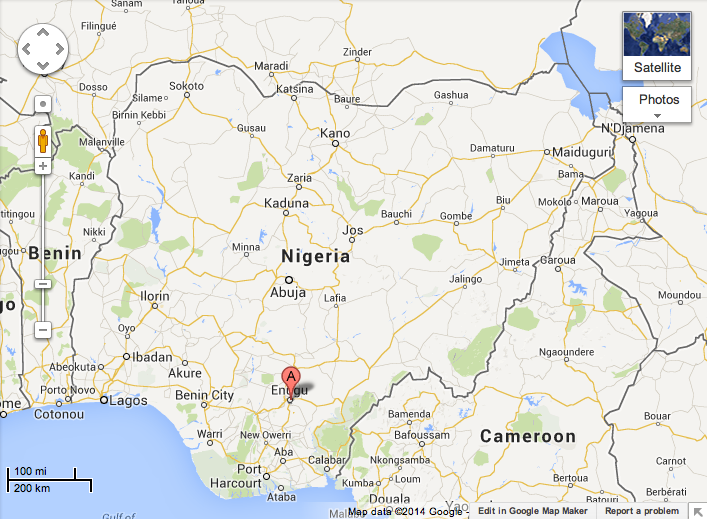
As you pray for the well-being of Enugu, would you also pray for all those places where religion is a cause for strife? Syria, northern Nigeria, the newest country in the world, South Sudan? To me, it is just heartbreaking that those who should be living in peace, working together, are in armed bloody conflict against one another.
Pensacola Named ‘Toughest City in America’
This is from the Pensacola News Journal, I think. I realized I hadn’t attributed it.
Just because our mayor is a pretty boy doesn’t mean Pensacola ain’t got grit.
And if you say otherwise, we’ve got a knuckle sandwich for you.
Pensacola has received this dubious honor via PolicyMic.com says the Pensacola News Journal:
Yes, little ol’ Pensacola has been named the Toughest City in America by the online news site PolicyMic (www.policymic.com).
Writer Akil Holmes used a variety of statistics to determine the “toughness” ranking, including the number of first round NFL draft picks, boxing champions, Medal of Honor and other military service citations, violent crime rates, and the percentage of workers employed in protective service, farming, fishing, construction and other tough-guy occupations.
Pensacola ranked No. 1 on the list, followed by Miami, Memphis, Detroit and Washington D.C.
Find story and see the other cities, visit policymic
.com. Look for the headline, “If You Can’t Stand Hipsters, These 11 Cities Are For You.’’ Pensacola might be tough, but it’s far from hipster-free. (Hello, Sluggo’s!)
Saudi Women Working in Shops
This weeks New Yorker, with a delightful cartoon of Pope Francis on the cover, making snow angels (Isn’t it great to see a powerful man having so much fun doing his job?)

. . . there is also a truly wonderful article, sympathetic and well written, about Saudi women being allowed to work in select shops. New Yorker only allows me to print an few lines from the article, but I loved how it captured the delight these women take in having a little bit of life outside the home to call their own. It also covers the dilemma of dealing with the religious police, the Muttawa, who are in a fit because now women will be in contact with MEN and who knows what might happen?
I had not read anything in the papers – our papers rarely cover smaller details of life in the Middle East. We were there when men were in every shop, selling underwear, selling abayas, and not a woman to be seen. This is a major change, done so so quietly, and women who need more space to breathe are finding a little bit of that space.
Not every woman wants to work outside the home, but many are bored and restless. When they talk about working, they talk about the friendships they form with other women, the pride they take in having a purpose to their daily life, and the increased respect with which they are treated by family members – all good things. The article is sensitively and sympathetically written.
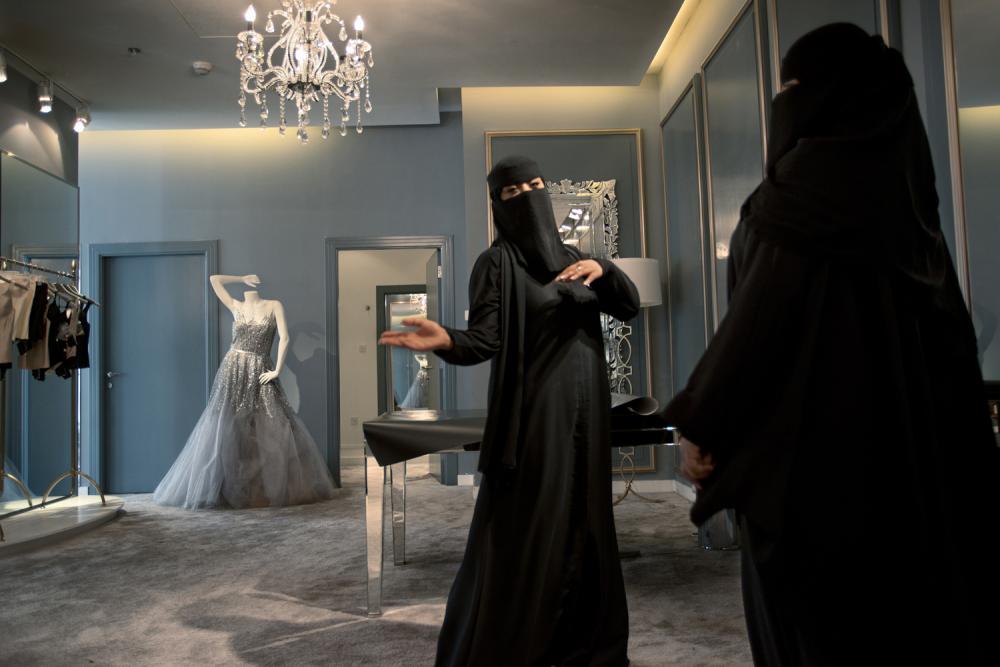
LETTER FROM RIYADH SHOPGIRLS: The art of selling lingerie.
BY KATHERINE ZOEPF
DECEMBER 23, 2013
A women’s revolution has begun in Saudi Arabia, although it may not be immediately evident. This fall, only a few dozen women got behind the wheel to demand the right to drive. Every female Saudi still has a male guardian—usually a father or husband—and few openly question the need for one. Adult women must have their guardians’ permission to study, to travel, and to marry, which effectively renders them legal minors. It took a decree from King Abdullah to put tens of thousands of them into the workforce. For the first time, they are interacting daily with men who are not family members, as cashiers in supermarkets and as salesclerks selling abayas and cosmetics and underwear.
One afternoon in late October, at the Sahara Mall, in central Riyadh, the Asr prayer was just ending. The lights were still dimmed in the mall’s marble corridor, but the Nayomi lingerie store had been unlocked. The rattle of steel and aluminum could be heard as security grilles were raised over nearby storefronts. Twenty-seven-year-old Nermin adjusted a box of perfume on a tiered display near the entrance, then turned to greet six saleswomen as they filed out of a storeroom, preparing to resume their shift. Nermin started working at Nayomi eighteen months ago, as a salesclerk herself. She was warm and engaging with customers, and was recently promoted to a position in which she oversees hiring and staff training for Nayomi stores across four Saudi provinces. All the employees wore long black abayas and niqabs, which revealed nothing but their eyes. They positioned themselves among the racks of bras, underpants, nightgowns, and foundation garments—black-cloaked figures moving against a backdrop of purples, reds, and innumerable shades of pink.
Nermin is one of the Nayomi chain’s longest-serving female employees. She was hired nearly a year after King Abdullah issued a decree, in June of 2011, that women were to replace all men working in lingerie shops. Early in 2012, on a visit to the Nayomi store in a mall near her house with her younger sister, Ruby, Nermin noticed a poster advertising positions for saleswomen. The sisters had never considered working, since there were virtually no jobs for women without a college degree or special skills. Nermin and Ruby mostly spent their days watching television, exercising, and surfing the Internet. In a blisteringly hot city with few parks, the mall was one of the only places to go for a walk. They filled out applications on the spot, and their family encouraged the idea. “I was surprised to find that I like to work,” Nermin said. Ruby, who got a job at the same store, is now the manager there. She wore its key on a yellow lanyard around her neck; pink-trimmed platform sneakers were visible beneath the hem of her abaya. After graduating from high school, she had spent four years feeling increasingly trapped at home, she said. “Nayomi gave me the chance to go on with life.” . . .
Killing the Golden Goose in Pensacola
Every place we have ever lived in has it’s own politics, and the politics in Pensacola are opaque, and to me, bizarre. We have a very pretty mayor – great for photo ops – but WHAT IS HE THINKING???? He displays some of the very worst traits of the old-boy way of doing business. What are those traits? How about telling one of the top grossing restaurants in Pensacola that they now owe $5M because they haven’t been paying a percentage of their revenue to the City of Pensacola? How about voting a Dollar Store into an upper level residential neighborhood? Singlehandedly re-naming a small airport without a single international flight Pensacola “International” airport? How about allocating all the food services at our “International” airport to bland chains, rather than some of our really good local vendors?
Lots of behind the scenes machinations, not putting items on the agenda – countering the spirit of the Sunshine Laws and making the deals in public – giving those who will be impacted some input on the measures.
It’s killing the golden goose. When something is working – and the Fish House restaurant is a go-to place in Pensacola, a place you meet up with friends and a place you take your out-of-town visitors to show off the city – LEAVE IT ALONE! When good people like the Studers and Collier Merrill are investing in downtown Pensacola, and building downtown up as a destination, let them make a buck or two – they are breathing life into the city! Do not kill the golden goose!

“The Emperor Has No Clothes!”
In contrast to some of the places we have lived, Pensacola has an outspoken paper – Our favorite newspaper, Rick Outzen’s Independent News has several wonderful articles this week. It’s where you find out what is really going on in Pensacola. His paper will bravely call out when the emperor has no clothes. I have shamelessly copied and pasted from his website at the Independent News:
How Not To Do Business
 City vs. The Fish House
By Rick Outzen
The title of the Pensacola News Journal’s (PNJ) article on Tuesday, Nov. 26 could have easily been “Mayor Accuses Fish House of Cheating City Out of Millions.” It wasn’t, but that is how some interpreted the article about the default notice sent on behalf of Mayor Ashton Hayward to Collier Merrill, co-owner of the restaurant.
But PNJ readers didn’t know what Merrill knew—that the notice was a negotiation ploy by the city, unsupported factually or legally, according to his attorney. They also didn’t know that the notice itself was leaked, Merrill believed, to the media to hurt his business.
The notice demanded that Seville Harbour, Inc. (owned by Ray Russenberger) and Merrill Land LLC (owned by Burney, Collier and Will Merrill) pay as additional rent payments five percent of The Fish House and Atlas Oyster House’s gross sales since April 2000, plus interest—an amount that could total well over $5 million.
Seville Harbour, Inc. has the ground lease for Pitt Slip, the name given to the three parcels owned by the city that include the anchorage between the Port of Pensacola and Bartram Park. Merrill Land LLC bought in April 2000 the building on the property from Seville Harbour for $1.3 million and subleased the parcel upon which it was built.
The default notice stated that the two companies had 90 days to pay up or the city would terminate the master lease, which would shut down the two restaurants on Feb. 13, 2014.
The impact of the article on The Fish House was immediate. Merrill tried to prepare his staff for any questions from customers.
“I had a meeting with the managers the next morning at 9:30 after the written article came out,” he said. “As much as you can say everything is fine, a few were a little hesitant. They were getting calls from other restaurants; one guy was offered a job.”
Jean Pierre N’Dione, the general manager of the two restaurants, said that the holiday business has been slower than prior years. He’s also dealt with questions from customers.
“The day of the article, a couple came in and said they were here to get a meal before the restaurant closed,” said N’Dione. “They were thinking we were going to be shut down in a few days. It was difficult to say if they were jokingly saying that or if they really believed it.”
The restaurant’s party and catering businesses have also been hurt by the city’s threat.
“We’ve definitely lost business,” said Merrill. “Over Thanksgiving weekend, there were brides in town booking their parties for next October. They didn’t want to take the chance that we might not be in business next year. People are now hesitant to book their Christmas parties with us.”
Why would the mayor’s office resort to such strong-arm tactics? Many would expect a default notice to be sent by Mayor Hayward only after his negotiations with Seville Harbour and Merrill Land had hit an impasse, especially when the notice is a public record that could hurt two landmark restaurants.
However, there had been no negotiations with the city, though Russenberger’s attorney asked for the leases to be combined in 2009. The leases were properly renewed in July 2011, and the mayor had never sent them any written proposals for the properties.
Merrill told the IN that he had only two meetings with the Hayward administration on the lease—one in 2011 with City Attorney Jim Messer and then Chief of Staff John Asmar, the other this past September with City Administrator Colleen Castille. Neither time did the city officials bring up anything about the restaurants owing millions in back rent. Never did the city ask for five percent of his restaurants’ sales.
“We have been waiting for the city to get back to us,” said Merrill. “We had no idea this was an issue or the mayor’s position on the leases.”
Pensacola Landmark
For many, The Fish House is an iconic Pensacola landmark.
The restaurant has hosted presidents, governors, senators, congressmen and other celebrities. During the 2008 presidential election, John McCain, Rudy Giuliani and Fred Thompson held campaign fundraisers there. This past election cycle, GOP presidential hopeful Mitt Romney, with McCain, actor Jon Voight and Mayor Hayward, held a rally on The Fish House deck, pictures of which appeared in the Washington Post and New York Times.
Chef and co-owner Jim Shirley has served his famous Grits a Ya Ya for dignitaries in Washington, D.C. and New York City. Pensacola native, former congressman and author Joe Scarborough has hosted his MSNBC show “Morning Joe” several times from the restaurant.
Three reality shows have been filmed there. The Travel Channel aired an episode of “Bizarre Foods” that featured The Fish House’s grouper throats. “American Pickers” also filmed an episode from The Fish House, which featured the Merrill brothers trading some of their memorabilia for a model of the USS Atlanta. This past August, Chef Emeril Lagasse showcased The Fish House as part of his show “Emeril’s Florida” on the Food Network.
The Fish House and Atlas Oyster House have made Pitt Slip a destination for many visiting our area, serving an estimated 500,000 customers a year. They also are part of what was one of the city’s first public-private development projects.
In the 1980s, the Pensacola City Council wanted a marina built on Pitt Slip, the inlet across from the town’s historic district and outside the gates of the Port of Pensacola. Three parcels were combined—the water area for the docks (Parcel 1), the area along Barracks Street that the city leased from the state (Parcel 1A) and the lot south of the marina (Parcel III).
The intent was to lease to a developer the parcels for 30 years with a renewal option for an additional 30 years. When the original lease was executed in 1985, the city learned that its lease for Parcel 1A with the state only had 27 years remaining. The city had to amend the original lease to adjust its end date. The state required that it be renewed for five successive five-year periods.
The history of the development was filled with ownership changes and business failures. The project never was as successful as the council had hoped until Russenberger and the Merrills got involved.
In January 1998, Chef Jim Shirley rented the space formerly used by the closed Beef & Ale House in the Seville Harbour building on Parcel 1A. He opened the Fish House with Brian Spencer and Dr. Roger Orth as his investors. By the spring, Merrill brothers stepped in as investors in The Fish House, forming Great Southern Restaurant Group of Pensacola, Inc. that put about $2 million into the restaurant, according to Merrill. Spencer and Orth focused on Jackson’s, a restaurant they were opening on Palafox.
“At the time, my brothers and I had invested in several businesses downtown,” said Merrill. “We bought the Bass building on the corner of Palafox and Gregory and were the landlord to Jim Shirley and the Screaming Coyote. We bought Seville Tower on the corner of Palafox and Government streets, which is where my grandfather had his offices in the 1940s.”
He said, “We wanted to move downtown. At the time, our offices were near the mall at Madison Park. Though not a lot was going on downtown, we loved it and saw the potential.”
In 2000, Merrill learned Russenberger was looking to sell the Seville Harbour building. Merrill Land LLC, the brothers’ real estate development company, bought it for $1.3 million and agreed to sublease the ground lease for parcel 1A upon which it was built at the same terms of the master lease. The purchase and sublease were both recorded with the clerk of courts.
Great Southern Restaurant Group went from renting from Seville Harbour, Inc. to renting from Merrill Land LLC.
“Merrill Land got a loan to buy the building, on which it is still making payments,” said Merrill. “It’s like any business. It rents out spaces. We charge rent and hope that those collections are enough to cover our mortgage, lease payment to Russenberger for the ground lease, utilities, repairs and maintenance. At the end of the day, we hope to make a profit like any landlord does.”
Merrill admitted he has been surprised by how much he has come to like the restaurant business. He enjoys the positive feedback he receives from customers and is proud of the role The Fish House plays in the community.
“Maria Goldberg, our marketing director, and I get together once a week,” said Merrill. “We go over all the requests for donations from charities, and there’s always a stack of them. We try to help every one of them, from the high school booster clubs to the NICU at Sacred Heart.”
The Fish House caters events for charities, hosts parties and donates appetizers and the services of its chefs for other fundraising events. He said, “We’ve tried to be good citizens by giving back to the community, trying to get downtown going and helping to promote Pensacola.”
Legal Battle
The default notification from the city asserted that it was entitled to five percent of the gross sales of the restaurants because Merrill Land had been partially assigned the master lease when it bought the Seville Harbour building. The city claimed Great Southern Restaurant Group was a subsidiary or business combination of Merrill Land and therefore should have paid rent based on its gross sales.
Attorney Bruce Partington responded on Nov. 27 on behalf of Seville Harbour and Merrill Land LLC.
First, he made it clear that the leases had been properly renewed. According to Partington, the renewals required nothing more than delivery of a written notice. The letter exercising the renewals was sent July 21, 2011 by Leo Cyr on the behalf of Seville Harbour.
Seville Harbour never partially assigned its lease to Merrill Land.
“Seville Harbour retains multiple rights and duties with respect to the property sub-leased to Merrill Land,” said Partington. “The fundamental concept of an assignment is that the assignor’s entire interest is transferred to the assignee which did not occur here.”
He pointed out that the city had refused in 2000 to approve any assignment to Merrill Land, which is why the transaction was done as a sublease. He asserted that the city’s new position of the relationship between the two companies being an assignment was “irreconcilable and fundamentally inconsistent” with its position 13 years ago.
He pointed out the two restaurants are not owned by Merrill Land. The owner, Great Southern Restaurant Group, “is not, and has never been, a ‘subsidiary or business combination’ of Merrill Land.”
“Merrill Land has no ownership or other interest in Great Southern Restaurant Group, nor does Merrill Land receive any portion of the revenues from the operation of the restaurants on the property.”
Partington believed that the city’s position is without merit and based on “two dubious propositions which are unsupported factually or legally.”
He expressed Merrill’s concerns about how the daily newspaper got wind of the letter one day after the certified letter was received.
“It is extremely troubling that Seville Harbour’s multiple attempts over several years to meet with representatives of the city to discuss the lease were ignored,” wrote Partington, “and then, after years without a response, receive a notice of default, which was then leaked by the city to the media for dramatic effect.”
He put the city on notice that it was responsible for any damage that the leak may have caused Great Southern Restaurant Group.
The Leak
Merrill admitted that when he first received the letter from Daniel he was not that concerned. He was surprised the attorney brought up gross sales, but believed that the restaurants were on solid legal ground.
He said, “I wasn’t really worried about it. I don’t even think I told my brothers about it because I knew it was baseless.”
He sent the letter to Stephen Moorhead, Russenberger’s attorney, to review. Then on the afternoon of Thursday, Nov. 21, Merrill received a call from the PNJ saying that they had heard about a letter sent to him saying The Fish House owed the city millions of dollars. The reporter would not tell him how they got that information, but he admitted they had not yet seen the letter.
Merrill called City Administrator Colleen Castille, who denied any responsibility for the leak. “Colleen, I don’t think you understand the severity of this. This is going to be a front-page story and I’m going to lose business immediately.”
A meeting was set up for the following morning between the daily newspaper, Castille and Merrill. He hoped that the City Administrator, whom he had given the details of the leases in September, would say the letter was wrong. That did not happen.
According to Merrill, she said the letter was a negotiating tool.
“I said that’s fine if you want to sit down at the negotiation table. We’ve been wanting to do it for years,” Merrill recalls what he told Castille at the meeting.
“But to say something that bad about my business is just wrong. I told the City Administrator that to send out a totally baseless letter with inaccurate facts to hurt my business is almost criminal.”
The IN asked the city for an interview with Castille for this article. The city’s communications director, Tamara Fountain, replied the following week, “Colleen has decided not to do any further interviews.”
The city did not offer for anyone else to explain the mayor’s decision to send the default notice or talk about the negotiations and did not give the paper permission to talk to its attorney Nix Daniel.
Who does Merrill think leaked the letter?
“Obviously it had to come from the city. It was either someone with the city or they gave the information to someone who then leaked it to the News Journal,” he said. “The last thing I wanted was this inaccurate letter to come out, because it’s hard to get that genie back in the bottle. I knew people were going to think The Fish House owes the city millions and the city was going to shut us down.”
Merrill said that the city knows the letter is totally inaccurate. “We’ve paid every bit of rent we owe. We’ve shared our financial information. I’m shocked that the mayor’s office would use this tactic. We sat down with Colleen, explained all the details of the leases and we thought it was all good—until we got the default notice.”
He said for the city to send out a default notice demanding millions of dollars without any discussion is unconscionable. “We properly and legally renewed our leases in July 2011. We got a letter from the city attorney that our attorney responded to almost immediately. We received nothing in writing until two years later and it’s a baseless default notification about something that the city has never mentioned to us was even an issue.”
Merrill asked, “What kind of message does this to send to businesses looking to invest in Pensacola and possibly partner with the city?”
Editor’s notes: •Collier Merrill owns a five percent interest in the Independent News. Ray Russenberger owns 2.5 percent of the paper. Neither has, or has ever had, any control over the paper’s editorial coverage.
•At the time of print, the mayor and his attorneys had scheduled a meeting for Monday Dec. 9 to discuss Pitt Slip with Ray Russenberger, Collier Merrill and their attorneys.
———————————————
Don’t Forget The Airport
Mayor Hayward has been in a dispute with The Fish House over the food services contract at the Pensacola International Airport.
Hayward recommended to the city council at its Sept. 26 regular meeting the 10-year concession contract should be awarded to OHM Concessions—which included Chick-fil-A, Einstein Bros. Bagels, Surf City Squeeze and Corona Beach House. Collier Merrill’s The Fish House had joined forces with Bagelheads, Varona’s, and Pensacola Bay Brewery to offer a more local option that had placed second to OHM during the selection process.
The issue was tabled at the meeting when Merrill, the other local business owners, their employees and citizens spoke out in favor of their proposal. Since then, Mayor Hayward has pulled the item off the council’s agenda twice.
Those familiar with council politics say the mayor simply doesn’t have the votes to win approval for OHM. Did the mayor’s office leak the default notice to the daily newspaper to tarnish the image of Merrill and The Fish House to gain the one or two votes needed to bring Chick-fil-A to the airport?
“I certainly hope not,” said Merrill, “because I would hate to see them use those tactics (the notification of default and subsequent leak to the media) to win on a completely separate issue and to punish my 250 employees and my family.”
The next week in his “Upwords” newsletter Hayward criticized Merrill and the others who spoke out at the council meeting claiming they “ambushed” the council.
“It is a terrible idea to disregard our objective business processes in response to a few influential people politically strong-arming our elected officials,” said the mayor.
Merrill was dumbfounded by the mayor’s comments.
“I spoke before the city council because City Administrator Colleen Castille said that was what I should do,” he said. “She said she was going to let the Airport Director, Greg Donovan, stand on his own. We could make our argument and then we let the council make the decision.”
After the newsletter, he met with Castille and City Attorney Jim Messer and asked for explanation of the mayor’s comments.
“I asked Colleen, didn’t I do what you told me do?” he told the IN. “Basically she told me that she didn’t think we would be that organized.”
On Tuesday, Oct. 15 at his first “Mornings with the Mayor” session, Hayward bristled when asked about his “ambush” comment.
“That’s what I called it,” said Hayward, “It was an ambush.”
The IN asked how so, especially since Merrill had been instructed by the City Administrator to make his case at the council meeting.
“They did, but in my opinion I said it was an ambush,” said the mayor.
Mayor Hayward said of the upcoming council vote on the issue, “We will see what happens. They might win. If they do, we will move on. We’re going to support them and we’re going to say let’s make Pensacola a better place. I’m a big boy. Sometimes you win ’em; sometimes you lose ’em.”
When the council agenda for its Oct. 24 meeting was released, the food services contract was on it. The following Sunday, Hayward supporter Bob Kerrigan wrote a viewpoint in favor of OHM getting the contract. Ads appeared in the daily newspaper supporting the mayor’s proposal. A website was set up for Hayward supporters to send emails to council members.
Then at the council’s agenda review meeting, City Administrator Castille, on the mayor’s behalf, unexpectedly pulled it off the agenda. The mayor appeared no longer willing to lose on the issue.
The airport food services recommendation was not on any of the council’s agenda. On Dec. 2, Merrill received an email from the city that stated the issue would not come up in December either.
“Please be advised that the Airport Director will not be bringing the Food and Beverage concession lease agreement to the Pensacola City Council during its December, 2013 meeting,” wrote Airport Administration & Contracts Manager Michael Laven. “Both the Director and the Mayor will be out of the country on business. We believe that the scheduling of this concession will take place in January or February of 2014.”
Stay tuned.
Kuwait Drivers Without Drivers’ Licenses
This disturbing piece of writing is from the Arab Times. Disturbing not just because Kuwaiti citizens are driving without licenses – that’s nothing new – but also because some editor let this piece run without some badly needed editing. Ayb!
Some Citizens Said Driving For Many Years ‘Without’ License
KUWAIT CITY, Nov 23: Intensive traffic campaign the Interior Ministry’s Assistant Undersecretary for Traffic Affairs embarks upon since the past few months uncovered that some Kuwaitis have been driving for many years without license, reports Al-Watan Arabic daily. A source disclosed that a Kuwaiti in his 40s’ recently applied for driver’s license at a driving test section. The added the act is strange in Kuwait since almost every Kuwaiti goes for driving test at the age of 18. Other driving test sections have received similar applications from many Kuwaitis in their late 20s and 30s. Some of the concerned citizens changed their minds to apply for driver’s license after they were caught by traffic officers. He also said many others were caught driving
“The added the act is strange . . . ” Gibberish. And what about that lead sentence?
Kuwait to Limit Auto Ownership to Solve Traffic Gridlock?
Limit Kuwaitis to two cars per citizen?
Limiting expats to one car will also limit the people willing to take contracts in Kuwait, and family willing to accompany them . . .
Or is this another of those unenforceable laws to put on the books?
Restrictions on automobile ownership in the offing – Bid to solve traffic problems
KUWAIT: According to a report published yesterday in a local Arab daily, the government is planning to limit the number of vehicles a person is allowed to own at two for citizens and one for expats. This proposal may be announced at the beginning of the next year. The proposal also calls to stop renewing registrations of old vehicles without specifying the period, which could be between 8 to 12 years.
The Ministry of Interior hasn’t received any official instructions to take action in this matter. “We are an executive department that applies the law and executes decisions. It’s possible that there are committees at the ministry studying this proposal, but we are not aware of it yet,” Maj Naser Buslaib, Head of the Media Department at the Ministry of Interior told Kuwait Times. Economic analyst Hajaj Bukhadour thinks such a proposal is not realistic and doesn’t believe it may be applied. “Such rules do not exist in any country, even the poor ones or those suffering from traffic woes. Through such unreal proposals, the officials in charge are trying to shirk the problem.
The officials pin the blame and responsibility on expats as they are not qualified and creative enough to find a solution for the traffic problem in Kuwait,” he pointed out. Development and improvement in administration is important to solve major problems. “We should improve the performance of the officials who are in charge of issuing decisions.
There are mistakes in any institution, but we need to improve and this is a great part of solving the problem. Such a proposal proves that officials in charge at the Ministry of Public Works, Ministry of Interior and other institutions didn’t study the problem correctly,” stressed Bukhadour. There are various solutions according to him.
“Different public institutions should cooperate to organize the movement of people in streets through different timings of public employees, schools and others. Also, the government should provide modern and clean public transportation such as a metro or new modern buses that will respect the time and have stops near residential areas that are shaded to suit the hot weather when passengers are waiting for the bus,” he explained.
He mentioned additional solutions. “Developing roads and the infrastructure is very important in solving the traffic problem. Also, the development of the Traffic Department will help in this matter. I think that such suggestions may bring better results in solving the traffic problem rather that coming up with unreal proposals,” concluded Bukhadour.
By Nawara Fattahova
Rape Victim Should Have Just Closed Her Legs: Defense Attorney
Ignorance and outrageous statements on rape are rampant world-wide. Today, this story from New Zealand, via AOL HuffPost World:
This week’s example of how not to handle a rape trialhave comes to you from New Zealand, where a defense attorney is being criticized for saying a sexually assaulted woman should have kept her legs shut.
Speaking to a Wellington District Court jury on Wednesday, defense lawyer Keith Jefferies claimed that his client, George Jason Pule, a bouncer at a local club, had merely engaged in consensual sex with the victim, as quoted by local paper The Dominion Post.
Jefferies’ “proof”? The drunk 20-year-old woman did not attempt to stop Pule’s advances after he convinced her to follow him down an alley.
“All she would have had to do was to close her legs,” Jefferies told the jury in his closing argument, per the Post. “[I]t’s as simple as that.”
Pule had attempted to claim that the victim had filed a false rape charge because she regretted having sex with him, reports the Post.
Despite his best efforts, Jefferies’ client was ultimately convicted on the rape charge and is currently awaiting sentencing.
It’s been a difficult month so far for victims advocates in New Zealand, with the Wellington trial following news of an alleged “teen rape club, ” known as the “Roast Busters,” operating in New Zealand. Members of the group, which is currently being investigated by police, are said to have boasted about getting underage girls drunk and sexually assaulting them.
“This whole situation is horrific,” Wellington Rape Crisis Center’s Natalie Gousmett said in a press release. “First we have the abhorrent behaviour of the members of the rape group, causing serious harm to the victims they have targeted. Then we have appalling coverage by media, including extreme victim-blaming. … All of this demonstrates the rape culture in [New Zealand], which is extremely harmful to survivors.”
Gousemett went on to note that victims who “are told they are at fault for being raped” are far less likely to come forward and receive the support they need.
In an effort to counteract the problem, advocacy groups have launched a new public service campaign called “Who Are You,” urging New Zealanders to keep “an eye on your mates when you’re out –- You look after them, they look after you. It’s all about having fun and making it home safely.”
“if You Can’t Prevent Rape, You Enjoy It”: Ranjit Sinha
The Chief of India’s Central Bureau of Investigation said this! Was he snorting cocaine in a drunken stupor? Of course he is apologizing, but his careless remark demonstrates the sentiments buried deep in his culture’s heart – it’s only women. Not worth much, not like us men. Outrageous.

NEW DELHI (AP) — India’s top police official apologized Wednesday for saying, “If you can’t prevent rape, you enjoy it,” a remark that has outraged women across the country.
Central Bureau of Investigation chief Ranjit Sinha made the remark Tuesday during a conference about illegal sports betting and the need to legalize gambling. The CBI, the country’s premier investigative agency, is India’s equivalent of the FBI.
Sinha said at the conference that if the state could not stop gambling, it could at least make some revenue by legalizing it.
“If you cannot enforce the ban on betting, it is like saying, ‘If you can’t prevent rape, you enjoy it,'” he said.
The remarks have caused outrage across India, which in the past year has been roiled by widespread protests following the fatal gang rape of a 23-year-old woman on a bus in New Delhi.
On Wednesday, Sinha said that his comments had been taken out of context and misinterpreted, and that he was sorry if he had caused hurt.
Angry activists, however, called for his resignation.
Communist Party of India (Marxist) leader Brinda Karat said Sinha’s comments were offensive to women everywhere.
“It is sickening that a man who is in charge of several rape investigations should use such an analogy,” Karat told reporters. “He should be prosecuted for degrading and insulting women.”
The New Delhi attack on the young woman last December caused nationwide outrage and forced the government to change rape laws and create fast-track courts for rape cases. New laws introduced after the attack make stalking, voyeurism and sexual harassment a crime. They also provide for the death penalty for repeat offenders or for rape attacks that lead to the victim’s death.
Recent Comments
ExpatAlien on What Country am I Living … intlxpatr on Yellowstone: Old Faithful to C… Michelle on Yellowstone: Old Faithful to C… Cathy on No Grown-Ups in Charge intlxpatr on Waiting for Snow Wikipedia Donate Button

Amazina


Early Voting in Florida


 Here There and Everywhere