I love this. Women are using technology – and the traditional system – to persist in seeking justice for women who are often little more than slaves to their husband.
From BBC News:

Tahira
Women in Pakistan’s Swat valley are making history, and perhaps some powerful enemies, by convening an all-female jirga, a forum for resolving disputes usually reserved for men. Some readers may find details of this report by the BBC’s Orla Guerin disturbing.
Tahira was denied justice in life, but she continues to plead for it in death – thanks to a grainy recording on a mobile phone.
As she lay dying last year the young Pakistan wife and mother made a statement for use in court.
In the shaky amateur video, she named her tormentors, and said they should burn like she did.
Tahira was married off at the age of 12 and died last year following a suspected acid attack
Tahira’s flesh was singed on 35% of her body, following a suspected acid attack. Her speech was laboured and her voice was hoarse, but she was determined to give her account of the attack, even as her flesh was falling off her bones.
“I told her you must speak up and tell us what happened,” her mother Jan Bano said, dabbed her tears with her white headscarf. “And she was talking until her last breath.”
Tahira’s husband, mother-in-law, and father-in-law were acquitted this month of attacking her with acid. Her mother plans to appeal against that verdict, with help from a new ally – Pakistan’s first female jirga.
Under the traditional – and controversial – jirga system, elders gather to settle disputes. Until now this parallel justice system has been men-only, and rulings have often discriminated against women. The new all-women jirga, which has about 25 members, aims to deliver its own brand of justice.
It has been established in an unlikely setting – the scenic but conservative Swat valley, formerly under the control of the Pakistan Taliban. We sat in on one of its sessions in a sparsely furnished front room. Women crowded in, sitting in a circle on the floor, many with children at their feet. Most wore headscarves, and a few were concealed in burqas.
Probing injustice
For more than an hour they discussed a land dispute, problems with the water supply, unpaid salaries, and murder. The only man in the room was a local lawyer, Suhail Sultan. He was giving legal advice to jirga members including Jan Bano who he represents.
“In your case the police is the bad guy,” he told her. “They are the biggest enemy. ” He claims the police were bribed by the accused, and were reluctant to investigate the case properly.

The jirga tackled land disputes, water supplies, and murder
The jirga is making history, and perhaps making enemies. In Swat, as in many parts of Pakistan, men make the key decisions – like whether or not their daughters go to school, when they marry, and who they marry. And oppression starts early. Tahira was married off at just 12 years old, to a middle-aged man.
“Our society is a male-dominated society, and our men treat our women like slaves,” said the jirga founder, Tabassum Adnan. “They don’t give them their rights and they consider them their property. Our society doesn’t think we have the right to live our own lives.”
This chatty social activist, and mother of four, knows that challenging culture and tradition comes with risks. “Maybe I could be killed,” she said, “anything could happen. But I have to fight. I am not going to stop.”
They glued [my daughter’s] mouth and eyes closed. Just her face was left, the rest was flesh and broken bones”
Taj Mehal
As we spoke in a sun-baked courtyard Tabassum got a disturbing phone call. “I have just been told that the body of another girl has been found, ” she said. ” Her husband shot her.” She plans to investigate the case, and push the authorities to act.
“Before my jirga women have always been ignored by the police and by justice, but not now. My jirga has done a lot for women,” she said.
There was agreement from Taj Mehal, a bereaved mother with a careworn face, sitting across the courtyard on a woven bed.
Her beloved daughter Nurina was tortured to death in May.
“They broke her arm in three places, and they strangled her,” she told me, putting her hands to her own throat to mimic the action. “They broke her collarbone. They glued her mouth and eyes closed. Just her face was left, the rest was flesh and broken bones.”
She speaks of her daughter’s suffering with a steady voice, but grief is wrapped around her, like a heavy shawl.
“When I looked at her, it was like a piece was pulled out of my heart,” she said. “I was turned to stone. I see her face in front of my eyes. I miss her laughter.”
Women are a rare sight on the streets of Mingora
Nurina’s husband, and his parents, have now been charged with her murder, but her mother says that initially the courts took no interest.
“Whenever we brought applications to the judge he would tear them up and throw them away,” she said. “Now our voice is being heard, because of the jirga. Now we will get justice. Before the jirga husbands could do whatever they wanted to their wives.”
Women are little seen or heard on the bustling streets of Mingora, the biggest city in Swat. Rickshaw taxis dart past small shops selling medicines, and hardware supplies.
There are stalls weighed down with mangoes, and vendors dropping dough into boiling oil to make sugar-laden treats. Most of the shoppers are men.
‘No justice’ at jirgas
When we asked some of the local men their views on the women’s jirga, the results were surprising. Most backed the women.
“It’s a very good thing,” said one fruit seller, “women should know about their rights like men do, and they should be given their rights.”
Another said: “The jirga is good because now finally women have someone to champion their cause.”
The response from the local male jirga was less surprising. They were dismissive, saying the women have no power to enforce their decisions.
Most local men who spoke to the BBC expressed support for the women’s initiative
That view was echoed by the prominent Pakistani human rights activist Tahira Abdullah. “I don’t see it as more than a gimmick,” she said. “Who is going to listen to these women? The men with the Kalashnikovs? The Taliban who are anti-women? The patriarchal culture that we have?”
Ms Abdullah wants jirgas stopped whether male or female. “The jirga system is totally illegal, and has been declared illegal by the Supreme Court of Pakistan. It can never be just. There are several extremely notorious cases where we have noticed that women do not get justice from jirgas, neither do non-Muslims.”
One of those cases took place last year in a remote region of northern Pakistan where a jirga allegedly ordered the killing of five women – and two men – for defying local customs by singing and dancing together at a wedding.
And there are regular reports of jirgas decreeing that women and young girls be handed over from one family to another to settle disputes.
But for some, like Jan Bano, the women’s jirga is bringing hope. Every day she climbs a steep hill to visit Tahira’s grave, and pray for the daughter whose voice has still not her heard. Her video recording was not played in court.
July 26, 2013
Posted by intlxpatr |
Community, Counter-terrorism, Cultural, Family Issues, Law and Order, Living Conditions, Marriage, Mating Behavior, Pakistan, Political Issues, Relationships, Social Issues, Women's Issues | acid attack, Child marriage, jirga, Pakistan, Swat Valley |
Leave a comment
From today’s AOL/Huffpost:
DUBAI, United Arab Emirates — A Norwegian woman sentenced to 16 months in jail in Dubai for having sex outside marriage after she reported an alleged rape said Friday she decided to speak out in hopes of drawing attention to the risks of outsiders misunderstanding the Islamic-influenced legal codes in this cosmopolitan city.
The case has drawn outrage from rights groups and others in the West since the 24-year-old interior designer was sentenced Wednesday. It also highlights the increasingly frequent tensions between the United Arab Emirates’ international atmosphere and its legal system, which is strongly influenced by Islamic traditions in a nation where foreign workers and visitors greatly outnumber locals.
“I have to spread the word. … After my sentence we thought, `How can it get worse?'” Marte Deborah Dalelv told The Associated Press in an interview at a Norwegian aid compound in Dubai where she is preparing her appeal scheduled for early September.
Dalelv, who worked for an interior design firm in Qatar since 2011, claims she was sexually assaulted by a co-worker in March while she was attending a business meeting in Dubai.
She said she fled to the hotel lobby and asked for the police to be called. The hotel staff asked if she was sure she wanted to involve the police, Dalelv said.
“Of course I want to call the police,” she said. “That is the natural reaction where I am from.”
Dalelv said she was given a medical examination seeking evidence of the alleged rape and underwent a blood test for alcohol. Such tests are commonly given in the UAE for alleged assaults and in other cases. Alcohol is sold widely across Dubai, but public intoxication can bring charges.
The AP does not identity the names of alleged sexual assault victims, but Dalelv went public voluntarily to talk to media.
Dalelv was detained for four days after being accused of having sex outside marriage, which is outlawed in the UAE although the law is not actively enforced for tourists as well as hundreds of thousands of Westerners and others on resident visas.
She managed to reach her stepfather in Norway after being loaned a phone card by another woman in custody.
“My stepdad, he answered the phone, so I said, that I had been raped, I am in prison … please call the embassy,” she recounted.
“And then I went back and I … just had a breakdown,” she continued. “It was very emotional, to call my dad and tell him what happened.”
Norwegian diplomats later secured her release and she has been allowed to remain at the Norwegian Seamen’s Center in central Dubai. She said her alleged attacker received a 13-month sentence for out-of-wedlock sex and alcohol consumption.
Dubai authorities did not respond to calls for comment, but the case has brought strong criticism from Norwegian officials and activists.
“This verdict flies in the face of our notion of justice,” Norway’s foreign minister, Espen Barth Eide, told the NTB news agency, calling it “highly problematic from a human rights perspective.”
Previous cases in the UAE have raised similar questions, with alleged sexual assault victims facing charges for sex-related offenses. Other legal codes also have been criticized for being at odds with the Western-style openness promoted by Dubai.
On Thursday, Dubai police said they arrested a man who posted an Internet video of an Emirati beating a South Asian van driver after an apparent traffic altercation. Police said they took the action because images of a potential crime were “shared.”
In London, a spokesman for the Emirates Center for Human Rights, a group monitoring UAE affairs, said the Dalelv case points out the need for the UAE to expand its legal protections for alleged rape victims.
“We urge authorities to reform the laws governing incidents of rape in the country,” said Rori Donaghy, “to ensure women are protected against sexual violence and do not become the targets of prosecution when reporting crimes.”
July 20, 2013
Posted by intlxpatr |
Bureaucracy, Crime, Cross Cultural, Cultural, Detective/Mystery, ExPat Life, Living Conditions, Social Issues, Women's Issues, Work Related Issues | Dubai |
2 Comments

I had downloaded The Twelve to my iPad for a trip, but didn’t get to it, and sort of forgot it was there until my son mentioned he was listening to it on audio-books, and it was good, maybe even better than the first book in the trilogy, The Passage. He had loaned me The Passage several years ago when it came out, and as soon as I finished, I got on the list to download as soon as the next book came out – it was that good.
Cronin’s gift is an ability to create a future world entirely different from our own, with a devastating enemy – the virals – who, literally, are us, transformed. Cronin can make the enemy terrifying, destructive, truly horrifying – and can make them also captive to their repugnant nature and even pitiable. I think that is an amazing dance for an author to accomplish.
The setting is post-apocalyptic USA; the government had a sector working on a secret weapon which – of course – was not able to be contained, creating 12 super vampire-like creatures called Virals, who in turn create hordes of minions. This volume, The Twelve, is set more than 100 years later, but shifts back to earlier times to help us understand how this disaster occurred, and how characters relate back to the earliest times of the disaster. The populations live in fear of sudden attacks; one family, out on a picnic, are almost totally wiped out by an eclipse for which the Virals were prepared – and the families were not.
As I read his books, I find them very cinematic, but, as my son and I discussed, too complex for a movie; it would need a gritty HBO series like The Wire, or OZ, or Deadwood to capture the subtleties, the nuances that make this a best-selling series. The heroes and heroines are all make for the screen, their relationships – and inter-relationships – make them interesting, and then, as we learn more, interesting again. We never know enough to make a final judgement on any character; the characters are complex and the relationships obscure until the author chooses to reveal. It makes it fun to try to spot them before he tells us. I missed a couple!
Although it can be read as a great-adventure stand-alone, you’ll be happier if you read The Passage before you read The Twelve. If you have a problem with postponing gratification, you might want to wait until the third and conclusive volume of the trilogy is published – and that may be a year or so.
July 13, 2013
Posted by intlxpatr |
Adventure, Books, Character, Community, Fiction, Health Issues, Living Conditions, Political Issues, Relationships, Social Issues, Survival | Post Apocalypse, virals |
Leave a comment
It doesn’t matter how enlightened the legislation – if the law is not enforced, the rules on the book are laughable. It gives the illusion of a lawful society, but if citizens know that they will not be penalized for breaking the law, they will scoff at the law and do as they please. People who came to the country expecting to make a fair wage and be treated decently and with dignity find themselves without proper paperwork due to the corruption of their employer or recruiter.
If the MOI in Qatar enforces this law, a terrible situation will be slightly better. This, from The Qatar Gulf Times:
By Ramesh Mathew/Staff Reporter
| With the Ministry of Interior (MoI) taking a firm stand on ID cards, residents believe that this will safeguard the interests of workers as their employers will now be forced to abide by the rules. |
A report in the Tuesday edition of Gulf Times had quoted a senior official as saying that residents should always carry their residence permit ID cards and produce the same whenever asked by the authorities concerned. Those failing to do so would be fined up to QR10,000, the report had said, adding that the MoI could also transfer the sponsorship of expatriates if they proved that they were abused by sponsors under Law No 4/2009.
Welcoming the MoI’s decision, legal expert and rights activist Nizar Kochery said this would make employers more accountable as any long delay or failure on their part to stamp the visas of their staff would invite a hefty fine.
“There have been cases of companies refusing to stamp visas for long periods and workers being picked up by the law-enforcing agencies for failing to produce valid residence proof,” said Kochery, adding that the ministerial reaffirmation would force employers to stamp visas promptly.
Reacting to the report, an Asian diplomat said his country’s mission frequently received complaints from people alleging that their employers had not stamped their visas even months after their arrival in Qatar.
“The embassy receives such complaints from expatriates every week though there has been a drastic fall in their numbers in recent times due to strict enforcement of the rules by the local authorities,” he added.
Kochery said there should also be stringent implementation of the rules pertaining to expatriates’ passports. “Though the ministry issued guidelines more than three years ago on the issue of custody of passports, complaints of violation of this norm continue,” the legal expert said.
The ministry had instructed employers to hand over the passports of employees after the completion of formalities. However, there have been cases of some employers retaining the passports in violation of the local rules.
“A similar fine (like the one for not carrying IDs) should be imposed on erring employers for illegally keeping their workers’ passports,” he said.
A few years ago, this newspaper had reported about a theft in a manpower company’s office in Musheireb. More than 150 passports of workers, which the firm had kept in its custody in violation of rules, went missing in the incident. Meanwhile, residents have also said similar penalties were required to curb violations regarding exit permits as well. A social activist in the Indian community said there have been complaints of employers failing to arrange exit permits for their workers on time even during emergencies.
There have also been reports of residents, mainly drivers, lodging complaints with embassies, alleging that their sponsors take away their licences when they go on vacation.
“The MoI should consider imposing hefty fines on such employers as well. Like a passport, a driving licence is not only the property of an individual, but is also a proof of identification under the local rules,” said Kochery.
July 11, 2013
Posted by intlxpatr |
Bureaucracy, ExPat Life, Interconnected, Kuwait, Law and Order, Leadership, Lies, Living Conditions, Pet Peeves, Qatar, Relationships, Scams, Social Issues, Transparency, Work Related Issues | exit permits, Ministry of Interior, passports, resident IDs |
Leave a comment
It looks like rather than investing in better highways, Qatar will follow in Kuwait’s footsteps to restrict driver’s licenses. This is another example of a law that invites unequal enforcement. “Ambiguous” implies that the rule will not be applied to everyone, but will be subject to bribery and connections to the right people.
Why do I even care, you might ask. As a white Western woman, this rule won’t apply. I won’t be stopped in traffic stops; if I am, and can’t show a valid license, I will politely be told I need to get one. But I publish this because it isn’t fair. It applies to my fellow expat wives, as well as to the hairdresser who would come to my home to cut my hair, or the carpenter with his own little business who wants to deliver the new couch he made for me. And, if the traffic doesn’t get better by eliminating catagories of employment, the next step considered is often eliminating licenses for WOMEN.
If the taxi situation in Doha were not so abysmal, it could be bearable not to have a license, but once the state took over the taxi business and ruthlessly clamped down on independently owned and operated taxis, taxi transportation was no longer the blessing it once was. Even at the most posh hotels in town, you might wait an hour for a taxi to show up. Or maybe things have radically improved in the time since I have been gone, but I somehow doubt it.
From the Qatar Gulf Times:
Driving schools in Qatar have started “implementing” the Traffic Department’s decision to make certain categories of expatriate workers ineligible for driving licences but there was some ambiguity in the whole exercise as the plan is in its initial phase, sources yesterday said.
According to an unofficial list those who are eligible include sales representatives, accountants, administrators, representatives, sales supervisors, receptionists, clearance agents and fitness trainers. Also, professionals like doctors, engineers, pilots, architects and lawyers will find no problem in getting a licence.
However, people who work as clerks, stewards, cashiers, salesmen, foremen, tailors, blacksmiths, masons, cooks, carpenters, plumbers, painters, electricians, mechanics, computer technicians, waiters, barbers, beauty saloon workers, store keepers, photographers and secretaries will not be issued driving licences.
People who are brought to the country on driver visas, whether they are sponsored by companies or individuals, will not find it difficult to get a licence, the source said.
An employee of a driving school said the Traffic Department had yet to issue an official and final roster of categories that will be allowed to apply for a licence.
“Right now, they are in the process of implementing the new rule and so there is some ambiguity,” he said.
The licensing section of the Traffic Department had earlier issued a circular limiting the issuance of driving licences to certain categories of expatriate workers. The move is aimed at easing traffic congestion on Qatar roads.
The source also referred to another change in policy where students who failed the road test four times might not be given a fifth chance anymore.
He disclosed that there was a plan to ban old cars on Qatar’s roads. “The new rules will be implemented very strictly.”
Earlier reports said that the Central Municipal Council (CMC) members had welcomed the move, saying it would significantly contribute to reducing the growing number of new vehicles on roads, which was cited as one of the major causes of traffic jams.
The source said the Traffic Department will also study the impact of the new rule in the coming months.
July 11, 2013
Posted by intlxpatr |
Bureaucracy, ExPat Life, Living Conditions, Political Issues, Qatar, Social Issues, Survival, Technical Issue, Transparency, Values, Women's Issues, Work Related Issues |
Leave a comment
When you read this article from the Kuwait Times, you will see that the requirements for obtaining a Kuwait driver’s license are not new, but enforcing the requirements – if it happens – will be new. It will make Kuwait more like Saudi Arabia for expat wives, where women cannot drive their own car to pick up the laundry or drop the kids off at school or go grocery shopping – unless, in the case of Kuwait, she has a university degree AND has lived in Kuwait for two years AND is employed earning 400KD. No mere expat wife will have a driver’s license under these guidelines.
But these are the same guidelines that were in effect when I arrived in Kuwait. When I was in Kuwait on a house hunting trip before moving there, I asked how this would work, with me not being able to have a license, according to the rules. I was asking Kuwaiti officials. They said that the rules did not apply to me. (This answer still stuns me.) So where is it written to whom the law applies? The office of the Interior Ministry for Traffic Affairs will have a great deal of leeway making their approvals – will they apply this law equally to all peoples of all nationalities?
No licenses without traffic chief’s nod
KUWAIT: The Interior Ministry’s Assistant Undersecretary for Traffic Affairs Maj Gen Abdulfattah Al-Ali issued a decision yesterday to stop the acceptance of applications for driving licenses from non-Kuwaitis (expatriates and bedoons) unless they are approved by his office. The decision number 61/2013 went into effect from July 1, 2013, and allows the undersecretary’s office to inspect every application forwarded by foreigners and stateless residents in order to verify whether they meet the conditions to apply for a driving license. Ali reportedly threatened traffic department officials with retribution if they fail to abide by the new instructions.
According to security sources who spoke to a local daily, the decision came after cases were discovered in which manipulations were found in some departments where licenses were issued to expatriates who do not meet the requirements. A foreign resident in Kuwait must have a university degree, a minimum monthly salary of KD 400 and have been residing in Kuwait for at least two years among other conditions to apply for a driving license.
The sources also argued that the new decision does not take away the authority of traffic departments around Kuwait. “The departments’ main role is to issue licenses to Kuwaitis, while issuing licenses to expatriates is the exception,” they said, adding the decision means transferring the exception to the assistant undersecretary’s office so that traffic department officials can focus on their jobs of serving citizens and putting more traffic police officers on the streets.
“Any decision – even if it’s for the safety and organization of traffic regulations in the country – issued suddenly without informing the public in advance will surely create hostility,” said attorney Labeed Abdal, a Kuwaiti columnist. “I advise the good undersecretary to hold a press conference to explain to the people why such a regulation is needed. In this way you send the message correctly to people who will not be angry or surprised,” he added. Abdal agreed that the decision is directed to ease traffic jams in the country blamed on reckless drivers. “I think the decision is good. Be informed that he (Ali) did not stop it completely – he said he will give a chance, under his ultimate mercy. He did this to avoid license forgery and wasta (influence),” he stressed.
Another Kuwaiti was not very happy about the new decision. “(A driving license) is the right of every human being…why can’t they understand this. This decision is short of saying ‘just terminate all the services of expatriates in Kuwait’. Why are expats here if you cannot provide the facilities they need. I ask the official (Ali) to try at least once to ride in a bus or even wait for a taxi. If he can stay for one minute under the scorching heat of the sun, then OK, cancel the licenses of expats. If not, forget about your decision – it’s inhuman and cannot be accepted,” he fumed.
I do not agree that a driving license is a right of every human being. I do believe that those under 18 should not be driving on the roads of Kuwait – I don’t mind them learning how to drive out in the desert, but save the testosterone driving for way out there where you can’t endanger the rest of us. I don’t believe people who don’t know the laws should have a license. I think there should be a test that every person can study for and must pass to have a driver’s license, otherwise you are simply saying that every human being has a right to a license to kill! I believe that every driver must be adequately insured to be licensed, and that the police must be impartial when determining fault in an accident. These are the rules that hold those responsible enough to drive the wild roads of Kuwait to be held accountable for their driving.
I applaud the sincerity with which Maj Gen Abdulfattah Al-Ali is striving to make the roads in Kuwait safer for all, and enforcing the law equally against all nationalities, even Kuwaitis. I hope he will remember transparency and accountability as he builds a truly modern and enforceable traffic system in Kuwait.
July 6, 2013
Posted by intlxpatr |
Cross Cultural, Cultural, Customer Service, ExPat Life, Family Issues, Financial Issues, Kuwait, Law and Order, Satire, Saudi Arabia, Social Issues, Transparency, Women's Issues, Work Related Issues | Driving in Kuwait, Maj Gen Abdulfattah Al-Ali |
Leave a comment

I didn’t expect to like this book as much as I did; from the first chapter I was hooked, so hooked I didn’t want to go to water aerobics of go to sleep until I had finished it. The title sounds girly and romantic, big yawn, but the book is anything but. The book is tough, and edgy, and tackles the foster care system without using sexual assault or out-of-the-ordinarily-cruel foster parents to bludgeon the point. She botches her one great chance at happiness when she sabotages her adoption by Elizabeth, who loves her dearly. The system can even be caring, but the effect of warehousing unwanted and neglected children damages their ability to trust, and to form relationships. We watch her as a child, self-destructive, angry, undermining her own chances of happiness.
Victoria even has a girly name to go with the title, but she is tough, and self-reliant, and very, very vulnerable, in spite of her toughness. Aging out of the system, she emerges a waif, with a hunger that stems more from emotional needs than physical.
She is greatly blessed to cross paths with people who look at her and truly see her, see her possibilities and her vulnerabilities, people who are willing to work with her, even to love her patiently, in spite of her prickliness and tendency to push people away. One of these is a florist, Renate, who recognizes in Victoria a gift for floral arrangement and is willing to work around her eccentricities. She gives Victoria a part-time job, in which Victoria flourishes.
In her emotional life, however, Victoria still has a lot of unresolved issues, stemming back to the very beginning when she was given up by a mother who, for whatever reason, didn’t want her. While she is hungry for love, she fears it as much as she wants it. Relationships overwhelm her. She abandons the love of her life, and then has to live with the consequences.
Watching her resolve her issues is cliff-hanging. You can’t stop reading. It’s not like watching a train-wreck; you know this girl has inner resources she has not yet tapped; you can read it in the loving evaluation of those who surround her. Every page of the way you are rooting for her to succeed.
July 1, 2013
Posted by intlxpatr |
Books, Character, Circle of Life and Death, Cultural, Family Issues, Fiction, Health Issues, Living Conditions, Mating Behavior, Parenting, Social Issues |
Leave a comment
Fascinating study results published in Qatar’s Gulf Times:
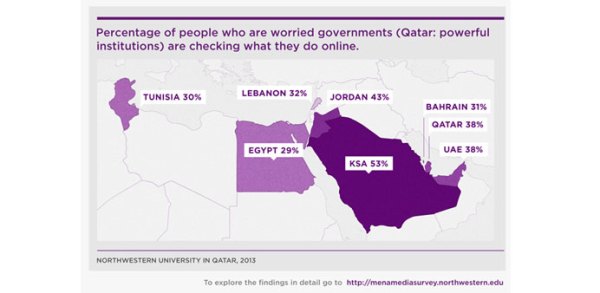
Northwestern University in Qatar has released new findings from an eight-nation survey indicating many people in the Arab world do not feel safe expressing political opinions online despite sweeping changes in the aftermath of the Arab Spring.
From over 10,000 people surveyed in Lebanon, Tunisia, Egypt, Saudi Arabia, Bahrain, Qatar, Jordan and the UAE, 44% expressed some doubt as to whether people should be free to criticise governments or powerful institutions online.
Over a third of Internet users surveyed said they worry about governments checking what they do online.
According to the report, “The implied concern (of governments checking what they do online) is fairly consistent in almost all countries covered, but more acute in Saudi Arabia, where the majority (53%) of those surveyed expressed this concern.”
The study – titled ‘Media Use in the Middle East – An Eight-Nation Survey’ – was undertaken by researchers at NU-Q to better understand how people in the region use the Internet and other media. It comes as the university moves towards a more formalised research agenda and is the first in what will be a series of reports relating to Internet use.
The survey includes a specific chapter on Qatar, the only country where those surveyed regarded the Internet as a more important source of news than television. “We took an especially close look at media use in the State of Qatar – a country with one of the highest Internet penetration rates in the Arab world—and internationally,” said NU-Q dean and CEO Everette Dennis.
These findings follow a preliminary report NU-Q released last April that showed web users in the Middle East support the freedom to express opinions online, but they also believe the Internet should be more tightly regulated. “While this may seem a puzzling paradox, it has not been uncommon for people the world over to support freedom in the abstract but less so in practice,” Dennis explained.
Among other findings, the research shows: 45% of people think public officials will care more about what they think and 48% believe they can have more influence by using the Internet.
Adults in Lebanon (75%) and Tunisia (63%) are the most pessimistic about the direction of their countries and feel they are on the ‘wrong track.’
Respondents were far more likely to agree (61%) than disagree (14%) that the quality of news reporting in the Arab world has improved in the past two years, however less than half think overall that the news sources in their countries are credible.
Online transactions are rare in the Middle East, with only 35% purchasing items online and only 16% investing online.
The complete set of results from the survey is available online at menamediasurvey.northwestern.edu. The new interactive pages hosting the survey on the website have features that allow users to make comparisons between different countries, as well as between different demographics within each country.
Dennis confirmed that the research report is the first in an annual series of reports produced in collaboration with the World Internet Project; one of the world’s most extensive studies on the Internet, in which NU-Q is a participating institution.
NU-Q and WIP signed an agreement earlier in the year, providing a global platform for the current research.
June 29, 2013
Posted by intlxpatr |
Blogging, Bureaucracy, Communication, Community, Cross Cultural, Cultural, ExPat Life, Jordan, Leadership, Living Conditions, Middle East, Privacy, Qatar, Safety, Saudi Arabia, Social Issues, Survival, Transparency, Tunisia | Bahrain, Egypt, Lebanon, U.A.E. |
Leave a comment
. . . Only 5 deportees allowed per Kuwait Air flight, deportees only allowed on Kuwait Air, so it takes 1200 flights just to export the deportees they have already lined up crowding the jails? Or is this 6000 already deported?
Is it orderly? Do people know why they are being deported? Do they have time to make arrangements for family and/or pets? Is there an appeal process? Are the courts also clogged? Are only illegals being deported?
Has anyone seen a breakdown of deportees by nationality?
From the Kuwait Times
6,000 illegal residents deported in 6 months – Jails getting overcrowded
KUWAIT: Nearly 6,000 people were deported over the past six months of crackdowns on illegal residents in Kuwait, a local daily reported yesterday, quoting Interior Ministry statistics as of June 23. According to a source, who agreed to provide the statistics to Al-Qabas on the condition of not being named in the report, as many as 25,000 expatriates were arrested during security campaigns carried out since the beginning of the year across Kuwait.
The source said around 15,000 people were later released after their employers submitted documents to prove that the workers were living legally in Kuwait. In other cases, workers whose visas had recently expired were released after their employers gave assurances to renew their visas immediately.
The source also revealed that some employers were required to sign undertakings that they would not to allow their employees to work in other firms before the workers were officially released.
In addition to people with expired visas, the continuing crackdowns are targeting expatriate laborers reported missing by their employers, as well as people holding Article 20 visas (for domestic helpers) but working in private firms, for which visas are issued under Article 18 of the labor law. However, the source stated, such security campaigns could be put on hold until further notice, with jails getting “overcrowded with detainees.”
The source indicated that nearly a thousand employers were blacklisted for allowing domestic workers to work for others. Furthermore, he said cooperation with the Ministry of Social Affairs resulted in the blacklisting of nearly 500 companies found guilty of visa trafficking.
The source also indicated that Kuwait Airways is currently the only airline used to transport deportees. A maximum of five deportees per flight are allowed, he added, in order to avoid trouble inside the airplane.
Minister of Social Affairs and Labor Thekra Al- Rashidi had announced in March the government’s intention to deport 100,000 foreigners this year, as part of a plan to reduce the expatriate population in Kuwait by one million within a decade.
The Interior Ministry never confirmed that the ongoing crackdowns on illegal residents were part of the deportation plan. In response to criticism from rights groups inside and outside Kuwait, Al-Rashidi later identified “marginal labor forces” as the target of the plan.
Kuwait is home to 2.6 million expatriates, who make up 68 percent of the country’s 3.8 million population.
Nearly 90,000 of them live illegally in the country, according to official numbers.
June 26, 2013
Posted by intlxpatr |
Bureaucracy, Community, Cultural, ExPat Life, Kuwait, Law and Order, Leadership, Social Issues, Work Related Issues |
5 Comments
From Doha News:
Saudi Arabia’s King Abdullah has issued a royal decree to change the country’s weekend to Friday-Saturday, effective June 29, state news agency SPA reports.
The move, which puts KSA in line with the rest of the GCC countries, was made “for the sake of putting an end to the negative effects and the lost economic opportunities” due to the difference in workdays between the nation and the rest of the world, Riyadh Bureau reports.
It will apply to all government bodies and monetary agencies, including the central bank and stock exchange, SPA said. But schools and educational institutions will maintain the Thursday-Friday weekend until the beginning of the new academic year.
According to Riyadh Bureau:
The change will align banking and business days with most other countries in the region, as well as being closer to the workweek of international financial markets and businesses. Oman was the latest GCC country to shift its weekend to a Friday start last May.
KSA, Qatar’s giant neighbor the west, has been mulling a shift for more than five years, but didn’t move forward previously due to resistance from religious leaders.
Read more: http://dohanews.co/post/53674862889/saudi-joins-rest-of-gulf-with-shift-to-friday-saturday#ixzz2XGgRsogw
June 25, 2013
Posted by intlxpatr |
ExPat Life, Financial Issues, Living Conditions, Saudi Arabia, Social Issues |
Leave a comment


 Here There and Everywhere