House Rules by Jodi Picoult
I got it all done – two days before Christmas. Wooo HOOOO, I get the reward, a new book! One I had been eager to read, House Rules by Jodi Picoult. (You can read reviews of other Picoult books by doing a blog search, enter Jodi Picoult in my blog’s search window.)

What I really like about Jodi Picoult is that she writes about really tough situations and exposes our ignorance and ambivalence to us. In this book, she writes about a single mother who is raising two sons, one of whom has Asperger’s Syndrome. He is extremely bright, but lives in a world where he is bombarded by too much sensation. He cannot block out sensory input that we learn to ignore, and some of it – noise, colors – in his case, the color orange – or any change in routine can cause him to spin out of control. Imagine a two year old having a tantrum in a grocery store . . . now imagine an eighteen year old young man having the same tantrum. It helps you see what the Mom is dealing with.
Dad left when the second son was born. “It’s too hard,” he said, and left her to cope with all of it.
She gets child support, while her husband is raising his new family a continent away. She free lances as an advice columnist, and edits from her home to supplement the bare bones family existence. She learns to cope with Jacob’s needs, and she advocates for him fiercely, to be mainstreamed in the school system AND to have some special supports to soothe him when he becomes over-stimulated.
Jacob isn’t a burden, although his need for routine – certain colors for different days of the week, including meals – can be burdensome. Jacob is also very very bright, and obsessed with crime scene forensics. He loves setting up “crime scenes” for his mom to solve and the one bright spot in his daily life is the Crime Busters show which comes on every day at 4:30.
And then, suddenly, a life which is already wobbling turns upside down. Jacob is implicated in the murder of his tutor, a young woman Jacob loved working with, who helped him develop an understanding of how people interact and behave. Those who know Jacob understand his quirks and eccentricities are due to his wiring, but Jacob looks very odd, very threatening and even violent to the outside observer – a nightmare client as a defendant.
It is a GREAT read. Picoult keeps her secrets up to the very end; the book is tightly wired and we are given clues all along the way. The edition I read had both a reader’s guide and an interview with the author at the end. It is NOT cheating to read those first! It gives you good guidance on what the author is trying to say, and what may be significant, while not appearing particularly so.
It gave me a great appreciation for parent’s of children outside the realm of ‘normal.’ It gave me an appreciation for the work and persistence and dedication it takes to try to get a more level playing field for their children.
It the book Jacob has some self-awareness, and compares Asperger’s Syndrome to seasonings, and he believes we all have a dose of Asperger’s Syndrome in our wiring, but that some children get a little extra.
Shopping Styles: Predatory, Social or Desperation?
As AdventureMan once said, I am not entirely sure I agree with what I am about to say. Feel free to jump in.
Today I was mopping the floors, washing the floors and vacuuming the carpets. This is not – way not – something I like to do, but something I do because long ago somewhere in my tiny little brain, a seed was planted that a dirty floor was a shameful thing. I remember once thinking “people could eat off my floor; there must be a whole meal here!” when I left it unwashed for a few days. In my last three incarnations, in Kuwait and in Qatar, I was blessed with wonderful women who came in and took care of my floors for me, also the dusting, and the laundry, and the windows, and all the things I now do. It takes a surprising chunk of time out of my day. 😦
Oh! Yes. The shopping.
I just wanted you to know that I am not cleaning my house willingly or joyfully, but dutifully. I have discovered, however, that mindless physical activity frees the mind, and you never know where a free mind will go.
I have a friend coming to visit, and this friend and I have had so much fun together, through the years, exchanging books, going out on double dates with our husbands to wonderful places in France and Germany, and . . . shopping.
Finding a person who shops the way you do is a real blessing. I say I am not much of a shopper, but we all have to shop sometimes. Mostly, I shop alone, I am a predator. I am looking for specific game, and I want the juiciest prey at the best price. Most of my friends are like me – we don’t hunt in packs, because when you shop in packs a group mentality surfaces, and you get home with things you never would have bought.
I do shop with other solitary predators from time to time; this is how you know them. You don’t shop together. You shop the same stores, sometimes just the same mall, meeting up to compare items and to go on to the next stop. Most of my predatory shoppers friends know their own style, know their own preferences, and few ask me what I think, nor do I ask them. We do exclaim gleefully over our purchases.
In the military, in Germay, there would be shopping tours to take you to places. Sometimes I took them, most times I didn’t. It depended on whether or not you had to stay together. I saw people buy some truly appalling things because it had a particular name or a particularly low price. The fact that it was obviously inferior did not even seem to strike their consciousness, once the herd shopping mentality kicked in. If the tour were going to a village, and people were on their own and then met up, I would do that. I went to Paris on such a trip; leaving
Germany at midnight, leaving the tour at six in the morning for croissants and coffee at La Duree at its original location on Rue Royale arranging to meet up with them later.
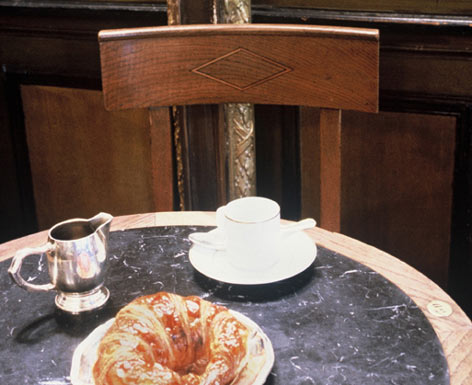
The Musee D’Orsay had just opened, and I was dying to see the exhibit. I spent the morning there, leaving as the hoardes started arriving, had a little lunch of Vietnamese salad rolls on the Left Bank, and strolled over the bridge to the shopping areas around Rue Royale. I found three great outfits at Galleries Lafayette, grabbed a salad from their gorgeous food court, and met up with my group at six to depart. I was home by midnight. 🙂 I would have liked a friend, but I didn’t know anyone, once again I was new, and Paris is so easy that just 12 hours there was a piece of cake.
Social shoppers find us solitary predators very strange. They live in a different world than we do. They consult. Their shopping goals are not so much the goods as the experience. They enjoy the company, and they like having someone to help them make their purchasing decisions. They often meet up for shopping and lunch, and some even shop to kill time. (What luxury! In my whole life, I have never had time to kill; I always have projects, and lists of things that need doing!)
I have been one other kind of shopper, though, and that is a desperation shopper. It was when I was a young mother. Shopping was for survival. I never knew when the baby would start to cry, need to be nursed, or need a change. When I had a babysitter, I was always aware of how little time I had and how much I had to get done. Once a month, I would go to the commissary, about twenty miles away, to buy a month’s worth of diapers, meat (we ate more meat then), canned goods and paper goods.
I see the same desperation in the elderly here in Florida; shopping takes energy and you never know when your energy will desert you. As you can see, I am still thinking about my experience at the Navy Commissary, and I now I can empathize. I might be grumpy and aggressive, too, when I reach a stage where I remember having energy, and now I don’t know where it has gone. I may even scowl at cheerful, energetic people because I wish I still were . . .
We’re all wired so differently. There may be some shopping styles to which I am oblivious. Can you think of any?
A Reliable Wife by Robert Goolrick
You know how wonderful it is when you start a book, and immediately you are hooked? This is not that kind of book. This is a book you start reading and you think “Why am I reading this? I don’t like ANY of the characters!”
And yet, somehow, I kept reading. And slowly, slowly, the hook was set, I could not stop reading.
Actually, I read the book several months ago, and I am still thinking about it. That’s a good book. 🙂
We meet one of the main characters as he stands waiting for a train to arrive, carrying his bride-to-be. As we stand waiting with the man, we discover that he is not very likable. We also learn that winters in his part of the country are long and hard, and very strange things happen to people cooped up together during these long, hard winters. It is a very bleak beginnning.
Then we are riding in the train with a woman who is answering an ad placed by the first man who was advertising for a wife. We get a few clues that she is misrepresenting herself, but . . . isn’t a little misrepresentation part of the mating process? Do we really show all our less attractive features to the person to whom we want to be married? And does she know what she is getting in for with this rather cold and distant man?
Do you really want to read this book?
It gets better. So much better. People are complicated, and they lead complicated lives. Sometimes evil leads only downward, and to more evil, and from time to time, there is a gleam of hope and the slim promise of redemption. It gives a clear slice of time from the early 1900’s, and a much earlier time in America. For anyone with the illusions that life in that turn-of-the-century America was a better, simpler, more moral time, this book is a reality check.
Nothing in the beginning of this book is quite what it seems, and yet every word is finely crafted to give a clue as to where the book is going. Will you be able to figure it out before you get there?
(I did not.)
There are so many good books out there. This one is slow to start, but builds steadily to an unforgettable ending. It is worth a read.
The Disciple Jesus Loved
In today’s gospel reading is this story, a story I love because it tells us, as all our mothers always have, to mind our own business, to look to correcting our own behavior and not that of others.
There is a note to this passage, in The Lectionary: “The most ancient authorities lack 7.53—8.11; other authorities add the passage here or after 7.36 or after 21.25 or after Luke 21.38, with variations of text; some mark the passage as doubtful.”
The story is in the book of John, who is believed to be the disciple Jesus loved the best, and who tends to see into the heart of things. Although his closest followers, the disciples, often got it wrong (like arguing over who would sit at his right hand in heaven), they lived and worked with Jesus while he was here living on earth, and John seemed to know him best of all. To me, this story shows what Jesus expects of us – that we look to our own sins – and also, his compassion towards women.

(This is an image by Dagmar Anders)
John 7:53-8:11
53Then each of them went home, 81while Jesus went to the Mount of Olives. 2Early in the morning he came again to the temple. All the people came to him and he sat down and began to teach them.
3The scribes and the Pharisees brought a woman who had been caught in adultery; and making her stand before all of them, 4they said to him, ‘Teacher, this woman was caught in the very act of committing adultery. 5Now in the law Moses commanded us to stone such women. Now what do you say?’ 6They said this to test him, so that they might have some charge to bring against him.
Jesus bent down and wrote with his finger on the ground. 7When they kept on questioning him, he straightened up and said to them, ‘Let anyone among you who is without sin be the first to throw a stone at her.’
8And once again he bent down and wrote on the ground.* 9When they heard it, they went away, one by one, beginning with the elders; and Jesus was left alone with the woman standing before him.
10Jesus straightened up and said to her, ‘Woman, where are they? Has no one condemned you?’ 11She said, ‘No one, sir.’* And Jesus said, ‘Neither do I condemn you. Go your way, and from now on do not sin again.’]]*
The Gift
AdventureMan and I used to have lavish Christmases, trying to delight one another, and we did. One year, I bought his some crystal goblets he had been admiring, and some years I was able to add to his collection. One year, he bought me a Mont Blanc pen, which I adored, and another year two beautiful salad serving bowls with irises in them. (I still have them and delight to use them.)
This year, he gave me the best gift of all. I was working on a committee in our church, helping to make sure children we had volunteered to sponsor in the Salvation Army angel program received gifts of clothing and a toy or bike or age-appropriate gift. There were a few children at the end who had not found sponsors, but other people had chosen to donate cash or checks in lieu of sponsoring a child.
As we were getting ready for church, AdventureMan told me he had an idea for my Christmas gift, but he wanted to run it by me.
“How about if I make a donation to the Angel Tree, to help sponsor the kids who don’t have sponsors?”
He took my breath away. He can still do that.
We are not rich, we are modestly comfortable. We have always lived within our means, and placed a high value on saving. We have a comfortable home, enough to eat, and we keep our spending under control so that we even continue to grow our savings a little while we are now ‘retired.’ There is nothing I need for Christmas.
I’m still grinning from the grandness of his gift; the delight it continues to give me every time I think about it.
The Salvation Army has one of the lowest rates of administration funds to charitable funds of all the charities in America. They make every dollar you donate squeak, they work it so hard. They feed the poor, they give hope to children, they comfort the homeless and veterans, and they counter pornography and human trafficking (Yes. It happens in America, too.)

To find out how you can help this organization which helps so many, so generously, just click on the blue type Salvation Army and it will take you to their home page. There are many options for giving, including donations, giving of your time and energies as a bell ringer, or working with them in a variety of human services.
Just Say No – to Gossip
From today’s Lectionary readings:
Sirach 19:4-17
4 One who trusts others too quickly has a shallow mind,
and one who sins does wrong to himself.
5 One who rejoices in wickedness* will be condemned,*
6 but one who hates gossip has less evil.
7 Never repeat a conversation,
and you will lose nothing at all.
8 With friend or foe do not report it,
and unless it would be a sin for you, do not reveal it;
9 for someone may have heard you and watched you,
and in time will hate you.
10 Have you heard something? Let it die with you.
Be brave, it will not make you burst!
11 Having heard something, the fool suffers birth-pangs
like a woman in labour with a child.
12 Like an arrow stuck in a person’s thigh,
so is gossip inside a fool.
13 Question a friend; perhaps he did not do it;
or if he did, so that he may not do it again.
14 Question a neighbour; perhaps he did not say it;
or if he said it, so that he may not repeat it.
15 Question a friend, for often it is slander;
so do not believe everything you hear.
16 A person may make a slip without intending it.
Who has not sinned with his tongue?
17 Question your neighbour before you threaten him;
and let the law of the Most High take its course.
Food Shortages?
My friends in Kuwait are complaining about the price of tomatoes. The price of tomatoes in Kuwait?? Can a Kuwaiti cook without tomatoes?? 😉
I remember when suddenly, rice, a reliable cheap staple, suddenly went through the roof, and then, disappeared from the shelves when India announced a shortage and refused to export Indian rice. Kuwait, and other Gulf countries, announced they were buying unused farmland in other countries to insure their food supplies. But tomatoes? I thought everyone in Kuwait grew tomatoes, at least in winter.
And then, today, I saw this article on creeping food shortages:
Another lackluster monthly jobs report took center stage Friday. Stocks rallied, and government bond yields remained at rock-bottom levels as investors anticipate more action soon by the Federal Reserve to drive down interest rates even further.
Reports about how much slack the U.S. economy still needs to work through — like unemployment — understandably get the spotlight. But investors may be overlooking an even bigger story as the developing world stages a sharp rebound: Shortages of items like food and commodities are once again becoming a major concern.
Prices for agricultural commodities spiked so much on Oct. 8 that they triggered daily movement limits on the Chicago exchange. Options markets saw prices for commodities like corn soar more than 13% during the day following reports of supply shortages around the world.
Commodity-oriented exchange-traded funds like the PowerShares DB Agriculture (DBA) leaped as well. The ETF surged almost 10% over the previous week, with more than 6% of the gains registered on Friday alone.
Supply and Demand Discrepancies
A sharp shortfall in the U.S. Department of Agriculture’s corn production forecast, due to poor weather patterns, also helped set prices soaring around the world. U.S. corn crop yields would come in 4% short of prior estimates and drop to their lowest levels in 14 years, the Agriculture Department said.
Fears of commodity shortages in the face of surging global demand are leading to export-slashing. Ukraine announced a sharp cutback in the amount of commodities like wheat and barley it would allow to be shipped out of the country. The likelihood of a major discrepancy between supply and demand have led to surging prices worldwide. European wheat prices rallied 10%, with other commodities, such as soybeans and cotton, climbing as well.
Still, investors should be cautious because commodity prices are known to be extremely volatile and difficult to put a price on.
Fundamental Forces
Nevertheless, rising prices are creating alarm about humanitarian concerns. Morgan Stanley (MS) and the U.N. have warned about the prospects of a rerun of the 2007 food crisis that slammed the developing world.
See full article from DailyFinance: http://www.dailyfinance.com/story/poor-crops-soaring-demand-currency-wars-a-recipe-for-food-sho/19667693/?icid=sphere_copyright
As we drove across the United States this summer, we saw acres and acres of US farmland, unworked, for sale. Farming is a tough life, and fewer and fewer families are still farming. It’s scary and sad.
What Women Did For Fun
Several weeks ago, AdventureMan presented me with two (large) piles of files, saying that they were mine and needed to be gone through. I spent the day today tossing out old term papers, old manuscripts, old resumes – lots and lots of things that were worth saving, and now, not so much.
One thing I came across was a file with copies of work my departed aunt Helen had done to gain entrance into the DAR, Daughters of the American Revolution (Revolutionary War for America’s Independence). It was like a game, only when she started playing, there was no e-mail, only snail mail. Long distance telephone calls were expensive, and she was a Navy wife, so it was all done by hand.
Genealogy work, too, was painstakingly done, and family histories, cemetery records, lists of people arriving and departing on ships and who married who – all lovingly compiled and typed on manual typewriters by people with a passion for making connections, solving the mysteries of who married whom and for how long:
(“no need to mention the divorce” one correspondent wrote, “it happened in my family, too, and it isn’t relevant so we just won’t mention it” she wrote about a marriage that ceased to exist over a hundred years before)
My aunt had a sure thing, and she had a unique entry, so she was tracking three entries at the same time, trying to prove a new connection, while knowing she had in her pocket an already proven entry.
I lost a couple hours of my life, reading through all the correspondence, trying to decipher her notes and the arcane charts of relationships stretching back to 1690, when one line of the family arrived on these shores. I grinned, thinking how we document our bloodlines, leaving out the pirates and the horse thieves, and (legend has it) the French aristocrat who left his first family in France and started our branch here, without having divorced his first family, LOL.
My aunt must have been a little younger than I am when she started on this search, and I know that she served proudly in the DAR for many years, along with several civic committees, library committees and planning commissions in Santa Barbara, California. I still miss her.
Recent Comments
intlxpatr on Shampoo Ginger tigerbutterya0c5ff1d… on Shampoo Ginger intlxpatr on British Soldier Kidnapped, Esc… John on British Soldier Kidnapped, Esc… intlxpatr on British Soldier Kidnapped, Esc… Wikipedia Donate Button

Amazina


Early Voting in Florida


