One in Four American Mortgages ‘Underwater’
Underwater Mortgages Hit 11.3 Million
Posted: February 23, 2010 at 7:25 pm
There is a reason that 702 American banks, nearly one in ten, were on the FDIC “problem list” as of the end of 2009. A large number of small and mid-sized banks are burdened with home and commercial mortgages that are in default and may even go into foreclosure.
New data from First American CoreLogic shows why the solution to the problem banks face is so difficult to find. Eleven million, three hundreds thousand homes had underwater mortgages as of the fourth quarter of last year. That number represent 24% of all residential homes loans in America.The mortgage numbers are much worse when homes with equity of less than 5% are included. First American reports that ”an additional 2.3 million mortgages were approaching negative equity at the end of last year, meaning they had less than five percent equity.” That means that three out of ten homes have virtually no financial value to their owners.
The pressure that the home value trouble puts on banks is clear. The aggregate dollar value of negative equity was $801 billion at the end of last year, up $55 billion from $746 billion in Q3 2009. People who believe there is no hope of their homes ever having any economic value are more likely to default on mortgages, especially in an environment where unemployed and under-employed people make up 17% of the total available workforce nationwide. Many homeowners are as concerned about their employment future as they are about the value of their houses.
Problem home loans are concentrated in the regions where real estate values have fallen the most–Arizona, Florida, Nevada, Michigan, and California. First American says that “among the top five states, the average negative equity share was 42 percent, compared to 15 percent for the remaining 45 states.” In other words, the odds are relatively high that some of the home owners in those states will never sell their houses for more than the amount of their mortgages. That creates a vicious cycle in which high numbers of people with underwater loans default in the states where real estate values have dropped the most. There is no easy way to create a foundation under home prices.
The FDIC has closed 20 banks this year, Five of those were in the five states where mortgage equity problems are at their worst. The agency closed 15 banks in December. Of those, five were in Arizona, Florida, Nevada, Michigan, or California. The bank failure and mortgage failure problems area inextricably linked.
The First American numbers do not leave much hope for a home price rebound this year. It is too hard to sell a house with an underwater mortgage because the bank has to be paid the balance of the loan in cash at closing. Many people do not even try make home payments or cannot afford to under those circumstances. The Mortgage Bankers Association reported that a record 15% of American mortgage holders are either in foreclosure or at least one payment behind.
The difficulties that face small and mid-sized banks, which ultimately are a problem for the FDIC, are to a large extent still a fallout of the deteriorating real estate sector. The underwater mortgage problem is still growing and that almost certainly means bank closings will be high again this year as well.
Douglas A. McIntyre
From Kuwait MOI
One reader was asking about where to go online to pay his Kuwait traffic violations. While looking it up (Google “Kuwait Government Traffic Violations Website”) I found this essay on Equality Before the Law in Kuwait:
Lt. Gen. Al-Rejaib: His Highness the Amir stresses on applying the law on everyone
The Interior Undersecretary Lt. Gen. Ahmad Abdullatif Al-Rejaib affirmed on embedding the principle of reward and punish with applying it, where is no place in the Interior Ministry for slackers or neglegants or lacker individuals.
He stressed importance on respecting the authority of the security man after it had been affected for some reasons, affirming on the need of restoring mutual respect between the security man and citizens as well as residents.
Lt. Gen. Al-Rejaib cleared out thoughout his meeting which was featured with honesty and transparency on Wednesday morning 3/2/2010 attended by the Interior Assistant Undersecretary for General Security Affairs, Maj. Gen. KHalil Al-Shamali, leaders and officers of the General Security sector, that the supreme directives of His Highness the Amir, the Supreme Commander of the Armed Forces Sheikh Sabah Al-Ahmad Al-Jaber Al-Sabah, is to apply law on everyone and no one is above it no matter how high this person is.
Lt. Gen. Al-Rejaib urged the leaders and officers of the General Security sector to follow up on all the works that are assigned to them as well as the tasks entrusted on them with honesty and transparency so justice prevails among everyone and for homeland residents to live in comfort, secure and safety. He demanded to honor the hardworker as soon as he accomplished any such achievements so it would be a motivation and an incentive for others to do work accurately.
At the beginning of the meeting in where it was took place at First Lt. Gen. Yousef Al-Khurafi Hall, Lt. Gen. Al-Rejaib welcomed his brothers and sons leaders and officers of the General Security sector, and conveyed to them the greetings of H.E. the Interior Minister Staff Lt. Gen. (ret.) Sheikh Jaber Al-Khaled Al-Sabah and his good wishes for them for success and to exert to give more efforts.
This meeting comes for the sake of discussing many of the issues concerning about security direcotorates and police stations, emphysizing the importance of police station as it is the first point for citizen and resident to turn to and the first security venue known by the Kuwaiti society, he added.
He affirmed that police station was a safeguard for every citizen and resident and a source of fear for any such violators or outlaws; pointed out that the Ministry of Interior has restored the authority of police stations two years ago.
There are bright sides represented by outstanding distinguished efforts done by area leaders, police stations chiefs as well as their officers but in the other hand, there are few who don’t perform their duty in full, and this is not allowed for any case, he added.
Lt. Gen. Al-Rejaib warned on the sluggard individuals who will receive a proper punishment, whereas the sincere and hard work individuals will receive the most appreciable rewards. He stressed importance to reject any such favoritism or mediation or a compliment, and such matters should be dealt with strictness and be terminated.
The Lt. Gen. called on good work organization in police stations, mentioning that the Ministry of Interior is putting all possible support and resources from officers, constables and police patrols, and to such reasons police stations officers should be present in their posting duties.
The leaders of the General Security sector, on top of them Maj. Gen. Khalil Al-Shamali have to be in presence in their places day and night; therefore, it is not exceptable at all that high leaders are in presence at their posts and no police stations officers existed at their assigned locations, he pointed out.
He stressed out that evaluating leaders and officers work stemmed from their performing their duties on combating crime and running after outlaws and out system, and there are not such other way around.
Lt. Gen. Al-Rejaib requested leaders and officers of the General Security sector to work as always do and promised for the sake of Kuwait and its people who deserved to be given all such exerted efforts.
He called on police stations chiefs and their officers to identify the area nature where they work at in terms of its demographic structure, its foremost economical activities and its existent educational and banking facilities, affirming that such information are essential to be awared about by the police station officers.
The security work is an honorable task and an obligatory on us to hold responsibilities, working as a one team and any such achievements accomplished are due to fruitful cooperation and continuous coordination, and self-denial is a trait we should characterized by for the sake of homeland security, he noted out.
The Interior Undersecretary Lt. Gen. Ahmad Abdullatif Al-Rejaib concluded by expressing his hope that the leaders and officers of the General Security sector to be as always as they promised us of being discipline, committed with high duty performance; pointed out that this meeting is a beginning of a series of upcoming meetings with different security sectors.
In Pensacola, people ask me if I wasn’t scared living in Kuwait and Qatar. Safe? I feel safer in Qatar and Kuwait than in Pensacola! And that is what I tell them!
Pensacola Moments
Yesterday I drove AdventureMan to the airport. He rushed off to check in, planning to meet once the car was checked in. The checker-inner said “do you really want to pay $7.49 a gallon?” so I rushed off to fill the tank, God bless her. It’s funny, with all the stuff we have going on, little things we normally remember just slip right out of our minds.
I came back, picked up my next rental (I know, I know, not cost effective, but I thought I was going to buy a Rav4 while I was here – LLLOOOLLL! I still plan to, but I am waiting for some dealer incentives) and went in to spend some time with AM before he left.
When I came back out and went to my car, it REEKED! I have a non-smoker profile! I went back to the fast-booth, and waited in line. When I explained the problem, they gave me another car, a serious upgrade. Wooo HOOOO!
I only mention these instances, because two people at Avis/Budget Car Rental in Pensacola took the time to insure that I was a happy customer. I am. I am a happy customer.
Somewhere, I lost my sunglasses, and because mostly I only need glasses for driving, I needed to get a new pair. Walk in, have an eye exam within 30 minutes (he told me my old prescription was too strong!) and a pair of prescription sunglasses that are PERFECT in one hour. Professional, courteous service all the way.
I need some baby clothes, so I go to a very good department store looking for WARM baby clothes (it is very cold in Pensacola this year!) and the very nice lady says “Oh, we have some beautiful baby clothes I just marked down to 70% off.”
Am I dreaming?
Hey Ayatollah! Leave Those Kids Alone!
Every now and then I make a new friend. I can see in their eyes – life! love! willingness to engage and take risks! people who don’t necessarily see things the way the majority does.
One of these friends, my Kuwaiti friend, is a treasure. She has the most amazing mind, and sends me the most amazing things.
You might look at me and think I am too old for Pink Floyd, but you would be wrong. Pink Floyd makes my blood run faster. They did when I was younger, they did when my own son discovered Pink Floyd, and then, watching this video my friend sent – WOW. There goes the adrenelin!
OK, YouTube won’t let me insert it in this post. Go to the original post, play the video. . . very creative, very moving:
http://www.blurredvisionmusic.com/
Don’t you love young people? They love justice, and they hate injustice. They hate unnecessary constrictions. They hate people telling them how to think. All that energy, all that passion, all that vision!
Most of my friends – like AdventureMan, like my Kuwaiti friend – are still 25 on the inside. 🙂
Most of my friends will get this video – and love it! 🙂
Qatar’s ‘Manly Women’
Thank you, Little Diamond, who sent this article from The Economist as an update to blog entry on cross dressing based on a tiny article in the Gulf Times
CROSS-DRESSING is on the rise among young Qataris. The local press says that more tradition-minded locals are upset by the growing number of young women affecting a masculine style of dress, baggy trousers, short hair and deep voices. These women, who call themselves boyat, which translates as both tomboy and transsexual (and is derived from the English word boy), are being seen in schools and on university campuses where some are said to harass their straiter-laced sisters.
In an episode of a talk show on Qatari television, called Lakom al Karar (The Decision is Yours), a leading academic said that the “manly women” phenomenon was part of a “foreign trend” brought into Qatar and the Gulf by globalisation. Foreign teachers, the internet and satellite television have been blamed. So have foreign housemaids, for badly influencing children in their care.
The studio audience was divided over how to respond. Some called for the death penalty for cross-dressers, while others favoured medical treatment. A rehabilitation centre for Qatari boyat has been set up, but a local report says that as many as 70% of them refuse to give up their “abnormal behaviour”.
It is not just Qataris who are rattled. A year ago the ministry of social affairs in the United Arab Emirates (UAE) launched a campaign against “masculine women”. The project, entitled “Excuse me, I’m a girl”, involved workshops, lectures and television programmes, stressing the virtues of femininity and raising awareness of the presumed dangers of women looking like men. An emirates’ foundation is helping to fund a research project on “gender identity disorder among Emirati youth”.
One official describes the “deviant behaviour” of the boyat as a “menace” to society. But others sound less fazed. An American university lecturer in the region says the short hair and gym shoes worn by these young women would look perfectly normal on an American campus. That is just what unnerves the traditionalists.
Why do you think these girls dress and act like men? Why would a girl do that?
I think girls do that – in any country – for a reason. If privileges and freedoms are heavily weighted in favor of males, perhaps there is no great mystery as to why some females would prefer to be males. It makes sense to me. Girls aren’t stupid. They can see who is getting all the goodies. My guess it is less a gender issue than a values issue.
On the other hand, when – and if – things are more equal, there is less motivation to be other than what we were created to be.
I had some young local friends who told me that they were taking Tai Kwan Do, but quit when a neighbor told their mother that it might threaten their virginity. It broke my heart. The martial arts give grace and confidence to young women. There are a lot of ways a hymen can be broken; I have never heard of it happening while training in Tai Kwan Do. These young, vibrant girls have fewer and fewer activities that they are encouraged to do, and end up staying home or strolling endlessly at the local malls. Aaarrgh!
Dads – teach your daughters to hunt! Teach them to fish! Teach them to swim, to throw a softball, to kick a football. Take them camping in the desert, and let them run freely. Teach them chess, and how to win. Give them the gift of physical and intellectual activity, give them the understanding that sports, employment and power are equally accessible for all sexes, and you won’t be having problems with girls who yearn for the freedoms and privileges of being male.
Gulf Women Twice as Likely as Men to Die of Heart Attack
Women face greater risk of heart attack deaths: study
You can read this entire article in today’s Gulf Times by clicking on this blue type
Women throughout the Gulf are almost twice as likely to die in hospital after a heart attack, as male patients, a new regional study published by the American Journal of Cardiology has revealed.
The research involved looking at the death rate of 8,166 males and females hospitalised in 2009 for acute coronary syndrome (ACS) – which includes heart attack and unstable angina.
It was found that female patients who suffered ACS were 1.75 times more likely to die while in hospital than males with the same condition.
Delayed diagnosis of ACS in women, and failure to prescribe the correct cardiovascular medications, and not carrying out the necessary interventions after the event, were behind the increase in the death rate.
The research project was called the Gulf Registry for Acute Coronary Events (Gulf RACE) and the study was titled Comparison of Men and Women with Acute Coronary Syndrome in Six Middle Eastern Countries, 2009.
Chinese Parents Abort Females; Men Can’t Find Mates
There is a part of me that thinks “What were you thinking??”
Of course, you know by now if you’ve been reading Here There and Everywhere that I don’t hate men, and also that I see RED when women are undervalued because they are women and not men. Equal rights, equal pay for equal work, equal citizenship – my battles to fight.
So what happens when poor people are told they can have only one child, and they all abort their female children – or they disappear shortly after birth – and only little boys who can grow up to take care of their parents are born?
Dearth of Women to Leave 24M Chinese Men Unwed
From AOL News Sphere where you can read this entire article by clicking on this blue type
Terence Neilan
Sphere
(Jan. 11) — More than 24 million Chinese men of marrying age could find themselves without a woman to wed by 2020, and a Chinese proclivity to abort female fetuses is a major contributing factor, a major study has found.
Gender imbalance among newborns is the most serious demographic problem facing the country’s population of 1.3 billion, the study by the government-backed Chinese Academy of Social Sciences says.
“Sex-specific abortions remained extremely commonplace,” the academy said, “especially in rural areas,” where the cultural preference for boys over girls is strongest.
Community Police Graduate
Community policing is necessary when we neglect to police ourselves. . . if, for example, we find ourselves throwing a tissue out of our car window as we drive along, littering the pristine streets of Doha. If we bully someone because we want that parking spot he is driving into, if we disrupt the peace and quality of life of others by our behavior.
I notice, in this story from the Gulf Times, that women are a part of this program, and that they are wearing uniforms, and hijab, and that those uniforms are very modest and also that they are wearing pants. Please see the previous article.
I commend Qatar for this visionary program, helping the community police itself, and for including women from the very first class.
46 take part in community policing basic course
Graduates with officials at the convocation ceremony
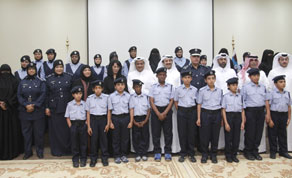
The Police Training Institute (PTI) recently held a ceremony to mark the graduation of participants in the first batch of the Community Policing Basic Course, under the auspices of Minister of State for Interior Affairs HE Sheikh Abdullah bin Nasser bin Khalifa al-Thani.
Some 46 students from various security departments took part in the course, which lasted seven weeks, said a spokesperson.
The ceremony was attended by the chairman on the Central Municipal Council, HE Nasser al-Kaabi; director of the PTI, Brigadier Mohamed Hassan Youssef al-Saei as well as other ministry officials.
Brigadier al-Saei explained that the course has been conducted to “enhance the role and mechanisms of community policing,” as well as helping to create partnerships with various social institutions to help with national security.
The PTI director added that the graduates of this course will be able to translate the Ministry of Interior’s aims and strategies to encourage understanding between various communities and to help the police to be able to prevent crimes before they are committed.
Brigadier Rashid Shaheen al-Atheeque, chairman of the steering committee of community policing, said: “The graduation of the first course of community policing is one of the stages of qualifying the national cadres at the Ministry of Interior to work in the national project.”
“Qatar is currently witnessing progress in all aspects of development in economic and social fields – this increases the role of all sectors in the country to face all kinds of challenges brought with this development,” he said, adding: “These factors require the improvement of capabilities to keep pace with development.”
Brigadier al-Atheeq explained that the ministry had pursued the initiative of community policing to help reduce crime throughout all institutions, and said that they had pursued the objective with the co-operation of the Supreme Council for Family Affairs as well as other ministries and companies, working towards the National Vision 2030.
He explained that the concept will initially be employed in the North Security Department from April 2010, with plans to apply it across the board from 2011.
Representing the director of the Ummul Qura Independent School for Boys, teacher Areezah al-Yami described the noticeable benefits of introducing the community policing programme in the school over the past year.
Qatar Divorce Rate 12th Highest in the World
Today’s story in The Peninsula examines the increasing number of divorces this year, in relation to the number of marriages.
Not a single expert quoted mentions that perhaps many of these marriages were bad alliances in the first place. One expert continually mentions the problem being women having greater access to divorce.
It is no surprise that women who have access to divorce get out of bad marriages.
She is supposed to stay with a man addicted to pornography?
With a man who cannot complete the sexual act?
With a man with a drug problem?
With a man who is openly gay, and she is to provide cover?
With a man who has a fatal sexually transmitted disease which he neglected to disclose?
With a man who is still emotionally attached to his long-time girlfriend and was forced to marry another woman?
With a man who hits her?
With a man who ignores her and goes off with his friends all the time in preference to spending time with her? (Yes, expectations for marriage are higher now than they used to be. Times change. Expectatons change.)
(These are all stories told to me by local women about failed marriages.)
I’m not a big fan of divorce. I think marriage is serious business, and a lot of hard work. And I strongly believe that women need to have the exact same access to divorce that men have. I don’t see any of the experts citing male behavior as a possible cause of this divorce rate.
Divorce rate to reach new high this year
Web posted at: 12/30/2009 5:38:55
Source ::: The Peninsula / BY SATISH KANADY
DOHA: Qatar’s divorce rate is steadily going up. Crossing last year’s figure of 939 divorces, a total of 982 couples split in the country during the first 11 months of this year.
Going by the latest data released by the Qatar Statistics Authority (QSA), more than 80 divorces take place every month in the country. The 2009 figure is expected to cross the 1,000 mark once the figures for December come in.
According to the QSA, of the 982 divorce cases this year, 655 involved Qatari women. The number of non-Qatari women who split with their spouse during the period was 327.
The months of April, May and June witnessed a large number of divorces. While 127 women got divorced during the month of May, 107 and 101 women got divorced in June and April, respectively.
It may be noted that a recent international study identified Qatar as the country with the 12th highest divorce rate in the world. The country has 0.97 divorces per thousand people, it said.
The total number of divorces in the country in 1999 was 496. However, the number has grown steadily over the past decade and touched 997 in 2007, with a total of 721 Qataris and 276 non-Qataris getting estranged. Though the rate went down in 2008 (939), this year’s figures are expected to break the 2007 record.
The QSA’s figures are disturbing against the backdrop of the fact that the total number of marriages held this year in Qatar until November 2009 was 2,917, against which the number of divorces was 982.
Against the 266 marriages that took place last month, 90 couples got divorced. Of them, 57 included Qatari women. In the month of May, which witnessed the largest number of divorces — 127 — the number of marriages was 323.
Opinions are divided among Qatari social scientists on the data revealed by the QSA. While a section of them sees the divorces as a direct consequence of Qatar’s “culture shock”, others say QSA’s methodology in collecting the data is not foolproof and the figures do not seem realistic.
“The data collected from the courts need not necessarily reflect the exact divorce rate in Qatar. For, there are a large number of cases where the couples re-join after obtaining a divorce from the court”, said a Qatari woman scholar who is doing research on Qatar’s broken families and divorces.
However, Moza Al Malki, a prominent Qatari psychologist, said: “Qatari women’s exposure to the changing world and their growing self-reliant nature are the prime reasons for this social problem.”
Al Kula, a system that encourages women to approach a court if they are not comfortable with their partner, is also contributing to the growing number of divorces, she added.
Recent Comments
intlxpatr on Yellowstone: Old Faithful to C… Michelle on Yellowstone: Old Faithful to C… Cathy on No Grown-Ups in Charge intlxpatr on Waiting for Snow intlxpatr on Waiting for Snow Wikipedia Donate Button

Amazina


Early Voting in Florida


 Here There and Everywhere