Qatar Divorce Rate 12th Highest in the World
Today’s story in The Peninsula examines the increasing number of divorces this year, in relation to the number of marriages.
Not a single expert quoted mentions that perhaps many of these marriages were bad alliances in the first place. One expert continually mentions the problem being women having greater access to divorce.
It is no surprise that women who have access to divorce get out of bad marriages.
She is supposed to stay with a man addicted to pornography?
With a man who cannot complete the sexual act?
With a man with a drug problem?
With a man who is openly gay, and she is to provide cover?
With a man who has a fatal sexually transmitted disease which he neglected to disclose?
With a man who is still emotionally attached to his long-time girlfriend and was forced to marry another woman?
With a man who hits her?
With a man who ignores her and goes off with his friends all the time in preference to spending time with her? (Yes, expectations for marriage are higher now than they used to be. Times change. Expectatons change.)
(These are all stories told to me by local women about failed marriages.)
I’m not a big fan of divorce. I think marriage is serious business, and a lot of hard work. And I strongly believe that women need to have the exact same access to divorce that men have. I don’t see any of the experts citing male behavior as a possible cause of this divorce rate.
Divorce rate to reach new high this year
Web posted at: 12/30/2009 5:38:55
Source ::: The Peninsula / BY SATISH KANADY
DOHA: Qatar’s divorce rate is steadily going up. Crossing last year’s figure of 939 divorces, a total of 982 couples split in the country during the first 11 months of this year.
Going by the latest data released by the Qatar Statistics Authority (QSA), more than 80 divorces take place every month in the country. The 2009 figure is expected to cross the 1,000 mark once the figures for December come in.
According to the QSA, of the 982 divorce cases this year, 655 involved Qatari women. The number of non-Qatari women who split with their spouse during the period was 327.
The months of April, May and June witnessed a large number of divorces. While 127 women got divorced during the month of May, 107 and 101 women got divorced in June and April, respectively.
It may be noted that a recent international study identified Qatar as the country with the 12th highest divorce rate in the world. The country has 0.97 divorces per thousand people, it said.
The total number of divorces in the country in 1999 was 496. However, the number has grown steadily over the past decade and touched 997 in 2007, with a total of 721 Qataris and 276 non-Qataris getting estranged. Though the rate went down in 2008 (939), this year’s figures are expected to break the 2007 record.
The QSA’s figures are disturbing against the backdrop of the fact that the total number of marriages held this year in Qatar until November 2009 was 2,917, against which the number of divorces was 982.
Against the 266 marriages that took place last month, 90 couples got divorced. Of them, 57 included Qatari women. In the month of May, which witnessed the largest number of divorces — 127 — the number of marriages was 323.
Opinions are divided among Qatari social scientists on the data revealed by the QSA. While a section of them sees the divorces as a direct consequence of Qatar’s “culture shock”, others say QSA’s methodology in collecting the data is not foolproof and the figures do not seem realistic.
“The data collected from the courts need not necessarily reflect the exact divorce rate in Qatar. For, there are a large number of cases where the couples re-join after obtaining a divorce from the court”, said a Qatari woman scholar who is doing research on Qatar’s broken families and divorces.
However, Moza Al Malki, a prominent Qatari psychologist, said: “Qatari women’s exposure to the changing world and their growing self-reliant nature are the prime reasons for this social problem.”
Al Kula, a system that encourages women to approach a court if they are not comfortable with their partner, is also contributing to the growing number of divorces, she added.
New Qatar Traffic Violations and Fines
Update: LLOOLL, I went to QatarLiving.com and discovered that these “new” laws came out in 2007. These are great laws, deterrents to bad driving and aggressive driving, but the laws mean nothing without enforcement. Do I still see many many children sitting in the front seat? Are people driving while talking on their mobile phones? And not a word about one of the worst offenses these days – texting.
A recent study showed texting is even more dangerous while driving than talking on a mobile phone:
The crash risk attributable to texting is substantial. One possible explanation is that drivers who text tend to decrease their minimum following distance and also experience delayed reaction time. For example, in the Drews et al. study, drivers’ median reaction time increased by 30% when they were texting and 9% when they talked on the phone, compared with their performance in a driving-only condition.
Notwithstanding the safety risk of texting while driving, previous research by Drews and colleagues at the University of Utah — not to mention crash data and widespread legislation — makes clear that using a phone while driving is dangerous.
(To check my source, just click on the blue type, above)
We were talking about people who were saying “Qatar is the most dangerous place to drive in the world” and wondering where this is coming from? Most of us have driven in more dangerous places, but this is the new quote floating around, with no foundation, no statistics, no studies, at least not any I can find with a simple Google.
The topic of new laws came up next over Christmas dinner. New laws? New fines?
“I never saw a word about this in the paper,” I said, peevishly.
“Oh, didn’t I tell you?” said AdventureMan.
People who have been married a long time will understand the urge to kill . . .
Someone else jumped in,
“I think the different companies are passing it around. The Education Foundation has it. Some of the universities have it. That’s the way it is in Qatar, news of new laws filters out.”
LLLOOOLLL. News of new laws “filters out?”
I found it online HERE, at Team BPH and it looks exactly like the copy AdventureMan brought home yesterday, but there is no attribution. Who put this out? There is no kind of official marking on it at all.
IF ENFORCED, these laws would have a serious effect on Qatar traffic.
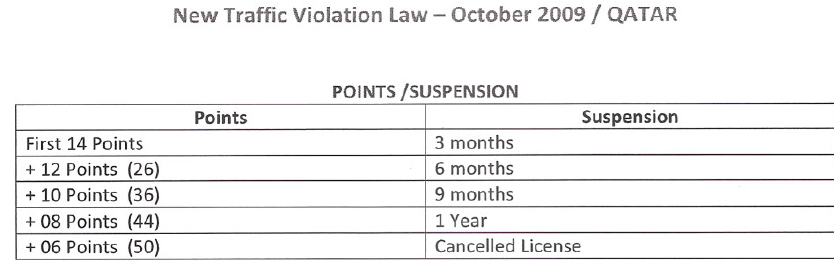

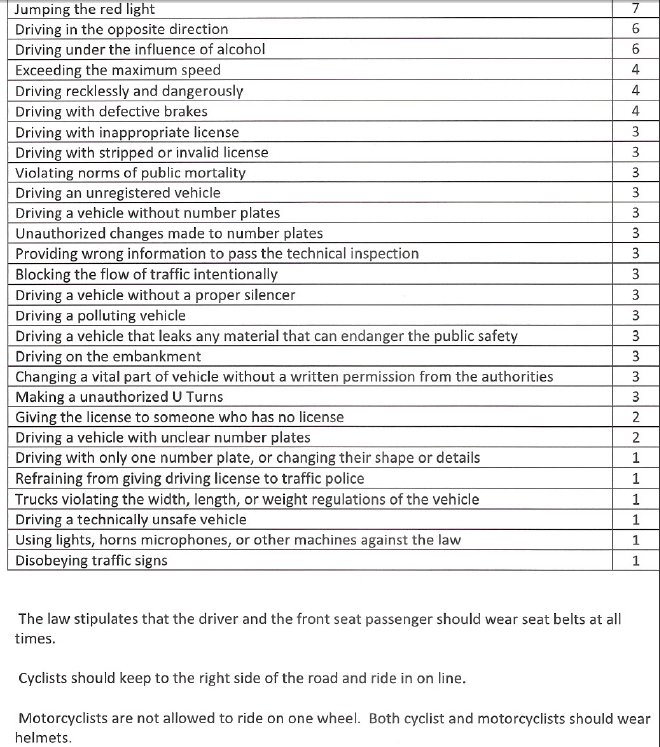
In theory, these went into effect in November 2009, just last month. Who issued these? Has there been any coverage in the newspapers? TV? How can people be held accountable for violating laws of which they are not aware? Or is this something one of the companies printed up, anticipating new laws?
It’s Good To Be The Amir :-)
One of the first things visitors say when I take them around Doha is “It’s so clean!” said in a voice of total wonder. Doha IS clean, noticeably clean. Along the Corniche, everything is clean – and manicured. Doha is beautiful. The roads are beautiful, and getting beautifuller – er . . . more beautiful.
Qatar is not a democracy. It has a monarch, the Amir. The Amir has huge resources, and he channels much of his resources into infrastructure – highways, water treatment, electricity, parks (along the Corniche, wireless internet is provided to the community, totally FREE, miles of free internet), education – and serious work is being done to raise the level of education and educational possibilities continually – planning for future food and water, trying to insure that if and when the gas runs out, Qatar will have a sustainable economy.
It’s not a job I would want. It’s a lot of hard work, and who do you trust to share your vision and help you get the job done? Every day must have its frustrations, and the triumphs take a lot of work and perseverance. Building a country’s infrastructure is not for the faint-hearted.
But the job has its perks, and one of them is that you can create your own viewing stand for the 0800 Friday morning military review parade. This reviewing stand makes me grin. This Amir has some Events people with a flair for the dramatic and a tip of the hat to the traditional at the same time. While some complain that the new souks are like Disney Does Doha, anyone who used to go there and goes there now will tell you that there is new life in the souks. They are clean and safe and light and well cared for.
Anyway, I digress.
Here is where the Amir gets to sit to review his military at the parade tomorrow morning at 0800:
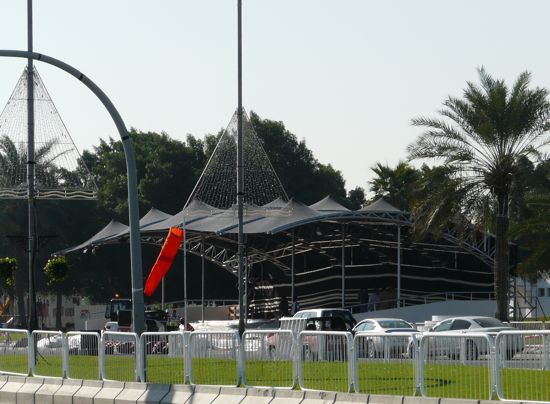
I was afraid to go any closer, as people were practicing for the parade, security might not like me taking photos, but how cool is this? They used original beit as-shar (house of hair, i.e. wool) fabric for the inner lining of the review tent. I totally love it. This fabric was originally made mostly from goat hair, but also stripes of sheep and camel hair. I have some. It’s tough and strong, and in panels, woven by the women. I don’t think they make tent bodies like this any more.
Saturday Night Live Does Tiger Woods
There are mixed reviews on this hilarious Saturday Night Live take-off of the Tiger Woods situation. Some people feel it is tasteless, and that if the batterer were a man, it would be seriously unfunny.
They are right. And who on earth expects Saturday Night Live to stay within the boundaries of good taste? Or any boundaries at all?
As for me – I find it tastelessly hilarious.
( I will try to keep posting ones that work until they get taken off)
Round 2, Why You Should Always Carry Your Camera in Doha
“HOLY COW!” I shouted at AdventureMan, as I am already digging for my camera. He hates it when I do that, he things maybe I have spotted some danger or something and it gets his adrenaline going. I couldn’t help it. I was shocked, and I said “There’s a CHEETAH in that car!”
We love cheetah. Anyone who has ever seen a cheetah in the wild knows the awesome measure of God’s creativity and wonder. The cheetah is a speed machine, a glorious hunter, born to run. The cheetah is a glorious creation.
AdventureMan didn’t believe me, not for two or three full seconds and then – he saw it, too:


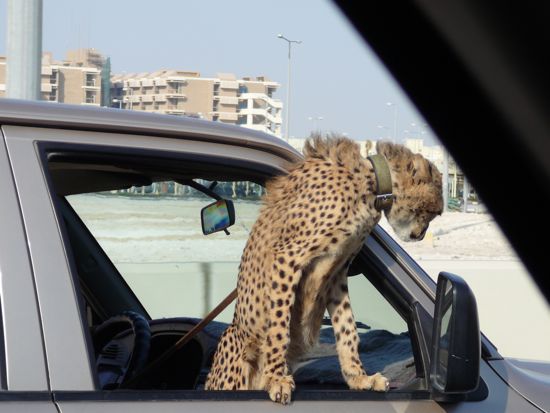
The man with the very young cheetah on a leash under very loose control was having a ball. The cheetah looked very happy to be out in the car with him, even on a leash.
It is a shame, and it should be a crime.
A cheetah, even when snatched away from his mother early in life, is not a toy, not an accessory. A cheetah can eat your innocent babies. A cheetah can bite you or scratch you badly, and think it is just playing. Taking a cheetah out of the wild is probably not a really good thing for the cheetah. How long with this man find him novel and fun and pay attention to him? And then what?
This is what a cheetah is meant to do, and this is how a cheetah is meant to live:
My friends, if you love wildlife, no matter how rich you are, leave the wildlife in the wild. Please.
Qatar Population on Monday is 1,580,050
This gave me a grin – as of a certain date, Qatar has a number, not an approximate number, a fairly fixed number – for its population.
You know what? I believe it. I have seen the way the computers here operate; they seem to have some inter-operability, and quick ways of accessing information back and forth between departments. I can believe they are tallying people leaving, people coming, people being born, people dying, as fast as the data can be entered.
I wouldn’t have believed it six years ago. I believe they have this capability now. They must have made a significant investment in this infrastructure, and it’s continuous upgrade.
From today’s Peninsula
Doha: The population of Qatar till Monday is 1,580,050, according to statistics released by Qatar Statistics Authority (QSA) yesterday. These data represent the number of individuals of all ages (Qataris and non-Qataris) within the state on Monday, excluding Qataris and residents who were outside the borders of the State at the time of the statement monitoring. The total number of males according to these data, is 1, 225,487 compared to 354,563 females.
These figures indicate a decline in population within the state with 86,803 people compared to last October, which recorded the highest rise in population during the year. It is noteworthy that QSA started presenting data on its website showing total population at the end of each month since October last year.
Qatar Train Map
I found the paper with the map! How cool is this?

When I look at this, I think if the money ever runs out in Qatar, they will still have invested in a superior infrastructure – education, transportation, roads, parks, attractive public areas, effective policing and traffic control – way more important than luxury malls.
Recent Comments
ExpatAlien on What Country am I Living … intlxpatr on Yellowstone: Old Faithful to C… Michelle on Yellowstone: Old Faithful to C… Cathy on No Grown-Ups in Charge intlxpatr on Waiting for Snow Wikipedia Donate Button

Amazina


Early Voting in Florida


 Here There and Everywhere