Internet Use Changes Older Brains
I love this story – using the internet is good for aging brains!
Internet Use Changes Older Brains
LiveScience
posted: 14 HOURS 46 MINUTES AGOcomments: 10filed under: SCIENCE NEWS
(Oct. 19) — Adults with little internet experience show changes in their brain activity after just one week online, a new study finds.
The results suggest Internet training can stimulate neural activation patterns and could potentially enhance brain function and cognition in older adults.
As the brain ages, a number of structural and functional changes occur, including atrophy, or decay, reductions in cell activity and increases in complex things like deposits of amyloid plaques and tau tangles, which can impact cognitive function.
UCLA/LiveScience
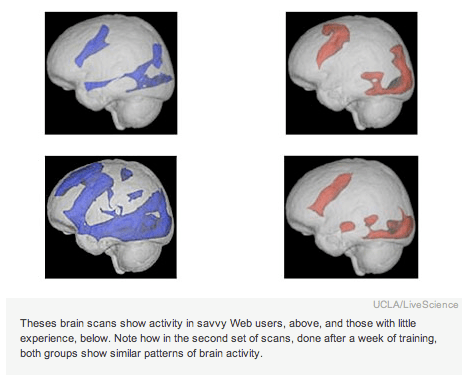
Research has shown that mental stimulation similar to the stimulation that occurs in individuals who frequently use the Internet may affect the efficiency of cognitive processing and alter the way the brain encodes new information.
“We found that for older people with minimal experience, performing Internet searches for even a relatively short period of time can change brain activity patterns and enhance function,” Dr. Gary Small, study author and professor of psychiatry at the Semel Institute for Neuroscience and Human Behavior at UCLA, said in a statement.
The UCLA team worked with 24 neurologically normal volunteers between the ages of 55 and 78. Prior to the study, half the participants used the Internet daily, while the other half had very little experience. Age, educational level and gender were similar between the two groups.
The participants performed Web searches while undergoing functional magnetic resonance imaging (fMRI) scans, which recorded the subtle brain-circuitry changes experienced during this activity. This type of scan tracks brain activity by measuring the level of blood flow in the brain during cognitive tasks. While the study involves a small number of people and more research on this topic is needed, small study sizes are typical of fMRI-based research.
After the initial brain scan, subjects went home and conducted Internet searches for one hour a day for a total of seven days over a two-week period. These practice searches involved using the web to answer questions about various topics by exploring different websites and reading information. Participants then received a second brain scan using the same Internet simulation task, but with different topics.
The first scan of participants with little Internet experience showed brain activity in the regions controlling language, reading, memory and visual abilities. The second brain scan of these participants, conducted after the home practice searches, demonstrated activation of these same regions, but there was also activity in the middle frontal gyrus and inferior frontal gyrus – areas of the brain known to be important in working memory and decision-making.
Thus, after Internet training at home, participants with minimal online experience displayed brain activation patterns very similar to those seen in the group of savvy Internet users.
“The results suggest that searching online may be a simple form of brain exercise that might be employed to enhance cognition in older adults,” Teena D. Moody, the study’s first author and UCLA researcher, said in a statement.
You can read the rest of this article from Live Science on AOL News by clicking here.
Suq al Waqif Bird Market
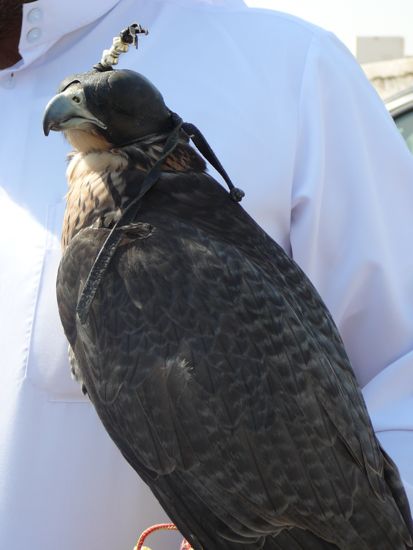
As we were heading into the Suq al Waqif for breakfast Saturday morning (Yes! Several of the restaurants are open for breakfast!) we saw a man and his son, both carrying falcons.

AdventureMan joked that they are hired by the administrators to walk around adding local color. We scoffed. Maybe someday, but for right now, these are still real people, with their own falcons. We know because our Kuwaiti visitor stopped them and asked about the falcons. They were so sweet and so delighted to tell us about their birds, and to allow us to photograph them:
There was also a lively bird auction going on:

What we love about the renovated market is that it is still a true market, where real people by daily items for use.
Farewell Dar al Thaqafa
We were sitting in a meeting when two friends rushed in, full of news of the fire down at the Souk al Diraa / Souk al Asseiri, familiarly known as The Fabric Souks. Our friend’s car had been near where the blaze broke out and they had been stuck while the firemen refused to allow her near her car, and finally they moved it out of the way for her, covered with ash and dirty water, but otherwise unharmed.
We all waited breathlessly to hear if the fabric souks were harmed. They weren’t. For such a big blaze, such a long-lasting fire, no lives were lost, no one was hurt, as far as anyone knows.
But in this morning’s paper, I see that while the fire started out a small fire, somehow, it was not contained, and in the clutter and chaos of the older souks, it grew, fed by stacks of stored goods and rubbish.
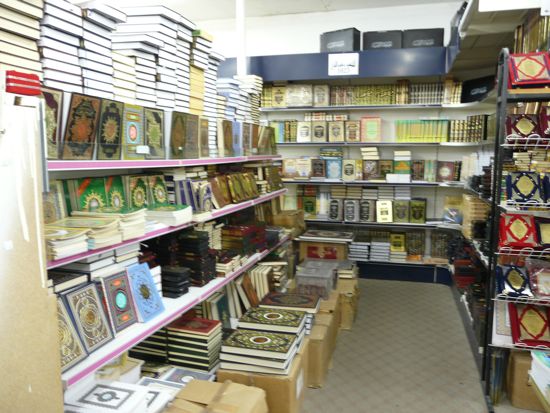
One of the victims was an old friend of mine – the Dar al Thaqafa. Little Diamond and I would often find treasures there, books you couldn’t find anywhere else. There are other bookstores in this chain, but this one, this Dar al Thaqafa was THE oldest bookstore in Doha, stocking school supplies, children and adult fiction and non-fiction, textbooks and obscure Islamic scholarly works. It was a quiet place, an old fashioned book-store, tucked behind the very tacky toy vender where I once bought both a dancing Osama bin Laden and a dancing Saddam Hussein.
We are sorry to see this old friend go. (They gave me permission to take these photos)

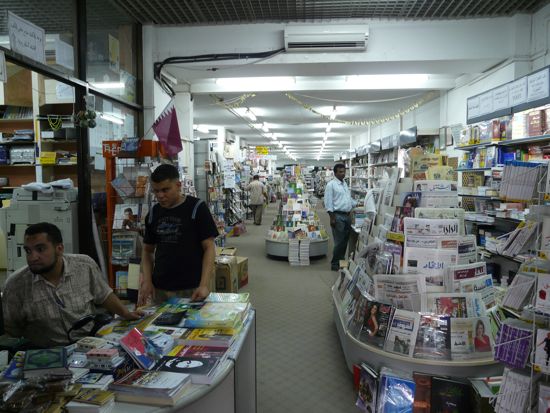
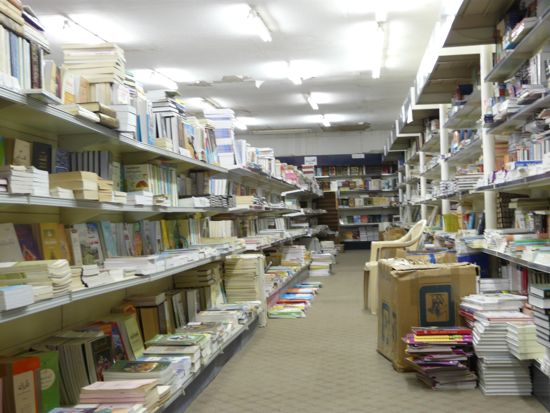


The area was full of small merchants, most of whom I suspect could ill-afford this loss of merchandise and income. I took a photo of an alleyway in the area of the fire (taken in July)

The Help by Kathryn Stockett

In my book club last year, one of the themes that continued to arise as we read books from many cultures was how we are perceived by the people we hire to help us in our homes. In The White Tiger, a Man Booker Award Winner, the main character lucks into a job working for a family as a driver. We see the people for whom he works from the inside, their sweet acts and all their flaws. We see how callous they can be, and, ultimately, how the driver takes his revenge and becomes his own boss. (Not one of my favorite books, but then again, I’m still thinking about it a year later, so there is something to be said for it.)
In Half of a Yellow Sun we saw an entirely different relationship (in a book I totally loved, BTW) between employer and employee, but it shared with White Tiger the aspect of employer as seen from the eyes of an employee inside the house who sees the family and all its interactions intimately.
The Help, a surprise best seller, does the same to 1960’s era Mississippi. A recent graduate from Ole Miss (University of Mississippi) starts interviewing the maids from local households, any maid that will talk to her. At first, no one will talk with her, but after traumatizing racial clashes, one by one, they share their stories. Just interviewing the maids, just the maids sharing their stories, is enough to bring on serious consequences.
First, the book is riveting. I have a million things I really REALLY need to be doing, and I can’t stop reading. There is something about peeking into your neighbors house, seeing how they behave when they think no one is looking, that appeals to the voyeur in each of us.
Second, these women are taking serious risks. I am on the edge of my chair with each reading, hoping nothing bad happens to them.
Third, there is something that makes you squirm, it is the old “wee giftie” that shows us the worst in ourselves as others might see us; our own hypocrisies, our condescensions, our patronizing acts, how cruel our charitable acts can appear through the eyes of others, and how callous we are in the end towards those who take care of us every day.
It has rocketed onto the best seller list, now the #6 best selling book on Amazon.
If your book club is looking for a book to read that will get you talking and keep you talking for a long time, this is one of the best.
If you have hired help in the house, I double-dog-dare-you to read this book. (OOps, sometimes the little Alaska girl in me pops back out!) Fair warning, though, once you start, you won’t want to put it down.
FBI Press Release Re: FaceBook, Social Networking Sites
Read the message for yourself on the FBI Press Release Page
No, Your Social Networking “Friend” Isn’t Really in Trouble Overseas
According to the Internet Crime Complaint Center (IC3), there has been an increase in the number of hijacked social networking accounts reported to http://www.ic3.gov.
One of the more popular scams involves online criminals planting malicious software and code onto to victim computers. It starts by someone opening a spam e-mail, sometimes from another hijacked friend’s account.
When opened, the spam allows the cyber intruders to steal passwords for any account on the computer, including social networking sites. The thieves then change the user’s passwords and eventually send out distress messages claiming they are in some sort of legal or medical peril and requesting money from their social networking contacts.
So far, nearly 3,200 cases of account hijackings have been reported to the IC3 since 2006.
Cyber thieves are also using spam to promote phishing sites, claiming a violation of the terms of service agreement or creating some other issue which needs to be resolved. Other spam entices users to download an application or view a video. Some of these messages appear to be sent from friends, giving the perception of legitimacy. Once the user responds to a phishing site, downloads an application, or clicks on a video link, the electronic device they’re using becomes infected.
Some applications advertised on social networking sites appear legitimate but install malicious code or rogue anti-virus software. These empty applications can give cyber criminals access to your profile and personal information. These programs will automatically send messages to your contacts, instructing them to download the new application too.
Infected users are often unknowingly spreading malware by having links to infected websites posted on their webpage without the user’s knowledge. Since the e-mail or video link appear to be endorsed by a friend, social networking contacts are more likely to click on these links.
Although social networking sites are generally a safe place to interact with friends and acquaintances, keep in mind these suggestions to protect yourself while navigating the Internet:
• Adjust website privacy settings. Some networking sites have provided useful options to assist in adjusting settings to help protect your identity.
• Be selective when adding friends. Once added, contacts can access any information marked as viewable by all friends.
• Limit access to your profile to only those contacts you trust with your personal information.
Disable options, such as photo sharing, that you might not regularly use. You can always enable these options later.
• Be careful what you click on. Just because someone posts a link or video to their wall does not mean it is safe.
• Familiarize yourself with the security and privacy settings and learn how to report a compromised account.
Each social networking site may have different procedures on how to handle a hijacked or infected account; therefore, you may want to reference their help or FAQ page for instructions.
If your account has been hijacked or infected, report it to by visiting http://www.ic3.gov or http://www.lookstoogoodtobetrue.com.
The Internet Crime Complaint Center is a partnership between the FBI and National White Collar Crime Center (NW3C).
Young Adults Report Anxiety Overload
Young adults ‘anxiety overload’
No, it’s not just your imagination. And you are not alone – others in your age group are likely suffering the same anxieties you are, and covering it up.
You can read the entire article at BBC News
Young adults are suffering from “anxiety overload”, a UK charity warns.
A survey of 18-24 year olds found 66% feel stressed or anxious at least once a week, with money and job worries being the main cause.
Almost a third of respondents said they did not tell anyone of their worries, raising the need to teach young people “coping strategies”, said Rethink.
Women seemed most badly affected, with one in three suffering frequent anxiety, compared with one in 10 men.
The YouGov poll of 2,000 adults, 250 of whom were aged 18-24, found 33% of young women felt stressed or anxious most days or every day.
Attempt to Kidnap Kuwaiti Girl: Print Their Names
From the Arab Times
Here is what scares me about this story – the language. It says “the side glass of the car broke.” That is very neutral language. I am pretty sure that the girl who was the intended victim would not break the glass; it was part of the barrier protecting her from the would-be kidnappers. It bothers me that it doesn’t state that the man broke the car glass attempting to kidnap the girl.
It also bothers me that the language says that they have been “detained for interrogation.” These men are a danger to society. They need to be locked up, for their own good and for the sake of the innocent young women who are their potential victims. There are witnesses, including the police. Enough! Try them, convict them and put them away!
It is also time to start publishing the names of the men who commit these acts. Would you want your daughter to marry such a man? Your cousin? Your sister? Doesn’t a woman have a right to know what sort of man she is marrying? Yes, it would shame the families from which the kidnappers have come. It seems that maybe shame is the only effective tool for deterring this kind of shameful behavior. If the families forbade this kind of behavior, you would see a drastic drop in the crime of kidnapping. Print their names.
Women are not the only victims. These same entitlement-loaded kidnappers seize boys and young me off the streets, sometimes lure their own friends, take them to the desert and rape them. What are they thinking? What makes them think they have that right? What makes them think there will be no consequences for bestial behavior?
Police save Kuwaiti girl from kidnappers’ clutches in Shaab Entertainment Park
KUWAIT CITY, Oct 2: The Hawalli police recently foiled at attempt by two Kuwaitis to kidnap a female compatriot from the parking lot of the Shaab Entertainment Park, reports Al-Shahid daily.
It has been reported as the victim was about to pull out of the parking lot, the youths blocked her way with their car and one of them got down from his vehicle and tried to drag the girl into his vehicle.
At this point the victim strongly resisted and in the confusion the side glass of the car broke. The victim then cried for help and a passing police patrol went to her rescue.
Seeing police the suspects grabbed the victim’s handbag containing her personal documents, cell phone and money and tried to escape but police chased and arrested them.
They have been detained at the Hawally Police Station for interrogation.
Predators prey on those they perceive to be weak and without protection. We, society, are supposed to be protecting the weak. When this man is refused sex, he and his friends try to rape the man, and trash the entire massage parlor?
Kuwaiti Man attempts to rape Jordanian massageur
KUWAIT CITY, Oct 2: An 18-year old Jordanian teenager reported at Jahra Police Station that a Kuwaiti man attempted to rape him while he was massaging the suspect inside a men’s salon — where the complainant works, in the Industrial Area on Thursday.
He narrated the man offered to pay him certain amount of money if he acceded to his demand for immoral act, which the complainant turned down and immediately asked the suspect to leave the salon.
He stressed the suspect later tried to kidnap him, which he resisted, so the suspect fled with his friends, but they destroyed some contents of the salon before fleeing the scene. However, he managed to record the number plate of the suspect’s car, which the detectives found out it belonged to a Kuwaiti man. A case has been registered against the suspect.
Karabaa in Rubble
It’s even worse. Rubble everywhere. It looks like a war zone.

Ripping out the Heart of Doha . . .
Drive to Reduce Traffic Deaths in Qatar
I am a great admirer of Brig Mohamed Abduallah al-Malki. I remember once, when Qatar was much smaller, when he printed his phone number in the paper and told people to call him when they saw drivers misbehaving. What a brave man, a committed man, and a courageous man.
I admire his persistence, his sincere desire to bring down traffic deaths in Qatar.
Yesterday, as I was driving, I noticed most drivers slowing down – when that happens, you know there are new speed cameras set up, and you slow down too. You slow down – or most of us do. There are a visible few who seem to believe that the rules do not apply to them.
There is a persistent rumor that traffic fatalities fell dramatically when the new laws were introduced – and enforced – equally – against all law breakers. As long as laws are enforced equally against ALL nationalities, the death rate will lower.
To me, it is a huge national tragedy that so many young Qatteri men lose their lives, or are seriously physically damaged, in traffic accidents that could have been prevented. It is like a huge national resource, just wasted, all that potential, gone.
This is from today’s Gulf Times
Drive to raise students’ road safety awareness
Traffic department and IBQ officials at the launch of the campaign yesterday
By Riham el-Houshi
The ‘Schools without Accidents’ campaign launched yesterday for the second year running by the Traffic Department is aimed at cutting the number of road accidents in Qatar by half, a top official has said. The campaign aims at raising awareness about road safety among students.
Traffic Department expert and general co-ordinator of the National Campaign for Road Accident Prevention, Brig Mohamed Abduallah al-Malki, said “there has been a decrease in the number of deaths in 2009 but a final picture will emerge only by December.”
The number of road accident deaths in the country fell by 20% in 2008 compared to the previous year. The total number of road accidents last year was 20,455, with approximately 200 deaths, according to the Traffic Department.
The initiative, launched within the framework of the ‘National Campaign for Road Accidents Prevention,’ is a programme to raise awareness on the importance of road safety among students across Qatar.
Al-Malki added that 35% of road accident victims were pedestrians who were usually expatriates.
“Therefore the campaign this year will focus on expatriate schools as well as local ones,” al-Malki pointed out.
The campaign will be funded by the International Bank of Qatar (IBQ), who has given QR500,000 to the Traffic Department. The bank donated QR250,000 to the cause last year. According to al-Malki, the money will be spent on brochures, signboards, and competitions.
“Too many of our young people never have the chance to realise life’s opportunities as their lives are cut tragically short by preventable road accidents,” said IBQ managing director George Nasra.
“We can and must do even more to reduce the number of traffic accidents and fatalities – especially among our youth.”
A recent survey conducted by Gulf Times had shown that 41% of the respondents feel that Qatar was the worst country to drive because of the number of accidents caused by reckless driving.
Recent Comments
intlxpatr on Yellowstone: Old Faithful to C… Michelle on Yellowstone: Old Faithful to C… Cathy on No Grown-Ups in Charge intlxpatr on Waiting for Snow intlxpatr on Waiting for Snow Wikipedia Donate Button

Amazina


Early Voting in Florida


 Here There and Everywhere