It’s Good To Be The Amir :-)
One of the first things visitors say when I take them around Doha is “It’s so clean!” said in a voice of total wonder. Doha IS clean, noticeably clean. Along the Corniche, everything is clean – and manicured. Doha is beautiful. The roads are beautiful, and getting beautifuller – er . . . more beautiful.
Qatar is not a democracy. It has a monarch, the Amir. The Amir has huge resources, and he channels much of his resources into infrastructure – highways, water treatment, electricity, parks (along the Corniche, wireless internet is provided to the community, totally FREE, miles of free internet), education – and serious work is being done to raise the level of education and educational possibilities continually – planning for future food and water, trying to insure that if and when the gas runs out, Qatar will have a sustainable economy.
It’s not a job I would want. It’s a lot of hard work, and who do you trust to share your vision and help you get the job done? Every day must have its frustrations, and the triumphs take a lot of work and perseverance. Building a country’s infrastructure is not for the faint-hearted.
But the job has its perks, and one of them is that you can create your own viewing stand for the 0800 Friday morning military review parade. This reviewing stand makes me grin. This Amir has some Events people with a flair for the dramatic and a tip of the hat to the traditional at the same time. While some complain that the new souks are like Disney Does Doha, anyone who used to go there and goes there now will tell you that there is new life in the souks. They are clean and safe and light and well cared for.
Anyway, I digress.
Here is where the Amir gets to sit to review his military at the parade tomorrow morning at 0800:

I was afraid to go any closer, as people were practicing for the parade, security might not like me taking photos, but how cool is this? They used original beit as-shar (house of hair, i.e. wool) fabric for the inner lining of the review tent. I totally love it. This fabric was originally made mostly from goat hair, but also stripes of sheep and camel hair. I have some. It’s tough and strong, and in panels, woven by the women. I don’t think they make tent bodies like this any more.
Saturday Night Live Does Tiger Woods
There are mixed reviews on this hilarious Saturday Night Live take-off of the Tiger Woods situation. Some people feel it is tasteless, and that if the batterer were a man, it would be seriously unfunny.
They are right. And who on earth expects Saturday Night Live to stay within the boundaries of good taste? Or any boundaries at all?
As for me – I find it tastelessly hilarious.
( I will try to keep posting ones that work until they get taken off)
Round 2, Why You Should Always Carry Your Camera in Doha
“HOLY COW!” I shouted at AdventureMan, as I am already digging for my camera. He hates it when I do that, he things maybe I have spotted some danger or something and it gets his adrenaline going. I couldn’t help it. I was shocked, and I said “There’s a CHEETAH in that car!”
We love cheetah. Anyone who has ever seen a cheetah in the wild knows the awesome measure of God’s creativity and wonder. The cheetah is a speed machine, a glorious hunter, born to run. The cheetah is a glorious creation.
AdventureMan didn’t believe me, not for two or three full seconds and then – he saw it, too:
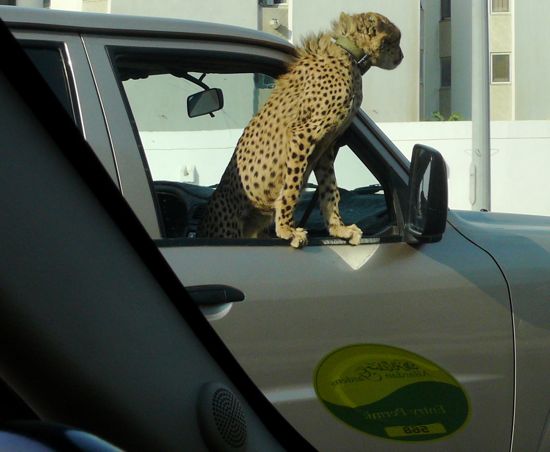

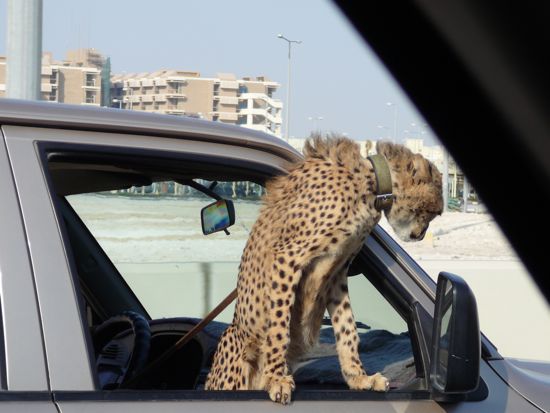
The man with the very young cheetah on a leash under very loose control was having a ball. The cheetah looked very happy to be out in the car with him, even on a leash.
It is a shame, and it should be a crime.
A cheetah, even when snatched away from his mother early in life, is not a toy, not an accessory. A cheetah can eat your innocent babies. A cheetah can bite you or scratch you badly, and think it is just playing. Taking a cheetah out of the wild is probably not a really good thing for the cheetah. How long with this man find him novel and fun and pay attention to him? And then what?
This is what a cheetah is meant to do, and this is how a cheetah is meant to live:
My friends, if you love wildlife, no matter how rich you are, leave the wildlife in the wild. Please.
Qatar Population on Monday is 1,580,050
This gave me a grin – as of a certain date, Qatar has a number, not an approximate number, a fairly fixed number – for its population.
You know what? I believe it. I have seen the way the computers here operate; they seem to have some inter-operability, and quick ways of accessing information back and forth between departments. I can believe they are tallying people leaving, people coming, people being born, people dying, as fast as the data can be entered.
I wouldn’t have believed it six years ago. I believe they have this capability now. They must have made a significant investment in this infrastructure, and it’s continuous upgrade.
From today’s Peninsula
Doha: The population of Qatar till Monday is 1,580,050, according to statistics released by Qatar Statistics Authority (QSA) yesterday. These data represent the number of individuals of all ages (Qataris and non-Qataris) within the state on Monday, excluding Qataris and residents who were outside the borders of the State at the time of the statement monitoring. The total number of males according to these data, is 1, 225,487 compared to 354,563 females.
These figures indicate a decline in population within the state with 86,803 people compared to last October, which recorded the highest rise in population during the year. It is noteworthy that QSA started presenting data on its website showing total population at the end of each month since October last year.
Qatar Train Map
I found the paper with the map! How cool is this?

When I look at this, I think if the money ever runs out in Qatar, they will still have invested in a superior infrastructure – education, transportation, roads, parks, attractive public areas, effective policing and traffic control – way more important than luxury malls.
FYI: How Long is a Generation?
So I get on a track and I can’t get off, like a little hamster running on the wheel. I got to thinking about generations, and how long ago is 10 generations and so I had to ask Google the question: How long is a generation? Don’t you love Google? They always have an answer.
Now I know something new. Now I will share it with you. This comes from Ancestry.com
Research Cornerstones: How Long Is a Generation? Science Provides an Answer
How Long Is a Generation?
By Donn Devine, CG, CGI
We often reckon the passage of time by generations, but just how long is a generation?
As a matter of common knowledge, we know that a generation averages about 25 years—from the birth of a parent to the birth of a child—although it varies case by case. We also generally accept that the length of a generation was closer to 20 years in earlier times when humans mated younger and life expectancies were shorter.
In genealogy, the length of a generation is used principally as a check on the credibility of evidence—too long a span between parent and child, especially in a maternal line, has been reason to go back and take a more careful look at whether the evidence found reflects reality or whether a generation has been omitted or data for two different individuals has been attributed to the same person. For that purpose, the 20- and 25-year averages have worked quite acceptably; birth dates too far out of line with the average are properly suspect.
But now, researchers are finding that facts differ from what we’ve always assumed—generations may actually be longer than estimates previously indicated.
Several recent studies show that male-line generations, from father to son, are longer on average than female-line generations, from mother to daughter. They show, too, that both are longer than the 25-year interval that conventional wisdom has assigned a generation. The male generation is at least a third longer; the female generation is about one-sixth longer.
As early as 1973, archaeologist Kenneth Weiss questioned the accepted 20- and 25-year generational intervals, finding from an analysis of prehistoric burial sites that 27 years was a more appropriate interval but recognizing that his conclusion could have been affected if community members who died away from the village were buried elsewhere.
Why Age Matters
In a more-recent study regarding generation length, sociologist Nancy Howell calculated average generational intervals among present-day members of the !Kung, contemporary hunter-gatherer people of Botswana and Namibia whose lifestyle is relatively similar to that of our pre-agricultural ancestors. The average age of mothers at the birth of their first child was 20 years and at the last birth 31, giving a mean of 25.5 years per female generation—considerably above the 20 years often attributed to primitive cultures. Fathers were six to 13 years older than mothers, giving a male generational interval of 31 to 38 years.
A separate study, conducted by population geneticists Marc Tremblay and Hélène Vézina, was based on 100 ascending Quebec genealogies. Researchers found a generational interval, based on the years between parents’ and children’s marriages, to average 31.7 years, and they determined that male generations averaged 35.0 years while female generations averaged 28.7 years.
Biological anthropologist Agnar Helgason and colleagues used the Icelandic deCODE genetics database to arrive at a female line interval of 28.12 years for the most recent generations and 28.72 years for the whole lineage length. Male line lineages showed a similar difference—31.13 years for the recent generations and 31.93 years overall. For a more mathematically appealing average, Helagason and fellow researchers recommended estimating female generational line intervals at 30 years and male generational intervals at 35 years, based on the Quebec and Iceland studies.
Calculating Ideas
What does this mean to the genealogist? When assigning dates to anthropologically common ancestors 50 or more generations in the past, using the “accepted” 20 or 25 years as a conversion factor can produce substantial underestimates of the time interval.
For my own purposes, however, given the imprecision of the various results and my own need for an estimate that lends itself to easy calculation, I decided that three generations per century (33 years each) for male lines and 3.5 generations per century (29 years each) for female lines, might work better when I needed to convert generations into years.
To check the accuracy of my values, I decided to compare the generational intervals from all-male or all-female ranges in my own family lines for the years 1700 to 2000. I was pleasantly surprised to see how closely the intervals agreed with the estimates I was using. For a total of 21 male-line generations among five lines, the average interval was close to 34 years per generation. For 19 female-line generations from four lines, the average was an exact 29 years per generation.
In genealogy, conclusions about relationships are subject to change whenever better evidence is discovered. Similarly, it’s the nature of the physical and biological sciences that current understandings are subject to change as more data becomes available and that data’s interpretation becomes more certain. So, for now, when genealogists want to convert generations to years and create probable date ranges, using an evidence-based generational interval—like Helagason’s 30 and 35 years or one that you’ve developed based on your own family history research—may be the best solution.
Donn Devine, CGSM, CGISM, a genealogical consultant from Wilmington, Delaware, is an attorney for the city and archivist of the Catholic Diocese of Wilmington. He is a former National Genealogical Society board member, currently chairs its Standards Committee, is a trustee of the Board for Certification of Genealogists, and is the administrator for Devine and Baldwin DNA surname projects.
Big Change; No Smoking
Sometimes change happens, and it happens so slowly or so subtly that you don’t really realize it has happened until something draws it to your attention.
Kuwait blogger Touche, one of my old virtual-blogging-buddies commented on a driving post, wondering about the baby steps it takes to change a mentality. The subject was driving, and I know he was right, I am writing “endlessly” about how annoyed I get by the lack of civility in driving here.
What I am not writing about, I noticed, is how annoying it is to be breathing other people’s smoke while I am eating.
Because it is not happening.
Who knew?
When we lived in Qatar before, people would sit right under the NO SMOKING signs and light up.
I saw things change in Kuwait. From the time we got there to the time we left, there were fewer and fewer times someone would light up in a restaurant.
Things CHANGED.
Expectations changed. I am guessing the smokers felt pressure, not just from the community, but also from family members. I don’t know if there are fewer smokers; I am inclined to think not, because I can see them smoking in their own cars. Hey – as long as I do not have to breathe their smoke, it’s fine with me, it’s their choice.
But the significant thing is – I didn’t believe it could ever change. And it did change, and it changed faster than I would have thought possible.
So I have hope for the driving issue. I think it starts with seat belts. I think if Mothers and wives start buckling up, and buckling up their children, that will be a first step. I think if there is an emphasis on driving manners, things could change. It’s a mind-shift before a behavior shift, an awareness of safety and an awareness of our interconnectedness. One thing I have seen in the Gulf is that parents raise their children to have good manners; manners are an important consideration also when considering a mate. If you take the driving problem as a manners problem, and emphasize the need for good manners on the road, maybe there is a possibility of change . . .
There is another area where I think change can happen – throwing things out the car window. If it becomes a commonly held value that throwing trash / cigarette butts / food wrappers out the window is bad behavior, I think it will stop. Maybe hand out car trash bags to raise awareness?
Have you seen the change in smoking? What I am noticing is that my dinners are no longer ruined by someone nearby lighting up. I don’t smell smoke in the malls. I don’t smell smoke in the airports. Pretty amazing, don’t you think?
Doha: Keep Your Camera Handy
Today I had one of those experiences I have so often in Doha, a “no-one-would-believe-me” moment, but I have learned to keep my camera handy, and fortunately we were stopped in traffic so I could snap this one without endangering any lives, especially my own.
Traffic is steady, busy, but pretty mellow. Yeh, there are the normal “I’m-going-to-make-a-left-turn-from-the-right-lane” guys; I’ve lived here for so long it doesn’t even rate a roll of the eyes. It’s part of the Doha / Kuwait driving culture.
This, however, I only see in Qatar. Mr. I’m-So-Important-I-Can’t-Wait is this guy in the white Land Cruiser.
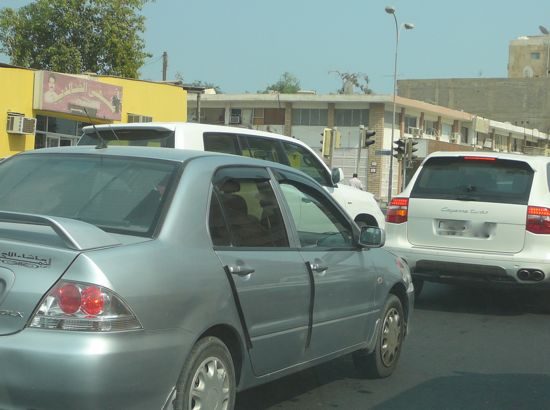
He is sitting half on top of the street median, trying to get back into traffic going in his direction. To get there, he drove down the wrong way down the street on the other side of the divider. At first, there was no traffic, but when traffic came, he got up on the divider so he was only HALF blocking traffic from the other direction, and he is bullying his way back into the line he was too important to wait in.
I carry my camera now, every day, in my purse, because I know if I just tell you about these things, you won’t believe them.
I have seen this also at major roundabouts. Some yahoo drives up the other side of the road to the roundabout to avoid waiting in the line. Up over the medians, facing oncoming traffic. I know, I know, what are they thinking?
In Kuwait, I was sickened by the number of young men killed on the roads every week, every month. If it were an epidemic killing young men, people would do something about it, but tell these guys to obey the law? Make them pay fines for reckless driving? Make them wear seat belts? Their behavior tells me that no one has ever held them accountable for their arrogant and dangerous driving habits.
While we are told that “no one is above the law” somehow the message hasn’t made it to these guys.
Recent Comments
intlxpatr on Shampoo Ginger tigerbutterya0c5ff1d… on Shampoo Ginger intlxpatr on British Soldier Kidnapped, Esc… John on British Soldier Kidnapped, Esc… intlxpatr on British Soldier Kidnapped, Esc… Wikipedia Donate Button

Amazina


Early Voting in Florida


