Driver – and His Father – Obstruct Police
Don’t you wonder what happens next? Do they ever find out who the people are who are blocking them? I can see the whole thing happening in my mind – blocking the police!!
Driver arrested after obstructing onـduty police
Staff Writer Al Watan
KUWAIT: While police were organizing traffic at the second crossـsection in Jahra, they spotted two juveniles joyـriding nearby. They reported the incident to another police patrol which went to investigate the case. The two cars, upon being flagged down by the police patrol, immediately drove off and a police chase ensued.
The police patrol initially found it difficult to corner them due to wedding party, but as they were closing in a car of a German make impeded them.
Police repeatedly instructed him to clear from the route but the driver persistently blocked them. The officers approached the man to investigate the matter, but he refused to cooperate. Police asked for his identification, but the driver and the passenger, who was the driver”s father, refused to present identification. The two were arrested in place of the joyـriders and taken into police custody.
Kuwait imposes fee on public toilets?
LOL – there are public toilets in Kuwait? Where? Women always memorize which buildings have public restrooms, but aren’t those owned by the buildings? And holy smokes, what do we do if we don’t have small change left after all our shopping??? Men are more . . . umm. . . err. . . flexible, but women need privacy, i.e. restrooms!
TRAIN your cleaners! Give them proper supplies! Hold their supervisors responsible for their inspection and maintenance of standards! This is called ACCOUNTABILITY.
Charging for use of public restrooms will impose, at the very least, inconvenience for women, and most likely, embarrassment for those who don’t have the money, at the very worst times, like when you have seven children with you and three of them need to use the toilets. Charging fees for usage? Bad idea.
Municipality to impose fees on public toilets
Staff Writer From this morning’s Al Watan
KUWAIT: Kuwait is seriously mulling over the notion of imposing nominal fees for using public toilets.
Mohammad AlـAmri, the Convener of the Cleansing Committee at Kuwait Municipality, stated that the fee is aimed at providing better sanitary services along the lines that are implemented in certain neighboring countries. The official also noted that the current cleaning contracts are scheduled to expire in November 2010.
In a related development, the outgoing Minister of State for Municipal Affairs and Minister of Public Works Dr Fadhil Safar disclosed that Kuwait Municipality is currently working on a proposal to implement a new mechanism in keeping track with the performance of cleaning companies to ensure that the garbage is disposed off at the assigned dumpsites. He added that the system has been already implemented in the Kuwait City Governorate and is expected to be applied in all other governorates soon.
Last updated on Thursday 26/3/2009
First Kuwaiti Policewomen Graduate
Wooo HOOO on you, Kuwaiti policewomen! It is always hard to be in the vanguard, you take the criticisms, you take the disbelieving stares, and you handle questions, even from your own families. It’s always tough to be out front – to be a leader.
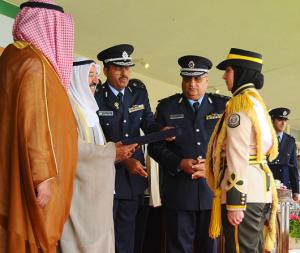
First group of policewomen graduate
From today’s Al Watan
KUWAIT: His Highness the Amir and Supreme Commander of the Armed Forces Sheikh Sabah AlـAhmad AlـSabah has attended on Wednesday the graduation ceremony of the 35th batch of military cadets, the 20th batch of specialized officers and the first batch of female cadets at the Support Authority Institute of the Saad AlـAbdullah Academy for Security Sciences.
The ceremony witnessed the graduation of the first batch of policewomen in the country. His Highness the Amir who arrived at the academy at 10:30 a.m. was warmly received by the Minister of Interior Lieutenant General Sheikh Jaber AlـKhalid AlـSabah, as well as other senior police officers.
The ceremony was also attended by His Highness the Crown Prince Sheikh Nawaf AlـAhmad AlـSabah, Vice President of the National Guards Corps Sheikh Mishaal
AlـAhmad AlـSabah, His Highness the Prime Minister Sheikh Nasser AlـMohammed AlـSabah, First Deputy Prime Minister and Minister of State for Defense Sheikh Jaber AlـMubarak AlـSabah, as well as other members of the ruling family, senior statesmen and members of the families of the graduating cadets.
Representatives of the 35th batch of military cadets then handed over the national flag to the representatives of the 36th batch. The Assistant Director General of the Academy for Education and Training Affairs Brigadier Dr. Waleed Khalaf BinـSalama read the ministerial decrees before inducting the new male and female police officers into the police force.
His Highness the Amir handed the graduates awards and certificates in appreciation for their efforts and then received the shield of the academy, that is dedicated to him, from Major General Yousef Mubarak AlـMedhahka. ـKUNA
Last updated on Thursday 26/3/2009
A Modern Parable
Thank you, Anita!
A MODERN PARABLE . .
A Japanese company ( Toyota ) and an American company (Ford) decided to have a canoe race on the Missouri River. Both teams practiced long and hard to reach their peak performance before the race.
On the big day, the Japanese won by a mile.
The Americans, very discouraged and depressed, decided to investigate the reason for the crushing defeat. A management team made up of senior management was formed to investigate and recommend appropriate action.
Their conclusion was the Japanese had 8 people rowing and 1 person steering, while the American team had 8 people steering and 1 person rowing.
Feeling a deeper study was in order, American management hired a consulting company and paid them a large amount of money for a second opinion.
They advised, of course, that too many people were steering the boat, while not enough people were rowing.
Not sure of how to utilize that information, but wanting to prevent another loss to the Japanese, the rowing team’s management structure was totally reorganized to 4 steering supervisors, 3 area steering superintendents, and 1 assistant superintendent steering manager.
They also implemented a new performance system that would give the 1 person rowing the boat greater incentive to work harder. It was called the ‘Rowing Team Quality First Program,’ with meetings, dinners, and free pens for the rower There was discussion of getting new paddles, canoes, and other equipment, extra vacation days for practices and bonuses.
The next year the Japanese won by two miles.
Humiliated, the American management laid off the rower for poor performance, halted development of a new canoe, sold the paddles, and cancelled all capital investments for new equipment. The money saved was distributed to the Senior Executives as bonuses and the next year’s racing team was out-sourced to India.
Sadly, The End.
Here’s something else to think about:
Ford has spent the last thirty years moving all its factories out of the US, claiming they can’t make money paying American wages.
TOYOTA has spent the last thirty years building more than a dozen plants inside the US. The last quarter’s results:
TOYOTA makes 4 billion in profits while Ford racked up 9 billion in losses.
Ford folks are still scratching their heads.
St. Oscar Romero
I didn’t even know we had a St. Oscar Romero, so when it came up on my screen, this morning as I was doing my daily lectionary readings I took a little time to read about him.
What an incredible man – and a modern day saint, too, a man for our times:
OSCAR ROMERO
ARCHBISHOP OF SAN SALVADOR, AND THE MARTYRS OF EL SALVADOR
(24 March 1980)
Óscar Arnulfo Romero y Galdámez (August 15, 1917 – March 24, 1980), commonly known as Monseñor Romero, was a priest of the Roman Catholic Church in El Salvador. He later became prelate archbishop of San Salvador.
As an archbishop, he witnessed numerous violations of human rights and began a ministry speaking out on behalf of the poor and victims of the country’s civil war. His brand of political activism was denounced by the hierarchy of the Roman Catholic Church and the government of El Salvador. In 1980, he was assassinated by gunshot while consecrating the Eucharist during mass. His death finally provoked international outcry for human rights reform in El Salvador.
In 1997, a cause for beatification and canonization into sainthood was opened for Romero and Pope John Paul II bestowed upon him the title of Servant of God. The process continues. He is considered the unofficial patron saint of the Americas and El Salvador and is often referred to as “San Romero” in El Salvador. Outside of Catholicism Romero is honored by other religious denominations of Christendom, like the Church of England through its Common Worship. He is one of the ten 20th-century martyrs from across the world who are depicted in statues above the Great West Door of Westminster Abbey, London.
You don’t have to be perfect to be a saint, in fact in the reading for today, St. Paul writes that “22 For I delight in the law of God in my inmost self, 23 but I see in my members another law at war with the law of my mind, making me captive to the law of sin that dwells in my members. 24 Wretched man that I am! Who will rescue me from this body of death? 25 Thanks be to God through Jesus Christ our Lord!
So then, with my mind I am a slave to the law of God, but with my flesh I am a slave to the law of sin.
We cannot, in our own strength do right all the time, even if we want to choose rightly. Oscar Romero may not have been perfect (because none of us are, it’s not like I know anything scandalous about him) but he dedicated himself to righting a major wrong he saw in society, and his persistence and dedication ended up causing his death.
Closed Circuit TV in all Kuwait Schools
From today’s Al Watan:
CCTV cameras to be in place next school year
Staff Writer
KUWAIT: Former Minister of Education and Minister of Higher Education Dr. Nouriya AlـSubaih has confirmed that the ministry is finalizing the installation of CCTV cameras on school campuses and is expected to be fully and completely implemented by the beginning of the next school year.
AlـSubaih”s statement came during a press conference organized by the Teachers Society for its 38th Educational Conference, which was held under the title ”Excellent Training, Future in the Making”.
The minister stressed that all steps are being taken to provide students with a proper and adequate education and that their safety and security are equally prioritized.
She made reference to the recent abuse incidents in local schools and pointed out that contrary to popular belief, school incidents have taken place in the past with the only difference being that they were never reported to police and the press “because they were dealt with and tackled by the school management then.”
She recalled how when she was herself a teacher school problems were dealt with privately and discretely due to the sensitive nature of the problems.
AlـSubaih further pointed out that acquiring the correct specifications and right CCTV cameras to do the job adequately and comprehensively “requires careful consideration to check the right models types, otherwise we would have gone to the local market,” adding that there were some models which the ministry had acquired but due to poor quality was later decided to be dropped.
For his part, Teachers Union Director Ayed AlـSahli said that teachers play an essential role in education and upbringing and that “the idea of training fits perfectly with the requirements of this noble profession to ensure that teachers make the children they teach more useful and productive.
“There is a need for training while teaching and great consideration is being put into the latest training programs with an eye to the future, so that teachers” skills and abilities are enhanced adequately,” he remarked.
Last updated on Tuesday 24/3/2009
Barbara Nadel: The Ottoman Cage
I got the recommendation for this book from Little Diamond; we have a long family tradition of trading books back and forth, my sisters, our children, even my mother; we are all sending books and exchanging suggestions all the time. I know I can count on Little Diamond and Sparkle for particularly good recommendations, and they never disappoint me.

When The Ottoman Cage arrived, I was put off by the cover. “Who’s Likely to Like This?” the cover asked – it seemed like screaming to me – “Fans of Donna Leon and exotic, atmospheric locales”
Remember, I am in a dark time, taxes, turbulence, destabilization. . . I am easily disgruntled when I am vulnerable like this. I don’t want to think I am so predictable. I love reading Donna Leon! So I am predisposed (grumble grumble grumble) NOT to like Barbara Nadel.
I fail miserably. The first five pages I am resisting. By the sixth page, I am ready to stay up all night to read this book (I don’t really, but I did finding myself making more time to read so I could find out what happens next.)
It is like the Donna Leon series in that while the plot is original and interesting, the real focus is on the police inspector, his crew, the relationships with friends and characters, the bureaucracy, and the way systems and institutions function in modern day Turkey.
One particular relationship was of great interest to me, that of Suleyman, who dutifully married his first cousin. They both tried very hard to make it work, but when we meet him, we discover that the marriage has become a painfully dry and desolate place, where each lead their individual lives, with very little of the relationship together.
Another character is detective Cohen, a rare Jew in the police force described as follows:
When one has been known and admired as a prolific womanizer for most of one’s adult life, any change in that situation can come rather hard. Although Cohen had been married since the age of nineteen, he had never let that fact or indeed his rather short stature and dishevelled apearance hold him back from the most ardent pursuit of other women. Jokey charm, of which he possessed copious amounts, had always seen him through. The knowledge that women love a man who can make them laugh had successfully taken him to many bedrooms and had, quite frequently, resulted in his being asked back again. Until this year.
Whether it was because now he was on the ‘wrong’ sied of forty five or just a patch of ill fortune, Cohen didn’t know but the fact was beyond dispute. Women, it seemed, didn’t want him any more. The rbuffs and even in one notable case the cruel sound of mocking laughter were hideously painful for him to bear. Even his long-suffering wife, who had for so many years pleaded with him to leave other women alone and attend to her, had lost interest. He’d tried to find a little comfort in her arms the previous night when he found that he couldn’t sleep, but she, like all the lithe little girls that he still so desired, had just sent him on his way, back to his customary couch, flinging her curses in his unfaithful wake.
It was, Cohen would have been the first to admit, his own fault. Had he bothered to try and be faithful to Estelle he would now, in his middle years, have both a friend and a over with whom he could take comfort as the lines overwhelmed his face and the loose skin around his middle began to sag. His wife was, after all, ageing like himself and, unlike the pretty little tarts he hankered after, unable to point mocking fingers at his inadequacies.
The plot hinges on a dead boy, a beautiful boy, found dead, alone, on a bed in an empty, tasteful but unlived in home. Who is he? Why is he here? Why is he dead?
We meet the gossipy neighbors, we meet the Armenian community, we meet some of the lowest characters you would ever hope to meet, the kind the police deal with every single day. Nothing is simple, one single clue leads slowly, painfully to another. I give credit to Nadel; she relies on good honest police work, chasing down the clues, going through the stacks of old files, interviewing unsavory lowlifes; the things good police really do to solve their cases.
More than the plot, I loved the rich and intricate textures of this mystery novel, I loved the descriptions of the interiors and the interior lives of the characters. Nadel has that in common with the other writers I read serially – Leon, Pattison, Qiu Xiaolon, James Burke and Peter Bowen. It is another rich entry into the genre of the “mystery novel set in exotic, atmospheric locations.”
Definitely worth a read!
US Embassy: Kuwait Low Threat fro Crimes
From today’s Al Watan
Kuwait 2009 Crime & Safety Report
U.S. Department of State rates Kuwait as low threat for crime
WASHINGTON: The Department of State rates Kuwait as low threat for crime. The incidence of crime in Kuwait City remains low. The government of Kuwait (GOK) maintains a high police profile with large numbers of uniformed and plainـclothes officers on the streets. Each district and governorate has police stations operating under the direction of the Ministry of Interior (MOI) Directorate of Public Safety. Incidents of crime do occur, with few instances reported to the U.S. Embassy”s Regional Security Officer (RSO).
Violent crime is primarily confined within the thirdـcountry national (TCN) community, which comprises the majority of the manual labor force in Kuwait ـ approximately twoـthirds of Kuwait”s residents are TCNs.
It is probable that a high percentage of crimes in the TCN community go unreported because of lack of police responsiveness.
The threat of immediate deportation looms large for many of these guest workers who generally prefer maintaining a low profile so as to avoid unwanted attention from the GOK.
Although several districts within Kuwait City are known to have higher incidences of crime, only one area (Jahra) remains generally offـlimits to official embassy personnel. One factor contributing to the high rate of crime in Jahra is the inability of the police to enforce laws in areas where tribal customs take precedence.
Residential crime remains low. There have been no reported breakـins at any official embassy residences within the past year, nor have any vehicles been stolen. It is not uncommon for embassy staff and dependents to report suspicious persons in their neighborhoods to the RSO, but the majority of these instances have been resolved without any criminal or other hostile intent discovered.
There are no reports of petty thefts against the official American community in any of the popular outdoor markets or shopping malls frequented by tourists and westerners living in Kuwait. However, the opportunity for such crime does exist. It is understood that individuals should not assume that they can maintain a carefree attitude in these venues even though the crime threat in Kuwait is rated low.
Last updated on Wednesday 18/3/2009
Honored Guest
In every country where I have lived, we have felt like honored guests. This week, I have been truly honored, my blogging friend Hilaliya has asked me to be an occasional guest blogger on his revamped blog, now featuring a Kuwait Blogging Diwaniya. Pretty cool, huh? I have to admit it, I have a smile from ear to ear.
The revered blogger Don Veto led the way with an article yesterday, and I jumped in today.
In honor of my ear-to-ear smile, it’s called Smile for me Baby – Let Me See Your Grill but fair warning – it’s political polemic, about parliamentary gridlock, so you will see a grittier side of Intlxpatr.
Housing Prices Fall 30 – 40% in Kuwait
From today’s Arab Times
Price of residential homes falls as ‘meltdown’ digs in
KUWAIT CITY, March 10, (KUNA): Prices of residential homes in Kuwait have fallen between 30 and 40 percent since February, the Manazel Holding Company chairman said here Tuesday. The drop differs from one area to another, dipping by 60 percent at some areas and 15-20 percent at others, Adnan al-Nesf told Kuwait News Agency (KUNA). The prices have been on the wane since Laws 8 and 9 for 2008 were put in place. Both laws bar companies from selling or buying houses, he said.
The global financial crisis is to blame for the decline in house rates, al-Nesf added. The laws were adopted after the prices had reached record levels, but the situation could have been solved in a way that would not lead to a ban on home activities by mortgage companies, he said. Several rules and controls could be imposed on dealing in homes that directly concern citizens; including allowing landlords to sell their houses only after five years of buying, he suggested.
However, he voiced optimism that the crisis would be resolved soon, especially following a recent court ruling allowing the Kuwait Finance House (KFH) to deal in houses. An improvement in the real estate sector would surely push the economic wheel forward, he argued, pointing out that the property market was waiting for an in-the-offing rescue plan to be put in place soon. Just like other companies, real estate dealers have been negatively affected by the current world financial meltdown, he affirmed. But, he recognized that most property dealers were trying to retrench their expenses, lay off workers or cut workers’ salaries.
Recent Comments
intlxpatr on Shampoo Ginger tigerbutterya0c5ff1d… on Shampoo Ginger intlxpatr on British Soldier Kidnapped, Esc… John on British Soldier Kidnapped, Esc… intlxpatr on British Soldier Kidnapped, Esc… Wikipedia Donate Button

Amazina


Early Voting in Florida


