Sweet October Morning
Goooooood Morning, Kuwait!
It is a sweet morning, a beautiful morning. You can see almost all the way to the horizon, and the lethal layer that hangs over it is somehow thinner this morning:

One of my favorite places, Weather Underground: Kuwait tells us we have five more days below 100°F coming up and here is what it looks like this morning:

The house still smells of cinnamon and clove and Mom’s Fruit Cakes which I spent all day yesterday chopping, pitting, baking, and wrapping in the crisp Kuwait Autumn weather. 😉 I fell into bed last night around eight, and slept almost straight through until 0600 this morning, an exhausted Qatteri Cat snuggled up between AdventureMan and me. No, no, we don’t eat the fruitcakes yet. You make them around the end of October and you store them, heavily wrapped, in the refrigerator until Thanksgiving (4th Thursday in November) when you are allowed to taste the first one. They mellow as they age in the refrigerator.
In other countries, not Kuwait, you wrap them in cheesecloth soaked in brandy, and you can open them now and then and brush on a little more brandy with a pastry brush. Sigh. I am not much for drinking, but I miss the smell of the brandy soaking into the fruitcakes.
Sand Relocation Program
As you are driving along, or stopped in the gridlock of school’s-out traffic, have you noticed the bags of something along the road?
AdventureMan was asking me what that was all about. I said I didn’t know, but I had seen a bunch in front of our place, too. I thought they were full of sand. In Seattle, it might be about getting ready for winter, like sand for when there is a freezing rain or heavy snowfall or something, but that is so not remotely possible in Kuwait.
AdventureMan thought they might be full of trash cleaned off the streets, but they are packed too solidly or it to be trash.
We finally figured it out – it is sand, sand and grit removed from the streets AND, more importantly, from the drains, so that when it rains, the drains will be clear and the water from the (Insh’allah) heavy rainfall will have a way to run back to the sea without puddling in lower areas, as it did several years ago when a couple people actually drowned in Kuwait.
Kudos for the ministry in charge, for anticipating the problem and getting the drains in top condition now, in case it rains. Which ministry, I wonder? Public Works? Highways?
AdventureMan speculated, as he is known to do – what do you think happens to these bags of sand? Are they used as sandbags somewhere? Are they dumped in the desert? What would happen if you could tag a grain of sand, the way you tag an animal, and you could track it through it’s lifetime, where would it take you?
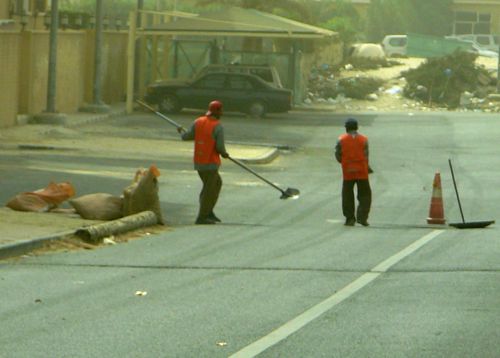
He calls this the government Sand Relocation Project.
Hearts, Hands and Hope
Opportunities for you from Operation Hope – Kuwait:
Thank You all baking volunteers:
We at Operation HOPE want to express our thanks to all our baking volunteers for their beautifully packed and labeled donations. We appreciate your extra effort and work of excellence to support our mission. And a special thanks to Jaye Lynn and Emily Lester for manning the sales table!
Thank You all Tent clearance and inventory volunteers:
What a blessing when men, women and children, who represent multiple nations can come together for the good of mankind. Many hands did make for lighter work. As our tent was cleared, inventoried and then restocked. We are able to do what we do because of you.
Volunteers needed:
We are happy to announce our very first packing schedule for winter apparel for this year on Saturday October 18, 2008 from 7am to 10:30 am. At this time our goal is to pack 3000 bags each, with a set of thermal underclothing, pair of socks, pair of gloves and cap. Lend your help packing a few bags or all 3000 bags; but DO lend us your help. Please RSVP your commitment ASAP.
Flea market Saturday October 25, 2008:
Operation HOPE will have a Flea market at the OH head quarters (Rumaithiya, Block 9, Street 92, House 23) at 7am to 12 noon. We will be selling books, small appliances, electronics, gently used household items etc. All proceeds of the sale go to Operation Hope. We encourage you to spread the word around and bring in at least one friend with you.
Volunteers needed: to set up the items for the flea market, Friday, October 24, 2008 at 3 PM. Please RSVP your commitment to help as soon as possible.
Volunteers needed: to help at the Flea Market with sales and clean-up, Saturday, October 25th from 6:30 AM – 12:30 PM. Your RSVP is appreciated as soon as possible.
Laptop Needed:
The Operation HOPE administration has grown considerably and we require a mobile tool to keep on top of our busyness. We appreciate your consideration towards the contribution of a NEW laptop.
Demolish Tariq Rajab Museum?
I am horrified. Blogger Hanan reports that there are rumors that the Tariq Rajab Museum has received a warning to close or be demolished, that they have no permit to run a museum.
This family has two museums, two fine, fabulous museums, and admission to the public is free of charge. It is a bright spot in Kuwaiti Culture. (I thought there was a movement out there to encourage tourism? This is where I take my guests! This is where we tell tourists to go!)
I have no WASTA my friends. First, can you confirm that the museum has indeed been warned? Can you make this go away?
What Poverty Does to US (Blog Action Day 2008)
Today, Blog Action Day 2008, we are to write about poverty.
There are many levels of poverty, and I have seen the worst. I have seen people without the very most basic necessities of life, without enough food, without a safe place to spend the night, people who would sell their baby for another fix, people who live in filth. The very worst thing about poverty is what it does to those who see it, but are not poor – it hardens our hearts.

The overwhelming nature of poverty, the knowledge that we can only do so much, that our efforts are like little drops in a great sea, it can make you turn away from doing anything at all. Afraid to feel to much, we build a wall around our hearts, so we won’t have to feel. We judge, we walk away.
So who is poor? Does not God look at our hearts? He teaches us that the poorest of the poor, who shares one crust of bread with another, is more merciful than the donor who gives generously out of abundance. If we harden our hearts, if we turn away from these problems, who then is poor? Do we not have a deep inner problem, a severe inner poverty, a poverty of spirit?
One of the great God-jokes I see as I live my life is how what we see and what we learn is often the opposite of what God teaches us. He tells us not to put our faith on earthly treasures, our cars, our houses, our material possessions. He tells us the greatest wealth of all is in giving it all away and serving him.
As the financial markets dip and twirl on the roller coaster of doubts and fears and perceptions, as people watch their life savings dwindle, will we learn our lesson? (Can you hear God laughing?)
One of the great secrets of wealth is giving it away – ask Warren Buffet, the richest man in the world, or Bill Gates. They have made fortunes, walked away and given abundantly of their wealth to make the world a better place. God smiles on them. They learned the secret.
When you help the poor, you are blessed.
There is a story we tell volunteers about a little boy along the seashore. Thousands of starfish are stranded on the shore as the tide recedes and a man watches as the little boy picks up starfish and throws them out into the ocean, one at a time. After watching a while, he shouts at the boy “Give it up! There are so many starfish! You can’t save them all!” and the little boy, without pausing, shouts back “But I can save THIS one!”
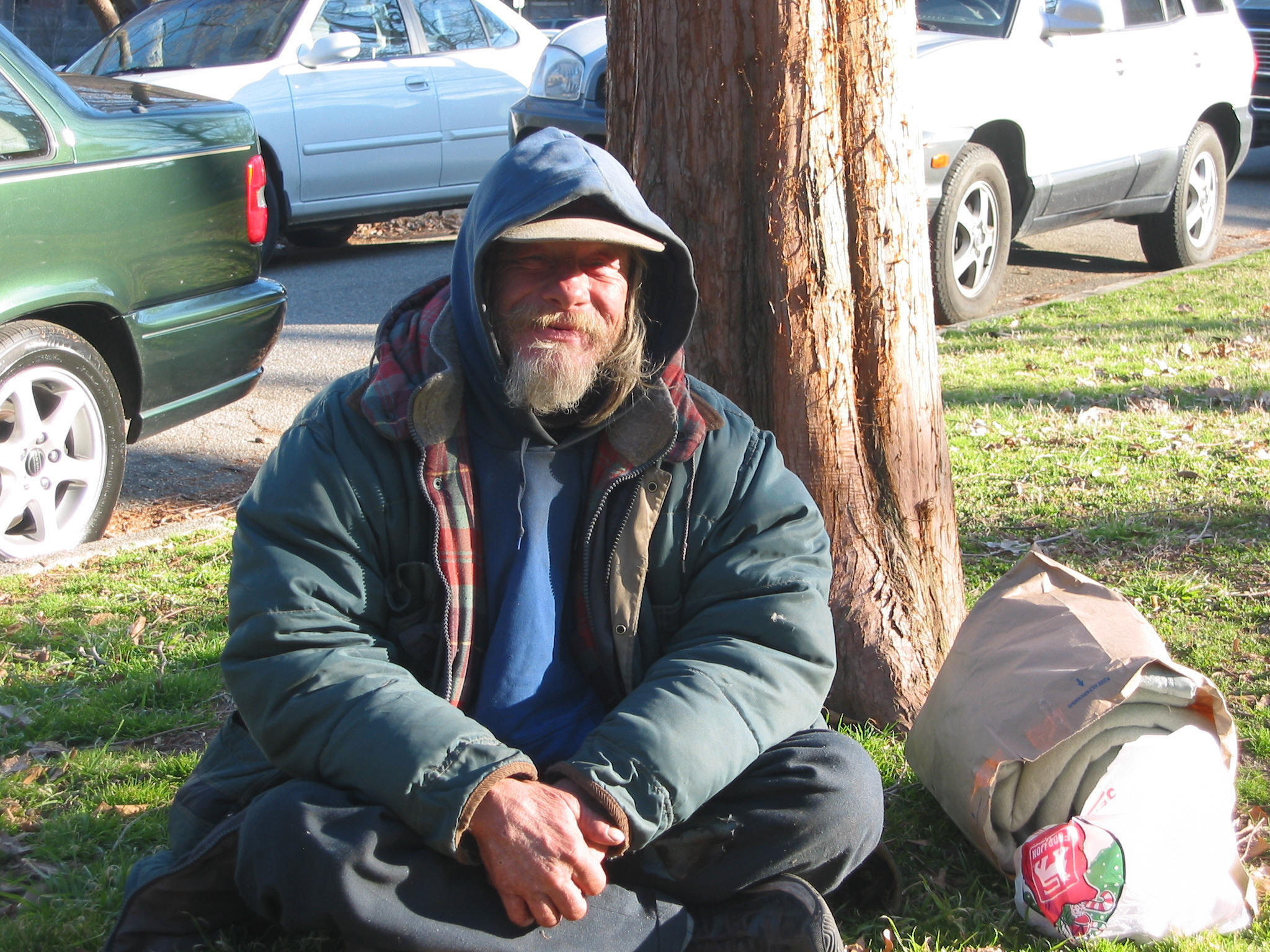
I worked for a year with homeless families. As I worked with them, I found myself learning from their stories, and from their determination to make a better life for their children. Working with the homeless is like throwing starfish back into the sea. Some might make it and others won’t. There are dark days, days when you feel overwhelmed by the sheer numbers of those who need your help. By focusing on what you CAN do, you hope to make a difference, even in the life of just THIS family, or that child.
We need to ask ourselves, those of us who live in abundance, how can we receive this blessing, the blessing of working with and/or giving to the poor? Is there a food closet that needs your donations and your weekly volunteer effort? Is there a mosque or church that uses volunteers to serve a daily meal to the poorest of the poor? Is there a sandwich delivery to the street poor? Is the Salvation Army active in your area? Are there decent clothes in your closet which you have outgrown? Are there pillows or blankets you could donate to Operation Hope Kuwait? How can you serve the poor? How can you receive this blessing?
Donations of your time, your energy, your vision will not only be a small contribution towards improving the world one small act at a time, it will also lessen the soul-deadening impact of poverty, it will be a blessing to YOU. Working together, people can make a difference. You can make a difference in the life of the poor. You can make a difference, by serving, in your own life.
For Expats: Understanding Kuwait Issues
I am reprinting this entire article from today’s Arab Times because it covers so much ground and gives those of us with little understanding of Kuwait issues a lot of background. It is an interview done with Osama Al-Sayegh, head of the Ja’ffery Department at Kuwait Awqaf Public Foundation.
Sectarian animosity between Shias and Sunnis in the region had mellowed down since the beginning of the last century, but has been revived following the Iran-Iraq war in the 80’s. Though the sectarian feelings are not allowed to override national sentiments in Kuwait, the fires burning in our close neighborhood could spread into our country. Osama Al-Sayegh, head of the Ja’ffery Department at Kuwait Awqaf Public Foundation, was sharing some of the deep concerns of his community in Kuwait with the Arab Times, alongside putting the community’s spiritual and political relations with Iran in the right perspective.
Q: Elections took place, and some months have gone by since the new government and Parliament took office. How do you assess the situation in Kuwait?
A: From my point of view, Kuwait has been affected by the meltdown in the US economy, and the worldwide repercussions because of it. Most of the countries are affected by this turn of events, and Kuwait cannot be isolated.
Probably, as of now it is not that bad, but in future Kuwait will also be hit hard, I fear. The price of oil is coming down, as consumers around the world are beginning to rationalize their consumption, while inflation is still high. These factors will affect the people of Kuwait, creating a financial squeeze, which in turn will have political fallouts.
Q: What do you think about the composition of the new Parliament and the cabinet? Are they efficient enough to tackle these crises?
A: That’s a real problem in Kuwait. While all these crises are looming large over Kuwait, our Parliament members seem too apathetic, and are only worried about grinding their personal axes. Each member has a set of personal agendas divorced from national interests, which he tries to fulfill using his office. This attitude is inimical to the country.
Q: Do you think this situation is peculiar to the current Parliament only, or has it been the trend of the Parliament for long?
A: The situation has become so worse only in the last 15 years. Before that we had good government and parliamentarians who worked for national interest. The results were palpable in the health and educational sectors. However, now it seems there is a disjuncture between the Parliament and the cabinet, and so even if the latter come up with a good vision, the MPs don’t give due support. Sometimes, it seems to me that both the government and the Parliament are in cahoots with each other in scuttling good projects for the nation. Finally, it’s the people who are suffering from all these petty politics.
Q: One common reason ascribed to this lack of cooperation between the executive and legislative bodies in Kuwait is sectarian division. How strong is the Shia-Sunni division in politics?
A: The division between Shias and Sunnis dates back to 1400 years. And the rivalry had been acerbic through out the centuries. However, towards the beginning of the last century, the lines had blurred and the intensity of the differences had waned between the two sects. But with the coming of the Iranian revolution in the late 70’s and the ensuing Iran-Iraq war, the clock has been turned back, and the sectarian spirit among people in the Middle East has been revived.
Now, in that context, Kuwait is a tiny country wedged between a Shiite Iran, a Sunni Saudi Arabia and a mixed Iraq, where an intense battle is raging still, with a marked sectarian perspective. We shall be very careful, as the fire in our neighborhood can spread to us also. And going by the size of our country, even a minor spark can burn down the nation.
We have to focus on factors that unite the two sects and stay away from getting deep into our differences. The basics are all the same between us. Our God is Allah, our Prophet is Mohammed (PBUH), our book is the Holy Quran and our Qibla (the direction of prayer) is the Kabah. Other peripheral things have to be kept on the sidelines.
We have to understand that we are a very small country, and we shouldn’t let petty sectarianism destroy our social fabric. We have only our country, and we shall preserve it in our best interest.
Q: How alive are these sectarian tendencies in Kuwait?
A: As I said things were quite normal until the late 70’s. When the revolution swept through Iran, the government of Kuwait feared that the revolution might get imported into Kuwait through sectarian influences. And therefore to counterbalance Shias in the society, the government allowed Sunni foreign nationals to immigrate into Kuwait. However, some of these new immigrants came from very fundamentalist schools of thought. In reaction to these events some Shias in Kuwait took to extreme ideologies, giving rise to sectarian tensions in the society. Fanatical groups in both these sects are only a small minority and not mainstream. Yet, in a small country like Kuwait, it is enough to start a communal conflagration.
We have to understand that Islam is a religion of peace. Its fundamental aim is peace, and there is no force in religion. Yes, there are principles and practices, which we believe have to be followed and adhered to. For example issues like segregation in educational institutions and so on … we believe these have to be followed, but we should not force them on anyone. These have to be abided out of one’s own will.
Q: The government of Kuwait once feared that Iran might influence Shias in Kuwait, and we see such ideas still current in the society at least when some MPs make veiled statements of Shiite politicians taking orders from their “foreign masters.” What’s the truth of the matter?
A: This is not true, because Shias here are Arabs and not Persians. Our Arab identities are very strong. Similarly, it is also wrong to accuse Sunni MPs of loyalty to Saudi Arabia.
Q: The question of loyalty is an important issue in all societies which have minority communities in them on the basis of nationality, ethnicity or religion. During World War II, Japanese in America were targeted; similarly Muslims in India often face charges of being loyal to Pakistan. So, it is only natural that such questions of belongingness are also faced by Shias in Kuwait. Your comments.
A: Yes, there may be one or two misguided currents, like in all communities, who may have wrong ideas of allegiance and patriotism. However, this is only a very insignificant fringe that wields no influence over the mainstream community in any terms. But for such minor aberrations, the rest of the community is very clear and proud about its Kuwaiti identity. This is our soil and our roots are here, and we belong here and our allegiance is only to this country.
Q: Generally speaking, what is the Kuwaiti identity? Is there such a strong national identity in Kuwait that is free from any religious or sectarian taint?
A: Yes. There is a strong national identity. But this is not something we wear on our sleeves and strut around. We live our normal lives, but whenever there is a crisis we unite as one. For example, look what happened during the invasion. All Kuwaitis, from wherever they were, fought in their own ways for our freedom. It was this collective will and ambition that got us our freedom.
Q: Spiritually do you look up to Iran in any way? Are the Fatwas passed by Ayatollahs applicable to you also?
A: No. May be such things happen in Lebanon, where the Shiite community looks to Iran or Syria for support. But here in Kuwait, we have a very strong sense of national identity and we act as Kuwaitis at times of crisis.
Q: I was referring to spiritual matters, not political. For example, when Ayatollah Khomeini passed a Fatwa demanding the death of Salman Rushdie for authoring the controversial book “Satanic Verses” demeaning Islam’s Prophet (PBUH), did Shias here feel that it was a universal call and accept it as binding on them as well?
A: There were many Fatwas regarding Salman Rushdie that came from Iran and Saudi Arabia. But Kuwait’s mainstream community, be it Sunnis or Shias, were not affected by those Fatwas. Yes, there might have been a small group in both communities who might have been very emotionally moved by those Fatwas and even wanted to act on it. But by and large, Kuwaitis did not react to these Fatwas.
Q: What do you think of tribal primaries, especially those that have a strongly sectarian character?
A: The law should be strictly implemented to stop such tribal primaries. This is a very unhealthy practice and can hurt the very fundamental objectives of democracy. It violates the fundamental rights of the people to elect their representative, as primaries preempt elections and decide winners beforehand. So I am strongly against primaries.
Q: Will political parties help the situation in any way, because then you will have people grouping under parties based on larger manifestoes?
A: May be yes. But we have to make sure the country is ready for such a transformation. Otherwise, we may not be able to realize the benefits of change.
Q: Is the presence of such a large number of Islamists in the Parliament positive for the nation or is it negative?
A: Going by the current trend, it is negative. However, I attach this negativism not to their ideologies, but their greed and manipulation of ideologies for personal ends. From history we know that all major conflicts happen when religion is exploited by opportunists. Religion, be it Islam, Christianity or any other religion for that matter, is never the actual cause behind conflicts.
Q: Islamists are clamoring to make Sharia the only source of law in Kuwait. Do you agree with them?
A: Sharia is indeed the best source of legislation. But before enforcing it, we should have pure intentions and we should raise ourselves to those high standards instigated by Sharia. But with our tainted lawmakers it is impossible to apply true Sharia, and so I don’t go for it currently.
Q: But Islamically speaking is that the correct approach, because as against God’s law you are asking for man-made laws?
A: Of course God’s law is most superior. But how to apply this law in our lives is the question, and there are differences of opinion.
Q: Does the Awqaf have any strategy for the right application of Sharia?
A: The Awqaf deals not with matters of legislation. We are focused on charitable works and on social issues, such as raising the standard of education and healthcare in Kuwait and tackling unemployment and so on.
Q: You seem to be adopting a very soft stance even in matters of religion, for example, while you were talking about segregation you said it should not be enforced but only offered as a choice. Are you taking religion too lightly?
A: See, the religion is very clear; there are ‘do’s’ and ‘don’ts’ that have been spelt out very clearly. Basic principles of religion such as the ban on drinking, where there is consensus, have to be enforced. But in matters where there are differences of opinion, and where we engage with other people as humans, we have to be soft. We should not think ourselves morally superior to judge others; it is only Allah who has the right to judge humans, because only he knows what is in their hearts.
Q: Is this your personal stance, or is this the general stance of all Shias in such matters?
A: This is the general stance of Shias. That’s why here in Awqaf, it is customary for us to pay visits to centers of other people’s faiths. We went to Vatican and visited Pope Benedict XVI.
I believe there is much to learn from each other. The Vatican church is known for its charities all over the world across religious or ethnic divides. For example, Christian charities worth millions of dollars poured into disaster areas like Indonesia during Tsunami, Iran during the Bam earthquake or Lebanon during the recent war, and so on. Though the motive behind these charities is often alleged to be religious conversion, we cannot deny the fact that those acts of kindness draw sympathy towards the Christian faith.
Though we don’t believe in such conversions, acts of charities like these will definitely help in breaking the ice with other communities and making them open to the message of Islam.
Q: How do you, given your sectarian orientations, look at broader international issues related to Iran such as the country’s nuclear ambitions and its standoff with the US?
A: This is a political issue. Iran claims that it requires nuclear energy for civilian purposes, while America alleges that Iran has ulterior motives of building nuclear weaponry. And sitting here we can’t be sure who is lying. May be both parties are lying.
Q: Both parties are lying. Can you explain more?
A: What I mean is that when politics is involved, religious principles are sidelined. Do you know that Iran gives financial aid to al-Qaeda though they are ideologically opposed to Iran?
Iran has also supplied money to Taleban, who are antagonistic to Shias and have even conducted targeted killings of Shias in Afghanistan. So all this is politics. The current government of Iraq comprises more of Shias, and logically speaking Iran should be supporting this government. But they are against Iraq’s government because of political reasons. So, in most cases, politics takes precedent over religion, and the political equations are often too complicated to be made sense out of.
Q: How do you look at Hezbollah?
A: The only group that is sincere to the cause that they set out to accomplish in the Arab world is the Hezbollah, at least as of now. Every other organization has veered off from its main objectives.
While all the mighty Arab nations are keeping mum over Israel’s illegal occupation of Palestine, only Hezbollah has been offering a stiff resistance, despite the smallness of their means as against a mighty power like Israel — we shall bear in mind that Hezbollah is not even a nation, they are only a small group, and in the recent war broke the myth of Israel’s invincibility.
Q: Moughniya was a controversial figure in Kuwait for his alleged connections with Hezbollah and a hijack drama many years ago. When he died there were new controversies raised when some MPs hailed him as a martyr and extolled his virtues during his funeral. Is Moughniya the victim of a slur campaign because he belonged to the minority community?
A: The greatest tragedy regarding Moughniya is that his story is shrouded in mystery and people have never been given a clear picture of what he actually was. The government is to be blamed for this, and this led to mixed opinions with some lionizing him and some demonizing him.
Until now there has not been any clear verdict on him. Nobody knows whether he is guilty or not. If he is guilty, he should have been punished, or if he is innocent, he should be cleared of all charges and acquitted. Neither of this has happened in clear terms.
Q: So do you think it is a crime to praise a person whose credentials are in doubt? The MPs were only expressing their opinion on an issue that lies in the grey area. Do you think it’s proper to incriminate them for that?
A: It is not about expressing opinions. As members of the Parliament, these two MPs should have shown greater discretion in indulging in controversies that rake up sectarian turmoil. Sentiments of the people should also be taken into consideration, especially while involving in deeply controversial issues such as these, where much of the truth lies in the realm of the unknown.
Q: Are you scared this could spill into Kuwait also?
A: Yes, the fire is very close by. It can easily spread. It would only take a small band of misguided youth to spark off a conflagration. There are extremists on both sides, who are of course small in number, but Kuwait is a small country and even such ragtag groups are enough to upset the harmony of our nation.
Q: Is Kuwait sitting on a time bomb? Can there be an outbreak of a sectarian violence any time?
A: No, no. The situation is very much under control. The government is doing an extremely good job on that front. They are acting prudently, and making sure no community is made to feel deprived of justice. Whenever there are any communal embers flaring, they put it off with iron hands, and do not allow such things to spread.
Q: What in your opinion are the priorities of the government?
A: I think Kuwait should focus on education and health. We shall think of improving our infrastructure and manpower in the health sector, so that we wouldn’t have to spend millions of dinars in sending our patients to Europe or America for better treatment. Let’s bring experts from outside, I think even that will work out much cheaper.
By Valiya S. Sajjad
Arab Times Staff
No Kuwaitization for Ministry of Public Works?
When I saw this article in this morning’s Al Watan I thought about garbage trucks. In Seattle, when I was there last summer, the garbage trucks seemed to be run mainly by great big East Europeans. I also thought of how in some big cities, the people who own the garbage removal contracts are making a fortune. Everyone has to start somewhere!
Municipality wants out of Kuwaitization
Al Watan staff
KUWAIT: Minister of Public Works and Minister of State for Municipal Affairs Dr. Fadhil Safar has formally asked the Civil Service Commission to exempt Kuwait Municipality from the Kuwaitization policy which has been enacted to replace nonـKuwaiti employees in the public sector with citizens.
The request was reportedly contained in a letter the minister addressed to the Head of the Civil Service Commission Abdulaziz AlـZebin.
It has been gathered that the minister asked the commission to exempt the municipality from the Kuwaitization policy for at least two years starting from 2009 – ـ2011 during which the local labor force can be sufficiently trained.
He went on to say that the municipality has terminated the contracts of at least 500 nonـKuwaitis, which has had an adverse impact on the overall performance of the municipality.
Minister Safar underscored that the municipality”s work involves tasks which citizens are not interested in taking over.
Millions Lost Trillions
I used to finish my assignements early in grade school. Mostly I always had a book with me to read, but one teacher challenged me to write all the numbers to 1 million.
“Piece of cake” I thought. (Arrogant little brat!)
I learned my lesson. It took me forever. I wouldn’t give up, and I filled sheets and sheets of paper with numbers, all the way to one million.
It’s a lesson I won’t forget.
But a billion? A trillion? Those are numbers that boggle my mind. I can’t think that big.
So far, the losses are mostly on paper – they won’t be real losses until investors go to sell, or cash in.
It’s a huge demographic, the baby-boomers getting ready to retire – or as this article from the Washington Post states – maybe not so fast:
Retirement Savings Lose $2 Trillion in 15 Months
By Nancy Trejos
Washington Post Staff Writer
Wednesday, October 8, 2008; Page A01
The stock market’s prolonged tumble has wiped out about $2 trillion in Americans’ retirement savings in the past 15 months, a blow that could force workers to stay on the job longer than planned, rein in spending and possibly further stall an economy reliant on consumer dollars, Congress’s top budget analyst said yesterday.
For many Americans, pensions and 401(k) plans are their only form of savings. The dwindling of these assets — about a 20 percent decline overall — is another setback just as many people are grappling with higher gas and food prices, more credit card debt, declining home values and less access to loans.
You can read the entire article in the Washington Post, here.
Sudan Protects Women from Alien Influences
This is from today’s Daily Star
South Sudan arrests 20 women for wearing pants, short skirts
By Agence France Presse (AFP)
JUBA, Sudan: A Southern Sudan Cabinet minister said on Tuesday that more than 20 women were arrested and beaten for allegedly dressing inappropriately under a new edict against “bad behavior.” “Between 20 and 30 girls were picked up from different points, hurled into police lorries, arrested and taken to the police station and some of them were beaten,” said Mary Kiden Kimbo, the gender, social welfare and religious affairs minister in the semi-autonomous southern government.
“This is absolutely not acceptable: it is not the job of police to judge what is and what is not a correct way to dress in such a manner of blanket punishment,” she said.
The police crackdown on young women wearing trousers or short skirts follows an order from the commissioner of Juba county, the capital of Southern Sudan. Most of the women, said to be in their late teens and 20s, were rounded up as they left Catholic mass in Juba on Sunday, Kimbo said.
Others were picked up in market places.
The order bans “all bad behaviors, activities and imported illicit cultures,” according to a copy seen by AFP, signed by Juba’s commissioner, Albert Pitia Redantore.
Inappropriate behavior may include wearing tight trousers, short skirts or skimpy tops considered “Western” attire.
The order, dated October 2, said that it aimed to “preserve the cultural values, dignity and achievements of the people of southern Sudan, checking out the intrusion of foreign cultures into our societies, for the sake of bringing up [a] good generation.” Those deemed in contravention of the order are liable to three months imprisonment. Those convicted for a second time face another three-month sentence and a fine of 600 Sudanese pounds ($300).
Traditional values are important in largely Christian and animist Southern Sudan, which is recovering from decades of war against the mainly Muslim north. It was the imposition of Sharia law by the north that helped spark the southern rebellion, which was rooted in complaints of marginalization.
“This kind of thing looks like the old days of Sharia law, and it is dangerous because creating such a situation can encourage mob justice,” Kimbo told AFP.
The minister said that the principle of gender equality was enshrined in Southern Sudan and added that she was investigating the matter. – AFP
Morality Police Accuse Married Couple of Being Alone Together
This is one weird story. Saw it in today’s Kuwait Times, but it is not on the online version, so I had to copy it from the Arab News website. The woman’s family and the man’s family all verified that this couple are married, but they are continually harassed by the morality police, saying they are not married.
Vice cops accused of attacking married couple in Madinah
Fatima Sidiya I Arab News
JEDDAH: A 22-year-old Saudi woman told Arab News yesterday that she and her husband of four years were stopped on a road by the religious police of Al-Jurf, west of the holy city of Madinah, accused of being an unrelated man and woman in an illegal state of seclusion (khulwa) at about 1 a.m. on Sunday.
“As we were driving home, my husband and I realized we were being followed by three men in a car,” said the woman, who did not want her name published. “They were coming from both sides of the car and (at one point in the chase) were also in front of our car. I was afraid of having an accident. The whole scene looked just like something in a movie.”
She also said that because no police officer was accompanying the three members of the Commission for the Promotion of Virtue and Prevention of Vice, her husband was afraid to stop. Eventually, the commission vehicle got in front of the car they were pursuing and forced the couple to stop, according to the woman.
Abdullah Al-Zahrani, the head of the Madinah branch of the commission, confirmed to Arab News yesterday that the commission was tailing the couple, but he maintains that the three commission members did not abuse the suspects. He also claims that the two are not married.
“The woman is neither his wife nor his cousin,” said Al-Zahrani.
When asked if the police, in response to the woman’s complaint, had questioned the commission members over what happened early Sunday morning, he said the police did not seek any clarification. “The police did not question the commission members, as they (the commission) are a monitoring body, which hands suspects over to the police for further investigation,” he said.
The couple has filed a complaint and the Commission for Investigation and Prosecution is looking into the case.
Relatives have come out in defense of the commission’s denial that the two are married. According to the woman, a commission member told her husband: “If you bring everybody in your family to tell me she is your wife, I will not believe them. You are lying; she is not your wife.”
According to the woman, she and her husband had been visiting her husband’s family and decided to return home late at night.
After the two were pulled over, said the woman, “one of them pulled my arm and was shouting at me, telling me to get into their car. I was shocked. How could a man from the commission touch a woman when he is not her mahram (a woman’s legal male escort or guardian)? He ordered me to get into the commission car and said they would keep everything secret in order to protect my reputation.”
The commission considers unrelated men and women in cars to be committing the moral crime of khulwa.
The woman said that her husband objected to her treatment, and asked the men to take him in custody instead. At that point, the woman said an older man who happened to be passing by intervened and protested against the commission members touching a woman, “but the commission member told him that I had forced him to do so.”
The woman says that two of the commission members got into her husband’s car with her and accused her of being an immoral woman for being out late at night with an unrelated man. The members of the commission also said that the woman had committed a crime and that she therefore deserved to be punished.
“This is the first time I have seen anything like this,” she said. “One of the members was totally unreasonable and was aggressive from the start. He didn’t want to hear anything that contradicted his set ideas and beliefs. He looked to be in his late 20s. Only one of the three was rational and wanted to talk to us away from the public eye. But he then went and got into their car. The members refused to come to the police during the investigation and said that I had insulted them. I did no such thing; I simply told them over and over: ‘I swear to God that I am this man’s wife.’”
The woman said that after hearing what had happened, her brothers went to the commission branch in Al-Jurf, furious and telling the commission members to stay away from their sister.
She said a commission member then hit one of her brothers and broke his nose.
“My brother became unconscious and an ambulance came and took him to the hospital,” she said.
Then, in anger another brother erroneously went to the wrong commission center to retaliate against the attack on his brother. He was then arrested.
But the police reportedly released the two brothers after confirming their identities. The woman claims that the local police view this particular branch of the commission as problematic.
Maj. Muhsin Al-Radadi, a spokesman for the Madinah police, said that the only reports they received about this incident were about the brother who went to the incorrect commission center.
“The commission members (at Al-Azizia commission branch) were attacked in their offices by a young man,” he said, adding that he wouldn’t comment on hearsay regarding the other events.
“We were not doing anything that was remotely immoral or inappropriate,” said the woman. “Even my eyes were covered. The members shamed us in the area where we live and my husband and I cannot now go out of the house.”
She says that the incident has instilled fear in her about venturing out of the house.
“I will not go to a public place or anywhere in a car unless a lot of my family is with me,” she said.
Recent Comments
ExpatAlien on What Country am I Living … intlxpatr on Yellowstone: Old Faithful to C… Michelle on Yellowstone: Old Faithful to C… Cathy on No Grown-Ups in Charge intlxpatr on Waiting for Snow Wikipedia Donate Button

Amazina


Early Voting in Florida


 Here There and Everywhere