No Sunrise in Kuwait
You will not find me complaining about the rain. I am imagining what a difference this steady downpour is going to make in very short time. People who think of “desert” have no idea of the life in the desert waiting to spring forth at the slightest sign of moisture. It doesn’t take much – and I believe we are going to see some amazing things soon in Kuwait.
I was up for the sunrise this morning . . . no sunrise appeared. This is about the best I could do:

I thought the heavy downpour last week had washed my windows clean, but I think some dust must have come and stuck to the wet windows. Or else the rain is not so clean . . . 😦 Please pardon my streaked windows!
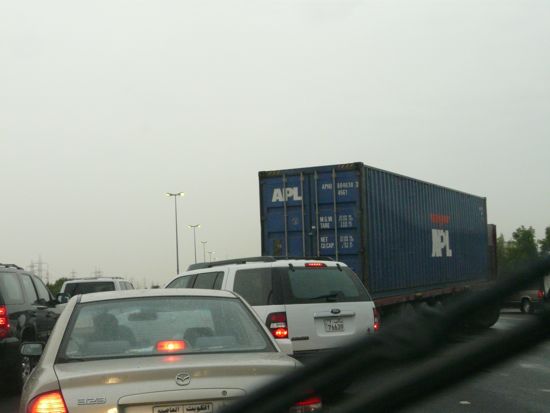
Life interrupts blogging. We had an emergency that had us out on highway 40 to help out a friend in Eqaila. We was a terrible accident on 40; truck jacknifed and hit two cars. Traffic was totally gridlocked waiting for the ambulances and police to arrive. Folks, please be careful out there.
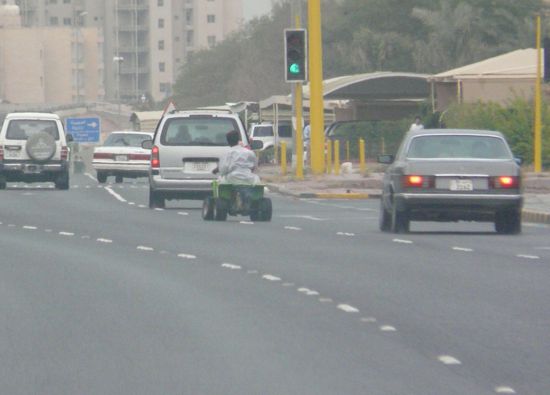
And please, mothers, fathers, protect your children. Anyone who doesn’t need to be on the roads should be at home. These kids, riding on the slick highways, barely visible, are taking a huge risk:
Election: Will Life Follow Fiction?
This is an article from the New York Times
Will life follow fiction? The article talks of some very eerie similarities between the TV race for the White House, and this year’s real race:
By BRIAN STELTER
Published: October 29, 2008
When Eli Attie, a writer for “The West Wing,” prepared to plot some episodes about a young Democratic congressman’s unlikely presidential bid, he picked up the phone and called David Axelrod.
Mr. Attie, a former speechwriter for Vice President Al Gore, and Mr. Axelrod, a political consultant, had crossed campaign trails before. “I just called him and said, ‘Tell me about Barack Obama,’ ” Mr. Attie said.
Days after Mr. Obama, then an Illinois state senator, delivered an address to the 2004 Democratic National Convention, the two men held several long conversations about his refusal to be defined by his race and his aspirations to bridge the partisan divide. Mr. Axelrod was then working on Mr. Obama’s campaign for the United States Senate; he is now Mr. Obama’a chief strategist.
Four years later, the writers of “The West Wing” are watching in amazement as the election plays out. The parallels between the final two seasons of the series (it ended its run on NBC in May 2006) and the current political season are unmistakable. Fiction has, once again, foreshadowed reality.
Watching “The West Wing” in retrospect — all seven seasons are available on DVD, and episodes can be seen in syndication — viewers can see allusions to Mr. Obama in almost every facet of Matthew Santos, the Hispanic Democratic candidate played by Jimmy Smits. Santos is a coalition-building Congressional newcomer who feels frustrated by the polarization of Washington. A telegenic and popular fortysomething with two young children, Santos enters the presidential race and eventually beats established candidates in a long primary campaign.
Wearing a flag pin, Santos announces his candidacy by telling supporters, “I am here to tell you that hope is real.” And he adds, “In a life of trial, in a world of challenges, hope is real.” Viewers can almost hear the crowd cheering, “Yes, we can.”
Comparisons between Senator John McCain and the “West Wing” Republican candidate, Arnold Vinick, a white-haired Senate stalwart with an antitax message and a reputation for delivering “straight talk” to the press, also abound. Vinick, played by Alan Alda, is deemed a threat to Democrats because of his ability to woo moderate voters. And he takes great pride in his refusal to pander to voters, telling an aide: “People know where I stand. They may not like it, but they know I’ll stick with it.”
Even the vice-presidential picks are similar: the Democrat picks a Washington veteran as his vice presidential candidate to add foreign policy expertise to the ticket, while the Republican selects a staunchly conservative governor to shore up the base.
Certainly some of the parallels are coincidental. It is unlikely, for example, that the writers knew Mr. Obama had an affection for Bob Dylan when they made Santos a Dylan fan. But it is the unintentional similarities that make the DVDs of the sixth and seventh seasons, which at the time received mixed reviews, so rewarding to watch now. In both “The West Wing” and in real life, for example, the Phillies played in the World Series during the election campaign.
As the primaries unfolded this year, “I saw the similarities right away,” said Lawrence O’Donnell, a producer and writer for the series who has appeared on MSNBC as a political analyst. Mr. O’Donnell had used Mr. McCain as one of the templates for the Vinick character in the episodes he wrote, though he said that “McCain’s resemblance to the Vinick character was much stronger in 2000 than in 2008.”
Echoing the criticism Mr. McCain faced during the primaries, a White House aide in “The West Wing” contends that Vinick is “not conservative enough” for the Republican base. Sometimes the two candidates’ situations are almost identical: when the press starts asking where Vinick attends church, he tells his staff that “I haven’t gone to church for a while.” Asked in July by The New York Times about the frequency of his church attendance, Mr. McCain said, “Not as often as I should.”
Mr. Alda and Mr. McCain are the same age. When a hard-edged strategist played by Janeane Garofalo joins the Santos campaign, she immediately alludes to Vinick’s age. “He’s been in the Senate for like 90 years. He was practically born in a committee room,” she says.
In the same way that Obama surrogates have subtly knocked Mr. McCain’s lack of computer skills, the Garofalo character remarks to the Santos campaign manager, Josh Lyman: “Why are you always talking about high-tech jobs? Because Vinick uses a manual typewriter.”
Conversely, Santos staffers talk about getting video of the candidate with his “adorable young children hugging their hale and vital dad.” The casting of Mr. Smits introduced story lines about the prospect of a minority president. But when an aide suggests a fund-raising drive in a Latino community, Santos snaps: “I don’t want to just be the brown candidate. I want to be the American candidate.” The Obama campaign has made similar assertions.
Still, “The West Wing” — like Mr. Obama — does not ignore racial issues entirely. In the seventh season Santos delivers a speech on race at a critical moment for his campaign, and staffers privately worry that voters will lie about their willingness to vote for a minority candidate.
If the show sometimes seems like a political fantasy — a real debate where politicians are required to answer questions? a candidate rejecting an attack ad? — it also reflects the tenor of the real-life campaign season.
Santos wins the nomination only after a lengthy fight on the convention floor, an inexact parallel to Obama’s extended primary fight with Senator Hillary Rodham Clinton. Just as the Obama campaign pivoted to the economy this fall, Lyman tells Santos staffers that “this new economic message may be our ticket,” and he winds up being right. An economic crisis does not ensue, but back-to-back emergencies on “The West Wing” — a nuclear power plant malfunction and a dispute in Kazakhstan — bring to mind the election-defining qualities of the actual economic crisis.
“Dramatically, they are exactly the same thing: the unforseeable,” Mr. O’Donnell said.
As President Bush did during the bailout talks, Jed Bartlet, the Democratic “West Wing” president played by Martin Sheen, brings both candidates to the White House for a briefing. Facing the prospect of deploying 150,000 American soldiers to Kazakhstan three weeks before the election, Vinick grumbles, “I can say goodbye to my tax cut.” He tells Santos, “Your education plan’s certainly off the table.”
Santos emerges victorious weeks later, but only after a grueling election night. Online, some “West Wing” fans are wondering whether the show will wind up forecasting the real-life result as well. In Britain, where the series remains popular in syndication, a recent headline on a blog carried by the newspaper The Telegraph declared: “Barack Obama will win: It’s all in ‘The West Wing.’ ”
Internal Revenue Service Scam
This was in my mailbox this morning:
After the last annual calculations of your fiscal activity
we have determined that you are eligible to receive
a tax refund under section 501(c) (3) of the
Internal Revenue Code. Tax refund value is $189.60.
Please submit the tax refund request and allow us 6-9 days
in order to IWP the data received.
If u don’t receive your refund within 9 business
days from the original IRS mailing date shown,
you can start a refund trace online.
If you distribute funds to other organization, your records must show wether
they are exempt under section 497 (c) (15). In cases where the recipient org.
is not exempt under section 497 (c) (15), you must have evidence the funds will
be used for section 497 (c) (15) purposes.
If you distribute fund to individuals, you should keep case histories showing
the recipient’s name and address; the purpose of the award; the maner of
section; and the realtionship of the recipient to any of your officers, directors,
trustees, members, or major contributors.
To access the form for your tax refund, please click here
This notification has been sent by the Internal Revenue Service,
a bureau of the Department of the Treasury.
Sincerely Yours,
John Stewart
Director, Exempt. Organization
Rulings and Agreements Letter
Internal Revenue Service
The IRS uses “u” for “you?”
An IRS e-mail signed by a real person?
Hahahahahahahahahahahahahahahahahahahahahahahahaha!
Just another scam.
Rain in Kuwait
Lots of rain, peals of thunder, lightning strikes and lots of rain! The Qatteri Cat is totally freaked out, running from the leaking window with it’s new drip drip drip to the windows – he thinks the rain drops are bugs or something, and makes that eh-eh-eh-eh-eh sound cats make when they see birds. Rain!
I am laughing; who would think this PacificNorthwest gal would be celebrating rain – we get so much rain out there in the PNW. But even when there was a huge rainstorm here in Kuwait last year, we didn’t see any where we live, or only a drop or two, not even enough to smear a window or create a puddle. Now Rain! Real rain!

When it started, I was driving. We got home as soon as we could; the first rains turn the highways into grease slicks.

Remember – this is not California, where people might stop and dance for joy at the parking lights. (California has droughts, too.) Dancing for joy only allowed in the privacy of your own home!
Update – an hour later it is still raining, and I have towels under several of my windows to collect the intrusion!
New Buses, Mixed Blessing
As many of you may remember, I am a supporter of public transportation. I would SO much rather have the time to read a book or magazine than to be stuck in traffic. When I saw the bright, modern, fast new buses hit the streets recently in Kuwait – during the last year – instead of the clunky slow, old buses they had, my heart rejoiced.
Hmm. Not so fast.
I drive on a major local road regularly. The buses have become a menace. They drive way fast. They halt, and then merge back into traffic as if they have the right of way, which as we all know, in Kuwait there is no right of way. I guess they figure that because they are big, and faster, they are king of the road. I can tell you for a fact, they don’t like being passed by a woman. Imagine, being chased down by a bus!
Buses cause accidents on Sixth Ring Road
KUWAIT: Sixth Ring Road was the scene of two accidents caused by public buses.
A man driving a small car suffered serious injuries when he hit a public bus after the bus driver lost control of his vehicle and hit the barrier and then stopped at the middle of the road. The man was taken to the hospital by a fellow citizen to seek medical assistance.
Ten minutes later, another bus driver repeated the same scenario of the first accident except as he hit the barrier he also hit a small car. The car driver suffered serious injuries and was taken to hospital to seek medical assistance. The two buses caused serious traffic congestion but police officers managed to move them to the side of the road and continue the traffic flow.
I don’t know what training the drivers receive before they head out in their buses. I have a suspicion that it isn’t much. I think they need to be trained in safe driving practices, and warned against aggression on the roads. I think they need to use their rear view mirrors, their signals, and they need to be an example of proper driving, because they are a visible, public model of state policy.
Fighting for Muslim Women’s Rights
BBC News reports on a fascinating conference taking place right now in Barcelona regarding Women’s Rights in Islam:
Fighting for Muslim women’s rights
Some of the world’s leading Islamic feminists have been gathered in Barcelona for the third International Congress on Islamic Feminism, to discuss the issues women face in the Muslim world.
Some of the women taking part in the conference explained the problems in their home countries, and where they hoped to make progress.
ASMA BARLAS, Author, Pakistan
Religions always come into cultures, they don’t come into abstract and pure spaces. Islam came into a very patriarchal, tribal and misogynistic culture. One of the deepest damages to Islam has been its reduction to “Arabisation”.
I’m not going to say that the Arabs are particularly misogynistic in a way that nobody else is, but I do think there are very particular traits and attitudes towards women that have crept into Islam.
I have a friend who has been studying the interface between what he calls the Persian models and the Arabist models of Islam in the subcontinent and surprise, surprise: the Arabist models are misogynistic, authoritarian, unitarian and the Persian models are much more plural and tolerant.
This is a fight on two fronts – on the one hand we are struggling against the kinds of oppression dominant in Muslim patriarch societies and, on the other, Western perceptions of Islam as necessarily monolithic, and confusing the ideals of Islam with the reality of Muslim lives.
If we read the Koran as a totality rather than pulling out random verses or half a line, that opens all kinds of possibilities for sexual equality.
RAFIAH AL-TALEI, journalist, Oman
Oman is relatively liberal, women are free to choose what to wear, and can choose their jobs and education. And the law does not require us to wear any particular form of clothing. But there are strong social and cultural factors – coming from the fact that we are in Arabia – that limit women.
As a journalist, it has not been hard for me to work among men, but it has been hard for some of my colleagues whose families told them this was not “appropriate” work for them.
The biggest difficulties are the social and cultural factors, and some aspects of law. For example, women who marry a foreigner cannot pass on their nationality to their children, whereas men in that situation can.
Religion is not an issue in our struggle, although there are problems with family law about divorce and marriage status. Omani laws are based on sharia law. Sharia is fair, but it is the wrong interpretations that are the problem. Male judges often don’t understand the principal goals of sharia.
We feel the law is fair, but ends up being unfair for women because of how judges interpret it.
Cultural and social factors often get mixed up with religion. Educated women can be more empowered and separate the two, but many don’t dare challenge the conventions.
NORANI OTHMAN, Scholar-activist, Malaysia
I don’t think it is any more difficult to be an Islamic feminist than a non-Muslim, or secular feminist.
Asian Muslim states have very different traditions to Middle Eastern countries
Feminists in general have to face up to political and cultural obstacles, to achieve our objectives of women’s rights. Even Western feminists have had a similar history – having to engage with certain religious beliefs not conducive to gender equality.
Perhaps the only distinctive difference peculiar to Muslim feminists is that we are caught in the cross-currents of modernisation and a changing society, due to a modern economy on the one hand and the global resurgence of political Islam on the other.
Political Islam wants to impose a world view about the gender order that is not consistent with the realities and the lived experiences of Muslim men and women in contemporary society.
Our detractors would hurl empty accusations at us – calling us Western, secular or anti-Islamic
There is a difference between South East Asian Muslim countries and the ones in the Middle East – culturally we are less patriarchal, we can always respond to our detractors by pointing out we don’t have the cultural practices that they do.
Our detractors would hurl empty accusations at us – calling us Western, secular or anti-Islamic.
Our arguments are rooted within Islam – we want renewal and transformation within the Islamic framework. They don’t like that.
We have a holistic approach, seeking gender equality within the Islamic framework, supported by constitutional guarantees. We see that these are not inconsistent with the message of the Koran, particularly during its formative stages. We have to understand the history and cultural context and extract the principle that will be applicable in modern times.
SITI MUSDAH MULIA, Academic, Indonesia
In my experience, I find that it is very difficult to make Indonesian Muslim women aware that politics is their right.
In Indonesian society, politics is always conceived as cruel and dirty, so not many women want to get involved, they think it is just for men.
According to the [radicalist] Islamic understanding, women should be confined to the home, and the domestic sphere alone
We try to make women understand that politics is one of our duties and rights and they can become involved without losing their femininity.
Personally, I’m non-partisan, I’m not linked to one political party because, in Indonesia, the political parties often discriminate against women.
I struggle from outside the political sphere to make it women-friendly, to reform political parties and the political system.
One day, I hope to be involved more directly, if the system becomes more women-friendly. We have passed a law about affirmative action and achieving 30% female representation, but we won’t see if it is implemented until after 2009 elections. We are waiting.
In Indonesia, some groups support us, but some radical groups oppose what we are trying to achieve. They accuse me, accuse feminist Muslims, of being infidels, of wanting to damage Islamic affairs.
According to their Islamic understanding, women should be confined to the home, and the domestic sphere alone.
AMINA WADUD, Academic, United States
There are many more conversations going on today between different interpretations of Islam. Some interpretations are very narrow, some are more broad, principled, ethically-based.
Unless we have sufficient knowledge about Islam, we cannot bring about reform of Islam. I am not talking about re-interpretation, I am talking more about gender-inclusive interpretation.
Islam and feminism are not mutually exclusive
We have a lot of information about men’s interpretations of Islam, and of what it means to be a woman in Islam. We don’t have equal amounts of information about what women say it means to be a good woman in Islam.
Now it’s time for men to be active listeners, and after listening, to be active participants in bringing about reform.
There is a tendency to say that it is Islam that prohibits women from driving a car, for example, when women drive cars all over the world except in one country. So then you know it is not Islam. Islam has much more flexibility, but patriarchy tends to have the same objective, and that is to limit our ability to understand ourselves as Muslims.
I have always defined myself as pro-faith and pro-feminism.
I do not wish to sacrifice my faith for anybody’s conception of feminism, nor do I sacrifice the struggle and actions for full equality of women, Muslim and non-Muslim women, for any religion. Islamic feminism is not an either/or, you can be Muslim and feminist and strive for women’s rights and not call yourself a feminist.
FATIMA KHAFAJI, Consultant, Egypt
In Egypt, Islamic feminism is a way for women activists to reach a large number of ordinary women in the villages and in urban low-income areas, using a framework of Islam. So there would be a reference to Islam when talking about women’s rights. Experience has shown that that is an easy way to get women to accept what you’re saying.
Not many women get information about women’s rights easily, so you have to counter what has been fed to them, to both men and women, from the strict, conventional, religious people who have more access to women.
They have their own idea of women’s rights in Islam – that is, patriarchal, still limiting opportunities for women. But women have been receiving this concept for ages, through the radio, TV, mosques, so the challenge is how to give them another view, of enlightened Islam, that talks about changing gender roles. It’s not an easy job.
Historically, in Egypt in the feminist movement, there have been both Muslim and Christian women. It has never been a problem. Unfortunately nowadays, it has become a problem. Religious discrimination has been dividing people very much. We have to think carefully about how to supersede the differences.
With family law, we’re aiming to change the philosophy of the law itself. Traditional family law puts women down. I can see this whole notion of “women do not have control over their bodies” in so many laws, in the penal code and family law. For example, sexual harassment is happening because men think the control of women’s bodies is a matter for them. Even the decision whether to have children is the decision of men. This whole notion has to be changed in a dramatic way if we are really going to talk about women’s rights in Egypt.
Interesting Twist on Hijab
From today’s Al Watan:
”Policewomen must comply with Islamic attire”
Al Watan staff
KUWAIT: In reaction to a statement by the Director General of Sheikh Saad AlـAbdullah Academy on policewomen”s uniforms, MP Mohammed Hayef noted that the current uniform requirements for female police contravene with the spirit of Islamic law as well as the Constitution, which guarantees personal freedom.
According to him, the announced uniform will ban policewomen for wearing a veil, even if they chose to do so.
The lawmaker reiterated his resolve to stand against the uniform to ensure that Islamic law is observed.
He also criticized the period during which policewomen will undergo training, arguing that 12 hours is too long for the female conscripts, considering their physical abilities.
Describing the training period as similar to hard labor, he called on the relevant authorities to reconsider their decision on this particular matter.
Last updated on Tuesday 28/10/2008
What do you think? I think that there are ways of covering your hair that are not inconsistent with being a policewoman. If the uniform forbids hijab, in my mind, that is as bad as the parliament requiring hijab, for the same reason – wearing hijab or not wearing hijab is a personal decision between a woman and her God. It is not to be mandated by state or mankind. Instead of getting into a big fracas about it, why not have a fashion-design contest to design a professional headgear that a covered woman could CHOOSE to wear as part of her uniform?
As to the 12 hours – well LLLLOOOLLLL! How many hours of hard labor per day do women put in with taking care of children, cleaning, shopping and meal preparation, not to mention family obligations? Working a 12 hour day training to be a policewoman? Piece of cake!
Women in all parts of the world are working as soldiers, police, fire protection, etc. They train as hard as the men, and they get the job done. Think of the female doctors in Kuwait, and the hours they work! Think of their sacrifice! Our estrogen issues are no more diverting and/or debilitating than male testosterone issues!
(thank you, thank you, I’ll get off my soapbox now)
She Kept Her Head
From today’s Arab Times:
Police arrest youth, hunt for two in kidnap, rape bid of schoolgirl
KUWAIT CITY: Police have arrested a Kuwaiti youngster and are looking for his two other accomplices who allegedly kidnapped a schoolgirl, drove her to a deserted area and tried to rape her, reports Al-Dar daily.
The girl told police that the youngsters got scared when she screamed for help and drove off; however, she managed to note down the plate number of their vehicle and it led to the arrest of one of them.
God bless this scared, screaming girl – she used her head. The miserable cowards who abducted her and intended to rape her dumped her, and she wrote down their license number! Wooo HOOO on you, girlie!
An Insult – and 3 Dead Kuwaitis
From today’s Arab Times. How many hearts are breaking in Kuwait over one young man’s lack of self-control? I know, I know, this is Kuwait, and things are different. Because of an insult, three brothers are dead, and one in intensive care. Two families devastated, one with dead sons, one with a son who is a murderer. Three crashed vehicles, one from an innocent man who only stopped to see if he could help, and ended up with his car stolen and crashed, too. . . the whole thing is tragedy, from beginning to end.
Three brothers dead: Three Kuwaiti brothers in the age group of 25-30 years died in a road rage accident in Mina Abdullah while their fourth brother is currently confined to the intensive care unit of Adan Hospital, reports Al-Anba daily.
According to a security source, a Kuwaiti youth’s car broke down on King Fahd Expressway. The youth reportedly called his father to inform about the breakdown and told that four Kuwaiti youngsters had insulted him. When his father went to help the youth, the latter took his father’s vehicle, drove at full speed and crashed into the Jeep of the four brothers. The Jeep overturned due to the impact and one of the brothers died on the spot. Two others died in Adan Hospital and the fourth one is confined to the intensive care unit.
Meanwhile, the youth, who appeared disoriented, left his father’s car at the site of the accident and drove away with an Asian’s car who stopped to check what happened. He was eventually arrested after crashing into another car.
How does the law work in a case like this?
It says the young man was arrested. Is he still in jail? Can you get bail after killing three people in an act of rage?
Is his driving license taken away?
is an insult considered justification for a crime of rage?
Does he go to prison, or if he pays blood money, does he walk away free?
If he is convicted of murder, what is the likely sentence?
Will he also go on trial for stealing the Asian’s car and crashing it?
Not a legal question:
Does this cause an unending feud between two families? Or is this just another chapter in an already ongoing feud?
How many drivers am I sharing the road with who have killed?
Indian Drivers the Worst
When it came time to get a driver’s license, it wasn’t important to me. I was living in a place with great public transportation. When I finally decided to learn to drive, I took driving lessons. My best friend, still my friend to this very day, would take me out driving. One time my car stalled in the middle of a crowded intersection, the light changed, and I was almost out of my mind with panic.
My friend calmly said “You’re doing just fine. Take a breath. You have time. Start the car, and complete the turn.” She didn’t sound worried at all – only later did I discover how terrified she was. She held it together. I will owe her to the end of my life for her loyalty to me and for her patience with me.
This is from the Arab Times. My mistake – I thought Kuwait was the deadliest spot on earth to drive. Not so – the Indians take that cake:
Good luck needed as Indians drive themselves to death
MUMBAI, Oct 23, 2008 (AFP) – The Good Luck Motor Training School in Mumbai is aptly named, according to its owner, Sohail ‘Raja’ Kappadia, who says luck is exactly what you need to drive on India’s roads.
Kappadia knows it only too well: a friend recently became another of the country’s shocking fatal road accident statistics, while one of his pupils has just rammed into the back of another car during a lesson.
‘Sometimes you just don’t know if the guy in front is going to brake,’ he told AFP with a shrug. ‘Presence of mind is a must here. Most of the accidents in Mumbai are due to rash negligence.’
India has the dubious distinction of being the deadliest place in the world to drive.
The country has 10 percent of the estimated 1.2 million road deaths worldwide, according to the International Road Federation in Geneva.
Mortality rates on Indian roads are 14 per 10,000 vehicles, compared to less than two per 10,000 in developed countries, the World Bank has said.
And by the end of the next decade, the organisation predicted that road deaths will overtake those from deadly diseases and most of the fatalities will be pedestrians.
It is not difficult to see why.
Drivers here run the gauntlet of speeding taxis, weaving auto-rickshaws, trucks and buses as well as hand-carts and cows on congested, pot-holed roads, some of which have remained largely unchanged since the end of the colonial era more than 60 years ago.
At the same time they have to be on their guard against stray dogs and jaywalking pedestrians, forced into the road by the clutter of street vendors, crumbling pavements or crossings.
Meanwhile laws governing the wearing of seatbelts and a ban on using mobile phones at the wheel are frequently flouted, indicators are seldom used and at night drivers often fail to switch on their headlights.
Motorcyclists riding without helmets with pillion passengers perched behind are a common sight.
For a learner driver, Shahik Arqam looks unfazed by such experiences.
‘It’s a little bit difficult but I know how other drivers work,’ the 24-year-old architect said.
During an hour-long lesson in a battered right-hand drive Hyundai Santro, Arqam has had to be alert.
Other drivers made no allowance for the red L-plates and warning triangle displayed prominently on the car.
Instead he was treated like any other road user and blasted by a chorus of car horns for driving too slowly, failing to pull away quickly enough from traffic lights or for stalling.
Filtering vehicles from the left failed to give way as he headed down the main road to Churchgate railway station, and he had to hold his nerve as cars swerved in and out of lanes in the tussle for pole position.
Mohsin Ali, an instructor for 12 years, takes Mumbai’s chaotic roads in his stride, gently issuing either verbal instructions or hand signals to his pupil as the car picked its way through the heavy mid-afternoon traffic.
‘If you follow the traffic rules then it’s very easy,’ the 39-year-old said afterwards. ‘Compared to Calcutta (Kolkata) and Madras (Chennai) the traffic is better here.’
To be sure, the Mumbai authorities have been trying to make the roads safer.
Roadsigns reminding drivers to belt up, only use the horn when necessary — rather than in constant cacophony, as encouraged by the ‘horn please’ request painted on the rear of many vehicles — and not use their mobile phones have appeared across the city.
Signs also remind motorcyclists to wear helmets and there has been a crackdown on drink-driving.
Some 632 people died in what the Indian media calls road traffic ‘mishaps’ in Mumbai in 2007, but by the end of August that had fallen to 377, according to police figures.
Kappadia agrees that better driver training is a must if safety is to be improved on India’s roads, particularly as private car ownership increases on the back of the country’s strong economic growth.
The 33-year-old said he would ban heavy goods vehicles from cities during the day, toughen sentences for drink-drivers, improve road infrastructure and spread the message that speed kills, especially among the young.
Some welcome measures have been taken, such as raising entry standards and lowering age limits for truck drivers, but more needs to be done, he said.
In the meantime, the Indian driving mantra of ‘good brakes, good horn, good luck’ will have to do.
Recent Comments
intlxpatr on Shampoo Ginger tigerbutterya0c5ff1d… on Shampoo Ginger intlxpatr on British Soldier Kidnapped, Esc… John on British Soldier Kidnapped, Esc… intlxpatr on British Soldier Kidnapped, Esc… Wikipedia Donate Button

Amazina


Early Voting in Florida


