Humility

From this morning’s readings in The Lectionary:
Sirach 3:17-31
17 My child, perform your tasks with humility;*
then you will be loved by those whom God accepts.
18 The greater you are, the more you must humble yourself;
so you will find favour in the sight of the Lord.*
20 For great is the might of the Lord;
but by the humble he is glorified.
21 Neither seek what is too difficult for you,
nor investigate what is beyond your power.
22 Reflect upon what you have been commanded,
for what is hidden is not your concern.
23 Do not meddle in matters that are beyond you,
for more than you can understand has been shown to you.
24 For their conceit has led many astray,
and wrong opinion has impaired their judgement.
25 Without eyes there is no light;
without knowledge there is no wisdom.*
26 A stubborn mind will fare badly at the end,
and whoever loves danger will perish in it.
27 A stubborn mind will be burdened by troubles,
and the sinner adds sin to sins.
28 When calamity befalls the proud, there is no healing,
for an evil plant has taken root in him.
29 The mind of the intelligent appreciates proverbs,
and an attentive ear is the desire of the wise.
30 As water extinguishes a blazing fire,
so almsgiving atones for sin.
31 Those who repay favours give thought to the future;
when they fall they will find support.
Florida Breaks All Records for COVID Cases
First, to those of you who know me and are far away, we are well.
My Mother died of COVID in Seattle, in April. It was a shock. Although she was 96, she was mentally fit, very sharp, and her mother lived to 104. We all expected Mom to break her Mom’s record.
We don’t live in the biggest hot-spot, the Miami/Dade County area far to the south and east of Pensacola. No, we are in the eighth worst hit part of Florida, and part of the 18 greatest concerns for COVID according to the study out yesterday.
No one I know here has gotten sick. Almost everyone I know has the luxury of staying home, working from home, not needing to interface with the public unnecessarily. It is stunning, however, to think that one person in ten in this area has or has had the virus.
These graphs are not from the Florida Department of Health website. The person hired to design that website designed a great, comprehensive website to transparently share information. She was fired. She says she was fired for not agreeing to manipulate the information to make things look not so bad in Florida. Our governor is a total toady to President Trump, who is doing nothing to provide leadership to our country in fighting this pandemic, not providing comfort to those who suffer from it.


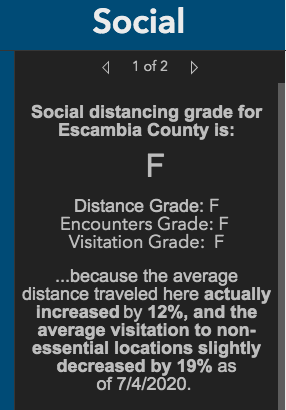
These snapshots are from her new website, which has much more accurate presentations of the situation in Florida than the official site. She, and others, gather information which may be obscure, but is available to the public, and publishes it. Her website is Florida Covid Action. She is a hero.
I live in a county where I have friends who support Trump and believe that the Democrats are over-hyping the problems for political reasons, so that Trump will lose his bid for re-election. They also believe masks are unnecessary. They don’t see any reason to socially distance. They perceive restrictions on their behavior as violations of their First Amendment rights.
So Trump has mandated our schools to open as normal – that means in August. The schools must offer an in-school option, which has many teachers frightened and/or furious. They also offer a remote school-day option, 6 hours in front of a computer, and an independent option, where a student completes a curriculum on his or her own. Those who attend school will not be required to mask or to social distance.
My grandchildren are 7 and 10. Their parents face having to choose the least bad of the three proposals. Parents all around the state are debating what to do. Many parents work, and child care is almost impossible to find and very costly. Many parents will have to send their children to school or leave them unattended and unsupervised at home.

The pediatric cases are for my county, Escambia County. The highest rate of transmission is among those 15 – 24. They’ve closed the bars, but the rate remains high, and rising. The rate of transmission among children is also rising.
I am outraged. We have handled this contagion worse that a third world country. We know masks work. We know social distancing, plus masks, plus conscientious hand-washing can flatten this curve, bring the number of cases down, and expect a rational re-opening. Nothing we have done, especially in Florida, has been rational. God help us. Lord, have mercy on us.
Pensacola Smashes Record Corona Virus Rate
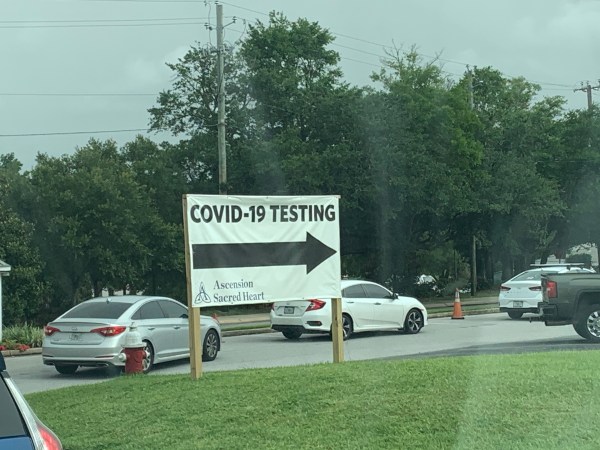
Pensacola has had a full week of record breaking cases of Corona Virus, way up from where it was when we all began to shelter in place.
With news that the leadership has decided that testing is the problem, and that the government is beginning to withdraw support for testing, the cars are lining up at the local drive-through testing station, concerned people trying to get tested before testing goes away.
So what looks worse for re-election? Dealing with the problem, or pretending the problem doesn’t exist, not dealing the the problem, and pulling funding from studying the problem?
Forty-Seven Years
“Happy Anniversary!” smiled AdventureMan as he headed for the daybed in my office. He sets his alarm, gets up and comes into the office, curls up, pulls a quilt over him and goes back to sleep. Ragnar and Uhtred, who love a warm body, trail him in, and as soon as they hear him purring (as we call it) they snuggle right up.
Tropical Storm Cristobal is on our doorstop and with the bands of the storm come periods of light rain, occasional medium rain, and from time to time, lengthy showers of intense rain, sometimes sideways rain if the winds are blowing hard.
We still aren’t eating in restaurants, but I think when he wakes up I will suggest we talk with our son and his wife to see if they might like pizzas today, with us, from Ozone Pizza. While there are a couple expensive restaurants I like, my preference for celebration is always reliably good food, tasty food, and Ozone is tasty, reliably good, and has something to make every one of the six of us happy. On a rainy Sunday, this seems like a relaxed, family option.
The actual move is still stalled. We live our normal lives, waiting for the log jam to break. First, our son and his wife have to be able to close on their house, which is tied up in a legal glitch we expect to be soon solved. They move. We have the bedrooms and hallway painted, then we move. Sigh. These things just take time.
Meanwhile, I want to share something special with you – this was done by 8 downtown Pensacola religious leaders who years ago committed to meeting regularly for breakfast, getting to know and support one another. Their established relationship enabled them to come together to share their commitment to making Pensacola a better place for all races:
New Normal at the YMCA
“You think it’s safe?” my good friend asked me, not hiding her concern. “It’s not too soon?”
“It might be,” I replied, “And I really NEED to swim.”

There is a new system for the new normal, I discovered as I arrived a little early for my reservation. Yes, reservations open two days in advance for a 45 minute swim in the lap pool. Today, when I walked in, past the blue lines marked on the floor to keep us six feet apart, there was a man waiting at the door with a little thermal gun-like object which he pressed close to my forehead (I was holding my mask in my hand, LOL), before I could get through to the membership card kiosk. Chatted briefly with a friend who recently lost her husband (old age, not Covid) and then headed for the main desk, to check in for my reservation.
She pointed out the new entry for the pool, a door I had never seen anyone use before, and when I got into the pool area, I was greeted with more information on the new way things were being done. I dropped my bag, marked my lane with my equipment, and showered.
Even though I arrived early, there were two swimmers there before me, and it was still fifteen minutes before the reserved time – no one waited. We all went right to swimming.

I felt so blessed. This morning, as I opened my shades, the huge Flower Moon was setting over toward the west, the sky was clear and it was glorious. Now, in my favorite lane, as I swam toward the far end of the pool I swam into shimmering sunlight, and then back into the darker area, back and forth. My first lap was a little rocky, I lost my breath. It’s been two months since I last swam. With the extra 15 minutes, I might come close to my mile, a goal I had reached earlier this year only after months of build-up.
Slowly, the rhythm returned, and I was going back and forth, in and out of the sunlight, and building speed. Around eight, an old swimming comrade arrived and signaled to ask if it was OK if we share a lane. He is always considerate, and sensitive to boundaries, and I was happy to be sharing with him.
Six swimmers in four lanes, and two women exercising in the nearby exercise pool – eight people total, sharing this wonderful, clean, sunny space. What luxury. I felt safe.
I came so close! I came within one lap of completing my mile. It was 8:45 and while no one was pushing me out, everyone else was leaving, so good little lamb that I am, I left too, so the crew can do whatever it is they need to do before the next swimmers arrive, for the 9:00 slot. I didn’t go into the changing room, just dried as best I could and wrapped a Zambian kikoy around me for the drive home, using my towel to protect the seat of the car.

This is not me, this is a photo I found online to show how kikoy can be worn to get one quickly and modestly home rather than having to dry off and change.
I thought I would be tired, exercising hard after two months of no swimming, but no! I had energy! I tackled the linen closet, organized medical kit, linens, boxes of supplies for the upcoming move, and boxed up excess for people who might need them.
Amazing Women Visiting Pensacola
When I first came to Pensacola, a woman at our church who is very welcoming and kind to newcomers told me she “wanted to find just the right place for me to plug in.” A couple of her suggestions were not exactly what I wanted, but then she introduced me to Jena Melancon, the founder and director of the Gulf Coast Citizens Diplomacy Council, and I found my niche.
Jena is an amazing woman. She has created this organization. She has a data base of resources that allow her to tailor visits for foreign delegates so that they can meet the needs of their missions – Election Transparency, Entrepreneurship, Environmental Protection, Leading an NGO, Military and Civilian Community Cooperation, Domestic Violence, Creating Fair Policies, Programs for Enriching Disadvantaged Children – you name it, Jena can create a program that will enrich their understanding from an American perspective.
At the same time, Pensacolians who come into contact with the delegates sent by the Department of State find that their lives are also enriched. Many times they, too, learn something new and unexpected. Both groups benefit.
Jena also has a group in GCCDC that studies Great Decisions, and creates events throughout the year for membership participation. Members of the Gulf Coast Citizens Diplomacy Council can volunteer in Jena’s office, can host dinners for delegates and have some one-on-one time learning about customs in another part of the world, can sponsor a Pensacola child in an international exchange, can host teenagers here on an international exchange, or attend the famous Mint Julep party in Spring. Many in the GCCDC are also resources; the exchange of ideas bringing inspiration to both sides.
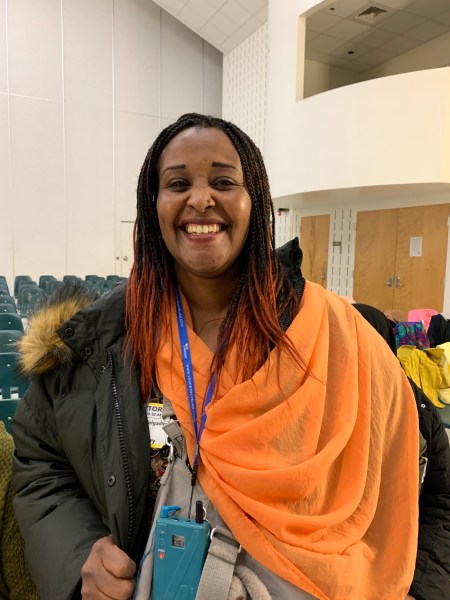
This week, I was honored to be able to work with a group of Women in Leadership, women from Chad, Iraq, Jordan, Saudi Arabia, Egypt and the Sudan. Each and every one of the women was a hero in her own right, making life better in their communities by stepping into leadership roles. Rehab, above, from the Sudan, works to empower women and to make the laws show greater equality in the treatment of men and women.

CPT Aseel is a police chief in Iraq.

Maki, from Chad, works to prohibit child marriages and female genital mutilation.

Mariam, from Saudi Arabia, is a high level journalist in the Saudi media industry, accepting honorary citizenship from the City of Pensacola city council chair Sherri Myers.
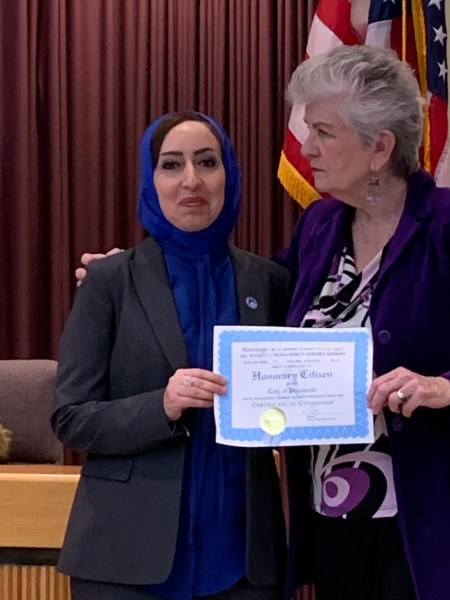
Wasfiya is a minister of parliament in Iraq.
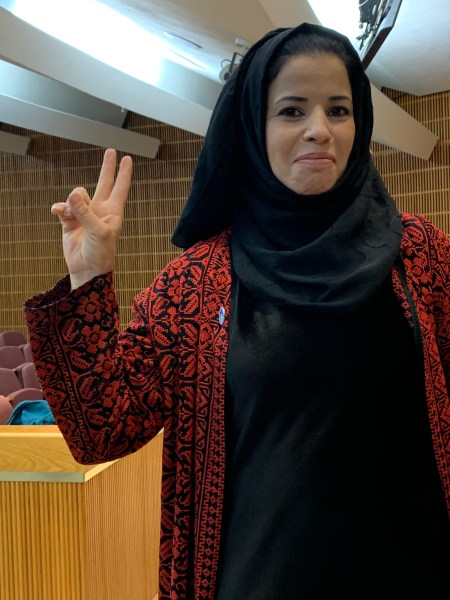
Ola is the delegate from Jordan.
I was honored to spend three days of my life with these women, and with Jena, and with other inspirational women of Pensacola at the Women in Leadership conference at UWF.
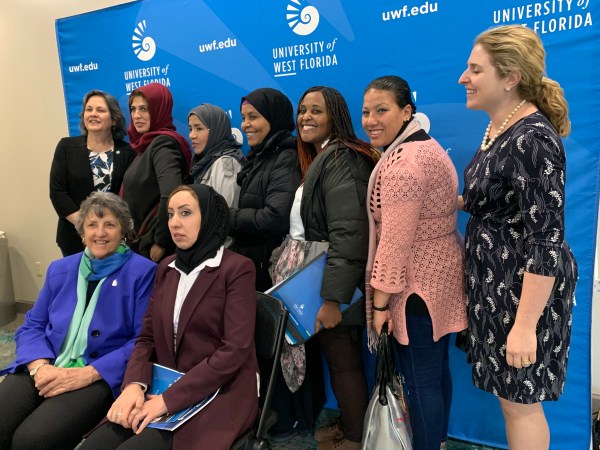
Here is most of the group with Judy Bense, President Emeritus of UWF, at the closing of the Women in Leadership conference, 2020. Life can be amazing when so many women of talent and confidence gather together to inspire one another.
Seven Years In A French Village

Sometimes I tease my husband about going on and on about a series he watches. He watches a lot of programs and movies via the internet. I tend to read books. I mentor a class requiring a lot of reading, and I run a book club. OK. I’m “bookish.” I always have been. I own it.
He went on and on about A French Village, until he had to skip Season 3 because he couldn’t access it, and went on to Season 4 and had problems understanding what was going on because significant events had happened in Season 3.
As I was trying to find a way to work around it, or find the most economical way to watch it – for him – I started watching the first episode. AdventureMan joined me. The beginning is full of events, it moves fast and – did I mention it is entirely in French with English subtitles?
I speak French. Well, I used to be fluent, now I am slow, and have forgotten a lot of little grammatical details. I can still speak, I can still understand, when people will speak more slowly. A French Village was so French it took my ear a long time to regain all that I have lost; I had an idea what they were saying but was not really tracking with accuracy. I needed the subtitles.
The first year, the first episode starts off with a normal day in the village; the population knows the Germans are miles away, approaching Villenueve, a fictional village in the Jura, close to the Swiss border. No one seems very concerned until all of a sudden, the Germans are there, in the village, and all hell breaks lose. We meet our main characters, Dr. Larcher (who becomes, by default, the village mayor) and his wife, Hortense, Lucienne, a school teacher, Raymond Swartz, his wife, Jeannine, and his lover, Marie, and several more characters.
People are herded into the church, where Dr. Larcher tends to the wounded under chaotic conditions, and during which he also agrees, without enthusiasm, to become mayor and to try to create some way to protect the people of the village from the demands of the Germans.
It is confusing – a lot like it would be in real life. At the beginning, it is a struggle to figure out who all the people are, but . . . you have seasons and seasons and episodes and episodes to figure it all out.
We started watching on Amazon Prime, for seasons 1 – 4, then subscribe to Mhz ($7.99/mo) for season 5 and six, but for season 7, we had to pay Amazon Prime $14.99 for these final episodes. Mhz was a good find for us; it has several foreign mystery and dramatic series – and movies – and is right up our alley. The Amazon payment was annoying, but we figured was the cost of lunch for one person, not such a large sum for seven episodes.
There are SEVEN seasons of A French Village. The first five years have 12 one hour episodes each. Seasons 6 and 7 are shorter, and deal with tying up loose ends.
What we love about this series (as well as the sheer French-ness of it all) is that the characters are allowed to be textured and layered. No one is all good, or all bad. They make mistakes. They have human failings and weaknesses. They have some moments of heroic goodness. They are very real people. Well, maybe very real French people; there are a lot of complicated love interests throughout the series, some of which are inexplicable and to me improbable, but I just shrug my shoulders and say “It’s a French production,” and guess that their ways are not our ways.

It’s a quick education to the experience of WWII, The German blitz of France, of Belgium, of the Netherlands, Poland, and the dread among German officers of serving on the eastern front. It’s horrifying to watch the passive response among the French to the round-up and eviction of the Jews (read a little of our own history before you go getting all judge-y), the petty competition for foods in the black market, the role of “renunciation” and anonymous letters accusing friends and neighbors of dark deeds, and the endless bickering which went into the cooperative operations for the French resistance.

Who collaborates? Almost everyone at one point or another; the consequences of standing on your principles are often fatal.
It is a little uncomfortable seeing Americans through the eyes of the French. They are not so impressed with our efforts in North Africa, they are not so happy to have Americans in their town. One episode of rape in Villeneuve involves American soldiers and a French girl.
We cannot wait for evening, when we can watch two or three or four episodes. We are slowing down a little in Season Seven, not wanting to series to end. It has been a wonderful excursion into a whole new and different world. At the end of which, I am understanding the French-spoken-at-normal-speed much more easily, and even spotting a small flaw or two in the translations.
There are two episodes I love. One involves a parade on November 11th. The other involves the execution of two Villeneuve inhabitants, one an unscrupulous and despicable mayor and the other a heroic leader of the Resistance. I know, I know, you’ll have to watch it yourselves to see what I mean.
Record High STD Rates Go Hand in Hand With Rising Ignorance
CDC says STD cases in U.S. rose to record high in 2018 as funding lags

“The resurgence of syphilis, and particularly congenital syphilis, is not an arbitrary event, but rather a symptom of a deteriorating public health infrastructure and lack of access to health care,” Gail Bolan, the CDC’s director of STD Prevention, said in the report.
Antibiotics can cure chlamydia, gonorrhea and syphilis, but many people fail to get screened and treated for the diseases.
The CDC’s annual STD prevention budget decreased in purchasing power by 40% from 2003 to 2018, according to data released by the National Coalition of STD Directors, an association of local health officials. The CDC’s financial data was first consolidated into the U.s. Health and Human Services financial reports in 2003.
Half of STD cases occur in people between the ages of 15 and 24 years old and can lead to health complications including infertility and increased risk of contracting HIV.
In 2018, the CDC received reports of nearly 1.8 million cases of chlamydia, some 580,000 cases of gonorrhea and more than 115,000 cases of syphilis. Of the 1,306 cases of congenital syphilis in 2018, 78 resulted in stillbirths and 16 in infant death.
(Reporting by Gabriella Borter in New York; Editing by Frank McGurty and Bill Berkrot)
My comment: This is what happens when we rely on “abstinence” and fail to fund Planned Parenthood AND other community sources of reliable information for young people. Oh yes, it would be so nice if teen-agers and young adults went to their parents for advice on keeping sex safe – is that what YOU did? What teenager does??
Teenagers and sex go hand in hand, young adults and sex go hand in hand. If we want to prevent STD’s, we have to give them accurate information as to what they are and how they can be prevented.
Do I sound exasperated????
Some of the things out there these days are increasingly drug-resistant. It is a DISGRACE that we are not preparing our children for the realities of the world, preparing them to live responsible lives and funding sources of accurate information (and yes, even birth control products) to keep them SAFE.
Exasperated?? Yes! Thanks for letting me vent.
The Texas Solution to Mass Shootings – More Guns
Forgive me for going political, but occasionally I have to let off steam.

I was raised with guns. My husband fought in Vietnam; we have great respect for weapons of all kinds, and when they are needed, and the damage they can inflict. We believe in protecting ourselves.
We don’t need an assault rifle.
When the governor of Texas pulled a sad face and talked about the need to protect Texans, without getting specific, the hair on the back of my neck started going up. Another politician hiding what he is really saying, I thought. When pushed, he referred to the eight new laws going into effect that very day, the same day another angry white American-born male had shot and killed seven people and wounded many more.
He carried an assault rifle. First killed was a policeman making a traffic stop.
The gun laws that the governor referred to as going into effect, each and every law, protect gun ownership and allow guns legally to be carried in more places.
Churches, synagogues and mosques.
Schools.
God forbid.
More guns, in my experience, do NOT make us more safe.
While we were with the military, guns which were not being used for training purposes (or war) were locked up. Every base, every unit has it’s own weapons storage center, kept under lock and key, and those are the rules for professionals with a huge familiarity with guns, and their proper handling, and their capabilities.
Any person can become temporarily insane. I myself have had moments when I knew I was capable of killing, especially to protect my child, or another innocent. None of us know what we are capable of under extreme stress or circumstances.
I can imagine NO circumstance under which it would be appropriate for me to carry an assault weapon.
Here, courtesy of CNN, are the eight new gun laws the governor cited in his lily-livered bow to the NRA:
A series of new firearm laws go into effect in Texas on Sunday, just hours after a shooting left seven people dead in the western part of the state.
Weapons on school grounds
Marshals at schools
Guns in foster homes
Weapons in apartments
Handguns during a disaster
Firearms in places of worship
“You Can’t Send Money to the Sudan”
I totally get it. My bank is trying to protect me. I am “elderly” and I am sitting in the bank officer’s office asking to wire money to my friend in South Sudan.

“I need to talk with somebody,” she says and comes back with a man. I manage, barely, to keep from rolling my eyes.
“You know,” he tells me sternly, “We are forbidden to send money to the Sudan. It’s on the prohibited list.”
“Yes,” I say brightly, “The Sudan is on the prohibited list. The South Sudan, and entirely different country, is not.”
They want to make sure I know what I am doing. They tell me true stories of people here in Pensacola sending money to scam artists. Thousands of dollars. How do I know this person?
I explain he was a State Department International Visitor on their IVLP program, that he has attended church with me, is a renowned journalist, that he has dined in my home. They are looking at me with pity.
“This isn’t thousands of dollars,” I tell them. “This is school tuition, he only asks for help this one time to keep his daughters in school. The South Sudan is going through tumultuous times.”
“I know this person,” I re-assure them. “I believe I am sending money to my friend,” I tell them. “I can afford this risk; I can afford to lose this money,” I tell them.
I have to also tell this to the international wire-banking account manager who they get on the line. We go over it all again. I sign all the papers.
A couple hours later, I get a call asking if I am really sure. What are the names of the daughters? I look up our correspondence and provide the names. The bank information is in Juba, where my friend lives, not Nigeria, not anywhere other than where my friend lives.
In only two days, my friend notifies me that the funds have arrived, and he is profoundly grateful.
A week later, my bank calls me again, concerned as to whether the funds made it to my friend, and how I felt about the experience. They are still concerned. I assure them the funds have reached my friend, he has contacted me, thanked me. I do not tell them my friend continues to raise his voice at a time when the government is transitioning, and he is trying to be a voice of reason and civility.
There is a part of me that totally understands the banks need to protect their customers, and how gullible I might appear to them. And there is a part of me that despairs at our fear of the stranger, at our fear of being taken, and at our ignorance, not even knowing that there is a Sudan, and that there is a new country called the South Sudan.
Four times in my life I have been asked to help with school expenses, in tough times, to people we know in four different countries. Four times my husband and I have wired money to people who only want to give their children a chance at a better life. We have always been thanked, We have never been asked again.
I met a woman whose theory was that none of the money that came her way was hers, that it was God’s money and she was merely the steward; it passed through her hands on the way to where God wants it to go. It helps me with requests like this, from people I know. It helps me with the homeless on the streets of Pensacola, knowing I am to freely, freely give, and God will see that it gets where it needs to go.
Recent Comments
intlxpatr on Shampoo Ginger tigerbutterya0c5ff1d… on Shampoo Ginger intlxpatr on British Soldier Kidnapped, Esc… John on British Soldier Kidnapped, Esc… intlxpatr on British Soldier Kidnapped, Esc… Wikipedia Donate Button

Amazina


Early Voting in Florida


