Weight Loss: Fat Burning Beads
I could not believe my eyes. Would you buy these beads? You can read the entire story at BBC Health News.
‘Fat-burning’ bead marketing ends
A company that said its “fat-burning” beads triggered “automatic weight loss” has agreed to stop marketing in the UK.
One claim suggested that Accu-Slim Beads worked “faster than total starvation” by placing one bead behind each ear.
The Office of Fair Trading (OFT) sought assurances from Global DM Licensing, based in Hong Kong, that it would stop mailings being sent to UK consumers.
The OFT says thousands fall victim to claims about weight loss products.
Misleading claims
The company, using the name The AccuSlim Centre, claimed the beads were “fat burning acupuncture without needles, diets, exercise or effort”.
It claimed that users could eat as much as they liked but still lose 30lbs in 30 days, as the bead stimulated acupressure points that led to automatic weight loss.
The company claimed guaranteed results and charged £65 for a package of up to 120 beads.
OOps – I just noticed that they only have to stop marketing these beads in the UK. So if someone approaches you on the streets of Kuwait offering to sell you fat-burning beads (wouldn’t you feel like punching someone who thought you needed fat burning beads?) DON’T BUY THEM! THEY DON’T WORK!
More Three Cups of Tea
The timing couldn’t be better. Thank you, Phantom Man, for sending a link to this New York Times article on Three Cups of Tea, from the July 13th New York Times.
By NICHOLAS D. KRISTOF
Published: July 13, 2008
Since 9/11, Westerners have tried two approaches to fight terrorism in Pakistan, President Bush’s and Greg Mortenson’s.
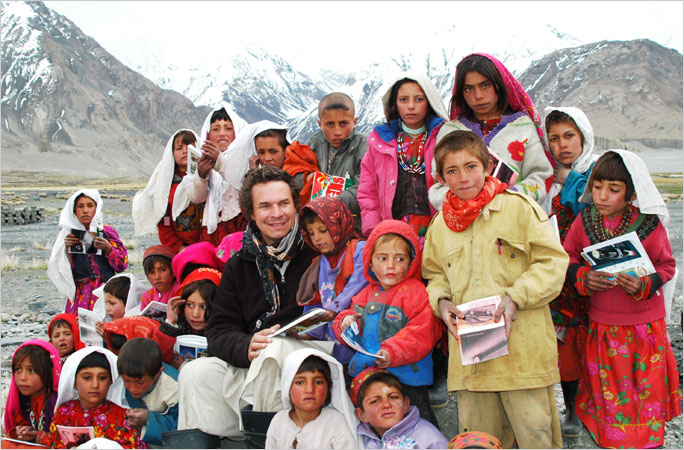
Greg Mortenson with Sitara “Star” schoolchildren. Photo: Fred R. Conrad/The New York Times
Mr. Bush has focused on military force and provided more than $10 billion — an extraordinary sum in the foreign-aid world — to the highly unpopular government of President Pervez Musharraf. This approach has failed: the backlash has radicalized Pakistan’s tribal areas so that they now nurture terrorists in ways that they never did before 9/11.
Mr. Mortenson, a frumpy, genial man from Montana, takes a diametrically opposite approach, and he has spent less than one-ten-thousandth as much as the Bush administration. He builds schools in isolated parts of Pakistan and Afghanistan, working closely with Muslim clerics and even praying with them at times.
The only thing that Mr. Mortenson blows up are boulders that fall onto remote roads and block access to his schools.
Mr. Mortenson has become a legend in the region, his picture sometimes dangling like a talisman from rearview mirrors, and his work has struck a chord in America as well. His superb book about his schools, “Three Cups of Tea,” came out in 2006 and initially wasn’t reviewed by most major newspapers. Yet propelled by word of mouth, the book became a publishing sensation: it has spent the last 74 weeks on the paperback best-seller list, regularly in the No. 1 spot.
Now Mr. Mortenson is fending off several dozen film offers. “My concern is that a movie might endanger the well-being of our students,” he explains.
Mr. Mortenson found his calling in 1993 after he failed in an attempt to climb K2, a Himalayan peak, and stumbled weakly into a poor Muslim village. The peasants nursed him back to health, and he promised to repay them by building the village a school.
Scrounging the money was a nightmare — his 580 fund-raising letters to prominent people generated one check, from Tom Brokaw — and Mr. Mortenson ended up selling his beloved climbing equipment and car. But when the school was built, he kept going. Now his aid group, the Central Asia Institute, has 74 schools in operation. His focus is educating girls.
To get a school, villagers must provide the land and the labor to assure a local “buy-in,” and so far the Taliban have not bothered his schools. One anti-American mob rampaged through Baharak, Afghanistan, attacking aid groups — but stopped at the school that local people had just built with Mr. Mortenson. “This is our school,” the mob leaders decided, and they left it intact.
You can read the entire article in the New York Times by clicking on the blue type.
Obama Magazine Cover Controversy
This is the New Yorker magazine cover that is causing so much controversy in the USA – it shows a newly elected Obama showing up to work in the oval office (US President’s office) in Islamic dress and trading congratulatory fists with his terrorist dressed wife. Obama and his election campaign group find it distinctly unfunny.

Three Cups of Tea
My best-friend-from-college and I were chatting the other day and I asked her “what are you reading?” because we have always exchanged book recommendations back and forth.
“I’m reading a biography of Teddy Roosevelt,” she started, and I groaned, because most of the time biographies don’t interest me that much. “And I am reading Three Cups of Tea . . . “ and I interrupted her (rudely) to exclaim “so am I!”
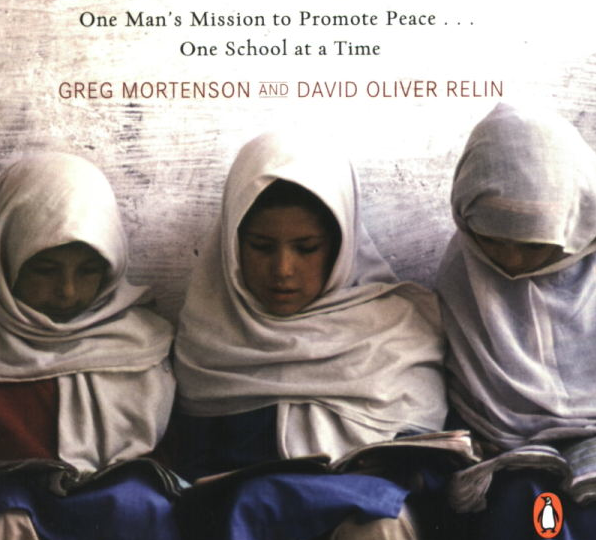
Three Cups of Tea is a must-read in the US. It was actually published in 2006, and has sold more and more books every month, and has been on the New York Times best seller list almost since it was published.
The book begins with a failure. A mountaineer, attempting a climb on K2 runs into problems, including evacuating two severely injured fellow climbers from the mountain. Exhausted, and devastated by his failure to capture the summit, he gets lost on his way back to the base camp, and ends up in a village where the people are very kind to him. He is treated as an honored guest, he regains his strength, and on his last day in the village, learns the children have no school. He rashly promises to come back and build a school for them.
One of the great redeeming features in this book is Greg Mortenson’s endless humility. He has a co-author, to whom he gave a long list of people he could talk with, including all his enemies and people who thought he was crazy. He’s that kind of guy. He talks about his life’s personal failures and his toughest moments, and he moves on.
He doesn’t take credit for the dogged persistence with which he keeps his promise, in spite of daunting obstacles. He doesn’t take any credit for the good will he builds.
Several years ago, I read another book which has changed my life, The Purpose Driven Life (which, by the way, the hardcover is $9.99 and the paperback is $10.19, go figure) in which the basic premise of the book is that we are each created uniquely, individually, by a loving creator, for a purpose. As I read Three Cups of Tea, I thought this man is greatly blessed; he discovered his purpose and nothing kept him from fulfilling it!
The book deserves every single one of it’s Amazon Five Star ratings.
I had a hard time putting the book down. Even though my life is full of other demands, once I had the chance, I spent an entire afternoon finishing this great book.
Greg Mortenson isn’t discouraged that his first school takes three years, and first he has to build a bridge. His second, third and fourth schools take just . . . three months! He has a gift for inspiring others, and people give what they can. The villagers give their time and their efforts, and western supporters donate funds.
By the end of the book, 24 school have been built, in the very poorest mountain villages in Pakistan, where money from the government for education doesn’t trickle at all, until near the end of the book. He doesn’t build the schools himself – he meets with the villagers, they donate a plot. He buys the materials, and together, they all build a school. These villagers are hungry for their children to become educated, to have a chance for a better life. Mortenson learns to focus on the girls.
He learns that as the boys become educated, they leave the villages for the city, but as the girls become educated, they come back, and like yeast, they raise the standard of living for the entire village, providing health care services and information, providing education for the newest crop of children, learning new skills, bringing them back and sharing them.
One of Mortenson’s gifts is that he isn’t interested in changing these mountain people into westerners. He likes them, and he learns from them, just the way they are. He dresses like them, he prays with them, he learns their language, and he has no western agenda for the curriculum in these schools. He also helps the government schools – building an additional room here for an overflowing school, paying a teacher’s salary there – his goal is to educate children. That’s it. No political agenda. The people of the villages love him for it, and give him their full support.
You cannot undertake a project like this without a lot of help. Mortenson had some extraordinary experiences, experiences that to me look like the grace of God, that drew together teams of people to help build and supply his schools.
“I looked at a sign in front of the school and saw that it had been donated by Jean Hoerni, my cousin Jennifer’s husband,” Bergman says. “Jennifer told me Jean had been trying to build a school somewhere in the Himalaya, but to land in that exact spot in a range that stretches thousands of miles felt like more than coincidence. I’m not a religious person,” Bergman says, “but I felt I’d been brought there for a reason and I couldn’t stop crying.”
A few months later, at Hoerni’s memorial service, Bergman introduced herself to Mortenson. “I was there!” she said, wrapping the startled man she’d just met in a bruising hug. “I saw the school!”
“You’re the blonde in the helicopter,” Mortenson said, shaking his head in amazement. “I heard a foreign woman had been in the village, but I didn’t believe it.”
“There’s a message here. This is meant to be,” Julia Bergman said. “I want to help. Is there anything I can do?”
“Well, I want to collect books and create a library for the Korphe School,” Mortenson said.
Bergman felt the same sense of predestination she’d encountered that day at the school. “I’m a librarian,” she said.
After struggling for many years, seeking donors who would help to build a school, Mortenson now has a foundation eagerly supported by many Americans, and especially the mountaineers, who continue to build schools. At the end of the book, the foundation is moving into the poorest sectors in Afghanistan, and building schools there. They have children’s programs in many of the schools in the United States, where children donate pennies to help pay for books for the schools, and for the teacher’s monthly salaries, where salaries are not reaching the teachers. You can donate to the school building fund, teacher’s salaries and books using your credit card, online, at the website Three Cups of Tea. You can order this book there, too, as well as music CD/s and learn more about the work being done.
France Rejects Veiled Muslim Wife
From BBC News: Europe

France rejects veiled Muslim wife
A French court has denied citizenship to a Muslim woman from Morocco, ruling that her practice of “radical” Islam is not compatible with French values.
The 32-year-old woman, known as Faiza M, has lived in France since 2000 with her husband – a French national – and their three French-born children.
Social services reports said the burqa-wearing Faiza M lived in “total submission to her male relatives”.
Faiza M said she has never challenged the fundamental values of France.
Her initial application for French citizenship was rejected in 2005 on the grounds of “insufficient assimilation” into France.
She appealed, and late last month the Conseil d’Etat, France’s highest administrative body which also acts as a high court, upheld the decision to deny her citizenship.
Bush Tours America To Survey Damage Caused By His Presidency
Hilarious video from The Onion.
Georgia Man Kills Daughter for Honor
This is a sad story. When police arrested him, you get the impression he was really sad he did it, and caught up in something he regretted.
Georgia Man Charged in ‘Honor Killing’
CNN
Posted: 2008-07-08 22:21:56
Filed Under: Crime News, Nation News
ATLANTA (July 8) – A Pakistani man is charged with killing his 25-year-old daughter in Georgia because she wanted out of an arranged marriage, police said.
Chaudhry Rashid, 54, of Jonesboro, an Atlanta suburb, appeared in court Tuesday afternoon to face murder charges in the death of Sandeela Kanwal, according to court records.
He was arrested early Sunday, after his wife called police at about 2 a.m. She reported that she had been awakened by screaming but couldn’t understand the language, a Clayton County police report said. She said she was afraid and left the house to call police.
Officers found Kanwal dead in an upstairs bedroom of the home, according to the police report.
Rashid’s wife told authorities Kanwal recently had been married in Pakistan — an arranged marriage, she said. The young woman’s husband was living in Chicago, Illinois, police said, but Kanwal remained at her father’s home and worked at a metro Atlanta Wal-Mart for a brief time.
You can read the rest of the story on AOL News by clicking here.
Wrong, So Wrong
I was wrong, so wrong, and I admit it. I had scanned the news online. When I finally got my hands on a hard copy paper, I discover there IS news, news you don’t find online, and so much of it. Because I can’t copy it online, you will have to bear with my hand-typed-in renditions of the page 2 “In the News” section from the Kuwait Times.
1. Rehab Centers
Kuwait: Dr Haya al Metairi called for establishing a specialized health center to treat and rehabilitate homosexurals. She urged the authorities to impart moral guidance and offer psychological counseling to affected people (sic) instead of incriminating the phenomenon of homosexuality. She said she has already submitted a demand of establishing the center to the parliamentary committee for curbing negative invluences. She also called for the implementation of a draft law to evaluate the degree that the patient is psychologically affected. (sic)
Once diagnosed, appropriate psychological treatments should then be administered accordingly after referring those ailing from sexual deviation to the relevant health centers. She also called for subjecting them to periodic checkups as well as conducting awareness campaigns to expedite their rehabilitation.
Al Metairi urged the Ministry of Health to subject local pharmacies to strict surveillance, reported Al Watan. She said most pharmacies sell banned female hormone inducting drugs over the counter that could fatally endanger the lives of consumers. She said such pills activate female hormones, leading to weakening the male sexual organs. Prolonged use of such drugs transforms a man’s physical appearance to resemble that of a woman and also negatively reduced the power of their sexual organs.
2. Diplomatic Appointments
Kuwait: Undersecretary at the Ministry of Foreign Affairs Khalid Al-Jarallah denied the involvement of wasta in admission tests held for inducting diplomats. He refuted reports that the ministry resorts to wasta, saying “The ministry never subjects itself to pressure from anyone, nor does it accept wasta in any form.”
He said appointing diplomats is a very sensitive issue as this select group represents the country abroad. Speaking on qualifications required to qualify for the posts, he said the maximum age required to qualify for the examinations is 24. No applicant under 24 has ever qualified for the written tests, he added. All candidates then have to mandatorily undergo a series of other appraisals and examinations before being finally accepted as diplomats, reported Al-Wasat. Written exams, which are graded by an expert panel of officials from the ministry are then followed by personal interviews and stringent brain storming sessions while grading the applicants on their personal capabilities.
3. No Blackouts
Kuwait: Fears of impeding electricity outages this summer dominated the Cabinet’s recent weekly meeting, officials said. The Ministry of Electricity and Water Mohammed Al-Olaim briefed the Cabinet with a detailed report on the current situation as well as details of the expected consumption as compared with the actual production.
He assured the Cabinet that he does not expect any electricity outage; scheduled or otherwise. He said the overall situation was under control with production exceeding the state’s consumption. “We are safely within the parameters of the green consumption line.” he added. He however slammed some local dailies of sparking unconfirmed reports of a power crisis, reported Al-Wasat. He said the reason electricity in some areas, was disrupted recently was due to technical snags leading to an overload, resulting from an excessive increase in day temperatures.
He said residents do not have to worry as technicians are on standby around the clock to deal with any contingency that might arise at any given time or place.
4. Donkey Ordered Out
Kuwait: The Minister of State for Municipa Affairs Dr. Fadel Safar saw a donkey grazing on a green patch while travelling through the capital recently. He called municipal officials and snstructed them to clear the mule off, reported Al-Watan. The officials in turn called capital police who arrived and took the animal to the Capital Security Directorate.
Laugh? Or cry?
The Wire, Season 4
This show, The Wire, is one of our all time favorites, all the more so because our son also loves this show and passes along the entire season when he has finished watching.
Season 4 is the very best so far. The major theme is a subject near and dear to my heart – the schools, keeping kids in school, and trying to find ways to help them learn. Two former policemen end up in Tilghman Middle School, working with the poorest kids in the Baltimore school system.
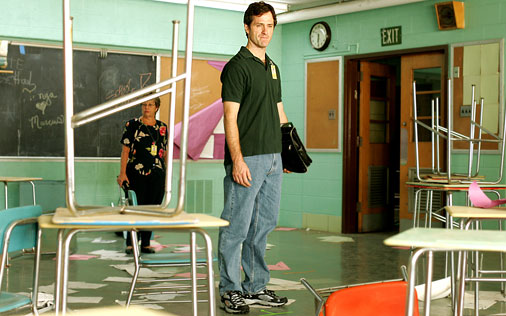
First, you need to know that teaching middle school is the stuff of heroes. At very best, middle school kids are dealing with those raging hormones of adolescence. They can’t sit still. They are so full of energy, and sitting and reading is the last thing they want to do.
New teacher “Prez” suffers total loss of control over his class on his first day, but slowly finds ways to engage their attention – such as teaching them to use math to figure odds rolling dice. Once they understand the value of the new information, they are enthusiastic learners . . . or at least, they co-operate with the boring stuff because he finds ways to reward them with interesting information, relevant to helping them cope with their lives. The teachers learn from the students – to keep it real, keep it relevant.
The teachers in Tilghman Middle School are HEROES. Most of the children they deal with have huge problems outside the school, poverty being the smallest of the problems. For many, their parents are their worst problems, literally stealing the food out of their mouths for another fix. The kids bring their baggage into the schools every day, their anger, their acting out. The teachers have to be a mix of tough, compassionate and flexible. They know they are going to lose some of them, and they have to keep on, hoping a few will make it. It is truly a war zone, and the teachers are the stand-up soldiers in this season.

We follow a tough race for the Mayor’s office, the rise of a drug lord, two stone-cold killers who figure out how to “disappear” their victims, and one very clever schemer who manages to pull off a major drug heist, and then sells the product back to his victims. It’s an amazing show.
If you follow this season via DVD, choose to use the subtitles. A lot of the language is slang, much of it is street talk, mumbled, garbled – real speech. It helps to use the subtitles.
Women Are Women: Abayas and Hijab
One of the questions I get most often when I am back in the US is whether I have to cover, whether I have to wear an abaya, whether I have to cover my hair.
I tell them that in Kuwait, it is still a choice. Many Kuwaiti women do not cover their hair, but most dress modestly and are still traditional and conservative in behavior.
I tell them that in Saudi Arabia, I had to wear the abaya, but that the embassy instructions were to carry a scarf, but only to wear it if the muttawa / religious police made a fuss, as it was not the law of the country. The law stated that Moslem women would be covered, but not non-Muslim women. The Saudi women would tell me all the time that I didn’t have to cover, but when I mentioned the Muttawa – they all just sighed and nodded, and said that some people have a funny idea about religion, but that this was not the real Islam.
What I loved about women in Saudi Arabia is that they have a lot in common with women everywhere. When confined, they have ways to press the envelope. For example, the malls are full of stores with the sexiest shoes I have ever seen – and when feet are one of the few things that CAN be seen, guess where the money gets spent? There were also entire floors devoted to perfumes, and women would pass and you could nearly swoon from the delicious scents, an entire cloud of scents as they passed, cloaked in anonymity. There were glove shops, with the sexiest, laciest gloves you have ever seen. At the time, most of the abayas and scarves in Saudi Arabia were plain black, although occasionally you might see one with a discreet little trim, or a tiny little sparkle.
The kids told me they could tell their family members; they learned to identify posture and voices. They didn’t have any problems picking out their Moms and sisters.
Women would approach me in stores, standing next to me, pretending to examine some goods and whisper “Hi! Where are you from?” and “Do you like it here?” Many times, on planes, husbands would make their wives change places so as not to be contaminated by sitting by the likes of me, a wicked western woman with her hair showing, but the women would smile shyly when the husband was looking the other way. Women are women. We have our ways. We manage to get around restrictions.
On the other hand, I want to share with my Western readers the trend in abayas and scarves in the last few years. They are GORGEOUS, and there are times I am tempted to buy just because they are gorgeous.
On a deserted morning, I found these shop windows to share with you:
These are going-out-calling dresses, worn under abayas

These would probably be worn to an evening event like a wedding

Even the younger girls have special evening clothes
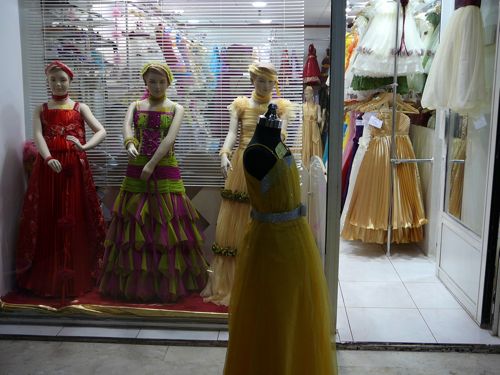
Not your old fashioned abayas

Love these details

Scarves to wear with abaya

Recent Comments
ExpatAlien on What Country am I Living … intlxpatr on Yellowstone: Old Faithful to C… Michelle on Yellowstone: Old Faithful to C… Cathy on No Grown-Ups in Charge intlxpatr on Waiting for Snow Wikipedia Donate Button

Amazina


Early Voting in Florida


 Here There and Everywhere