Maitland and The Company of Liars: A novel of the plague
I had just finished The Swallows of Kabul and still had a long flight to go. Fortunately, I was in the Johannisburg airport, with it’s truly wonderful bookstore, and came across The Company of Liars: a novel of the plague. Well, it isn’t exactly a novel of the plague. The story opens in 1348, a year in which le morte bleu hit the British Isles, only later to be called the plague. The author captures the times, the filth, the lack of bathing, the superstitions, the ways of life.
The plot centers around a group who wanders through the island, just trying to stay alive. The spreading plague impacts on their wandering, but to call this a novel of the plague is just not accurate. The plague is the reason for the journey, but the journey is the center of the novel, not the plague.
Before I started reading the book, I read the Historical Notes in the back, and that is where I came across the most interesting information in the entire book:
The 1348 plague was only the latest in a series of disasters to hit Britain. The period between 1290 and 1348 had seen a rapid and drastic climate change which was so noticeable that the Pope ordered special prayers to be said daily in every church. Eyewitness accounts claimed that 1348 was a particularly bad year, for it rained every day from Midsummer’s Day to Christmas Day. Climate change brought about crop failure, liver fluke in sheep and murrain in cattle, as well as causing widespread flooding which virtually wiped out the salt industry on the east coast. This, combined with a population explosion, meant that as many people died from starvation as from the plague itself.
Interestingly, the book will not be released in the US until September 2008. The cover shown is nothing like the cover of the book I bought.
American issue cover:

Cover on book bought in Johannisburg:
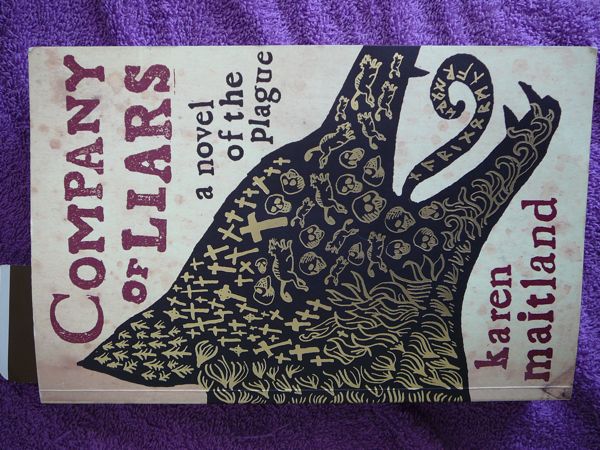
I like the cover of mine better.
Some reviewers call this book “enthralling” or “gripping.” I wans’t all that enthralled or gripped, but it did make good airplane reading. I learned a lot about the grim brutality of life in 1348, but as I told AdventureMan, this is more a book about a slice of time than a book with a great plot. The plot isn’t that great, it is the historical detail that is interesting, and fiction just makes it more easily absorbed. (my opinion)
Masumbe’s Wisdom By the Campfire
Every night before dinner in these camps is a time for gathering around the campfire, sharing stories, getting to know the fellow guests. At Tena Tena our third night, we are sitting with Msumbe, the assistant camp manager, and listening to him talk about Zambia.
Zambia is a peaceful nation, and it is a miracle. More than seventy different tribes, and that many different languages and dialects. Rich in natural resources, full of children hungry to learn, Zambia has placed a high priority in educating everyone in getting along with one another.
“So like when you come across another person, not from where you are from, you don’t start in with a lot of questions. First you ask ‘How is it where you are from?’ and then you listen. When you know where he is coming from, and how are things there, then you can ask better questions, and not offend someone.”
Hmmmm, I thought, good advice. Sometimes I feel a little shy, especially when there are large groups of “others” like South Africans, or British, and they have their own values, their own ways of communicating, different from ours.
Soon, I was sitting next to a British woman, and desperately trying to think of a way to get HER talking, so I could be listening, and that is exactly what I asked “Tell me what life is like where you are from?”
She looked at me like I was a little crazy and asked what I meant. I said that I knew her life was very different from mine, and I was interested to know what her daily life was like. So she started telling me she wasn’t very interesting really, but gave me some details, and actually, it WAS interesting. Once she got going, knowing I really was interested, I learned a whole lot!
One detail I will never forget is that she rides to the foxes every weekend in the fox hunting season, this very respectable woman, and that they all do, even if it is against the law. No matter what the weather, they ride, hour upon hour. She laughed and said they ride so long and so hard that her clothes become discolored from the saddle leather, and she comes home stained and filthy from her rides.
Now how would I ever have known all that without Masumbe’s good question? It’s like being given a key that opens many locks. You never know what treasures you will come upon, but you have this wonderful key. Thank you, Masumbe!
Grin for the Day
Thanks to some great long-time friends for this visual:
The American way of life!

Michelangelo’s famous statue, David, returns to Italy this week after a successful 12 week, 20 city tour in the United States of America.
The David statue after a visit to the USA
AIDS and Africa
Listening to BBC yesterday, I learned that in Ghana, men forbid their wives to get HIV testing. If the wife tests positive, it makes public his own shame, carrying HIV, and they don’t want people to know they are infected. They will even resist being treated rather than confess to having HIV.
Recently a Ghanian man divorced his wife for testing positive, even denied he was infected. She states he is the only man she has ever been with. He said she is bringing shame on him, going public.
What tragedy. What folly. Life enhancing, life prolonging drug treatments are available. First, you have to acknowledge you are infected. And, of course, if the women do not get tested, the dreaded disease passes along to the babies.
The newspaper recently published an article that 129 Kuwaitis are HIV positive. I imagine the problems here are similar, that people would prefer it all be kept very private. Is that possible? Is confidentiality respected? Do couples have blood tests before getting married?
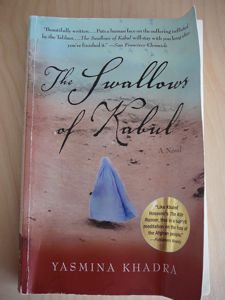
Khadra and The Swallows of Kabul
While waiting for our luggage to be offloaded, we were passing time, visiting with our greeter / expediter, asking about his family, his life in Zambia.
“How does this work, travelling with your son and your daughter-in-law?” he asked us. “Do you like her?”
Nothing on earth could disguise the delight on our faces as we both said “Yes!” We truly adore her.
When our son was only seven years old, a Christian speaker passing through said that if you have children, it is likely that their mates have also been born, so to start praying now for the unknown mate your child would choose, and we did.
When our son called us from university, and told us there was someone he wanted us to meet at graduation, and graduation was still months away, we knew, we just knew, that this might be THE ONE.
We were so delighted when we met her, we liked her immediately. What parent isn’t happy to see his/her son/daughter happy, and choosing well?
“But!” our meeter/greeter added, “how do you like her family?”
And we laughed again! We love her family! Her father is smart and very funny, and her mother is kind and practical, and we all share the same values on family and friends and living our lives. She comes from a large rowdy family that gathers when they can, and so do we.
And YOU are thinking “what does all this have to do with The Swallows of Kabul?” but I am getting there.
On the trip, we all had books for our quiet time, and I could see EnviroGirl deeply engrossed in this book. When I asked her, she said she had gotten it from her father’s wife, a woman with whom I often talk books, and that she (EnviroGirl) was trying to finish it so that she could leave it with me.
And thank goodness that she did! I couldn’t put it down!
First, you think it is written by Yasmina Khadra, but that is a pseudonym. The real author, Mohammed Moulessehoul, was Algerian army officer, and he used the pseudonym to avoid having to submit the manuscript for approval by military authorities. That got my attention right away.
The book is about Taleban era Afghanistan, and starts out with utter hopelessness, describing the deterioration in life brought about by the arbitrary imposition of religious rule, as interpreted by men who have memorized the Qur’an, but have a poor understanding of what they have memorized. Women lead a dismal, limited life, at the mercy of men who treat them as detestable if they are seen in public, even totally cloaked.
His language is beautiful, poetic and compelling, even describing despair and desolation.
We meet two couples, Atiq, a jailer, and his wife, Musarrat, who risked her own life to save his life back when he was seriously wounded and left for dead, and Mohsen, former member of a moderately successful merchant family, married to the love of his life, Zunaira, who is beautiful, educated and from a wealthy background. These men love their wives, and have a strong, genuine connection to them. Their ability to maintain that connection, and to stay connected to their own values, withers in the dry, dusty context of fundamentalist rule.
Their lives and relationships have been changing gradually, increasingly limited and undignified under the stress of Taleban rule, and the novel follows a rapid spiral of deterioration and folly. The steady decline of their lives speeds when Mohsen makes a terrible impulsive decision, has to live with the consequences, and confesses to his wife.
Atiq, too, faces dismal consequences. Even though we know he is limited, he becomes a sympathetic character. His hardness of heart covers a genuine grief that his wife is dying, and he can do nothing to stop it, nor to alleviate her pain.
We all face hard times. In our family, when someone lashes out unjustly, we often ask “is it something I have done, or am I just the nearest dog to kick?” It always gets a laugh, and it puts things back in perspective, puts us on the same side. Sometimes we can’t always vent our frustrations against those people or events creating the frustration, so we take it out on those we love – and who love us. It’s not right, it’s not fair or just, but it is very human, and once you get that out on the table, it is easier to discuss the real issue.
When Zunaira ends up in jail, Atiq’s world is shattered as if by an earthquake – the earth moves under his feet, all his understanding of life is shaken.
“As he cleans up, he cautiously lifts his eyes to the roof beam looming over the cell like a bird of evil augury, and his gaze lingers on the anemic little lightbulb, growing steadily dimmer in its ceiling socket. Screwing his courage to the sticking point, he walks back to the lone occupied cell, and there, in the very middle of the cage, the magical vision: the prisoner has removed her burqa! She’s sitting cross-legged on the floor. Her elbows are on her knees, her hands are joined under her chin. She’s praying. Atiq is thunderstruck. Never before has he seen such splendor. With her godess’s profile, her long hair spread across her back, and her enormous eyes, like horizons, the condemned woman is beautiful beyond imagination. She’s like a dawn, gathering brightness in the heart of this poisonour, squalid, fatal dungeon.
Except for his wife’s, Atiq hasn’t seen a woman’s face for many years. He’s even learned to live without such sights. For him, women are only ghosts, voiceless, charmless ghosts that pass practically unnoticed along the streets; flocks of infirm swallows – blue, yellow, often faded, several seasons behind – that make a mournful sound when they come into the proximity of men.
And all at once, a veil falls and a miracle appears. Atiq can’t get over it. A complete, solid woman? A genuine tangible woman’s face, also complete, right here in front of him? He’s been cut off from such a forbidden sight for so long that he believed it had been banished even from people’s imaginations. . . ”
Atiq has a friend, Mirza, who thrives under Taleban rule, as a soldier, and also running illegal businesses highly profitable under the current regime. He encourages Atiq to abandon his cancer-striken wife, to get rid of her and to find a fresh, young wife. He offers Atiq shady business opportunities, and tells him a wise man bends with the wind. Ignorance and chaos benefit Mirza, and he has no wish to see the good old days return.
In spite of the bleakness, the desolation, the crushing arbitrariness and inhumanity, there is hope, love, and compassion in a thin, steady stream throughout the book.
Once I started reading, I had to finish. It was a great book for the long trip back to Kuwait, one I am eager to pass along to the next avid reader.
Minister Proposes Eliminating Prostitution Entirely
From today’s Al Watan / Daily Star:
Minister vows to eradicate prostitution
KUWAIT: Interior Minister Sheikh Jaber AlـKhaled AlـSabah on Wednesday pledged to eradicate prostitution and close down any brothels in all of Kuwait”s districts. He said that the ministry will not hesitate to take legal action against any person or official who does not accomplish his role in banning such unethical behavior.
“Kuwait”s territory means a lot to us, and I am extremely concerned about the entire country, not just one district,” said AlـKhalid.
Sheikh Jaber said that the ministry intends to launch a major campaign against brothels and prostitution, in order to end such phenomena in Kuwait. ـAgencies
My comment: I commend the Minister, and I admire his resolve. I hate prostitution; I hate the fakery involved, I hate what it does to the prostitutes, their futures, and how it damages family relations.
But how do you stop prostitution? How can you eliminate the supply, when the demand continues? Instead of the pathetic prostitutes and their demented pimps, perhaps the focus should be on the customers who encourage prostitution to exist?
Japan, Seeking Trim Waists, Measures Millions
This article, from The New York Times (you can read the entire article by clicking here) gives me a big grin.
I can’t imagine American lining up because the government says we will have our waists measured, and be expected to meet a certain standard or lose weight and be penalized. Can you imagine Kuwaitis allowing the government to tell them how big their waists can be?
Japan is one of the most law-abiding nations on earth – I guess you have to be, when you have so many people occupying so little space. When you think of the Japanese, you think of politeness, courtesy. Outbreaks of rage are an anomoly.
And the government is right – obesity causes more and more expense down the road because it exacerbates other conditions. But someone’s weight is a very personal thing!
By NORIMITSU ONISHI
Published: June 13, 2008
A poster at a public health clinic in Japan reads, “Goodbye, metabo,” a word associated with being overweight. The Japanese government is mounting an ambitious weight-loss campaign.
Summoned by the city of Amagasaki one recent morning, Minoru Nogiri, 45, a flower shop owner, found himself lining up to have his waistline measured. With no visible paunch, he seemed to run little risk of being classified as overweight, or metabo, the preferred word in Japan these days.
But because the new state-prescribed limit for male waistlines is a strict 33.5 inches, he had anxiously measured himself at home a couple of days earlier. “I’m on the border,” he said.
Under a national law that came into effect two months ago, companies and local governments must now measure the waistlines of Japanese people between the ages of 40 and 74 as part of their annual checkups. That represents more than 56 million waistlines, or about 44 percent of the entire population.
Those exceeding government limits — 33.5 inches for men and 35.4 inches for women, which are identical to thresholds established in 2005 for Japan by the International Diabetes Federation as an easy guideline for identifying health risks — and having a weight-related ailment will be given dieting guidance if after three months they do not lose weight. If necessary, those people will be steered toward further re-education after six more months.
To reach its goals of shrinking the overweight population by 10 percent over the next four years and 25 percent over the next seven years, the government will impose financial penalties on companies and local governments that fail to meet specific targets. The country’s Ministry of Health argues that the campaign will keep the spread of diseases like diabetes and strokes in check.
The ministry also says that curbing widening waistlines will rein in a rapidly aging society’s ballooning health care costs, one of the most serious and politically delicate problems facing Japan today. Most Japanese are covered under public health care or through their work. Anger over a plan that would make those 75 and older pay more for health care brought a parliamentary censure motion Wednesday against Prime Minister Yasuo Fukuda, the first against a prime minister in the country’s postwar history.
Jody Shields and The Fig Eater
This is one of those books I picked up off the staff recommendations shelf at Barnes and Noble – one of the very best sources for cult classics like Wicked: The Life and Times of the Wicked Witch of the West, books that don’t get a lot of press hype but whose readership grows slowly by word-of-mouth.
The cover caught my eye. This woman is dressed modestly enough, all the important parts are covered, but look at her eyes – there is a sultriness there, and a challenge that I find intriguing. This shows signs already of being an-out-of the-ordinary book.

The book opens in the early 1900’s with a murder. We follow the investigations of the chief Inspector, and we follow the parallel investigations of his wife, a Hungarian, Erszebet, and her ally, the English Wally. It’s a mystery, and in this exquisite book, the process of solving the mystery is so much more interesting than who actually did it, or even why.
The most fascinating character in The Fig Eater is the nature of fin de siecle Vienna, it’s customs, it’s caste system, it’s manners, and the fusion of East and West. Entire meals are described, cafe’s, cakes, cooking methods. Clothing is described in loving detail, and we visit a tuburculosis sanitarium as well as an insane asylum.
We study Kriminalistics with the Inspector and his assistant, we learn the fundamentals of early photography from an three fingered photographer. We experience early Viennese medical practices.
We learn all kinds of Hungarian superstitions and beliefs, we dance at the Fasching Balls of Vienna, and we simmer with the repressed sexuality of the times. We mourn with the bereaved, we shiver in the cold winter, and we steam in the brutal heat of an extended summer.
The end is so totally unexpected that I had to go back and read it again. My bet is, that if you accept the challenge of reading this book, you will have to, too. Even after you have read it again, you will not be totally sure what has happened, and yet . . . it is a satisfying ending.
This was a wonderful read.
I will leave you with a quote:
The Inspector has always prided himself on his ability to listen, as a good Burger is confident of his business acumen. During interrogations, he can distinguish the different qualities of the witnesses silence, as if it were a tone of voice.
He had admonished Franz more than once for interrupting him. Don’t be so hasty. Slow down and listen. In the Pythagorean system, disciples would spend five years listening before they were allowed to ask a single question. That was in the 4th Century BC. Another philosopher, Philo of Alexandria, wrote about Banquets of Silence, where even the correct posture for listening was determined.
In Kriminalistic there is a text on the subject. He orders Franz to read it as part of his lesson. “To observe how the person question listens is a rule of primary importance, and if the officer observes it he will arrive at his goal more quickly than by the hours of examination.”
Pat or Scan?
Thank you to my good friend who sent this in an e-mail this morning. I had no idea the new scanners could see in such intimate detail. Makes me stop and think – would I prefer a pat down (shudder) or an invasive scan?
NEW YORK (AFP) – Security scanners which can see through passengers’ clothing and reveal details of their body underneath are being installed in 10 US airports, the US Transportation Security Administration said Tuesday.
A random selection of travellers getting ready to board airplanes in Washington, New York’s Kennedy, Los Angeles and other key hubs will be shut in the glass booths while a three-dimensional image is made of their body beneath their clothes.
The booths close around the passenger and emit “millimeter waves” that go through cloth to identify metal, plastics, ceramics, chemical materials and explosives, according to the TSA.
While it allows the security screeners — looking at the images in a separate room — to clearly see the passenger’s sexual organs as well as other details of their bodies, the passenger’s face is blurred, TSA said in a statement on its website.
The scan only takes seconds and is to replace the physical pat-downs of people that is currently widespread in airports.
TSA began introducing the body scanners in airports in April, first in the Phoenix, Arizona terminal.
The installation is picking up this month, with machines in place or planned for airports in Washington (Reagan National and Baltimore-Washington International), Dallas, Las Vegas, Albuquerque, Miami and Detroit.)
But the new machines have provoked worries among passengers and rights activists.
“People have no idea how graphic the images are,” Barry Steinhardt, director of the technology and liberty program at the American Civil Liberties Union, told AFP.
The ACLU said in a statement that passengers expecting privacy underneath their clothing “should not be required to display highly personal details of their bodies such as evidence of mastectomies, colostomy appliances, penile implants, catheter tubes and the size of their breasts or genitals as a pre-requisite to boarding a plane.”
Besides masking their faces, the TSA says on its website, the images made “will not be printed stored or transmitted.”
“Once the transportation security officer has viewed the image and resolved anomalies, the image is erased from the screen permanently. The officer is unable to print, export, store or transmit the image.”
Lara Uselding, a TSA spokeswoman, added that passengers are not obliged to accept the new machines.
“The passengers can choose between the body imaging and the pat-down,” she told AFP.
TSA foresees 30 of the machines installed across the country by the end of 2008. In Europe, Amsterdam’s Schipol airport is already using the scanners.
Rape for Chatting
Also from today’s Arab Times – rape is every big as horrifying when it happens to a man. I am glad this young man had the courage to report it to the police, and to prosecute his attackers.
I wonder how they found out their sister was chatting with this man?
Brothers kidnap, rape man in revenge for ‘chatting’ with their sister
KUWAIT CITY : The Criminal Court Monday dismissed an objection latter submitted by a bedoun identified only as Ali A., requesting the court to cancel a five-year jail sentence which has been issued against him in absentia in a case filed against him and his brother for kidnapping and molesting a Kuwaiti man.
During a previous session the defense lawyer had told the court there was no evidence to prove his client had committed the crime.
He added the victim’s testimony was contradictory and requested the court to cancel the verdict of the Court of First Instance and acquit his client.
Case papers indicate the victim filed the case against two brothers accusing them of kidnapping and molesting him after learning about his relationship with their sister via the Internet.
The victim explained he chatted with the sister of two men on the Internet and they exchanged messages on their cell phones. When the girl’s brothers learnt about this relationship, one of them called him and said he wanted to meet him.
When the victim met one of them, identified only as Essa, the latter asked him to get into his car and drove off. On the way, Essa stopped the car and his brother Ali got in.
The two men took the victim to a building under construction and ordered him to take off his clothes and molested him. They threatened to kill him if he talked to anybody about the incident.
On April 2, 2005, the Court of First Instance sentenced Essa to five years in jail to be followed by deportation and Ali to five years in absentia because he was not arrested or interrogated.
The session was presided over by Judge Abdullah Al-Sane.
By Moamen Al-Masri
Special to the Arab Times
Recent Comments
ExpatAlien on What Country am I Living … intlxpatr on Yellowstone: Old Faithful to C… Michelle on Yellowstone: Old Faithful to C… Cathy on No Grown-Ups in Charge intlxpatr on Waiting for Snow Wikipedia Donate Button

Amazina


Early Voting in Florida


 Here There and Everywhere