“So Many Christians!”
My Kuwaiti friend was shaking his head in disbelief. He had been to the old city to pay a condolence call on a Friday, and happened by the Lighthouse compound near the Sheraton circle on a Friday morning, just as some of the services were getting out.
“I had NO idea!” he looked at me in absolute amazement.
I just laughed. When we first got here, we attended church on that compound; our church moved off only months ago, when the road construction work got seriously under way and parking increasingly became a problem. It was the most amazing experience on earth – there were the Indian Men’s Catholic services and the Philipine Evangelical service and the rock-music evangelical service and the staid Anglican services and the family Philipine Catholic services and . . . well, you get the picture. There are an amazing number of expatriate Christians in Kuwait. At any one time on the compound, there are about twelve different services going on, and no sooner does one finish and the participants exit, than the new group is coming in.
Now, churches meet all over Kuwait. They met in villas, they meet in schools, they meet in every neighborhood. Today, in our church, we asked for blessings on Kuwait, on the Emir and his family, and those in leadership positions in Kuwait. We prayed for the leaders of all the countries in our congregation (English, Irish, Scottish, South African, Chinese, Indian, Nigerian, Kenyan, Dutch, Egyptian, Ethiopian, American, Australian {I have forgotten a few, I am sure} . . . lots and lots of blessings!) Most of all, we thank God for the freedom to worship in Kuwait.

(This is not our church in Kuwait. This is the Church of the Holy Sepulcher, in Jerusalem. I was looking for a church that looked more Middle Eastern than Western, and this is what I could find!)
Our pastor also has a blog, q8bridge about which he says “The purpose of this blog is to enable a bridge to be built between Christians and Muslims, especially those living in Kuwait. Through questions and dialogue we hope to promote deep friendships and mutual understanding.”
He examines the beliefs we have in common, and where we differ, and some of the reasons why we differ. I urge you to have a look.
Children Damaged by Materialism
A recent study discussed in BBC Health News:
Children ‘damaged’ by materialism
Some 89% of adults think children are more materialistic than ever
Most adults in the UK believe that children’s well-being is being damaged because childhood has become too commercial, a lifestyle poll has found. Some 89% of adults in the GfK NOP survey of 1,255 people believed today’s children were more materialistic than previous generations.
The poll is one of the contributions to a continuing inquiry into childhood.
The Children’s Society said adults had to “take responsibility for the current level of marketing to children”.
Bob Reitemeier, chief executive of the society, said: “A crucial question raised by the inquiry is whether childhood should be a space where developing minds are free from concentrated sales techniques.
“To accuse children of being materialistic in such a culture is a cop-out,” he said.
Mr Reitemeier said: “Unless we question our own behaviour as a society we risk creating a generation who are left unfulfilled through chasing unattainable lifestyles.”
The children’s market is worth an estimated £30 bn a year.
As chief executive of the National Schools Partnership, Mark Fawcett brings business and marketing into schools, and he believes you cannot shield children from the real world.
“We have to live in the current communications era where children can see a huge amount of information,” he told BBC TV news. “We have to use our judgement and we have to, as an industry, make sure we are working with children and families, and not exploiting them.”
Selling lifestyles
The evidence on lifestyle is part of a six-part series of investigations published by the Children’s Society for a continuing inquiry into childhood in the UK which brings together the views of academics, religious communities, teachers, local authorities and authors.
Dr. Rowan Williams, the Archbishop of Canterbury, who is patron of the inquiry, said: “Children should be encouraged to value themselves for who they are as people rather than what they own. “The selling of lifestyles to children creates a culture of material competitiveness and promotes acquisitive individualism at the expense of the principles of community and co-operation.”
Comment: It’s not just children. We are ALL damaged when we start to measure ourselves by what we own. You can read the entire article Here.
History of Architecture in Old Kuwait City (4)
This is my favorite section from The History of Architecture in Old Kuwait City by Saleh Abdulghani Al-Mutawa, Architect. It is quoted from the section called Social Customs, starting on page 206:
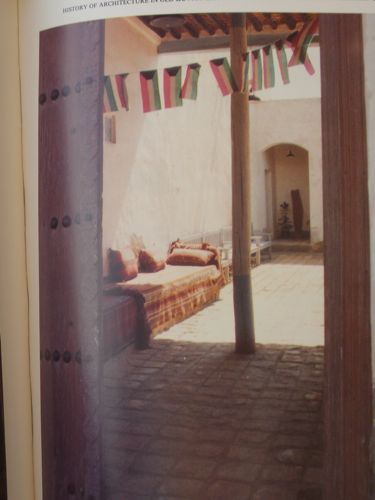
Kuwait is a small nation, with population of one million, that actually has a large influence on people’s behavior; it makes the whole country like one unified family. In the neighborhoods, it is customary to see houses left open and without any security measures, always ready for visitors, which reflects the strength of the relations between neighbors, and the confidence they enjoy. The most distinctive customs are:
1. Large families; average size is eight members. The young generation is trying to minimize the family size. They live in rather large houses, seven to ten bedrooms, which is considered to be an average size house. The house provides privacy for the boys, when they grow up and have their own families.
2. Large family groups, either under one roof or in clustered dwellings, is noticable throughout Kuwait neighborhoods. That reflect the willingness of families and relatives to cooperate and help each other.
3. Newly married sons tend to stay in their parent’s house and share the cooking and dining, so houses have rather large kitchens and dining rooms.
4. Families and relatives visit each other on Fridays and stay for lunch, which is the main meal of the day. The number of visitors varies from 20 – 50 persons, depending on the size of the families. Men and women visit in separate rooms, since separation of males and females is part of the custom. (The author notes that he is talking about old habits and traditions that were prevailing in the old city.)
5.All houses have what is called “Dewania” which is a guest room. In well designed houses, two “Dewanias” were furnished, one for males and one for females, since separation between males and females is mandatory as far as the customs are concerned. The “Dewania” has its separate entrance from the rest of the house, which is to provide privacy for the inhabitants and prevent sudden interactions with guests. It is considered bad for a female to be seen by a male guest, and vice versa. In poorly designed houses, the “Dewanias” don’t have proper privacy and seclusion. The men have the habit of visiting the neighborhood “Dewanias” at night for socialization and discussion of daily matters. In the past the “Dewanias” were the only news sources for the people. Different “Dewanias” are known by the last name of the owners. Hot tea and Arabian coffee are served on a regular basis and in big events like celebrations, “Eads”, wedding parties, and so forth, big feasts held for families, friends and neighbors.
6. “Chay Aldaha”, or afternoon tea at which it is customary for women to visit each other and gossip. Hot tea and cookies are served for refreshment. “Chay Aldaha” is held in the female “Dewania” to ensure privacy for female guests and to prevent sudden embarrassing interactions with male inhabitants.
7. Women are dressed in conservative clothes when they go out; the face and the two hands are the only parts of the body which are exposed. (The author makes a note that he is talking about old habits and traditions which were prevailing in the city) Privacy for women inside the house is an important factor. They should not be seen from the outside while they are doing their daily housework, and should not be in the way when male guests are visiting in the house.
As you can see, the winds of change have blown through Kuwait creating many, many changes. This book captures a slice of time in Kuwait history, and a wealth of information you don’t even know you know. The ways Kuwaitis lived for generations have changed, just in the last 20 years. I was particularly taken with the author’s mention – several times – that women should not be seen tending to their daily housework – how many Kuwaiti women do you know who are doing housework?
There is a current controversy regarding removal of diwaniyyas constructed on public grounds – if this is an old and accepted tradition, perhaps some adjustment can be made, particularly where the diwaniyyas are not impeding public transport or walking paths? Perhaps some can be “grandfathered”, i.e. exceptions made because of historical location?
Meanwhile, my Kuwaiti friends, sorry for boring you with these descriptions of your family dwellings; you already know all this, but the rest of the world does not, and I wanted to share this with those who follow this blog because they find you exotic and fascinating. 🙂 You really need to add this book to your libraries, as a record of a way of life that seems to be slipping all to quickly into the past.
Saudi Men Arrested for Flirting
This is in today’s BBC News.
Saudi men arrested for ‘flirting’
Relations between the sexes outside marriage is against the law
Prosecutors in Saudi Arabia have begun investigating 57 young men who were arrested on Thursday for flirting with girls at shopping centres in Mecca.
The men are accused of wearing indecent clothes, playing loud music and dancing in order to attract the attention of girls, the Saudi Gazette reported.
They were arrested following a request of the Commission for the Promotion of Virtue and Prevention of Vice.
The mutaween enforce Saudi Arabia’s conservative brand of Islam, Wahhabism.
Earlier in the month, the authorities enforced a ban on the sale of red roses and other symbols used in many countries to mark Valentine’s Day.
The ban is partly because of the connection with a “pagan Christian holiday”, and also because the festival itself is seen as encouraging relations between the sexes outside marriage, punishable by law in the kingdom.
You can read the whole article HERE.
I wonder . . . is this what is going to happen in Kuwait? So like they segregate the university. . . then they segregate all the schools, EVEN THE PRIVATE SCHOOLS, so there is no choice. . . then they start patrolling the malls?
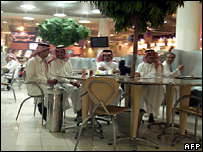
I lived in Saudi Arabia, and I remember the mutawaaeen were NOT police, but sometimes they took on the prerogatives of the police. So I have to wonder, like who made the arrest in the malls? Was it the police? Was it the mutawa hitting the boys with their little sticks? Did they call the boys parents? I have SO many questions!
How Decisions are Made in Kuwait
Here is the problem expats have in any country: you don’t know what you don’t know.
If you know you don’t know something, you can learn it. If you don’t know that you don’t know, there is this huge void in your understanding. Many times you can suspect there is a void, and if you ask, people will look at you like you are a little odd, and they will tell you there is no difference.
There IS a difference.
Working together with people of different nationalities, I have learned that some nationalities just forge on ahead and do things. Some nationalities use a more consultative process. Some nationalities expect to be told what to do and don’t do what they are not told to do.
In Friday’s Kuwait Times (February 21) is a column by Shamael Al-Sharikh, called The red, white, green and black. She talks about Kuwait National and Liberation Days, she talks about the shared heritage of all Kuwaitis (honestly, I would love to link you directly to this article but the website is still down) and then – I got a huge “AHA!” She talks about how decisions are made in Kuwait. I will quote a brief section, but I urge you all to find this column and read it in it’s entirety.
“. . . it has become painfully clear that there are nationals of this country who have no sense of belonging to it whatsoever.
However, the storm is about to subside. In a move that shows just how ready Kuwaitis are to mobilize for the sake of their national pride, a few diwaniyas in Kuwait signed a petition and sent it to the Takatul Shaabi political alliance at the National Assembly. It stated that unless MPs Adnan Abdulsamad and Ahmad Lari are asked to withdraw their membership from the Takatul Shaabi, none of it’s members will be welcome in Kuwait’s diwaniyas nor at weddings and funerals.
The move worked: the MPs have been asked to leave. . . the petitions included diwaniyas from all corners of the Kuwaiti society, both Sunni and Shiite, and it covered all sorts of ethnic backgrounds. . . I have never been more proud to support the red, white, green and black than I have now, and I am so proud to be a Kuwaiti.”
Not being welcome in diwaniyas, at weddings or at funerals is not something I would have considered political pressure. It matters here. It mattered enough that when diverse communities within Kuwait made the threat, it was effective. Who knew? Thanks to this column, I learned something I didn’t even know I didn’t know.
Corrupt Officials Beware
I don’t usually type out the whole article from the Kuwait Times, but because this one is so small, and buried way down on the page, I am making an exception and typing in the whole thing:
Responding to recent stories published by Al-Rai concerning alleged violations and corruption cases committed by ministers and MPs, HH the Prime Minister Sheikh Nassar Al-Mohammed noted that HH the Amir had instructed them to enforce the law to everybody. “And you can start with enforcing it on me,” the prime minister added.
Sheikh Nassar pointed out that the law would be enforced on everybody, be them (sic) (they) senior or minor officials. He added that he had instructed all concerned law-enforcement authorities to treat everyone equally with no exceptions at all.
Comment: WOOOO HOOOOOOOOO, HH Prime Minister Sheikh Nassar Al-Mohammed and BIG WOOOO HOOOOOOOOOOO to HH the Emir! If I knew how to make red letters, this would be a big RED letter day! WOOOOO HOOOOO law enforcement!
Parking Hall of Shame
Just four spots away was a legitimate spot, but no! This guy has to leave his rear end half out into the driving lane so that he could be right by the door. I am guessing he only parked there because all the handicapped spots were already taken (by able bodied people.)
The other day I heard a woman say that it is OK to park in a handicapped spot if no one else has taken it because it means that no handicapped person needs it.
What ignorance!
What happens when someone with a leg injury comes looking for that spot? Someone with asthma? Someone old, with joint problems? People who park in a handicapped spot have NO HEART!

Bulletin: New Kuwait Traffic Laws
From today’s Arab Times:
New traffic law enacted: e-mails
KUWAIT : Several people on Monday received e-mails and SMS messages on the new traffic fines allegedly imposed by the Interior Ministry. Sources at the Ministry refused to deny or confirm the messages but said a new traffic law will be implemented soon.
(Comment: Holy Smokes! Did the bloggers and e-mailers get it right???)
Kuwait Weirdness
This is such a small thing, but just TOO WEIRD! In the tiny little weather forecast in today’s Kuwait Times, it says that today’s weather will reach a high of 48°C and tonight will reach a low of 32°C. Like Weather Underground says 24°C/14° – that’s very different. It was hot today, but much more like 24° than a summery 48°C (118.4°F.)
More weirdness – isn’t there any warning when a major road is going to close, you know, like GULF ROAD??? I was caught in the quagmire today, trying to get home and not able to get on Gulf Road and seeing all the north-south major roads in total gridlock. What is this??? I never saw a word, not in Arab Times, not in Kuwait Times, not in the blogs – did anyone know this was coming?
Lighten Up!
More from Arab Times – guys, it’s just for fun. It’s just a day for sweet cards and taking your sweetie out for dinner – this isn’t a pagan anything.
Seeing red on roses … Group warns on Valentine’s Day
KUWAIT : Thawabet Al Umma, an Islamic group, has condemned the celebration of Valentine’s Day and warned the media against misguiding Muslims by “glorifying such pagan practices.” The media is playing an important role in popularizing such celebrations and leading Islamic nations on the path of disbelief, the group added. “Such traditions are imported from the West, and people blindly follow them without looking into the good and bad aspects. Participating in such celebrations will tarnish the image of Islam.”
Recent Comments
ExpatAlien on What Country am I Living … intlxpatr on Yellowstone: Old Faithful to C… Michelle on Yellowstone: Old Faithful to C… Cathy on No Grown-Ups in Charge intlxpatr on Waiting for Snow Wikipedia Donate Button

Amazina


Early Voting in Florida


 Here There and Everywhere