Exercise to Counter Mild Depression
Today in BBC Health News something we all knew intuitively, but studies are showing it to be true – if you are depressed, exercise can help deal with the symptoms.

Exercise aids depression, say GPs
Doctors are increasingly prescribing exercise for people with depression, mental health campaigners have found. In a survey of 200 English GPs, the Mental Health Foundation found 22% suggest exercise to help people with milder forms of the condition.
This compares with just 5% in a similar survey three years ago.
The foundation said it was important that doctors did not just prescribe antidepressants for patients, and looked for other options.
Tackling isolation
Research has shown that exercise can help people with mild forms of depression by improving self-esteem – through better body image or achieving goals, and by relieving feelings of isolation which can fuel their depression.
It also releases feel-good brain chemicals such as endorphins.
You can read the entire article HERE>
Kung hei fat choi/恭喜發財
Congratulations on the New Year and be prosperous!
Chinese New Years is when people travel for days to be with their family for this lunar celebration. There are special foods, special greetings and different activities scheduled for the different days. The Chinese New Year starts today, and the new year is The Year of the Rat.

Those born in The Year of the Rat from Wikipedia:
Being the first sign of the Chinese zodiacs, rats are leaders, pioneers and conquerors. They are charming, passionate, charismatic, practical and hardworking. Rat people are endowed with great leadership skills and are the most highly organized, meticulous, and systematic of the twelve signs. Intelligent and cunning at the same time, rats are highly ambitious and strong-willed people who are keen and unapologetic promoters of their own agendas, which often include money and power. They are energetic and versatile and can usually find their way around obstacles, and adapt to various environments easily. A rat’s natural charm and sharp demeanor make it an appealing friend for almost anyone, but rats are usually highly exclusive and selective when choosing friends and so often have only a few very close friends whom they trust.



Behind the smiles and charm, rats can be terribly obstinate and controlling, insisting on having things their way no matter what the cost. These people tend to have immense control of their emotions, which they may use as a tool to manipulate and exploit others, both emotionally and mentally. Rats are masters of mind games and can be very dangerous, calculative and downright cruel if the need arises. Quick-tempered and aggressive, they will not think twice about exacting revenge on those that hurt them in any way. Rats need to learn to relax sometimes, as they can be quite obsessed with detail, intolerant and strict, demanding order, obedience, and perfection.
Rats consider others before themselves, at least sometimes, and avoid forcing their ideas onto others. Rats are fair in their dealings and expect the same from others in return, and can be deeply affronted if they feel they have been deceived or that their trust has been abused. Sometimes they set their targets too high, whether in relation to their friends or in their career. But as the years pass, they will become more idealistic and tolerant. If they can develop their sense of self and realize it leaves room for others in their life as well, Rats can find true happiness.
According to tradition, Rats often carry heavy karma and at some point in life may face an identity crisis or some kind of feeling of guilt. Rats are said to often have to work very long and hard for everything they may earn or have in life. However, a Rat born during the day is said to have things a bit easier than those who are born at night. Traditionally, Rats born during the night may face extreme hardships and suffering throughout life. Rats in general should guard themselves against hedonism, as it may lead to self-destruction. Gambling, alcohol and drugs tend to be great temptations to Rat natives.
Traditionally, Rats should avoid Horses, but they can usually find their best friends and love interests in Monkeys, Dragons, and Oxen.
Professions include espionage, psychiatry, psychology, writing, politics, law, engineering, accounting, detective work, acting, and pathology.


One of the best part of Chinese New Years – if you are a young person – is the RED Envelopes, full of money. One of the worst parts of Chinese New Years if you are a grown up is passing out all the RED envelopes, full of money (groan!)
“Arab Education Falling Behind”
In a study recently released, the World Bank reports that education in the Arab World is falling behind. You can read the entire article HERE at BBC Middle East News:
The World Bank has said the quality of education in the Arab World is falling behind other regions and needs urgent reform if it is to tackle unemployment.
In a report, Bank officials said Arab states had to make improving education their top priority, because it went hand-in-hand with economic development.
The region had not seen the increasing literacy and school enrolment witnessed in Asia and Latin America, they said.
Djibouti, Yemen, Iraq and Morocco were ranked the worst educational reformers.
The bright spot? Here is one of the concluding paragraphs:
The report concluded that Jordan and Kuwait were the top educational reformers in the region, while Djibouti, Yemen, Iraq and Morocco ranked lowest in terms of access, efficiency and quality of education.
(An editorial Wooooo Hooooooo to Kuwait!)
“Bookstores, Bathouses, Bars . . . “
I’m following The Shield, a hard-edged detective show I have followed, when I can, ever since Glen Close was the police chief. If you thought Glen Close was tough as Cruella de Ville, wish you could see her as police chief/ 😉

The guy standing next to her is Detective Vic Mackey, a renegade plainclothes cop who plays fast and loose with the system. You know me, Mrs. Law and Order – whoda thunk I would find myself rooting for this guy as he undergoes close scrutiny from the Internal Affairs Division. He’s really a bad guy. He does really bad things. He is a LIAR! He lies to everybody! He kills people, he steals dope and money. And somehow you find yourself pulling for him. I don’t know why.
But the reason I am writing about this is because in yesterday’s episode, a couple guys get their private organs caught in rat traps because they stuck their organ in a place called a “glory hole” for a little excitement and got more than they had bargained for (ouch). See what you can learn from these shows? And this is on during daylight viewing hours?
So the new police chief, a very cool and tough black woman, tells the detectives to go check “bookstores, bathhouses, bars, you know, the places these perverts hang out. . . ” and I am thinking “BOOKSTORES?” BOOKSTORES?? I hang out in bookstores all the time! I never see any perverts at the Barnes and Noble, or Half Price Books!
The things you learn on televison. I hope children are not watching this show!
Ring Roads to be Modified
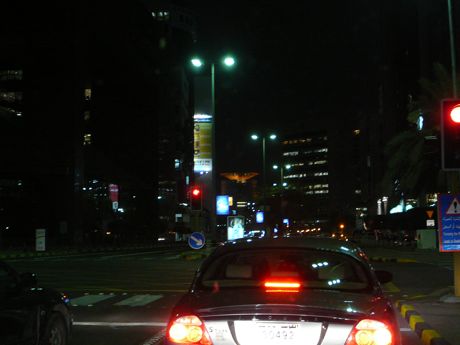
Here is another very small article in the Kuwait Times that is about to have a big impact on all our lives.
Roads to be Modified
The Ministry of Public Works, in cooperation with an international consultation office, recently signed a contract to develop and modify the Second Ring Road, the Third Ring Road, Cairo street and Damascus street. The contract includes the construction of bridges and tunnels on the road’s current intersections and building new intersections if necessary. The contract was signed by Minister of Public Works and MInister of Municipality Affairs Moussa As-Sarraf and has an estimated cost of KD 1.2 million and a duration of 18 months.
It’s going to be a mess, but if it has been well thought through, it should be SO worth it. Already, traffic along the Gulf Road at Bida’a (formerly Bida’a circle) has improved enormously – and I bet the accident rate there has already dropped, too.
Doesn’t that sum sound meager for so much anticipated improvement? Like KD 1.2 million is about the cost of building a serious villa in Kuwait these days, isn’t it? Bridges and tunnels are costly – and labor intensive. That just sounds like a bargain for all the work that is going to be done.
Obvious Paternity
Today’s LOL from I Can Has Cheezburgers – no DNA testing necessary:

moar funny pictures
Cab Ride
When I received this in the e-mail this morning, I realized I had read it before. I read through it anyway, and was every bit as moved as when I read it the first time, and so, I share it with you.
Twenty years ago, I drove a cab for a living. When I arrived at 2:30 a.m., the building was dark except for a single light in a ground floor window. Under these circumstances, many drivers would just honk once or twice, wait a minute, and then drive away. But I had seen too many impoverished people who depended on taxis as their only means of transportation. Unless a situation smelled of danger, I always went to the door. This passenger might be someone who needs my assistance, I reasoned to myself.
So I walked to the door and knocked. “Just a minute”, answered a frail, elderly voice. I could hear something being dragged across the floor. After a long pause, the door opened. A small woman in her 80’s stood before me. She was wearing a print dress and a pillbox hat with a veil pinned on it, like somebody out of a 1940s movie. By her side was a small nylon suitcase. The apartment looked as if no one had lived in it for years. All the furniture was covered with sheets.
There were no clocks on the walls, no knickknacks or utensils on the counters. In the corner was a cardboard box filled with photos and glassware. “Would you carry my bag out to the car?” she said. I took the suitcase to the cab, then returned to assist the woman. She took my arm and we walked slowly toward the curb. She kept thanking me for my kindness “It’s nothing”, I told her. “I just try to treat my passengers the way I would want my mother treated”. “Oh, you’re such a good boy”, she said.
When we got in the cab, she gave me an address, and then asked, “Could you drive through downtown?”
“It’s not the shortest way,” I answered quickly.
“Oh, I don’t mind,” she said. “I’m in no hurry. I’m on my way to a hospice”.
I looked in the rear-view mirror. Her eyes were glistening. “I don’t have any family left,” she continued. “The doctor says I don’t have very long.” I quietly reached over and shut off the meter.
“What route would you like me to take?” I asked.
For the next two hours, we drove through the city. She showed me the building where she had once worked as an elevator operator. We drove through the neighborhood where she and her husband had lived when they were newlyweds. She had me pull up in front of a furniture warehouse that had once been a ballroom where she had gone dancing as a girl.
Sometimes she’d ask me to slow in front of a particular building or corner and would sit staring into the darkness, saying nothing. As the first hint of sun was creasing the horizon, she suddenly said, “I’m tired. Let’s go now.”
We drove in silence to the address she had given me. It was a low building, like a small convalescent home, with a driveway that passed under a portico. Two orderlies came out to the cab as soon as we pulled up. They were solicitous and intent, watching her every move. They must have been expecting her. I opened the trunk and took the small suitcase to the door. The woman was already seated in a wheelchair.
“How much do I owe you?” she asked, reaching into her purse.
“Nothing,” I said. “You have to make a living,” she answered. “There are other passengers,”
I responded. Almost without thinking, I bent and gave her a hug. She held onto me tightly. “You gave an old woman a little moment of joy,” she said. “Thank you.” I squeezed her hand, and then walked into the dim morning light. Behind me, a door shut. It was the sound of the closing of a life.
I didn’t pick up any more passengers that shift. I drove aimlessly lost in thought. For the rest of that day, I could hardly talk. What if that woman had gotten an angry driver, or one who was impatient to end his shift? What if I had refused to take the run, or had honked once, then driven away? On a quick review, I don’t think that I have done anything more important in my life.
We’re conditioned to think that our lives revolve around great moments. But great moments often catch us unaware – beautifully wrapped in what others may consider a small one. People may not remember exactly what you did, or what you said, but they will always remember how you made them feel.
Stop Means Stop!
From time to time, we can hear the police pulling people over outside our residence. It gives us a big grin. One of the things they say, in English, is:
“Hey Buddy! Pull over!”
And the other thing they say is:
“Stop means STOP!”
We hear these two phrases over and over, so it must be part of their training.

Leon: Friends in High Places
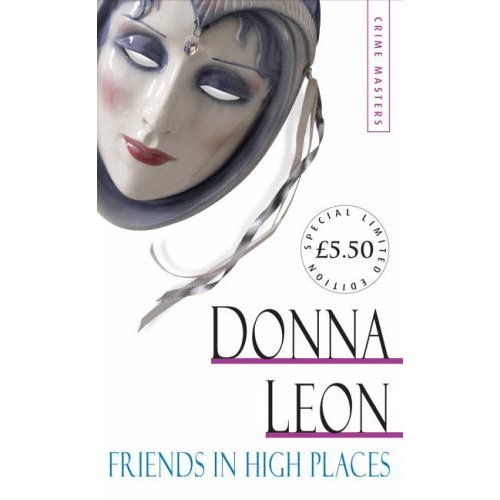
After reading two stinkers, I needed a read I could rely on for a good fix. I needed escape, mixed with good food, good clothes and some social awareness. I needed Guido Brunetti, Donna Leon’s Venetian detective, and his smart, savvy wife Paula, and his family meals of pasta with soft shell crabs and risi e bisi, his children, his disgust for the politics that impinge on his doing his job.
If you think Kuwait has “wasta” (doing business by connections, influence, calling in favors), you aint’ seen nuthin’ till you’ve seen how Byzantine Venetians operate.
Friends in High Places opens with Commissario Brunetti lying on his couch re-reading Anabasis when he receives a visit from a building inspector, who determines that the apartment he owns, on the very top of a building in Venice, was probably built illegally – there are no plans or restoration approvals on file at the bureaucracy regulating residential buildings in Venice – and may have to be torn down.
Wouldn’t that be a shock? It’s a shock to Brunetti and to his family, just as it would be to us. We learn all the ins and outs of housing codes, the impact of becoming part of the EEC, and how the clever Venetians devise ways around the codes, all while Brunetti is investigating one murder – and then three other murders.
It is a VERY satisfying book. I will share with you a lengthy quote from Friends in High Places as Guido and Paola discuss how to deal with the problem:
At no time did it occur to him, as it did not occur to Paola, to approach the matter legally, to find out the names of the proper offices and officials and the proper steps to follow. Nor did it occur to either of them that there might be a clearly defined bureaucratic procedure by which they could resolve this problem. If such things did exist or could be discovered, Venetians ignored them, knowing that the only way to deal with problems like this was by means of conoscienze: acquaintances, friendships, contacts and debts built up over a lifetime of dealing with a system generally agreed, even by those in its employ, perhaps especially by those in it’s employ, prone to the abuses resultant from centuries of bribery, and encumbered by a Byzantine instinct for secrecy and lethargy.
I am sorry to tell you that the only copy of this I could find on Amazon.com cost $99.98. I must have bought this one in England, where, I promise you, it was the normal cost of a paperback book.
I will warn you in addition, I was looking forward to reading a second Leon novel, Quietly in their Sleep, only to discover when I started that I had already read it, as The Death of Faith. The books published by Leon in England are often retitled for the American market. Leon fans, beware!
New Fatwa; Sabeeh set to survive
In today’s Friday Kuwait Times (it’s not online today, so I can’t reference it directly) is an article by B Izzak stating Sabeeh set to survive vote.
It’s a very interesting article, telling how some of the key players are lining up.
In paragraph five, we find this:
In a related development, MP Duaij Al-Shimmari, a member of the Islamic Constitutional Movement (ICM), or Muslim Brotherhood, yesterday distributed a Fatwa (or religious edict) which clearly supports women being appointed as ministers.
Duaij said he received te Fatwa from Sheikh Ajeel Al-Nashmi, a highly respected cleric, which said that a minister’s post is allowed by Islam for women and thus supporting the no-confidence vote against Sabeeh or opposing it should entirely depend on her replies and not on her being a woman.
Wooo Hooooooooo! Equality means just that – judge women, as men, on the issues and their performance. Hold them accountable – just as you would a man.
Recent Comments
ExpatAlien on What Country am I Living … intlxpatr on Yellowstone: Old Faithful to C… Michelle on Yellowstone: Old Faithful to C… Cathy on No Grown-Ups in Charge intlxpatr on Waiting for Snow Wikipedia Donate Button

Amazina


Early Voting in Florida


 Here There and Everywhere