We Do Not Have Homosexuals in Iran
I found this clip through Global Voices Kuwait who got it from somewhere else, too! Isn’t the net great?
Mahmud Ahmadinejad,Iranian president,said,in Columbia University,”we do not have homosexuals in Iran like you do in your country.” He brought the house down. Most just laughed, a few boo-ed.
The Columbia University president has taken a lot of criticism for his decision to have Ahmadinejad speak. He stuck to his guns.
You can see the film clip for yourself here: We Do Not have Homosexuals in Iran.
We Share the Road
Look closely. Look at the third set of wheels back, second set from the right. I know, I know, it is very difficult to see the tread. That’s because there is NO tread left on this tire.

Other tires on this truck were already shredding. Look, the one just in front of the bare-tread tire had some kind of exterior coating kind of thing on it, like a whole tire patch of some kind, also shredding. He is carrying a heavy load load. This is a disaster waiting to happen.
To my left is a police car.
I can’t remember? Is Kuwait the #1 most dangerous country for driving in the world, or the #2?
Kuwait Infant Mortality Rate
This very sad little item is from last week’s Kuwait Times:
Officials at the Ministry of Health disclosed that deaths among newborn infants were increasing at an alarming rate in Kuwait due to premature births and delayed deliveries over the past couple of years. The rate they said, touched 17.9 per thousand during the year 2006, in addition to the drastic decline in the quality of healthcare accorded to newborn infants. They called for urgent decisions to be taken to improve the healthcare for newborn infants.
Deaths among infants increased from 8.4 per thousand in the year 2005 to 9.1 per thousand during 2006.
The Jahra Governorate reported the highest rate of deaths among infants. Statistics indicated that 28.9 percent of the infants’ deaths were caused due to the short pregnancy period and inadequate weight of the infants when born and 17.2 percent were caused by various congenital deficiencies.
Ayb! Ayb!* Parking Hall of Shame
I am not outraged just because I passed up these two spots, both empty, once I saw the sign, which you will notice is in Arabic, English and just in case you can’t read, also in sign language. NO PARKING!
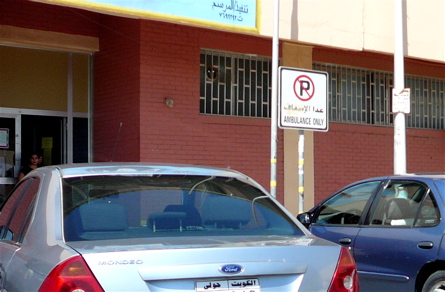
I am not outraged just because only about 20 feet from these two spots are also parking spots, it just means walking a few more feet in the hot sun, no, not rock star parking, but not like walking a couple hundred meters, either.
I am outraged because these were WOMEN. WOMEN! We know better! We have aging mothers and children, we sometimes NEED special treatment, but these women who parked here were both ample and able. Actually, in the first photo, I was so angry, I had the women as they got out of their cars, but I took a deep breath, and decided that would NOT be a good idea in case I ever want to go here again. They might beat me up! They might arrest me for insulting them!
But I am insulted. This is Ramadan, people are fasting, and it is hot hot hot, even though it is cooling down a little. Women faint, men get electrolyte imbalances, and people need ambulances. THIS is AMBULANCE PARKING.
There is something in each of us that believes in variations of Locard’s Exchange Principal where anytime two people come into contact they exchange some physical matter, no matter how small. On some level, when we say “what goes around comes around” we are applying the same physical properties to the spiritual world, and why not? Are we not taught that we are to treat our neighbors as we would want to be treated?
So my fear for these women who would park in an ambulance spot is that one day they would need an ambulance, and find that the ambulance cannot park because someone is parked in the ambulance spot. I wouldn’t wish that on anyone.
*Shame! Shame!
Donna Leon: Wilful Behavior
You think Donna Leon is writing about one thing, and then you discover it is about something else entirely. It seems to happen often in that line of work – you see the same thing on Law and Order, and Cold Case, and The Wire – what initially seems like a straightforward crime had depths and switch-backs unfathomable from the initial crime scene.
In Wilful Behavior, Paula, Brunetti’s wife, has just about had it with her university level students. They have no yearning for knowledge and insight, they are rife with materialism, she is feeling burned out and cynical. One student, who bucks the trend, comes to talk with her, and then Brunetti about the possibility of a post-mortem clearing of a person’s name, but she won’t give the name of the person or the crime that person committed. Before Commissario Brunetti has begun to plumb these depths – the student is murdered.
It’s always depressing when a young person dies. You can’t help but think of how treasured they were, how full of potential, and all that is gone now, wasted. A light in the world has gone out, and you grieve for how brightly that light might have shown. Brunetti and his wife only knew the murdered girl briefly, but her murder strikes them deeply.
Here is an excerpt from Brunetti’s discussion with the student before she was killed:
“I didn’t know young people even knew who Il Duce was.” Brunetti said, exaggerating, but not by much, and mindful of the almost total amnesia he had discovered in the minds of anyone, of whatever age, with whom he had attempted to discuss the war or its causes. Or worse, the sort of cock-eyed, retouched history that protrayed the friendly, generously disposed Italians led astray by their wicked Teutonic neighbors to the north.
The girl’s voice drew him back from these reflections. “Most of them don’t. This is old people I’m talking about. You’d think they’d know or remember what things were like then, what he was like.” She shook her head in another sign of exasperation. “But no, all I hear is that nonsense about the trains being on time and no trouble from the Mafia and how happy the Ethiopians were to see our brave soldiers.” She paused as if assessing just how far to go with this conservatively dressed man with the kind eyes; whatever she saw seemed to reassure her, for she continued. “Our brave soldiers come with their poison gas and machine guns to show them the wonders of Fascism.”
So young and yet so cynical, he thought, and how tired she must be already of having people point this out to her. “I’m surprised you aren’t enrolled in the history faculty,” he said.
“Oh, I was, for a year. But I couldn’t stand it, all the lies and dishonest books and the refusal to take a stand about anything that’s happened in the last hundred years.”
“And so?”
“I changed to English Literature. The worst they can do is make us listen to all their idiotic theories about the meaning of literature or whether the text exists or not.” Hearing her, Brunetti had the strange sensation of listening to Paula in one of her wilder moments. “But they can’t change the texts themselves. It’s not like what the people in power do when they remove embarassing documents from the State Archives. They can’t do that to Dante or Manzoni, can they?” she asked speculatively, a question that really asked for an answer.
“No,” Brunetti agreed. “But is suspect that’s only because there are standard editions of the basic texts. Otherwise, I’m sure they’d try, if they thought they could get away with it.” He saw that he had her interest, so he added, “I’ve always been afraid of people in possession of what they believe is the truth. They’ll do anything to see that the facts are changed and whipped into shape to agree with it.”
And, as it turns out, in the persistent corruption of Venetian bureaucracy, that is exactly what this murder is all about – the theft and possession of art during WWII, and how the ramifications are still trickling down today. How people are willing to kill to keep the past safely in the past, and to hang on to their treasured and priceless possessions.
Donna Leon continues to be one of my favorites because she is never formulaic – she has ISSUES, and she uses her Brunetti novels to educate her readers. As we become educated, we continue to experience Venice through all the senses, the smell of the veal cooking for dinner, the taste of the tiny espressos in the corner cafe meeting places, the gruesome murder sites, the sound of the waves in the canals, whipped up by the prevailing winds . . .you read Donna Leon, you become Venetian.
A Thousand Splendid Suns
Once I picked up Khaled Hosseini’s A Thousand Splendid Suns, I barely put it down again until I was finished. I found myself thoroughly involved in the lives of Mariam and Leila, unwilling even to stop to fix dinner! The author of Kiterunner has hit another home run.
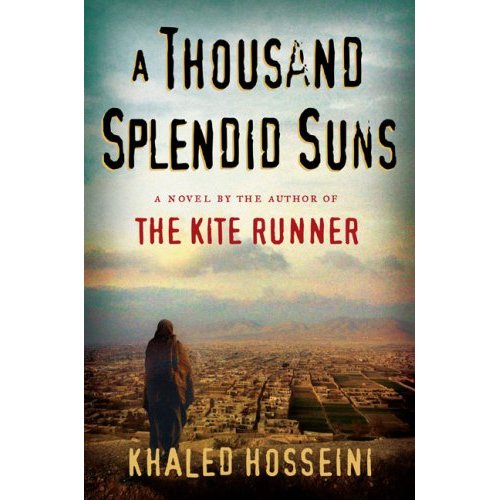
There was a time when we would listen to older state department types talk – with enormous longing – about their tours of duty in Afghanistan, pre-Soviet invasion, pre-Taliban, pre-American occupation. Have you ever read James Michener’s Caravan? There are two countries I long to vist, but the countries they are now are not the countries I heard people talk about – Afghanistan and Ethiopia. Our friends loved their times in these two countries.
A Thousand Splendid Suns opens in a small village outside Herat, and then takes us to Kabul. Mariam is born harami, a bastard, of a village cleaning woman in the house of a very wealthy man. Her father builds a small hut for her mother and herself in a remote part of the small village, and visits Mariam every week. Life is simple, and difficult, but also full of kind people who visit and who are concerned with Mariam’s welfare.
After marrying, Mariam goes to Kabul and learns a new way of life with her husband, Rasheed. What fascinates me with Hosseini is that while Rashid is one of the villians of this novel, he is just a man, doing the best he can given his own upbringing and limitations. In a sense, he is “everyman”, the strutting, domineering, sometimes brutal and abusive husband we find in every culture. But Hosseini also gives him transient bouts of kindness which blow through a little less often than the transient bouts of cruelty.
He also gives us good men, in this book, in the person of Jalil, the father of Mariam, who steps up to the plate in acknowledging Mariam and supporting her and her mother, but fails to nurture in the very real way women need nurturing from their fathers in order to reach their full potential in life. Hosseini also gives us a very strong man in the book, Tariq, who, although he has only one leg, is more wholly a man than any other man in the book. I imagine that this is not unintentional. (How Kissingerian is that for a double negative?!)
Written almost entirely in the Afghan world of women, we see through the eyes of Mariam, and later Leila, the transitions in Afghanistan and their impacts on daily life. We experience happiness with them, and peaceful scenes in quiet moments, raising the children, stepping outside into the garden at night to share a cup of tea and a shared bowl of halwa.
Between the moments of peacefulness, we also experience incoming morter rounds, explosions, marauding bands of warlords, and starvation. We go into a women’s hospital under Taliban control, where there are no medications, no running water, no instruments, and an Afghani female doctor does a C-section with no anaesthesia and is required to keep her burqa on. We watch a mother abandon her role and take to her bed when her two sons are killed fighting the Soviets, we experience betrayal and we experience helplessness, and we experience a Kabul women’s prison. A Thousand Splendid Suns is a rich feast of experiences, juxtaposing the everyday chores of women around the world – cooking, raising children, laundry – with events on the world stage.
(Available from Amazon for $14.27 plus shipping.)
K-Ville premiers tonight
Notice today from Amazon:
we thought you’d like to know that K-Ville, the new crime action series starring Anthony Anderson and Cole Hauser, premieres Tonight at 9/8c on FOX.
From writer and executive producer Jonathan Lisco (NYPD Blue, The District) comes K-Ville, a new police drama set and filmed in New Orleans. Marlin Boulet (Anthony Anderson) is a brash veteran of the NOPD’s Felony Action Squad, the specialized unit that targets the most-wanted criminals. He also held his post during Hurricane Katrina, spending days in the water saving lives and keeping order, even after his partner deserted him. Boulet’s new partner, Trevor Cobb (Cole Hauser), was a soldier in Afghanistan before joining the NOPD. Though committed to his new job, he’s less than comfortable with Boulet’s methods – and is harboring a dark secret.
Here is the official website:
I don’t know how to get these things and it just isn’t that important to me, but you tech-savvy people might have some fun with this. And it IS New Orleans! The music is worth a visit, just to view “Anthony gives Cole some advice about gumbo.” 😉
Peter Bowen: Wolf, No Wolf
“You have to take this. You’ll really like it,” Sparkle insisted as I inwardly groaned, thinking of the TWO stacks of unread-must-reads by the side of my bed, and my already bulging suitcases.

“I know it doesn’t sound like something you’ll like,” she went on, slightly frustrated with me, with herself, “but once you start reading, you’ll get into it.”
Not exactly a ringing endorsement, but good enough for me. I always KNOW what I think she will love, and she has done me many a favor in return, introducing me to authors and series worth reading.
“It’s about Montana. The main character is mixed Indian and French and some other things, a grandfather, and it all takes place in a small town in Montana . . . ” she sort of fizzles out. “I’m really not doing a very good job of making this interesting.”
And she sighs in frustration.
So, about a month later, just because I love my sister, I pick the book up and start reading while waiting for my husband to get home for dinner. As it turns out, he is very very late – and I am very very glad. I don’t want to stop reading!
When you first jump into Wolf, No Wolf by Peter Bowen, it takes you a minute to adjust your ear to the way they talk. These aren’t people most of us have met before. Gabriel DuPre´ is m´etis, a mixed blood. His ancestors are French who came early to the great continent that is now the US, Canada and Mexico, and they trapped and hunted, married native American wives, and developed a culture all their own. His language pattern is similar to that of the Cajun in Louisiana.
He is a cattle brand inspector in this small Montana town. His children are grown, he has so many grandchildren he can’t remember all their names. Every now and then, he pins on his deputy sherrif badge to solve a mystery in the small town of Toussaint, Montana.

Here is how Wolf, No Wolf opens:
Du Pre´ fiddled in the Toussaint Bar. The place was packed. some of Madelaine’s relatives had come down from Canada to visit. It was fall and the bird hunters had come, to shoot partridges and grouse on the High Plains.
The bird hungers were pretty OK. The big game hunters were pigs, mostly. The bird hunters were outdoors people; they loved it and knew it, or wanted to. The big game hungers wanted to shoot at something big, often someone’s cows.
Bart had bought a couple thousand dollars’ worth of liquor and several kegs of beer and there was a lot of food people had brought. Everything was free.
Kids ran in and out. The older ones could have beers. Bart was tending bar. Old Booger Tom sat on one of the high stools, cane leaned up against the front of the bar.
“You do that pretty good for someone the booze damn near killed,” said Booger Tom. “I know folks won’t be in the same room with the stuff.”
“Find Jesus,” said Bart. “It’s not too late to save your life.”
He went down to the far end of the bar and took orders. Susan Klein, who owned the saloon, was washing glasses at a great pace.
One of Madelaine’s relatives was playing the accordion, another an electric guitar. They were very good.
Du Pre´ finished. He was wet with sweat. The place was hot and damp and smoky, so smoky it was hard to see across the room. The room wasn’t all that big, either.
Madelaine got up from her seat, her pretty face flushed from drinking the sweet pink wine she loved. She threw her arms around Du Pre´ and kissed him for a long time.
“Du Pre´,” she said, “you make me ver’ happy, you play those good songs.”
. . …
Someday this fine woman marry me, thought Du Pre´, soon as the damn Catholic church, it tell her OK, your missing husband is dead now so you can quit sinning, fornicating with DuPre´.
I’ve never hung out in a bar in Montana, fiddled, or had a girlfriend named Madeleine (!), but already I feel like I know these people and this life. Peter Bowen is the Donna Leon of Montana, introducing us to the kind of crimes that happen in those sleepy looking towns we drive past on the superhighways, glancing at, or stopping to fill our gas tanks.
DuPre´ is a good man, and, like many a good man, sometimes has to do a bad thing to protect those he is sworn to protect. Policing is not pretty business.
The first story has to do with the re-introduction of wolves back into the Montana highlands, something not at all popular with those who have been raising cattle there. The second book in this two-book collection has to do with serial killers, how they stay under the radar, and how very difficult it is to catch them.
In both books, it is as much about a new way of living and thinking as it is about solving the crime. DuPre´ consults often with his friend Benetsee, the local medicine man, who sees things we don’t see. One of the FBI Agents is Harvey Wallace, also more than half native American, whose real name is Harvey Weasel Fat. The books are about how men and women fight, the nature of male friendships and female friendships, and very much about the human condition wherever we may be.
Life is short. I can never live in all these places long enough to even scratch the surface of the flavor of each variety of life. But these books help, they give us glimpses into another way of thinking, another way of doing things, and stretches our little minds just a little so that we learn to think more flexibly.
So who is going to write the Kuwait detective series? Who will take us into the diwaniyyas seeking information, who will take us out on the shoowi to gather information against those delivering drugs to Kuwait, with whom will we camp in the desert, avoiding explosives left over from the Iraqi invasion? I think his name is Anwar al Kout (the light of Kuwait!) and his wife is Suhail (the Yemeni Star!) – somewhere out there is someone who can take us into Kuwait and bring it alive. Where are you?
(You were right, Sparkle. I loved it!)
Feeding Stranded Bangladeshis
In today’s Arab Times is an op-ed piece by the Rev. Andy Thompson on the continuing plight of Bangladeship workers, whose employers stopped paying their 20KD salary PER MONTH (can YOU imagine?) and who now – only want to go home.
Over the summer, many people from many walks of life in Kuwait worked together to help try to see that these men got some food, and then tried to find a more equitable and lasting solution.
By Rev Andy Thompson
St Paul’s Anglican Church, Ahmadi
JUST before the summer holidays started, the Arab Times recorded a disturbing story about the plight of over a thousand Bangladeshi workers who had not been paid their paltry KD 20 a month for many months and so they consequently went on strike. With no money, no hope and living in appalling conditions these workers were at the end of their tether. A subsequent Arab Times article called “You can make a difference”, challenged readers to respond by at least making sure that the Bangladeshi workers did not go hungry. The story had clearly touched the hearts of many Arab Times readers and the response was fantastic. Over the last two months, food has been flowing into the Bangladeshi workers residence. I wish I could publicly acknowledge the many people who helped, but typically they gave generously and anonymously. They include both Kuwaiti and expatriate, rich and poor, Christian and Muslim. They were united in their repulsion of the inhuman and unacceptable treatment by a greedy and unscrupulous company who traded human misery for profit
You can read the rest of the article (and it is worth reading) HERE.
Ramadan for Non-Muslims
Ramadan started last night; it means that the very thinnest of crescent moons was sighted by official astronomers, and the lunar month of Ramadan might begin. You might think it odd that people wait, with eager anticipation, for a month of daytime fasting, but the Muslims do – they wait for it eagerly.
A friend explained to me that it is a time of purification, when your prayers and supplications are doubly powerful, and when God takes extra consideration of the good that you do and the intentions of your heart. It is also a time when the devil cannot be present, so if you are tempted, it is coming from your own heart, and you battle against the temptations of your own heart. Forgiveness flows in this month, and blessings, too.
We have similar beliefs – think about it. Our holy people fast when asking a particular boon of God. We try to keep ourselves particularly holy at certain times of the year.
In Muslim countries, the state supports Ramadan, so things are a little different. Schools start later. Offices are open fewer hours. The two most dangerous times of the day are the times when schools dismiss and parents are picking up kids, and just before sunset, as everyone rushes to be home for the breaking of the fast, which occurs as the sun goes down. In olden days, there was a cannon that everyone in the town could hear, that signalled the end of the fast. There may still be a cannon today – in Doha there was, and we could hear it, but if there is a cannon in Kuwait, we are too far away, and can’t hear it.
When the fast is broken, traditionally after the evening prayer, you take two or three dates, and water or special milk drink, a meal which helps restore normal blood sugar levels and takes the edge off the fast. Shortly, you will eat a larger meal, full of special dishes eaten only during Ramadan. Families visit one another, and you will see maids carrying covered dishes to sisters houses and friends houses – everyone makes a lot of food, and shares it with one another. When we lived in Tunisia, we would get a food delivery maybe once a week – it is a holy thing to share, especially with the poor and we always wondered if we were being shared with as neighbors, or shared with as poor people! I always tried to watch what they particularly liked when they would visit me, so I could sent plates to their houses during Ramadan.
Just before the sun comes up, there is another meal, Suhoor, and for that meal, people usually eat something that will stick to your ribs, and drink extra water, because you will not eat again until the sun goes down. People who can, usually go back to bed after the Suhoor meal and morning prayers. People who can, sleep a lot during the day, during Ramadan. Especially as Ramadan moves into the hotter months, the fasting, especially from water, becomes a heavier responsibility.
And because it is a Muslim state, and to avoid burdening our brothers and sisters who are fasting, even non-Muslims refrain from eating, drinking, touching someone of the opposite sex in public, even your own husband (not having sex in the daytime is also a part of fasting), smoking is forbidden, and if you are in a car accident and you might be at fault, the person might say “I am fasting, I am fasting” which means they cannot argue with you because they are trying to maintain a purity of soul. Even chewing gum is an offense. And these offenses are punishable by a heavy fine – nearly $400 – or a stay in the local jail.
Because I am not Muslim, there may be other things of which I am not aware, and my local readers are welcome to help fill in here. As for me, I find it not such a burden; I like that there is a whole month with a focus on God. You get used to NOT drinking or eating in public during the day, it’s not that difficult. The traffic just before (sunset) Ftoor can be deadly, but during Ftoor, traffic lightens dramatically (as all the Muslims are breaking their fast) and you can get places very quickly! Stores have special foods, restaurants have special offerings, and the feeling in the air is a lot like Christmas. People are joyful!
Recent Comments
ExpatAlien on What Country am I Living … intlxpatr on Yellowstone: Old Faithful to C… Michelle on Yellowstone: Old Faithful to C… Cathy on No Grown-Ups in Charge intlxpatr on Waiting for Snow Wikipedia Donate Button

Amazina


Early Voting in Florida


 Here There and Everywhere