A Child Is Born!
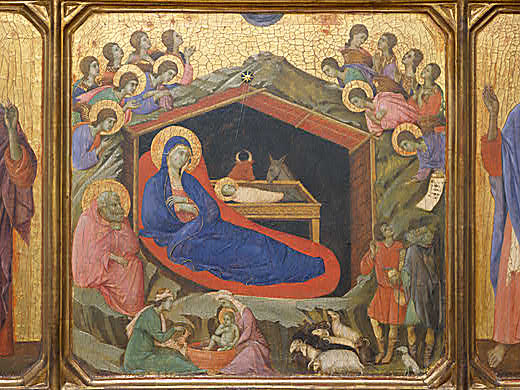
Duccio di Buoninsegna
detail: The Nativity with the Prophets Isaiah and Ezekiel, 1308/1311
Andrew W. Mellon Collection
May the Peace of God fill our hearts with love and compassion, and may it inspire us all to be better neighbors to one another.
Anglican Christmas Services in Doha, Qatar
Children’s Service:
Crib and Christingle Thursday, 24 December 5 pm DESS
Family Services:
Christmas Day Service Friday, 25 December 10:30 am DESS
Christmas Evening Service Friday, 25 December 7:30 pm DESS
If you need additional information, you can email:
epiphany@qatar.net.qa
The church website is:
http://www.epiphany-qatar.org
Peace on Earth, Good Will Towards Men
Today’s reading in Forward Day by Day is a difficult teaching from the prophet Amos, telling us that no, God isn’t on our side. God loves us, and he loves our allies as much as he loves us. And . . . he also loves our enemies – as much as he loves us.
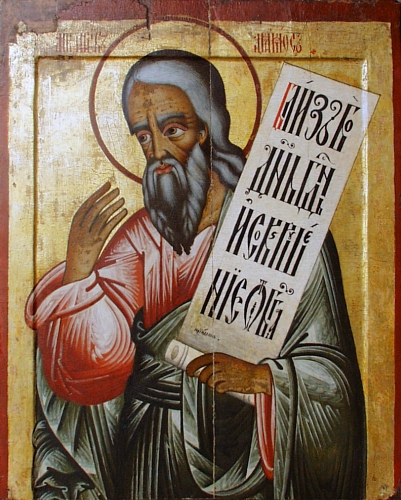
THURSDAY, December 10 International Human Rights Day
Amos 9:1-10. Are you not like the Ethiopians to me, O people of Israel?
Amos is the Bible’s first universalist. Gods in ancient times, including Israel’s god, were seen as localized deities, inhabiting a certain place and exercising power on behalf of the people who lived there, whom they favored over other people. A god’s authority was rather like that of a modern sheriff–one had to pay attention to it, but its jurisdiction was limited by geography.
Then Amos, speaking on behalf of Israel’s god, said the chosen people were no different in God’s eyes than the Ethiopians. If God had done something special for Israel, he had done something special for everyone else, too, including Israel’s sworn enemies. God has no favorites and his authority extends everywhere. In his brusque, in-your-face manner, Amos says one nation is no more precious than another.
In this day of immigration controversy, ethnic suspicion, religious absolutism, xenophobic frenzy, and false patriotism, Amos speaks a sobering word: “You’re no different from anyone else. I love you, but I love your enemy, too, and if you don’t also love your enemy, you are no friend of mine.”
St. Nicholas Eve
I’m putting out a little bit of Christmas, and came across these lovely, Palestinian embroidered towels. I’ve had them for around thirty years, and I still love them:

I’m also thinking – we in the west never hear about Palestinian Christians, of which there are / or used to be (?) many. I know there are groups in Jerusalem, working towards the use of Jerusalem as an inter-faith city, and I know they work closely with Palestinian Christians, but are the numbers of Palestinian Christians as large as they used to be?
Advent is a little like Ramadan, or it is supposed to be. The four weeks leading to Christmas are a time for thoughtful meditation, repentance of wrongful things we have done, and contemplating the birth of that special baby, the Gift of God, in Bethlehem. I love Advent; I love the whole peaceful focus and world-holding-its-breath-waiting-for-this-birth aspect.
A mosaic portrait of St. Nicholas:

He turns a desert into pools of water
One of today’s readings in The Lectionary are these verses from a much longer reading, Psalm 107. When I read these lines, I can’t help thinking how this very dull and flat land, Qatar, this little thumb sticking up into the Gulf, has greened, how the oil and gas have served to green this land, to change its face, and how much money is flowing out from this country to many other countries of the world.
All those of us from far away countries who labor here are benefitting from these springs of wealth, sending money home.
33He turns rivers into a desert,
springs of water into thirsty ground,
34a fruitful land into a salty waste,
because of the wickedness of its inhabitants.
35He turns a desert into pools of water,
a parched land into springs of water.
36And there he lets the hungry live,
and they establish a town to live in;
37they sow fields, and plant vineyards,
and get a fruitful yield.
38By his blessing they multiply greatly,
and he does not let their cattle decrease.
39When they are diminished and brought low
through oppression, trouble, and sorrow,
40he pours contempt on princes
and makes them wander in trackless wastes;
41but he raises up the needy out of distress,
and makes their families like flocks.
42The upright see it and are glad;
and all wickedness stops its mouth.
43Let those who are wise give heed to these things,
and consider the steadfast love of the Lord.
For my Christian readers, Muslims also use the Psalms as holy readings –
“The Qur’an (Surah An-Nisa 4:163) states “and to David We gave the Psalms”. Therefore, Islam confirms the Psalms as being inspired of God.”
Did you know that?
Greeting Your Enemies With a Feast (Elisha)
I love it when I come across a good story I haven’t heard before in my daily readings in The Lectionary and this one is a doozy. I didn’t hear a lot of bible stories about Elisha as I was growing up (Elisha followed Elijah) but this reading includes some amazing stories, including one of the first instances of turning away an enemy with a feast.
2 Kings 6:1-23
6Now the company of prophets* said to Elisha, ‘As you see, the place where we live under your charge is too small for us. 2Let us go to the Jordan, and let us collect logs there, one for each of us, and build a place there for us to live.’ He answered, ‘Do so.’ 3Then one of them said, ‘Please come with your servants.’ And he answered, ‘I will.’ 4So he went with them. When they came to the Jordan, they cut down trees. 5But as one was felling a log, his axehead fell into the water; he cried out, ‘Alas, master! It was borrowed.’ 6Then the man of God said, ‘Where did it fall?’ When he showed him the place, he cut off a stick, and threw it in there, and made the iron float. 7He said, ‘Pick it up.’ So he reached out his hand and took it.
8 Once when the king of Aram was at war with Israel, he took counsel with his officers. He said, ‘At such and such a place shall be my camp.’ 9But the man of God sent word to the king of Israel, ‘Take care not to pass this place, because the Arameans are going down there.’ 10The king of Israel sent word to the place of which the man of God spoke. More than once or twice he warned such a place* so that it was on the alert.
11 The mind of the king of Aram was greatly perturbed because of this; he called his officers and said to them, ‘Now tell me who among us sides with the king of Israel?’ 12Then one of his officers said, ‘No one, my lord king. It is Elisha, the prophet in Israel, who tells the king of Israel the words that you speak in your bedchamber.’ 13He said, ‘Go and find where he is; I will send and seize him.’ He was told, ‘He is in Dothan.’ 14So he sent horses and chariots there and a great army; they came by night, and surrounded the city.
15 When an attendant of the man of God rose early in the morning and went out, an army with horses and chariots was all around the city. His servant said, ‘Alas, master! What shall we do?’ 16He replied, ‘Do not be afraid, for there are more with us than there are with them.’ 17Then Elisha prayed: ‘O Lord, please open his eyes that he may see.’ So the Lord opened the eyes of the servant, and he saw; the mountain was full of horses and chariots of fire all around Elisha. 18When the Arameans* came down against him, Elisha prayed to the Lord, and said, ‘Strike this people, please, with blindness.’ So he struck them with blindness as Elisha had asked. 19Elisha said to them, ‘This is not the way, and this is not the city; follow me, and I will bring you to the man whom you seek.’ And he led them to Samaria.
20 As soon as they entered Samaria, Elisha said, ‘O Lord, open the eyes of these men so that they may see.’ The Lord opened their eyes, and they saw that they were inside Samaria. 21When the king of Israel saw them he said to Elisha, ‘Father, shall I kill them? Shall I kill them?’ 22He answered, ‘No! Did you capture with your sword and your bow those whom you want to kill? Set food and water before them so that they may eat and drink; and let them go to their master.’ 23So he prepared for them a great feast; after they ate and drank, he sent them on their way, and they went to their master. And the Arameans no longer came raiding into the land of Israel.
St. David P. Oakerhater
Another ‘who knew? ‘ I found this in the Lectionary readings for today – a Native-American saint:
DEACON AND MISSIONARY (1 SEP 1931)
David P. Oakerhater (born around 1850) was a warrior and leader of the Cheyenne Indians of Oklahoma, and led a corps of fighters against the United States government in a dispute over Indian land rights. In 1875 he and 27 other military leaders were taken prisoner by the U S Army and sent to a military post in Florida. There, thanks to the efforts of a concerned Army captain, they learned English, were encouraged to earn money by giving art and archery lessons to visitors, and encountered the Christian faith. David and three others were moved to become Christians and to go north to study for the ministry. David was baptized in Syracuse, New York, in 1878, and ordained to the diaconate in 1881. He returned to Oklahoma and there founded schools and missions, and continued to work among his people until his death on 31 August 1931. When he first returned to Oklahoma in 1881, he said:
You all know me. You remember when I led you out to war I went first, and what I told you was true. Now I have been away to the East and I have learned about another captain, the Lord Jesus Christ, and he is my leader. He goes first, and all He tells me is true. I come back to my people to tell you to go with me now in this new road, a war that makes all for peace.
by James Kiefer
Note: the “military post in Florida” is Castillo de San Marcos in St. Augustine, now a National Monument. Should you go there, you can learn more about his imprisonment there.
St. Moses the Black
Early early in the Seattle Friday morning, I was doing my readings from The Lectionary when I noticed that today was the Feast Day of St. Moses the Black.
St. Moses the Black? I had NEVER heard of St. Moses the Black.
Here is what it says in The Lectionary:
Saint Moses the Black (330 – 405), known as the Ethiopian or the strong, was a slave of a government official in Egypt who dismissed him for theft and suspected murder. He became the leader of a gang of bandits who roamed the Nile Valley spreading terror and violence. Attempting to hide from local authorities, he took shelter with some monks in a colony in the desert of Scetes, near Alexandria. The dedication of their lives, as well as their peace and contentment, influenced Moses deeply. He soon gave up his old way of life, became a Christian, was baptized and joined the monastic community at Scetes.
And, intrigued, I followed their link to Wickipedia where I read:

Saint Moses the Black (Coptic; 330 – 405), known as the Ethiopian or the strong, was a slave of a government official in Egypt who dismissed him for theft and suspected murder. He became the leader of a gang of bandits who roamed the Nile Valley spreading terror and violence. He was a large, imposing figure. On one occasion, a barking dog prevented Moses from carrying out a robbery, so he swore vengeance on the owner. Weapons in his mouth, Moses swam the river toward the owner’s hut. The owner, again alerted, hid, and the frustrated Moses took some of his sheep to slaughter. Attempting to hide from local authorities, he took shelter with some monks in a colony in the desert of Scetes, near Alexandria. The dedication of their lives, as well as their peace and contentment, influenced Moses deeply. He soon gave up his old way of life, became a Christian, was baptized and joined the monastic community at Scetes.
Moses had a rather difficult time adjusting to regular monastic discipline. His flair for adventure remained with him. Attacked by a group of robbers in his desert cell, Moses fought back, overpowered the intruders, and dragged them to the chapel where the other monks were at prayer. He told the brothers that he didn’t think it Christian to hurt the robbers and asked what he should do with them. The overwhelmed robbers repented, were converted, and themselves joined the community.
Moses was zealous in all he did, but became discouraged when he concluded he was not perfect enough. Early one morning, Saint Isidore, abbot of the monastery, took Moses to the roof and together they watched the first rays of dawn come over the horizon. Isidore told Moses, “Only slowly do the rays of the sun drive away the night and usher in a new day, and thus, only slowly does one become a perfect contemplative.”
Moses proved to be effective as a prophetic spiritual leader. The abbot ordered the brothers to fast during a particular week. Some brothers came to Moses, and he prepared a meal for them. Neighboring monks reported to the abbot that Moses was breaking the fast. When they came to confront Moses, they changed their minds, saying “You did not keep a human commandment, but it was so that you might keep the divine commandment of hospitality.” Some see in this account one of the earliest allusions to the Paschal fast, which developed at this time.
When a brother committed a fault and Moses was invited to a meeting to discuss an appropriate penance, Moses refused to attend. When he was again called to the meeting, Moses took a leaking jug filled with water and carried it on his shoulder. Another version of the story has him carrying a basket filled with sand. When he arrived at the meeting place, the others asked why he was carrying the jug. He replied, “My sins run out behind me and I do not see them, but today I am coming to judge the errors of another.” On hearing this, the assembled brothers forgave the erring monk.
Moses became the spiritual leader of a colony of hermits in the Western Desert. Later, he was ordained a priest. At about age 75, about the year 405 AD, word came that a group of Berbers planned to attack the monastery. The brothers wanted to defend themselves, but Moses forbade it. He told them to retreat, rather than take up weapons. He and seven others remained behind and greeted the invaders with open arms, but all eight were martyred by the bandits on 24 Paoni (July 1). A modern interpretation honors Saint Moses the Black as an apostle of non-violence. His relics and major shrine are found today at the Church of the Virgin Mary in the Paromeos Monastery.
I think I would have liked this guy. I’m glad to know about him!
When Iftar is not Iftar
Holy Cow! I thought there was a dispensation during Ramadan for those who are travelling, pregnant, sick, etc. But no, Qaradawi says even people living in high rises can not break the fast at the same time as those on the ground, and those in the air must watch for the sun to actually go down!
Sunset, not clock, decides Iftar time, says Qaradawi
Web posted at: 8/25/2009 4:19:40
Source ::: THE PENINSULA
DOHA: Islamic scholar Dr Yousuf Al Qaradawi has urged people while travelling to follow the sun’s position for breaking the fast. Most air travellers currently break their fast as per the timings on the ground.
“The people on flights should break the fast according to sunset, not according to the ground timings,” an Arabic daily reported Qaradawi as saying.
Qaradawi was shocked when a pilot on a Qatar Airways flight from Cairo to Doha announced Iftar time when the sun had still not set. The reason given was that it was prayer time on
the ground.
Qaradawi told his co-passengers that the time for Iftar was yet to come and asked them whether they could offer Maghreb prayers at that time. Most of the people on board agreed with him. The first class passengers did not break their fast but many in the economy class had had their Iftar. When he told them they need to compensate for the day’s fast, some started to cry.
“The mistake is not of the people, it was because the airline had announced it. People should not blindly follow any direction while fasting, they should ensure the right time has come,” he said.
He said that even people living in elevated areas, including highrises, should not follow what people on the ground do.
Ramadan For Non Muslims
This is becoming a tradition. I wrote the first Ramadan for Non Muslims post in 207, and repeated it last year. As Ramadan moves inexorably into the hottest months of the year, the sacrifice only increases. Ramadan is slated to start this year on August 22, but that will be determined by the moonsighting committee; those who watch for the very first glimmer of the thinnest crescent moon of the lunar month of Ramadan.
Already, stores are increasing their supplies of specialty foods, which includes, to my amusement, oatmeal, which I must eat, and I detest. There are also increased supplies of nuts and candied fruits, eggs and creams and fabulous desserts and exotic fruits. Little lambies are not long for this earth, and cows and grown sheep are not far behind. This is not the season for killing the fatted fig.
My first Ramadan ever, in Tunisia in 1979, I remember they had bananas – it was the only time all year we saw bananas, real Chiquita bananas, a boat brought them in. On the other hand, the night I had a dinner party, eggs totally disappeared, and cream, all bought up by what my friends call “the Ramadaners.”
Imagine, if you can, an entire month of Advent and Christmas. Observant Moslems fast every day, from dawn to sunset, and gather with family and friends to celebrate and feast every night. Some women have a new dress for every day of Ramadan. The tailors are crazy; this and the Eid al Kebir provide them with guaranteed income and their busiest time of the year.
Most Westerners don’t understand Ramadan. I wrote the original article to try to explain Ramadan to them, that the season is as holy to them as our Lent and Easter are to us. Ramadan was the month when The Qur’an was transmitted to Mohammed by the angel Gabriel. Most Moslems try to read through the entire Qur’an at least one time during each Ramadan, and then many go to Mekka on the Hajj at the end of Ramadan. I have given you references to both of the original articles, because as is my great joy on this blog, my readers filled in a lot of blanks, and gave us a lot of information that I didn’t have. The comments at the end of the two articles are better than the original article, thanks to my readers.
Please, if you have anything to add, ahlen wa sahlen, you are welcome. It is a joy to learn from you.
First Ramadan for Non Muslims + comments
Second Ramadan for Non Muslims + comments
Ramadan started last night; it means that the very thinnest of crescent moons was sighted by official astronomers, and the lunar month of Ramadan might begin. You might think it odd that people wait, with eager anticipation, for a month of daytime fasting, but the Muslims do – they wait for it eagerly.
A friend explained to me that it is a time of purification, when your prayers and supplications are doubly powerful, and when God takes extra consideration of the good that you do and the intentions of your heart. It is also a time when the devil cannot be present, so if you are tempted, it is coming from your own heart, and you battle against the temptations of your own heart. Forgiveness flows in this month, and blessings, too.
We have similar beliefs – think about it. Our holy people fast when asking a particular boon of God. We try to keep ourselves particularly holy at certain times of the year.
In Muslim countries, the state supports Ramadan, so things are a little different. Schools start later. Offices are open fewer hours. The two most dangerous times of the day are the times when schools dismiss and parents are picking up kids, and just before sunset, as everyone rushes to be home for the breaking of the fast, which occurs as the sun goes down. In olden days, there was a cannon that everyone in the town could hear, that signalled the end of the fast. There may still be a cannon today – in Doha there was, and we could hear it, but if there is a cannon in Kuwait, we are too far away, and can’t hear it.
When the fast is broken, traditionally after the evening prayer, you take two or three dates, and water or special milk drink, a meal which helps restore normal blood sugar levels and takes the edge off the fast. Shortly, you will eat a larger meal, full of special dishes eaten only during Ramadan. Families visit one another, and you will see maids carrying covered dishes to sisters houses and friends houses – everyone makes a lot of food, and shares it with one another. When we lived in Tunisia, we would get a food delivery maybe once a week – it is a holy thing to share, especially with the poor and we always wondered if we were being shared with as neighbors, or shared with as poor people! I always tried to watch what they particularly liked when they would visit me, so I could sent plates to their houses during Ramadan.
Just before the sun comes up, there is another meal, Suhoor, and for that meal, people usually eat something that will stick to your ribs, and drink extra water, because you will not eat again until the sun goes down. People who can, usually go back to bed after the Suhoor meal and morning prayers. People who can, sleep a lot during the day, during Ramadan. Especially as Ramadan moves into the hotter months, the fasting, especially from water, becomes a heavier responsibility.
And because it is a Muslim state, and to avoid burdening our brothers and sisters who are fasting, even non-Muslims refrain from eating, drinking, touching someone of the opposite sex in public, even your own husband (not having sex in the daytime is also a part of fasting), smoking is forbidden, and if you are in a car accident and you might be at fault, the person might say “I am fasting, I am fasting” which means they cannot argue with you because they are trying to maintain a purity of soul. Even chewing gum is an offense. And these offenses are punishable by a heavy fine – nearly $400 – or a stay in the local jail.
Because I am not Muslim, there may be other things of which I am not aware, and my local readers are welcome to help fill in here. As for me, I find it not such a burden; I like that there is a whole month with a focus on God. You get used to NOT drinking or eating in public during the day, it’s not that difficult. The traffic just before (sunset) Ftoor can be deadly, but during Ftoor, traffic lightens dramatically (as all the Muslims are breaking their fast) and you can get places very quickly! Stores have special foods, restaurants have special offerings, and the feeling in the air is a lot like Christmas. People are joyful!
Recent Comments
ExpatAlien on What Country am I Living … intlxpatr on Yellowstone: Old Faithful to C… Michelle on Yellowstone: Old Faithful to C… Cathy on No Grown-Ups in Charge intlxpatr on Waiting for Snow Wikipedia Donate Button

Amazina


Early Voting in Florida


 Here There and Everywhere