The Feast of St. Andrew
This is the Feast of Saint Andrew, one of my favorite of all the Saint’s Days, and the Saint’s feast closest to my very favorite season of the church or all – Advent, during which we prepare our hearts for the arrival of the little baby Jesus.
I learned things I never knew, reading James Kiefer’s write up for The Lectionary including that Andrew is known for bringing others to Christ. He was one of two of the very first Apostles, and while not often mentioned individually, is mentioned as one who brings others to the knowledge of Christ.

ANDREW THE APOSTLE
(30 NOV NT)
Most references to Andrew in the New Testament simply include him on a list of the Twelve Apostles, or group him with his brother, Simon Peter. But he appears acting as an individual three times in the Gospel of John. When a number of Greeks (perhaps simply Greek-speaking Jews) wish to speak with Jesus, they approach Philip, who tells Andrew, and the two of them tell Jesus (Jn 12:20-22). (It may be relevant here that both “Philip” and “Andrew” are Greek names.) Before Jesus feeds the Five Thousand, it is Andrew who says, “Here is a lad with five barley loaves and two fish.” (Jn 6:8f) And the first two disciples whom John reports as attaching themselves to Jesus (Jn 1:35-42) are Andrew and another disciple (whom John does not name, but who is commonly supposed to be John himself — John never mentions himself by name, a widespread literary convention). Having met Jesus, Andrew then finds his brother Simon and brings him to Jesus. Thus, on each occasion when he is mentioned as an individual, it is because he is instrumental in bringing others to meet the Saviour. In the Episcopal Church, the Fellowship of Saint Andrew is devoted to encouraging personal evangelism, and the bringing of one’s friends and colleagues to a knowledge of the Gospel of Christ.
Just as Andrew was the first of the Apostles, so his feast is taken in the West to be the beginning of the Church Year. (Eastern Christians begin their Church Year on 1 September.) The First Sunday of Advent is defined to be the Sunday on or nearest his feast (although it could equivalently be defined as the fourth Sunday before Christmas Day).
Several centuries after the death of Andrew, some of his relics were brought by a missionary named Rule to Scotland, to a place then known as Fife, but now known as St. Andrew’s, and best known as the site of a world-famous golf course and club. For this reason, Andrew is the patron of Scotland.
When the Emperor Constantine established the city of Byzantium, or Constantinople, as the new capital of the Roman Empire, replacing Rome, the bishop of Byzantium became very prominent. Five sees (bishoprics) came to be known as patriarchates: Rome, Alexandria, Antioch, Jerusalem, and Byzantium. Now, the congregation at Rome claimed the two most famous apostles, Peter and Paul, as founders. Antioch could also claim both Peter and Paul, on the explicit testimony of Scripture, and of course Jerusalem had all the apostles. Alexandria claimed that Mark, who had been Peter’s “interpreter” and assistant, and had written down the Gospel of Mark on the basis of what he had heard from Peter, had after Peter’s death gone to Alexandria and founded the church there. Byzantium was scorned by the other patriarchates as a new-comer, a church with the political prestige of being located at the capital of the Empire, but with no apostles in its history. Byzantium responded with the claim that its founder and first bishop had been Andrew the brother of Peter. They pointed out that Andrew had been the first of all the apostles to follow Jesus (John 1:40-41), and that he had brought his brother to Jesus. Andrew was thus, in the words of John Chrysostom, “the Peter before Peter.” As Russia was Christianized by missionaries from Byzantium, Andrew became the patron not only of Byzantium but also of Russia.
Andrew is the national saint of Scotland. George (23 Apr) is the national saint of England, Patrick (17 Mar) of Ireland, and Dewi = David (1 Mar) of Wales. George, who was a soldier, is customarily pictured as a knight with a shield that bears a red cross on a white background. This design is therefore the national flag of England. It is said that Andrew was crucified on a Cross Saltire — an ‘X’ -shaped cross. His symbol is a Cross Saltire, white on a blue background. This is accordingly the national flag of Scotland. A symbol of Patrick is a red cross saltire on a white background. The crosses of George and Andrew were combined to form the Union Jack, or flag of Great Britain, and later the cross of Patrick was added to form the present Union Jack. Wales does not appear as such (sorry!). Whether there is a design known as the cross of David, I have no idea.
by James Kiefer
Sharing Faith
Several years ago, a woman put a book in my hands and said “I got this for you because I think you will love it.” It was kind of a shock; I didn’t know this woman all that well, but she knew me better. I loved the book, and I ordered a workbook to go with it, and I loved doing it. It was a forty day study called The Purpose Driven Life.
If you think I am trying to convert you, I’m not. Just as this woman wasn’t trying to convert me. The Purpose Driven Life is all about trying to make your walk in faith more meaningful. It starts with the premise that each one of us is uniquely created, and has a unique function to fill. The book has changed how I live my life. Intrigued? Go read the book!
I also subscribe to their daily e-mail, and today it was all about gaining wisdom from reading THE BOOK, learning from our own experiences and those of others:
Write down the major life lessons you’ve learned so you can share them with others. We should be grateful Solomon did this, because it gave us the books of Proverbs and Ecclesiastes, which are filled with practical lessons on living. Imagine how much needless frustration could be avoided if we learned from each other’s life lessons.
Mature people develop the habit of extracting lessons from everyday experiences. I urge you to make a list of your life lessons. You haven’t really thought about them thoroughly unless you’ve written them down. Below are a few questions to jog your memory and get your started:
So what?
What has God taught me from failure?
What has God taught me from a lack of money?
What has God taught me from pain or sorrow or depression?
What has God taught me through waiting?
What has God taught me through illness?
What has God taught me from disappointment?
What have I learned from my family, my church, my relationships, my small group, and my critics?
It felt like a jolt of electricity going through me when I read those questions. Sometimes, I think I am not very bright; sometimes I don’t even learn from my own experiences and mistakes! As I read these questions, I started thinking how the financial crisis has energized us and changed our plans. We thought we would have a hunk of money to work with when we retire, and suddenly that hunk has shrunk! Meanwhile, we are instigating all kinds of new strategies to make our money go farther. You would think it would be depressing, but the truth is . . . we are having fun! I’d forgotten the thrill of the hunt; getting items for good prices, finding substitutes . . . and the questions above reminded me that at one time we knew a lot about stretching money.
AdventureMan is a great cook, and truly, if we ate fewer meals out, we probably wouldn’t have to worry about our waistlines. I used to bake all our bread, when we lived in Tunis, and only had access to wonderful baguettes. I even baked English muffins, my favorite.
Every one of the questions he asked today reminded me of a lesson I had learned . . . and then kind of let go. I didn’t exactly forget, but now all these life-lessons are fresh again!
You don’t have to be Christian, or Moslem, or a even a believer to think about these questions. Take a look at the questions and see what YOU have learned from life’s circumstances.
Where do YOU find wisdom?
To Obama from Alice Walker
Another gem from my mentor and from the morning mail – I share this with you because I have never seen it before; it is from Alice Walker who wrote a controversial book in America called The Color Purple.
An Amazing letter, by an amazing woman!!
Dear Brother Obama,
You have no idea, really, of how profound this moment is for us. Us
being the black people of the Southern United States. You think you
know, because you are thoughtful, and you have studied our history.
But seeing you deliver the torch so many others before you carried,
year after year, decade after decade, century after century, only
to be struck down before igniting the flame of justice and of law,
is almost more than the heart can bear. And yet, this observation
is not intended to burden you, for you are of a different time,
and, indeed, because of all the relay runners before you, North
America is a different place. It is really only to say: Well done.
We knew, through all the generations, that you were with us, in us,
the best of the spirit of Africa and of the Americas. Knowing this,
that you would actually appear, someday, was part of our strength.
Seeing you take your rightful place, based solely on your wisdom,
stamina and character, is a balm for the weary warriors of hope,
previously only sung about.
I would advise you to remember that you did not create the disaster
that the world is experiencing, and you alone are not responsible
for bringing the world back to balance. A primary responsibility
that you do have, however, is to cultivate happiness in your own
life. To make a schedule that permits sufficient time of rest and
play with your gorgeous wife and lovely daughters. And so on. One
gathers that your family is large.
We are used to seeing men in the
White House soon become juiceless and as white-haired as the
building; we notice their wives and children looking strained and
stressed. They soon have smiles so lacking in joy that they remind
us of scissors. This is no way to lead. Nor does your family
deserve this fate. One way of thinking about all this is: It is so
bad now that there is no excuse not to relax.
From your happy,
relaxed state, you can model real success, which is all that so
many people in the world really want. They may buy endless cars and
houses and furs and gobble up all the attention and space they can
manage, or barely manage, but this is because it is not yet clear
to them that success is truly an inside job. That it is within the
reach of almost everyone.
I would further advise you not to take on other people’s enemies.
Most damage that others do to us is out of fear, humiliation and
pain. Those feelings occur in all of us, not just in those of us
who profess a certain religious or racial devotion. We must learn
actually not to have enemies, but only confused adversaries who are
ourselves in disguise. It is understood by all that you are
commander in chief of the United States and are sworn to protect
our beloved country; this we understand, completely. However, as my
mother used to say, quoting a Bible with which I often fought,
“hate the sin, but love the sinner.”
There must be no more crushing
of whole communities, no more torture, no more dehumanizing as a
means of ruling a people’s spirit. This has already happened to
people of color, poor people, women, children. We see where this
leads, where it has led.
A good model of how to “work with the enemy” internally is
presented by the Dalai Lama, in his endless caretaking of his soul
as he confronts the Chinese government that invaded Tibet. Because,
finally, it is the soul that must be preserved, if one is to remain
a credible leader. All else might be lost; but when the soul dies,
the connection to earth, to peoples, to animals, to rivers, to
mountain ranges, purple and majestic, also dies.
And your smile,
with which we watch you do gracious battle with unjust
characterizations, distortions and lies, is that expression of
healthy self-worth, spirit and soul, that, kept happy and free and
relaxed, can find an answering smile in all of us, lighting our
way, and brightening the world.
We are the ones we have been waiting for.”
In Peace and Joy,
Alice Walker
Don’t Worry, Be Happy – Keeping Things in Perspective
This was sent to me today by a mentor from long ago. If you have any reason to feel sorry for yourself, you must see this. I dare you to watch it. It really puts things into perspective:
Thinking About Wealth
Today’s reading gives us a lot of food for thought about wealth and how we use it.
At one time, when I was still an Army wife, we had returned to the United States. We didn’t even have furniture – the military had provided it all our years overseas, and were in the process of picking up a few necessary things – like beds! All we had were some beautiful Oriental carpets, which we had picked up, piece by piece, as we were living overseas.
I would wake up at night and worry about thieves breaking in and stealing my carpets. Then I read Matthew 26: 19 – 21 – this verse:
19″Do not store up for yourselves treasures on earth, where moth and rust destroy, and where thieves break in and steal. 20But store up for yourselves treasures in heaven, where moth and rust do not destroy, and where thieves do not break in and steal. 21For where your treasure is, there your heart will be also.
I stopped worrying about the carpets. I’ve never worried about them since.
Now, like others, we have watched all the monies we have carefully invested for our retirement dwindle, and it is hard not to despair. And here again, comes a reading to make it clear to us where our real wealth lies. Our “wealth” is only on paper – it doesn’t really exist until we buy or sell. Our real wealth is what we are storing, day by day, towards our next life.
This reading is from Forward Day by Day:
Luke 12:13-31. So it is with those who store up treasures for themselves but are not rich toward God.
How often have you interrupted a preacher during a sermon? Probably never. In today’s story, a man interrupts Jesus while he is still preaching. Perhaps Jesus sniffed greed behind the man’s question as he responded with a parable about the right attitude to riches.
Advertisers try to convince us that good food, comfortable homes fitted with all modern conveniences, a healthy bank balance, and no financial worries are the stuff of which the good life is made. Jesus, who came that we may “have life and have it abundantly” (John 10:10), warns that an abundance of possessions cannot secure for us this abundant life.
Yet there is no condemnation of riches. It is not because of riches that the man in the parable is labeled a fool, but because wealth, rather than God, took first place in his life. The rich man’s barns overflowed with perishable grain, but he was spiritually bankrupt, for he had failed to store up imperishable riches in heaven by wise and generous use of his wealth.
God’s concern is not ownership (what we have) but stewardship (what we do with what we have). To be truly rich, be rich towards God.
Rosy Dawn with Chills
Wooo HOOO, Kuwait! Look at this temperature at 7 ayem!
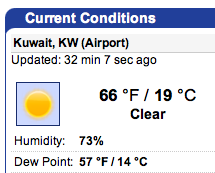
And then look at the humidity and the dew point! No wonder we all feel a little clammy!
The dawn is moving further and further to the south, and this morning was briefly rosy as the sun struggled to break through the thick haze:

When my husband and I prayed together this morning, we prayed to be able to keep our minds and hearts on the things that are really important, and not the things of the world. As financial empires crumble, we want to be thankful for all the riches with which we have been blessed – our marriage, our son and his wife, our families – for good jobs, and good friends – and we pray to be safe on the roads.
Even the Qatteri Cat likes morning prayer time. 🙂
Bone Mountain by Eliot Pattison
Several times I started Bone Mountain and couldn’t get into it. I love Pattison’s books – they are mysteries, but his mysteries are more about the process of solving the puzzle than it is about the solution. The process is indirect – we travel around Tibet with Shan Tao Yun, Chinese, but who crossed the bureaucracy in his investigation of corruption and ended up exiled in a Tibetan prison camp (Water Touching Stone) where, under the very worst circumstances, he finds a new way of looking at life, as he gets to know and respect the Tibetan monks in prison for their beliefs.

This time, when I started the book, it was as if I had never picked it up before. I picked it up and couldn’t put it down. I kept finding passages I wanted to share – with you, with my other friends – this is an amazing book.
Shan and a a couple monks are on a mission to return a Tibetan relic to the valley from which the Chinese stole it, and are traveling with a group of sheep herders and salt gatherers to disguise themselves. The artifact gets stolen from them, but they continue on to the valley, discovering a hidden passage through the mountains, visiting a destroyed and partially rebuilt monastery, and learning about healing herbs and practices in Tibet, as we see medical practices in a whole new way.
One of the themes in each book has to do with the Chinese bureaucracy, harvesting Tibetan resources relentlessly, timber, minerals, etc. with no regard to the devastation their techniques leave behind, no regard for replenishment.
The other issue is the Chinese hijacking of the Bhuddist religion. The Chinese “re-educate” the monks, bringing Bhuddist thought into alignment with Chinese government goals. The new monasteries are no longer teaching true Bhuddist teachings, but are teaching corrupted and even heretical teachings. The true monks are roaming the country disguised as sheep herders, dung carriers, but are the true carriers of the teachings to the people. The bureaucracy grinds their teeth in frustration as the true monks continually slip through their fingers.
“Has this foreigner been gathering salt too?” he asked Lhandro in Tibetan.
“Just along to enjoy the fresh air,” Winslow quipped in Tibetan, and the monk stared at him, his eyes wide with wonder.
“An American who speaks Tibetan?” he exclaimed, and looked back with intense curiousity, at Lhandro and Shan, as though the news somehow changed his perspective on the party.
As you can imagine, I laughed out loud when I read that passage. We get that all the time, when my husband speaks Arabic and I can follow the conversation. We call it “the dog can talk!” look.
Avoiders. It was part of their particular gulag language, stemming from a teaching given in their barracks by an old monk, in his twenty fifth year of imprisonment, just before he died. Guns were avoiders, he said, and bombs and tanks and cannons. They allowed the users to avoid talking with their enemy, and allowed them to think they were right just because they had more powerful technology for killing. But those who could not speak with their enemies would always lose in the end, because eventually they lost not only the ability to talk with their enemy, but also with their inner deity. And losing the inner deity was the greatest sin of all, for without an inner deity, a man was an empty shell, nothing but a lower life-form.
Pattison hikes us through mountains and valleys, shows us medicinal plants, and talks about how it matters where and when and how they are mixed. We learn of the evil that exists in the best of us, and the good that exists in the worst of us. On our journey to solve a mystery, we gain a wealth of new understanding.
Available from Amazon.com for $10.17 plus shipping. (Yep, I disclose once again, I own stock in Amazon.com. 🙂 )
Johah and Yunus
Sometimes one of my fellow Christians will say “God never changes his mind!” I won’t argue, but if you read scriptures, you know that God changes his mind all the time. Moses bargains with God, Noah bargains with God, Lot bargains with God – and after the mighty fish vomits Jonah (called Yunus in the Qur’an according to Wikipedia) onto dry land and Johah does the will of God – goes to Nineveh and tells them to repent, because their destruction is at hand – the entire population of Nineveh repents and God changes his mind, he relents, he forgives them.
Then the story takes one of those strange turns that stories often do in real life. Jonah gets his nose out of joint because God changed his mind and allowed the Ninevans to live.
Jonah 3:1-10,4:1-11
3The word of the Lord came to Jonah a second time, saying, 2‘Get up, go to Nineveh, that great city, and proclaim to it the message that I tell you.’ 3So Jonah set out and went to Nineveh, according to the word of the Lord. Now Nineveh was an exceedingly large city, a three days’ walk across. 4Jonah began to go into the city, going a day’s walk. And he cried out, ‘Forty days more, and Nineveh shall be overthrown!’ 5And the people of Nineveh believed God; they proclaimed a fast, and everyone, great and small, put on sackcloth.
6 When the news reached the king of Nineveh, he rose from his throne, removed his robe, covered himself with sackcloth, and sat in ashes. 7Then he had a proclamation made in Nineveh: ‘By the decree of the king and his nobles: No human being or animal, no herd or flock, shall taste anything. They shall not feed, nor shall they drink water. 8Human beings and animals shall be covered with sackcloth, and they shall cry mightily to God. All shall turn from their evil ways and from the violence that is in their hands. 9Who knows? God may relent and change his mind; he may turn from his fierce anger, so that we do not perish.’
10 When God saw what they did, how they turned from their evil ways, God changed his mind about the calamity that he had said he would bring upon them; and he did not do it.
4But this was very displeasing to Jonah, and he became angry. 2He prayed to the Lord and said, ‘O Lord! Is not this what I said while I was still in my own country? That is why I fled to Tarshish at the beginning; for I knew that you are a gracious God and merciful, slow to anger, and abounding in steadfast love, and ready to relent from punishing. 3And now, O Lord, please take my life from me, for it is better for me to die than to live.’ 4And the Lord said, ‘Is it right for you to be angry?’ 5Then Jonah went out of the city and sat down east of the city, and made a booth for himself there. He sat under it in the shade, waiting to see what would become of the city.
6 The Lord God appointed a bush,* and made it come up over Jonah, to give shade over his head, to save him from his discomfort; so Jonah was very happy about the bush. 7But when dawn came up the next day, God appointed a worm that attacked the bush, so that it withered. 8When the sun rose, God prepared a sultry east wind, and the sun beat down on the head of Jonah so that he was faint and asked that he might die. He said, ‘It is better for me to die than to live.’
9 But God said to Jonah, ‘Is it right for you to be angry about the bush?’ And he said, ‘Yes, angry enough to die.’ 10Then the Lord said, ‘You are concerned about the bush, for which you did not labour and which you did not grow; it came into being in a night and perished in a night. 11And should I not be concerned about Nineveh, that great city, in which there are more than a hundred and twenty thousand people who do not know their right hand from their left, and also many animals?’
So here is my question – what do Islamic traditions have to say about Yunus? I have read the scriptures in the Qur’an, they are sketchy, thin, but I also know that often tradition has more to say about the stories we share, and I am asking if there is any illumination about why Yunus felt angry after God did not destroy Nineveh?
What Poverty Does to US (Blog Action Day 2008)
Today, Blog Action Day 2008, we are to write about poverty.
There are many levels of poverty, and I have seen the worst. I have seen people without the very most basic necessities of life, without enough food, without a safe place to spend the night, people who would sell their baby for another fix, people who live in filth. The very worst thing about poverty is what it does to those who see it, but are not poor – it hardens our hearts.

The overwhelming nature of poverty, the knowledge that we can only do so much, that our efforts are like little drops in a great sea, it can make you turn away from doing anything at all. Afraid to feel to much, we build a wall around our hearts, so we won’t have to feel. We judge, we walk away.
So who is poor? Does not God look at our hearts? He teaches us that the poorest of the poor, who shares one crust of bread with another, is more merciful than the donor who gives generously out of abundance. If we harden our hearts, if we turn away from these problems, who then is poor? Do we not have a deep inner problem, a severe inner poverty, a poverty of spirit?
One of the great God-jokes I see as I live my life is how what we see and what we learn is often the opposite of what God teaches us. He tells us not to put our faith on earthly treasures, our cars, our houses, our material possessions. He tells us the greatest wealth of all is in giving it all away and serving him.
As the financial markets dip and twirl on the roller coaster of doubts and fears and perceptions, as people watch their life savings dwindle, will we learn our lesson? (Can you hear God laughing?)
One of the great secrets of wealth is giving it away – ask Warren Buffet, the richest man in the world, or Bill Gates. They have made fortunes, walked away and given abundantly of their wealth to make the world a better place. God smiles on them. They learned the secret.
When you help the poor, you are blessed.
There is a story we tell volunteers about a little boy along the seashore. Thousands of starfish are stranded on the shore as the tide recedes and a man watches as the little boy picks up starfish and throws them out into the ocean, one at a time. After watching a while, he shouts at the boy “Give it up! There are so many starfish! You can’t save them all!” and the little boy, without pausing, shouts back “But I can save THIS one!”

I worked for a year with homeless families. As I worked with them, I found myself learning from their stories, and from their determination to make a better life for their children. Working with the homeless is like throwing starfish back into the sea. Some might make it and others won’t. There are dark days, days when you feel overwhelmed by the sheer numbers of those who need your help. By focusing on what you CAN do, you hope to make a difference, even in the life of just THIS family, or that child.
We need to ask ourselves, those of us who live in abundance, how can we receive this blessing, the blessing of working with and/or giving to the poor? Is there a food closet that needs your donations and your weekly volunteer effort? Is there a mosque or church that uses volunteers to serve a daily meal to the poorest of the poor? Is there a sandwich delivery to the street poor? Is the Salvation Army active in your area? Are there decent clothes in your closet which you have outgrown? Are there pillows or blankets you could donate to Operation Hope Kuwait? How can you serve the poor? How can you receive this blessing?
Donations of your time, your energy, your vision will not only be a small contribution towards improving the world one small act at a time, it will also lessen the soul-deadening impact of poverty, it will be a blessing to YOU. Working together, people can make a difference. You can make a difference in the life of the poor. You can make a difference, by serving, in your own life.
Statistical Spike

As many of you have figured out, I get online early in the morning, then I get through my day – and sometimes it is a long day – before I can get back to answer any comments, etc. Yesterday was one of those super-busy days, and it was night before I was able to check the blog.
Something strange was happening. The stats were way high . . . and for what?
As it turns out, it was a post written a month ago – Moonsighting, and yesterday, that post alone got 539 hits. 539 – it hasn’t been that long since I would never have thought I would get 539 hits in one day, total. I think a lot of people were trying to find out whether Ramadan had ended, if that tiny thin crescent of a moon had been spotted. It gives me great joy to tell you that I also had a lot of hits, I am guessing from the Seattle area, on the Northgate mosque, and how to get to the Northgate mosque. Maybe this blog is doing some little bit of good in the world, helping just a little. It’s all I ask.
And it remains a totally humbling thought to me that the posts that live on, and on, and on – are posts greatly written by or inspired by fellow bloggers and commenters, in this case Fahad, at his blog Salmiya to whose blog I am totally addicted. He is also a little bit here there and everywhere. 🙂
I am only sharing this with you because it gave me a shock this morning to see the spike in statistics, and because I suspect I will never see the likes of it again.
May your day be full of unexpected blessings, and may you have the eyes to see them!
Recent Comments
ExpatAlien on What Country am I Living … intlxpatr on Yellowstone: Old Faithful to C… Michelle on Yellowstone: Old Faithful to C… Cathy on No Grown-Ups in Charge intlxpatr on Waiting for Snow Wikipedia Donate Button

Amazina


Early Voting in Florida


 Here There and Everywhere